Last Updated:

Deepak Singla

IN this article
Explore how AI support agents enhance customer service by reducing response times and improving efficiency through automation and predictive analytics.
Table of Contents
What you’ll achieve with this guide
What Is Intercom?
Intercom is now Fin: what the 2026 rebrand and Salesforce acquisition mean for buyers
Intercom company snapshot
Is Intercom a CRM, a helpdesk, or an AI agent?
Prerequisites before you evaluate or deploy
Step 1: Map your channels to how Intercom works
Step 2: Evaluate the unified inbox
Step 3: Evaluate Intercom as a ticketing system
Key Capabilities of Intercom for Support Agents
Step 4: Price it out, seats versus per-outcome AI
Step 5: Test reporting, analytics and predictive features
Step 6: Run a scoped pilot and migrate knowledge
Intercom limitations and where teams hit walls in 2026
Compliance in 2026: SOC 2, GDPR and the revised EU AI Act timeline
Intercom vs. Alternative Support Platforms
Common mistakes when evaluating Intercom
How to measure whether the rollout worked
Choosing your next step
What you’ll achieve with this guide
By the end of this guide you will be able to evaluate Intercom customer service software features the way a buyer does in 2026: channel by channel, feature by feature, and dollar by dollar. You will know what changed with the Fin rebrand, what the Salesforce acquisition means for your contract, and how to score the inbox, the ticketing layer and the analytics stack against your own volume.
Intercom, rebranded to Fin in 2026, is an AI-first customer service platform that unifies live chat, email, WhatsApp, SMS, phone and Slack into one workspace where an AI agent and human agents work the same conversation. Its AI agent, Fin, resolves queries end to end using a proprietary model called Apex. Helpdesk seats are still sold as Essential, Advanced and Expert, while AI usage is billed per outcome rather than per seat.
Two things happened in mid-2026 that make every pre-2026 Intercom guide wrong. The company renamed itself after its AI agent, and Salesforce signed a definitive agreement to buy it for roughly $3.6 billion (MarTech). Everything below reflects the state of the product as of 2026-07.
This is a working how-to, not a brochure. Each step names the actual screens, plan tiers and billing units you will meet, and ends with something you can check off.
What Is Intercom?
Intercom is a customer service platform that centralizes support conversations across messaging channels into a single workspace shared by AI and human agents. Since its 2026 rebrand it operates under the name Fin, named after its AI agent, and markets itself AI-first; helpdesk plans are now sold as “Fin and Intercom”. The word most people still search for, and the word used throughout this guide, is Intercom.
Its architecture rests on four layers. A messaging layer captures conversations across live chat, email, WhatsApp, SMS, phone and Slack. An automation layer routes and prioritizes by rules you define. A knowledge layer powers self-service. And Fin, the AI agent, resolves queries end to end.
Unlike legacy helpdesks built around email tickets, Intercom’s model centers on real-time messaging. A customer who starts in chat and follows up by email stays one continuous thread, not two tickets. That single design decision explains most of the difference in daily agent workflow.
The 2026 version of Fin is materially more capable than the 2025 version. Salesforce describes Fin as resolving, on average, 76% of support volume without a human (The Next Web). The “suggests responses to agents” function is now a separate paid add-on called Copilot.
Intercom meaning, in one line: in customer service software, “Intercom” refers to this specific vendor’s messaging-first support platform, not to the building hardware of the same name.
Intercom is now Fin: what the 2026 rebrand and Salesforce acquisition mean for buyers
Intercom adopted the name Fin roughly one month before June 2026, taking the name of its AI agent, and on 15 June 2026 Salesforce signed a definitive agreement to acquire the company for approximately $3.6 billion. Salesforce completed the acquisition in September 2026 and is folding Fin into Agentforce (MarTech).
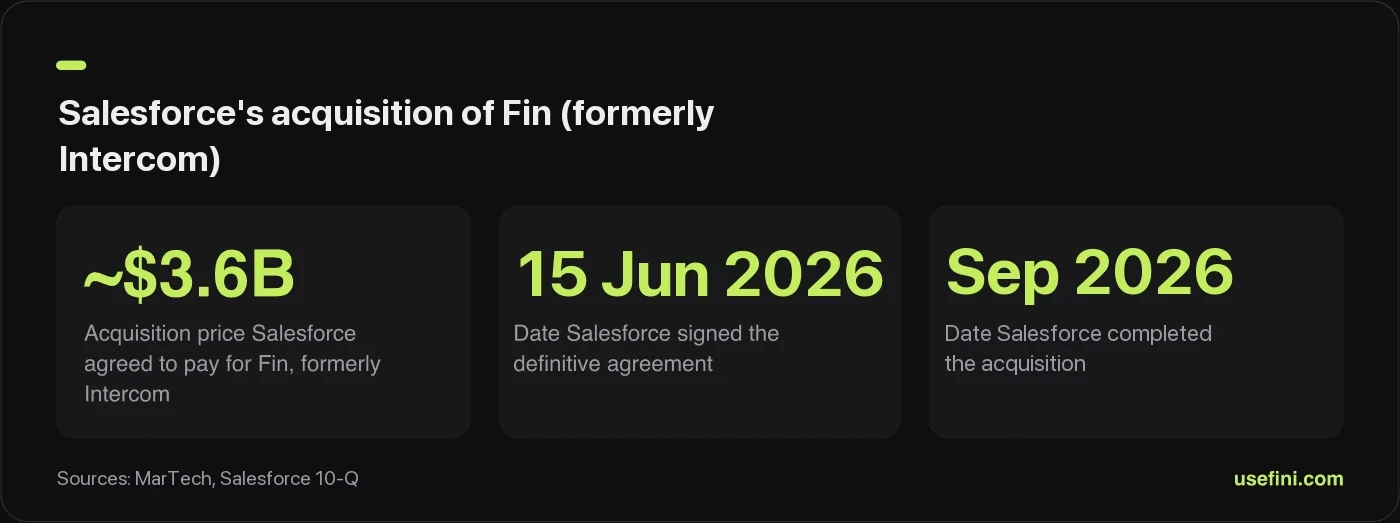
The deal closed in September 2026. Build change-of-control terms into your contract.
The distinction that matters to your procurement team: the deal closed in September 2026. Salesforce now owns Fin, and no source states whether pricing or plan structure will change as Fin moves into Agentforce.
Here is what a buyer should actually do with that information.
Buyer question | Current answer as of 2026-07 | What to put in the contract |
|---|---|---|
Who owns the product today? | Salesforce, which signed the agreement on 15 June 2026 and completed the acquisition in September 2026 | Change-of-control clause with price protection |
Where is the tech headed? | Folding into Salesforce Agentforce, which hit $1.2B ARR in Q1 FY27, up 20% YoY | Roadmap commitments in writing |
Will pricing change? | No source states this either way | Multi-year price lock, exit rights |
Does the name change break anything? | Plans are sold as “Fin and Intercom”; the helpdesk tiers kept their names | Confirm invoicing entity |
Are you already a Salesforce shop? | Then evaluate Agentforce head to head, not just Intercom | Single-vendor discount ask |
The strategic logic Salesforce gave is worth reading as a product statement. Agentforce suits large organizations that need deep customization; Fin arrives pre-trained and fast to deploy for SMB and mid-market teams (MarTech).
If you are a mid-market team signing a three-year deal this quarter, that framing is your negotiating leverage. You are buying the fast-to-deploy half of a merger that has not happened yet.
Intercom company snapshot
Intercom is the customer service software company behind the Intercom helpdesk and the Fin AI agent, now operating under the Fin brand and reachable at intercom.com. It sells to support, sales and product teams, with a helpdesk sold in three seat tiers and an AI agent sold on consumption. Its ownership status is the single most current fact about it: Salesforce completed its acquisition of the company in September 2026.
People searching for “intercom.io” are almost always looking for this company. The canonical product domain is intercom.com, with the AI agent documented separately at fin.ai.
Attribute | Detail (as of 2026-07) |
|---|---|
Current brand | Fin (rebranded from Intercom, approx. May 2026) |
Core products | Intercom helpdesk (Essential, Advanced, Expert), Fin AI Agent, Copilot add-on |
AI model | Apex, proprietary |
Channels | Live chat, email, WhatsApp, SMS, phone, Slack |
Ownership status | Acquired by Salesforce (~$3.6B), signed 15 June 2026, completed September 2026 |
AI billing unit | Per outcome, $0.99 |
Runs standalone on | Salesforce, HubSpot, Freshworks, Zoho |
Founding-year claims circulate widely, but this guide does not repeat them because they were not verifiable during research for this update. Where a number is not sourced here, treat competing pages that state it confidently with appropriate suspicion.
Company financials tell you nothing useful either, because ARR, customer count and headcount are not disclosed in the acquisition coverage. The $3.6 billion price tag is the only public valuation signal.
Is Intercom a CRM, a helpdesk, or an AI agent?
Intercom is primarily a helpdesk with an AI agent bolted to the front of it, plus enough customer data and outbound messaging to feel CRM-adjacent without replacing a real CRM. It stores customer attributes, conversation history and product usage signals, and it can trigger proactive campaigns. It does not manage pipeline, forecasting or opportunity stages the way Salesforce or HubSpot do.
The cleanest way to categorize it in 2026 is by which of three jobs you are buying.
As a helpdesk: a shared inbox, ticket objects, SLAs, macros, routing rules and a help center. This is the paid-seat part.
As an AI agent: Fin, sold per outcome, capable of running on top of Salesforce, HubSpot, Freshworks or Zoho without any Intercom seats at all.
As a lightweight CRM layer: customer profiles, segments, tours and outbound messages. Useful, but not a system of record for revenue.
That third bullet is why “is Intercom only for customer support?” keeps appearing as a question. It is not, teams use it for onboarding tours, product announcements and lead qualification, but support is where the seat economics make sense.
If your team already runs Salesforce as the system of record, the interesting question is not helpdesk versus CRM. It is whether you buy Fin as a standalone agent layer over what you have, which is now an officially supported deployment.
Prerequisites before you evaluate or deploy
Before you touch a trial, assemble five things: a channel inventory, a knowledge base audit, admin access to the systems Intercom must integrate with, a monthly conversation count, and a named owner for AI quality. Missing any one of these turns a 30-day evaluation into a 90-day one. The conversation count matters most, because 2026 AI pricing is consumption-based and you cannot model cost without it.
Tools and access you need:
Admin rights in your current helpdesk to export conversations and articles
API credentials for your CRM, billing system and product analytics
A staging or sandbox environment for workflow testing
Your last 12 months of conversation volume, split by channel and by intent
Your current CSAT and first-response-time baselines
Plan tiers and what unlocks where:
What you need | Where it lives |
|---|---|
Shared inbox, basic help center | Essential seat tier |
Advanced workflows, multiple teams | Advanced seat tier |
Multi-brand, deeper customization, SLAs | Expert seat tier |
Fin AI resolutions | Consumption, $0.99 per outcome |
Agent-facing suggestions and summaries | Copilot add-on, $29/agent/mo annual or $35 monthly |
Conversation analysis at scale | Pro add-on, $99 per 1,000 conversations |
Seat prices render client-side on Intercom’s own pricing page and did not expose themselves to automated verification during research. Third-party GetVoIP, updated 2026-07-01, lists $29 / $85 / $132 per seat per month on annual billing; another tracker lists $39 / $99 / $139. Confirm at checkout before you budget.
Permissions to sort out early: who can publish help center articles, who can edit Fin’s answer sources, and who can approve a workflow that touches billing. Support leads routinely discover in week three that only one admin can change routing.
Step 1: Map your channels to how Intercom works
Intercom captures customer input across live chat, email, WhatsApp, SMS, phone and Slack, then threads them into a single conversation rather than separate tickets. Real-time messaging is the architectural center: a chat that goes quiet and returns as an email stays one thread with one history. Before evaluating anything else, list every channel your customers actually use and check it against that inventory.
Customer Input: Omnichannel Message Capture works like this in practice. A message arrives on any channel and Intercom enriches it before an agent ever sees it, attaching previous conversations, product usage data, subscription status and any custom attributes your team configured.
That enrichment step is the thing legacy ticketing cannot replicate cheaply. It is also the thing that breaks if your customer attributes are not synced, which is why the prerequisites section put API credentials before trial signup.
Do this now:
List your channels in order of volume. If phone is 40% of your contacts, Intercom’s voice support becomes a primary evaluation criterion, not a footnote.
For each channel, note whether conversations currently carry customer context or arrive blind.
Flag any channel where you require strict SLA timers, since real-time channels and email SLAs behave differently.
Check whether the channels you need are covered on your candidate seat tier or require an add-on.
Test one cross-channel handoff during the trial: start in chat, reply by email, confirm it stays a single thread.
Fin now operates across all of those channels, not just chat. Exact multilingual coverage was not verifiable during this research, so ask for language-specific resolution rates in writing rather than accepting a general claim.
If a large share of your volume is voice, price it separately. Intercom’s pricing page showed no distinct Fin Voice SKU during verification, so treat voice economics as an open question to resolve with sales.
Step 2: Evaluate the unified inbox
Unified Inbox: Centralized Conversation Management
The Intercom inbox consolidates every conversation regardless of channel into one queue, with filters for unassigned messages, your own conversations, and tag-based views like “billing” or “urgent.” Keyboard shortcuts (J/K to navigate, R to reply, E to resolve) let agents move through volume without a mouse. Status is visible at a glance: open, pending customer response, snoozed, or resolved.
The interface is split-screen. Conversation thread on the left, context panel on the right showing customer details, history, linked accounts and relevant knowledge articles. Bulk actions let you assign, tag or close multiple threads at once.
That is the marketing description. Here is the rubric that separates a good inbox from a demo-friendly one.
Inbox evaluation checklist. Score each 0-2, target 18+ out of 24:
# | Criterion | What “2” looks like |
|---|---|---|
1 | Cross-channel threading | Chat + email + WhatsApp from one person is one thread, not three |
2 | Context without tab-switching | Subscription tier, last order and usage visible without clicking out |
3 | Keyboard-only operation | An agent can triage 20 conversations without touching the mouse |
4 | Custom views | Each team can save a view that surfaces only its work |
5 | Bulk actions | Assign, tag and close 50 threads in under a minute |
6 | AI handoff visibility | You can see exactly what Fin said before the escalation |
7 | In-thread actions | Refund, plan change or ticket creation without leaving the conversation |
8 | Search across history | Find a resolved thread from nine months ago in under 10 seconds |
Criterion 6 is the one most teams skip and most regret. When an AI agent handles the first four turns of a conversation, the human who inherits it needs the full transcript plus the reason for escalation, not a summary.
Criterion 7 separates a messaging tool from a support platform. Ask specifically: can an agent process a refund from inside the conversation, or does the integration merely link to an external page? We wrote about where that boundary sits in a piece on when an AI should act versus hand off.
Run this rubric during a trial with real conversations, not a sandbox. Sandbox inboxes are always fast because they are empty.
Step 3: Evaluate Intercom as a ticketing system
Intercom does have a ticketing system, but it is a messaging-first one: conversations are the primary object and tickets are a structured layer applied on top, rather than the reverse. That suits teams whose work arrives as chat and gets resolved in minutes. It fits less naturally where work arrives as long-lived cases with multi-day SLAs, approvals and hierarchical queues.
To evaluate the customer service company Intercom on its ticketing system specifically, score it on the seven dimensions below rather than asking whether it “has tickets.”
Dimension | Question to test | Strong fit signal | Weak fit signal |
|---|---|---|---|
Object model | Is a ticket first-class or derived from a conversation? | Fast, chat-led resolution | Multi-week case management |
SLA management | Can you set different SLAs per channel, plan and priority? | Simple SLA tiers | Contractual SLAs with penalties |
Routing | Skills-based, load-based, or rule-based only? | Rule-based routing is enough | You need workforce management |
Escalation | Can a ticket move to engineering with full context intact? | Handoffs stay in-thread | External ITSM is the source of truth |
Bulk operations | Can you reassign a queue after an outage? | Occasional bulk work | Constant queue reshuffling |
Audit trail | Is every AI and human action logged and exportable? | Standard compliance needs | Regulated audit requirements |
Reporting on tickets | Can you report on backlog age, not just response time? | Volume-led reporting | Backlog-led operations |
The escalation dimension is where Intercom does well. Internal notes, screenshots and reproduction steps live inside the same thread, so an engineer sees the full history without asking the customer to repeat anything.
The audit dimension is where AI-heavy setups get complicated. When Fin resolves a conversation autonomously, your audit trail needs to show which knowledge sources it used and why it decided the issue was closed.
A practical rule: if more than 20% of your volume needs a case to stay open for over 72 hours with multiple internal owners, test Intercom’s ticketing hard before committing. If most of your volume closes same-day, the conversation-first model is an advantage.
Key Capabilities of Intercom for Support Agents
The Intercom customer service software features that matter day to day cluster into six areas: the unified inbox, the Fin AI agent, the help center, workflows, the customer context panel, and reporting. Five of the six are unchanged in shape since 2025; the AI agent is the one that was rebuilt. Below is what each does now, in 2026 terms.
Fin AI Agent: End-to-End Resolution
Fin is no longer a deflection bot that answers FAQs. It is positioned as an AI agent that resolves complex customer queries end to end across live chat, email, WhatsApp, SMS, phone and Slack, powered by the proprietary Apex model (MarTech). Salesforce states Fin resolves an average of 76% of support volume without a human (The Next Web).
Fin can also run standalone on other helpdesks, including Salesforce, HubSpot, Freshworks and Zoho, with no Intercom seats at all. That changes the buying decision: you can adopt the AI layer without migrating your helpdesk.
The agent-assist function that used to be bundled is now Copilot, a separate add-on. If your evaluation assumed suggested replies came free with a seat, re-check your quote.
Help Center and Articles: Self-Service Knowledge Base
Your help center lives at a custom URL and embeds into your product, with Fin interpreting customer questions and surfacing relevant articles rather than keyword-matching. Agents can create articles directly from a conversation, so a repeatedly asked question becomes documentation in a few clicks. Articles support rich media, code snippets and multiple language versions.
The quality of this layer determines the quality of everything above it. An AI agent trained on stale articles produces confident, stale answers.
Audit your articles before you turn Fin on, not after. Kill duplicates, date-stamp policy pages, and assign an owner per category.
Workflows and Automation: Rule-Based Routing and Task Automation
Workflows are if-then rules built in a visual editor with no code required. A typical rule: if a conversation mentions “refund” and the customer is on the Pro plan, assign to billing and tag as high priority. Another: if a conversation sits unassigned for 10 minutes, notify the team lead.
Common patterns include after-hours auto-responses, VIP escalation rules and follow-up sequences on unresolved threads. Most teams end up with 15 to 40 active workflows within six months.
The maintenance cost is real. Every workflow is a small piece of logic someone has to remember, and undocumented rules are the leading cause of “why did this ticket go there?” Slack threads. We have written about why support automation that maintains itself changes that math.
Customer Context Panel: Real-Time User Data
The context panel surfaces customer details, conversation history and integration data in the right-hand rail so agents stop tab-switching. Custom attributes like subscription tier or account value appear alongside recent purchases, tickets in other systems and product usage metrics. It is the single feature agents mention most in reviews. An AI agent needs the same panel before it answers, which is why the ingestion pipeline sits first on the checklist for evaluating AI agents on Intercom.
Its usefulness is entirely a function of your integrations. A context panel wired to nothing is an email address and a timezone.
Ticketing and Escalation
Covered in depth above. The short version: conversations are primary, tickets are structured on top, and engineering handoffs keep full context inside the thread.
Reporting and Analytics
Covered in depth in Step 5, since it is where evaluations most often go shallow.
Step 4: Price it out, seats versus per-outcome AI
Intercom pricing in 2026 has two independent meters: paid seats for human agents, and per-outcome consumption for Fin. Fin AI Agent is priced at $0.99 per outcome, where an outcome is a resolution, a procedure handoff or a disqualification; lead qualifications bill at $9.99 each, and there is a 50-outcome monthly minimum when Fin runs on a non-Intercom helpdesk (Fin). Copilot is a separate add-on.
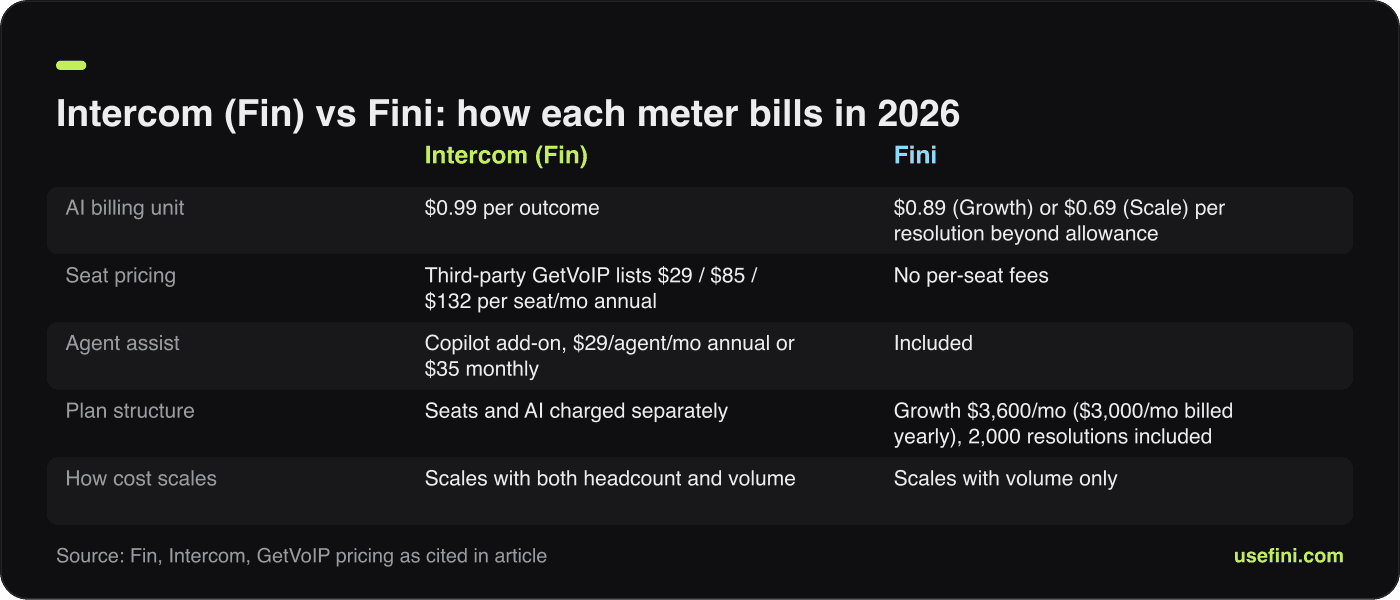
Dual-meter consumption pricing versus a bundled monthly resolution allowance.
Note the billing-unit change carefully. Pre-2026 guides say “per resolution.” The current unit is “per outcome,” defined as: a customer confirms their issue is resolved, or they do not ask for more help after Fin responds, or Fin completes a workflow.
That definition includes conversations where the customer simply went away. It is a broader unit than a verified resolution, which matters when you compare against vendors billing on confirmed outcomes only.
Line item | 2026 price | Source |
|---|---|---|
Fin AI Agent | $0.99 per outcome | |
Fin lead qualification | $9.99 each | |
Minimum on non-Intercom helpdesks | 50 outcomes/month | |
Copilot add-on | $29/agent/mo annual, $35 monthly | |
Pro conversation analysis | $99 per 1,000 conversations/mo | |
Helpdesk seats | Essential / Advanced / Expert; third-party GetVoIP lists $29 / $85 / $132 per seat/mo annual |
Worked example, 1,000 conversations per month, 8 agents:
Assume Fin handles 76% of volume to an outcome, in line with the vendor’s stated average. That is 760 outcomes at $0.99, or $752.40. Eight Advanced seats at the third-party annual figure of $85 add $680. Copilot for all eight agents adds $232.
Total: roughly $1,664 per month, before the Pro analysis add-on ($99) and before any lead qualifications at $9.99 each. Add 100 qualifications and you are at $2,763.
Now stress-test it. At 5,000 conversations a month with the same 76% outcome rate, Fin alone costs $3,762, and your seat count probably rises too. Consumption pricing is linear in volume, which is exactly what a growth-stage team should model before signing.
For contrast, Fini bundles the platform, implementation and a monthly resolution allowance into one plan: pricing starts at $0.49 per resolution, with no per-seat fees. There are no per-seat fees, annual billing gives two months free, and unused allowance rolls forward one month. Enterprise is custom pricing, contact Fini.
The structural difference is worth naming: Intercom charges for seats and AI separately, so cost scales with both headcount and volume. Allowance-based pricing scales with volume only.
Step 5: Test reporting, analytics and predictive features
Intercom’s reporting covers real-time operational dashboards (first response time, resolution time, CSAT, conversation volume), per-agent performance views, and conversation analysis that clusters topics across your volume. Its predictive and data-analysis features sit mostly in that conversation-analysis layer, which surfaces recurring intents, escalation patterns and knowledge gaps. Treat the word “predictive” carefully during a demo and ask what is forecast versus what is merely aggregated.
Intercom’s predictive analytics and real data analysis features are best evaluated with a specific list of questions. Here is the one to bring.
Reporting evaluation questions:
Can I segment every metric by channel, plan tier, and AI-handled versus human-handled?
Does the AI resolution number count verified resolutions or all outcomes, including customers who stopped replying?
Can I see the specific knowledge sources Fin used on any given conversation?
Does topic clustering run on all conversations or only a sampled subset?
Is conversation analysis included, or is it the $99-per-1,000-conversations Pro add-on?
Can I export raw conversation data to my warehouse, and on what schedule?
Can I forecast staffing from volume trends inside the tool, or does that need a separate WFM product?
Are agent-level metrics visible to agents themselves, or only to managers?
Question 2 is the one that reshapes budgets. Deflection counts any conversation that never reached a human, including customers who gave up; resolution counts only conversations genuinely solved. Those two numbers diverge, and the 2026 industry-wide move to outcome and verified-resolution billing exists precisely because they do. We unpacked that gap in detail in a piece comparing deflection rate against true resolution rate.
Maturity is measurable and it correlates with reporting discipline. Intercom’s own 2026 Customer Service Transformation Report finds 87% of teams at the mature deployment stage report improved metrics since implementing AI, compared to 62% overall (Intercom).
The same report finds 82% of senior leaders say their teams invested in AI for customer service over the last 12 months, with 87% planning to invest in 2026 (Intercom). Investment is no longer the differentiator. Measurement is.
Set your baselines before go-live: current FRT, current CSAT, current cost per contact, current escalation rate, and current backlog age. If you do not capture these in the two weeks before launch, you will spend the next quarter arguing about whether anything improved.
Step 6: Run a scoped pilot and migrate knowledge
Run the pilot with three to five agents on one conversation type for two to four weeks before touching the rest of your operation. Then migrate knowledge, configure workflows, train agents, and cut over gradually with the old system in read-only mode for 30 to 60 days. The knowledge migration is the long pole: budget four to six weeks and involve the agents who know which questions customers actually ask.
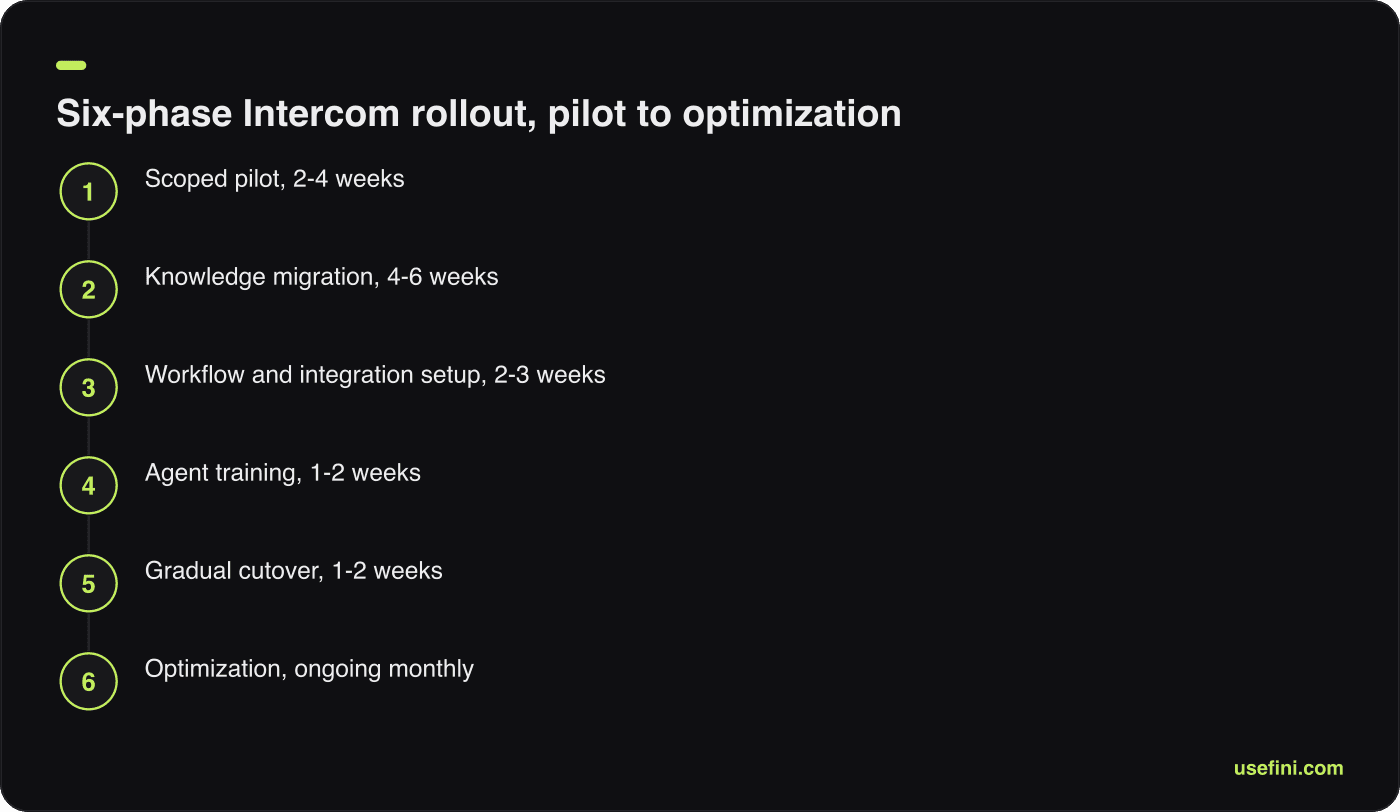
Knowledge migration is the long pole: budget four to six weeks.
Phase-by-phase plan:
Phase | Duration | Owner | Exit criterion |
|---|---|---|---|
1. Scoped pilot | 2-4 weeks | Support lead | Documented list of gaps and must-have integrations |
2. Knowledge migration | 4-6 weeks | Content owner | Top 50 intents each covered by a current, owned article |
3. Workflow and integration setup | 2-3 weeks | Ops + IT | Every routing rule tested with a real conversation |
4. Agent training | 1-2 weeks | Team leads | Agents hit baseline FRT in a sandbox |
5. Gradual cutover | 1-2 weeks | Support lead | New conversations only, then active threads, then archive |
6. Optimization | Ongoing, monthly | AI quality owner | Monthly review of Fin transcripts and escalation reasons |
Do not copy-paste articles during migration. Rewrite them in the plain, direct language an AI agent can parse, one question per article, with the answer in the first paragraph.
Set a firm cutoff date for the old system. Open-ended “we’ll switch when everyone’s comfortable” timelines run for months and stop teams from committing to either platform.
For teams weighing whether this whole sequence is worth it versus a faster deployment path, our comparison of AI support chatbots and true AI agents covers what the six phases look like when the AI layer arrives pre-trained.
Intercom limitations and where teams hit walls in 2026
Intercom’s four recurring limitations in 2026 are dual-meter cost growth, a recent acquisition by Salesforce, a conversation-first data model that strains under long-lived cases, and an outcome billing definition broader than a verified resolution. None of these disqualify the product. All of them belong in your risk register.
Where teams actually hit walls:
Cost scales on two axes. Seats grow with headcount, outcomes grow with volume. A team that doubles volume and adds four agents pays more on both meters at once.
The Salesforce deal is recent. Signed 15 June 2026 and completed in September 2026 (MarTech). No public source states what happens to pricing or plan structure as Fin moves into Agentforce.
Outcome definitions favor the vendor. An outcome includes a customer who simply stopped replying. Ask for a breakdown of outcomes by type before signing.
Copilot is an extra line item. Agent-facing suggestions cost $29 to $35 per agent per month on top of seats.
Long-lived cases fight the model. Multi-week cases with approval chains fit a case-management tool better than a messaging-first inbox.
Language coverage is unverified. Fin’s exact multilingual capability was not confirmed during this research. Request per-language resolution data.
Voice pricing is opaque. No distinct Fin Voice SKU or price surfaced on the pricing page during verification.
Two more caveats belong here for completeness. Integration counts widely quoted as “300+” were not verifiable, so check the current app directory for the specific systems you need. And customer-story ROI figures that circulated pre-rebrand may no longer be live, so ask for a reference call instead of a case study PDF.
None of that is unique to Intercom. Every vendor in this category has a version of the same list, which is why the evaluation rubrics in this guide matter more than any single feature claim.
Compliance in 2026: SOC 2, GDPR and the revised EU AI Act timeline
SOC 2, ISO 27001 and GDPR remain the baseline for any support platform touching customer data, and HIPAA plus a BAA is the additional bar for healthcare. What changed in 2026 is the EU AI Act calendar: the compliance cliff many 2025 articles placed in August 2026 has moved. Buyers should plan for AI Act readiness on the revised 2027-2028 timeline, not an imminent 2026 deadline.
Under the AI/Digital Omnibus, stand-alone Annex III high-risk obligations move from 2 August 2026 to 2 December 2027, and Annex I embedded systems move to 2 August 2028; watermarking and transparency marking obligations shift to 2 December 2026. Provisional agreement was reached 7 May 2026, Parliament endorsed it on 16 June 2026, and the Council gave final approval on 29 June 2026 (Council of the EU).
Annex III high-risk use cases cover recruitment, credit scoring, education, law enforcement and border control. Most customer support AI does not land there, but support agents that make eligibility or credit decisions might, which is a question for your legal team rather than your vendor’s sales engineer.
Compliance checklist to run on any vendor:
Requirement | What to ask for |
|---|---|
SOC 2 Type II | Current report, not a letter of intent |
ISO 27001 | Certificate with scope statement and expiry date |
GDPR | DPA, sub-processor list, EU data residency options |
CCPA | Consumer request handling process |
HIPAA | Willingness to sign a BAA, in writing |
AI transparency | Source citations per AI answer, exportable audit log |
AI Act posture | Written position on the revised 2027-2028 timeline |
Intercom publicly positions on SOC 2 and GDPR; verify current certificate scope directly with the vendor rather than relying on any third-party guide, including this one. Zendesk does not publicly state a per-automated-resolution rate on its pricing page, so compliance and pricing questions alike belong in a written RFP.
Fini’s own posture, stated as a vendor claim: SOC 2 Type II, ISO 27001:2022, HIPAA-compliant and BAA-eligible, GDPR and CCPA.
Intercom vs. Alternative Support Platforms
The 2026 comparison set is no longer Intercom versus Zendesk. It is Intercom/Fin, Zendesk’s Resolution Platform, Salesforce Agentforce (which is also Intercom’s acquirer), and outcome-priced AI agent specialists like Fini. All four have converged on billing for results rather than seats, and they diverge on how honestly a “result” is defined.
Criterion | Intercom (Fin) | Zendesk | Salesforce Agentforce | Fini |
|---|---|---|---|---|
AI approach | Fin AI agent on proprietary Apex model, end-to-end resolution across chat, email, WhatsApp, SMS, phone, Slack | Autonomous Service Workforce and Resolution Platform, trained on ~20B ticket interactions (CMSWire) | Agentforce agents inside the Salesforce platform; $1.2B ARR Q1 FY27 | Agentic AI with autonomous action-taking; vendor-stated 99% accuracy, 90% resolution rate |
Billing unit | $0.99 per outcome (resolution, procedure handoff or disqualification); $9.99 per lead qualification | Automated resolutions verified by the AI agent and an independent evaluation model; spam and routine exchanges excluded; rate not published | $2 per conversation, or Flex Credits at $500 per 100,000 (standard action 20 credits / $0.10, voice action 30 credits / $0.15) (Salesforce) | pricing starts at $0.49 per resolution, with custom pricing for enterprise volume |
Seat pricing | Essential / Advanced / Expert; third-party GetVoIP lists $29 / $85 / $132 per seat/mo annual | Support Team €19, Suite Team €55, Suite Professional €115 per agent/mo annual on the EUR page; USD not verified (Zendesk) | Sold within Salesforce licensing; Foundations includes 200,000 Flex Credits free on Enterprise Edition | No per-seat fees |
Agent assist | Copilot add-on, $29/agent/mo annual or $35 monthly | Copilot add-on, €50/agent/mo | Included in Agentforce actions | Included |
Runs on other helpdesks | Yes: Salesforce, HubSpot, Freshworks, Zoho, 50-outcome monthly minimum | Within Zendesk | Within Salesforce | Yes, sits on your existing stack |
Deployment speed | Marketed as fast to deploy, pre-trained | Enterprise implementation cycles | Suits large orgs needing deep customization | Fully live in 14 days, fully autonomous in 30 |
Ownership status | Acquired by Salesforce (~$3.6B), completed September 2026 | Independent | Acquirer | Independent |
Compliance | SOC 2, GDPR (verify scope with vendor) | Enterprise certifications; verify with vendor | Enterprise certifications; verify with vendor | SOC 2 Type II, ISO 27001, HIPAA-compliant and BAA-eligible, GDPR, CCPA |
Intercom is the strongest fit for messaging-led teams that want a pre-trained AI agent live quickly and are comfortable with a vendor now owned by Salesforce. Its channel coverage is broad and Fin’s ability to run on rival helpdesks removes the usual migration blocker.
Zendesk rebuilt its story at Relate 2026 on 19 May, launching the Autonomous Service Workforce and pricing AI agents on independently verified resolutions rather than seats. CEO Tom Eggemeier put it bluntly: “The era of the chatbot, the era of frustration and deflection, is over” (CMSWire). Its verified-resolution definition, which excludes spam and routine exchanges, is stricter than a broad outcome count.
Salesforce Agentforce makes sense if Salesforce is already your system of record and you need deep customization. Its Flex Credits model prices individual actions rather than conversations, which suits workflow-heavy automation. Note that Flex Credits and Conversations cannot be used in the same org.
Fini takes the agentic path: the AI does not just answer, it acts, with vendor-stated 99% accuracy and a 90% resolution rate, fully live in 14 days and fully autonomous in 30 days on top of your existing stack. Our head-to-head with Decagon covers how that architecture compares within the AI-agent category specifically.
Gartner’s forecast frames where all four are heading: agentic AI will autonomously resolve 80% of common customer service issues without human intervention by 2029, cutting operational costs by 30% (Gartner). The vendors differ mainly on how much of that they can do today.
Common mistakes when evaluating Intercom
Most failed Intercom evaluations share five errors: modelling cost on seats alone, accepting a deflection number as a resolution number, skipping the knowledge audit, ignoring the acquisition in contract terms, and demoing on clean sandbox data. Each is avoidable in an afternoon of preparation. Each costs six figures if you skip it.
Mistake | Why it hurts | Fix |
|---|---|---|
Budgeting seats only | AI is a separate consumption meter at $0.99 per outcome | Model seats + outcomes + Copilot + Pro add-on together |
Reading “outcome” as “verified resolution” | Outcomes include customers who stopped replying | Ask for outcomes split by type, monthly |
Turning on AI before auditing articles | Stale sources produce confident wrong answers | Fix the top 50 intents first |
Ignoring the acquisition | Ownership and roadmap may shift as Fin moves into Agentforce | Add change-of-control and price-lock clauses |
Demoing on sandbox data | Empty inboxes are always fast | Trial with real volume for at least two weeks |
Assuming Copilot is included | It is a $29-$35 per agent/month add-on | Line-item it in the quote |
Skipping voice economics | No public Fin Voice SKU pricing surfaced | Get voice pricing in writing before signing |
Comparing only two vendors | Agentforce and Zendesk’s 2026 platform changed the set | Score at least four vendors on the same rubric |
The knowledge-audit mistake deserves extra weight. AI quality is downstream of content quality, and no model fixes a contradictory refund policy documented in three places. Our write-up on how a structured knowledge layer differs from retrieval explains why that failure mode is architectural, not a tuning problem.
The demo-data mistake is the most common. Ask for a trial on your own conversation history, and if a vendor cannot support that, treat it as a data point.
How to measure whether the rollout worked
Six metrics prove an Intercom rollout worked: verified resolution rate (not deflection), cost per resolved contact across both meters, CSAT split by AI-handled versus human-handled, first response time, escalation precision, and backlog age. Capture all six for two weeks before go-live, then compare at day 30 and day 90. Anything measured only after launch is a story, not a result.
Metric | How to calculate | Target movement by day 90 |
|---|---|---|
Verified resolution rate | Conversations genuinely solved by AI ÷ total AI-handled | Up, and reported separately from deflection |
Cost per resolved contact | (Seats + outcomes + add-ons) ÷ resolved contacts | Down |
CSAT, AI vs human | Rated conversations, split by handler | AI within 5 points of human |
First response time | Median, by channel | Down on real-time channels |
Escalation precision | Correct escalations ÷ total escalations | Up; wrong escalations cost twice |
Backlog age | Median age of open conversations | Flat or down as volume grows |
Two reporting habits separate teams that improve from teams that plateau. First, always report resolution and deflection as two separate numbers so nobody quietly conflates them. Second, review a random sample of 20 AI transcripts every week with a named owner.
Intercom’s own data supports the maturity link: 87% of teams at the mature deployment stage report improved metrics since implementing AI, versus 62% overall (Intercom). Mature deployments are the ones that measure weekly.
Tie the numbers to money in the board deck. Cost per resolved contact, multiplied by volume, is the only figure a CFO will use to renew.
Choosing your next step
The right next step depends on which problem you actually have: if you need a messaging-led helpdesk with a fast-to-deploy AI agent, trial Intercom with real volume and the rubrics above; if you already have a helpdesk you like, evaluate AI agent layers that sit on top of it; if your priority is predictable cost, compare allowance-based pricing against dual-meter consumption. Run the same eight-question reporting test and the same eight-point inbox rubric on every vendor. Score them on paper before anyone takes a sales call.
Do three things this week. Pull your last 12 months of conversation volume by channel and intent. Audit your top 50 intents against your current help center articles. Then build a 12-month cost model on both a seat-plus-consumption structure and an allowance structure, at today’s volume and at double.
If you keep your current helpdesk and want the AI layer to do the work, that is exactly the shape Fini is built for: an agentic AI that resolves and acts on top of your existing stack, with vendor-stated 99% accuracy, a 90% resolution rate, and bundled implementation. Teams like Wefunder went that route rather than replatforming.
If you are weighing Intercom against an agentic AI layer for a support queue that is growing faster than your headcount, book a 30-minute working session with Fini and bring your volume numbers; the team will model your resolution allowance against your actual channel mix and show what going fully live in 14 days and fully autonomous in 30 days looks like for your queue.
Frequently Asked Questions
Is Intercom now called Fin, and did Salesforce buy it?
Intercom rebranded to Fin roughly one month before June 2026, taking the name of its AI agent, and Salesforce signed a definitive agreement on 15 June 2026 to acquire it for approximately $3.6 billion and completed the acquisition in September 2026 (MarTech). Fini advises buyers to add change-of-control and price-lock clauses before signing multi-year terms.
What are Intercom’s key features?
Intercom’s core customer service software features are a unified omnichannel inbox, the Fin AI agent for end-to-end resolution, a help center with AI-powered search, no-code workflows for routing and automation, a real-time customer context panel, and reporting with conversation analysis. Agent-facing suggestions now cost extra via the Copilot add-on. Fini bundles agent assist, analytics and implementation into a single plan instead. See how Fini works inside Intercom.
How much does Intercom cost in 2026, and what is an outcome?
Fin AI Agent bills at $0.99 per outcome, where an outcome is a resolution, procedure handoff or disqualification; lead qualifications cost $9.99 each, with a 50-outcome monthly minimum on non-Intercom helpdesks (Fin). Copilot adds $29 to $35 per agent monthly. Fini prices differently: a starting rate of $0.49 per resolution, with no tiers and no monthly minimum.
Does Intercom have a ticketing system, and how does it compare to a traditional helpdesk?
Yes, but conversations are the primary object and tickets sit as a structured layer on top. That suits fast, chat-led resolution and engineering handoffs that keep full context in-thread. It fits less well where cases stay open for weeks with approval chains and contractual SLA penalties. Fini works alongside whichever ticketing model you already run, without forcing a replatform.
How does Intercom’s real-time messaging work across channels?
A message from live chat, email, WhatsApp, SMS, phone or Slack becomes one continuous conversation thread rather than separate tickets, enriched automatically with prior history, product usage and subscription attributes before an agent sees it. Fin can respond on any of those channels. Fini applies the same omnichannel principle while adding autonomous actions like refunds and account changes, at a stated 90% resolution rate.
What reporting and predictive analytics does Intercom offer?
Intercom provides real-time dashboards for first response time, resolution time, CSAT and volume, per-agent performance views, and conversation analysis that clusters recurring intents and escalation patterns. Ask whether AI numbers count verified resolutions or all outcomes, since those diverge. Fini reports resolution and deflection as separate figures so cost per resolved contact stays honest.
Which is the best guide to Intercom for customer support teams?
This guide is built for 2026 buyers: it covers the Fin rebrand, the $3.6B Salesforce acquisition, per-outcome pricing with worked math, an inbox rubric and a ticketing evaluation. For teams choosing an AI layer rather than a new helpdesk, Fini delivers 99% accuracy, a 90% resolution rate, fully live in 14 days, fully autonomous in 30, with SOC 2 Type II, ISO 27001:2022, HIPAA and GDPR coverage.
Related guides
Guides
Understanding Fini's 90-Day Money-Back Guarantee October 2026
Oct 15, 2026

Guides
Reg E Error Resolution: AI Workflow Guide 2026
Oct 13, 2026
Guides
30-Day AI Support Pilot Scorecard, October 2026
Oct 13, 2026

Guides
Knowledge Base Audit Checklist for AI Launch, 2026
Oct 13, 2026

Guides
How a Self-Updating Knowledge Base Flags Stale Docs
Oct 13, 2026

Guides
Full Guide to AI Support Resolution, Oct 2026
Oct 13, 2026

Co-founder