Agentic AI
Last Updated:

Akash Tanwar

IN this article
Every AI support vendor uses retrieval-augmented generation because it ships fast. But RAG was built for informational search, not policy enforcement. Benchmarking across 500 real fintech support tickets shows RAG accuracy drops to 72% on policy-dependent queries while structured execution holds at 98%. This post explains why the gap exists at an architectural level, where it shows up in production (math, conditional logic, and confirmed actions), and how to evaluate whether a vendor is actually executing or just retrieving. Includes a five-step vendor evaluation framework and production data from a 50,000 ticket per month deployment that moved from 35% to 78% autonomous resolution after switching architectures.
RAG vs Structured Execution in AI Customer Support: Why Retrieval Hits an Accuracy Ceiling
One of the first questions we get from technical evaluators is: “What does your RAG pipeline look like?”
We do not have one.
Every other AI support product we know of uses some version of retrieval-augmented generation. Embed the customer’s help docs into a vector database, retrieve relevant chunks at query time, feed them to an LLM, generate a response. It is the default architecture for AI support in 2026. We looked at it early, built prototypes with it, and decided not to ship it.
This blog explains why.
Table of Contents
What Is RAG and How Does It Work in AI Customer Support?
RAG vs Structured Execution: A Direct Comparison
The RAG Accuracy Ceiling: Why Retrieval Fails on Policy Queries
What Structured Execution Actually Looks Like
Where the RAG vs Structured Execution Gap Matters Most
How to Tell Whether Your AI Support Vendor Uses RAG or Structured Execution
What This Looks Like in Production
The Tradeoff: Why Structured Execution Is Worth the Setup Cost
Frequently Asked Questions
What Is RAG and How Does It Work in AI Customer Support?
RAG (retrieval-augmented generation) was designed for open-domain question answering. You have a large corpus of text, a user asks a question, and the system finds the most relevant passages to ground the LLM’s response. For a research assistant or internal search tool, this works well. The task is informational: find relevant text, summarize it, present it.
Customer support is not an informational task. A customer who writes “I was charged twice and I want a refund” is not asking you to find a document. They are asking you to check their billing history, evaluate their refund eligibility, calculate the correct amount, and process the transaction. Four of those five steps require computation against live data.
RAG answers the question: “What does the policy say?” Customers are asking a different question: “What does the policy mean for me, right now, given my account?”
According to Forrester’s research on AI in customer service, the majority of customer contacts that escalate to human agents are policy-dependent or action-oriented, not informational. This is precisely the query type where retrieval-based architectures underperform.
RAG vs Structured Execution: A Direct Comparison
Here is how the two architectures compare across the query types that make up real support volume.
Query Type | RAG (Retrieval + Generation) | Structured Execution |
|---|---|---|
Informational queries (“What are your hours?”) | 90%+ accuracy | 90%+ accuracy |
Policy-dependent queries (“Am I eligible for a refund?”) | ~72% accuracy | 99%+ accuracy |
Calculation queries (“How much is my prorated refund?”) | Unreliable. LLM approximates math from text. | Deterministic. Function computes exact amount. |
Multi-condition queries (“Can I get a refund past 30 days with 12+ months tenure?”) | Frequently drops conditions or misapplies them. | Evaluates all conditions every time. |
Action queries (“Process my refund”) | Cannot execute. Generates text confirming an action it did not take. | Calls the API. Refund is processed. |
Data source | Static documents embedded at index time | Live customer data from billing, CRM, order systems |
Failure mode | Confidently wrong (hallucination) | Escalates when uncertain |
Setup time | Low (embed docs, deploy) | Higher (encode rules, connect systems) |
Accuracy on financial calculations | Unreliable | 99%+ with zero hallucinations |
Setup cost amortization | Paid on every wrong answer | Paid once at configuration |
The informational row is roughly equal. Every other row favors execution, and those other rows represent the majority of tickets that actually require a support agent.
The RAG Accuracy Ceiling: Why Retrieval Fails on Policy Queries
We ran a benchmark on 500 real support tickets from a fintech deployment and compared RAG outputs to the correct resolutions determined by human agents. There is a closer look at this in our post on From RAG to Agentic AI.
On simple informational queries, RAG performed well. Accuracy above 90%.
On policy-dependent queries, accuracy dropped to 72%. The failure mode was consistent: the retrieval step found the right policy document, but the generation step misapplied it to the customer’s specific situation. The LLM would read a policy with multiple conditions and either ignore one or calculate the proration incorrectly.
This is not a retrieval quality problem. The right document was retrieved. The problem is that an LLM interpreting policy text is doing approximate reasoning: usually close to correct, occasionally confidently wrong. In customer support, “usually close” is not an acceptable accuracy standard when every answer carries financial or legal weight.
We call this the accuracy ceiling of retrieval. You can improve your chunking strategy, fine-tune your embeddings, add reranking, and optimize your prompts. You will get incremental gains. But as long as the final step is “LLM interprets text and generates an answer,” you are bounded by the model’s ability to reason about rules it read, not rules it executes.
What Structured Execution Actually Looks Like
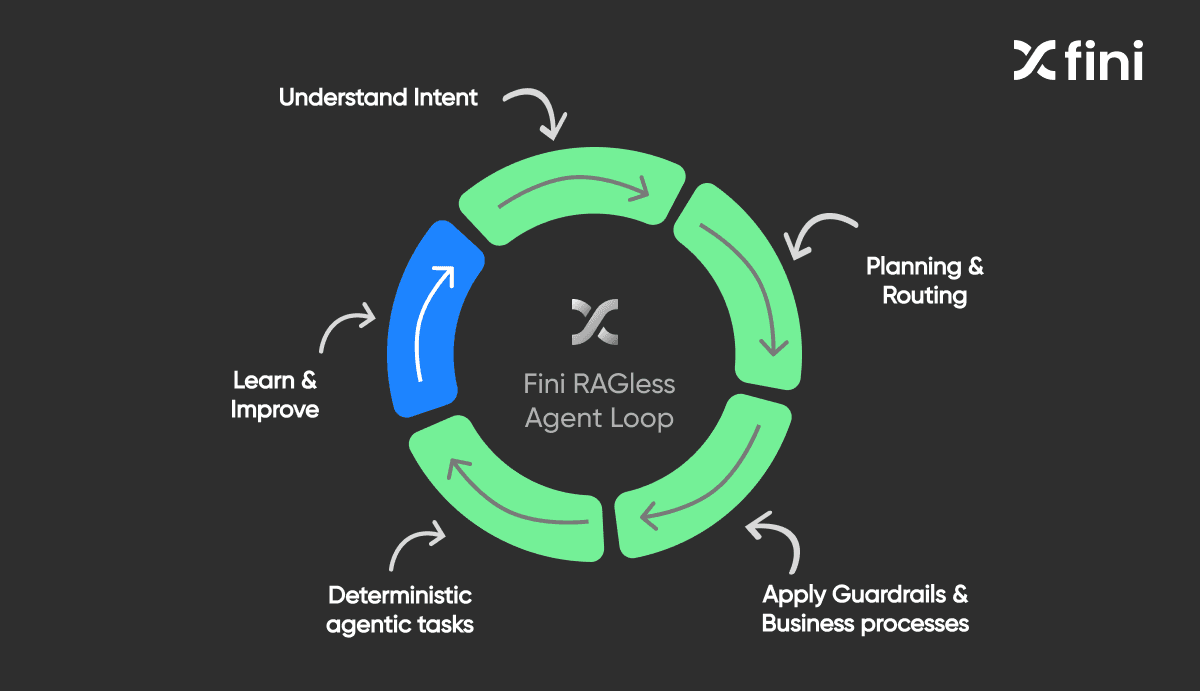
Fini does not retrieve documents at inference time. Instead, we operate on structured knowledge in three ways.
Policies become functions. A refund policy is not a paragraph the AI reads. It is a function that accepts inputs (purchase date, product category, customer tenure, refund history) and returns an output (eligible: yes/no, type: full/prorated, amount: $X.XX, reason: string). When a customer asks about a refund, we invoke the function against their actual data.
Customer data comes from live systems. When a customer asks “why was I charged twice?”, we pull their transaction history from the billing system in real time, identify the duplicate, and calculate the refund from the actual transaction amounts. We are not searching for a “duplicate charge” article and hoping the LLM applies it correctly.
Actions are deterministic. When Fini processes a refund, it calls the Stripe API with the exact amount derived from the policy function. There is no step where an LLM decides what amount to refund based on its interpretation of a text passage.
The LLM still plays a role: intent recognition, conversation management, response generation. But it does not make policy decisions, calculate amounts, or determine eligibility. Those steps are executed by structured logic that produces the same correct answer every time, regardless of how the customer phrased their question.
Where the RAG vs Structured Execution Gap Matters Most
The accuracy gap shows up across three categories of support queries.
Queries Involving Math
Prorated refunds, usage-based billing calculations, loyalty point balances, plan comparison pricing. LLMs are unreliable calculators. They approximate from the text they read. A function that computes the prorated amount from the actual transaction date and plan price will produce the correct number every time.
Queries Involving Conditional Logic
Policies with multiple qualifying criteria, regional variations, grandfathered plans, and time-dependent rules. An LLM reading a policy document with four conditions will occasionally drop one. This is not a failure of model quality; it is a structural limitation of generation. A function that checks all four conditions as explicit logic will not.
Queries Requiring Confirmed Actions
When the customer needs something done, not just answered. Processing a refund, updating an address, cancelling a subscription, escalating to a specific team. The gap between “Your refund has been processed” (true) and “Your refund has been processed” (hallucinated) is the gap between an AI agent and a liability. Structured execution calls the API and returns a confirmed transaction ID. RAG generates text about what it would do.
How to Tell Whether Your AI Support Vendor Uses RAG or Structured Execution
Most vendors do not advertise their architecture clearly. Here is a practical five-step evaluation framework.
Step 1: Ask about the data source at inference time. Does the AI retrieve from static embedded documents or pull from live backend systems? Live data access is a prerequisite for structured execution. If the answer is a vector database, you are looking at a RAG-based product.
Step 2: Test a policy-dependent query with a custom scenario. Give the AI a hypothetical that requires applying a multi-condition policy to a specific account situation. A RAG-based system will often drop one condition or approximate the output. An execution-based system will evaluate all conditions correctly.
Step 3: Test a calculation query. Ask the AI to calculate a prorated refund or usage-based billing adjustment. Verify the math manually. LLMs approximate. Functions compute. A wrong calculation here tells you everything about the architecture.
Step 4: Ask for an action and verify it happened. Request an action against a test account. Check whether the action was actually executed in the backend system. A RAG-based system generates text confirming an action it did not take.
Step 5: Ask for accuracy figures by query type. Request separate accuracy numbers for informational queries versus policy-dependent queries. A vendor that only reports aggregate accuracy is hiding the gap. Fini reports 99% on policy-dependent queries across production deployments. RAG-based vendors typically cannot separate these numbers.
What This Looks Like in Production
One of our fintech deployments processes roughly 50,000 support interactions per month. Before Fini, their RAG-based chatbot handled about 35% of tickets. The remaining 65% went to human agents, mostly because the chatbot could not reliably answer policy-dependent questions or take actions.
After switching to structured execution:
78% of tickets resolve autonomously, up from 35%
99% accuracy on policy-dependent queries, up from 72%
Fewer than 30 wrong-answer escalations per month, down from around 400
cost per resolution from $0.49, down from $4.20 blended cost
The gains did not come from a better model or better prompts. They came from removing the step where an LLM interprets a document and replacing it with a step where a function executes a rule.
See how Fini customers like Atlas, PostFinance, and CoverGenius measure accuracy in production.
The Tradeoff: Why Structured Execution Is Worth the Setup Cost
This architecture is harder to set up than RAG. A RAG pipeline can be functional in hours: embed your docs, wire up retrieval, deploy. Structured execution requires encoding your business rules as logic, connecting to your backend systems, and mapping your policy surface area. This is real configuration work.
The tradeoff is correct for customer support. Every response carries financial, legal, or retention weight. A wrong refund amount costs real money. A policy misapplication creates compliance exposure. A hallucinated confirmation (“Your refund has been processed”) when nothing happened destroys customer trust.
The setup cost is paid once. The accuracy gain compounds on every interaction. A deployment processing 50,000 tickets per month at 99% accuracy versus 72% produces 13,000 fewer wrong answers per month. At a conservative $4.20 blended cost per human-handled escalation, that is over $54,000 in monthly savings from the architecture choice alone.
RAG will continue to work well for search, research, and informational products. For customer support, where every answer has consequences, the industry is moving toward execution-first architectures.
Compare Fini’s structured execution approach against RAG-based AI support platforms.
FAQs
What is RAG and why do most AI support tools use it?
RAG (retrieval-augmented generation) embeds your help docs into a vector database, retrieves relevant chunks when a customer asks a question, and feeds them to an LLM to generate a response. Most AI support tools use it because it is fast to set up and works reasonably well for informational queries. Fini chose a different path because RAG hits an accuracy ceiling on policy-dependent and action-oriented tickets, which are the majority of real support volume.
What is structured execution in AI customer support?
Structured execution replaces document retrieval with encoded business logic. Policies become executable functions that accept live customer data as inputs and return deterministic outputs. When a customer asks about a refund, the system invokes a function against their actual account data rather than retrieving a policy document and asking an LLM to interpret it. The LLM handles conversation flow and intent recognition, but policy decisions and calculations are handled by deterministic logic.
What is the accuracy difference between RAG and structured execution in AI support?
On informational queries, both approaches achieve above 90% accuracy. On policy-dependent queries, RAG drops to around 72% while structured execution maintains 98%. The gap is widest on queries involving math, multi-condition policies, and actions that require confirmed execution in backend systems. Fini’s benchmarking covered 500 real fintech support tickets across both query types.
Can RAG-based AI support tools be improved to match structured execution accuracy?
Incremental improvements are possible through better chunking, reranking, and prompt engineering, but the fundamental limitation remains. An LLM interpreting policy text is doing approximate reasoning. On queries involving math, conditional logic, or confirmed actions, retrieval-based systems will continue to produce occasional confident errors. Structured execution eliminates this class of failure by computing answers instead of generating them.
What types of support queries need structured execution instead of RAG?
Any query involving math (prorated refunds, usage-based billing, loyalty points), conditional logic (multi-criteria eligibility, regional policy variations, grandfathered plans), or confirmed actions (processing a refund, updating an address, cancelling a subscription). Purely informational queries with no account context do not require structured execution, but those are the queries your help center already handles. The tickets that reach your support team are the account-specific, policy-dependent ones.
Does Fini use any form of document retrieval?
Fini does not retrieve documents at inference time. Policies are encoded as executable functions and customer data is pulled from live systems (billing, CRM, order management) in real time. The LLM handles conversation flow and intent recognition, but policy decisions and calculations are handled by deterministic logic, not generated from retrieved text. This is what Fini calls the Knowledge Atlas architecture.
How long does structured execution take to set up compared to RAG?
A RAG pipeline can be functional in hours by embedding existing help documentation. Structured execution requires encoding business rules as logic and connecting to backend systems, which is a more involved configuration process. The setup cost is a one-time investment. A deployment processing 50,000 tickets per month at the accuracy difference between 72% and 99% produces 13,000 fewer wrong answers monthly, which compounds into significant cost savings and CSAT improvement over time.

GTM Lead