
A customer whose card just got declined does not care which vendor logo sits behind the chat window. They care whether the next message solves the problem or hands them to a queue. Fini is a per-resolution AI agent backed by Y Combinator and Matrix Partners that runs on top of the helpdesk you already have. Zendesk AI is the agent layer built into the Zendesk platform, included with every Suite and Support plan and billed per automated resolution.
Cost per resolved ticket is the metric that decides this
Almost every evaluation of these two platforms starts in the wrong place, with a feature grid. Feature grids do not survive a budget review. The number that does is cost per resolved ticket, because it is the only figure that combines what you pay, what you get, and what the vendor is willing to count.
That single metric splits into three questions, and they are the spine of this comparison:
What are you buying? One meter or three.
What counts as a resolution on the invoice? The definitions differ more than the prices do.
Who maintains the knowledge after launch? This is where the running cost actually lives.
Work those three in order and the decision usually makes itself, well before anyone opens a feature checklist.
Zendesk AI vs Fini at a glance
Fini | Zendesk AI | |
|---|---|---|
What you buy | An AI agent layer on top of your existing helpdesk | An AI agent inside the Zendesk platform |
Pricing model | Starts from $0.49 per resolution, no per-seat fees | Per-agent Suite licence plus per automated resolution |
What is published | $0.49 per resolution, starting rate | Seat prices and included allowances, but not the rate for additional resolutions |
Escalations to humans | Free, not billed | Not counted as an automated resolution |
Knowledge upkeep | Self-maintaining, articles written from resolved tickets | Configured, with generation tools in early access |
Go-live | Live in 14 days, fully autonomous in 30 (Day 1 / Day 14 / Day 30) | Not publicly stated as a fixed timeline |
Requires replacing your helpdesk | No | Zendesk is the helpdesk |
What is Fini?
Fini is an AI agent for customer support that resolves tickets end to end across chat, email, and voice in 130+ languages. It reaches a 90% resolution rate at 99% accuracy with a roughly 5 second first response, and runs more than 3 million monthly resolutions across fintech and healthcare teams. Pricing starts from $0.49 per resolution, with no per-seat fees. Fini connects to the helpdesk, CRM, billing system, and claims or records system you already run, takes actions inside them, and writes the decision audit trail back.
What is Zendesk AI?
Zendesk AI is the agent layer inside the Zendesk platform. At its Relate conference in May 2026, Zendesk launched what it calls the Resolution Platform: Agent Builder and Custom Agents for no-code build and test cycles, an expanded Knowledge Graph with connectors to sources like SharePoint, Google Drive, Notion and Confluence, Action Flows for taking steps in connected systems, Context Graph audit trails, and access over the Model Context Protocol. Zendesk completed its acquisition of Forethought on 4 June 2026, adding self-improving agents, Autoflows, and voice.
Zendesk is the incumbent, with the deepest ticketing, routing, and reporting stack in this comparison and a marketplace of several thousand integrations. It is also a platform being assembled from parts, and the newest parts are the ones this comparison turns on.
The decision most teams get backwards
Teams evaluating Zendesk AI against a challenger usually frame it as a helpdesk migration. It is not. Zendesk AI and Fini sit at different layers of the stack, and that distinction changes the shape of the decision.
Zendesk AI is a feature of Zendesk. Choosing it means the agent, the ticketing system, the routing rules, and the reporting all come from one vendor, which is genuinely valuable if Zendesk is already the system of record and your team knows it well.
Fini is an agent layer that sits on top of whatever helpdesk you run, including Zendesk. There is a Fini app in the Zendesk marketplace, and teams already run Fini’s agent against their Zendesk tickets without moving a single macro, view, or SLA. Nothing about evaluating Fini requires touching the helpdesk your team logs into every morning.
That reframes the question. You are not deciding whether to leave Zendesk. You are deciding whether the AI layer that resolves your tickets should come bundled from your helpdesk vendor or be chosen separately on its own numbers.
Zendesk AI pricing in 2026
Zendesk runs three meters and publishes two of them. You pay a per-agent Suite licence, a per-agent Copilot add-on for agent assist, and a charge for every automated resolution. The published part is the included allowance by tier. The unpublished part is the rate you pay once you exceed it.
Line item | Published? | What is known |
|---|---|---|
Suite licence | Yes | Per agent per month, scales with headcount |
Copilot agent assist | Yes | Separate per-agent charge |
Included automated resolutions | Yes | Roughly 5, 10 or 15 per agent per month by tier, account cap near 10,000 per year |
Rate beyond the allowance | No | Third-party invoice reconstructions land near $1.50 committed and $2.00 pay as you go, directional only |
Implementation | No | Not publicly stated |
See Fini’s full pricing breakdown for plan details, add-ons, and a resolution calculator.
Zendesk AI Agents: what the allowance actually covers
On a 20-agent Enterprise account the allowance works out at roughly 300 automated resolutions a month. A team handling 6,000 tickets a month at a 60% resolution rate would generate around 3,600, so more than 90% of resolutions fall outside the allowance and onto a rate Zendesk does not publish. Since 18 May 2026 every billed resolution is verified twice, once by the agent and once by a separate evaluation model, with spam and routine exchanges excluded, which is a real improvement on what counts as billable. Escalations to a human are not counted as automated resolutions. Ask for the overage rate in writing, and ask specifically how voice conversations are metered.
What you actually pay for
Fini prices one thing: $0.49 per resolution, covering the platform and implementation. Zendesk runs three meters, a per-agent Suite licence, a per-agent Copilot add-on, and a charge per automated resolution. Two of the three are published.
Fini | Zendesk AI | |
|---|---|---|
Additional resolutions | $0.49 Enterprise | Not published |
Per-seat fees | None | Yes, scales with headcount |
Agent assist | Included | Copilot, a separate per-agent charge |
Implementation | Included in the rate | Not publicly stated |
Escalation to a human | Free | Not counted as an automated resolution |
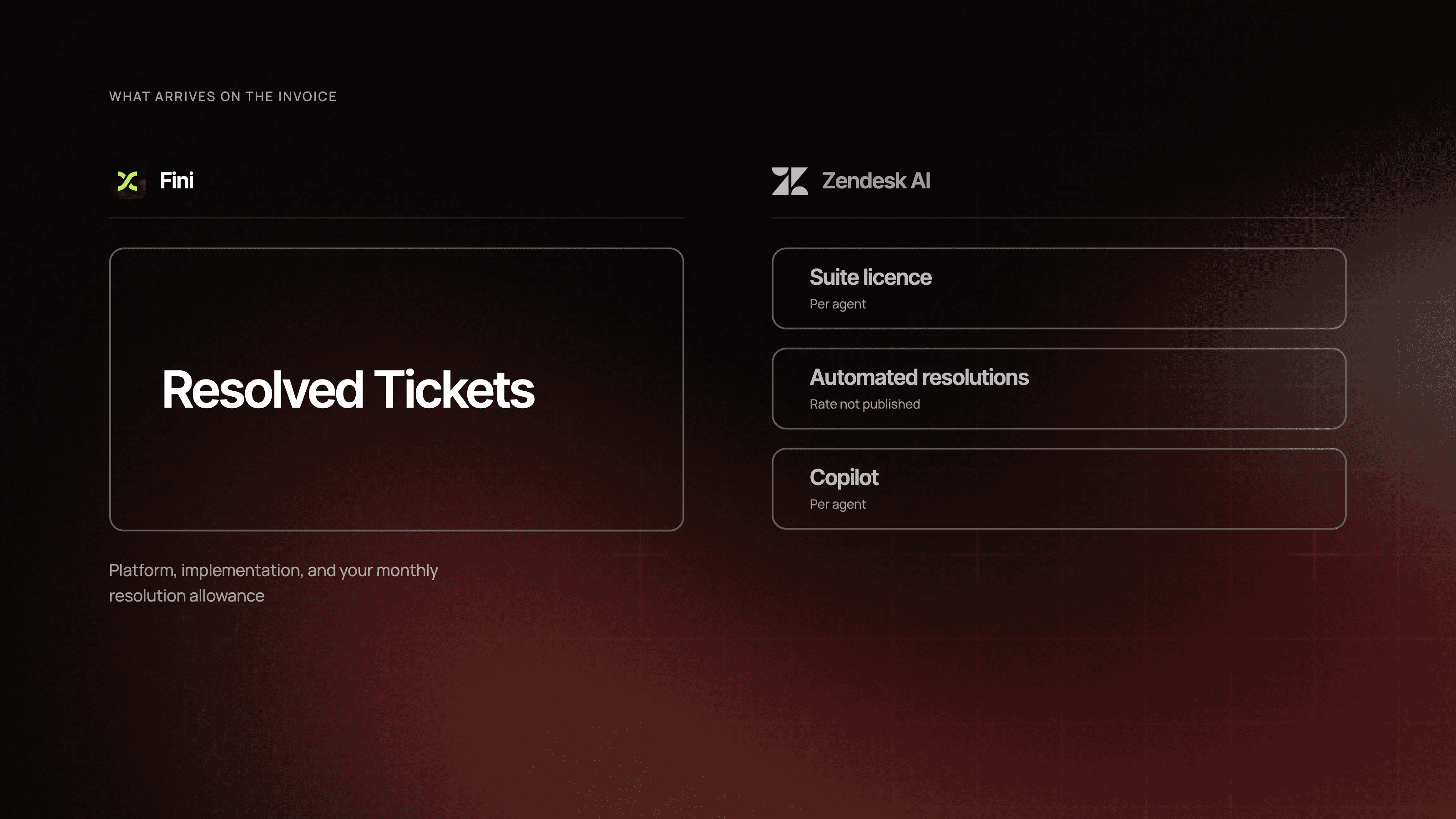
The unpublished cell is the one to ask about. On a 20-agent Enterprise account the allowance works out at about 300 automated resolutions per month, while a team fielding 6,000 tickets at a 60% automation rate generates roughly 3,600. Around 3,300 land at a rate you cannot look up. Third-party analyses of customer invoices converge on roughly $1.50 per resolution on commitment and $2.00 pay-as-you-go, but those are reconstructions, not quoted rates.
Read the two columns as different shapes rather than different sizes. Zendesk's resolution charge sits on top of the seat licences and the Copilot add-on, while Fini's per-resolution rate is the whole bill. That is why a Fini invoice can be forecast from two numbers you already have, your ticket volume and your rate, and a Zendesk AI invoice needs your headcount, your Suite tier, your Copilot seats, and a rate you have to request. Zendesk’s seat prices also render in the currency of the region you browse from, so confirm them for your own billing entity.
Enterprise adds a 90-day pilot on live traffic with resolution, CSAT, and accuracy targets agreed in writing, plus a switching-cost credit capped at $50,000, all backed by the 90-Day Money-Back Guarantee: miss the agreed resolution target and the fees are waived.
How Fini and Zendesk AI differ
Three differences move deals. Each one is worth checking against your own ticket data rather than a feature list.
1. What counts as a resolution
Fini bills when the issue is solved with no human involved, and escalations to your team are free. That definition is short because the billing event is the outcome.
Zendesk’s definition is more specific and worth reading closely before signing. Per Zendesk’s own documentation, an automated resolution is counted after a period of end-user inactivity, 72 hours for email AI agents and two hours by default for messaging agents. It counts when AI evaluation has confirmed the agent’s response was relevant and the last interaction was one of the following: the end user gave positive feedback, the end user gave no feedback at all, the AI agent shared help center articles in response to the request, or the end user reached the final step in an answer flow. Escalation to a human means it is never counted.
Zendesk tightened this in May 2026 with automated resolution tiers, where every billed resolution is verified twice, once by the agent and once by a dedicated evaluation model, with spam and routine exchanges excluded. That is a real improvement on the buyer’s side and worth acknowledging.
Billing question | Fini | Zendesk AI |
|---|---|---|
Billing event | Issue solved, no human involved | Automated resolution, verified by a separate evaluation model |
Silence from the customer | Not billable on its own | Counts, if evaluation judged the response relevant |
Agent shared a help center article | Not billable on its own | Counts |
Escalated to a human | Free | Not counted |
Internal channels and sandbox tests | Not billed | Excluded from counting |
Two clauses still deserve attention. Silence counts. So does sharing a help center article. Neither is unreasonable, but both mean the billed number and the solved number are not the same number. If you track your escalation rate closely, run the two definitions against a month of your own tickets before you compare rates. The gap between them is usually larger than the gap between the prices.
2. Who maintains the knowledge after launch
This is the difference that compounds, and it is covered in depth in the feature comparison below. In short: Fini’s knowledge layer writes and reconciles itself from resolved tickets. Zendesk’s equivalent tooling generates drafts for a human to review and is still in early access.
3. How fast each goes live
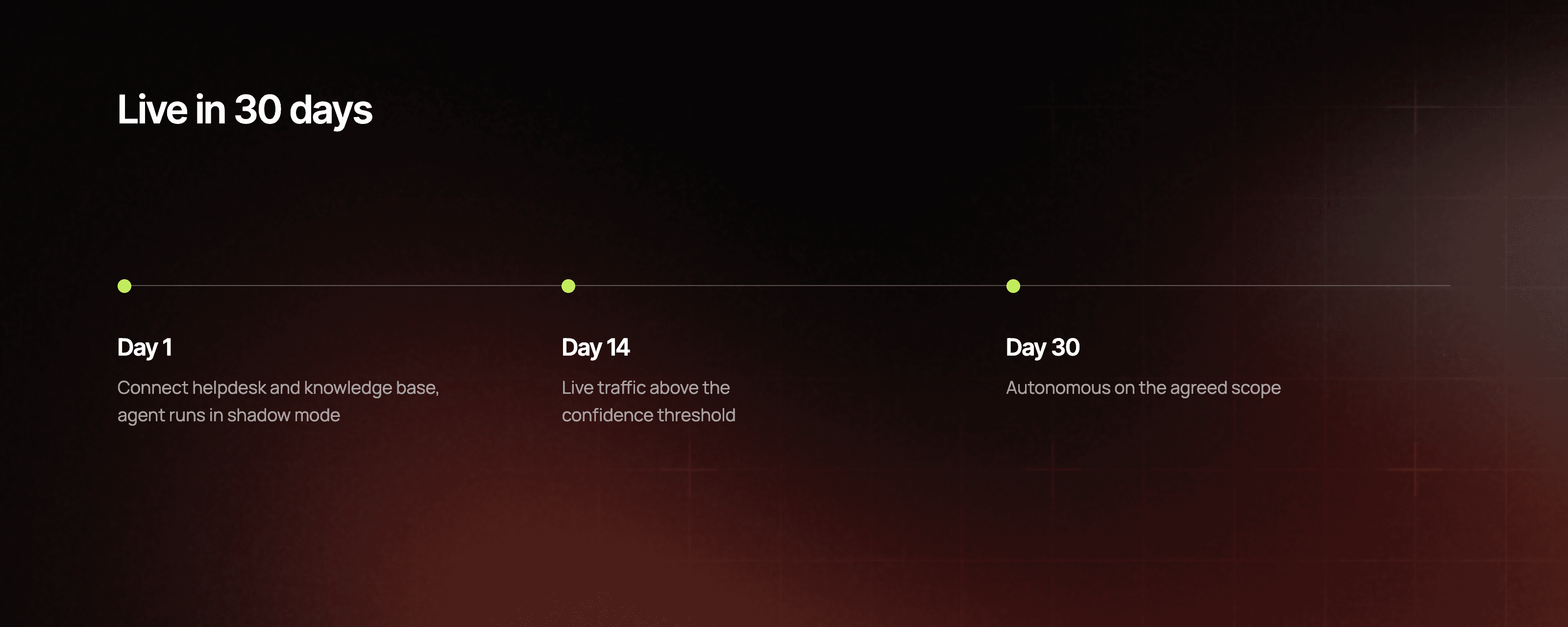
Fini goes live in 14 days and is fully autonomous in 30, on a staged path. Day 1 connects the helpdesk and knowledge base and the agent begins answering in shadow mode. Day 14 it handles live traffic on the journeys that clear the confidence threshold. Day 30 it runs autonomously on the agreed scope with escalation rules in place. On Enterprise, that sits inside a 90-day pilot on live traffic with targets agreed in writing before anything is billed.
Zendesk does not publish a fixed implementation timeline for AI agents. Because the agent lives inside the platform, the timeline depends on the state of your instance: how clean the help center is, how many intents you need, how much flow authoring the team wants. A tidy instance can go live quickly. A ten-year-old instance with 4,000 macros will not.
Feature by feature
Beyond the commercial decisions above, three capabilities separate the two platforms under the hood: how each one reasons over your data, how each one keeps its knowledge current, and how each one proves what it did.
Architecture and reasoning
Fini. Fini runs what it calls structured execution rather than retrieval-augmented generation. Instead of retrieving policy text and letting a model paraphrase it, Fini turns policies into executable functions, pulls live account data, and calls backend APIs so an action is confirmed rather than described. The model handles intent recognition and natural language generation, not the policy decision or the calculation. On Fini’s published 500-ticket fintech benchmark, policy-dependent accuracy rose from about 72% under retrieval to 99% under structured execution.
Zendesk AI. Zendesk pairs its Knowledge Graph, which indexes the help center and connected sources, with Action Flows and Agent Builder for authored behaviour. Retrieval sits at the centre of the design and admins close the gaps with flows. It is a well-built version of the retrieval-plus-flows pattern, and Zendesk does not publish a retrieval-versus-execution accuracy benchmark.
Verdict: Fini ✓ publishes a structured-execution benchmark and a confirmed-action design. Zendesk ✓ ships mature authoring over a broad Knowledge Graph, but ✗ publishes no comparable accuracy benchmark.
Knowledge management
This is where the two platforms diverge most, and where the running cost of an AI agent actually sits. Every AI support deployment degrades the same way: the help center drifts, articles start contradicting each other, confidence drops, and the team quietly becomes a documentation factory.
Fini. Fini’s Knowledge Atlas is a self-maintaining knowledge layer, shipped and generally available. When a human resolves an escalation, the Atlas extracts the solution, writes a formatted help article, files it in the right branch of a category tree, and makes it searchable immediately. It flags duplicates, contradictory instructions, and outdated policies on a reconciliation dashboard. It routes queries by intent rather than keyword, so “why won’t my payment go through”, “transaction failed at checkout” and “card not working” all reach the same article. And because the knowledge base is tree-structured, every answer traces back to exactly one authoritative article rather than a blend of several. Fini reports AI resolution moving from 50-60% to 85-90% and knowledge upkeep falling from about 20 hours a week to two.
Zendesk AI. Zendesk is building toward the same place and is not there yet. The Knowledge Graph is generally available and its connector list is genuinely broad. Knowledge Builder generates starter content from past tickets for teams without a solid help center. Knowledge Copilot, which identifies gaps, outdated content and inconsistencies from real conversations, is the closest analogue to the Atlas, and as of August 2026 it remains an early access program limited to Suite Professional and above. It produces article drafts for a human to review and publish. Zendesk publishes no before-and-after numbers for knowledge upkeep.
Verdict: Fini ✓ self-maintaining knowledge, generally available, with auto-written articles, conflict detection, and single-source attribution, plus published upkeep numbers. Zendesk ✓ a broad, generally available Knowledge Graph, but ✗ its gap-detection and article-writing tooling is early access, draft-only, and plan-gated.
Attribution and the audit trail
Fini. Because the Atlas is tree-structured, a Fini answer resolves to one source article, which is the difference between an auditable answer and a plausible one. As Fini’s co-founder Deepak Singla puts it, “most AI tools blend information from multiple articles, creating answers that don’t match any single source. That’s a compliance violation waiting to happen.” Fini pairs that with configurable confidence thresholds that escalate anything below the line, mandatory human review on sensitive categories including account closure and fraud claims, exportable step-level traces, and no training on customer data.
Zendesk AI. Zendesk shipped Context Graph at Relate 2026, capturing audit trails over agentic reasoning, which retires the older “black box” criticism. The open questions are whether traces export into your own security monitoring and quality workflows rather than staying in the console, and how attribution behaves when the Knowledge Graph is drawing on several connected sources at once.
Verdict: Fini ✓ single-source attribution by design and exportable traces. Zendesk ✓ a shipped reasoning audit trail, but ✗ does not publish an attribution guarantee across blended sources.
What Fini customers report
Two customers, two different relationships with Zendesk, and the same conclusion: the helpdesk and the AI layer are separate decisions.
TrainingPeaks kept Zendesk and changed the AI layer. At peak season its team fields as many as 1,700 tickets a week, and answering coaches inside a 24-hour window was the binding constraint. With Fini resolving first, the queue the team actually saw topped out around 500, average response time fell to 25.9 seconds, and CSAT improved 12%.
“We have on our busiest week potentially 1,700 tickets submitted into Zendesk. But what we saw in our queue at max was right around 500. Clearly, Fini is taking a huge number of those.”
Kristina Green, Senior Support Rep, TrainingPeaks
LISA, the Dutch platform behind the national Hockey, Tennis, and Padel federations, arrived from the other direction. Its team had already tried Zendesk’s built-in bot, before the platform’s 2026 rebuild, and gave up on it because keeping it configured had become a full-time job on its own. Fini went live in under two weeks and cut the weekly support load from roughly 80 hours to 40.
Capabilities side by side
Product capabilities only. The commercial picture is summarised above and the compliance detail sits below.
Capability | Fini | Zendesk AI |
|---|---|---|
Chat, email, and voice on one reasoning layer | ✓ | Voice via Contact Center and Forethought agents |
Runs on top of an existing helpdesk | ✓ | ✗, Zendesk is the helpdesk |
Native ticketing, routing, and SLA engine | Uses yours | ✓ |
Takes actions in CRM, billing, and records systems | ✓ | ✓, via Action Flows and the marketplace |
Self-maintaining knowledge, generally available | ✓ | ✗, early access and draft-only |
Single-source attribution per answer | ✓ | Not published |
Flow and intent authoring for admins | Policy and threshold, not flow diagrams | ✓, Agent Builder and Custom Agents |
Exportable step-level traces | ✓ | Not publicly stated |
Go-live timeline | Live in 14 days, fully autonomous in 30 | Not published |
Agent assist for human staff | ✓ | ✓, Copilot as a separate add-on |
Workforce management and quality assurance | ✗ | ✓ |
Marketplace of third-party integrations | ✗ | ✓, several thousand apps |
Languages | 130+ | Not publicly stated |
Where Zendesk AI is stronger
Zendesk is the incumbent for good reasons, and a comparison that pretends otherwise is not useful to a buyer.
Platform depth. Ticketing, routing, SLAs, business hours, side conversations, and reporting are more mature than anything a newer vendor ships. If you need all of it on one contract, Zendesk is the answer.
Compliance breadth. Zendesk’s trust center names SOC 2 Type II under NDA, ISO 27001:2022, 27017, 27018 and 27701, FedRAMP LI-SaaS, Cyber Essentials Plus, and CSA STAR AI Levels 1 and 2. That list is broader than Fini’s, and for public-sector buyers FedRAMP or Cyber Essentials Plus can decide the deal outright.
Ecosystem. A marketplace of several thousand apps means the integration you need probably already exists.
Adjacent products. Workforce management, quality assurance, and contact centre come from the same vendor on the same invoice.
Certification or framework | Fini | Zendesk |
|---|---|---|
SOC 2 Type II | ✓ | ✓, report under NDA |
ISO 27001 | ✓ | ✓, 27001:2022 |
HIPAA | ✓ | Requires a BAA and the paid Advanced Compliance add-on |
BAA eligible | ✓ | Add-on required |
GDPR | ✓ | ✓ |
CCPA | ✓ | ✓ |
Data residency | ✓, on Enterprise | ✓ |
ISO 27017 / 27018 / 27701 | ✗ | ✓ |
FedRAMP LI-SaaS | ✗ | ✓ |
If FedRAMP or Cyber Essentials Plus is a hard procurement requirement, Zendesk is the answer and this comparison ends there. On the certifications most commercial buyers gate on, both clear the bar, and the difference is packaging: Fini’s SOC 2 Type II and HIPAA-compliant, BAA-eligible handling come with the plan, while Zendesk’s HIPAA support requires both a BAA and a paid add-on.
Where Fini is stronger
Knowledge that maintains itself. The Atlas writes articles from resolved tickets, reconciles conflicts, and attributes every answer to one source. Zendesk’s equivalent is in early access and produces drafts.
A bill you can model. A published starting rate, $0.49 per resolution, so you can forecast the invoice from your own ticket volume before you talk to anyone.
No per-seat fees and free escalations. The bill tracks resolutions, not headcount, so hiring an agent does not raise the software cost and handing off a ticket does not create a charge.
A 30-day path to autonomy. Day 1, Day 14, Day 30, with a 90-day Enterprise pilot on live traffic before anything is billed.
It does not require replacing your helpdesk. Fini runs on top of Zendesk, so the AI layer can be evaluated and changed without a platform migration.
Which should you choose?
Choose Fini if you want:
Knowledge that maintains itself rather than a documentation backlog that grows with ticket volume
A published per-resolution rate you can model against your own volume before a sales call
A bill that does not scale with headcount, and escalations that cost nothing
Single-source attribution on every answer for regulated review
To change your AI layer without migrating the helpdesk your team already knows
Choose Zendesk AI if you want:
Ticketing, routing, reporting, workforce management, and the AI agent from one vendor on one invoice
The deepest flow and intent authoring available, with an operations team that wants to own it
FedRAMP LI-SaaS, Cyber Essentials Plus, or the full ISO 27001, 27017, 27018 and 27701 set as a procurement requirement
A marketplace of several thousand integrations
Ready to compare on your own data?
Bring your 200 hardest tickets. Fini connects to your helpdesk and knowledge base on the call and shows resolution numbers on your tickets, not a sandbox. Talk to the team.
Does Fini replace Zendesk?
No. Fini runs as an AI agent layer on top of the helpdesk you already use, and there is a Fini app in the Zendesk marketplace. Your tickets, macros, views, and SLAs stay where they are. Zendesk AI, by contrast, is a feature of the Zendesk platform, so using it means Zendesk is your helpdesk. This is the main structural difference between the two, and it means you can evaluate Fini against your live Zendesk traffic without committing to a migration. The same pattern applies to building a knowledge base from your existing Zendesk tickets.
How much does Zendesk AI cost per automated resolution in 2026?
Partly published. Zendesk includes AI agents in every Suite and Support plan with an allowance of roughly 5 automated resolutions per agent per month on Team, 10 on Professional, and 15 on Enterprise, against an annual account cap in the region of 10,000. It publishes per-agent seat prices for Support Team, Suite Team, and Suite Professional plus the Copilot add-on, with Suite Enterprise as contact-sales. What it does not publish is the overage rate once you pass the allowance. Fini's pricing starts from $0.49 per resolution. A Fini bill can be modelled up front; a Zendesk AI bill needs a quote to complete. Understanding the difference between deflection and resolution matters before comparing any two rates.
What counts as an automated resolution in Zendesk?
Fini bills when the issue is fully solved with no human involved, and escalations to your team are free. Zendesk counts an automated resolution after a period of end-user inactivity, 72 hours for email agents and two hours by default for messaging agents, when evaluation has confirmed the response was relevant and the last interaction was positive feedback, no feedback at all, a help center article shared by the agent, or the end user reaching the final step of an answer flow. Escalation to a human means it is not counted. Since May 2026 every billed resolution is verified twice, once by the agent and once by a separate evaluation model. Run both definitions against a month of your own tickets before comparing rates. Measuring first contact resolution on your current traffic gives you the baseline for that check.
Which platform requires less knowledge base maintenance?
Fini. Its Knowledge Atlas writes a formatted article whenever a human resolves an escalation, files it in a category tree, flags duplicates and outdated policies on a reconciliation dashboard, and traces every answer back to one authoritative source. Fini reports resolution moving from 50-60% to 85-90% and upkeep falling from around 20 hours a week to two. Zendesk has been building the same capability: the Knowledge Graph is generally available with connectors to sources like SharePoint, Notion and Confluence, and Knowledge Copilot identifies gaps and inconsistencies from real conversations. As of August 2026 Knowledge Copilot is an early access program on Suite Professional and above, and it generates drafts for a human to review rather than maintaining the base on its own.
Are Fini and Zendesk both compliant for regulated industries?
Both clear the bar most regulated teams set, and Zendesk carries a longer certification list. Fini holds SOC 2 Type II and ISO 27001, handles data on a HIPAA-compliant, BAA-eligible basis, covers GDPR and CCPA, and offers data residency on Enterprise. Zendesk’s trust center additionally names ISO 27017, ISO 27018, ISO 27701, FedRAMP LI-SaaS, Cyber Essentials Plus, and CSA STAR AI Levels 1 and 2. Zendesk’s HIPAA support requires a BAA and the paid Advanced Compliance add-on, while Fini’s comes with the plan. If FedRAMP is a hard requirement, Zendesk is the answer. For regulated review, also ask each vendor whether a given answer traces to a single source article or a blend of several.
How long does each platform take to go live, and do both support voice?
Fini goes live in 14 days and is fully autonomous in 30, on a staged path: Day 1 connects the helpdesk and knowledge base with the agent answering in shadow mode, Day 14 it handles live traffic above the confidence threshold, and Day 30 it runs autonomously on the agreed scope, with chat, email and voice on one reasoning layer in 130+ languages. Enterprise wraps that in a 90-day pilot with targets agreed in writing before billing starts. Zendesk does not publish a fixed timeline, because the work depends on the state of your instance. Its voice arrives through Contact Center and the Forethought agents acquired in June 2026, so confirm in writing how voice conversations count toward the resolution meter. If you run support across many markets, compare the two on multilingual coverage.
Is Zendesk's native AI good enough now, or do I still need a third-party agent?
Zendesk's May 2026 Resolution Platform closed some of the gap, but two limits remain as of this writing: the automated-resolution allowance is capped per agent seat (roughly 5 to 15 a month depending on plan, against an annual account cap around 10,000), and Knowledge Copilot — the piece that would keep the knowledge base current — is still an early-access program that drafts articles for a human to approve rather than publishing them autonomously. If your volume regularly exceeds the seat-based allowance or your knowledge base needs daily upkeep, a layer like Fini running on top of Zendesk (no migration required) removes both caps. If your volume sits comfortably inside the allowance and you're fine reviewing Knowledge Copilot drafts by hand, native may be enough for now.