When a customer’s payment declines, their account locks, or their claim gets denied, they are not comparing reasoning architectures. They want the right answer in five seconds, without the third “please hold while I transfer you.” Fini and Decagon both target that moment, with different bets on how a buyer should pay, who should own the agent after launch, how fast it should go live, what it can act on, and how many channels and languages it covers.
Decagon vs Fini at a glance
Fini | Decagon | |
|---|---|---|
Pricing | $0.49 per resolution, published | Custom contract, not published |
Outcome guarantee | 90-Day Money-Back Guarantee: 90% in 90 days | None published |
Go-live | Live in 14 days, fully autonomous in 30 | Not publicly stated |
Best for | Budgetable pricing, regulated fintech and healthcare | Author-everything workflows on a custom contract |
Backing | Y Combinator, Matrix Partners | Series D, January 2026 |
In this comparison: What each is · How they differ · Capabilities · Feature by feature · Ease of use · What customers say · The full side-by-side · Which to choose · Compliance · FAQ
What is Fini?
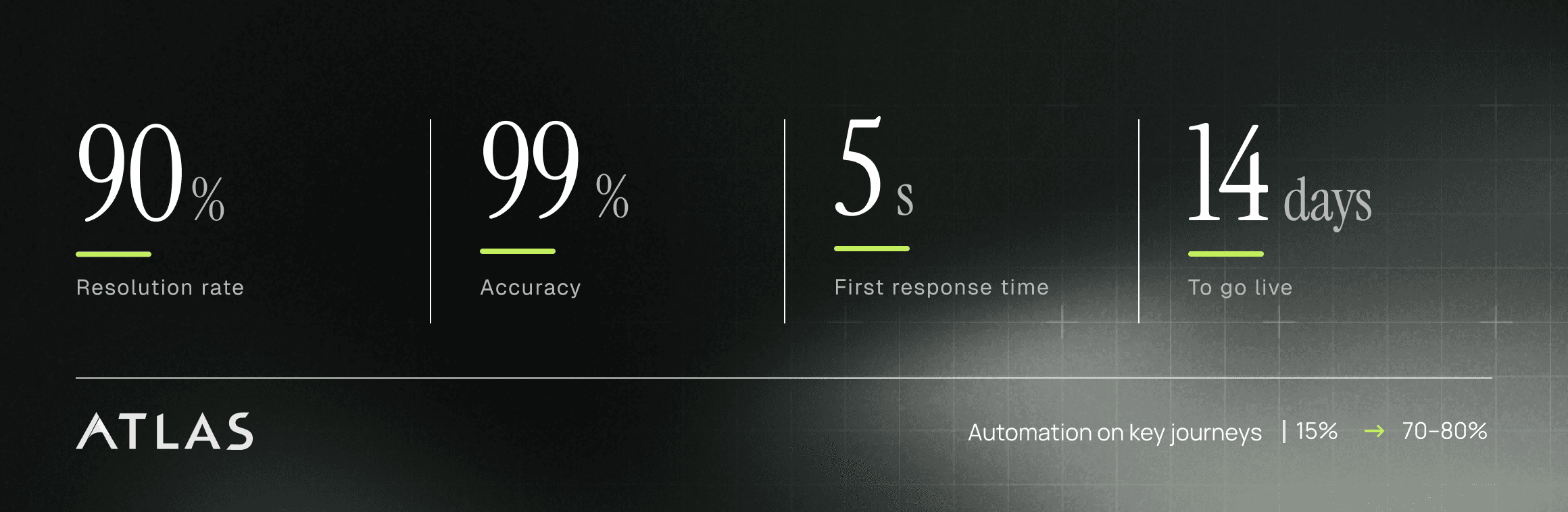
Fini is an AI customer-support agent priced per resolution, backed by Y Combinator and Matrix Partners. It connects to your helpdesk, knowledge base, CRM, billing, claims, and EHR systems natively, reaches a 90% resolution rate at 99% accuracy, and is built to go live in 14 days and reach full autonomy in 30. Across its customer base, Fini handles more than 3 million monthly resolutions in fintech and healthcare. The agent works across voice, chat, and email, answers in 130+ languages, and returns a first response in about five seconds.
What is Decagon?
Decagon is an enterprise agentic AI platform built around Agent Operating Procedures, a natural-language way for operations teams to author and version-control agent behavior. It describes itself as “the AI concierge for every customer” and serves voice, chat, and email from a single intelligence layer on a build-once-deploy-everywhere model. Decagon raised a Series D in January 2026, with named customers including Avis Budget Group, Block, and Deutsche Telekom. It runs an enterprise sales motion and does not publish its pricing.
Decagon pricing in 2026
Decagon does not publish a price list. Every deal is a custom enterprise contract quoted per account, so there is no rate card to model against. The closest public benchmark is third-party procurement data from Vendr, which puts the median Decagon contract near $386,000 per year across a range of roughly $95,000 to $590,000. Treat that as directional evidence from other buyers’ contracts rather than a quoted rate.
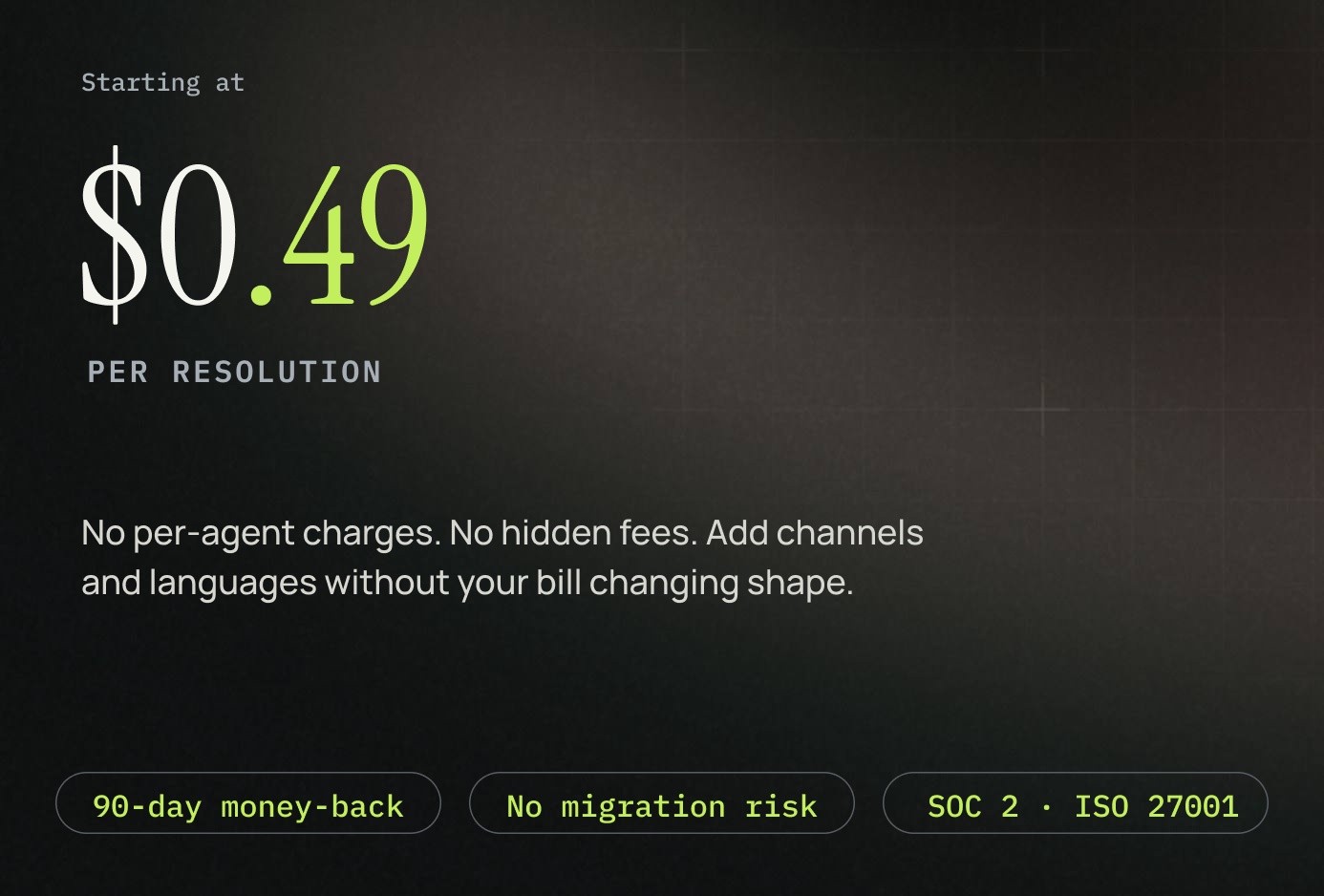
Fini publishes its rate: $0.49 per resolution, with no per-seat fees. The difference that matters is not the number, it is whether you can forecast the invoice from your own ticket volume before you speak to a salesperson.
What buyers ask | Decagon | Fini |
|---|---|---|
Published price list | ✗ | ✓ |
Price | Quoted per account | $0.49 per resolution |
Rate for additional resolutions | Not published | N/A, flat rate |
Public benchmark | Vendr median about $386,000 per year | Published, no benchmark needed |
Can you model cost before a sales call? | No | Yes |
See Fini’s full pricing breakdown for plan details, add-ons, and a resolution calculator.
Decagon competitors and how buyers shortlist them
Decagon is an autonomous AI agent platform for customer support, founded in 2023 and backed by Accel and a16z, competing at the enterprise end of the category. Buyers comparing it usually shortlist Sierra, Intercom Fin, Ada CX, Salesforce Agentforce and Fini. Reviews consistently praise resolution quality on well-scoped intents and consistently flag two things: a concierge sales motion with multi-week onboarding, and no public pricing, which makes internal budget approval slower than it needs to be.
How Fini and Decagon differ
Five decisions separate the two platforms: how you pay, who owns the agent after launch, how quickly it goes live, what it can act on across your stack, and how many channels and languages it covers. Each one moves a real deal, and each is sourced on both sides below.
1. Pricing: a published rate against a custom contract
Fini publishes the number: $0.49 per resolution, starting rate. The 90-Day Money-Back Guarantee waives all fees if Fini does not reach 90% resolution within 90 days, which turns procurement from a forecast into a measurable bet you can check against your own tickets. Decagon does not publish a pricing page and runs an enterprise sales motion. The only public signal comes from Vendr, which lists a median annual contract of $386,000 with a range of $95,000 to $590,000. For a finance team, the difference is whether you can model cost before a sales call or only after one.
Fini | Decagon | |
|---|---|---|
Pricing page | Public | No public pricing page |
Model | Plan with included resolutions | Custom enterprise contract |
Rate | $0.49 per resolution | Vendr median $386,000 per year (range $95,000 to $590,000) |
Minimum | $0.49 per resolution, no minimum | Not published |
Guarantee | 90-Day Money-Back Guarantee: 90% in 90 days | None published |
Fini pricing
Tip: To model Fini cost, just multiply your monthly resolved-ticket volume by $0.49. You cannot run that math on a custom contract until after the sales call. If you are an early-stage team, Fini runs an AI support credits giveaway for startups that can cover your first months.
2. Who owns the agent after launch
This is the real split, and it is where Decagon is strongest. Its Agent Operating Procedures let an operations team author and version-control agent behavior in natural language, without engineering. That is a clear answer to the question every support leader asks after the demo: who maintains this once it is live. Fini makes the opposite bet. The agent is self-learning and improves from resolved tickets without team tuning, so the maintenance burden stays low rather than moving to an owner. A team that wants to author every workflow leans Decagon; a team that wants agentic AI that improves on its own leans Fini. Neither bet is wrong; they suit different operating models.
Tip: The ownership question is really a staffing question. Ask each vendor who maintains the agent after launch, and whether that is a named role on your team or a function of the platform.
3. How fast each goes live
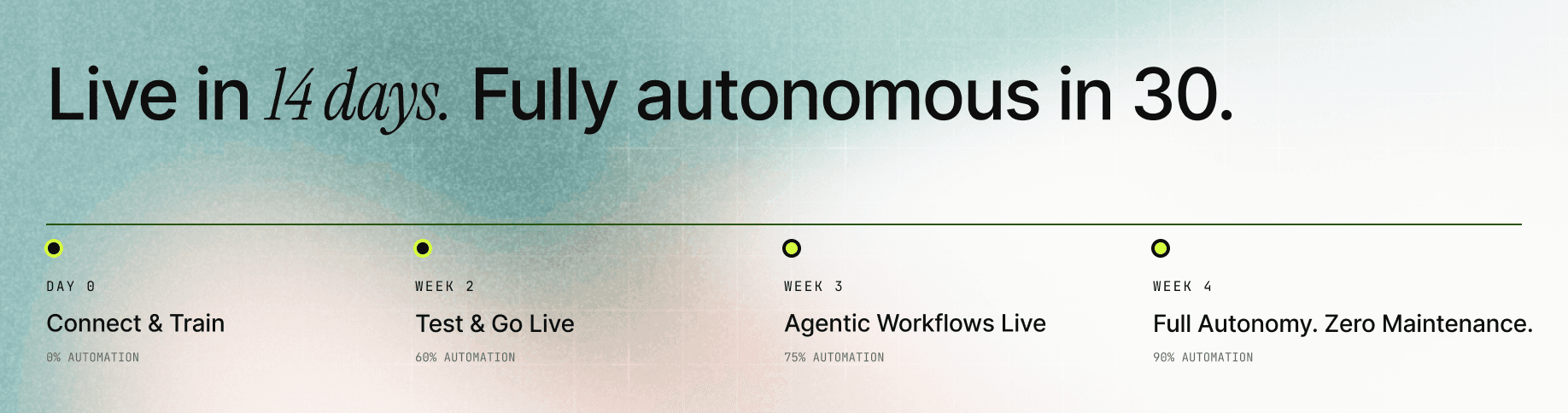
Fini publishes a three-stage rollout you can hold it to:
Day 1, Knowledge Agent Live. Helpdesk and knowledge base connected. FAQ-level resolution, 5-second first response, no code.
Day 14, Agentic Workflows. Billing, CRM, claims, and EHR connected. The agent takes actions: refunds, account updates, benefit lookups, prescription routing.
Day 30, Full Autonomy. Self-learning on. Voice, chat, and email unified at 99% accuracy.
Decagon does not publish an implementation timeline. Customer case studies describe multi-week rollouts driven by the Agent Operating Procedure build for each deployment, which is the cost of that authoring control.
4. Action coverage across your stack
A resolution is only real if the agent can do the thing the customer asked for. Fini connects natively to the helpdesk, CRM, billing, claims, and EHR systems behind a ticket, so it can issue a refund, update an account, look up a benefit, or route a prescription without an integration platform in between. Each action runs against the system of record and writes back the audit trail a regulated team needs, which is what separates a resolved ticket from a deflected one. Decagon’s build-once-deploy-everywhere model routes actions through its own integration layer and the Model Context Protocol, with the connections defined during the Agent Operating Procedure build. Both reach the systems of record; the difference is whether action coverage ships as a configured default or as part of a per-deployment build, and how much of that build your team owns afterward.
Tip: A resolution only counts if the agent completes the action and writes it back to the system of record. When you evaluate either platform, test a real refund or account update end to end, not a scripted demo answer.
5. Channels and languages
Both platforms serve voice, chat, and email from one system, so neither buyer has to stitch channels together. Fini publishes its reach: 130+ languages and a first response in about five seconds across all three channels, with the same resolution graph behind each, so a customer who starts on chat and calls back gets continuity rather than a cold restart. Decagon serves the same channel set from its single intelligence layer but does not publish a language count. For a global support organization, the published language coverage is a procurement input rather than a discovery item: you can plan a rollout against 130+ named languages, or you can scope coverage during evaluation.
Capabilities side by side
The pricing and commercial picture is summarized later. This table holds the product capabilities, with a check where each platform names a published strength.
Capability | Fini | Decagon |
|---|---|---|
Channels | Voice, chat, email, unified ✓ | Voice, chat, email, single layer ✓ |
Action coverage | Native to helpdesk, CRM, billing, claims, EHR ✓ | Via integration layer, scoped per deployment |
Post-launch ownership | Self-learning, no team tuning ✓ | Operations-authored |
Workflow authoring | Self-improving from resolved tickets | Natural-language Agent Operating Procedures, version-controlled ✓ |
Deployment model | Published Day 1 / Day 14 / Day 30 timeline ✓ | Per-deployment build |
Safety engineering | 99% accuracy on structured execution ✓ | Published layered-guardrails framework ✓ |
Languages | 130+ published ✓ | Not publicly stated |
Feature by feature
Beyond the commercial decisions above, three product capabilities separate the two platforms under the hood: how each reasons over your data, how each keeps its knowledge current, and how each stays safe in regulated work.
Architecture and reasoning
Fini. Fini runs what it calls structured execution rather than retrieval-augmented generation. Instead of retrieving policy text and letting a model paraphrase it, Fini turns policies into executable functions, pulls live account data, and calls backend APIs so an action is confirmed rather than described. The model is left to handle intent recognition and natural language generation, not the policy decision or the calculation. On Fini’s published 500-ticket fintech benchmark, policy-dependent accuracy rose from about 72% under retrieval to 99% under structured execution, and one production fintech cut wrong-answer escalations from roughly 400 a month to under 30.
Decagon. Decagon takes a different route: a multi-model architecture that draws on OpenAI, Anthropic, and Cohere models plus fine-tuned variants, wrapped in a published layered-guardrails framework with hallucination detection. It does not publish a retrieval-versus-execution benchmark or a single headline accuracy figure.
Verdict: Fini ✓ publishes a structured-execution benchmark and a confirmed-action design. Decagon ✓ runs a multi-model stack with a published guardrails framework, but ✗ publishes no accuracy benchmark.
Knowledge management
Fini. Fini’s Knowledge Atlas is a self-maintaining knowledge layer. When a human resolves an escalation, the Atlas writes a formatted help article, files it in a category tree, and makes it searchable; it flags conflicts and stale policies across sources, routes queries by intent rather than keyword, and traces every answer back to one authoritative article, the single-source attribution regulated teams need. Fini reports AI resolution moving from 50-60% to 85-90% and knowledge base upkeep falling from about 20 hours a week to two.
Decagon. Decagon ingests an existing knowledge base and connects to the CX stack, with agent behavior authored and versioned through Agent Operating Procedures. It does not publish a self-maintaining equivalent that writes or reconciles articles on its own.
Verdict: Fini ✓ self-maintaining knowledge with auto-generated articles and conflict detection. Decagon ✓ knowledge-base ingestion plus version-controlled authoring, but ✗ no published self-maintaining layer.
Safety and guardrails
Fini. Fini lets a team set tone, guardrails, and policy rules through a Prompt Builder, and runs human-in-the-loop escalation on configurable confidence thresholds. Sensitive categories, including account closure, fraud claims, and regulatory complaints, always route to a person; every action writes back a full audit trail; and Fini does not train on customer data.
Decagon. Decagon treats safety as a core design principle: it publishes a layered-guardrails framework, its strongest piece of public engineering content, alongside hallucination detection. Both vendors take the problem seriously; the difference is between Fini’s configurable controls and Decagon
‘s published framework depth.
Verdict: Fini ✓ configurable guardrails, mandatory human review for sensitive categories, and a full audit trail. Decagon ✓ a published layered-guardrails framework and hallucination detection.
Ease of use and admin experience
The two products feel different to set up and to run day to day, and the split mirrors their pricing and ownership models.
Setup. Fini connects the helpdesk and knowledge base with no code on Day 1 and reaches full autonomy in 30 days, so the first value lands before a long build. Decagon’s deployment runs roughly six to twelve weeks and expects dedicated engineering on the customer side, the cost of building each Agent Operating Procedure to spec.
Configuration and control. Decagon is the stronger surface for teams that want to shape behavior directly. Agent Operating Procedures let operations staff write and version workflow logic in plain language, and tools like Trace View, Watchtower, and the Agent Workbench expose how the agent reasoned and let a team debug it. Fini makes the opposite trade: the agent self-learns from resolved tickets, so there is less to author and less to maintain, but also less step-by-step control for a team that wants to script every path.
Onboarding. Both run a white-glove motion. Fini assigns dedicated engineers and a shared Slack channel during rollout, and Decagon embeds forward-deployed engineers and account product managers, so neither buyer is left to self-serve.
The honest read: Decagon gives a larger team more authoring and observability control, while Fini gives a leaner team faster time to value with less to maintain. Match the choice to how much of the agent you want to own.
Fini’s differentiators
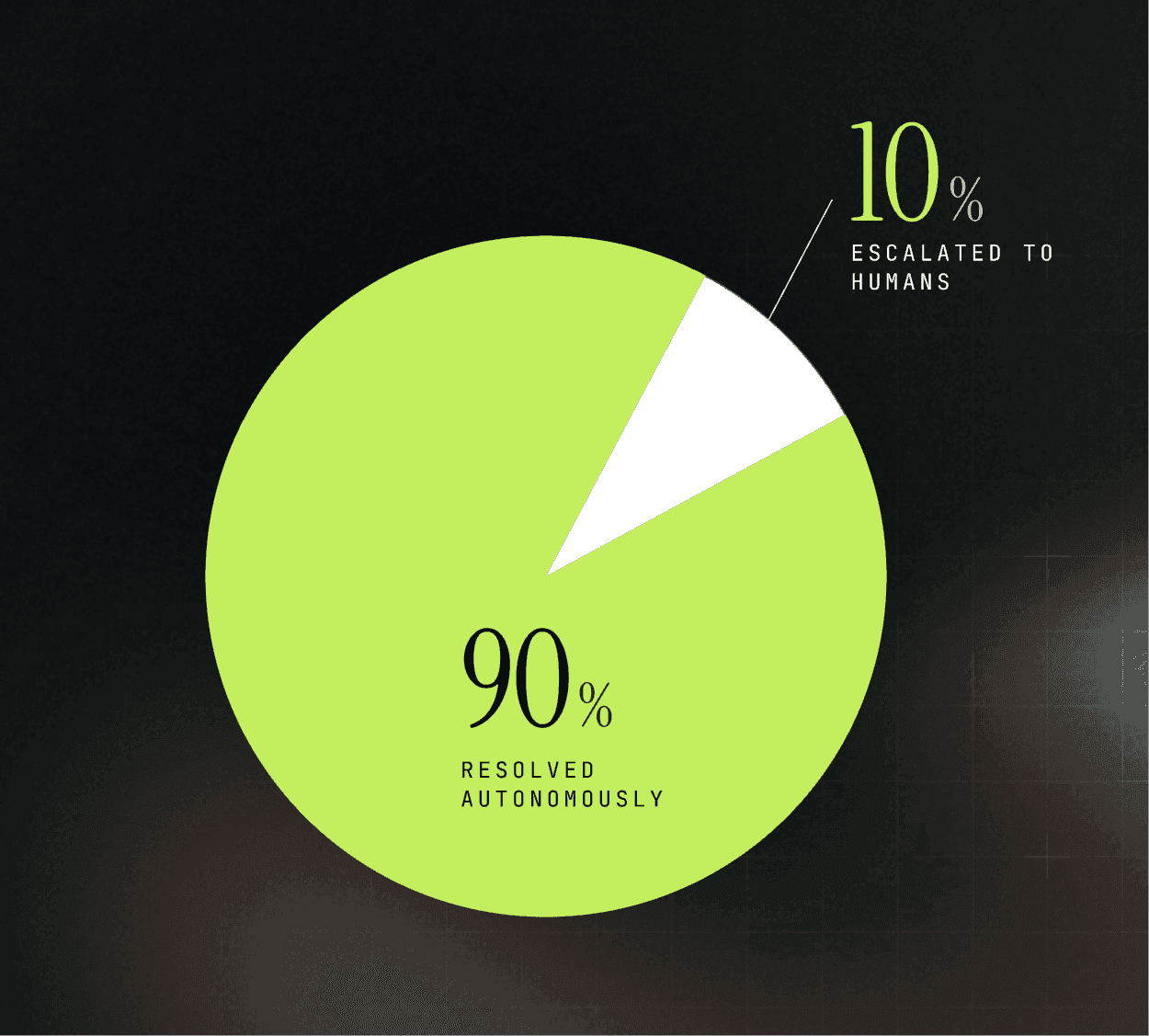
Published per-resolution pricing. $0.49 per resolution, budgetable without a negotiation, backed by the 90-Day Money-Back Guarantee.
Resolution and accuracy at scale. 90% resolution rate and 99% accuracy across more than 3 million monthly resolutions.
A 30-day path to autonomy. Voice, chat, and email unified on a stated Day 1 / Day 14 / Day 30 timeline.
Native action coverage and compliance. Direct to helpdesk, CRM, billing, claims, and EHR with no integration platform in between, and a posture spanning SOC 2 Type II, ISO 27001, HIPAA, GDPR, and CCPA.
Decagon’s recognized strengths
Agent Operating Procedures. Natural-language workflow authoring lets operations teams version-control agent behavior without engineering.
Published safety engineering. Decagon’s flagship content on layered guardrails is among the strongest in the category: “When AI agents are placed at the front lines of customer experience, they must reflect your brand values, speak accurately, and operate safely.”
One intelligence layer. Voice, chat, and email served from a single system with a build-once-deploy-everywhere model.
Enterprise roster. Named Series D customers include Avis Budget Group, Block, and Deutsche Telekom.
What customers say
Both products are used by teams that take support seriously, and the public record reads differently for each. Fini’s proof is concentrated in named case studies; Decagon’s is concentrated in enterprise references and third-party review sites.
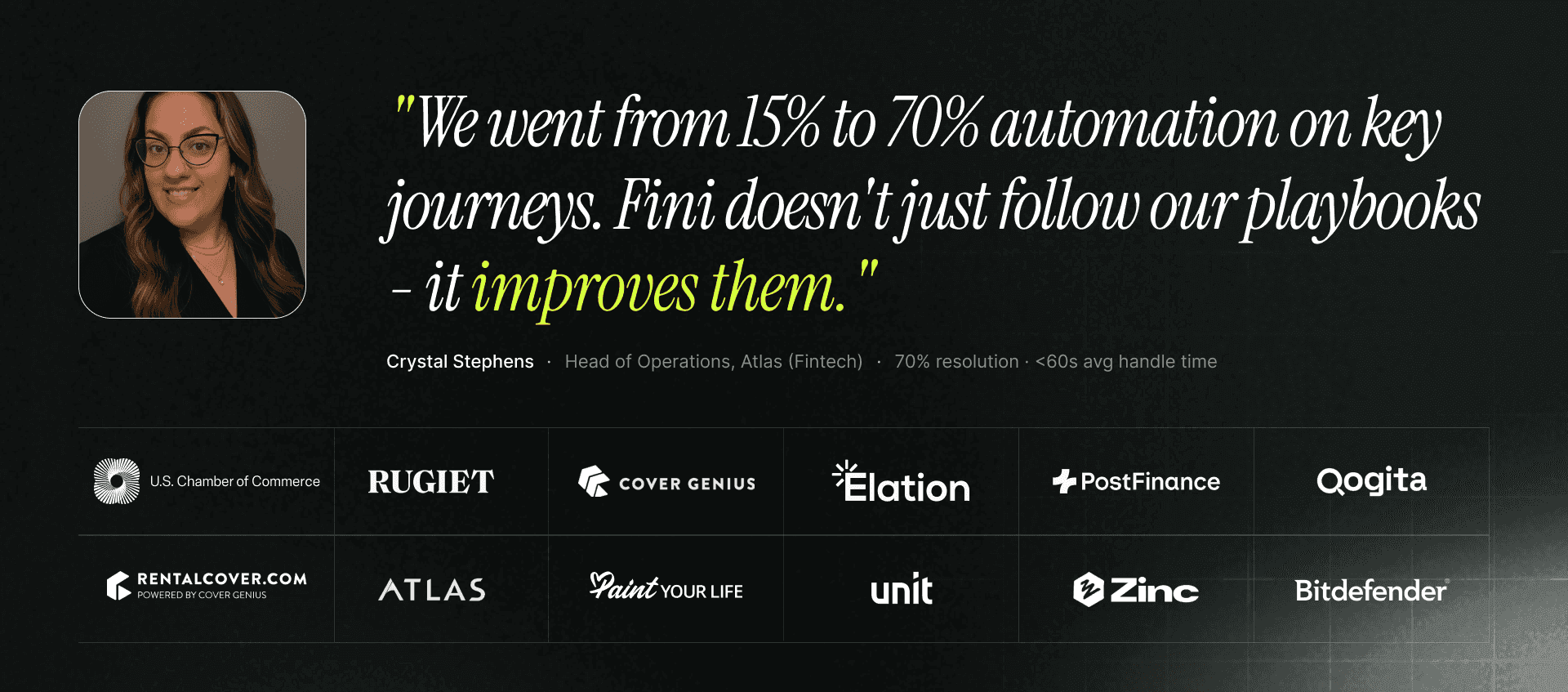
Fini. Atlas, a fintech operator, moved its support from 15% to 70-80% automation after deploying Fini, with answers returning in under sixty seconds. Atlas is one customer inside the 3 million-plus monthly resolutions Fini runs across fintech and healthcare, the verticals where declined transactions, blocked cards, and denied claims make precision non-negotiable. If you know a support team that needs this, Fini’s referral program rewards the introduction.
What Decagon users report. Decagon’s customers tend to praise its rollout support and its results at enterprise scale. Rippling’s support operations manager credited its “commitment, responsiveness, and on-the-ground engineering support” as crucial to a successful rollout, and Substack reported it “shortened our time-to-resolution rate” while holding a high CSAT and deflection rate, both in Decagon’s published customer references. Decagon’s case studies report strong deflection at scale, including a 70% combined chat-and-voice resolution rate at Chime and 90% at Substack.
The watch-outs in third-party reviews are consistent. A typical rollout runs roughly six to twelve weeks and expects dedicated engineering on the customer side despite the low-code positioning. Pricing stays behind a sales call as a six-figure custom contract, with no free trial or self-serve evaluation. Decagon’s G2 ticket-resolution sub-score sits at 7.9 out of 10, and some reviewers note it is hard to see why the agent made a particular decision. None of this is disqualifying for an enterprise buyer with a budget and an engineering team; it is the cost of the authoring control Decagon is built around.
The full side-by-side
Here is the full commercial picture in one view, after the detail above. Where a cell reads “Not publicly stated,” Decagon does not publish the figure. Product capabilities are in the table above; this one collapses pricing and compliance to a single row each.
Category | Fini | Decagon |
|---|---|---|
Pricing model | $0.49 per resolution, published | Custom enterprise, ~$386,000 median (Vendr) |
Outcome guarantee | 90-Day Money-Back Guarantee: 90% in 90 days or $0 | None published |
Go-live | Live in 14 days, fully autonomous in 30 (Day 1 / 14 / 30) | Not publicly stated |
Named logos | Atlas, Unit, Postfinance, Found, plus healthcare | Avis Budget Group, Block, Deutsche Telekom |
Monthly resolutions | 3M+ | Not publicly stated |
Backing | Y Combinator, Matrix Partners | Series D (January 2026) |
Compliance posture | SOC 2, ISO 27001, HIPAA, GDPR, CCPA | SOC 2, ISO 27001, HIPAA, GDPR, CCPA, EU AI Act |
Which should you choose?
If you came here weighing Decagon alternatives, the decision usually comes down to how you want to pay and how much of the agent you want to own. The fastest read is by use case, and the lists below add the detail.
Fini | Decagon | |
|---|---|---|
Best for | Teams that want published per-resolution pricing, a go-live in 14 days (fully autonomous in 30), and native action coverage in regulated fintech and healthcare | Enterprises that want to author and version-control every workflow and have budget for a custom contract |
Less ideal for | Teams that need to hand-author and version every workflow step in-house | Teams that need budgetable pricing before a sales call or a go-live in 14 days |
Choose Fini if you want:
A published per-resolution rate you can budget before a sales call
An outcome guarantee: 90% resolution in 90 days or you pay $0
Voice, chat, and email autonomy on a 30-day timeline
Native action coverage and a fit for regulated fintech and healthcare support
Choose Decagon if you want:
Natural-language workflow authoring your operations team owns
A single intelligence layer across every channel
A high-profile enterprise roster as a reference base
And a custom six-figure contract fits the budget
Compliance
Both vendors clear the same core bar: SOC 2 Type II, ISO 27001, HIPAA, GDPR, and CCPA, named on their trust portals with audit reports behind an access request. Decagon additionally names EU AI Act alignment; Fini contracts HIPAA-compliant and BAA-eligible coverage for healthcare deployments. The table below shows only certifications named in publicly accessible text on each trust portal.
Certification | Fini | Decagon |
|---|---|---|
SOC 2 Type II | ✓ | ✓ |
ISO 27001 | ✓ | ✓ (2022) |
HIPAA | ✓ (HIPAA-compliant, BAA-eligible) | ✓ |
GDPR | ✓ | ✓ |
CCPA | ✓ | ✓ |
EU AI Act | ✓ | ✓ |
Compliance is not the deciding factor between these two. Both are serious enterprise vendors that clear the regulated-industry bar. The decision rests on the pricing model, the 90-Day Money-Back Guarantee, and the 30-day path to autonomy.
Ready to compare on your own data?
Book a 30-minute demo. Fini connects to your helpdesk and knowledge base on the call and shows resolution numbers on your tickets, not a sandbox. Book a demo.
Read the architectural argument in full: Why Sierra Is the Wrong Approach to Agentic Customer Support.
Where is Decagon’s pricing published?
Decagon does not publish a pricing page. The only public pricing signal is third-party data from Vendr, which lists the median annual contract at $386,000 with a range of $95,000 to $590,000. Buyers should expect a custom enterprise contract motion. Fini publishes its rate openly: $0.49 per resolution, billed per resolved ticket whether that is a refund, an account update, or KYC automation in fintech.
Are Fini and Decagon both compliant for regulated industries?
Yes. Both maintain trust portals that name their certifications. Fini publishes SOC 2 Type II, ISO 27001, and GDPR, with HIPAA-compliant, BAA-eligible contracting and CCPA available under agreement. Decagon publishes SOC 2 Type II, ISO 27001:2022, HIPAA, GDPR, CCPA, and EU AI Act. Neither has a material compliance gap, and for buyers with data residency requirements both can scope storage region under contract, so the decision comes down to pricing and deployment timeline rather than certifications.
How long does each platform take to go live?
Fini publishes a three-stage rollout: Day 1 knowledge agent live, Day 14 agentic workflows on billing and CRM, Day 30 full voice, chat, and email autonomy. The speed comes from structured execution rather than open-ended retrieval, so the agent resolves reliably from day one. Decagon does not publish an implementation timeline. Customer case studies describe multi-week rollouts driven by the Agent Operating Procedure build for each deployment.
Can I migrate from Decagon to Fini?
Yes. Fini ingests the same knowledge sources Decagon connects to, including Zendesk, Intercom, Salesforce, Notion, Confluence, and Guru, and rebuilds the resolution graph from those sources. Atlas, a fintech customer, moved from 15% to 70-80% automation after switching, and most migrations run in shadow mode for two weeks before live cutover so the two systems can be compared on the same traffic.
Which platform has broader action coverage?
Fini connects natively to the helpdesk, CRM, billing, claims, and EHR systems behind a ticket, so it can automate payments and refunds, update accounts, and route prescriptions as configured defaults. Decagon reaches systems of record through its own integration layer, with connections defined during each Agent Operating Procedure build. Both act on backend systems; Fini ships action coverage as a default, while Decagon scopes it per deployment.
Do Fini and Decagon support voice and multiple languages?
Both serve voice, chat, and email from a single system. Fini publishes its reach at 130+ languages with speech recognition and text-to-speech across voice and chat, and a first response in about five seconds. Decagon serves the same channel set from its single intelligence layer but does not publish a language count, so global teams should confirm coverage during evaluation.