An investor who cannot withdraw funds does not care which vendor logo sits behind the chat window. They care whether the next message solves the problem or puts them in a queue. Fini is an AI agent for customer support, backed by Y Combinator and Matrix Partners, priced starting from $0.49 per resolution. Intercom Fin is the AI agent from the company formerly called Intercom, which renamed itself Fin in May 2026.
The tickets that decide this are the ones with no article behind them
Most evaluations of these two platforms open with a feature grid. Skip it. Both agents resolve the question that has a help centre article sitting behind it, and both do it well. The comparison is decided somewhere else: on the tickets where the right answer depends on the customer’s account, their plan, their current state, and what your policy says about that exact combination.
Three questions follow from that, and they are the spine of this comparison:
What happens on a question that depends on the customer’s account? One architecture retrieves the policy, the other executes it.
Who writes the knowledge after launch? This is where the running cost of an AI agent actually lives.
Can you prove where an answer came from? In a regulated review, one source beats a good answer.
Intercom Fin vs Fini at a glance
Fini | Intercom Fin | |
|---|---|---|
What you buy | Starts from $0.49 per resolution | A meter that bills $0.99 per outcome |
Entry point | $0.49 per resolution, no minimum | 50 outcomes per month minimum, about $50 |
Account-dependent answers | Policy executed against live account state | Retrieval, plus Procedures your team authors |
Answer attribution | Traces to exactly one source article | Not published |
Per-seat fees | None | None standalone, $29 to $132 per seat on the Intercom helpdesk |
Knowledge upkeep | Articles written and filed from resolved tickets | Recommendations surfaced for your team to apply |
Ownership | Independent, Y Combinator and Matrix Partners | Salesforce acquisition signed June 2026, not yet closed |
What is Fini?
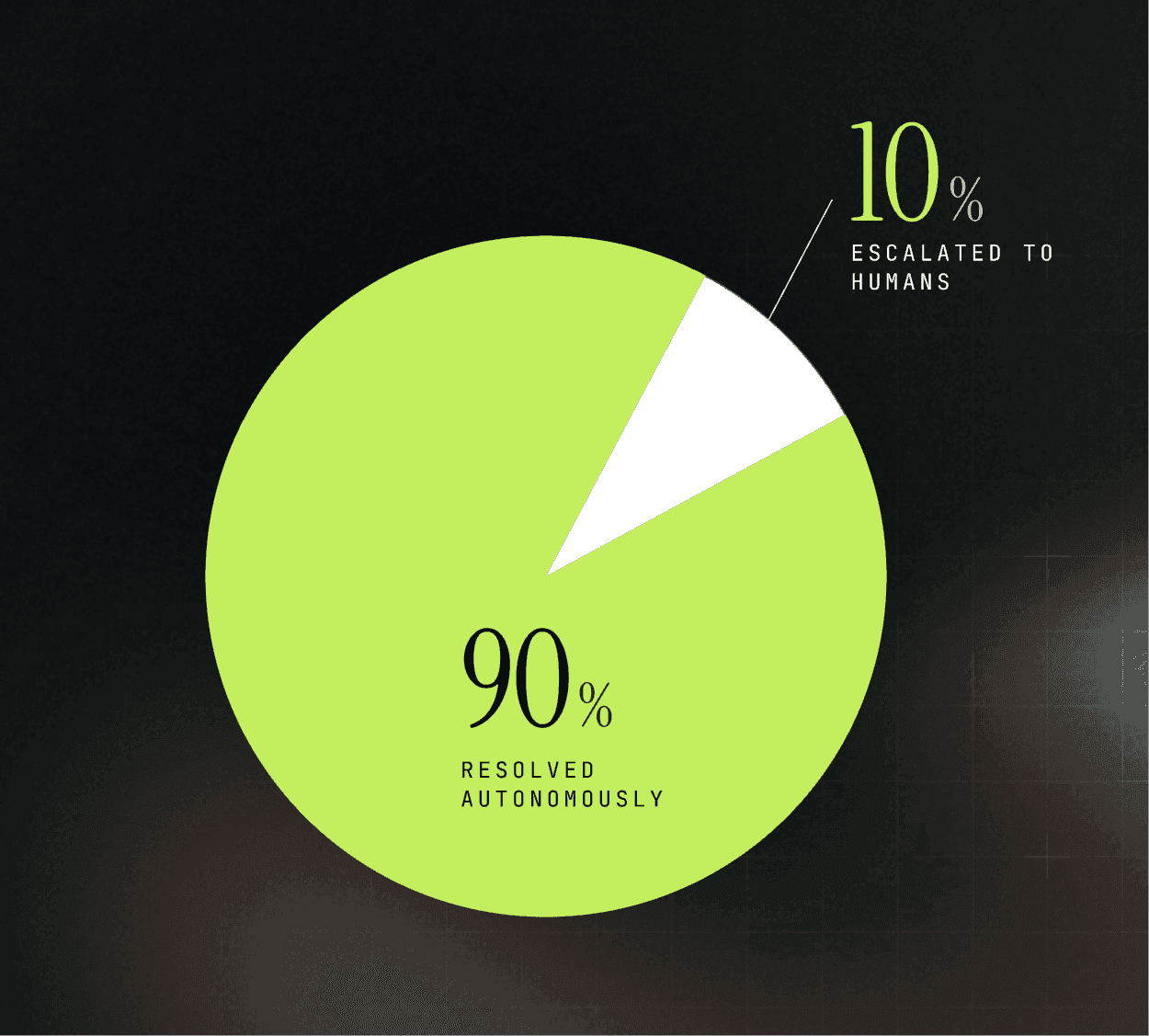
Fini is an AI agent for customer support that resolves tickets end to end across chat, email, and voice in 130+ languages. It reaches a 90% resolution rate at 99% accuracy with a roughly 5 second first response, and runs more than 3 million monthly resolutions across fintech and healthcare teams. Pricing starts from $0.49 per resolution, with no per-seat fees. Fini connects to the helpdesk, CRM, billing system, and claims or records system you already run, takes actions inside them, and writes the decision audit trail back.
What is Intercom Fin?
Fin is the AI agent built by the company that spent fifteen years as Intercom and renamed itself Fin in May 2026, a rebrand around the agent rather than the helpdesk. It runs standalone on Salesforce, HubSpot, Zendesk, Freshworks, Dixa, Front, Zoho, Sprinklr, and Gorgias, or inside the Intercom helpdesk. It runs on Apex 1.0 and Apex Flash, in-house models trained on customer service interactions, which the company reports deliver a 2.8% higher resolution rate and a 65% reduction in hallucinations against Sonnet 4.6. It publishes a 76% average resolution rate across 12,000+ customers, rising about 1% a month, at 2 million weekly resolutions. Named customers include Anthropic, Lightspeed, Rocket Money, Clay, and Gamma.
On 15 June 2026, Salesforce signed a definitive agreement to acquire Fin for approximately $3.6 billion, with the close expected in Salesforce’s fiscal fourth quarter of 2027. The deal is signed, not closed.
One question, two architectures
A customer writes: “My transfer is still pending after three days. Your site says transfers take one business day.”
Both agents find the same help article, because there is one and it is correct: domestic transfers settle in one business day. A retrieval-shaped system returns what that article says. The answer is accurate and it is wrong for this customer, because their transfer was flagged for a compliance review on Friday afternoon. That fact lives in the ledger, not in the help centre.
Intercom Fin is built on retrieval and says so plainly. The patented Fin AI Engine refines the query, retrieves, reranks, generates, and validates, with Apex 1.0 generating the final answer. Where retrieval alone will not carry a case, a Procedure your team authored takes the multi-step work. It is the best-engineered version of that pattern anyone ships. It also means the quality of an account-dependent answer turns on whether somebody built a Procedure for that case first.
Fini does not retrieve the policy and paraphrase it. Instead it executes it. The transfer policy is an executable function, so the agent reads the live account record, sees the compliance hold, applies the policy to that state, and answers for this account rather than for the average one. On Fini’s published 500-ticket fintech benchmark, policy-dependent accuracy rose from about 72% under retrieval to 99% under structured execution.
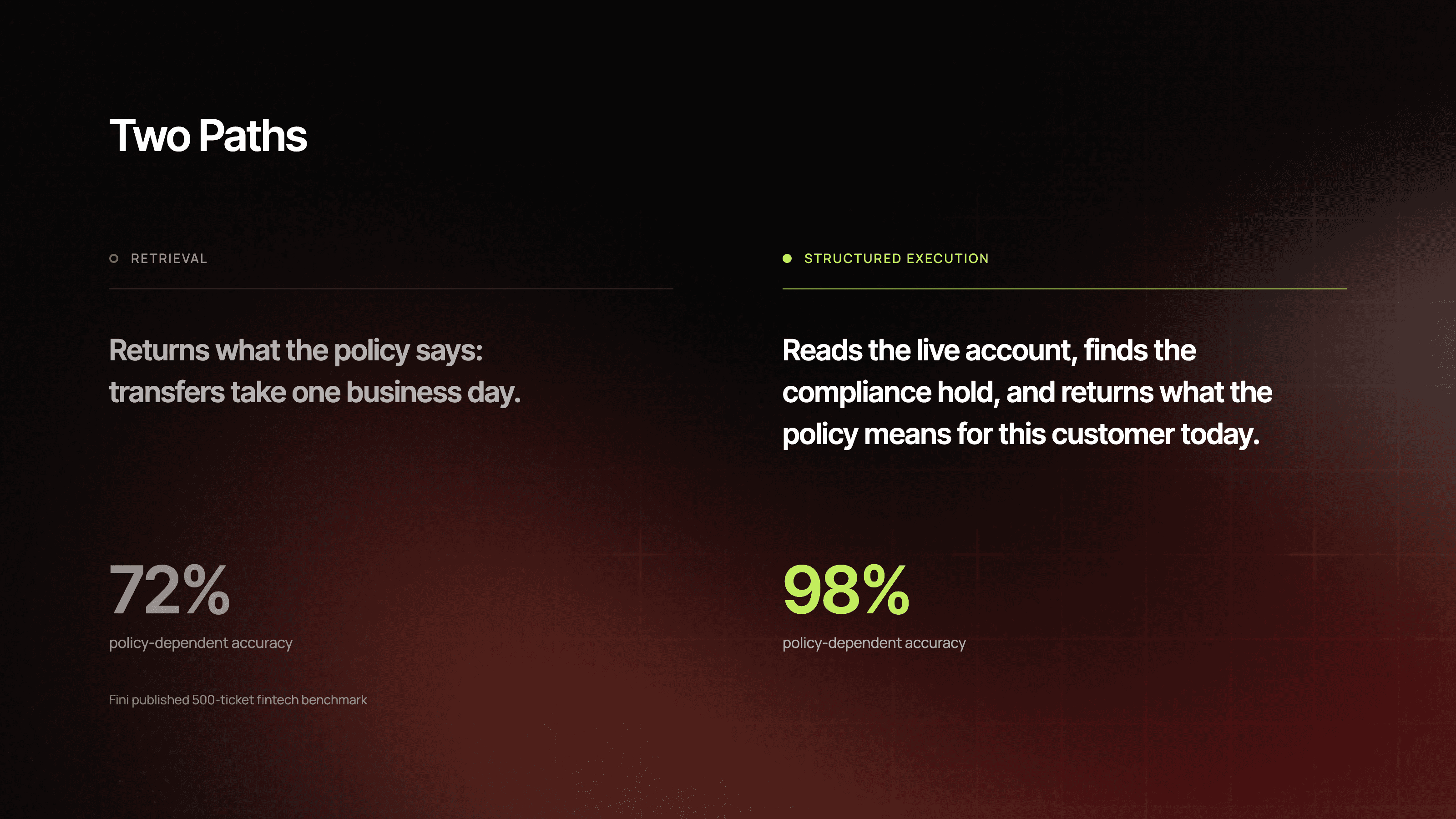
This gap only opens on tickets carrying account state, which in fintech, healthcare, and insurance is most of the expensive ones. On a general knowledge question, both agents answer well, and any comparison claiming otherwise is selling.
Intercom Fin pricing in 2026
Fin is the most transparently priced autonomous agent in this category at a published $0.99 per resolved outcome, with a 50 per month minimum. That transparency is genuinely useful. The cost that surprises buyers is what sits around it, because Fin is not sold standalone and the helpdesk seats underneath it are priced separately.
Line item | Published price |
|---|---|
Fin outcome | $0.99 per resolution, 50 per month minimum |
Intercom helpdesk seats | $29 Essential, $85 Advanced, $132 Expert per seat per month |
Copilot agent assist | $29 per agent per month billed annually, $35 monthly |
Standalone option | None, Fin requires the Intercom helpdesk |
See Fini’s full pricing breakdown for plan details, add-ons, and a resolution calculator.
Intercom Fin review: where the maths turns
At $0.99 per outcome the model is excellent at low volume and gets expensive as you scale, because every resolution is metered with nothing included. A team at 20,000 monthly resolutions pays roughly $19,800 in Fin outcomes alone before a single seat. Against Fini's $0.49-per-resolution starting rate, Fin is more expensive at every volume, standalone. Run your own volume through both before you commit, and remember that the seat cost is a floor you pay whether or not Fin resolves anything.
What you actually pay for
Fini prices one thing: $0.49 per resolution, covering the platform and implementation. Fin prices one thing too, an outcome at $0.99, then adds meters around it depending on how you deploy.
Fini | Intercom Fin | |
|---|---|---|
Price | $0.49 per resolution, starting rate | None standalone, seats on the Intercom helpdesk |
Included resolutions | 2,000 Growth, 8,000 Scale, unused allowance rolls forward one month | None, every outcome is metered |
Rate for additional resolutions | N/A, starts from $0.49 | $0.99 per outcome, 50 per month minimum |
Per-seat fees | None | $29 Essential, $85 Advanced, $132 Expert on the Intercom helpdesk |
Agent assist | Included | Copilot, $29 per agent per month billed annually, $35 monthly |
Analytics and quality tooling | Included | Pro add-on from $99 per month |
Sales qualification outcomes | Not a separate charge | $9.99 each |
Implementation | Included in the rate | No setup, integration, or platform fees |
Escalation to a human | Free | Not charged |
Read those two columns as different shapes rather than different sizes. Fin’s shape is pay-per-unit with almost no floor, so a small team starts at about $50 a month and a large one scales linearly forever. Fini's shape is a per-resolution rate with no minimum, so cost scales directly with volume from the first resolution. Fini's $0.49 per resolution is lower than Fin's $0.99 per outcome at every volume shown here.
The shapes no longer cross. On published rates, standalone and without seats on either side, Fini is cheaper than Fin at every volume, and helpdesk seats only widen that gap further. Run it against your own volume before anyone quotes you a rate.
Two commitments sit outside the arithmetic. Fini’s custom pricing adds a 90-day pilot on live traffic with resolution, CSAT, and accuracy targets agreed in writing, a switching-cost credit capped at $50,000, and the 90-Day Money-Back Guarantee: miss the agreed resolution target and the fees are waived. Fin offers a 14-day trial with no credit card and unlimited outcomes, plus the Fin Million Dollar Guarantee for new customers. Both are real. The trial is faster to start; the pilot is measured on your own live traffic.
How Fini and Intercom Fin differ
Three differences move deals once the architecture question is settled.
1. What counts as a billable outcome
This is usually the section where a comparison finds an unpleasant surprise. Here it does not, and saying so is more useful than manufacturing a gap.
Fini bills when the issue is solved with no human involved, and escalations to your team are free. Fin bills $0.99 when no further help is requested after its last answer, when it completes a Procedure configured to end in a handoff, or when it disqualifies a prospect. Fin does not charge for escalations, failed Procedures, conversations where the customer explicitly asks for a human, spam-filtered conversations, or abandoned conversations with no answer given. Both vendors charge once per conversation regardless of how many questions it contains.
Two clauses still deserve a line in the contract review. A Procedure that ends in a deliberate handoff to a human is billable at $0.99 even though a person finishes the work, so the count of things you pay for and the count of things the agent finished alone are not identical. And qualification outcomes are $9.99, ten times the resolution rate, which is easy to miss in a forecast built from the headline number. If you track your escalation rate closely, model both definitions against a month of your own tickets.
2. Who maintains the knowledge after launch
Every AI support deployment degrades the same way. The help centre drifts, articles start contradicting each other, confidence drops, and the support team quietly becomes a documentation team. What separates these two platforms is who does that work, and it is covered in depth in the feature comparison below.
In short: Fin surfaces the problem and recommends the fix, then your team writes and validates it using a testing suite built for exactly that. Fini writes the article, files it, and flags the conflicts itself.
3. Who owns the roadmap
Fini is independent, backed by Y Combinator and Matrix Partners.
Fin is being acquired. Salesforce signed a definitive agreement on 15 June 2026 for approximately $3.6 billion, with the close expected in Salesforce’s fiscal fourth quarter of 2027, subject to regulatory approval. Salesforce has said the intent is to bring Fin’s agent capability to Agentforce and its own customers.
That is a fact and it cuts both ways. A Salesforce-owned Fin arrives with more engineering behind it and deeper native reach into Salesforce data. It also means a product roadmap, a support model, and a price list set by a new owner after your contract is signed. If you are signing a multi-year term before the deal closes, ask for price protection and roadmap commitments in writing. If you are already standardised on Salesforce, the same fact reads as an advantage.
Feature by feature
Three capabilities separate the platforms under the hood: how each one reasons over your data, how each one keeps its knowledge current, and how each one is controlled when it is wrong.
Architecture and reasoning
Fini. Beyond the policy-execution difference above, the design point is that an action is confirmed rather than described. Fini calls the backend API, so “your refund has been processed” is a statement about something that happened, not a sentence the model produced. The model handles intent recognition and natural language generation, never the policy decision or the calculation, which is why the failure mode is an escalation rather than a confident wrong answer.
Intercom Fin. Fin has the strongest model story in this comparison. It runs Apex 1.0 and Apex Flash, its own post-trained models rather than a general-purpose frontier model, trained on customer service interactions and reported to deliver a 2.8% higher resolution rate, a 0.6 second faster time to first token, and 65% fewer hallucinations than Sonnet 4.6. No other vendor here owns its model layer.
Verdict: Fini ✓ executes policy as code and confirms actions against the system of record, with a published accuracy benchmark for it. Fin ✓ ships proprietary models with published performance deltas, but ✗ account-dependent reasoning depends on a Procedure being authored for the case.
Knowledge management
Fini’s Knowledge Atlas is a self-maintaining knowledge layer, shipped and generally available. When a human resolves an escalation, the Atlas extracts the solution, writes a formatted help article, files it in the right branch of a category tree, and makes it searchable immediately. It flags duplicates, contradictory instructions, and outdated policies on a reconciliation dashboard. It routes queries by intent rather than keyword, so “why won’t my payment go through”, “transaction failed at checkout” and “card not working” all reach the same article. Because the knowledge base is tree-structured, every answer traces back to exactly one authoritative article rather than a blend of several. Fini reports AI resolution moving from 50-60% to 85-90% and knowledge upkeep falling from about 20 hours a week to two.
Fin’s approach is a flywheel the customer operates, and it is well built. Fin learns from every interaction and turns insights into recommendations and improvements, surfacing where the gaps are. Its observability suite monitors quality and alerts on what you configure, and its testing suite runs simulations, regression tests, and audience testing so changes are validated before they go live. Personio’s CX AI Operations Lead describes exactly that value: an agent that shows the team where the problems are and recommends improvements. What Fin does not do is write and file the article itself, and Fin publishes no before-and-after numbers for knowledge upkeep hours.
Verdict: Fini ✓ writes, files, and reconciles articles automatically, with published upkeep numbers, and ✓ traces every answer to one source. Fin ✓ has the stronger testing and observability tooling for a team that wants to own the loop, but ✗ leaves the writing and validation with your team.
Guardrails and escalation control
Fini. Fini pairs configurable confidence thresholds with mandatory human review on sensitive categories, so account closure and fraud claims escalate by rule rather than by model judgment. It exports step-level traces, runs a guardrail evaluation pass over agent behaviour, does not train on customer data, and keeps every answer attributable to a single source article. As Fini’s co-founder Deepak Singla puts it, “most AI tools blend information from multiple articles, creating answers that don’t match any single source. That’s a compliance violation waiting to happen.”
Intercom Fin. Fin gives admins deep control through Guidance, Categories, and Procedures, and its testing suite lets a team check the effect of a change before it reaches customers. Its models carry what the company describes as checks and balances to keep answers accurate and on-intent. Its published control surface is oriented around configuration and observation rather than a rules layer that always overrides the model on named categories, and it publishes no single-source attribution guarantee.
Verdict: Fini ✓ rule-level escalation on sensitive categories and single-source attribution. Fin ✓ pre-production simulation and regression testing, which Fini does not publish an equivalent for, but ✗ no published attribution guarantee.
What Fini customers report
Wefunder runs equity crowdfunding, which means its support queue carries investor money and founder fundraises, and its Success team was fielding more than 1,000 emails a week on Front with response times averaging seven hours. The team topped out at roughly 600 emails a week. After Fini, average response time fell to 15 minutes, the team handled twice the previous volume without adding headcount, and by the second week Fini was sending more than 80% of outbound messages.
The pattern repeats outside fintech. Qogita, a health and beauty wholesale marketplace running support on HubSpot, reached 88% ticket resolution with 50% of tickets handled end to end, a 121% improvement in SLA, and email and form response times down to 10 minutes.
Both sit inside the more than 3 million resolutions Fini runs every month.
Capabilities side by side
Product capabilities only. The commercial picture is above and the compliance detail sits below.
Capability | Fini | Intercom Fin |
|---|---|---|
Runs on top of an existing helpdesk | ✓ | ✓ |
Native helpdesk, inbox, and ticketing of its own | Uses yours | ✓ |
Chat, email, and voice on one reasoning layer | ✓ | ✓ |
Social and messaging channels, WhatsApp, SMS, Instagram, Slack | ✓ | ✓ |
Policy executed as code against live account state | ✓ | ✗, retrieval plus authored Procedures |
Takes actions in CRM, billing, and records systems | ✓ | ✓ |
Self-writing knowledge base, generally available | ✓ | ✗, recommendations only |
Single-source attribution per answer | ✓ | Not published |
Rule-level mandatory escalation on named categories | ✓ | Not published |
Exportable step-level traces | ✓ | Not published |
Published resolution rate | 90% | 76% average across 12,000+ customers |
Languages | 130+ | exact count not published |
Where Intercom Fin is stronger
Fin is the category’s most visible product for good reasons, and a comparison that pretends otherwise is not useful to a buyer.
It owns its model layer. Apex 1.0 and Apex Flash are post-trained in house with published performance deltas. No other vendor in this comparison publishes that.
You can start today without talking to anyone. A 14-day trial with no credit card and unlimited outcomes, a $0.99 rate anyone can read, and a 50-outcome floor mean a small team can be live this week. Early-stage startups get 93% off Intercom and a year of Fin.
Channel breadth. Voice, chat, email, Slack, WhatsApp, SMS, Instagram, Facebook Messenger, and an API, all native.
AI-specific certification. AIUC-1 are AI management and assurance standards Fini does not hold, and for a security review that asks specifically about AI governance, they answer the question directly.
Compliance
Both vendors clear the bar most regulated teams set, and Fin carries the longer list of AI-specific certifications.
Certification or capability | Fini | Intercom Fin |
|---|---|---|
SOC 2 | ✓ Type II | ✓ |
ISO 27001 | ✓ | ✓ |
ISO 42001, AI management | ✗ | ✓ |
AIUC-1, AI assurance | ✗ | ✓ |
ISO 27701, privacy | ✗ | ✓ |
HIPAA | ✓, included in the plan | ✓, and HIPAA support is a feature of the Expert tier at $132 per seat on the Intercom helpdesk |
BAA eligible | ✓ | Not stated on the public product pages |
GDPR and CCPA | ✓ | Not stated on the public product pages |
Data residency | ✓, on Enterprise | ✓, US, EU, or Australia |
SSO, 2FA, SCIM | ✓ | ✓, SSO is an Expert-tier feature on the Intercom helpdesk |
Two things are worth reading closely. Fin’s certification list is broader on AI-specific standards, and if your security review asks about ISO 42001 the answer is Fin. What Fin gates behind a plan tier is different: on the Intercom helpdesk, HIPAA support and SSO are features of the Expert tier at $132 per seat per month, while Fini’s SOC 2 Type II audit, HIPAA-compliant handling, and BAA eligibility come with the plan at every level. For a 40-person support team, that gate alone is the difference between $85 and $132 per seat, about $22,560 a year.
Both vendors run a trust portal that requires access rather than publishing every artefact openly, so confirm GDPR terms, CCPA terms, BAA availability, and the model-training position for each in writing during security review rather than from a marketing page.
Where Fini is stronger
It executes the policy instead of retrieving it. On account-dependent questions the agent reads live state and applies the rule to it, which is the 72% to 98% difference on Fini’s published policy-query benchmark.
Knowledge that maintains itself. The Atlas writes articles from resolved tickets, reconciles conflicts, and attributes every answer to one source, against a flywheel that recommends and a team that writes.
Rule-level control on sensitive categories. Account closure and fraud claims escalate by rule, not by model confidence, with exportable step-level traces behind them.
Compliance without a tier gate. HIPAA-compliant, BAA-eligible handling comes with the plan rather than the top seat tier.
An independent roadmap. No pending change of ownership to price into a multi-year term.
A lower rate at every volume. Fini's $0.49 starting rate per resolution costs less than Fin's $0.99 per outcome regardless of scale.
Which should you choose?
Choose Fini if you want:
Correct answers on tickets that turn on the customer’s account state, not just on what the policy says
Knowledge that maintains itself rather than a documentation backlog that grows with ticket volume
Rule-level mandatory escalation and single-source attribution for regulated review
HIPAA-compliant, BAA-eligible handling included rather than gated to a top seat tier
A vendor whose roadmap and price list are not subject to a pending acquisition
A lower per-resolution rate at any volume, standalone or with Intercom seats added
Choose Intercom Fin if you want:
To start this week on a self-serve trial without a procurement cycle
The widest native channel list, including Slack, WhatsApp, SMS, and Instagram
A vendor that builds and publishes its own models, with AIUC-1 on the certification list
A full helpdesk and an AI agent from the same vendor, or a deeper future tie into Salesforce
Ready to compare on your own data?
Bring your 200 hardest tickets. Fini connects to your helpdesk and knowledge base on the call and shows resolution numbers on your tickets, not a sandbox. Talk to the team.
Does Fini replace Intercom?
No, and neither does Fin. Both products run as an AI agent layer on the helpdesk you already use. Fini connects to your existing helpdesk, CRM, billing system, and records system, takes actions inside them, and writes the audit trail back, so tickets, macros, views, and SLAs stay where they are. Wefunder runs Fini on Front, and Qogita runs it on HubSpot. Fin runs standalone on Salesforce, HubSpot, Zendesk, Freshworks, Dixa, Front, Zoho, Sprinklr, and Gorgias, or inside the Intercom helpdesk, where seat licences apply on top of outcomes. The practical difference is not helpdesk independence, which both offer, but what each one costs at your volume. The same pattern applies to running an agent on Front.
How much does Intercom Fin cost per resolution in 2026?
$0.99 per outcome, published, with a 50-outcome monthly minimum and no seat costs when Fin runs on your existing helpdesk. Qualification outcomes are $9.99 each. On the Intercom helpdesk, add seats at $29, $85, or $132 per seat per month, Copilot at $29 per agent per month billed annually, and the Pro analytics add-on from $99 per month. Fini's pricing starts from $0.49 per resolution. At that rate against Fin's $0.99 per outcome, Fini is cheaper than Fin at every volume, standalone or with Intercom seats added. Understanding the difference between deflection and resolution matters before comparing any two rates.
What counts as a billable Fin outcome?
Fin charges $0.99 when no further help is requested after its last answer, when it completes a Procedure configured to end in a handoff to a human or a workflow, or when it disqualifies a prospect, and $9.99 when it qualifies one. It charges once per conversation regardless of how many actions it takes, and does not charge for escalations, failed Procedures, conversations where the customer explicitly asks for a human, spam, or abandoned conversations with no answer given. Fini bills when the issue is solved with no human involved, and escalations are free. These are two of the cleaner definitions in the category and they are close to each other, with one gap worth modelling: a Procedure that ends in a deliberate human handoff is billable on Fin. Measuring first contact resolution on your current traffic gives you the baseline for that check.
Which platform requires less knowledge base maintenance?
Fini. Its Knowledge Atlas writes a formatted article whenever a human resolves an escalation, files it in a category tree, flags duplicates and outdated policies on a reconciliation dashboard, and traces every answer back to one authoritative source. Fini reports resolution moving from 50-60% to 85-90% and upkeep falling from around 20 hours a week to two. Fin learns from every interaction and turns insights into recommendations, showing your team where the gaps are, then gives them simulations, regression tests, and audience testing to validate the fix before it goes live. That is strong tooling for a team that wants to own the loop, and it is a different model from one that writes the article itself. Fin publishes no upkeep-hours figure. If you are starting from an existing help centre, building a knowledge base from your Intercom tickets is the first step either way.
Are Fini and Intercom Fin both compliant for regulated industries?
Both clear the bar most regulated teams set, and Fin carries the longer certification list. Fini holds SOC 2 Type II and ISO 27001, handles data on a HIPAA-compliant, BAA-eligible basis, covers GDPR and CCPA, and offers data residency on Enterprise. Fin names SOC 2, ISO 27001, AIUC-1, ISO 27701, and HIPAA, supports SSO with Okta, Azure AD, and OneLogin plus 2FA, SCIM, and IP restrictions, and hosts data in the US, EU, or Australia. and AIUC-1 are AI-specific standards Fini does not hold. The difference that shows up on an invoice is packaging: on the Intercom helpdesk, HIPAA support and SSO are Expert-tier features at $132 per seat per month, while Fini’s come with the plan at every level.
What does the Salesforce acquisition mean for Intercom Fin customers?
Salesforce signed a definitive agreement to acquire Fin on 15 June 2026 for approximately $3.6 billion, with the close expected in Salesforce’s fiscal fourth quarter of 2027, subject to regulatory approval. As of August 2026 the deal is signed and not closed, and Fin continues to sell, support, and ship as an independent product. For buyers the practical effect is contractual rather than technical: a roadmap, a support model, and a price list set by a new owner after signature. If you are committing to a multi-year term before the close, ask for price protection and roadmap commitments in writing. Teams already standardised on Salesforce read the same fact as an advantage, since the stated intent is to bring Fin’s capability into Agentforce. Fini is independent, backed by Y Combinator and Matrix Partners. If you run support across many markets, compare the two on multilingual coverage as well.
Our Intercom Fin resolution rate is stuck around 50%. What should we look at instead?
A resolution rate stuck in the 50-60% range usually traces back to two things: what counts as a billable outcome, and how the knowledge base gets maintained. Fin bills per outcome even when a Procedure ends in a deliberate human handoff, which can flatter the resolution number without moving it. Fini customers starting from a similar 50-60% baseline report moving to 85-90% once Knowledge Atlas takes over article writing and gap detection (see "Which platform requires less knowledge base maintenance?" above). At a starting rate of $0.49 per resolution versus Fin's $0.99 per outcome, running a side-by-side pilot on your live ticket volume costs less than a month of your current Fin usage at 50 outcomes.