Case Studies
Last Updated:

Leonardo Maestri
In this article
How Wefunder cut response times from 7 hours to 15 minutes while handling 2x the email volume, without adding headcount.
In short: Wefunder, the equity crowdfunding platform, connected Fini to its Front help desk to handle investor and founder support, including password resets, 2FA fixes and withdrawal questions. In the first two weeks live, Fini answered roughly 2,000 emails, took over 80% of outbound messages, and cut average response time from more than 7 hours to minutes.
Snapshot
Company: Wefunder, equity crowdfunding platform connecting founders and investors
Challenge: 1k+ support emails per week, 7 hour average response time, no capacity for higher-impact work
Avg response time after Fini: 15 mins (down from 7 hours)
Volume handled: 2x previous capacity in the first two weeks
“Fini looks complex and complete. Not complex in a way that it’s difficult to use, but complex in a way that you can tell they’ve thought about all the different things that need to be considered by an AI agents built for fintech.” - Kai
The Company
Wefunder is an equity crowdfunding platform that lets anyone invest in startups. They connect founders raising capital with everyday investors who believe in them.
Their Success team supports both sides of that equation, founders navigating raises and investors managing their portfolios. Every interaction carries weight. As Kai Moon, who leads the Success team, put it: the goal is to give every user an “11-star experience”, a bar borrowed from Airbnb’s philosophy of going far beyond what’s expected.
The Problem: Volume Without Capacity
Wefunder’s Success team was receiving 1,000+ emails per week. Questions ranged from routine how-tos to complex account actions: password resets, email unsubscribes, 2FA fixes, withdrawal inquiries. The kind of work that demands accuracy but consumes disproportionate time. The kind of work that’s necessary but repetitive.
Response times averaged around 7 hours. The team was maxing out at roughly 600 emails per week. There was zero capacity left for higher-value work: improving processes, building better experiences, or tackling the complex cases that actually needed a human.
“Every investor and founder deserves prompt, reliable support. But with the volume of incoming messages, we couldn’t do that dependably.”, Kai Moon, Success Team Lead
The team faced a binary choice: hire more people, or find a smarter way to handle the routine volume without adding headcount.
The Solution: What did Fini do?
Before Fini, Wefunder only had email support. If an investor had a question mid-investment or a founder needed help with their campaign, they’d send an email and wait, often ~7 hours for a reply.
Fini changed that on two fronts.
First, Fini plugged an AI agent into Front, Wefunder’s help desk. It reads incoming emails, pulls answers from Wefunder’s knowledge base, and either handles it or passes it to the team. Most routine stuff never needs a human.
Second, we set up live chat for founders through the Fini widget: giving Wefunder real-time support for the first time. Before this, there was no way for a user to get an instant answer. Now founders with critical questions about their withdrawals can get help in seconds, right where they are. Investors are next.
And critically, Fini doesn’t just answer questions: it takes actions. Password resets, marketing unsubscribes, 2FA fixes, withdrawal-specific responses. Instead of telling users what to do, it actually does it for them.
And Wefunder’s team stays in the loop the whole time. Escalation rules, keyword triggers, tone controls, and a shadow-testing mode meant they could see exactly how the agent would respond before it ever talked to a real user.
Why Fini
Kai joined Wefunder in September. By October, it was clear they needed responsive but sophisticated AI agent.
“I chose Fini because of its solid reputation, capacity for complexity, and history of working with fintech startups which need complete accuracy and strong compliance guardrails built into the product.” - Kai
They evaluated several AI support platforms and sat through demos with competitors. Fini stood out on four dimensions:
Depth of guardrails and escalation logic. Fini’s agent instructions, keyword handling, and content structure showed a level of thought that competitors hadn’t reached.
Maturity of the knowledge management system. The help center, article structure, and similar-questions engine were built with years of iteration behind them.
The Fini reasoning engine. Most AI tools just reply. Fini’s reasoning engine combines LLM intelligence with deterministic rules, so the agent knows when to act and exactly how to execute with strong guardrails. Password resets, unsubscribes, 2FA fixes, withdrawal lookups: handled automatically, reliably, at scale.
Product maturity overall. As Kai noted: “The alternatives hadn’t been around as long. They were kind of thrown together. Fini has been around for several years.”
Implementation: Thorough by Design
Every phase was deliberate:
1. Prompts and guardrails. Writing and refining the instructions that control the agent’s tone, actions, and escalation logic.
2. Complete knowledge base overhaul. The most intensive phase. Every existing help article was reviewed. Many were consolidated into more comprehensive overview articles. Content was added, removed, and restructured, as if building a help center from scratch.
3. Shadow testing with real traffic. Using Fini’s Front integration, they turned on “comments” mode mid-implementation. Fini posted draft replies as internal comments, visible only to the Wefunder team, so they could evaluate and adjust before going live.
4. Action configuration. Two dedicated weeks wiring up agent actions: password resets, marketing unsubscribes, 2FA fixes, and withdrawal-specific responses.
Results: First Two Weeks Live
Before Fini, the team maxed out at ~600 emails per week with 7+ hour response times. Here’s what happened when they flipped the switch:
After Fini: they handled more volume and responded faster.
Metric | Week 1 | Week 2 |
|---|---|---|
Messages received | 1,500 (1k new convos) | 1,400 (900 new convos) |
Messages sent (total) | 1,300 | 1,200 |
Fini messages | 900 | 1,000 |
Team messages | 440 | 240 |
Avg response time | 3 hours | 25 mins |
By the second week, Fini was handling over 80% of outbound messages. Response time dropped from 7+ hours to 25mins. The team sent fewer than 250 messages, not because they were doing less, but because Fini was handling the routine work for them.
In total, Fini answered roughly 2,000 emails in the first two weeks.
What Users Actually Said
Even when users recognize they’re talking to an AI agent, the response has been positive.
A few real examples from the first weeks:
“Thank you so much for your quick response. Phenomenal!”, Founder, after receiving fundraising strategy guidance
“Thank you! I appreciate the clear directions.”, Investor, after step-by-step guidance on increasing an investment
“Awesome! That was really fast and helpful, THANK YOU!”, User, after support merging accounts
From Wefunder’s President
Wefunder President Jonny Price shared the results publicly:
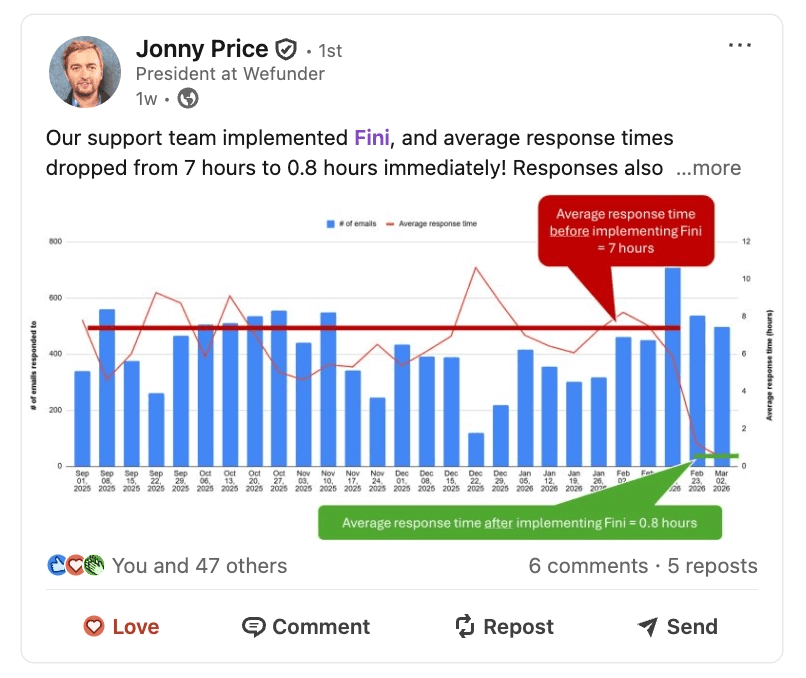
48 reactions. 5 reposts. When leadership shares results like this unprompted, it speaks louder than any case study.
What’s Still Being Refined
Kai was upfront about the edges that still need work:
“Last week we saw a couple of cases where the bot told someone it took care of something it actually couldn’t and didn’t flag it. We saw it, are fixing it, and watching closely for anything else like it.”
This is normal for any AI agent deployment, especially in the first weeks. The important thing is that the team is actively monitoring, catching issues quickly, and tightening the system in real time.
The Real Impact: Capacity, Not Just Speed
Faster response times are the easy metric. The bigger story is what the team can do now that they couldn’t before.
“Now investors and founders will get the 11-star support and service they deserve, and the team will have time back that we can fill with more impactful projects, instead of being heads down and reactive in the inbox.”
“There’s room to breathe now, and instead of trying to add and train more people, we can thrive at our current size.”
The Success team is already using freed-up capacity for higher-impact work: vibe coding an end-to-end investment transfers tool, optimizing the identity verification process, and building a faster IRA investment flow for investors.
These are the projects that improve the platform for everyone, and they weren’t getting done when the team was buried in routine email.
The Takeaway
Wefunder’s challenge wasn’t unique. High-volume support teams in fintech face it constantly: routine queries consume all available capacity, response times slip, and the work that actually moves the business forward gets pushed to “someday.” If you are comparing options, see our guides to AI customer support for banks and fintech and the best AI email responders for fintech support.
Four months after starting implementation, Wefunder is handling 2x the volume with 6x faster response times, at the same team size. More importantly, the team has capacity to do work that matters.
👉 Book a demo to see how Fini can give your team that room back.
FAQs
How does Wefunder handle support and withdrawal questions?
Wefunder runs investor and founder support through Fini’s AI agent inside its Front help desk. The agent answers routine questions from Wefunder’s knowledge base, takes actions such as password resets, 2FA fixes and marketing unsubscribes, and sends withdrawal-specific responses. Founders can also use live chat through the Fini widget to get help with withdrawal questions in seconds, and anything the agent cannot handle is escalated to the Success team.
What was Wefunder's support situation before implementing Fini?
Wefunder's Success team was receiving 1,000+ emails per week. Response times averaged around 7 hours. The team was maxing out at roughly 600 emails per week. There was zero capacity left for higher-value work: improving processes, building better experiences, or tackling the complex cases that actually needed a human.
What did Fini actually do for Wefunder's support operation?
Fini plugged an AI agent into Front, Wefunder's help desk. It reads incoming emails, pulls answers from Wefunder's knowledge base, and either handles it or passes it to the team. Most routine stuff never needs a human. Fini also set up live chat for founders through the Fini widget, giving Wefunder real-time support for the first time. And critically, Fini doesn't just answer questions: it takes actions. Password resets, marketing unsubscribes, 2FA fixes, withdrawal-specific responses.
Why did Wefunder choose Fini over competitors?
"I chose Fini because of its solid reputation, capacity for complexity, and history of working with fintech startups which need complete accuracy and strong compliance guardrails built into the product." Fini stood out on four dimensions: depth of guardrails and escalation logic, maturity of the knowledge management system, the Fini reasoning engine, and product maturity overall. As Kai noted: "The alternatives hadn't been around as long. They were kind of thrown together. Fini has been around for several years."
What results did Wefunder see in the first two weeks after going live with Fini?
Before Fini, the team maxed out at ~600 emails per week with 7+ hour response times. In Week 1, they received 1,500 messages and responded with an average response time of 3 hours. By Week 2, they received 1,400 messages and average response time dropped to 25 mins. By the second week, Fini was handling over 80% of outbound messages. In total, Fini answered roughly 2,000 emails in the first two weeks.
What is the broader impact beyond faster response times?
"Now investors and founders will get the 11-star support and service they deserve, and the team will have time back that we can fill with more impactful projects, instead of being heads down and reactive in the inbox. There's room to breathe now, and instead of trying to add and train more people, we can thrive at our current size." The Success team is already using freed-up capacity for higher-impact work: vibe coding an end-to-end investment transfers tool, optimizing the identity verification process, and building a faster IRA investment flow for investors.
Are there any known limitations or ongoing refinements with Fini at Wefunder?
Kai was upfront about the edges that still need work: "Last week we saw a couple of cases where the bot told someone it took care of something it actually couldn't and didn't flag it. We saw it, are fixing it, and watching closely for anything else like it." This is normal for any AI agent deployment, especially in the first weeks. The important thing is that the team is actively monitoring, catching issues quickly, and tightening the system in real time.
What types of actions can an AI support agent take automatically, beyond just answering questions?
Fini takes real actions like processing password resets, handling marketing unsubscribes, fixing 2FA issues, and responding to withdrawal inquiries, without a human in the loop. At Wefunder, these automated actions accounted for the majority of outbound messages within the first two weeks of going live.
How does shadow testing work before an AI agent goes live with real users?
Shadow testing lets the AI post draft replies as internal comments visible only to your team, so you can review and adjust responses before any user sees them. Wefunder ran this mode through Fini's Front integration during implementation to catch edge cases and tune escalation logic before flipping the switch.
Should I rebuild my knowledge base before deploying an AI support agent?
Yes, and Wefunder's experience shows why it matters. Their most time-intensive implementation phase was a full knowledge base overhaul: consolidating articles, removing outdated content, and restructuring everything as if building a help center from scratch. The quality of your knowledge base sets the ceiling on what the agent can resolve.
How does an AI agent keep improving over time without manual retraining?
Fini runs a nightly learning pipeline that ingests escalated conversations, spots knowledge gaps, generates draft articles, and surfaces them for human review before publishing. Your team only reviews AI-flagged edge cases; the agent gets sharper on its own.
What does a realistic AI support deployment timeline look like for a fintech team?
A structured rollout runs across three stages: Day 1 deploys the Knowledge Agent with no code; Day 14 connects billing, CRM, and internal tools with real actions and a full audit trail; Day 30 reaches full autonomy with voice, chat, and email unified at Resolution Rate 90%.
How do you maintain compliance guardrails when an AI agent is handling fintech support queries?
Fini uses a reasoning engine that combines LLM intelligence with deterministic rules, so the agent knows exactly when to act and how, with guardrails that don't bend. Every decision carries an audit trail, and the platform is SOC 2 Type II, ISO 27001, HIPAA-compliant, and BAA-eligible by default.
What's the best way to handle support volume spikes without adding headcount?
Deploy an autonomous agent that scales with volume rather than with hiring. Wefunder went from a ceiling of roughly 600 emails per week to handling 1,400 to 1,500 messages in a single week, at the same team size, after going live with Fini.
How does the AI agent capture unanswered questions so your knowledge base can improve?
Fini automatically detects conversations where the agent couldn't resolve the query, logs them as knowledge gaps, and surfaces draft articles for review. Your team sees only the gaps that need attention, not every ticket.
What's the difference between deflection and resolution in AI support, and why does it matter?
Deflection counts any response that stops a follow-up, even a wrong or unhelpful one. Resolution means the user's problem is actually closed. Fini is measured on Resolution Rate 90%, not deflection, because deflection rewarded avoidance while CSAT quietly dropped.
How do you add live chat to a platform that only had email support before?
You deploy an AI widget alongside your existing helpdesk integration, giving users a real-time channel without rebuilding your support stack. Wefunder launched live chat for founders through the Fini widget and, for the first time, users could get answers in seconds rather than waiting hours for an email reply.
GTM