
Nobody buys an AI support agent for the day it launches. They buy it for month nine, when the pricing page has changed twice, three policies have been rewritten, and the help centre no longer says what the company actually does. Fini is an AI agent for customer support, backed by Y Combinator and Matrix Partners, priced starting at $0.49 per resolution. Ada is an enterprise agentic customer experience platform, founded in 2016, running 550+ AI agents across 85+ countries with 6.4 billion interactions behind it. Both resolve tickets well. They disagree about who keeps them right.
Why knowledge upkeep is the cost that decides this one
Most comparisons of these two open with a capability grid, and the grid will tell you they are close. On the questions that already have a correct article behind them, they are. Ada publishes an 84% automated resolution rate and Fini publishes 90%, and neither number is the reason a deal goes one way or the other.
The decision sits in three places instead, and they are the spine of this comparison:
Who writes the knowledge after launch? This is where the running cost of an AI agent actually lives, and the two platforms answer it with different org charts.
How long until it resolves real tickets at a real rate? Both vendors publish the destination. Only one publishes the trip.
Can you model the bill before you talk to sales? One of these platforms has a public price list and one does not.
Ada vs Fini at a glance
Fini | Ada | |
|---|---|---|
What you buy | a starting rate of $0.49 per-resolution rate | A custom enterprise contract, quoted per account |
Published pricing | $0.49 per resolution | None published |
Who writes new knowledge articles | The platform, from resolved escalations | Your CX team, which Ada states owns the knowledge layer end to end |
Ongoing tuning model | Self-improving, no coaching loop required | Coaching, a recurring human review of conversation logs |
Stated time to live | Live in 14 days, fully autonomous in 30 | Not published |
Answer attribution | Traces to exactly one source article | Grounded in your approved content, single-source not published |
Published resolution rate | 90% | 84% |
Native channels | Chat, email, voice | Voice, chat, email, WhatsApp, SMS, Messenger, Instagram, in-app, custom |
Specialisation | Fintech, healthcare, and regulated support | Ecommerce, travel, gaming, financial services, SaaS, insurance |
Ownership | Independent, Y Combinator and Matrix Partners | Independent, founded 2016 |
What is Fini?
Fini is an AI agent for customer support that resolves tickets end to end across chat, email, and voice in 130+ languages. It reaches a 90% resolution rate at 99% accuracy and runs more than three million resolutions a month across fintech and healthcare teams. Its published timeline is specific and requires no code: first responses inside two weeks, running autonomously by day 30. Pricing is $0.49 per resolution, starting rate, with no per-seat fees. Fini connects to the helpdesk, CRM, billing system, and claims or records system you already run, takes actions inside them, and writes the decision audit trail back. The headline commitment on its homepage is the one this comparison keeps returning to: autonomous, self-improving agents in 30 days, and never tune them again.
What is Ada?
Ada is an enterprise agentic customer experience platform built in Toronto since 2016, and one of the longest-running vendors in the category. In February 2026 it launched a unified Reasoning Engine, a patent-pending dual-reasoning architecture that gives an immediate, empathetic response to the customer while working the complex part of the task in the background. Its point is consolidation: a single instruction is authored once and replicated across voice, messaging, social, and email, in every language, drawing on the same knowledge, policies, and brand standards. Ada’s Chief Product and Technology Officer, Mike Gozzo, described it as “one ‘brain’ behind every AI agent, applying the same context, logic, and safeguards.”
Around that engine sit Playbooks, which execute multi-step service workflows against live system data; Processes, block-based flows for interactions that need exact wording; Coaching, a feedback loop a human operates; Simulations for testing changes before release; a Conversation Hub for omnichannel deployment; and a developer toolkit with APIs, SDKs, and an MCP server. Ada reports 84% of inquiries resolved autonomously, 550+ agents deployed, 6.4 billion interactions, 350+ businesses, 85+ countries, and 99.99% uptime. Customers named in its March 2026 growth announcement include Cebu Pacific, Malaysia Airlines, Ancestry, Sky, Digicel, monday.com, Blackhawk Network, Branch, and Epos Now.
Who staffs the agent after go-live
Every AI support deployment creates work after launch. The help centre drifts, articles start contradicting each other, confidence drops, and somebody has to notice. The two platforms answer that in public, in their own words, and the answers are not the same shape.
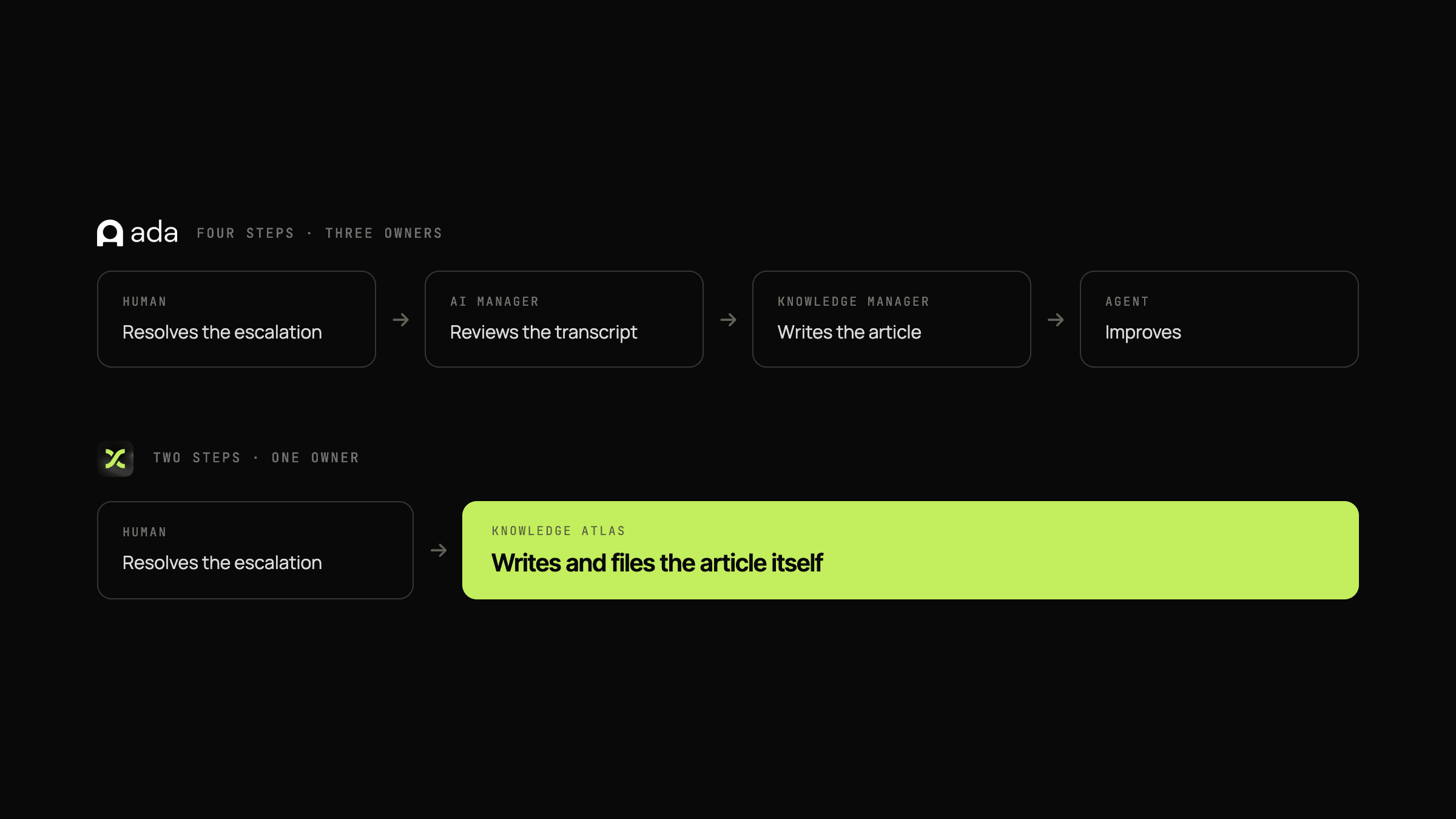
Fini’s answer is a product. Knowledge Atlas is a self-maintaining knowledge layer, generally available today. When a human resolves an escalation, the Atlas extracts the solution from the conversation, writes a formatted help article, files it in the correct branch of a category tree, and makes it searchable immediately. It flags duplicates, contradictory instructions, and outdated policies on a reconciliation dashboard. It routes by intent rather than keyword, so “why won’t my payment go through”, “transaction failed at checkout”, and “card not working” all reach the same article. Fini reports AI resolution moving from 50-60% to 85-90% and knowledge upkeep falling from about 20 hours a week to two.
Ada’s answer is an operating model, and its documentation names the two roles it runs on.
The first is a Knowledge Manager. Ada’s own guidance describes the job precisely: “A Knowledge Manager doesn’t just keep content current, they audit for gaps, turn escalation patterns into knowledge priorities, build content segments to personalize answers, and get ahead of product launches.” The same guidance sets the cadence, working through your sources on a rolling 90-day basis, and states the ownership model in a single line: “Your CX team owns the knowledge layer end to end.”
The second is an AI Manager. From Ada’s coaching guidance: “An AI manager plays a crucial role in maximizing the AI agent’s success. A person familiar with the AI agent’s initial coaching journey and responsible for constant monitoring can help effectively manage and channel resources toward coaching.” The recommended rhythm is a recurring review, weekly, monthly, or quarterly depending on traffic, in which a person reads conversation logs and finds where the agent used the wrong content, gave a partial answer, or missed a resolution it should have made. The agent keeps a memory of those coaching moments and applies them to similar cases later.
None of that is a criticism. It is a coherent model, it is genuinely well tooled, and Ada’s published case studies show it working. Dott moved from a 32% automated resolution rate in February 2024 to 77% by 2026. Green Feather Online grew automated resolution by 37 percentage points in five months. Checkr, which runs Ada across chat and email under FCRA compliance, reports 69% of inquiries resolved automatically and a 162% CSAT improvement, and its case study names the mechanism plainly: weekly conversation reviews for continuous improvement.
Read those numbers for what they are. They are journeys, and somebody walked them. Ada is one of the few vendors in this category honest enough to publish the starting point as well as the destination.
The question for a buyer is not which model is more sophisticated. It is whether the people who would fill those two roles exist on your team, and what it costs you when they do not.
Ada CX pricing in 2026
Ada CX does not publish a price at all. There is no rate card, no published plan tiers and no stated implementation fee, so every number in an Ada proposal arrives through a sales conversation and cannot be checked against a public reference.
What buyers ask | Ada CX | Fini |
|---|---|---|
Published price list | ✗ | ✓ |
Price | Quoted per account | $0.49 per resolution |
Included resolutions | Not published | N/A, no allowance, billed per resolution |
Rate for additional resolutions | Not published | N/A, $0.49 rate |
Per-seat fees | Not published | None |
Implementation | Professional services engagement, terms not published | Included in the rate |
See Fini’s full pricing breakdown for plan details, add-ons, and a resolution calculator.
Ada chatbot and Ada customer service: what you are buying
Ada CX is a no-code customer service automation platform, strongest on speed to launch and on letting a non-technical team build and change flows without engineering. That is a real strength and it is why Ada wins evaluations where time to first value is the deciding factor. The recurring cost that does not appear in the quote is knowledge upkeep: the accuracy of an Ada deployment tracks the quality of the content behind it, and keeping that content correct stays with your team. When you model Ada against a published-price alternative, model the staff hours as well as the licence.
What you actually pay for
Fini prices one thing: $0.49 per resolution, covering the platform and implementation. Ada does not publish a price at all, so the right column below is what can be evidenced rather than what is quoted.
Fini | Ada | |
|---|---|---|
Published price list | ✓ | ✗ |
Price | $0.49 per resolution | Quoted per account |
Included resolutions | N/A, no allowance, billed per resolution | Not published |
Rate for additional resolutions | N/A, $0.49 rate | Not published |
Per-seat fees | None | Not published |
Implementation | Included in the rate | Professional services engagement, terms not published |
Escalation to a human | Free | Not published |
Voice | $0.49 per answered call to 10,000, then $0.59, then $0.35 | Not published |
Annual and multi-year | Two months free annually, 15% to 25% off multi-year | Annual or multi-year commitment reported by third parties |
Trial or pilot | 90-day Enterprise pilot on live traffic, targets agreed in writing | Not published |
Third-party reconstructions of Ada’s pricing converge on a platform fee starting around $30,000 a year, usage billed somewhere between $1 and $3.50 per AI resolution, and enterprise contracts running from roughly $100,000 to $300,000 a year at high volume. Those come from resellers, review sites, and buyer reports rather than from Ada, and they are directional only. The honest statement is simpler: Ada’s cost is unknowable until you are in a sales cycle, and so is its shape, because the unit of billing is not published either.
That matters more than the number. A published rate can be modelled against your own ticket volume in an afternoon by anybody on the team. An unpublished one turns the first month of an evaluation into a procurement exercise, and it removes your ability to compare two vendors on the same axis before you commit calendar time to both.
Two commitments sit outside the arithmetic on Fini’s side. The custom pricing adds a 90-day pilot on live traffic with resolution, CSAT, and accuracy targets agreed in writing, a switching-cost credit capped at $50,000, and the 90-Day Money-Back Guarantee: miss the agreed resolution target and the fees are waived. One note before you model anything: Fini’s custom pricing card says “Unlimited” while the pricing FAQ on the same page says 30,000 resolutions, so get the Enterprise allowance in writing.
How Fini and Ada differ
Three differences decide deals once both demos have gone well.
1. Time to a real resolution rate
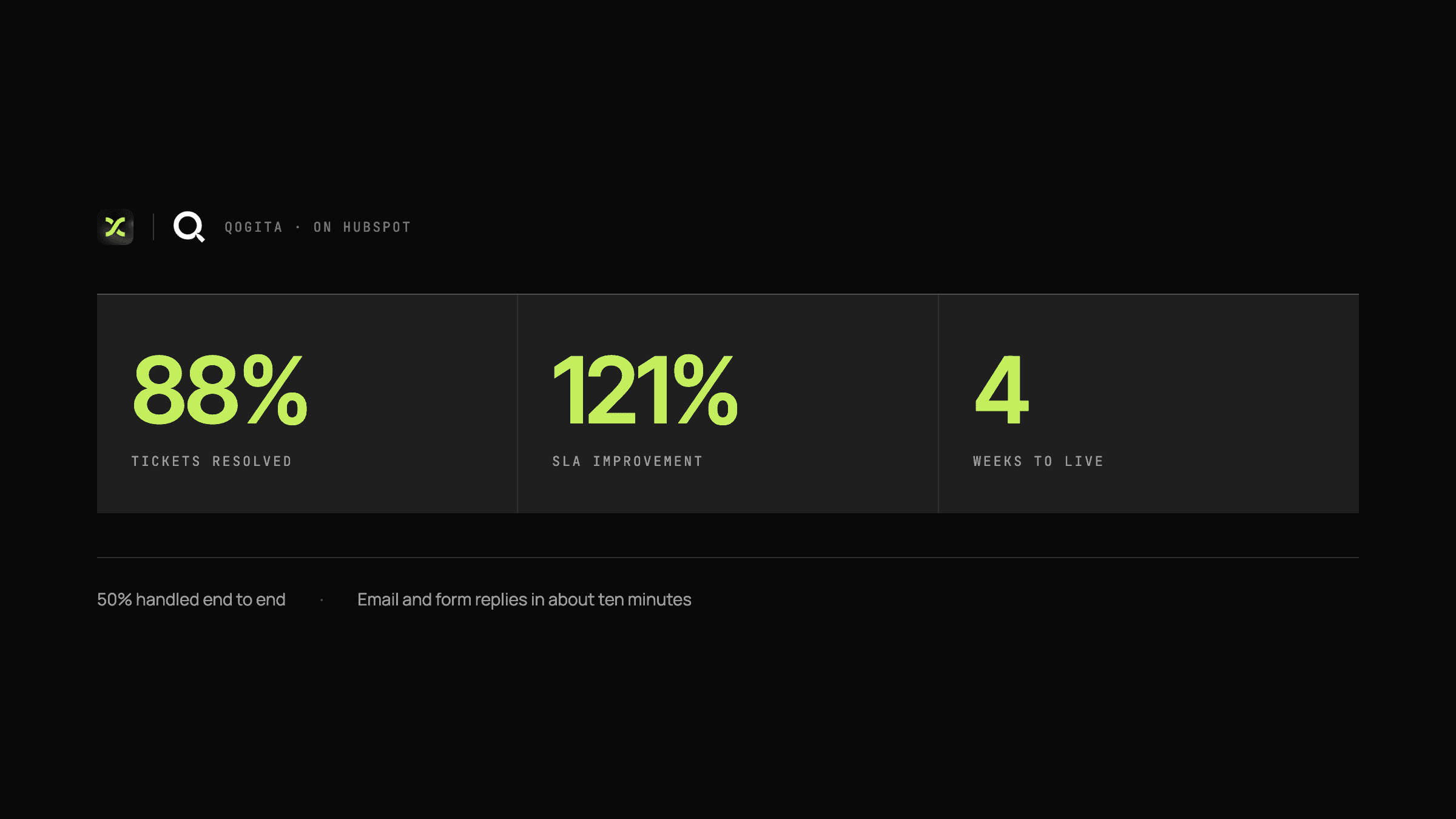
Fini states 14 days to live and 30 days to full autonomy, and its published customer timelines are consistent with the 30-day mark. Qogita went from kickoff to production in four weeks: two weeks building the knowledge base from about 100 existing macros, one week testing and refining replies, one week wiring up HubSpot and the API, then weekly syncs.
Ada does not publish a deployment timeline. Third-party reviews put an enterprise rollout at eight to sixteen weeks with Ada’s professional services team configuring integrations, designing Playbooks, and connecting knowledge sources, and Ada’s own material describes dedicated customer success teams and a phased rollout. Its published case studies point the same direction: Green Feather Online took five months to add 37 points of automated resolution, Checkr’s agent reached 76% CSAT by month nine, and Dott’s climb from 32% to 77% ran from early 2024 into 2026.
Neither shape is wrong. A phased rollout with professional services is the correct answer for an airline running nine channels across dozens of markets. It is an expensive answer for a 40-person support team that needs the queue under control this quarter.
2. What counts as resolved, and who decides
Ada’s definition is one of the better ones published in this category, and it is worth reading before comparing any two resolution rates. A conversation counts as an automated resolution when it is relevant, accurate, safe, and contained: the agent understood the inquiry, gave correct and current information, behaved appropriately, and did not hand off to a human. The judge is Ada’s own AI language understanding, assessing both the customer’s inquiry and the agent’s responses after the conversation closes. Escalated conversations are marked not resolved at the moment of handoff. Idle conversations auto-close after 24 hours on web and social, 72 hours on email.
Fini counts a resolution when the issue is solved with no human involved, and escalations to your team are free rather than billed. Both vendors are measuring the same thing, and both are measuring something real, which is more than a deflection rate does.
The gap is not the definition, it is what rides on it. Ada’s number is a reporting metric, and because its commercial terms are unpublished you cannot tell from outside whether the same number also sets your bill. Fini’s allowance is the bill, published, with the counting rule attached to it.
3. Where the answer comes from
Ada grounds every response in content you have explicitly connected and approved, and says plainly that the agent does not draw on general internet knowledge or generate answers from the model’s training data. That is the right architecture and it removes the worst failure mode in the category.
Fini goes one step further on provenance. Because the Atlas is tree-structured, every answer traces back to exactly one authoritative article rather than a blend of several that happen to be individually approved. Fini’s co-founder Deepak Singla makes the case for why that distinction is not academic:
“Most AI tools blend information from multiple articles, creating answers that don’t match any single source. That’s a compliance violation waiting to happen.”
Deepak Singla, co-founder, Fini
For a retail or travel deployment, approved-source grounding is enough. For a bank explaining to a regulator which document produced a specific answer to a specific customer on a specific date, one source beats several good ones. Ada publishes conversation-level records that support internal reviews, continuous monitoring, and audit logging, which covers the transcript. It does not publish a single-source attribution guarantee, which covers the reasoning.
Feature by feature
Three capabilities separate the platforms under the hood: how each one reasons, how each one is controlled when it is wrong, and how far each one reaches.
Architecture and reasoning
Fini. Fini does not retrieve a policy and paraphrase it, it executes it. A policy is an executable function, so the agent reads live account state, applies the rule to that state, and answers for this customer rather than the average one. On Fini’s published benchmark of 500 real fintech tickets, accuracy on policy-dependent questions rose from about 72% under retrieval to over 98% under structured execution. Actions are confirmed rather than described: the agent calls the backend API, so “your refund has been processed” reports something that happened. The model handles intent recognition and natural language generation, never the policy decision or the calculation, which is why the failure mode is an escalation rather than a confident wrong answer.
Ada. The unified Reasoning Engine is the most interesting architectural idea any incumbent shipped in 2026. Its dual-reasoning design answers the customer immediately while a second track works the multi-step task, which addresses the specific reason voice automation has historically felt broken: silence while the machine thinks. Consolidating every channel onto one reasoning layer, with one set of instructions replicated across languages, is a real answer to configuration sprawl. Account-dependent work runs through Playbooks, which read from and write to your systems in real time, and Playbooks are authored by your team.
Verdict: Fini ✓ executes policy against live account state with a published accuracy benchmark for it. Ada ✓ ships a genuinely novel unified reasoning layer with the strongest voice story in this comparison, and ✓ takes real actions through Playbooks, but ✗ the depth of an account-dependent answer depends on a Playbook having been authored for that case.
Control and testing
Fini. Fini’s published control model is confidence you can audit: every answer is scored and policy-checked before it goes out, low-confidence tickets escalate to your team with full context, and a guardrail evaluation classifier sits in front of the response. Escalations are free rather than billed, which removes the commercial incentive to let a marginal answer through. Every action the agent takes lands in a full audit trail.
Ada. Ada’s control surface is the most complete in this comparison for a team that wants to own the loop. Simulations test changes before they reach customers. Coaching lets a manager correct the agent in natural language, and the agent retains that correction. The Performance Center surfaces unresolved and low-confidence conversations clustered by topic, so the highest-volume knowledge gaps rise to the top automatically rather than being hunted for. Every conversation is continuously monitored and logged, with role-based access, MFA, and audit logging behind it.
Verdict: Ada ✓ better pre-production testing and a better gap-discovery surface than Fini publishes an equivalent for. Fini ✓ scores and policy-checks every answer before it sends, and ✓ makes escalation free so the incentive points the safe way. The split is real: Ada gives a team more levers, Fini needs fewer pulled.
Reach across channels and systems
Fini. Chat, email, and voice on one reasoning layer, 130+ languages, connected to the helpdesk, CRM, billing, and records systems you already run, with actions taken inside them and the audit trail written back. Voice is metered per answered call at a published rate.
Ada. This is Ada’s strongest category and it is not close. Nine channel types out of the box: voice, web chat, email, WhatsApp, SMS, Facebook Messenger, Instagram DMs, in-app, and custom API channels. An app directory of prebuilt integrations covering Zendesk, Salesforce, ServiceNow, Shopify, Freshworks, Kustomer, Microsoft Dynamics 365, and AWS. Voice handoff to a live agent runs through Genesys, NICE CXone, Twilio Flex, Amazon Connect, and Aircall, and Ada states the full conversation context transfers automatically so the customer does not repeat themselves. That handoff is the part most voice deployments get wrong.
Verdict: Ada ✓ on channel breadth, CCaaS handoff maturity, and prebuilt integration count. Fini ✓ on depth in the systems that decide a regulated answer, ✓ on published per-call voice pricing, and ✓ on published language coverage, 130+ across every channel against Ada’s 42 for voice with no platform-wide figure given, but ✗ it does not publish native social or messaging channels.
What Fini customers report
Qogita is a health and beauty wholesale marketplace, the kind of high-volume ecommerce account Ada competes hardest for. Rapid growth had buried its team in order-status inquiries, and hiring against the curve was not working. Support runs on HubSpot, which stayed exactly where it was.
Four weeks after kickoff the agent was live. Fini now resolves 88% of tickets, handles 50% of them end to end with no human involved, and answers email and web forms in about ten minutes. SLA performance improved 121%. Customers rate 93% of responses as perfect and 99% as good or better, and the agent runs above 97% accuracy. The account is owned on Qogita’s side by a revenue operations manager rather than a dedicated knowledge or AI role, and the published ongoing commitment is a weekly sync.
Those numbers sit inside the more than three million resolutions Fini runs every month.
Capabilities side by side
Product capabilities only. Commercial terms are above and compliance is below.
Capability | Fini | Ada |
|---|---|---|
Runs on top of an existing helpdesk | ✓ | ✓ |
Chat, email, and voice on one reasoning layer | ✓ | ✓ |
Takes actions in CRM, billing, and records systems | ✓ | ✓, through Playbooks |
Self-writing knowledge base | ✓ | ✗, your team authors the content |
Single-source attribution per answer | ✓ | Not published |
Pre-production simulation and testing | Not published | ✓ |
Human coaching loop with retained memory | Not required | ✓ |
Every answer scored and policy-checked before sending | ✓ | Not published |
Free escalation to a human | ✓ | Not published |
Audit trail on agent actions | ✓ | ✓, conversation-level records and audit logging |
CCaaS voice handoff integrations | Not published | ✓, Genesys, NICE CXone, Twilio Flex, Amazon Connect, Aircall |
Published resolution rate | 90% | 84% |
Published time to live | Live in 14 days, fully autonomous in 30 | Not published |
Languages | 130+ across every channel | 42 published for voice, platform-wide count not published |
Where Ada is stronger
Ada has been in this category since 2016 and the reasons show up on a shortlist.
Channel and telephony reach. Nine native channel types, a broad prebuilt integration directory, and mature voice handoff into Genesys, NICE CXone, Twilio Flex, Amazon Connect, and Aircall with context carried across. If your contact centre is the centre of gravity, this is the shorter path.
AI-specific certification and published data handling. Ada was the first customer service platform to earn AIUC-1, the AI assurance standard, against roughly 3,400 real-world tests, and it is PCI DSS compliant. It also publishes more detail than Fini does on the mechanics: zero data retention agreements at the LLM layer, built-in PII and PHI redaction, and annual third-party penetration tests at both the platform and model layers.
Operating scale, and customers who say so. 550+ agents, 6.4 billion interactions, 350+ businesses, 85+ countries, 99.99% uptime, 108% agentic AI ARR growth, and 146% net revenue retention. Eric Burdullis, SVP of Operations at Checkr, puts the dependency plainly: “If I turned off Ada tomorrow, I would need to double my support team.”
The unified Reasoning Engine. Authoring an instruction once and having it replicate correctly across every channel and language is a real answer to a real enterprise problem, and no other vendor in this comparison ships it.
A deeper control surface. Simulations, Coaching with retained memory, and volume-ranked gap clustering give an experienced CX operations team more to work with than Fini publishes.
Compliance
Both vendors clear the bar most regulated teams set, and each carries something the other does not.
Certification or capability | Fini | Ada |
|---|---|---|
✓ | ✓ | |
ISO 27001 | ✓ | Not named on the public trust pages |
AIUC-1, AI assurance | ✗ | ✓, first in the category |
PCI DSS | ✗ | ✓ |
✓ | ✓ | |
BAA eligible | ✓ | Not published |
GDPR | ✓ | ✓ |
CCPA | ✓ | Not named on the public trust pages |
Data residency | ✓, on Enterprise | ✓, specified in enterprise agreements |
Independent penetration testing | ✓, application penetration testing, cadence not published | ✓, annual, at platform and model layers |
Three lines are worth reading closely. If your security questionnaire asks about ISO 27001 or CCPA, Fini answers it and Ada’s public pages do not. If it asks about AI-specific assurance or card data, Ada answers it and Fini does not. And on the operational questions underneath the badges, redaction, retention at the model layer, and testing cadence, Ada publishes and Fini does not, which is a gap Fini’s security team can close in review but its public pages currently leave open. Ask both for the actual reports rather than the badge wall.
Where Fini is stronger
The knowledge maintains itself. The Atlas writes the article from the resolved escalation, files it, and reconciles conflicts, against a model that names a Knowledge Manager and an AI Manager as the people who do that work.
Live in 14 days, fully autonomous in 30, published. With a customer timeline that matches it, against an enterprise deployment that third parties put at eight to sixteen weeks with professional services attached.
A price you can model today. The per-resolution rate, voice rates, and multi-year discounts are all public. Ada publishes none of them.
Single-source attribution. Every answer traces to exactly one authoritative article, which is the difference between producing a transcript and producing a defence.
Every answer scored before it sends. Answers are policy-checked, low-confidence tickets escalate with full context, and escalation is free, so nothing about the pricing model rewards letting a marginal answer through.
Built for regulated support specifically. Fintech and healthcare are the design target rather than one vertical among seven, and ISO 27001, HIPAA-compliant handling, and BAA eligibility come with the plan at every level. Published language coverage is 130+ across every channel, where Ada publishes 42 for voice and no platform-wide number.
Which should you choose?
Choose Fini if you want:
Knowledge that maintains itself instead of two roles you have to staff or borrow
To be live in about a month rather than a quarter, without a professional services engagement
A price you can model against your own ticket volume before booking a call
Single-source attribution, and every answer policy-checked before it sends, for regulated review
Correct answers on tickets that turn on the customer’s account state, not just on what the policy says
ISO 27001, HIPAA-compliant, BAA-eligible handling included at every plan level
Choose Ada if you want:
Nine native channels including WhatsApp, SMS, Instagram, and Messenger from one platform
Mature voice with context-preserving handoff into Genesys, NICE CXone, Twilio Flex, or Amazon Connect
AIUC-1 and PCI DSS on the certification list
A CX operations team that wants to own the coaching loop, with simulations and gap clustering to do it well
A decade-old vendor with 6.4 billion interactions and a deep published case study library
One instruction authored once and replicated across every channel and language
Ready to compare on your own data?
Bring your 200 hardest tickets. Fini connects to your helpdesk and knowledge base on the call and shows resolution numbers on your tickets, not a sandbox. Talk to the team.
How much does Ada cost in 2026?
Ada does not publish pricing. There is no price list, no published tiers, and no published unit of billing, so every figure in circulation is a third-party reconstruction. Those reconstructions converge on a platform fee starting around $30,000 a year, usage somewhere between $1 and $3.50 per AI resolution, and enterprise contracts from roughly $100,000 to $300,000 a year at high volume, with annual or multi-year commitments. Treat all of that as directional. Fini publishes everything: a starting rate of $0.49 per resolution, no per-seat fees, free escalations, and voice metered per answered call from $0.49. Before comparing any two rates, it is worth being clear on the difference between deflection and resolution, because a rate attached to a soft metric is not the same number.
Which platform needs less knowledge base maintenance?
Fini. Its Knowledge Atlas writes a formatted article whenever a human resolves an escalation, files it in a category tree, flags duplicates and outdated policies on a reconciliation dashboard, and traces every answer back to one authoritative source. Fini reports resolution moving from 50-60% to 85-90% and upkeep falling from around 20 hours a week to two. Ada states that your CX team owns the knowledge layer end to end, recommends working through your sources on a rolling 90-day cadence, and recommends a Knowledge Manager who audits for gaps, turns escalation patterns into priorities, and gets ahead of product launches. Its Performance Center does the discovery work well, clustering unresolved and low-confidence conversations by volume so the biggest gaps surface first. The writing stays with your team. If you are starting from an existing help centre, building a knowledge base from your existing tickets is the first step either way.
What is Ada’s automated resolution rate and how is it measured?
Ada publishes 84%. A conversation counts as an automated resolution when it meets four criteria: relevant, meaning the agent understood the inquiry and gave directly related help; accurate, meaning the information was correct and current; safe, meaning the agent behaved appropriately and avoided harmful topics; and contained, meaning it never handed off to a human. The assessment is made by Ada’s own AI language understanding after the conversation ends, escalated conversations are marked not resolved at the moment of handoff, and idle conversations close automatically after 24 hours on web and social or 72 hours on email. Fini publishes 90% at 99% accuracy and counts a resolution when the issue is solved with no human involved, with escalations free rather than billed. Both definitions are published and both are specific, which is the useful part. Check each against your own escalation rate on a month of real tickets before you compare the two headline numbers.
How long does each platform take to deploy?
Fini states 14 days to live and 30 days to full autonomy, and its published customer timelines match the 30-day mark: Qogita went from kickoff to production in four weeks, spending two weeks building knowledge from about 100 existing macros, one week testing replies, and one week on the HubSpot and API integration. Ada does not publish a deployment timeline. Third-party reviews put an enterprise rollout at eight to sixteen weeks with Ada’s professional services team configuring integrations, designing Playbooks, and connecting knowledge sources, and Ada’s own case studies describe multi-month ramps: Dott climbed from a 32% to a 77% automated resolution rate, and Green Feather Online added 37 percentage points over five months. The longer path buys a more configured system. Whether that trade is right depends on how many channels you are launching and whether you have a human in the loop available to run the programme.
Are Ada and Fini both compliant for regulated industries?
Both clear the bar most regulated teams set, and each holds something the other does not. Fini holds SOC 2 Type II and ISO 27001, handles data on a HIPAA-compliant, BAA-eligible basis, covers GDPR and CCPA, and offers data residency on Enterprise. Ada holds SOC 2 Type II, is HIPAA compliant, operates under GDPR, was the first customer service platform certified against AIUC-1, and is PCI DSS compliant, with zero data retention agreements at the LLM layer, built-in PII and PHI redaction, annual third-party penetration tests and model evaluations, and data residency options specified in enterprise agreements. ISO 27001 and CCPA are not named on Ada’s public trust pages, and AIUC-1 and PCI DSS are not held by Fini. Ada publishes more operational detail on data handling than Fini does, so confirm data residency terms, BAA availability, redaction behaviour, penetration testing cadence, and the model-training position for each in writing during security review rather than from a marketing page.
Does Fini replace my helpdesk, and does Ada?
Neither does. Fini runs as an AI agent layer on the helpdesk you already use, connecting to it along with your CRM, billing system, and records system, taking actions inside them and writing the audit trail back, so tickets, macros, views, and SLAs stay where they are. Qogita runs Fini on HubSpot. Ada is also a layer rather than a helpdesk, with an app directory of prebuilt integrations covering Zendesk, Salesforce, ServiceNow, Shopify, Freshworks, Kustomer, and Microsoft Dynamics 365, and handoff to live agents through Genesys, NICE CXone, Twilio Flex, Amazon Connect, and Aircall. The practical difference is not helpdesk independence, which both offer, but reach against depth: Ada connects to more surfaces, Fini goes further inside the ones that decide a regulated answer. If you run support across many markets, note that Fini publishes 130+ languages across every channel while Ada publishes 42 for voice and no platform-wide figure, and compare the two on multilingual coverage directly.