
Support leaders comparing these two are usually asked to answer a product question. The question in front of them is closer to an architecture question. Fini is a per-resolution AI agent backed by Y Combinator and Matrix Partners that runs on top of the helpdesk you already have. Salesforce Agentforce is the agent layer of the Salesforce platform, priced on consumption, and since July 2026 also available as Agentforce Help Agent on a pay-per-resolution basis.
One question decides this, and it is not about the AI
Both of these resolve tickets well. Neither of them is a weak product, and a feature grid will not separate them, because the features converge every quarter.
What separates them is what each one has to be standing on before it resolves anything. That splits into three questions, and they are the spine of this comparison:
Is Salesforce your system of record? Everything downstream follows from this one answer.
How many meters end up on the invoice? Both publish rates. They do not publish the same number of them.
Who owns the knowledge after go-live? This is where the running cost actually lives.
Work those three in order and the decision usually makes itself, well before anyone opens a checklist.
Agentforce vs Fini at a glance
Fini | Salesforce Agentforce | |
|---|---|---|
What you buy | An AI agent layer on top of your existing helpdesk | The agent layer of the Salesforce platform |
What it stands on | The helpdesk, CRM, and billing system you already run | Salesforce Knowledge, Data 360, and a Service Cloud edition |
Pricing model | a starting rate of $0.49 per-resolution rate, no per-seat fees | Per-user editions plus consumption, either Flex Credits or per conversation |
Outcome pricing | Yes, every plan, since launch | Yes, on Agentforce Help Agent, published July 2026 |
Escalations to humans | Free, not billed | Not charged on Help Agent pay-per-resolution |
Knowledge upkeep | Self-maintaining, articles written from resolved tickets | Grounded on Salesforce Knowledge, which your team maintains |
Go-live | Live in 14 days, fully autonomous in 30 (Day 1 / Day 14 / Day 30) | Minutes to set up Help Agent, longer for a configured programme |
Requires adopting Salesforce | No, Salesforce is a supported integration | Yes, Salesforce is the platform |
What is Fini?
Fini is an AI agent for customer support that resolves tickets end to end across chat, email, and voice in 130+ languages. It publishes a 90% resolution rate at 99% accuracy and runs more than 3 million resolutions a month across fintech and healthcare teams. Pricing is $0.49 per resolution, starting rate, with no per-seat fees. Fini connects by one-click OAuth to the helpdesk you already run, Zendesk, Intercom, HubSpot, Front, Freshdesk, Livechat, Gorgias, Slack, and Salesforce among them, takes actions inside your billing and records systems, and writes the decision audit trail back.
What is Salesforce Agentforce?
Agentforce is the agentic AI layer of the Salesforce platform. Salesforce announced general availability of Agentforce 360 on 13 October 2025 at Dreamforce, bringing the Agentforce platform, Data 360, the Customer 360 apps, and Slack into one system, with Agentforce Builder for building agents conversationally, Agent Script for tighter control of agent behaviour, Agentforce Voice, and Intelligent Context for grounding agents in unstructured data. Underneath sits a reasoning engine Salesforce calls Atlas, which breaks a request into steps and plans across them, and the Salesforce Trust Layer, which handles secure grounding, data masking, toxicity detection, and a zero data retention policy at the third-party model layer.
In July 2026 Salesforce shipped Agentforce Help Agent, a purpose-built customer support agent with prepackaged actions, channel setup for voice, web, portal, and messaging from a single screen, and pay-per-resolution pricing. Salesforce runs the same technology on its own help site, where it reports 4.3 million inquiries handled and 70% resolved. Salesforce is also mid-transaction on the AI support vendor formerly known as Intercom, having signed a definitive agreement on 15 June 2026 with close expected in its fiscal fourth quarter of 2027, so the shape of its support portfolio is still moving.
This is a serious product from the largest vendor in the category, and the honest version of this comparison says so early.
What the agent is standing on
Read one clause from Salesforce’s own Help Agent launch and the whole decision comes into focus. The agent, Salesforce writes, is grounded on your Salesforce Knowledge.
That is a reasonable design. It is also a dependency, and it is worth following the chain all the way down before signing anything.
Salesforce Knowledge is a Service Cloud module. On Salesforce’s published Service Cloud pricing, Knowledge Management appears as read-only across the editions, with read and write access listed as an additional $75 per user per month. So the knowledge the agent is grounded on is a licensed module, and the ability of your team to write into it is its own line item.
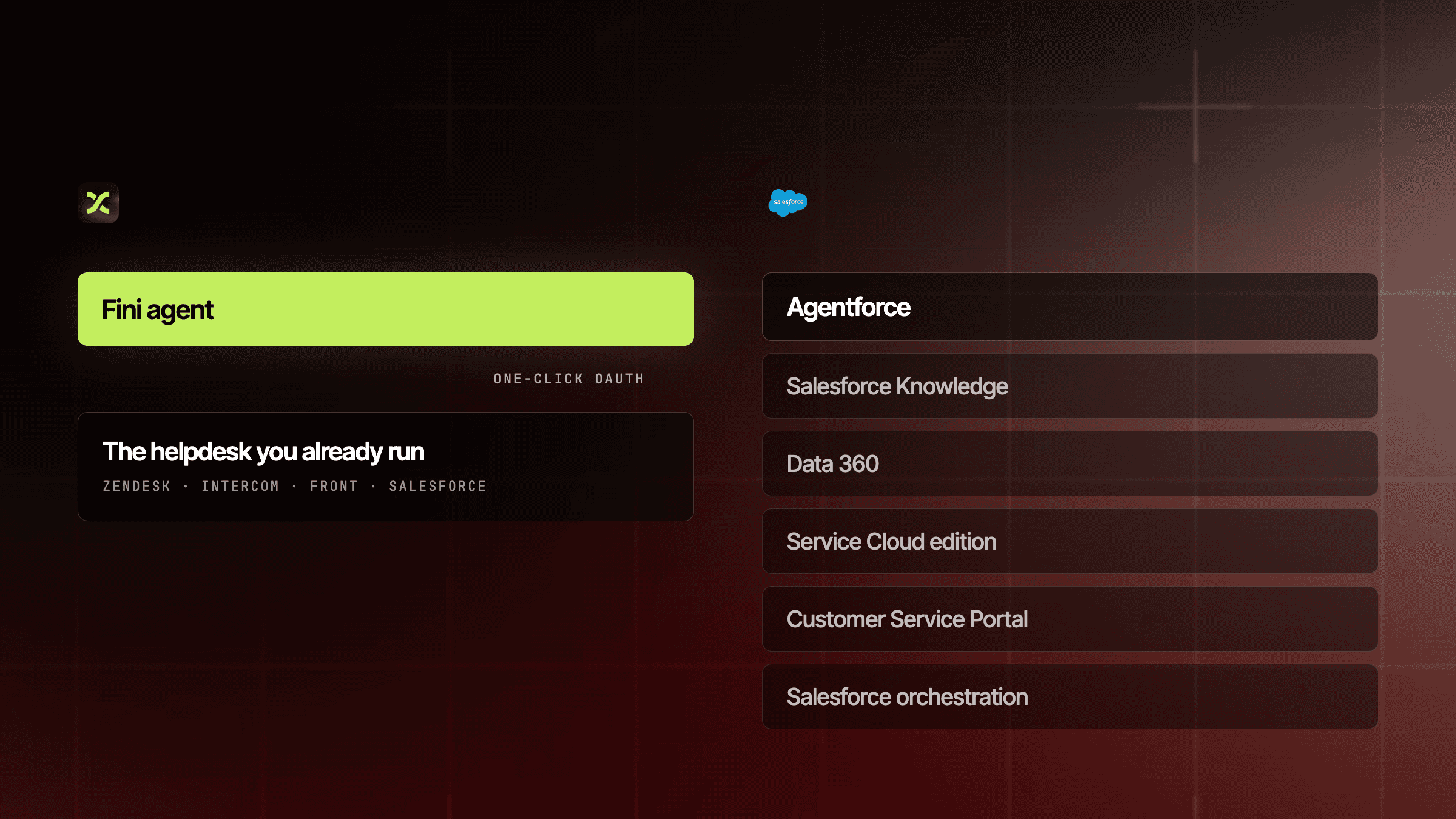
Below that sits the data. Salesforce grounds agent context in Data 360, and the credit examples on its own pricing page carry a note that they exclude Data 360 credits and other consumption services. Below that sits the deployment surface, the Agentforce Customer Service Portal, which is the channel Salesforce names as the common home for Help Agent. And beside all of it sits the action layer: out of the box the agent answers questions and manages cases, while order management, appointment scheduling, and account management are added through Agentforce Builder or, in Salesforce’s own words, the coding agent of the customer’s choosing.
None of that is hidden. Salesforce publishes every piece of it, which is more than most vendors in this category do. The point is not that the list is long. The point is what the list assumes: that Salesforce is already the system of record, the knowledge base, the data layer, the portal, and the orchestration surface. For a company where all five are already true, the agent is close to free to stand up, and Agentforce is very likely the right answer. For a company where none of them are true, the AI decision has quietly become a platform decision.
Fini answers the same question with one line. It stands on the helpdesk you already run. Connecting it is one-click OAuth with no engineering on your side, Salesforce included, so a team running Service Cloud can evaluate Fini against live Salesforce tickets without moving a case, a queue, or a routing rule. That is the actual difference between the two, and everything below is downstream of it.
Agentforce pricing in 2026
Salesforce publishes more prices than any other vendor in this category, which is a genuine transparency advantage. The difficulty for buyers is not finding a rate, it is working out how many rates apply at once.
Line item | Published price |
|---|---|
Service Cloud licence | $25 to $350 per user per month |
Agentforce 1 Service | $550 per user per month |
Included AI volume | 2.5M Flex Credits per org per year on Agentforce 1 Editions |
Flex Credits | $500 per 100,000 credits |
Outcome option | Help Agent at $2 per resolution or $2 per conversation |
Employee-facing agents | $125 per user per month, $150 for Industries |
Knowledge read and write | $75 per user per month on Service Cloud |
See Fini’s full pricing breakdown for plan details, add-ons, and a resolution calculator.
How much does Agentforce cost per conversation?
A standard action costs 20 Flex Credits, and at $500 per 100,000 credits that is $0.10 per action. The number nobody publishes is how many actions one conversation consumes. A support conversation that looks up an order, checks a policy and updates a record is three actions before it answers anything, so $0.10 per action is not comparable to a $0.99 or $0.49 per-resolution rate. The 2.5M annual credit allowance works out at roughly 125,000 standard actions per org per year. Before signing, ask Salesforce for the average action count per resolved conversation on accounts like yours, in writing.
What you actually pay for
Fini prices one thing: $0.49 per resolution, covering the platform and implementation. Salesforce publishes more prices than any other vendor in this comparison set, which is a genuine transparency advantage, and the work for the buyer is not finding a rate but working out how many of them apply.
Fini | Salesforce Agentforce | |
|---|---|---|
Price | $0.49 per resolution, starting rate | Service Cloud from $25 to $350 per user per month, Agentforce 1 Service $550 |
Included AI volume | N/A, no allowance, billed per resolution | 2.5M Flex Credits per org per year on Agentforce 1 Editions |
Consumption rate | $0.49 per resolution, starting rate | $500 per 100,000 Flex Credits, a standard action costs 20 credits |
Outcome option | Every plan is per resolution | Help Agent at $2 per resolution, or $2 per conversation |
Employee-facing agents | Included | Agentforce add-on $125 per user per month, Industries $150 |
Knowledge read and write | Included | Additional $75 per user per month on Service Cloud |
Per-seat fees | None | Yes, scales with headcount |
Implementation | Included in the rate | Not published, commonly a partner engagement |
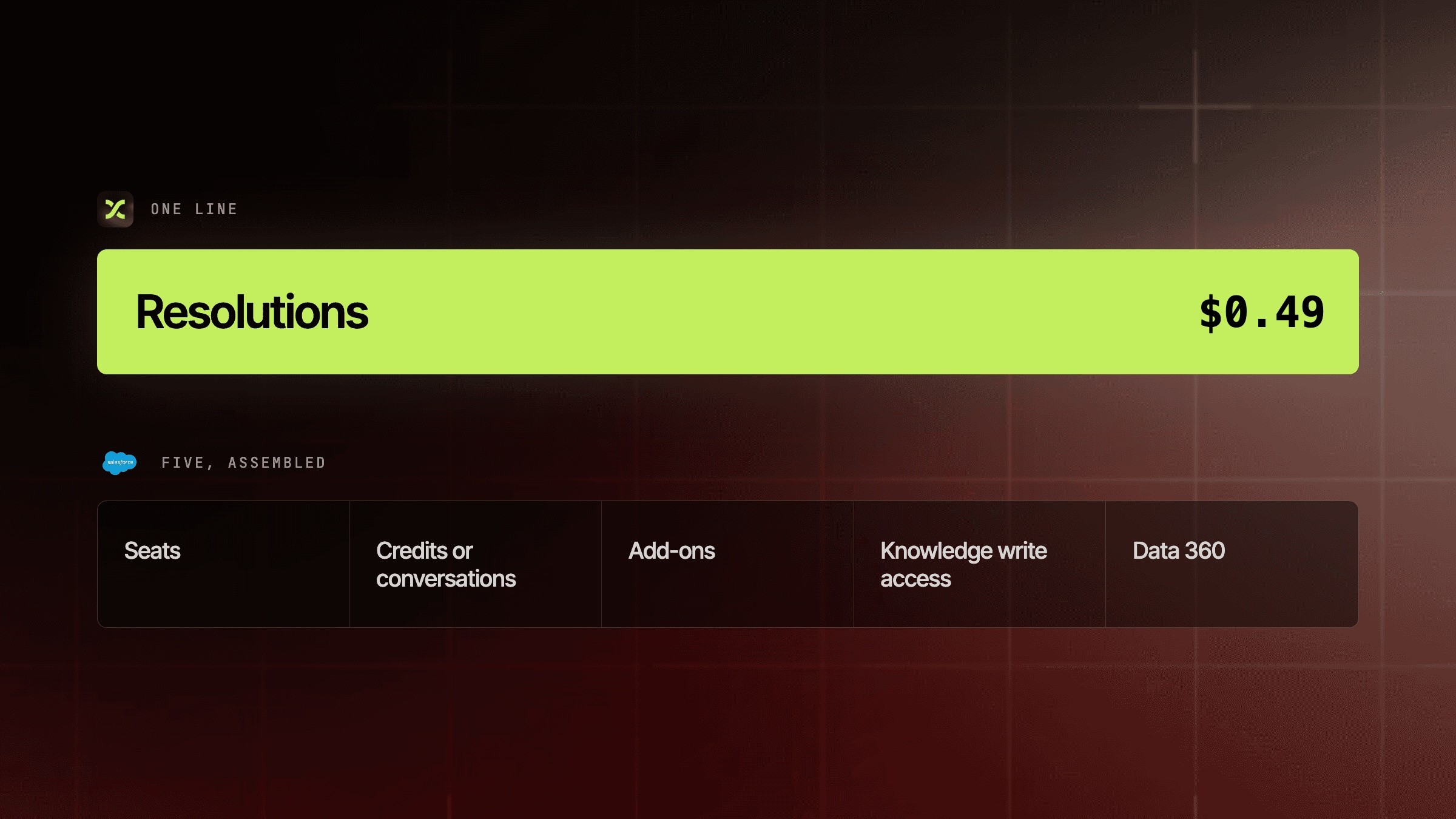
The arithmetic is worth doing with Salesforce’s own examples rather than anyone else’s. Salesforce prices Flex Credits at $500 per 100,000, which puts a credit at half a cent and a standard action at $0.10. Its published self-service example, a customer asking where their order is, uses two actions, so 40 credits, so $0.20 per request. Its case management example uses three actions at $0.30, and it scales that to 100 users handling three cases a day for 20 days at $1,800 a month. The 2.5M annual credit allowance on an Agentforce 1 edition works out at roughly 10,400 standard actions a month, or about 5,200 customer requests at Salesforce’s own two-action rate.
Set that beside the outcome-priced options and the comparison sharpens. Help Agent bills $2 per autonomous resolution and charges nothing when a customer escalates or leaves unhappy. Fini's rate is $0.49 per resolution, and that figure covers the platform, implementation, and every escalation. That is the number to put beside Agentforce's per-action cost, because it is the only one that includes everything.
Enterprise adds a 90-day pilot on live traffic with resolution, CSAT, and accuracy targets agreed in writing, all backed by the 90-Day Money-Back Guarantee: miss the agreed resolution target and the fees are waived.
How Fini and Agentforce differ
Three differences move deals. Each is worth checking against your own ticket data rather than a feature list.
1. What the invoice counts
Fini bills when the issue is solved with no human involved, and escalations to your team are free. One meter, one definition, published on the pricing page.
Salesforce now offers a definition that is just as clean, and a page that claimed otherwise would be out of date. On Help Agent pay-per-resolution, you are charged when the agent resolves an issue autonomously from start to finish, and if the customer gives negative feedback or asks for a human there is no charge. Salesforce also states that Data 360 and Agentforce are unmetered during the agent interaction, which removes the forecasting problem that consumption pricing usually creates.
The difference is not the definition. It is how many meters sit around it. Fini's flat rate is the entire bill. The outcome rate on Help Agent sits alongside Service Cloud seats, and next to any employee-facing agent add-on, knowledge write access, and Data 360 consumption a given org happens to need. Both invoices are forecastable. Only one of them is forecastable from two numbers you already have.
2. Who owns the knowledge after go-live
This is the difference that compounds, and it is covered in depth in the feature comparison below. In short: Fini’s knowledge layer writes and reconciles itself from resolved tickets, while Agentforce is grounded on a knowledge base your team writes and maintains, with write access licensed separately.
3. How fast each goes live
Fini goes live in 14 days and is fully autonomous in 30, on a staged path. Day 1 connects the helpdesk and knowledge base and the agent begins answering in shadow mode. Day 14 it handles live traffic on the journeys that clear the confidence threshold, and agentic workflows are running. Day 30 it runs autonomously on the agreed scope with escalation rules in place. On Enterprise that sits inside a 90-day pilot on live traffic with targets agreed in writing before anything is billed.
Agentforce has two answers now, and both are true. Help Agent is designed to stand up quickly, with prepackaged actions, drag-and-drop file or URL grounding, a preview pane for testing, and channels enabled from one screen. That is a real change from a year ago. A configured multi-agent programme is a different exercise: Salesforce does not publish a timeline for it, and third-party implementation practices describe first agents in the region of six to sixteen weeks and larger programmes running longer, usually with a partner and usually gated on data readiness rather than on the agent itself.
The honest read is that the gap has narrowed at the simple end and remains at the complex end. If your first use case is deflecting help-centre questions, both are fast. If it involves reaching into a ledger, a claims system, or a core banking platform, ask both vendors who does that integration work and whose invoice it lands on.
Feature by feature
Beyond the commercial picture, three capabilities separate the two platforms under the hood: how each reasons over your data, how each keeps its knowledge current, and how each proves what it did.
Architecture and reasoning
Fini. Fini runs what it calls structured execution rather than retrieval-augmented generation. Instead of retrieving policy text and letting a model paraphrase it, Fini turns policies into executable functions, pulls live account data, and calls backend APIs so an action is confirmed rather than described. The model handles intent recognition and natural language generation, not the policy decision or the calculation. On Fini’s published benchmark across 500 real fintech tickets, policy-dependent accuracy rose from about 72% under retrieval to over 99% under structured execution.
Agentforce. Salesforce’s reasoning engine decomposes a request into steps and plans across them, with hybrid reasoning that lets teams pin deterministic behaviour where they need it and Agent Script for explicit control of how the agent behaves. Grounding runs through the Trust Layer with secure data retrieval against Salesforce records. It is a strong design, and the control surface is deeper than anything a newer vendor ships. Salesforce publishes no retrieval-versus-execution accuracy benchmark of the kind Fini publishes.
Verdict: Fini ✓ publishes a structured-execution benchmark and a confirmed-action design. Agentforce ✓ ships deeper authoring control through Agent Script and hybrid reasoning, but ✗ publishes no comparable accuracy benchmark.
Knowledge management
This is where the two diverge most, and where the running cost of an AI agent actually sits. Every deployment degrades the same way: the help centre drifts, articles start contradicting each other, confidence drops, and the team quietly becomes a documentation factory.
Fini. Fini’s Knowledge Atlas is a self-maintaining knowledge layer, shipped and generally available. When a human resolves an escalation, it extracts the solution, writes a formatted help article, files it in the right branch of a category tree, and makes it searchable immediately. It flags duplicates, contradictory instructions, and outdated policies on a reconciliation dashboard. It routes by intent rather than keyword, so “why won’t my payment go through”, “transaction failed at checkout” and “card not working” all reach the same article. And because the knowledge layer is tree-structured rather than a knowledge graph spanning many sources, every answer traces back to exactly one authoritative article rather than a blend of several. Fini reports AI resolution moving from 50-60% to 85-90% and knowledge upkeep falling from about 20 hours a week to two.
Agentforce. Agentforce is grounded on Salesforce Knowledge, with Intelligent Context extending grounding into unstructured data and Help Agent adding drag-and-drop files and URL crawling to get a first agent standing without a mature help centre. The connective tissue is good. What Salesforce does not claim is that the platform writes and files the articles for you, and on the Service Cloud price list the ability to write into Knowledge at all is an additional $75 per user per month. Salesforce publishes no before-and-after numbers for knowledge upkeep.
Verdict: Fini ✓ self-maintaining knowledge, generally available, with auto-written articles, conflict detection, and single-source attribution, plus published upkeep numbers. Agentforce ✓ broad, well-governed grounding including unstructured data, but ✗ the knowledge itself stays your team’s job, and write access is licensed separately.
Attribution and the audit trail
Fini. Because the knowledge layer is tree-structured, a Fini answer resolves to one source article, which is the difference between an auditable answer and a plausible one. As Fini’s co-founder Deepak Singla puts it, “most AI tools blend information from multiple articles, creating answers that don’t match any single source. That’s a compliance violation waiting to happen.” Fini scores every answer for confidence and checks it against policy before it sends, escalates anything below the threshold to a human with full context attached, and commits the decision to an audit log. Enterprise adds a full decision audit trail alongside data residency options and BAA and DPA terms.
Agentforce. The Trust Layer is Salesforce’s answer and it is a substantial one: secure data retrieval that respects existing permissions, dynamic grounding, data masking of personally identifiable information before prompts reach the model, toxicity detection, and a zero data retention policy under which prompts and responses are never stored or used to train the third-party models. Fini states the same on its own pricing page, that customer data is never used to train foundation models, so this is a bar both clear rather than a gap. The open question for a regulated buyer is attribution: when grounding draws across Salesforce Knowledge, Data 360, and crawled sources at once, Salesforce publishes no guarantee that a given answer traces to a single authoritative record.
Verdict: Fini ✓ single-source attribution by design, confidence scoring with policy checks before send, and a decision audit trail on Enterprise. Agentforce ✓ a mature, documented trust architecture with permission-aware retrieval and zero data retention, but ✗ publishes no single-source attribution guarantee across blended grounding.
What Fini customers report
Peaksware builds training software under two brands, TrainingPeaks for endurance athletes and Train Heroic for strength coaching, and that is exactly what made it a hard deployment. The two brands share vocabulary but not policy, so generic AI tools kept answering a question about one with a rule that belonged to the other. Support also runs on a season: volume climbs from Black Friday through February, and at peak, response times had stretched to 24 hours.
“Our system is so nuanced. There are times where the way someone phrases something may seem like it’s a coach when it’s an athlete.”
Kristina Green, Senior Support Rep, TrainingPeaks
That is the attribution problem described by the person who lives with it. An answer assembled from whichever article scored highest is wrong here even when every sentence in it is true somewhere.
Rollout ran in four phases: prompts and guardrails, a knowledge base overhaul with dashboard access, shadow testing in internal comment mode, then iteration and launch on a weekly cadence. At peak, Fini now deflects around 1,200 tickets a week on TrainingPeaks alone and more than 10,000 across the January and February surge, cutting the visible queue by over 70%. Average response time fell to 25.9 seconds and CSAT rose 12%. On Train Heroic the Monday queue dropped from 200-250 tickets to 100-120, a backlog that used to take the whole week now clears by Wednesday, and the team recovered two full days of capacity every week.
The knowledge loop is the part that matters most for this comparison, because it is the thing a support rep has to live with long after go-live.
“I was able to go in and add a knowledge item very easily and improve the response. That was a huge shift in progressing Fini forward.”
Darren Lacy, Senior Support Rep, Train Heroic
That sits inside more than 3 million resolutions Fini runs every month at a published 99% accuracy rate, across fintech and regulated support teams.
Capabilities side by side
Product capabilities only. The commercial picture is summarised above and the compliance detail sits below.
Capability | Fini | Salesforce Agentforce |
|---|---|---|
Chat, email, and voice on one reasoning layer | ✓ | ✓, voice, web, portal, and messaging |
Runs on top of an existing helpdesk | ✓ | ✗, Salesforce is the platform |
Native ticketing, routing, and case management | Uses yours | ✓ |
Takes actions in CRM, billing, and records systems | ✓ | ✓, prepackaged actions plus Agentforce Builder |
Self-maintaining knowledge, generally available | ✓ | ✗, grounded on knowledge your team maintains |
Single-source attribution per answer | ✓ | Not published |
Deterministic control over agent behaviour | Policy and threshold, not flow diagrams | ✓, Agent Script and hybrid reasoning |
Outcome-based pricing | ✓, every plan | ✓, on Help Agent |
Decision audit trail | ✓, full trail on Enterprise | ✓, via the Trust Layer |
Go-live timeline | Live in 14 days, fully autonomous in 30 | Fast for Help Agent, not published for a configured programme |
Agent assist for human staff | ✓ | ✓, employee agents as a per-user add-on |
Workforce management and field service | ✗ | ✓ |
Marketplace of third-party integrations | ✗ | ✓, AgentExchange |
Languages | 130+ | Not published as a single figure |
Where Agentforce is stronger
Salesforce is the largest vendor in this category for good reasons, and a comparison that pretends otherwise is not useful to a buyer.
One platform, one contract. If Salesforce is already your system of record, the agent inherits your data model, your permissions, your reporting, and your procurement relationship on day one.
Compliance breadth. Salesforce’s compliance documentation covers SOC 2 and SOC 3, ISO 27001, 27017, 27018, and 42001, HIPAA, HITRUST, FedRAMP, PCI DSS, CSA STAR, and regional attestations. That list is broader than Fini’s, and for public-sector buyers FedRAMP can decide the deal outright.
Control surface. Agent Script, hybrid reasoning, and Agentforce Builder give an operations team more explicit control over agent behaviour than a threshold-and-policy model does.
Scope beyond support. Sales, field service, marketing, and employee-facing agents run on the same platform, which matters if the mandate is company-wide rather than support-only.
Certification or framework | Fini | Salesforce |
|---|---|---|
SOC 2 Type II | ✓ | ✓ |
ISO 27001 | ✓ | ✓ |
HIPAA | ✓, BAA eligible | ✓, under the shared responsibility model |
GDPR | ✓ | ✓ |
CCPA | ✓ | ✓ |
Data residency | ✓, on Enterprise | ✓ |
ISO 27017 / 27018 / 42001 | ✗ | ✓ |
HITRUST | ✗ | ✓ |
FedRAMP | ✗ | ✓ |
PCI DSS | ✗ | ✓ |
Customer data excluded from model training | ✓ | ✓, zero data retention at the model layer |
If FedRAMP, HITRUST, or PCI DSS is a hard procurement requirement, Salesforce is the answer and this comparison ends there. On the certifications most commercial buyers gate on, both clear the bar: Fini’s SOC 2 Type II and HIPAA-compliant, BAA-eligible handling come with the plan.
Where Fini is stronger
It does not require adopting a platform. Fini runs on top of the helpdesk you already have, Salesforce included, so the AI layer can be evaluated and changed without a platform decision attached to it.
Knowledge that maintains itself. Articles written from resolved tickets, conflicts reconciled, every answer traced to one source, with published upkeep numbers behind it.
One meter. A flat rate that covers platform and implementation, so the invoice can be modelled from your ticket volume before a sales call, with no per-seat fees and free escalations.
A 30-day path to autonomy. Day 1, Day 14, Day 30, with a 90-day Enterprise pilot on live traffic before anything is billed.
Built for regulated support. Confidence scoring with policy checks before send, low-confidence escalation with full context, and a decision audit trail, shipped as the default rather than assembled.
Which should you choose?
Choose Fini if you want:
To change your AI layer without making a platform decision, whether or not you run Salesforce
Knowledge that maintains itself rather than a documentation backlog that grows with ticket volume
One published flat rate covering platform and implementation, with escalations free
Single-source attribution and a decision audit trail for regulated review
A staged 30-day path to autonomy with targets agreed in writing before billing starts
Choose Salesforce Agentforce if you want:
Salesforce as your system of record, with the agent inheriting that data model and those permissions
FedRAMP, HITRUST, PCI DSS, or the wider ISO set as a procurement requirement
Deterministic, scripted control over agent behaviour owned by an in-house operations team
Agents across sales, service, field service, and employees on one platform and one contract
Ready to compare on your own data?
Bring your 200 hardest tickets. Fini connects to your helpdesk and knowledge base on the call and shows resolution numbers on your tickets, not a sandbox. Talk to the team.
Do you need Salesforce to use Fini?
No. Fini runs as an AI agent layer on top of whatever helpdesk you already use, and Salesforce is one of its one-click OAuth integrations alongside Zendesk, Intercom, HubSpot, Front, Freshdesk, Livechat, and Gorgias. Your cases, queues, and routing rules stay where they are, which means a Service Cloud team can evaluate Fini against live Salesforce tickets without a migration. Agentforce, by contrast, is the agent layer of the Salesforce platform, so using it means Salesforce is your system of record, your knowledge base, and your data layer. That structural difference is the single biggest input to this decision, and it is worth separating from the question of which agent answers better. Before comparing either on numbers, it helps to be clear on the difference between deflection and resolution.
How much does Agentforce cost per resolution in 2026?
Salesforce publishes several rates. Agentforce Help Agent bills $2 per autonomous resolution, with no charge when a customer escalates or gives negative feedback. Consumption pricing runs either at $500 per 100,000 Flex Credits, where a standard action costs 20 credits or $0.10, or at $2 per conversation. Those sit alongside Service Cloud editions from $25 to $350 per user per month, Agentforce 1 Service at $550 with 2.5M Flex Credits per org per year, and add-ons for employee-facing agents. Fini costs a starting rate of $0.49 per resolution, covering platform, implementation, and every escalation. Watch your escalation rate when modelling either.
Which platform requires less knowledge base maintenance?
Fini. Its Knowledge Atlas writes a formatted article whenever a human resolves an escalation, files it in a category tree, flags duplicates and outdated policies on a reconciliation dashboard, and traces every answer back to one authoritative source. Fini reports resolution moving from 50-60% to 85-90% and upkeep falling from around 20 hours a week to two. Agentforce is grounded on Salesforce Knowledge, with Intelligent Context extending grounding into unstructured data and Help Agent able to ingest uploaded files and crawled URLs to get started. What Salesforce does not claim is that the platform authors and files articles for you, and read and write access to Knowledge is listed at an additional $75 per user per month on Service Cloud. If your ticket mix has a long tail of categories, the upkeep on that knowledge base is the number to model.
Are Fini and Salesforce both compliant for regulated industries?
Both clear the bar most regulated teams set, and Salesforce carries a longer list. Fini holds SOC 2 Type II and ISO 27001, handles data on a HIPAA-compliant, BAA-eligible basis, covers GDPR and CCPA, offers data residency on Enterprise, and states that customer data is never used to train foundation models. Salesforce’s compliance documentation additionally covers SOC 3, ISO 27017, 27018 and 42001, HITRUST, FedRAMP, PCI DSS, and CSA STAR, and its Trust Layer applies data masking, toxicity detection, and zero data retention at the third-party model layer. HIPAA on Salesforce runs under a shared responsibility model that includes customer-side configuration. If FedRAMP or PCI DSS is a hard requirement, Salesforce is the answer. For regulated review, ask both vendors whether a given answer traces to a single source record or a blend of several.
How long does each take to go live?
Fini goes live in 14 days and is fully autonomous in 30, on a staged path: Day 1 connects the helpdesk and knowledge base with the agent answering in shadow mode, Day 14 it handles live traffic above the confidence threshold with agentic workflows running, and Day 30 it runs autonomously on the agreed scope. Enterprise wraps that in a 90-day pilot on live traffic with resolution, CSAT, and accuracy targets agreed in writing before billing starts. Salesforce has two answers. Help Agent is built to stand up quickly, with prepackaged actions, a testing preview pane, and channel setup from one screen. A configured multi-agent programme has no published timeline, and implementation practices describe first agents in the region of six to sixteen weeks, usually with a partner and usually gated on data readiness. Ask both vendors who performs backend integration work and whose invoice it lands on. Tracking first contact resolution on current traffic gives you the baseline to judge either against.
Can both take actions in other systems, and do both support voice?
Yes to both, with different shapes. Fini runs chat, email, and voice on one reasoning layer in 130+ languages and takes actions in the CRM, billing, and records systems you already run, turning policies into executable functions so a refund or an account change is confirmed rather than described, with the decision written to an audit log. Agentforce enables voice, web, portal, and messaging from a single screen, ships prepackaged actions for answering questions and managing cases, and adds order management, appointment scheduling, and account management through Agentforce Builder or a coding agent, with Agentforce Voice for spoken conversations. Salesforce does not publish a single platform-wide language figure. The practical question is which actions are prepackaged for your use case and which need building, since that is where the timeline and the integration invoice come from. For payment-adjacent journeys specifically, see how AI agents automate payments.