Last Updated:

Deepak Singla

IN this article
Explore how AI support agents enhance customer service by reducing response times and improving efficiency through automation and predictive analytics.
Picking between Sierra and Decagon is a reasonable place to start if you're scoping an enterprise AI support agent. Both cover the core channels, both target high-volume teams, and both will send you through a scoping process before you see a price. What they don't advertise is the ceiling: resolution rates that plateau because every ticket a human closes stays closed, with nothing feeding back into the agent. That's the part of this comparison that actually matters.
TLDR:
Sierra and Decagon both require sales calls before configuration, with Sierra deployments taking 4 to 8 weeks after signing.
Neither vendor publishes pricing, compliance certs, or a self-learning loop that improves the agent from escalations.
Without a closed feedback loop, resolution rates plateau at 50 to 60%, and ops teams spend 20 hours per week on manual knowledge maintenance.
The missing piece in both products is escalation design: handoffs run one direction, and closed tickets teach the agent nothing.
Fini's Knowledge Atlas closes that loop, with Resolution Rate 90% at 99% accuracy, live in 14 days, and a Zero Pay Guarantee: 90% resolution in 90 days, or you pay $0.
What Sierra Does
Sierra deploys AI agents across voice, chat, email, SMS, and WhatsApp, targeting enterprise organizations that want brand-aligned customer conversations. The pitch is built around policy adherence: agents follow company-specific guidelines and stay on-tone across channels.
Pricing is not public. Contracts are estimated from $150,000, with costs climbing based on scope. Third-party estimates place year-one spend as high as $1.5M for larger deployments.
Sierra is co-founded by Bret Taylor and Clay Bavor, which gives it credibility in enterprise sales cycles. Its strength is conversational quality. Where it gets harder to assess is deployment timeline, self-maintenance, and what happens when the knowledge base drifts.
What Decagon Does
Decagon handles inbound customer support using agent operating procedures (AOPs). You write the AOP once, and the agent follows it across chat, email, and voice, resolving queries like a trained rep. The model targets enterprise teams with high ticket volume where consistent, compliant responses matter.
Like Sierra, Decagon has no public pricing or free trial. You get a number by going through sales. Onboarding is white-glove, which means setup time and implementation effort are both part of the equation before you see any resolution data.
How Sierra and Decagon Compare on Deployment
Both products require custom scoping calls before any configuration begins. There is no self-serve path, no sandbox you spin up overnight, and no benchmark you can run on your own data without involving a sales team. For a VP of CX sitting on a growing ticket backlog, that matters.
Sierra's deployment timeline is not published. third-party reports on Sierra migration timelines for core use cases, after contracts are signed. Decagon's onboarding is described as white-glove, which is a polite way of saying implementation effort is front-loaded and the clock does not start until the services team is ready for you.

Neither vendor publishes a day-by-day rollout plan. You are negotiating scope, not selecting a timeline.
Criteria | Sierra | Decagon | Fini |
|---|---|---|---|
Channels | Voice, chat, email, SMS, WhatsApp | Voice, chat, email | Voice, chat, email (one reasoning layer) |
Pricing transparency | Not public; estimated from $150K/yr | Not public; usage-based, sales-quoted | Published: $0.89 / $0.69 / $0.49 per resolved ticket |
Deployment timeline | 4 to 8 weeks after contract signing | White-glove onboarding; timeline not published | Live Day 1; full autonomy Day 30 |
Self-learning loop | No automated feedback from escalations | No automated feedback from escalations | Knowledge Atlas: escalations auto-generate articles |
Resolution rate | Plateaus at 50 to 60% without manual updates | Plateaus at 50 to 60% without manual updates | 90% at 99% accuracy |
Compliance stack | Not publicly documented | Not publicly documented | SOC 2 Type II, PCI DSS L1, ISO 27001, GDPR, HIPAA-compliant, BAA-eligible, CCPA |
Resolution guarantee | None published | None published | Zero-Pay Guarantee: 90% in 90 days or $0 |
How Sierra and Decagon Compare on Channel Coverage
Both Sierra and Decagon cover voice, chat, and email. Sierra adds SMS and WhatsApp. On paper, that looks like a meaningful gap. The harder question is whether those channels run on one reasoning layer or require separate configurations you maintain independently.
Neither vendor is explicit about this in public documentation. Decagon's AOPs are written once and applied across channels, but how deeply the reasoning unifies across voice versus chat versus email is not something you can confirm without a sales call. Sierra's architecture similarly stresses brand alignment across channels, but the underlying coordination between them is not publicly documented.
For enterprise teams managing high volume across chat and voice simultaneously, "multi-channel" and "unified" are different things. Separate configurations mean separate failure modes.
How Sierra and Decagon Compare on Pricing Transparency
Neither vendor puts a number on their website. Sierra's pricing is outcome-based and custom-quoted. Decagon follows the same pattern: usage-based rates tied to support volume, with no public tiers or calculator. What you get from both is a sales call, a scoping conversation, and a number weeks later.
For a CFO approving a vendor evaluation, that creates a problem. Understanding AI customer support pricing TCO and ROI matters here: you cannot model cost per resolution before committing time to the process, and you have no public benchmark to hold either vendor against after signing.
The downstream risk is predictability. Custom contracts without published resolution guarantees mean you are buying on trust, not on a defined commercial commitment.
Where Both Products Fall Short for Enterprise Support
Three gaps come up repeatedly when enterprise teams in fintech and healthcare run Sierra and Decagon past their procurement and compliance teams.
The first is the knowledge ceiling. Neither product ships with a self-learning loop that ingests human-resolved escalations and pushes that knowledge back into the agent automatically. When a human closes a hard ticket, that resolution stays in the ticket. The agent does not get smarter from it. For teams running 100K-plus tickets per year, resolution quality plateaus unless your ops team manually updates procedures and rewrites AOPs.
The second gap is escalation design. Decagon's handoff runs one direction: AI to human. There is no mechanism that brings the resolution back into the agent's knowledge and closes the gap that caused the escalation. You get handled tickets, not a system that improves from them.
The third is compliance posture. Neither vendor publishes a documented, out-of-the-box compliance stack covering what compliance-bound operators need, a gap covered in the review of AI support platforms for compliance-heavy fintech: SOC 2 Type II, HIPAA-compliant, BAA-eligible, and full decision audit trails at the ticket level. For a fintech running disputes or a healthcare operator handling PHI, that is a procurement blocker.
Why the Knowledge Gap Is the Real Problem
When a human closes a ticket the AI couldn't handle, that resolution disappears into a closed queue. The agent learns nothing. The same question comes back next week, a human closes it again, and the cycle repeats.
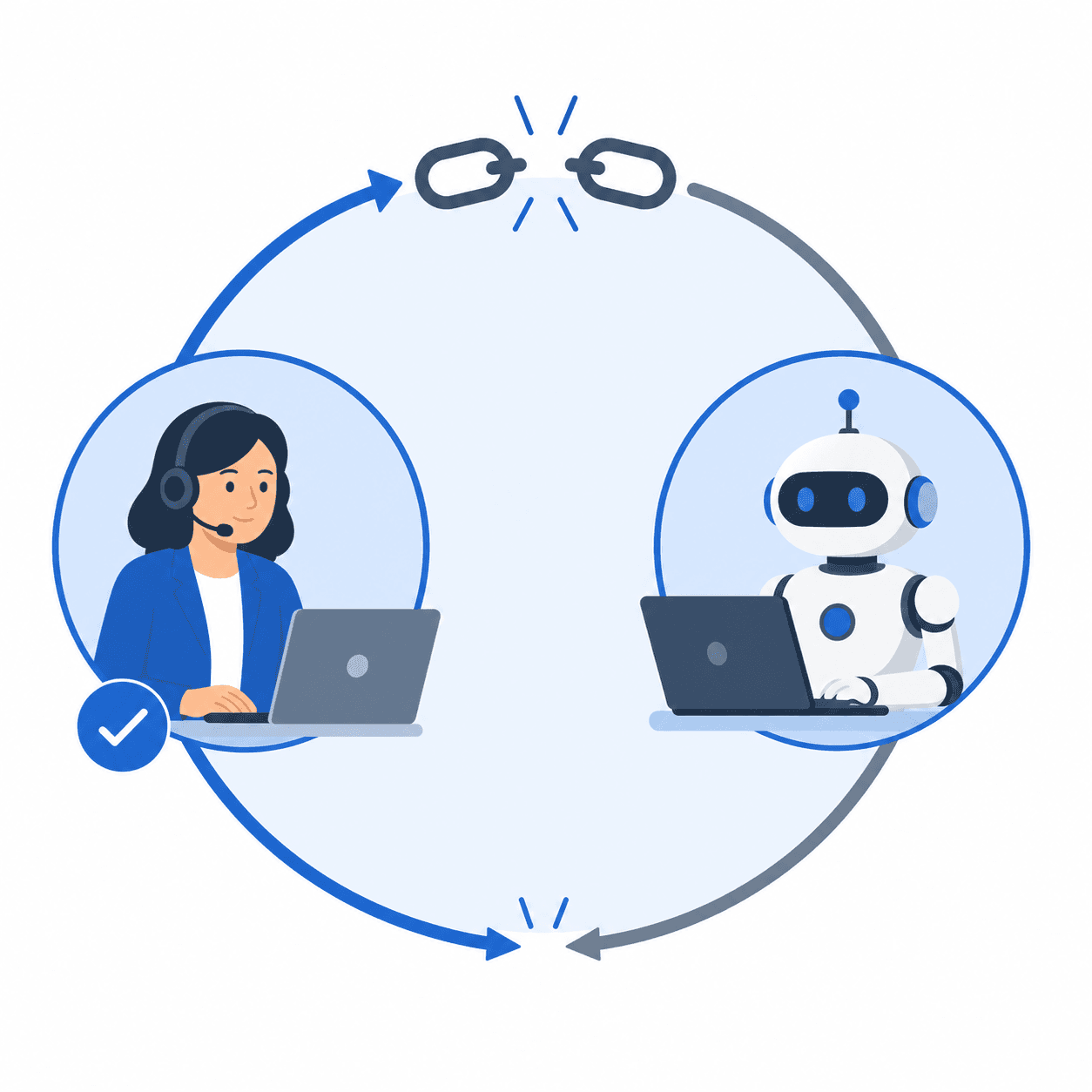
This is the Knowledge Death Spiral. The help center goes stale, articles start contradicting each other, AI confidence drops, and the support team becomes a documentation factory. Without a self-learning loop, resolution rates plateau at 50 to 60 percent.
Neither Sierra nor Decagon closes this loop structurally, which is why autonomous customer service platforms that self-learn are increasingly the benchmark. AOPs in Decagon are written once and updated by hand. Sierra's brand-alignment architecture has no automated mechanism to push human resolutions back into the agent's knowledge. The ceiling is wherever your ops team's documentation bandwidth runs out.
Fini built Knowledge Atlas to break this pattern. When a human resolves an escalation, Atlas extracts the solution, drafts an article, files it in the correct branch of the knowledge tree, and surfaces it for review before publishing.
The agent gets smarter from every ticket it could not handle, without anyone rewriting procedures manually. Resolution rates for teams running Knowledge Atlas reach 85 to 90 percent, with ops time on documentation dropping to roughly 2 hours per week.
Fini Resolves What Sierra and Decagon Cannot
Resolution Rate 90% at 99% accuracy. Live in 14 days. 3M+ monthly resolutions across fintech and healthcare already in production. For a full breakdown, see the VP of CX support evaluation guide. Those are the numbers Sierra and Decagon would need to match.
When Fini routes a ticket to a human, the handoff includes full context and an AI-generated conversation summary. When the human resolves it, that resolution feeds back into the knowledge tree. Atlas went from 15% to 70% automation on key support journeys. That kind of improvement requires a loop, not a one-time setup.
Voice, chat, and email run on one reasoning layer with one audit trail. Compliance is built in from day one: SOC 2 Type II, PCI DSS Level 1, ISO 27001, GDPR, HIPAA-compliant, BAA-eligible, CCPA. See how Fini ranks among AI support platforms for autonomous resolution. For fintech and healthcare procurement teams, that is the baseline for passing review.
How Fini's Rollout Compares
Day 1, the helpdesk and knowledge base connect. The agent handles FAQ-level tickets immediately. No code required. Day 14 agentic workflows: billing, CRM, and internal tools connect, and Fini takes real actions: refunds, account updates, data pulls. That is the live milestone. Day 30, the agent runs fully autonomous across voice, chat, and email, self-learning active, no tuning needed.
That is a committed schedule, not an estimate. Sierra and Decagon give you white-glove onboarding and a scoping call. Fini gives you a milestone you can put in a board update. For a side-by-side view, see best AI customer service agents compared.
Fini's Commercial Terms vs. Opaque Pricing
Sierra and Decagon will quote you a number after several weeks of scoping. Fini publishes its pricing: $0.89 per resolved ticket on Growth, $0.69 on Scale, $0.49 on Enterprise. No per-seat fees. Escalations are free.
The Fini Zero Pay Guarantee is the commercial commitment neither competitor offers: 90% resolution in 90 days, or you pay $0. Enterprise customers also get a 90-day free pilot on live traffic, with resolution, CSAT, and accuracy targets agreed in writing before the clock starts.
Before any of that, send us 1,000 real tickets. We'll run them on your data and return the accuracy score. If the math doesn't work, you walk.
Final Thoughts on Sierra, Decagon, and What Enterprise Support Actually Needs
Both products handle brand-aligned conversations. What your team will feel 90 days post-launch is the part neither vendor solves: escalations that don't improve the agent, knowledge that drifts without constant manual updates, and resolution rates that stop climbing. That gap has a cost, and it compounds.
Talk to us if you want to see what a self-learning loop looks like on your actual ticket data.
FAQ
Is Sierra better than Decagon for enterprise support teams that need consistent policy compliance?
Decagon's agent operating procedures give you one written procedure applied across channels, which suits teams where compliance consistency is the main requirement. Sierra's strength is brand-aligned conversational quality across voice, chat, email, SMS, and WhatsApp. Neither publishes a compliance stack covering SOC 2 Type II, HIPAA-compliant, and BAA-eligible out of the box, which creates a procurement blocker for fintech and healthcare teams before the feature comparison even begins.
How do Sierra and Decagon differ on pricing transparency?
Both require a sales call before you see a number. Sierra's contracts are estimated to start at $150,000 annually, with some analyses placing year-one spend at $1.5M or more for larger deployments. Decagon follows the same opaque, usage-based model. Neither publishes tiers, a calculator, or a resolution guarantee you can hold them to after signing.
When should you choose Decagon over Sierra?
Decagon is the stronger fit when your team wants to write procedures once and apply them across channels without rebuilding configurations per channel. Sierra is the stronger fit when brand voice and conversational tone across SMS and WhatsApp are procurement requirements. If your real requirement is a self-learning loop that improves resolution rates past 60% without manual documentation work, neither product closes that gap.
Why do Sierra and Decagon resolution rates plateau for high-volume enterprise teams?
Neither product ships a mechanism that feeds human-resolved escalations back into the agent automatically. When a human closes a ticket the AI could not handle, that resolution stays in the ticket queue. The agent does not learn from it. For teams running 100,000-plus tickets per year, that means resolution rates stall at 50 to 60 percent and ops teams spend roughly 20 hours per week maintaining knowledge that should be maintaining itself.
Can Fini replace Sierra or Decagon without a long migration process?
Fini connects to your existing helpdesk on Day 1 with no code required, goes live on agentic workflows by Day 14, and reaches full autonomy across voice, chat, and email by Day 30. Sierra and Decagon both require scoping calls before configuration begins, with Sierra deployments commonly reported at 4 to 8 weeks after contract signing. Fini's commercial terms also differ: pricing is published at $0.89 per resolved ticket on Growth, $0.69 on Scale, and $0.49 on Enterprise, backed by the Zero-Pay Guarantee: 90% resolution in 90 days, or you pay $0.
Related guides
Explore the guide topics to find more reading.
Co-founder