Last Updated:

Deepak Singla
IN this article
Explore how AI support agents enhance customer service by reducing response times and improving efficiency through automation and predictive analytics.
You're counting solved tickets, but that doesn't tell you whether your approved knowledge had the answers. A request can need human approval and still have complete guidance; an article match can leave key steps missing. We'll separate answer availability from resolution, then use consistent ticket checks to build a coverage score you can trust.
TLDR:
Count tickets as covered only when current, approved knowledge fully answers the question.
Calculate knowledge coverage: covered incoming tickets / total incoming tickets × 100.
Use 30 to 90 days of your ticket data to set a baseline. Track resolutions separately.
Rank knowledge gaps by uncovered ticket count in each category to choose what to write first.
Fini's coverage loop quantifies knowledge gaps and drafts articles for your team's approval.
What support knowledge coverage actually measures
Support knowledge coverage measures the share of incoming support ticket volume your approved, current knowledge base can answer. It connects knowledge base metrics to actual customer demand.
Count a ticket as covered only when approved knowledge answers the customer's question fully and applies to their situation.
Article count tracks publishing output. Page views track traffic. Keyword rankings track search visibility. None measures whether your knowledge base contains the answers customers need. A large library can still leave recurring questions unanswered unless you run an AI knowledge base that updates itself. Measure coverage against requests reaching your queue.
Why most teams measure the wrong thing
Publishing quotas reward completed articles even when recurring ticket questions remain unresolved. Content output is not a support knowledge coverage metric.
Answerbase's guide to measuring knowledge describes rankings, traffic, and content volume as incomplete measures of whether customers receive needed knowledge. Search impressions can reward a popular topic while a less visible billing exception keeps filling your queue, which is why teams train AI on company knowledge directly from ticket data.
Before approving the next article, require ticket evidence showing which incoming requests it will cover. Measure support volume covered by approved knowledge, not publishing activity.
The core formula: knowledge coverage rate
Knowledge coverage rate = (mapped incoming tickets / total incoming tickets) × 100.
Variable | Counting rule |
|---|---|
Total incoming tickets | All tickets received within the reporting window |
Mapped tickets | Tickets fully answerable by existing, approved knowledge |
Approved | Reviewed and authorized by the responsible knowledge owner |
If 600 of 1,000 tickets qualify, coverage is 60%. Count each ticket once, even when several articles apply.
Exclude deflected sessions. Gainsight warns that false deflection includes abandonment. Track confirmed resolutions separately: knowledge coverage measures answer availability, not resolution outcomes.
How to segment coverage by ticket category
A 70% aggregate support knowledge coverage score can hide 0% coverage in a high-volume billing category. Segment the total before choosing which knowledge gaps to close.
Assign each ticket a primary category, such as billing or account access.
Track product area and customer segment in separate fields.
Split tickets by channel: email, chat, or voice.
For each slice, divide tickets covered by approved knowledge by total incoming tickets in that slice. Show the uncovered ticket count beside the percentage, then sort by uncovered count to surface gaps affecting the most tickets.
Identify knowledge gaps from ticket data
Start with ticket text and resolution notes. Group requests by the answer they need, since different wording can reflect the same intent.
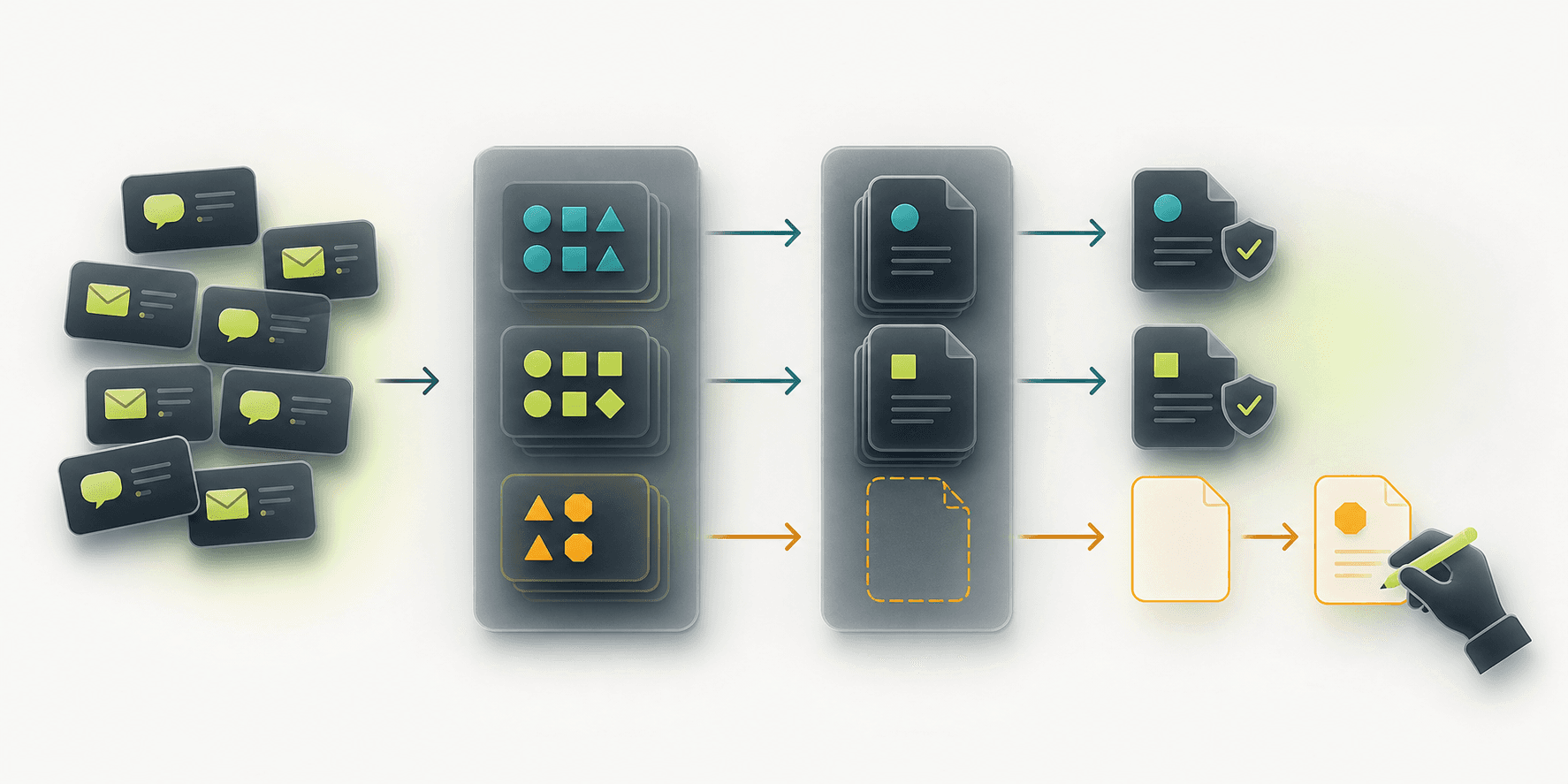
Label intents in a ticket sample manually, or use AI to propose clusters for human review.
Count tickets per cluster within a consistent reporting window.
Compare clusters with approved articles. Tag missing answers as knowledge gaps.
Rank gaps by ticket count to decide what to write first.
Attach representative tickets and the missing answer to each writing task. Label sample counts as sampled volume.
Set a baseline and target coverage rate
Pull 30 to 90 days of ticket data and map topics to measure support volume covered by approved knowledge. Choose a period reflecting normal demand; flag incidents and seasonal peaks.
Check exceptions and approval status before counting topic matches as covered. Broad matches can inflate your baseline.
Set a target based on gaps you can close within a defined period. Ticket complexity makes 100% coverage a poor default goal.
Separate requests requiring human judgment from documentation gaps, which is where help centers that spot content gaps prove useful.
The relationship between coverage rate and resolution rate
Knowledge coverage measures approved answer availability; resolution measures whether the issue was solved. High AI resolution requires coverage, correct application, and completion of required actions.
An article match is insufficient. Outdated, conflicting, or incomplete instructions should fail your coverage check, even if a mapping tool counts them, which is why platforms that detect conflicting answers matter here.
To turn coverage into resolved tickets:
Test answers against representative cases and policy exceptions.
Verify that AI follows instructions and completes required actions.
Check outcomes and repeat contacts.
HelpKit recommends tracking tickets per active customer to account for customer growth when measuring help center impact.
How knowledge staleness undermines coverage scores
Stale guidance can inflate your support knowledge coverage metric. Add a freshness check to each ticket-to-article mapping and track:
Average article age across mapped articles.
Last-updated date, checked against relevant policy or product changes.
Conflict flags for competing instructions.
Use age to trigger review, not automatic rejection. Remove mappings from the covered count when review finds obsolete answers or unresolved contradictions.

Count escalations caused by failed guidance as coverage failures. Tickets requiring human approval can remain covered. Apply this distinction when reviewing knowledge contribution quality.
How to track coverage improvement over time
Review your support knowledge coverage metric alongside other customer service KPIs for AI support teams weekly or monthly with consistent counting rules. Log changes to separate content gains from changes in ticket mix.
Use one reporting row per category:
Current coverage and change since the previous period.
Gaps closed and approval dates for added articles.
Escalation count and share of category tickets.
Owner and next review date for remaining work.
Compare escalations before and after each article goes live. If coverage rises but escalation volume stays flat, check category demand and read escalated tickets before crediting the update. Keep in mind what makes AI knowledge bases for human agents effective in escalation flows.
Fini Scout: measuring and closing coverage gaps continuously
Questions outside approved knowledge leave support teams with a coverage gap and no clear repair queue. We built Fini’s coverage loop to read tickets, reviews, and Slack threads, quantify gaps, and draft articles for approval.
Find questions approved knowledge cannot answer and turn them into a queue of knowledge fixes.
Review drafted articles before approving them for support use.
Our autonomous AI support agent talks to customers.
The coverage loop works for your team, connecting the support knowledge coverage metric to content upkeep.
Snapdocs raised the share of customer questions covered by approved knowledge.
Get Scout in your Slack.
Final thoughts on knowledge coverage gaps
A total score can hide gaps in your busiest categories. You can start with the category that has the most uncovered tickets. Discuss your next knowledge fix with us.
FAQ
When should Fini count multiple questions as covered?
Count a ticket as covered only when approved, current knowledge fully answers every question in it. If one answer is missing, keep the ticket outside the covered count and record the missing intent so your repair queue stays precise.
Which Fini Scout drafts should you review first?
Review drafts tied to recurring unanswered questions, then move policy-sensitive gaps ahead when incorrect guidance carries greater risk. Give each draft a knowledge owner and representative tickets to test before approval; article volume alone should not determine your review order.
How do you verify Fini Scout coverage gains?
Test the old and updated approved knowledge against the same ticket sample to isolate content gains from changes in customer demand. Keep counting rules fixed, check policy exceptions, and report that result beside coverage for your latest incoming tickets.
Related guides
Explore the guide topics to find more reading.
Co-founder