Last Updated:

Deepak Singla

IN this article
Explore how AI support agents enhance customer service by reducing response times and improving efficiency through automation and predictive analytics.
Customers are starting to send personal AI agents, such as Meta's Muse, OpenAI's Dots, Google's Gemini or Pine, to contact support for them. If you want the background on what these agents are and why they change support, read our explainer on personal AI agents in customer support. This post is the practical part: a checklist your support ops team can work through before the first agent-led request reaches a sensitive workflow.
TLDR:
Decide how you will spot agent traffic, then tag it instead of blocking it.
Verify the account holder and the agent's delegated authority as two separate checks.
Write policy limits per action: what an agent can read, request and never execute alone.
Define handoff triggers and what the handoff record must contain.
Log approval evidence, returned data, outcomes and the policy version for every decision.
Measure consistency and exposure on tagged exchanges before you widen scope.
Before you start: scope and owners
CNBC reports growing competition in personal agents, but no public source measures how much support traffic they create yet. Plan from your own queue, not market headlines.
Name one owner in support ops and one reviewer in compliance or risk.
Pick two or three low-risk request types for the first rollout (for example order status, booking changes, balance questions).
Keep refunds, transfers and payout changes out of scope until the checks below pass.
Step 1: Identify agent traffic
List the signals you will treat as "likely agent": self-disclosure, structured or templated messages, very fast reply cadence, known agent sender domains or phone numbers.
Treat these as tagging signals, never as identity proof.
Add an "agent-led" tag or field in your helpdesk so these conversations can be filtered, reviewed and reported on.
Decide your default stance: accept through controlled intake, apply the same eligibility rules as human requests.
Ask the sender directly whether it acts for the account holder, and record the answer.
Step 2: Verify identity and delegated authority
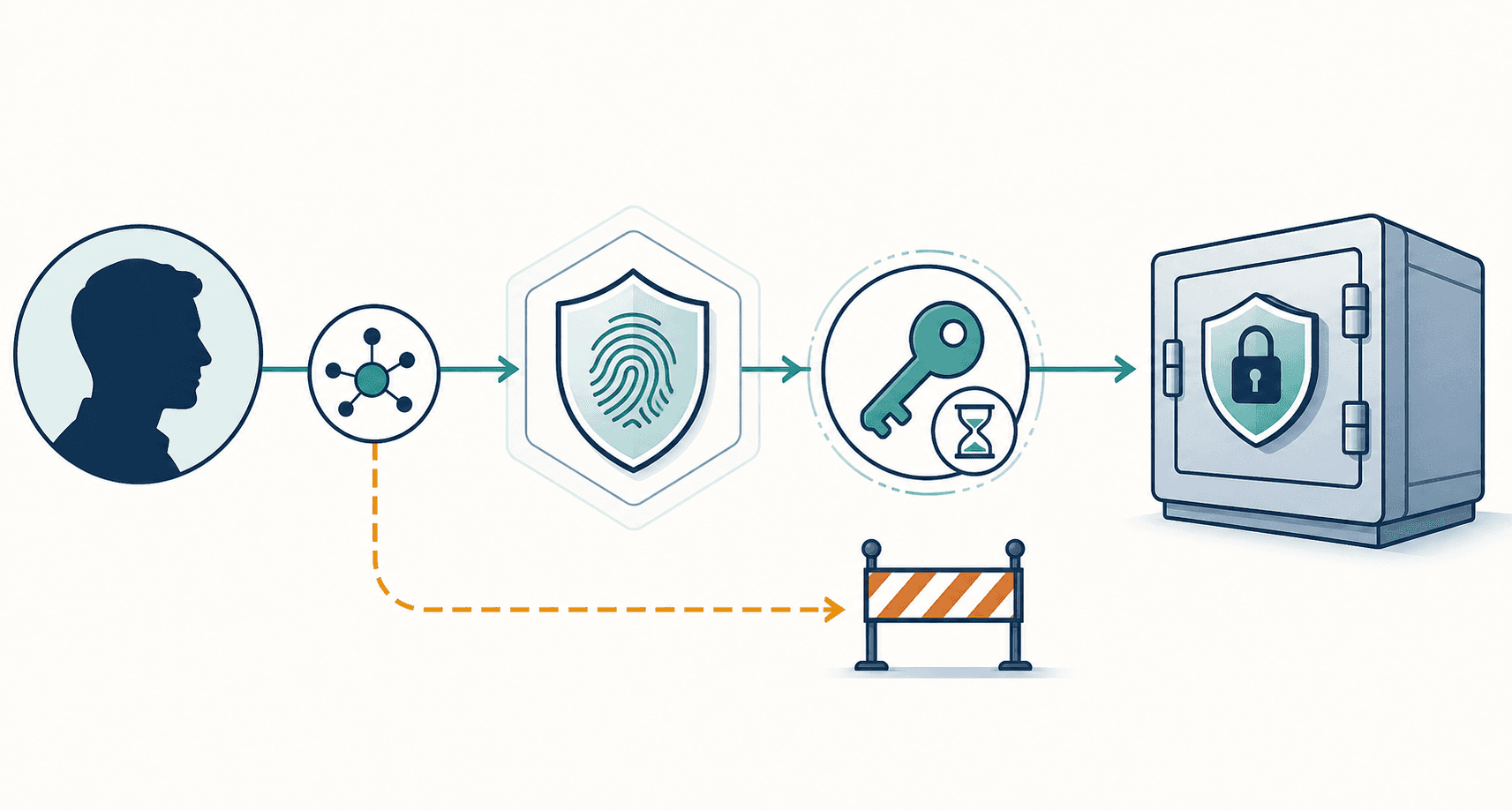
Verify the account holder through your existing approved process. Transaction details an agent already holds do not prove ownership.
Check the delegated authority separately: which tasks the customer allowed, and when that permission expires.
Confirm scope per task. Permission to read a balance does not authorize moving funds.
Define which actions need direct customer confirmation through a trusted channel (app push, verified email, known phone number).
If authority is missing or unclear, pause and send the account holder a verification path. Do not continue on the agent's word.
For the authentication pattern behind sensitive actions, see OAuth authentication for account closures.
Step 3: Set policy limits per action
Write a short table for each in-scope request type: what the agent may read, what it may request, and what always needs customer approval.
Gate refunds, transfers and payout changes behind direct customer approval, plus staff review where your risk policy requires it.
Return only the fields the authorized task needs. Cap record counts and date ranges; never return full transaction histories for a balance question.
Make eligibility depend on account facts and written rules, not on wording. A rejected "refund" renamed as a "courtesy credit" with the same facts must get the same answer.
End data access when the task finishes or the permission expires.
The tested hallucination prevention guide covers why retrieval-based replies drift when phrasing changes.
Step 4: Define handoff to a human
List handoff triggers: unclear authority, disputed decisions, requests outside the approved task, repeated retries of a rejected request, any money movement you have not automated.
Name the receiving team for each trigger.
Require the handoff record to carry verification status, approval evidence, the policy version applied and actions already taken.
Set the condition for resuming: what the customer or agent must provide before the request continues.
Add a loop stop: after a set number of retries with unchanged facts, close with the same answer or escalate.
Step 5: Log every decision

Log the requested action, the agent-led tag, verification and authority results, and approval evidence.
Log which data fields were returned to the agent.
Log the decision, the rationale and the policy version that applied at the time.
Log the execution result and any handoff.
Agree retention periods with counsel, especially for fintech and healthcare workflows. Our fintech support compliance automation guide covers audit evidence in more depth.
Step 6: Measure and widen scope
Decision consistency: do reworded requests with unchanged facts get the same outcome?
Exposure: any confidential fields (card numbers, internal notes) reaching an agent?
Approval gaps: any action executed without recorded customer approval?
Outcomes: completed requests, handoffs and reopened cases for agent-led versus human-led contacts.
Review tagged exchanges on a fixed schedule. Widen scope only when these stay clean for a full review cycle.
Where Fini fits
Fini's Agent Handshake tags likely personal agents in the Inbox and applies the same policies you set for human customers. Eligibility comes from live account data and written rules, so rewording a request does not change the decision. Before a reply goes out, Fini checks it for confidential fields, banned terms and link restrictions, and a failed check triggers a rewrite or escalation. You can route any money-moving action to a human.
Fini handles 3M+ monthly resolutions and is SOC 2 Type II · ISO 27001:2022 · PCI DSS Level 1 · HIPAA-compliant · BAA-eligible · GDPR · CCPA. Pricing starts at $0.49 per resolution, and teams deploy anywhere in 2 mins, fully live in 14 days and fully autonomous in 30 days, backed by our 90-Day Money-Back Guarantee. See how this works in practice in the Atlas story.
FAQ
Should we block personal AI agents from support?
No. Accept them through controlled intake and apply the same eligibility rules as human requests, with separate checks for account ownership and permission to act.
Is an agent's "yes" enough to approve a refund?
No. Require direct customer approval through a trusted channel before executing a refund, record it, and complete any staff review your money-movement policy needs.
Do we need to prove a sender is an AI agent first?
No. Check identity and authority for every sender. Agent signals are for tagging and review, not proof of identity.
Which workflows should we start with?
Two or three low-risk request types, such as order status or booking changes. Keep refunds, transfers and payout changes behind customer approval until your measurements stay clean.
What should a handoff record contain?
Verification status, approval evidence, the policy version applied, actions already taken and the condition for resuming the request.
Related guides
Explore the guide topics to find more reading.
Co-founder