Last Updated:

Deepak Singla

IN this article
Explore how AI support agents enhance customer service by reducing response times and improving efficiency through automation and predictive analytics.
AI chatbots close 44.8% of tickets. An AI support agent closes 90%. The gap is write access, not conversation design. Here's how to tell the difference, and what it means for the work your team still has to do manually.
TLDR:
A chatbot retrieves text and stops. An AI support agent queries your systems, applies policy, acts, and closes the ticket.
Containment rate and resolution rate are not the same metric. High containment with flat CSAT is where churn hides.
AI chatbots fully resolve about 44.8% of conversations. An agent that writes to your systems closes the gap.
Ask any vendor five questions: can it write to backend systems, hold context, escalate with full history, self-improve, and report resolution not containment?
Fini connects to billing, CRM, and claims infrastructure, runs 3M+ monthly resolutions at Resolution Rate 90%, and goes live in 14 days.
What a Chatbot Actually Is
A chatbot maps inputs to outputs. You type a question, it matches your words against a predefined list, and returns the closest pre-written answer it can find. No reasoning. No memory. No action.
The architecture underneath most chatbots is simpler than people assume. Intent classification routes your message to a response bucket. If your message fits a bucket, you get an answer. If it doesn't, you get "I didn't understand that" or a transfer to a human.
Generative AI has made chatbots more conversational, but the fundamental shape hasn't changed. A chatbot retrieves or generates text, then stops. It cannot look up your account, reverse a charge, or update a record without a human completing the action on the other end.
What an AI Support Agent Actually Is
An AI support agent doesn't retrieve an answer and stop. It receives a request, reasons over it using account data and policy, decides what action to take, executes that action across connected systems, and closes the ticket. The entire sequence runs without a human touching it.
The architectural difference is real. Where a chatbot pattern-matches text, an AI support agent holds a reasoning loop: interpret the request, query the right system, apply the relevant policy, act, confirm, log. A customer reporting a duplicate charge gets the charge reversed, not a response that says "please contact billing."
"Agentic" in a support context means the system can write as well as read. It can process a refund in Stripe, update an account status in your CRM, or pull transaction history from a data warehouse, then confirm the resolution to the customer in the same conversation. The distinction is system access with decision authority, not a better chat interface.
Human intervention enters when the agent hits a case it can't resolve confidently. That escalation is a design choice, not a failure state. In a well-deployed agent, it covers a fraction of volume. The rest closes without anyone on your team knowing the ticket existed.
Five dimensions: AI agents vs. chatbots
Dimension | Chatbot | AI Support Agent |
|---|---|---|
Input processing | Pattern-matches keywords to response buckets | Reasons over intent, account state, and policy together |
Output | Generates or retrieves text, then stops | Takes action across connected systems and closes the ticket |
Memory | Stateless across sessions | Carries context within and, where configured, across conversations |
Decision-making | Follows a script or prompt | Applies policy to a specific account situation, then decides |
Learning | Static until a human updates it | Detects its own knowledge gaps and improves from resolved tickets |
Each row in that table points to a real production difference.
A chatbot processing "my refund hasn't arrived" matches those words to a response template. An agent queries your payment processor, checks the refund status, and either confirms the timeline or initiates a new refund based on what it finds.
The self-improvement gap is where support cost diverges most. Chatbots require a human to notice the gap, write the fix, and redeploy. Fini surfaces gaps automatically, drafts the correction, and queues it for review. Your team approves, not authors.
The containment trap: wrong metric, hidden problem
Containment rate measures whether a customer stopped talking to the bot. Deflection vs. true resolution rate measures whether their problem got solved. Those are different things, and conflating them is how a support team ends up with strong dashboards and declining CSAT at the same time.
According to Comm100's AI Live Chat Benchmark Report, AI chatbots fully resolve about 44.8% of conversations without human intervention. Industries with high containment rates don't reliably produce high satisfaction scores. A customer who stops escalating after a vague answer has been contained, not helped. That gap is where churn hides.
What an AI support agent can actually do
The action layer is where the chatbot-vs-agent question stops being theoretical. AI support agents beyond chatbots connect to your backend systems and take actions your team would otherwise handle manually.
Concrete examples from production deployments:
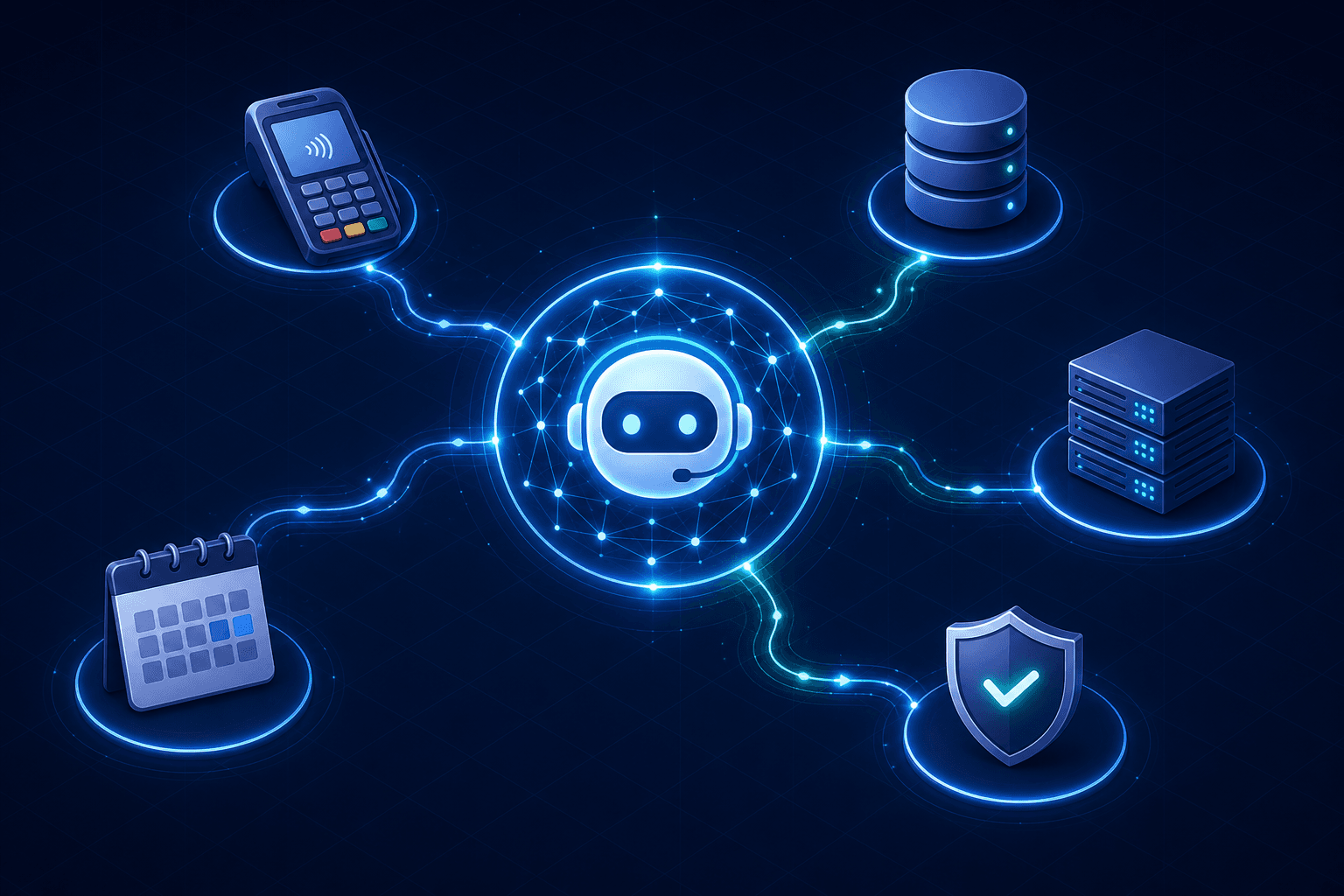
Processing refunds directly in Stripe when a duplicate charge is confirmed
Updating account status in a CRM after a verification check passes
Pulling transaction history from a data warehouse to answer a dispute
Rescheduling bookings by writing back to a reservations system
Running KYC lookups and returning a result within the same conversation
Each of these requires a real integration, not a conversation flow. The agent queries the system, reads the state, applies the relevant policy to that specific account, acts, and logs every step. Fini generates a full audit trail on every decision, which matters in compliance-driven industries where AI agents for compliance-critical support require more than "the AI did it" during a compliance review.
An action without a log is a liability. Every refund Fini processes, every account it updates, every record it pulls traces back to a specific policy, a specific trigger, and a specific outcome. That is what separates an agent running in a compliance-driven environment from a script that happens to call an API.
Agent-washing: how to spot a chatbot in disguise
Every vendor in the support space claims to have an "agent" now. Most of them have a chatbot with better marketing copy.
Agent-washing is straightforward to spot if you ask the right five questions during any vendor evaluation:
Can it take a backend action? Retrieve and write, beyond read-only. If the demo shows a conversation but the refund still requires a human to click something, it's a chatbot.
Does it maintain context across turns? A real agent carries what happened earlier in the conversation without being reminded. A chatbot resets.
Does it escalate with full context attached? When it hands off to a human, does the agent receive a complete summary and the conversation history, or does the customer have to repeat everything?
Does it improve without manual retraining? If someone on your ops team has to author fixes when new edge cases appear, that's automation, not autonomy.
Does it measure resolution, not containment? Ask the vendor which metric they report as their primary performance number. Containment is a chatbot metric. Resolution is an agent metric.
Any vendor who can't answer all five cleanly is selling you an upgraded chatbot at an agent price. See how the best AI customer service agents compare across these dimensions.
Chatbot vs. AI support agent: which to use
Chatbots fit a narrow, stable problem set. If your top 20 questions never change, require no account lookup, and can be answered with a single text response, a chatbot handles that volume cheaply and reliably. FAQ deflection for return policies, store hours, or shipping timelines fits that profile.
The calculus changes when a question requires pulling account data, applying transaction logic, processing a request that differs based on customer state, or producing an answer that must be accurate under regulatory scrutiny. A chatbot cannot do those things without a human completing the action. An agent can.
Volume alone does not determine the choice. A team handling 10,000 tickets a month of identical questions may genuinely be fine with a chatbot. A team handling 5,000 tickets where half involve billing disputes, account changes, or compliance-sensitive answers needs one of the top AI agents for customer service.
The clearest signal: if containment is up but CSAT is flat, or your team is still manually closing tickets the bot claimed to handle, you have outgrown it.
How AI agents handle escalation and handoff
Escalation in a well-designed agent is a deliberate tier, and the quality of information that travels with the handoff determines whether the human agent picks up a solvable problem or starts from scratch.
Fini scores every query by confidence before acting. High-confidence cases auto-resolve. Mid-confidence cases produce a drafted response queued for agent review. Low-confidence cases, and anything legally sensitive, follow bot-to-human escalation rules with the full conversation history and an AI-generated summary already attached.
The receiving agent sees what was asked, what was attempted, and why the agent stopped, before saying a word to the customer.
That context transfer is where most escalations break down. A customer who has already explained their situation to an AI and then has to repeat it to a human is a churn signal, not a resolved ticket. When the threshold is calibrated correctly, your team handles complexity, not repetition.
How AI agents manage their own knowledge
Chatbots don't know what they don't know. When a question falls outside the knowledge base, the bot deflects or escalates, but nothing records that gap for later. Someone on your team has to notice the pattern, write the fix, and redeploy. That cycle repeats every month.
Fini's Knowledge Atlas runs a different loop. It ingests escalated conversations nightly, identifies what the agent couldn't answer confidently, drafts new articles from how your team resolved those tickets, and queues them for review before publishing. The team approves content; it doesn't author it from scratch.
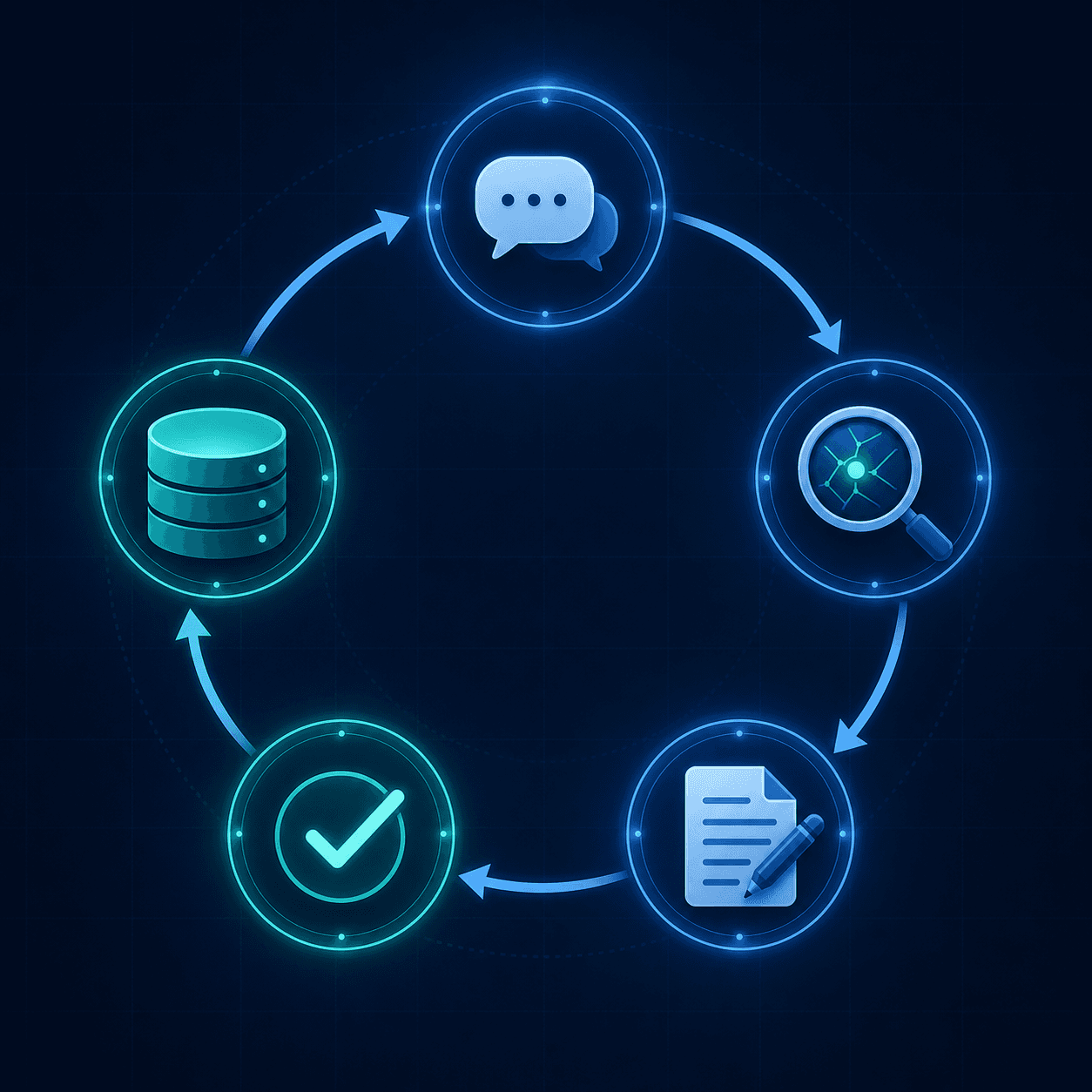
Three maintenance problems get handled automatically:
Conflicting source material gets flagged before it causes a wrong answer
Outdated policies surface in a reconciliation dashboard instead of quietly misfiring
Knowledge gaps appear as review items, not as an escalation spike two weeks later
Without that loop, resolution rates plateau. With it, teams move documentation from full authoring to review-only approval, while Resolution Rate holds at 90%.
Agentic AI in compliance-driven industries: what changes
Compliance-heavy industries carry requirements that make the chatbot-vs-agent question almost irrelevant. The real question is whether your AI can satisfy a compliance reviewer, and a customer.
Four requirements separate compliance-critical deployments from generic ones:
Every decision must be attributable to a specific policy source. AI guardrails for trustworthy support automation mean an answer traced to one authoritative source passes an audit, while one blended from five articles fails it.
PII and PHI require controlled access. The agent must query only what the customer's context authorizes, log what it accessed, and handle that data under the right residency and encryption constraints.
Identity must be verified before account actions. Processing a refund without confirming who is asking is a fraud risk, and a UX gap.
The audit trail must be exportable. "The AI resolved it" is not an answer a regulator accepts. Every action needs a timestamp, a policy reference, and an outcome log.
Most chatbots fail the first requirement by design. Generative responses blend sources.
Fini's Knowledge Atlas traces every answer to exactly one source article, which is the architecture that makes an answer defensible in a compliance review.
For healthcare, HIPAA-compliant and BAA-eligible status are the baseline, required before PHI touches the system.
For fintech, SOC 2 Type II, PCI DSS Level 1, and ISO 27001 cover the audit and data security requirements that compliance-driven buyers check before any AI goes near a customer account.
How Fini resolves the agent vs. chatbot question
Fini resolves tickets. That is the product definition, and it separates us from what most vendors in this space are actually shipping.
We connect to your billing system, CRM, and claims infrastructure. The agent queries account state, applies your policy, acts, and logs every step. Atlas went from 15% to 70% automation on key support journeys after deploying Fini. Not containment. Automation on journeys that previously required a human to close.
The Knowledge Atlas loop keeps that resolution rate from plateauing. When the agent hits a gap, it flags it, drafts a fix from how your team resolved the ticket, and queues it for review. Nothing requires authoring from scratch.
The Enterprise plan runs $0.49 per resolved ticket. Fini goes live in 14 days and reaches full autonomy by day 30. The Zero Pay Guarantee commits to 90% resolution in 90 days, or you pay $0. We run 3M+ monthly resolutions across fintech and healthcare at 90% Resolution Rate. See how AI support platforms solve accuracy to understand what that requires in practice.
Send us 1,000 real tickets. We return results on your data, not a staged demo.
Why the chatbot vs. AI agent distinction matters
Your support architecture is either closing tickets or creating follow-up work. A chatbot generates the second kind more than most teams realize, because containment and resolution are not the same metric. If you want to see the difference on your actual data, send us 1,000 real tickets and we'll return results before any conversation about pricing.
FAQ
AI chatbot vs AI support agent that takes actions: what's the real difference?
A chatbot generates or retrieves text and stops. An AI support agent connects to your backend systems, reads account state, applies policy to that specific situation, acts, and logs every step. A customer reporting a duplicate charge gets the charge reversed in Stripe, not a response that says "please contact billing." The architectural gap is write access with decision authority, not a better conversation interface.
How does Fini handle escalation to a human without losing context from the AI interaction?
Fini escalates with the full conversation history and an AI-generated summary attached, so the receiving agent never asks the customer to repeat themselves. The receiving agent sees what was asked, what was attempted, and why the agent stopped before saying a word to the customer. A customer who has to repeat their situation after an AI handoff is a churn signal, not a resolved ticket.
How do I identify whether a vendor is selling an AI support agent or just a chatbot with better marketing?
Ask five questions: Can it take a backend action by writing to a system, beyond read-only? Does it carry context across turns without being reminded? Does it escalate with full context attached? Does it improve without someone on your ops team authoring fixes? Does it report resolution rate as its primary metric, not containment? Any vendor who cannot answer all five cleanly is selling an upgraded chatbot at an agent price.
Best AI customer support for fintech that needs SOC 2 and strong auditability?
Fini holds SOC 2 Type II, PCI DSS Level 1, ISO 27001, GDPR, HIPAA-compliant, and BAA-eligible status, and generates a full audit trail on every decision: a timestamp, a policy reference, and an outcome log. Every answer traces to exactly one authoritative source article, which is the architecture that makes a response defensible in a compliance review. Atlas, a fintech customer, went from 15% to 70% automation on key support journeys after deploying Fini across those same compliance constraints.
Can an AI support agent process refunds and account changes without a human completing the action?
Yes. An AI support agent with real backend integrations can process a refund in Stripe, update account status in a CRM, pull transaction history from a data warehouse, and confirm the resolution to the customer in the same conversation. Fini logs every action with a full audit trail. A chatbot cannot do any of this without a human completing the step on the other end.
Related guides
Explore the guide topics to find more reading.
Co-founder