Last Updated:

Deepak Singla

IN this article
Explore how AI support agents enhance customer service by reducing response times and improving efficiency through automation and predictive analytics.
Six AI customer support solutions. One publishes a 90% resolution commitment backed by a 90-Day Money-Back Guarantee. The rest ask for a full sales cycle before sharing pricing or a performance number. Here is how they stack up on the criteria VP-level support teams actually get measured on.
TLDR:
Autonomous AI support agents resolve tickets end-to-end. Older tools deflect or assist, they do not close tickets.
Rank solutions on resolution rate, channel unification, compliance posture, time to autonomy, and self-maintaining knowledge.
Most vendors on this list publish no resolution rate, no go-live timeline, and no performance guarantee.
Sierra starts at $150,000 per year. Decagon and Maven AGI publish no pricing before a full sales cycle.
Fini resolves 90% of tickets at 99% accuracy across voice, chat, and email, live in 14 days, backed by a 90-Day Money-Back Guarantee.
What is AI customer support?
AI customer support, in its current form, means an autonomous agent that resolves tickets end-to-end across voice, chat, and email, without a human reviewing each response. That is a different thing from a chatbot following a script or a copilot suggesting replies for an agent to approve. The older tools deflect or assist. Autonomous customer service agents take real actions across connected systems, close the ticket, and log every decision.
How we ranked AI customer support solutions
Six criteria drove this ranking, each chosen because it maps to what VP-level support teams actually get measured on.
Deflection rate vs. true resolution rate: containment counts deflections. Resolution counts closed tickets. They are not the same number.
Channel coverage. Voice, chat, and email on one reasoning layer. Three separate vendors is not a solution.
Compliance posture. For fintech and healthcare, SOC 2 Type II, ISO 27001, HIPAA-compliant, and BAA-eligible are the floor.
Time to full autonomy. A six-month implementation is a headcount cost you forgot to model.
AI customer support pricing transparency. Outcome-based pricing aligns incentives. Per-seat and per-engagement models do not.
Self-maintaining knowledge. If your ops team is still retuning the agent every month, you bought a different problem.
Best overall AI customer support: Fini
Fini is the autonomous AI support agent built for enterprise fintech and healthcare, resolving 90% of tickets at 99% accuracy across voice, chat, and email on a single reasoning layer.
Core strengths:
Resolution Rate 90% at 99% accuracy, unified across voice, chat, and email with one audit trail
Knowledge Atlas auto-detects gaps and generates articles from resolved tickets, with zero manual tuning
Compliance built in from day one: SOC 2 Type II · PCI DSS Level 1 · ISO 27001 · GDPR · HIPAA-compliant · BAA-eligible · CCPA
3M+ monthly resolutions across fintech and healthcare in production
Outcome-based pricing that starts at $0.49 per resolution, with no per-seat fees. See how Fini stacks up in our best AI customer service agents comparison
Day 1 · Day 14 · Day 30 rollout, live in 14 days, fully autonomous in 30
The 90-Day Money-Back Guarantee puts a floor under procurement risk.
What happens on Day 1, Day 14, and Day 30
The rollout runs in three named stages. A Knowledge Agent goes live on Day 1, agentic workflows that take real actions across connected systems are running by Day 14, and the agent reaches full autonomy by Day 30. Live in 14 days, fully autonomous in 30, with each milestone something procurement can hold the vendor to.
Fin (by Intercom)
Fin bills $0.99 per resolved outcome with no platform fee, and sits at 4.5/5 on G2 across 3,904 reviews, making it one of the most widely reviewed agents in the category. Two events in 2026 changed the buying calculus: Intercom renamed itself Fin on May 12, and Salesforce signed a definitive agreement to acquire it for $3.6 billion on June 15.
What to weigh before signing
Good for teams already running on Intercom who want outcome-based pricing without a platform migration.
The Salesforce acquisition introduces roadmap uncertainty on multi-year deals. Fin's resolution definition spans four distinct billable outcome types, which makes true cost-per-resolution comparisons harder than the headline rate suggests. Voice and email unification on a single reasoning layer is not publicly documented.
Channel coverage and billing detail
Fin covers chat, email, voice, SMS, WhatsApp, and Instagram, and runs on top of an existing helpdesk without a migration. Channel breadth is not the same thing as one reasoning layer, and the billing deserves a close read: among the four billable outcome types are conversations where the customer simply goes quiet, which makes total cost hard to predict at volume. The Salesforce deal is expected to close in early 2027, so any multi-year contract signed today spans the ownership change.
Ada
Ada has been building AI support automation since 2016 and now serves 350+ businesses across 85+ countries, with a customer base weighted toward retail, DTC, travel, and gaming.
The product covers chat, email, and voice with multi-LLM orchestration and holds SOC 2, HIPAA, GDPR, PCI DSS, CCPA, and CPRA certifications. Ada self-reports an 84% automated resolution rate across its customer base.
What to weigh before signing
Ada suits broad-market enterprises in retail and travel that need omnichannel coverage outside fintech and healthcare.
Two things make VP-level evaluation harder. Ada does not publish pricing or a time-to-autonomy commitment, so budget modeling requires a full sales cycle before you have numbers. Our AI customer service platforms comparison covers how Ada ranks on resolution. The knowledge improvement loop is manually driven: ops teams run test-analyze-optimize themselves, meaning maintenance burden scales with ticket volume. For fintech or healthcare buyers where compliance architecture needs to be a design center, not a listed certification, that gap matters.
Decagon
Decagon positions itself as an enterprise AI agent for CX, with sub-second voice latency and white-glove onboarding as its headline differentiators. Every deployment involves custom integration work, so you're buying a services engagement as much as a product.
What they offer
Enterprise AI agent with voice support and sub-second voice latency
White-glove onboarding and custom integration as standard deployment components
Under the hood, Decagon runs on agent operating procedures (AOPs): your team writes a procedure once, and the agent follows it to handle inbound queries across chat, email, and voice. Pricing is custom and usage-based, and the customer base leans toward retail, travel, and financial services teams running high inbound volume.
Good for: Large enterprise teams with no urgency on time-to-autonomy requirements and comfortable with a services-led process. For a broader view, see the best AI customer service software platforms reviewed for 2026.
Limitation: As noted in this 2026 breakdown of Decagon, there is no public pricing, no free trial, and no self-serve signup. Cost-per-resolution benchmarking is nearly impossible before you've committed sales cycles to a discovery process. There is also no documented stage-based rollout, so procurement risk stays opaque longer than most VP-level buyers prefer.
Bottom line: Decagon works for organizations with long planning cycles and dedicated implementation budgets. If you need a transparent path to autonomy with predictable outcome-based pricing, it is a poor fit.
Sierra
Sierra is an enterprise AI agent built for autonomous customer conversations at scale, with a customer list that leans heavily toward large consumer brands.
What they offer
Enterprise AI agent focused on conversational resolution
Custom integrations through a services-led deployment model
Good for: Large enterprises with ample budget flexibility and no urgency around pricing transparency or structured rollout timelines.
Limitation: Sierra's pricing starts at $150,000/year, with no published pricing page. The product scope focuses narrowly on autonomous conversations, without a self-maintaining knowledge loop.
Bottom line: Sierra fits the largest enterprise budgets, but opaque pricing and the absence of a staged rollout commitment make it a harder choice for VP-level buyers assessing AI customer service software automation who need predictable costs and a clear path to full autonomy.
Maven AGI
Maven AGI is an enterprise AI agent product targeting complex support operations and large tech stacks. Public documentation on pricing, resolution rates, or time-to-live commitments is sparse, which creates real friction for VP-level buyers who need defensible numbers before a procurement decision.
What they offer
Enterprise AI agent for complex, multi-system support environments
Focus on enterprise CX transformation at scale
Named customers include Tripadvisor, ClickUp, and Rho. In practice the product leans toward deflection: it answers inbound questions by surfacing content from existing documentation and knowledge sources, with integrations into helpdesk and knowledge base tools. That is a different job from closing the ticket end to end.
Good for: Enterprise teams in early evaluation who haven't run a proof-of-concept on production data.
Limitation: No published pricing, no resolution guarantee, and no documented staged rollout. Snapdocs, now a Fini customer, ran Maven AGI for roughly a year before switching. Without a structured commitment like a 90-Day Money-Back Guarantee, that risk lands entirely on the buyer.
Bottom line: Maven AGI may warrant evaluation if you have a long planning horizon and no urgency on pricing transparency. For buyers who need a verifiable resolution number before signing, see which AI support platforms actually deliver. The absence of any public performance commitment makes it difficult to defend internally.
Feature comparison table of AI customer support solutions
Feature | Fini | Fin (Intercom) | Ada | Decagon | Sierra | Maven AGI |
|---|---|---|---|---|---|---|
Resolution Rate Commitment | 90% | Not published | 84% reported | Not published | Not published | Not published |
Voice + Chat + Email Unified | Yes | Partial | Yes | Yes | Yes | Yes |
Self-Maintaining Knowledge | Yes | No | No | No | No | No |
Transparent Outcome-Based Pricing | Yes (from $0.49 per resolution) | Yes ($0.99/outcome) | No | No | No | No |
Published Time to Live | Yes (14 days) | No | No | No | No | No |
Compliance (SOC 2 · ISO 27001 · HIPAA) | Yes | Partial | Yes | Not published | Not published | Not published |
Performance Guarantee | Yes (90-Day Money-Back Guarantee) | No | No | No | No | No |
A few columns stand out. Fini is the only solution with a published time-to-live commitment, a self-maintaining knowledge layer, and a 90-Day Money-Back Guarantee. See how all top AI agents for customer service compare in our full breakdown. Fin (Intercom) matches on outcome pricing but does not publish a resolution rate or a go-live timeline. Ada clears the compliance bar but carries no performance guarantee and no published deployment window.
Why Fini is the best AI customer support solution
Every alternative on this list asks your ops team to carry some part of the maintenance load: retuning the knowledge base, managing vendor sprawl across channels, or interpreting opaque pricing before you can model ROI. Fini removes all three. Knowledge Atlas self-maintains. Voice, chat, and email run on one reasoning layer with one audit trail.
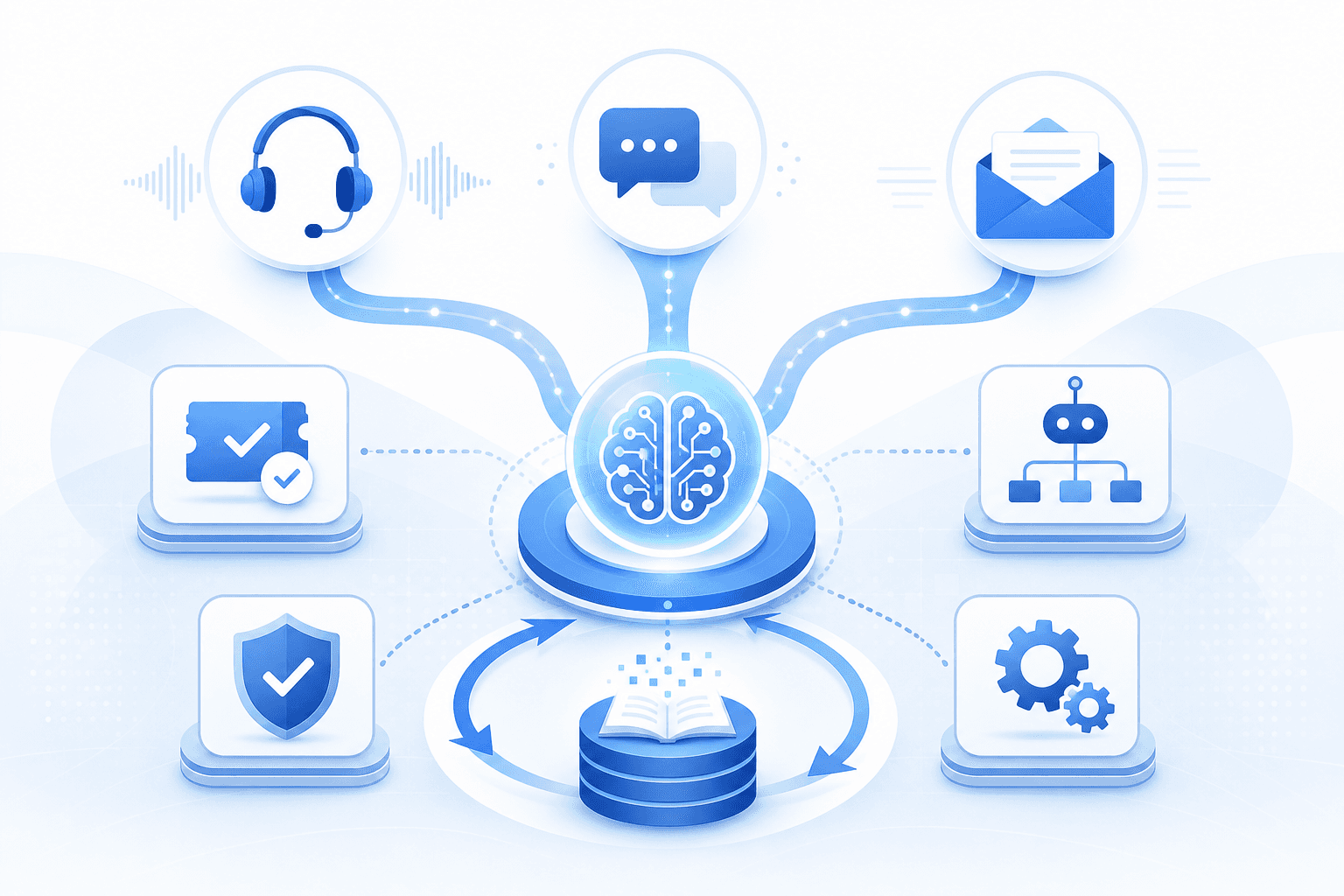
The commercial structure backs the claim. Pricing starts at $0.49 per resolution, with no per-seat fees. Atlas went from 15% to 70% automation. Send us 1,000 real tickets and we will prove it on your data.
Final thoughts on buying AI customer support tools
The criteria that matter most, resolution rate, time to live, pricing transparency, and compliance posture, are exactly the ones most vendors leave unpublished. That gap is a procurement risk that lands on your team. A 90% resolution commitment backed by a 90-Day Money-Back Guarantee is a different category of buying decision than a demo that ends with "we'll share pricing after discovery." Book an intro call and run the numbers on your own ticket volume.
FAQ
How do I choose between Fini, Fin (Intercom), Ada, Decagon, Sierra, and Maven AGI for an enterprise support team?
Start with three filters: published resolution rate, transparent pricing, and a documented time-to-live commitment. Fini publishes all three. Ada publishes a resolution rate but no pricing or deployment timeline. Decagon, Sierra, and Maven AGI publish none of the three, which makes internal budget defense harder before you have committed sales cycles.
Is Fini better than Fin (by Intercom) for fintech and healthcare support?
For fintech and healthcare, yes. Both offer outcome-based pricing, but Fin does not publish a resolution rate, a go-live timeline, or a performance guarantee. Fini holds SOC 2 Type II, PCI DSS Level 1, ISO 27001, HIPAA-compliant, and BAA-eligible certifications and is backed by a 90-Day Money-Back Guarantee, which is the compliance and commercial floor most fintech and healthcare procurement teams require.
When should a VP-level support team choose Sierra or Decagon over the other options on this list?
Sierra and Decagon fit organizations with long planning cycles, large implementation budgets, and no urgency on pricing transparency. If your team needs a verifiable resolution number before signing, a staged rollout with named milestones, or predictable per-resolution costs, both are poor fits. Neither publishes pricing, a resolution commitment, or a structured go-live timeline.
What is self-maintaining knowledge and why does it matter when comparing AI customer support solutions?
Self-maintaining knowledge means the agent detects its own gaps, generates articles from resolved tickets, and keeps the knowledge base current without manual input from your ops team. Of the six solutions reviewed, only Fini includes this through Knowledge Atlas. Without it, teams running Fin (Intercom), Ada, Decagon, Sierra, or Maven AGI carry the documentation load themselves, which scales with ticket volume.
How do I compare AI customer support solutions without committing to a full sales cycle?
Run a live benchmark on your own tickets before signing anything. Fini offers a 1,000-ticket benchmark on production data, backed by the 90-Day Money-Back Guarantee. Ada, Decagon, Sierra, and Maven AGI do not publish equivalent structured proof commitments, so meaningful cost-per-resolution comparisons require full discovery cycles before you have usable numbers.
Related guides
Guides
Best Ada alternatives for regulated support teams (Oct 2026)
Oct 1, 2026
Guides
The Complete Answer: Fini Language Support (Oct 2026)
Oct 1, 2026
Guides
Voice, Chat, Email on One AI Agent (October 2026)
Oct 1, 2026
Guides
AI Support vs Hiring Agents: Payback Period (Oct 2026)
Oct 1, 2026
Guides
6 Chatbase Alternatives Built for Real Resolution (Oct 2026)
Oct 1, 2026
Guides
Intercom Fin Alternatives: What to Do When Resolution Stalls and $0.99 per Resolution Adds Up
Sep 25, 2026
Co-founder