
Enterprise infrastructure vs. published fintech pricing
Sierra and Fini both sell AI agents that resolve customer support conversations, but they are built for different buyers. Sierra is enterprise infrastructure priced for Fortune 500 brands; Fini is packaged, published pricing for regulated fintech and healthcare teams that need to forecast cost before a sales call. The table below is the fastest way to see where they diverge, and every section after it goes deeper on one row at a time, pricing, capabilities, ease of use, compliance, and what actual customers and independent reviewers report once each platform is live in production.
In this comparison: What each is · How they differ · Capabilities · Feature by feature · Ease of use · What customers say · The full side-by-side · Which to choose · Compliance · FAQ
What is Fini?
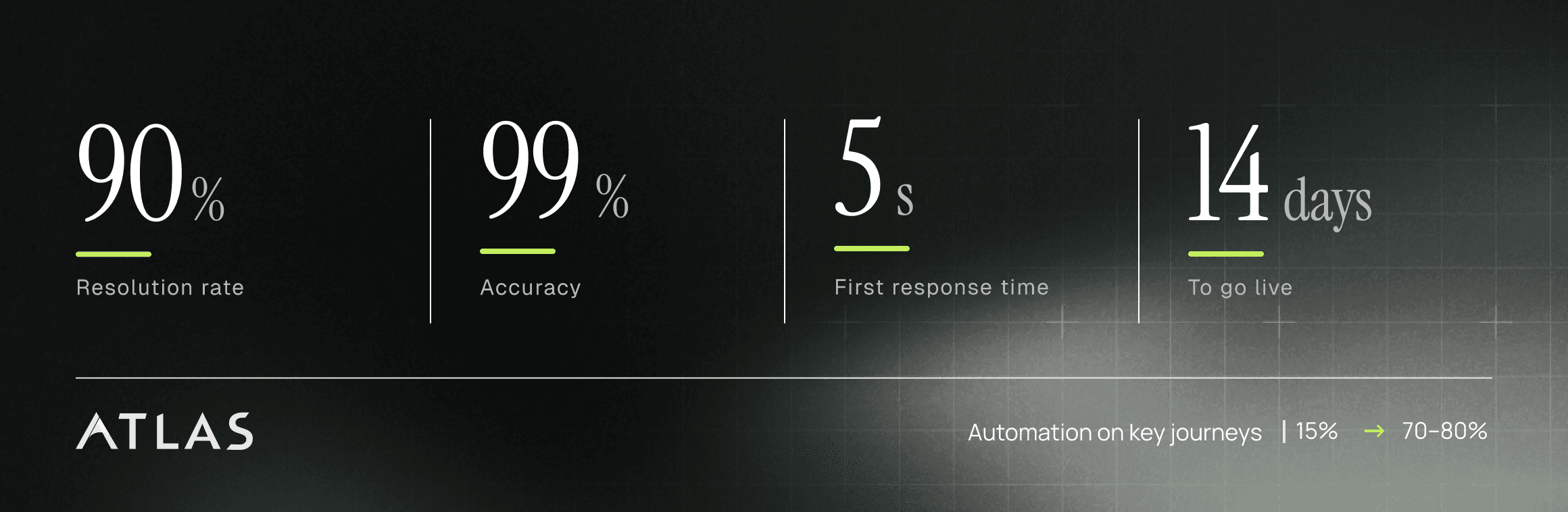
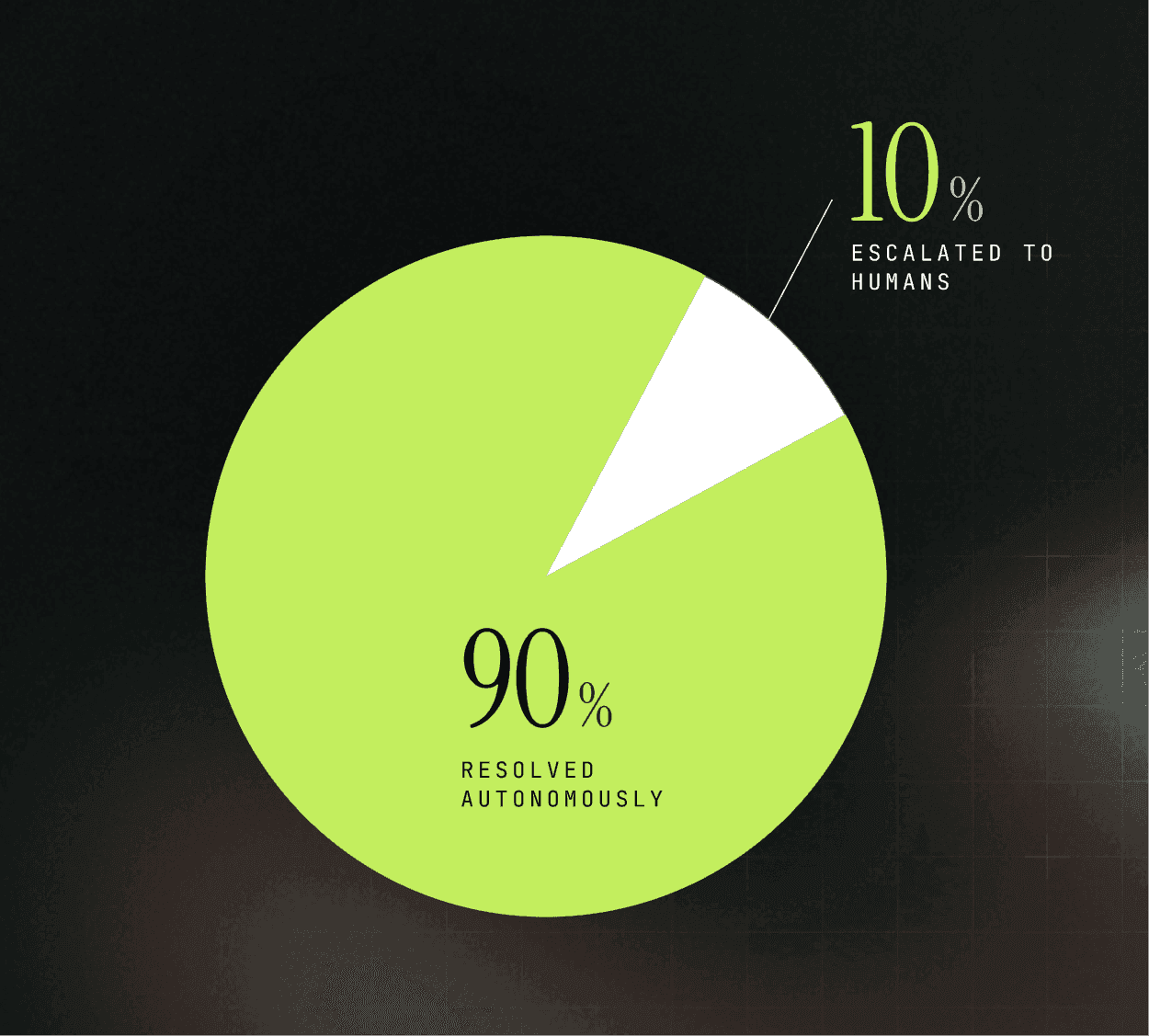
Fini is an AI customer-support agent priced per resolution, backed by Y Combinator and Matrix Partners. It connects natively to your helpdesk, knowledge base, CRM, billing, claims, and EHR systems, reaches a 90% resolution rate at 99% accuracy, and is built to go live in 14 days and reach full autonomy in 30. Across its customer base, Fini handles more than 3 million monthly resolutions in fintech and healthcare. The agent works across voice, chat, and email, answers in 130+ languages, and returns a first response in about five seconds.
The design center for Fini is a regulated support team that needs an agent to actually take action, not just answer questions: approving a refund, updating a KYC record, or walking a policyholder through a claims status change, all inside the compliance boundaries fintech and healthcare operators have to work within. Pricing is per resolution rather than per seat, and the published rate card means a team can model its own cost from ticket volume alone, before a sales conversation ever starts.
What is Sierra?
Sierra was founded in 2023 by Bret Taylor, former co-CEO of Salesforce and chairman of OpenAI’s board, and Clay Bavor, a longtime Google executive who ran the company’s AR/VR and later AI efforts. Sierra brands its product “Agent OS”, an operating-system framing that positions it as durable infrastructure a company builds its customer experience on for years, not a support-desk plug-in it swaps out. The pitch to a Fortune 500 buyer isn’t “install a chatbot,” it’s “replace the layer that sits between your brand and every customer conversation,” and the pricing, sales motion, and roadmap all follow from that framing.
The platform is built around seven modules. Agent Studio is the no-code builder a support or ops team uses day to day; Agent SDK is the developer-facing toolkit for teams that want to script more advanced logic directly. Insights 2.0 is the analytics layer that surfaces where agents are succeeding or failing across channels. Voice is Sierra’s dedicated speech pipeline, covered in more detail below. Live Assist is a human-copilot handoff mode that hands a live conversation to a human agent with full context, rather than dropping them into a cold transcript. The Agent Data Platform is a persistent, cross-channel memory layer so an agent remembers a customer’s history whether they called, chatted, or emailed. And Trust & Reliability is Sierra’s public compliance and security program, covered in the Compliance section below.
Sierra has raised $1.585 billion to date, most recently a $950 million Series E led by GV and Tiger Global that closed in May 2026 at a valuation above $15 billion, roughly triple where it stood about a year earlier on a $350 million round. That pace of valuation growth is unusual even by AI-infrastructure standards, and it signals how aggressively investors are betting on the “AI agent as platform” thesis rather than “AI agent as feature.” Reported annual recurring revenue sits near $200 million as of mid-2026. Sierra says it serves roughly 40% of the Fortune 50, with named customers including WeightWatchers, SiriusXM, Sonos, ADT, Chime, Cigna, Nordstrom, Nubank, Ramp, and Rivian: a customer list that skews toward large, brand-name consumer businesses in telecom, subscription services, retail, and insurance, rather than the fintech and healthcare operators Fini is built around.
Sierra pricing in 2026
Sierra does not publish a price list. Every deal is a custom enterprise contract, quoted per account on an outcome-based model, Sierra bills for resolved outcomes rather than seats or messages. Third-party and aggregator estimates, not confirmed by Sierra itself, put contracts starting near $150,000 per year, plus a $50,000 to $200,000 one-time setup fee: putting realistic year-one spend at roughly $200,000 to $350,000 or more. There is no free trial and no self-serve signup.
Outcome-based billing sounds similar between the two platforms on paper, both tie some portion of cost to resolved conversations rather than seats, but the mechanics differ in a way that matters for budgeting. Sierra’s outcome pricing is negotiated per contract, so the actual per-resolution economics aren’t visible until deep into a sales process. Fini publishes the per-resolution overage rate directly as part of each plan, so the marginal cost of the next 1,000 tickets is known on day one rather than something a finance team has to request from a Sierra account executive.
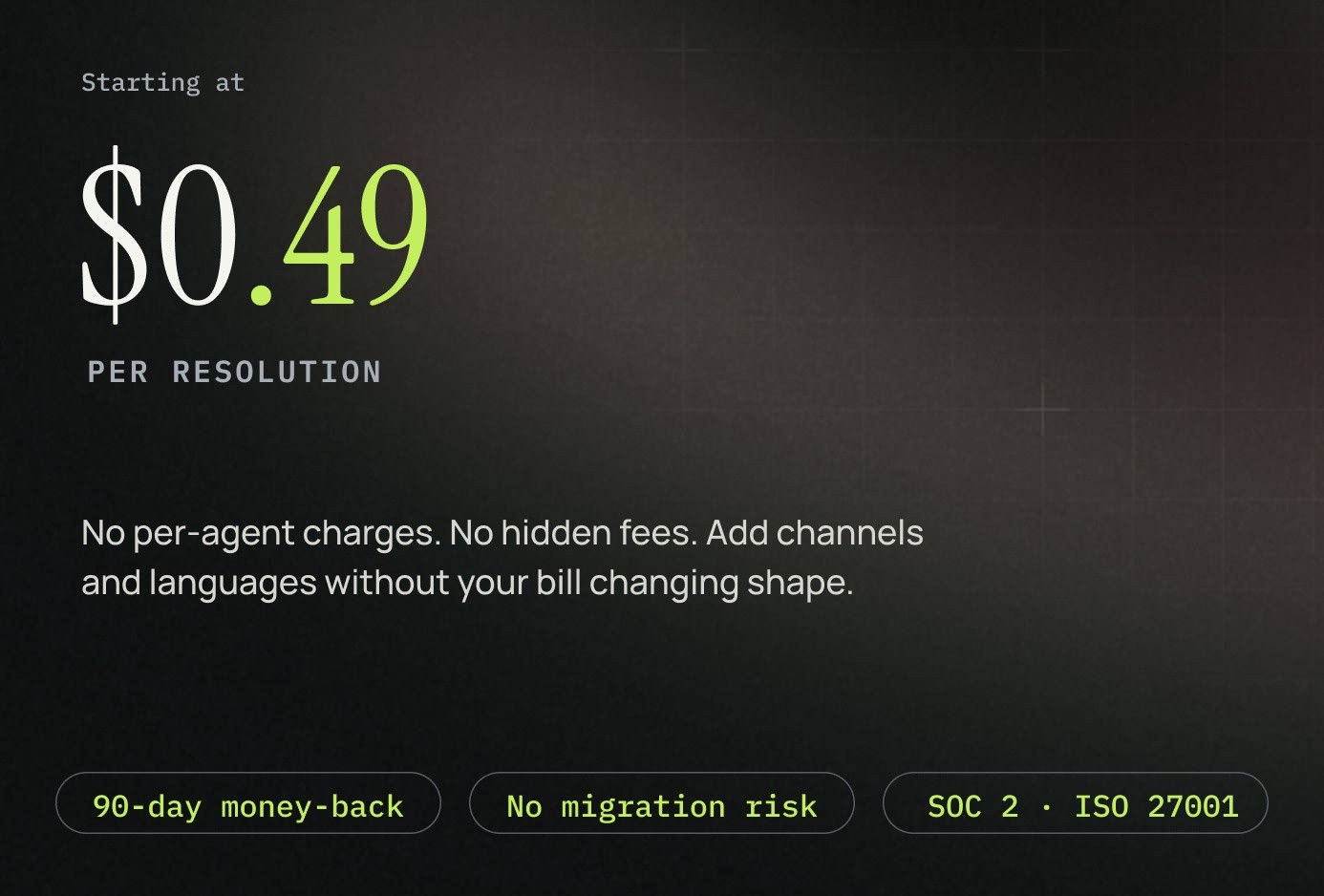
Fini publishes its rate directly: $0.49 per resolution, with no per-seat fees and no minimum monthly commitment. The difference that matters isn’t the headline number, it’s whether you can model your own cost from ticket volume before you ever speak to a salesperson.
What buyers ask | Sierra | Fini |
|---|---|---|
Published price list | ✗ | ✓ |
Price | Quoted per account, ~$150,000/year+ estimated | $0.49 per resolution |
Setup/onboarding fee | $50,000–$200,000 reported | Included |
Free trial or self-serve | None | Not a self-serve signup, go-live runs through a staged onboarding team |
Can you model cost before a sales call? | No | Yes |
See Fini’s full pricing breakdown for plan details, add-ons, and a resolution calculator. The practical effect of Sierra’s pricing model shows up long before a contract is signed. Without a published rate card, a buyer has to run a full evaluation cycle: discovery calls, a proof of concept, procurement review, before finding out whether Sierra is even in budget range. Fini’s published tiers let a team do that math on their own ticket volume in minutes, which matters more to a mid-market fintech or healthcare buyer working against a fixed budget cycle than it does to an enterprise buyer who expects a custom quote regardless of vendor.
Pricing starts at $0.49 per resolution, with no monthly minimum or per-seat fees. Backed by the 90-Day Money-Back Guarantee: 90% resolution in 90 days, or you pay $0. Send 1,000 real tickets, we’ll prove it on your data. If the math doesn’t work, you walk. Beneath the sticker-price gap sits Fini’s actual unit economics.
How Fini and Sierra differ
Sierra is enterprise-first infrastructure aimed at Fortune 500 consumer brands running huge, multi-channel volumes, with a dedicated push into voice as its next growth wedge. Fini is priced and packaged for fast, budgetable deployment inside regulated fintech and healthcare specifically. Sierra’s “Agent OS” framing implies a multi-year platform commitment backed by a six-figure setup investment; Fini’s per-resolution pricing and a rollout live in 14 days and fully autonomous in 30 target teams that need to forecast cost and start fast without that upfront capital outlay. Neither approach is wrong, they are built for different buying committees and different risk tolerances.
The clearest way to see the split is to ask who signs the contract. At Sierra, it’s typically a VP or C-level sponsor running a multi-quarter vendor selection process with procurement and security review baked in, the same way a company would evaluate a core infrastructure vendor. At Fini, a support or operations leader can size the cost against their own ticket volume, get a fixed timeline, and move without a six-figure setup commitment sitting in front of the decision. That difference in buying motion is at least as important as any feature checklist, it determines how long the evaluation takes and who has to say yes.
Capabilities side by side
Both platforms cover chat, voice, and email. Sierra adds SMS, WhatsApp, and a native ChatGPT plugin on top of that core set. Sierra’s voice pipeline is a genuine differentiator: it runs speech recognition, reasoning, and speech synthesis in a single inference pass and supports “barge-in,” letting a caller interrupt the agent mid-sentence the way they would a human. That’s a real strength worth stating plainly rather than minimizing, voice is explicitly where Sierra is investing for 2026, on the theory that roughly 80% of support volume still happens by phone. Fini also runs voice, chat, and email natively across 130+ languages, with a first response landing in about five seconds.
Language coverage is one area where the two platforms’ own marketing doesn’t fully agree with itself. Sierra’s materials cite 59 supported languages in some places, while at least one independent review describes “15+ languages in production,” including Korean, Thai, and Arabic with right-to-left rendering in chat. Rather than picking whichever number sounds better, it’s worth citing the more conservative, verified figure and noting the discrepancy, Sierra’s own product pages are the best place to confirm the current number before a purchase decision. Fini states its language coverage as 130+ across voice, chat, and email, consistently across its own materials.
On the action-taking side, Sierra connects to backend systems: CRM updates, order management, exchanges and returns, through integrations that are typically scoped per enterprise contract rather than offered as a self-serve marketplace. Fini takes a similar native-integration approach but specifically into the systems a regulated fintech or healthcare team runs day to day: helpdesk, knowledge base, CRM, billing, claims, and EHR platforms, which is where account actions, KYC checks, and claims workflows actually live.
Feature by feature
Zooming into individual capabilities, the two platforms overlap heavily on the basics and diverge on packaging and guarantees. Both let a non-technical admin build and edit agent behavior without writing code, both support voice with barge-in, and both let an agent hand off to a human mid-conversation with context intact. Where they split is in the extras layered on top: Sierra’s native ChatGPT plugin and dedicated developer SDK versus Fini’s self-writing Knowledge Atlas and published, guaranteed pricing. Neither list makes one platform strictly “more featured” than the other, the extras map directly back to who each platform is built to sell to.
Feature | Fini | Sierra |
|---|---|---|
No-code builder | ✓ | ✓ (Agent Studio) |
Developer SDK | API-first integration, not branded as a standalone SDK | ✓ (Agent SDK) |
Voice with barge-in | ✓ | ✓ |
Native ChatGPT plugin | ✗ | ✓ |
Human-agent copilot mode | Human handoff supported natively | ✓ (Live Assist) |
Self-writing knowledge base | ✓ (Knowledge Atlas) | Not published as a named capability |
Published pricing | ✓ | ✗ |
Outcome guarantee | ✓ (90-Day Money-Back Guarantee) | ✗ |
Ease of use and admin experience
Sierra’s own G2 reviews cite a steep learning curve and an interface that can feel overwhelming for new admins. More notably, despite the “no-code” pitch, reviewers describe real deployments needing significant engineering effort, with rollouts stretching from weeks to months and even small workflow changes sometimes requiring a rebuild rather than a quick edit. That stands in contrast with Fini’s published staged rollout (live in 14 days, fully autonomous in 30), run by a dedicated onboarding team against a fixed timeline rather than an open-ended enterprise rollout.
Part of that gap is structural, not a quality problem with either team’s engineering. Sierra’s Agent OS framing means an admin is configuring durable infrastructure meant to run for years across every channel a Fortune 500 brand operates, that scope inherently takes longer to stand up correctly than a narrower, single-purpose deployment. Fini’s timeline (live in 14 days, fully autonomous in 30) works specifically because the scope is bounded to the workflows a regulated fintech or healthcare team actually needs on day one, with the knowledge base and account-action integrations staged in a fixed sequence rather than configured from scratch by each customer’s own engineers.
Fini’s differentiators
Published, forecastable pricing
$0.49 per resolution, published and forecastable from day one.
The 90-Day Money-Back Guarantee
An outcome-based guarantee tied to 90% resolution within 90 days.
A published, staged rollout: live in 14 days, fully autonomous in 30
Rather than an open-ended enterprise timeline.
Purpose-built for regulated fintech and healthcare workflows
Claims, KYC, and account actions, not general-purpose support.
Knowledge Atlas
A self-maintaining knowledge base that keeps support answers current without manual upkeep. Taken together, these are the reasons a mid-market fintech or healthcare team would pick Fini over an enterprise “Agent OS”: the buying process is fast because the numbers are already public, the risk is capped because payment is tied to results, and the workflows on day one are the ones a regulated support team actually runs, not a general-purpose agent framework that has to be configured toward that use case afterward.
Sierra’s recognized strengths
Sierra earns its enterprise reputation honestly, and it’s worth stating what it does well rather than only what it doesn’t publish. Its certification list is genuinely broader than Fini’s today, PCI DSS 4.0.1, FedRAMP High, and CSA STAR Level One all sit on top of the SOC 2, ISO 27001, HIPAA, GDPR, and CCPA coverage both companies share. Its published case studies carry real Fortune-500-scale proof points: WeightWatchers reports roughly 70% of sessions resolved at a 4.6 out of 5 CSAT, and ADT handles around 2 million inquiries a month under tight human-in-the-loop guardrails. And at $1.585 billion raised, Sierra is one of the most capitalized companies in the category, with the bench strength to fund long roadmap bets like its native ChatGPT plugin and dedicated voice architecture.
That scale also buys Sierra something harder to quantify: staying power through a multi-year contract. A Fortune 500 brand signing a platform-level commitment is betting the vendor will still be funding roadmap development five years from now, not just at signing. Sierra’s fundraising trajectory, tripling its valuation in roughly twelve months, is itself a data point buyers weigh alongside the product features, even if it says nothing directly about resolution quality.
Sierra vs Fini: who each is actually built for
It helps to picture the two buyers side by side. A Sierra buyer is typically a director or VP of customer experience at a household-name consumer brand, running an RFP process alongside procurement and security, with the budget and patience for a multi-quarter enterprise rollout that touches six or more channels at once. A Fini buyer is typically a support or operations leader at a fintech or healthcare company who needs a specific, bounded set of regulated workflows: refunds, KYC checks, claims status, account changes, automated within 30 days, at a cost they can model against last month’s ticket volume before they ever get on a call. Neither buyer is wrong to want what they want; they are simply solving different problems on different timelines with different risk tolerances.
What customers say
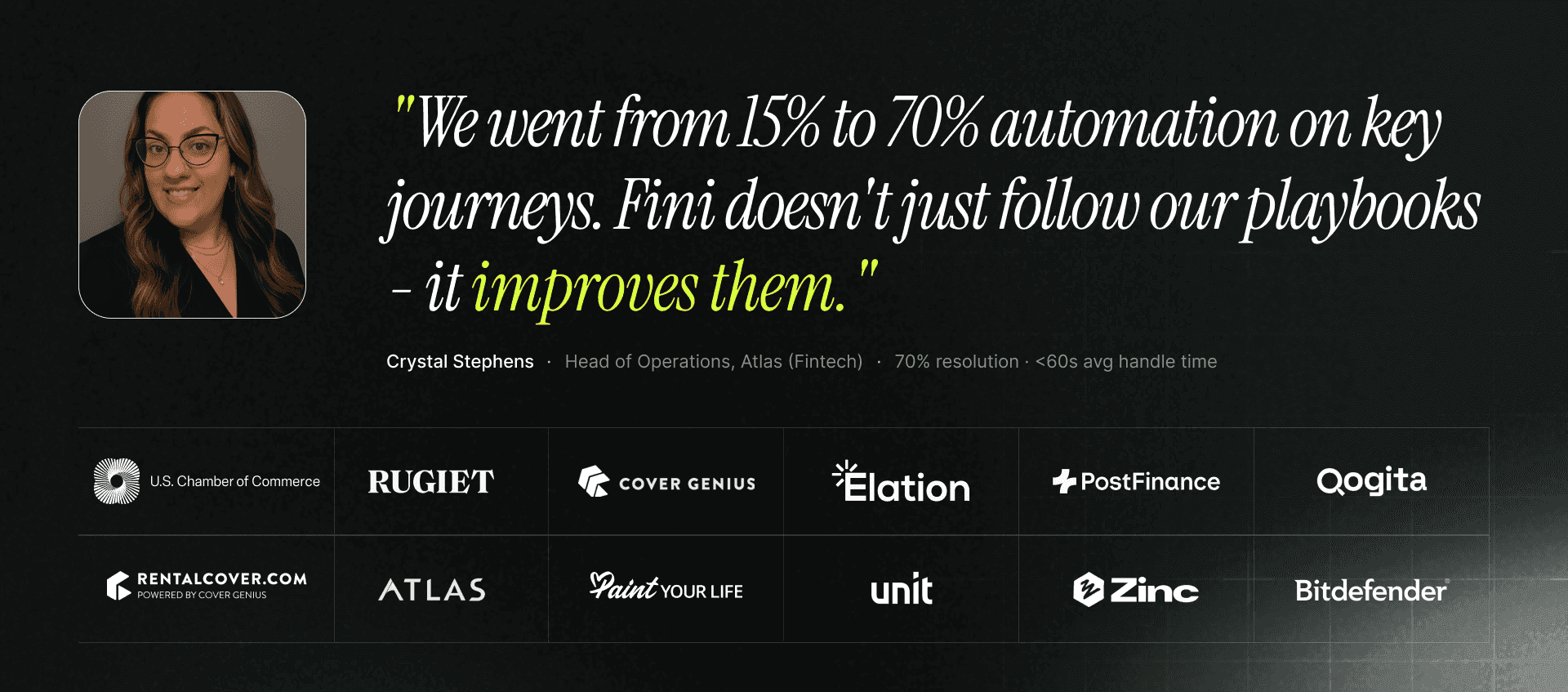
Sierra’s published case studies show resolution rates ranging from 64% to 94% across customers, with CSAT scores between 4.5 and 4.8 out of 5, strong numbers for an enterprise deployment at this scale. Independent reviewers on G2 tell a more mixed story on the admin side. The most consistent theme is a steep learning curve: reviewers describe the platform as capable but not something a new admin picks up quickly, which “can hinder productivity initially.” A second recurring theme is that real deployments require meaningful engineering investment despite the no-code positioning, with rollouts running weeks to months and small workflow tweaks occasionally demanding a larger rebuild. Reviewers also note occasional slowness or bugs, and responses that can feel generic compared with a skilled human agent. These are G2-sourced review themes, not direct customer quotes attributed to any named account.
Read together, the case-study numbers and the review themes tell a consistent story: Sierra’s platform performs well once it’s fully configured for a specific brand’s workflows, but getting there is a heavier lift than the no-code marketing implies. That’s the trade-off a buyer is actually evaluating, not whether Sierra can resolve tickets well (the published metrics say it can), but whether the team has the engineering bandwidth and the multi-month runway to get a deployment to that point.
The full side-by-side
Every dimension covered above: pricing, guarantees, go-live, channels, languages, compliance, customers, funding, and ideal buyer, comes together in one table below. Use it as the working checklist for an internal build-versus-buy or vendor-shortlist conversation, rather than re-deriving each row from the sections above.
Dimension | Fini | Sierra |
|---|---|---|
Pricing | $0.49 per resolution | Custom contract, ~$150,000/year+ estimated, not published |
Outcome guarantee | 90-Day Money-Back Guarantee, 90% in 90 days | None published |
Go-live | Live in 14 days, fully autonomous in 30 | Weeks to months, per user reports |
Channels | Voice, chat, email | Voice, chat, SMS, WhatsApp, email, ChatGPT plugin |
Languages | 130+ | Claims vary by source, roughly 15–59 |
Compliance | SOC 2 Type II, ISO 27001, GDPR, HIPAA-BAA-eligible, CCPA under agreement | , PCI DSS 4.0.1, FedRAMP High, CSA STAR, EU AI Act |
Notable customers | 3M+ monthly resolutions in fintech and healthcare | WeightWatchers, ADT, SiriusXM, Nordstrom, Nubank, Ramp |
Backing | Y Combinator, Matrix Partners | $1.585B raised, $15B+ valuation (May 2026) |
Best fit | Regulated fintech and healthcare teams needing forecastable cost | Fortune 500 consumer brands wanting a full multi-channel Agent OS |
Which should you choose?
Choose Fini if you want forecastable, published pricing, an outcome-based guarantee, a fast and predictable go-live, and a platform purpose-built for regulated fintech and healthcare workflows. Choose Sierra if you’re a Fortune 500-scale consumer brand that needs a heavily capitalized, full-channel platform, including a native ChatGPT plugin and an advanced voice pipeline, and can absorb a six-figure enterprise contract along with a multi-month rollout.
A useful gut check: if your team can’t yet say what a typical support ticket costs you today, or if a $150,000-plus annual commitment with a five- or six-figure setup fee would need board-level sign-off before a pilot even starts, Fini’s published pricing and a rollout live in 14 days and fully autonomous in 30 are built for exactly that situation. If you’re already running support across six channels for a household consumer brand and comparing full “Agent OS” platforms as infrastructure decisions, Sierra’s breadth and voice investment are the more relevant comparison set. See how Fini also compares against Decagon and Maven AGI, two other well-funded, enterprise-oriented platforms in this same category.
Compliance
Sierra’s published certification list is broader than Fini’s today. On top of the SOC 2 Type II, ISO 27001, HIPAA, GDPR, and CCPA both companies maintain, Sierra also publishes (an AI-management-system standard), PCI DSS 4.0.1, CSA STAR Level One, FedRAMP High, and alignment with the EU AI Act. That’s real and worth stating plainly rather than downplaying, it’s checkable directly on Sierra’s own trust page. FedRAMP High in particular signals Sierra has cleared a bar built for U.S. federal government workloads, and CSA STAR Level One is a cloud-security-specific attestation that not every AI vendor in this category bothers to pursue. Fini’s differentiator isn’t a longer certification list; it’s that Fini is purpose-built for fintech and healthcare workflows specifically: claims processing, KYC, and account actions, with compliance guidance written for regulated customer support and pricing that’s forecastable before a sales call even begins.
For a buyer specifically in fintech or healthcare, the practical question isn’t “which vendor has more badges”, it’s whether the vendor’s compliance program was built around your industry’s actual obligations or extended to cover it afterward. Sierra’s certification breadth reflects a platform built to satisfy a wide range of Fortune 500 industries at once, from retail to telecom to insurance. Fini’s narrower list reflects a program built specifically around the two industries, fintech and healthcare, where it operates, which is a different kind of depth than a longer checklist.
Neither company’s certification list should be the only thing a compliance team checks. SOC 2 and ISO 27001 reports are typically available under NDA from both vendors on request, and a regulated buyer should ask each vendor directly for its current audit scope, data-residency options, and, for healthcare specifically, the exact terms of its BAA before treating any published badge as sufficient due diligence on its own.
Ready to compare on your own data?
The fastest way to know which platform actually fits your ticket volume, channel mix, and compliance requirements is to run the numbers against your own data rather than a vendor’s published averages. See Fini’s plans or talk to the team about a side-by-side pilot. If you’re also weighing another enterprise-tier platform, our Giga vs Fini comparison covers a similarly well-funded, voice-first alternative, and our explainer on resolution rate covers how the accuracy numbers above are actually measured.
Read the architectural argument in full: Why Sierra Is the Wrong Approach to Agentic Customer Support.
Is Sierra’s pricing public?
No. Sierra runs an enterprise-only, custom-quoted sales process with an outcome-based pricing model. Third-party estimates put contracts starting near $150,000 a year plus $50,000 to $200,000 in setup fees, but Sierra does not confirm these figures publicly. Fini publishes its rate directly: $0.49 per resolution, with no per-seat fees.
What is Sierra’s “Agent OS”?
It’s Sierra’s platform framing: seven modules (Agent Studio, Agent SDK, Insights 2.0, Voice, Live Assist, Agent Data Platform, and Trust & Reliability) meant to function as durable infrastructure a company builds its customer experience on, rather than a single support tool.
Who founded Sierra and when?
Sierra was founded in 2023 by Bret Taylor, former co-CEO of Salesforce and chairman of OpenAI’s board, and Clay Bavor, a former longtime Google executive.
How much has Sierra raised, and what is it worth?
Sierra has raised $1.585 billion total, including a $950 million Series E led by GV and Tiger Global that closed in May 2026, valuing the company above $15 billion, roughly triple its valuation from about a year earlier.
Which companies use Sierra?
Sierra reports serving roughly 40% of the Fortune 50, with named customers including WeightWatchers, SiriusXM, Sonos, ADT, Chime, Cigna, Nordstrom, Nubank, Ramp, and Rivian.
Does Sierra support voice?
Yes, voice is one of Sierra’s most emphasized 2026 investments, with a pipeline that runs speech recognition, reasoning, and speech synthesis in a single pass and supports “barge-in,” where a caller can interrupt the agent mid-sentence. Fini also supports voice, chat, and email natively across 130+ languages.
What are the most common complaints about Sierra?
G2 reviewers most often cite a steep learning curve and a UI that can overwhelm new admins, plus real-world deployments that require significant engineering effort, despite Sierra’s no-code positioning, with rollouts sometimes taking weeks to months and small workflow changes occasionally requiring a rebuild.
Is Sierra or Fini better for regulated industries like fintech and healthcare?
Both maintain serious compliance programs. Sierra’s published list is actually broader, SOC 2 Type II, ISO 27001, PCI DSS 4.0.1, HIPAA, GDPR, CCPA, CSA STAR, EU AI Act, and FedRAMP High. Fini publishes SOC 2 Type II, ISO 27001, GDPR, HIPAA-BAA-eligible contracting, and CCPA under agreement. Fini’s differentiator isn’t a longer certification list, it’s that Fini is purpose-built for fintech and healthcare workflows specifically (claims, KYC, account actions), with pricing that’s forecastable before a sales call.
How fast can each platform go live?
Fini publishes a staged rollout: live in 14 days, fully autonomous in 30. Sierra doesn’t publish a standard timeline; user reports describe enterprise rollouts spanning weeks to months, consistent with its engineering-heavy setup and lack of a self-serve option.
Does Fini offer any guarantee Sierra doesn’t?
Yes, Fini’s 90-Day Money-Back Guarantee ties payment to results (90% resolution within 90 days) at publicly quoted rates. Sierra’s outcome-based pricing also ties cost to resolutions, but its terms are set per custom enterprise contract rather than published upfront.