Last Updated:

Deepak Singla

IN this article
Explore how AI support agents enhance customer service by reducing response times and improving efficiency through automation and predictive analytics.
You're probably comparing AI support vendors right now and trying to figure out which pricing model doesn't punish you for volume. Per-seat charges you whether your AI resolves anything or not. Per-conversation charges you for every inbound ticket, whether resolved or not. Per-resolution charges you only when a ticket closes without a human. That difference is where this post starts.
TLDR:
Per-resolution pricing charges you only when a ticket closes without a human, aligning vendor revenue with your outcome.
No free tier, no Starter plan, no per-seat fees exist in Fini's structure, despite what aggregators publish.
Picking the wrong plan tier costs real money: Scale saves $1,600/month over Growth at 8,000 resolutions.
Voice billing runs on a separate rate card, dropping from $0.89 to $0.35 per call as volume scales past 50,000.
Fini prices three plans per resolved ticket at $0.89, $0.69, and $0.49, backed by a Zero-Pay Guarantee: 90% resolution in 90 days, or you pay $0.
What Per-Resolution Pricing Actually Means
Per-seat pricing charges you for the humans logged into a tool. Per-conversation pricing charges you for every inbound message, resolved or not. Per-resolution pricing charges you only when a ticket closes without a human touching it.
The difference is material. Per-seat costs stay fixed whether volume doubles or halves. Per-conversation rewards deflection, not resolution. Per-resolution aligns the vendor's revenue with your actual outcome.
Published per-resolution rates from major customer-service vendors range from $0.50 to $2.00, a 4x gap on the same unit of value. And while only 5% are currently contracted on it, 76% of enterprise CX buyers say they are open to outcome-based pricing.
In Fini's case, a resolution means the customer's issue was solved end to end with no human handover. Escalations to your team are free, and they arrive with full context attached.
The Three Pricing Models in AI Support
Three pricing models cover most of the AI support market. Each one creates a different incentive between you and the vendor.

Per-seat pricing charges for each human user, monthly, so the vendor wins when headcount grows regardless of outcomes. Per-conversation pricing charges for every inbound ticket, resolved or not, rewarding volume over results. Per-resolution pricing charges only for closed tickets with no human handover, so the vendor wins only when the AI actually works.
The incentive gap matters more than the rate. Per-seat pricing doesn't care whether your AI resolves anything. The distinction between deflection rate vs. true resolution rate explains why per-conversation pricing rewards deflection. Per-resolution rates across major vendors run $0.50 to $2.00 per completed task, depending on vendor and volume tier.
Per-resolution fits support because the outcome is a closed ticket and the cost of a wrong answer is a chargeback or a complaint. AI support vendors for predictable TCO show how these incentives play out across real contracts. Per-seat fits tools where humans stay in the loop. Per-conversation fits high-volume workflows where speed is the proxy for value.
Fini AI Pricing Plans at a Glance
Three plans. One pricing rule across all of them: a single per-resolved-ticket rate covers the platform, implementation, and your monthly resolution allowance. No per-seat fees. Escalations to your team are always free, and they arrive with full context.
Plan | Per Resolved Ticket | Included Tickets/Month |
|---|---|---|
Growth | $0.89 | Up to 3,000 |
Scale | $0.69 | Up to 10,000 |
Enterprise | $0.49 | Unlimited |
Growth fits smaller support orgs. Scale is the most chosen plan and suits mid-market teams. Enterprise is built for operators running over a million tickets a year, with custom contracts and dedicated deployment support.
Annual billing removes two months from the total, roughly 17% savings. Unused allowance rolls forward one month, and overages bill at the same flat per-resolution rate. Teams managing churn can also review AI tools for subscription cancellation alongside their resolution pricing model.
What Voice Support Costs
Voice billing sits outside the base plan and runs on its own volume-tiered rate card, charged per answered call.
Volume | Per Call | Per Minute |
|---|---|---|
First 10,000 calls | $0.89 | $0.22 |
10,001 to 50,000 | $0.59 | $0.18 |
50,000+ | $0.35 | $0.14 |
Every tier includes speech recognition, AI reasoning, voice synthesis, and telephony. Multilingual support across all 130+ languages is included at no extra cost, regardless of which volume band you are in. For a broader view of cost modeling across vendors, see the AI support tools pricing and TCO guide.
What Does Not Exist in Fini AI Pricing
No free tier. No Starter plan. No per-seat fees. No per-message charges. No separate platform fee.
Third-party pricing aggregators regularly misrepresent Fini's structure. Here is what actually does not exist:
A free tier or freemium plan at any price point
A Starter tier, under any name
Per-seat charges layered on top of resolution pricing
Per-message billing that punishes volume
A platform fee billed separately from your resolution allowance
The 90-day free pilot does exist, but it is available on Enterprise only, on live traffic, with resolution and accuracy targets agreed in writing before it starts. It is a scoped commitment, not a broadly available trial you can sign up for on a pricing page.
How Volume and Overages Actually Work
Overages bill at the flat per-resolution rate for your plan: $0.89 on Growth, $0.69 on Scale, $0.49 on Enterprise. No penalty tier, no markup for exceeding your monthly allowance.
A few mechanics worth knowing:
Your plan allowance bills monthly in advance, while overages invoice in arrears on actual usage.
Unused resolutions roll forward one month.
Fini flags when an upgrade would lower your total bill.
Longer commitments carry additional discounts. At two years, Growth and Scale get 15% off. At three years, Growth and Scale get 20% off, and Enterprise gets 25% off. Paying annually upfront adds another 5% on top of either term discount.
Real-World Cost Scenarios
Three scenarios, using only the plan rates above.
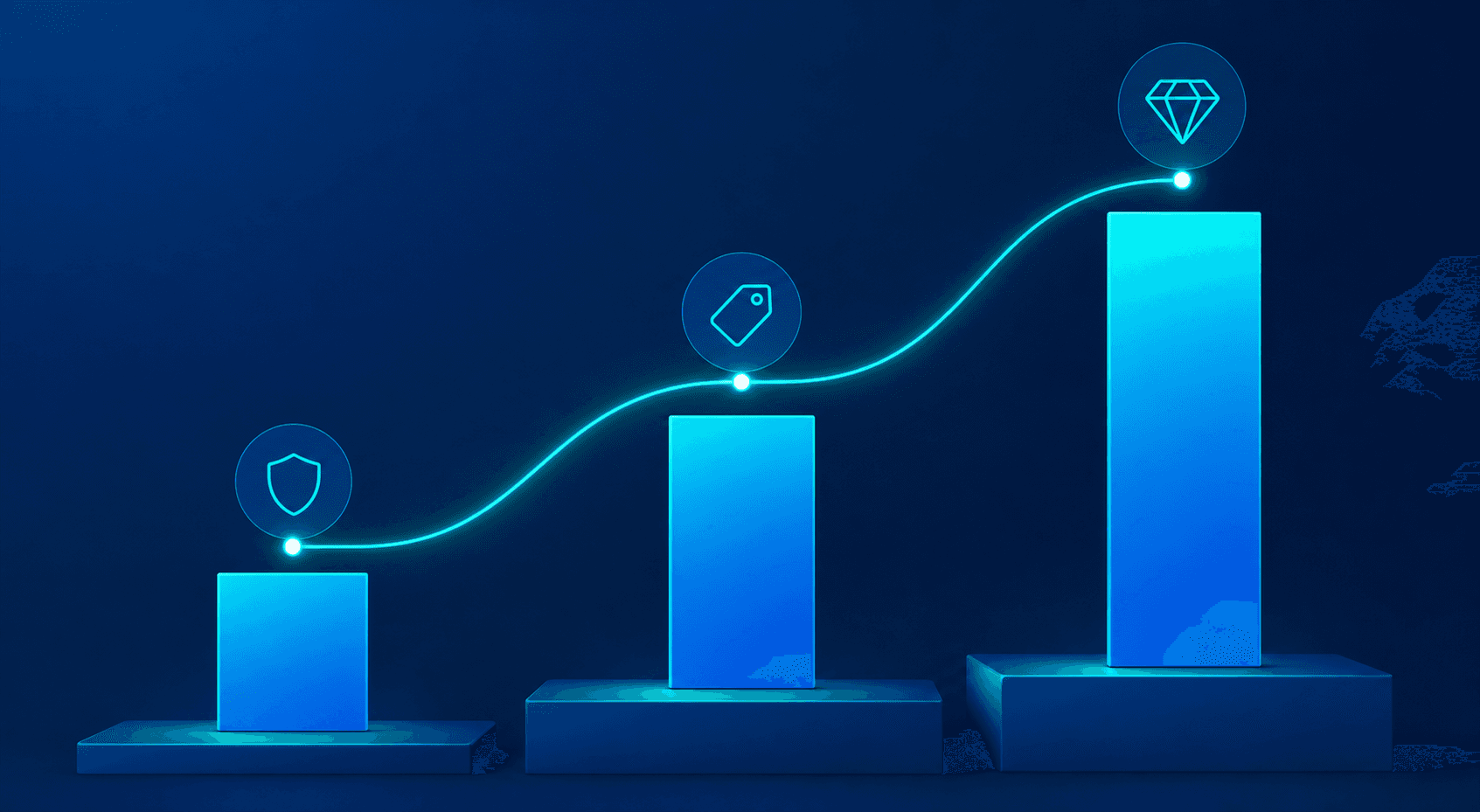
Growth puts 2,000 resolutions at $0.89 each, totaling $1,780/month, well inside the 3,000-resolution allowance with no overage.
Scale puts 8,000 resolutions at $0.69 each, totaling $5,520/month. The same volume on Growth costs $7,120, so Scale saves $1,600 monthly on identical output.
Enterprise puts 50,000 resolutions at $0.49 each, totaling $24,500/month. The same volume on Scale costs $34,500. The $0.20 per-resolution gap between Scale and Enterprise compounds fast at that tier.
Voice overlays onto any of these. A Scale team handling 15,000 calls/month pays $0.89 on the first 10,000 ($8,900) and $0.59 on the next 5,000 ($2,950), for a voice total of $11,850 alongside their base resolution cost. At 50,000+ calls, the per-call rate drops to $0.35.
If your monthly resolutions consistently exceed your plan's allowance, the next tier nearly always costs less in total. Fini flags that moment automatically.
The 90-Day Free Pilot and Zero-Pay Guarantee
Two mechanisms reduce the commitment risk before a contract starts.
The 90-day free pilot is available on Enterprise only. It runs on live traffic, with resolution and accuracy targets agreed in writing before day one. During those 90 days, you pay nothing. If the numbers hit, the plan starts. If they don't, you walk with the data.
The Zero-Pay Guarantee applies once you are live: 90% resolution in 90 days, or you pay $0.
The mid-funnel step before either is the 1,000-ticket benchmark. Send us 1,000 real tickets from production. We run them, return the accuracy score, and you see the Resolution Rate on your own data before signing anything. No integration required.
Fini AI pricing and your TCO calculation
Per-resolution pricing is predictable in a specific way: you pay more when Fini closes more tickets, and nothing for escalations. That aligns cost with output, but it requires you to know your volume well enough to pick the right tier.
Compare that to a per-seat helpdesk add-on, where you pay whether the AI resolves 10% or 90% of tickets. Per-conversation deflection tools charge for inbound volume, so a spike raises your bill regardless of whether tickets actually close.
The right question before signing is not "what is the per-resolution rate?" It is "what is my expected monthly resolved volume, and which tier prices that correctly?"
Modeling AI support ROI by cost per resolution helps clarify that decision. Model two numbers before committing: your average resolved volume and your peak. If a seasonal spike pushes you 30% over your allowance, overage bills at the same flat rate with no penalty, which matters for a CFO building a support cost forecast.
Which plan is built for your team
Fini has three plans, each priced per resolved ticket with a monthly resolution allowance built in.
Growth starts at $0.89 per resolution with a 3,000-ticket monthly allowance. It fits scaling support orgs running under 36,000 resolved tickets annually that need full autonomy without committing to mid-market volume.
Scale is $0.69 per resolution at 10,000 tickets per month. If you are running roughly 50,000 to 500,000 annual tickets, model Scale first.
Enterprise is $0.49 per resolution, built for operators running over a million tickets per year. Understanding AI support tools that prove ROI helps frame the right tier decision. It includes unlimited allowance, custom contracts, dedicated deployment support, and the 90-day free pilot available on this tier only.
A simple rule: pick the plan where your expected monthly resolved volume fits inside the allowance without consistent overage. Fini flags when upgrading would cost less than staying put.
How Fini AI pricing compares
Fini's three rates sit at $0.89, $0.69, and $0.49 per resolution depending on plan. per-resolution rates across AI support vendors range from $0.50 to $2.00 for the same unit of value.
A detailed Intercom Fin vs Zendesk AI vs Fini cost-per-resolution comparison shows how these rates stack up. Intercom's Fin charges $0.99 per outcome, and that rate sits on top of whatever Intercom seat costs you are already paying. The per-resolution fee and the platform fee are separate line items.
At 10,000 monthly resolutions, the difference between $0.99 and $0.69 is $3,000 per month, or $36,000 annually, before seat or platform costs are counted. At 50,000 resolutions, that gap is $15,000 per month.
The comparison to run: take your expected monthly resolved volume, multiply by each vendor's per-resolution rate, and add any platform or seat fees on top. Fini bundles platform and implementation into the resolution rate. Some competitors do not.
Resolution rate, proof, and what's included
Every Fini plan purchases the same resolution outcome: 90% Resolution Rate at 99% accuracy, live in 14 days, fully autonomous by Day 30, across voice, chat, and email on one reasoning layer. The per-resolution rate is the price of a closed ticket. The platform, implementation, and self-maintaining loop come with it.
Atlas is the clearest proof of what that rate delivers. They went from 15% to 70% automation on key support journeys. The 3M+ monthly resolutions running across fintech and healthcare in production are the scale bar behind that number.
Knowledge Atlas removes the tuning cost that typically sits outside any vendor's published price. It detects its own knowledge gaps nightly, drafts articles from resolved escalations, and surfaces them for human review before publishing. That labor cost disappears from the TCO calculation, but it never shows up in a competitor's rate card comparison.
The Fini Zero-Pay Guarantee backs the price directly: 90% resolution in 90 days, or you pay $0. Send us 1,000 real tickets and we run the benchmark on your data before you commit.
Choosing the plan that fits your volume
Your monthly resolved volume is the only number that drives the decision. Match it to the right tier, account for seasonal peaks at the flat overage rate, and you have a support cost model a CFO can actually forecast against.
Talk to us and we can map your volume to the plan that prices it correctly.
FAQ
What is Fini AI pricing: Growth, Scale, and Enterprise plans explained?
Fini AI pricing runs on three plans billed per resolved ticket: Growth at $0.89 per resolution with 3,000 tickets per month, Scale at $0.69 with 10,000 tickets per month, and Enterprise at $0.49 with unlimited resolutions. Each plan bundles the platform, implementation, and your monthly resolution allowance. No per-seat fees, no separate platform charge, and escalations to your team are always free.
Does Fini offer a free tier or Starter plan?
No. There is no free tier, no Starter plan, and no freemium option at any price point. The only no-cost entry point is the 90-day free pilot, available on Enterprise only, which runs on live traffic with resolution and accuracy targets agreed in writing before day one.
Fini AI vs Intercom Fin pricing: which costs less at scale?
Intercom Fin charges $0.99 per outcome on top of existing Intercom seat costs, so you pay two separate line items. Fini's Scale plan is $0.69 per resolution with the platform included, meaning at 10,000 monthly resolutions the gap is $3,000 per month or $36,000 annually before seat fees are counted. At 50,000 resolutions, that gap reaches $15,000 per month.
What is the AI customer support per-resolution cost at high volume, and when does upgrading plans make sense?
At Growth you pay $0.89 per resolution, at Scale $0.69, and at Enterprise $0.49. Overages on any plan bill at that same flat rate with no penalty markup. If your monthly resolved volume consistently exceeds your plan allowance, the next tier nearly always costs less in total; Fini flags that moment automatically so you are never paying Growth rates on Scale volume.
How does the 90-day pilot for Fini's Enterprise plan actually work, and what happens if the numbers miss?
The 90-day free pilot runs on live production traffic with resolution rate and accuracy targets written into the agreement before day one. You pay nothing during those 90 days. If Fini hits the agreed numbers, the Enterprise plan starts. If it does not, you walk with the data.
Related guides
Explore the guide topics to find more reading.
Co-founder