Last Updated:

Deepak Singla

IN this article
Explore how AI support agents enhance customer service by reducing response times and improving efficiency through automation and predictive analytics.
There's a version of the AI support ROI calculation that makes everything look great, and it's almost always built on deflection rate. The version that holds up six months later is built on resolution rate, real loaded agent cost, and a payback period tied to tickets actually closed. If you're trying to decide between AI support and adding headcount, those distinctions change the answer in a material way.
TLDR:
A fully loaded support agent costs 1.4 to 1.5x base salary annually. AI resolves the same ticket for under $1 vs. $20 to $25 for a human.
Build your ROI model on resolution rate, not deflection rate. Deflected tickets are not resolved tickets, and the gap shows up in churn data.
Teams with 60%+ repetitive ticket volume reach payback inside six months. Below 50K tickets per year, headcount is easier to right-size.
Four failure modes kill AI support ROI: measuring deflection, fragmented knowledge bases, measuring too early, and underestimating maintenance cost.
Fini prices on resolution outcomes at $0.49 per resolution with no per-seat fees, backed by a Zero-Pay Guarantee: 90% resolution in 90 days, or you pay $0.
The true cost of hiring more support agents
Salary is only part of what a support agent costs. According to U.S. Bureau of Labor Statistics, benefit costs average 30% on top of wages for private industry workers. Add recruiting, and contact center hiring costs $3,000+ per agent before anyone answers a single ticket.
Then comes onboarding: product training, compliance modules, CRM access, and ramp time before the new hire hits full productivity. In compliance-intensive industries like fintech or healthcare, that ramp runs longer.
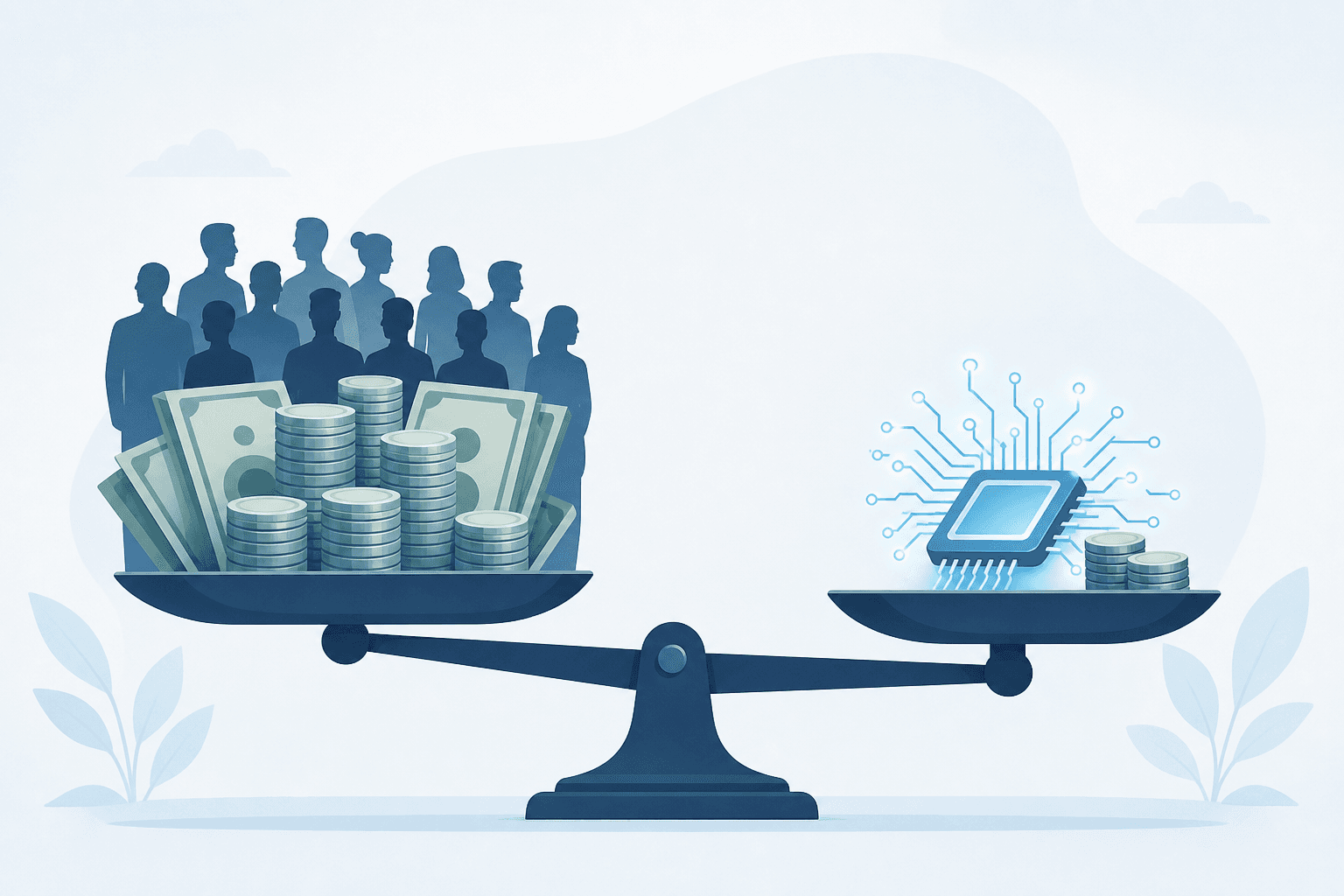
The fully loaded cost per agent, folding in benefits, recruiting, tooling, and attrition replacement, routinely hits 1.4 to 1.5x base salary annually. Hire ten agents to absorb a volume spike and you're adding a cost structure that doesn't shrink when ticket volume dips.
What AI support agents actually cost
The per-ticket gap is consistent across vendors. As Crisp's 2026 analysis shows, a human agent handles a routine query at $20 to $25 and AI handles the same query at $0.50 to $0.70, though Crisp notes these per-ticket figures capture only part of the full cost picture. That gap still compounds fast at scale.
Most AI vendors price on one of three models: per seat, per conversation, or per resolution. Per-seat fees mirror the headcount problem you're trying to solve. Per-conversation pricing charges regardless of outcome. Per-resolution pricing ties cost directly to value: you pay when a ticket closes without a human. That's the basis of AI customer support pricing models that track TCO accurately.
Model | Cost per ticket | Pricing basis | Fixed cost floor? |
|---|---|---|---|
Human agent (loaded) | $20 to $25 | Per ticket handled | Yes: headcount doesn't shrink with volume |
AI: per seat | Varies | Monthly seat fee regardless of tickets | Yes: mirrors headcount cost structure |
AI: per conversation | $0.50 to $0.70 | Per conversation started | No: charges even when unresolved |
AI: per resolution (Fini) | $0.49 | Per ticket closed without a human | No: cost moves with outcomes only |
Human hiring creates a fixed cost floor that doesn't move when volume drops. Resolution-based pricing moves with the work actually done.
Deflection rate vs. resolution rate: why the metric you pick changes everything
Deflection rate counts tickets removed from a human queue. Resolution rate counts tickets actually solved. Building an ROI model on the wrong one produces a figure that looks good in a board deck and quietly damages CSAT.
A deflected ticket is one the AI touched without handing to a human. The customer may have abandoned the chat, rage-closed the widget, or called back through a different channel. The deflection counter doesn't know.
Resolution measures whether the customer's issue closed. No callback. No reopened ticket. No churn event downstream. If you deflect 70% of tickets but only resolve 40%, your cost-per-outcome is far higher than it looks, and the gap typically shows up in churn data three months later.
"AI deflection rate is the headline metric most AI support vendors lead with, and it is also the most misleading one... a deflected ticket and a resolved ticket are not the same outcome."
We measure Fini on resolution rate because the ROI model only holds when the numerator is real.
How to build the ROI model: the core formula
The formula has two sides. Benefits minus costs, divided by costs, gives you ROI. Payback period is total AI spend divided by monthly savings.

Benefits to count:
Cost per ticket reduced, with human handling running $20-$25 versus AI at under $1
Tickets deflected from human agents, measured at your actual loaded cost per agent hour
Throughput gain from the same headcount handling higher volume
Reduced attrition spend from a smaller, less burned-out team
Costs to count:
AI licensing, whether priced per resolution, per seat, or per conversation
Implementation and integration hours
Ongoing oversight for escalations and edge cases
Where models break is on the benefit side: inflated deflection numbers, resolution rates from sandboxed demos instead of production, or CSAT assumptions with no baseline. A Forrester TEI study commissioned by Sprinklr found a modeled composite organization achieved 210% ROI over three years with payback periods under six months. Those results depend on resolution quality. A deployment that deflects 60% but resolves 35% produces a much flatter curve.
Build the model on resolution rate, not deflection. Use your actual loaded agent cost, not salary alone.
Hard ROI metrics to track
Five customer support metrics AI improves belong in every AI support ROI model. Each maps directly to a cost line.
Cost per resolution: Human resolution runs $20-$25 per ticket on loaded cost. AI resolution at under $1 means every shifted ticket is a real dollar reclaimed. Track this against your actual loaded agent hourly rate, not salary alone.
Tickets resolved per agent-hour: Baseline for most teams is 4-8 tickets per hour. AI handling routine volume can push that effective rate above 20 when agents focus only on escalations.
First response time: AI handles first response in seconds. SLA attainment scores move fast when FRT drops.
SLA attainment rate: Cost per SLA-point-gained is a useful denominator if you are adding headcount to close a gap. Qogita saw a 121% SLA improvement after deploying Fini.
Average handle time: A human agent averaging 8-12 minutes per ticket is a fixed throughput ceiling. AI resolution compresses handle time to near zero on resolved tickets, freeing agents for cases where judgment matters.
Plug each into the model separately. The combined savings figure is where the payback period calculation lands.
Soft ROI metrics that move the board
Soft ROI rarely lands in a spreadsheet, but a CFO who has lived through an attrition cycle or a support quality metrics cliff knows what these line items cost.
Four worth naming:
Agent retention: contact center turnover runs high, and each departure carries recruiting and ramp costs on top of lost institutional knowledge. Routing repetitive, low-complexity tickets to AI leaves human agents handling work that requires judgment, which tends to reduce burnout without changing headcount.
CSAT trend: Training Peaks saw a 12-point CSAT improvement after deploying Fini, driven by faster first response, more consistent answers, and fewer reopened tickets. CSAT also has a revenue tail, since churned customers rarely announce why they left.
Brand and compliance risk: in a compliance-intensive industry, an incorrect answer is a different class of problem than a slow one. A single compliance incident can dwarf months of AI licensing fees. That is the risk argument for accuracy over deflection.
Volume spike readiness: hiring to cover a seasonal or post-acquisition spike means carrying that headcount when volume normalizes. AI scales with demand without a trailing cost structure.
Present these to leadership as qualitative ranges, not hard forecasts. "Agent retention savings of $X per avoided departure" is defensible. "AI will eliminate all attrition" is not.
Where AI support delivers the fastest payback
Payback speed depends almost entirely on your ticket mix. Teams with high repetitive volume, FAQ-heavy queues, billing inquiries, account status checks, and password resets see the curve bend fastest. Complex, low-frequency issue types requiring judgment or account-level investigation take longer to shift.
The scenario that produces the shortest payback: a team handling 250K tickets per year where 60% of volume is repetitive. That's 150K tickets. At a loaded agent cost of $22 per ticket, those 150K tickets carry $3.3M in annual cost. Shift 90% to AI at under $1 each and savings on that slice alone approach $3M per year. Most teams in this profile reach payback inside six months.
Payback stretches past a year when:
Repetition rate is under 30% of total volume, leaving less FAQ-level work for AI to absorb
Escalation dependency is high, where the agent hands off most tickets without resolving them outright
Knowledge bases are fragmented and need substantial cleanup before the agent can perform accurately
Voice queues are active but AI voice has not been deployed alongside chat and email
Channel mix matters. Chat and email shift first, with voice following once the agent runs across all three. Teams that deploy across all channels from day one compress the payback window because resolution volume is higher from the start.
Why AI support projects fail to deliver expected ROI
Four failure modes account for most of the gap between projected and actual AI support ROI.
Measuring deflection instead of resolution. Deflection captures tickets removed from a human queue, not tickets closed. The cost savings tied to unresolved contacts never materialize, and churn from frustrated customers adds a cost the original model never anticipated.
Deploying against a fragmented knowledge base. AI resolution quality is a direct function of knowledge quality. If your knowledge base has conflicting articles or is split across eight systems with no canonical source, the agent surfaces bad answers. Resolution rate plateaus around 50-60% and the team ends up tuning the bot instead of running the business.
Measuring too early. A 90-day window captures implementation cost and only part of the savings curve. Teams that measure ROI at month three and declare it flat often see the curve break through months five and six, after the agent has learned from escalations and the knowledge base has stabilized.
Underestimating ongoing maintenance cost. Chatbot-style tools require regular re-tuning: updated flows, revised FAQs, and manual corrections when policies change. That maintenance carries a real cost, usually in ops time that never shows up in the licensing line.
When hiring more agents is still the right call
AI support ROI vs. hiring agents favors AI clearly for high-volume, repetitive queues. It has a weaker case in several specific situations.
If your ticket volume is below 50K per year, the savings from AI resolution may not offset setup and integration costs within a reasonable window. Headcount at that scale is easier to right-size.
If your queue is genuinely complex across the board, with tickets requiring account-level investigation or regulatory judgment before any answer is possible, resolution rate drops and the math changes. The right move is often AI for the 20-30% of repetitive volume, with humans covering the rest.
If your knowledge base is severely fragmented across ten systems with no canonical source and years of contradictory articles, deploying AI before fixing that foundation produces poor resolution rates and erodes customer trust. That is a knowledge problem to solve first.
If your compliance or legal team has not cleared AI in customer-facing flows and has no roadmap to do so, deploying anyway carries audit risk that hiring does not.
How to build the ROI case for leadership
Lead with payback period, not percentage ROI. A CFO who sees "210% ROI" wants to know when the cash starts coming back. Payback period is concrete, testable, and tied to the budget cycle.
Structure the case around three numbers the C-suite already tracks:
Support cost as a percent of revenue: show the current baseline and what it looks like if ticket volume grows 2x without adding AI.
Headcount plan: model the agents you would need to hire to absorb that volume, fully loaded cost including recruiting and ramp.
CSAT target: anchor the quality argument to the number leadership has already committed to publicly.
Use conservative inputs. Take your lowest realistic resolution rate estimate, not the vendor's headline number. Use your actual loaded agent cost, not salary alone. A model that holds under conservative assumptions is far easier to defend than one requiring optimistic targets.
Close with a bounded pilot. A 90-day window with defined success criteria, resolution rate, SLA attainment, and CSAT gives leadership a reversible entry point. The question stops being "do we buy AI" and becomes "do we run the pilot." That is a much easier yes.
How Fini fits into the ROI equation
Fini is priced on resolution outcomes, starting at $0.49 per resolution with no per-seat fees. You pay when a ticket closes without a human. Escalations are free. One plan covers the platform, implementation, and a monthly resolution allowance. That removes the fixed cost floor headcount carries.
The production numbers are public. Atlas went from 15% to 70% automation. Training Peaks cut their queue by 70%. We run 3M+ monthly resolutions across fintech and healthcare, live in 14 days and fully autonomous in 30.
The Zero-Pay Guarantee removes CFO approval risk: 90% resolution in 90 days, or you pay $0. Send us 1,000 real tickets. We'll prove it on your data. If the math doesn't work, you walk.
Final thoughts on AI support payback periods and headcount costs
The ROI case for AI support is real, but it only survives scrutiny when the inputs are accurate. Deflection numbers inflate the model. Resolution rate keeps it grounded. If your ticket mix skews repetitive and your knowledge base is in reasonable shape, the payback math tends to close faster than most teams expect. Start with a 30-minute conversation to see how the numbers look against your actual volume.
FAQ
My chatbot deflection rate looks healthy but customers keep emailing us anyway. What's actually going wrong?
Deflection counts tickets removed from a human queue, not tickets solved. When customers bypass the chatbot and open a new email, the deflection counter stays clean while your actual resolution rate sits far below it, often 35-40% when deflection reads 70%. The cost savings your model predicted never land, and the churn from unresolved contacts shows up three months later in revenue data, not support metrics.
What is the payback period for AI customer support versus hiring agents?
For teams handling 250K tickets per year with 60% repetitive volume, the AI support payback period typically runs under six months. That profile carries roughly $3.3M in annual cost on that slice alone at a $22 loaded cost per ticket. Shift 90% to AI at under $1 each and the savings are immediate. Payback stretches past a year when repetition rate falls below 30%, when knowledge bases are fragmented, or when AI voice has not been deployed alongside chat and email.
AI customer support vs hiring agents: when does the ROI case actually break down?
The ROI case for AI over headcount weakens in three situations: ticket volume below 50K per year, where setup costs outpace savings within a reasonable window; queues that are genuinely complex across the board with no repetitive slice for AI to absorb; and knowledge bases fragmented across ten or more systems with years of contradictory articles. In those cases, fixing the knowledge foundation or keeping headcount for the complex tier is the better call. AI handles the repetitive 20-30% once the base is clean.
How do I build a defensible AI support ROI model for a CFO or COO?
Lead with payback period, not percentage ROI. A CFO wants to know when cash comes back, not what the three-year multiple looks like on paper. Use your actual loaded agent cost (1.4-1.5x base salary), not salary alone, and build on resolution rate from production data instead of deflection rate from a sandboxed demo. Anchor the case to three numbers leadership already tracks: support cost as a percent of revenue, the fully loaded headcount plan to absorb 2x ticket volume, and the CSAT target already committed to publicly. Close with a 90-day bounded pilot with defined success criteria. The question becomes "do we run the pilot," which is a far easier yes.
How does Fini price AI support compared to per-seat or per-conversation models, and what is included?
Fini prices at $0.49 per resolution with no per-seat fees. You pay when a ticket closes without a human, and escalations are free. Per-seat pricing mirrors the headcount cost structure you are trying to move away from, and per-conversation pricing charges regardless of whether the customer's issue was solved. One plan covers the platform, implementation, and a monthly resolution allowance. Zero-Pay Guarantee: 90% resolution in 90 days, or you pay $0. Send us 1,000 real tickets. We'll prove it on your data. If the math doesn't work, you walk.
Related guides
Explore the guide topics to find more reading.
Co-founder