Last Updated:

Deepak Singla

IN this article
Explore how AI support agents enhance customer service by reducing response times and improving efficiency through automation and predictive analytics.
Wefunder's support queue ran 7 hours. After deploying Fini, it ran 15 minutes. Response time and resolution time are not the same metric, and conflating the two is how teams end up with clean dashboards and quietly dropping CSAT. The benchmarks below cover what AI support agents actually deliver in production, channel by channel, and what you should hold them to.
TLDR:
Fast first response and actual resolution are different metrics. Optimizing one while ignoring the other leaves CSAT quietly eroding.
AI support agents return live chat replies in under 3 seconds and email resolutions in 2 to 10 minutes, versus hours for human queues.
Slow AI responses trace to the knowledge base, not the model. Stale or conflicting articles drop resolution rates to 50 to 60%.
Track resolution rate, not response rate. A contained ticket is not a resolved ticket.
Fini delivers voice at under 100ms latency and a Resolution Rate of 90% across fintech and healthcare.
Why Response Time Is the Metric Every Support Leader Gets Wrong
Most support teams treat response time as a single number to minimize. Get it under two minutes, declare victory, move on. The problem is that a fast first reply and an actual resolution are two very different things, and conflating them is how CSAT scores quietly erode while the dashboard looks clean.
2026 customer support data shows customers expect a reply within an hour, yet the average first response across channels still takes 12 hours. But closing that gap with an automated acknowledgment doesn't resolve anything. A customer who waits 90 seconds for a non-answer and then waits another four hours for an actual fix has not been well-served by your first response time metric.
Speed matters. Resolution matters more.
What Customers Actually Expect by Channel
Channel shapes expectation. A customer who opens a live chat widget is in a different mental state than one sending an email, and they each arrive with a different clock in their head.
Channel | Customer expectation (2026) | Common human agent reality |
|---|---|---|
Live chat | Under 1 minute | 2-5 minutes |
Voice | Near-instant (under 30 seconds) | Hold times of 3-8 minutes |
Under 4 hours 12-24 hours | ||
Social media | Under 1 hour | 4+ hours |
Live chat carries the shortest tolerance. 79% of customers expect live chat on business websites, and when they open that widget, they expect a reply in seconds. Email has historically given teams more runway, but per 2026 email response benchmarks, customers now expect a reply within four hours, not a next-business-day wait.
Voice is where latency is felt most acutely. On a phone call, even a two-second pause registers as a breakdown. Research shows human conversation operates on a 200-300ms response window, and exceeding that threshold breaks conversational flow. Most voice AI agents today hit a median of 1.4 to 1.7 seconds, which is noticeable but functional. Anything past three seconds starts losing people.
Human agents can rarely meet these bars at scale. AI can, at least on first response.
First Response Time vs. Time to Resolution
First response time and time to resolution measure completely different things. First response time (FRT) tells you how fast the customer heard back. Time to resolution tells you how long their problem actually took to solve. A team can optimize FRT to under 60 seconds while their median resolution drags past 24 hours, and both numbers will look fine on separate dashboards.
The confusion gets expensive. A customer who receives a fast acknowledgment followed by three clarifying questions, two handoffs, and a 48-hour wait has not experienced fast support. Teams that track average handling time (AHT) alongside FRT see this gap clearly. They've experienced fast abandonment dressed up as responsiveness.
AI support agents tend to compress FRT dramatically but affect resolution time differently depending on what they're built to do. An agent that retrieves information and replies instantly can slash FRT to seconds. Whether that translates to faster resolution depends on whether the agent can actually close the ticket without human involvement. If it can't, the customer gets a faster first step in a slow process.
The agents that move both metrics are the ones designed for full resolution, beyond fast acknowledgment. When Wefunder deployed Fini, response time dropped from 7 hours to 15 minutes, while the same headcount handled twice the volume. That's a faster closed ticket, not a faster first message alone.
How AI Support Agents Reduce Response Times
The workflow for an AI support agent runs in parallel, not in sequence. Intent is detected the moment a message arrives. The right knowledge is retrieved in milliseconds. If an action is needed, like a refund or account lookup, it fires against connected systems immediately. No queue. No triage. No draft cycle.
A few specific mechanisms drive the speed gain:
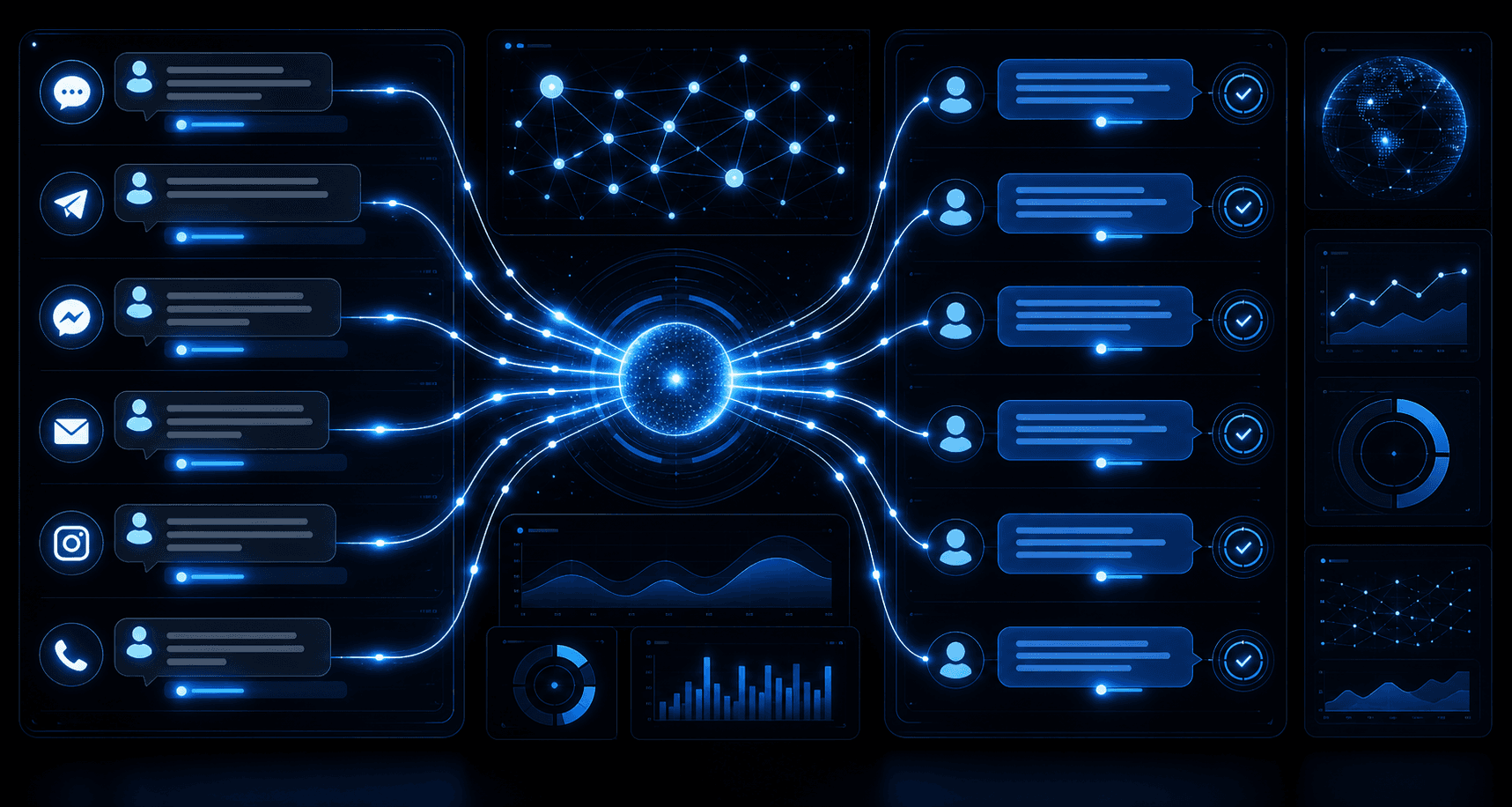
Availability. AI agents respond at 3am on a Sunday the same way they respond at 2pm on a Tuesday. No shift gaps, no peak-hour backlogs.
Concurrency. A human agent handles one conversation at a time. An AI agent handles thousands simultaneously without degradation.
No search time. Where a human might spend two minutes locating the right policy, a connected knowledge base returns the answer in under a second.
No drafting delay. The reply is generated during retrieval, not after it.
Wefunder went from a 7-hour response time to 15 minutes after deploying Fini, handling twice the volume on the same headcount. The hours were lost to queuing, routing, and drafting. AI removes all three from the loop.
AI Support Speed Benchmarks: What to Expect by Channel
Channel | AI first response (production) | Planning target |
|---|---|---|
Live chat | Under 3 seconds | Under 3 seconds |
2 to 10 minutes | Under 5 minutes | |
Voice | 800ms to 2 seconds end-to-end | Under 1.5 seconds |
Voice is the most demanding channel for latency. Human conversation runs on a 200 to 300ms window, but even well-optimized voice AI stacks rarely hit that in production. The gap is architectural: speech recognition, the LLM, and voice synthesis each carry their own latency, and those delays compound. Most voice AI agents median 1.4 to 1.7 seconds, which is noticeable but workable. At the 90th percentile, that stretches to 3 to 5 seconds, where user frustration becomes measurable.
Chat and email are more forgiving. A well-built AI agent on live chat returns a reply in under three seconds in most production environments, often under two. Email is asynchronous, so AI can compose and send a full resolution in minutes, not hours, with no queue dependency.
Fini delivers voice responses with under 100ms real-time latency, well inside the threshold where delays become perceptible. The channel difference goes beyond pipeline engineering. An instant first response that cannot act on connected systems still leaves the customer waiting.
Response Rate vs. Resolution Rate: The Metric That Actually Matters
Response rate tells you how fast a customer heard something. Resolution rate tells you whether their problem got solved. First contact resolution (FCR) is the cleaner measure, and treating response rate as a proxy for it is where most AI support benchmarks quietly break down.
Containment is the most common offender. A ticket "contained" by an AI agent means the customer didn't escalate, not that they got what they came for. The deflection vs. true resolution rate distinction matters more than most dashboards surface. Plenty of customers give up, close the window, and contact again tomorrow. Containment counts those as wins. Resolution rate does not.
For AI in particular, resolution rate is the cleaner signal because it requires the agent to actually close the ticket end to end. A fast acknowledgment that opens a 24-hour human queue moves the response time metric and nothing else. Resolution rate stays flat until the issue is gone.
The business case follows the same logic. A team that resolves 90% of tickets autonomously at 99% accuracy saves more per ticket than a team that responds in under five seconds and escalates half those conversations to human agents. Speed without resolution is overhead, not support. Fini's Resolution Rate 90% across fintech and healthcare is the number that moves cost per ticket, CSAT, and headcount planning simultaneously.
How Response Time Varies by Ticket Type and Complexity
Not every ticket is the same, and treating them as if they are is how teams end up with benchmarks that don't match reality.
A simple FAQ resolves in seconds. The intent is clear, the answer exists in the knowledge base, and no system action is required. AI handles these at whatever speed the channel allows.
Multi-step actions take longer, but for good reason. A customer disputing a charge requires the agent to query a billing system, verify account state, apply a policy, and write back a result. That chain might take 15 to 30 seconds end to end.
Escalations follow a third path. When confidence is low or the issue is legally sensitive, a well-designed AI agent stops resolving and hands off with full context attached. The resolution clock then continues on the human side.
A rough framework for setting internal expectations:
FAQ and informational: under 5 seconds
Account lookup or single-action workflows: 10 to 30 seconds
Multi-system actions such as refunds or account changes: 30 to 90 seconds
Escalations to human agents: depends on queue, not AI
The Knowledge Base Problem Hiding Behind Slow AI Responses
When an AI support agent responds slowly or incorrectly, the instinct is to blame the model. Usually, it's the knowledge base.

A stale or conflicting AI help center knowledge base forces the agent into one of two bad outcomes: a low-confidence answer requiring human review, or an escalation that should have resolved automatically. The latency you're measuring isn't model latency. It's time spent resolving ambiguity that better-structured knowledge would have eliminated.
The specific failure modes are predictable:
Duplicate articles with contradictory answers push confidence scores down and stall resolution.
Outdated policies generate answers that don't match current behavior, triggering reviews.
Keyword-indexed content fails when customer phrasing doesn't match article titles.
Solutions buried in resolved tickets never make it back into the base, so the same question escalates again next week.
A knowledge base that supports fast, accurate resolution has three properties: single-source attribution per answer, intent-based search over keyword matching, and a feedback loop that converts resolved escalations into new articles. Fini's Knowledge Atlas handles this automatically, running a nightly learning pipeline that ingests escalated conversations, identifies gaps, and drafts articles for human review before publishing. The result is roughly 85 to 90% resolution versus the 50 to 60% plateau teams hit when the knowledge base drifts.
Escalation Speed Matters as Much as First Response Speed
Slow escalation erases whatever speed the AI built on first response. When a human agent opens a blank ticket and asks the customer to explain themselves again, the clock resets.
A good escalation is fast and pre-loaded: the full conversation, a confidence score explaining why the AI stopped, and a plain-language summary of what the customer needs. Without that package, the handoff is just a delay.
Confidence scoring drives the resolve-or-hand-off decision, and AI support platforms ranked by accuracy guardrails differ widely here. At high confidence, the agent resolves autonomously. At mid confidence, it drafts a response for agent review. At low confidence, or on legally sensitive issues, it escalates immediately. The threshold varies by ticket type, channel, and the policies the agent is grounded on.
Two things make escalations slow in practice: the AI takes too long to detect it can't resolve, and context doesn't travel with the ticket. Fini's guardrails flag low-confidence situations before the customer waits through a dead-end interaction, and every escalation arrives with an AI-generated summary so the human picks up with full context.
Human queue time still controls how long escalated tickets take to close. AI can't compress that. What it can do is make sure the agent who picks up needs no ramp time at all.
Common Mistakes That Slow Down AI Support Agents
Four mistakes account for most of the performance gaps we see after deployment.
Deploying without a clean knowledge base is the most common. The agent is only as good as what it can retrieve. Contradictory articles, orphaned policies, and content untouched for two years all produce low-confidence answers that escalate instead of resolve. Fix the source before you go live, not after.
Misconfigured escalation thresholds cut both ways. Too tight and the agent over-escalates, routing tickets to humans that should have closed automatically. Too loose and it attempts resolutions it shouldn't, producing inaccurate answers at speed. Both hurt CSAT and are easy to miss if you're only watching response time.
Skipping baseline measurement leaves you blind. Teams that deploy without recording pre-AI first response time, resolution rate, and escalation volume cannot tell whether performance improved or just shifted. Set your benchmarks before day one.
Running AI and human agents from different knowledge sources is the quietest problem. When the AI references one version of a refund policy and a human agent references another, customers get contradictory answers depending on which path their ticket took. One canonical source for both removes the inconsistency entirely.
How to Measure AI Support Agent Response Performance
Five metrics belong on the dashboard. Everything else is noise.
Track first response time per channel, not as an aggregate. Chat and voice benchmarks are in seconds. Email is in minutes. Rolling them into one number hides which channel is underperforming.
Time to resolution
Segment by ticket type: FAQ, single-action, multi-system action. A 90-second resolution on a refund dispute is good. A 90-second resolution on a password reset is slow.
AI resolution rate
The headline metric. If your AI is resolving below 90%, the knowledge base needs attention before you adjust thresholds. If it's above 90%, check that escalations aren't being suppressed instead of resolved.
Escalation rate
Track escalation rate alongside resolution rate, broken out by ticket category. A spike in escalations on billing questions means the policy content is stale or ambiguous.
CSAT by resolution path
Run CSAT separately for AI-resolved and human-escalated tickets. If CSAT on escalated tickets is consistently lower, the handoff is arriving without enough context. If AI-resolved CSAT is lower, the resolution quality needs work, and speed alone won't fix it.
When any metric moves by more than 10% week over week, that's a signal worth pulling apart using AI support tools for tracking performance trends. It usually traces back to a knowledge gap, a threshold misconfiguration, or a new ticket category the agent hasn't seen before.
How Fini Approaches Response Time and Resolution at Scale
Fini runs voice, chat, and email on the same reasoning layer. One agent, one policy set, one audit trail across every channel.
On voice, Fini delivers under 100ms real-time latency. On chat, replies land in seconds. Email resolves in minutes. The production numbers back this up: Training Peaks cut its support queue by 70% and improved CSAT by 12 points. Wefunder went from a 7-hour response time to 15 minutes on the same headcount.
Speed holds because the knowledge base stays current. Knowledge Atlas runs a nightly learning pipeline, detecting gaps and drafting articles from resolved escalations before they repeat. Resolution accuracy improves between deployment and month six.
Full autonomy arrives by Day 30. Resolution Rate 90%, across 3M+ monthly resolutions in fintech and healthcare. The Zero Pay Guarantee: 90% resolution in 90 days, or you pay $0.
Final Thoughts on Measuring AI Live Chat Response Latency the Right Way
The teams that win on support speed are the ones tracking resolution rate alongside response time, not instead of it. Clean knowledge, well-tuned escalation logic, and channel-specific benchmarks are what separate a fast AI agent from a good one. Book a quick intro and we can walk through what this looks like on your ticket mix.
FAQ
What is a realistic AI support agent response time benchmark for live chat, email, and voice in 2026?
Production benchmarks vary by channel. Live chat returns a first response in under five seconds, often under two. Email resolves in two to ten minutes. Voice runs between 800ms and two seconds end-to-end, with well-optimized stacks like Fini delivering under 100ms real-time latency. These numbers assume a clean knowledge base; a stale or conflicting one adds resolution time regardless of model speed.
Fini vs. Intercom Fin for AI live chat response latency and full ticket resolution?
Intercom Fin operates on chat. Fini runs voice, chat, and email on the same reasoning layer, one audit trail, one policy set. On resolution rate, Fin is a chat deflection tool measured on containment; Fini is measured on closed tickets. Wefunder went from a 7-hour response time to 15 minutes after deploying Fini, handling twice the volume on the same headcount.
How fast should an AI customer support agent respond before users notice the delay?
On voice, human conversation runs on a 200 to 300ms window, and delays past three seconds measurably lose callers. On live chat, anything under five seconds is functional; under two is where satisfaction holds. The more relevant question for most support leaders is resolution time, not first response time: a fast acknowledgment that opens a 24-hour human queue moves the response metric and nothing else.
Can an AI support agent handle transaction disputes, card declines, and account restriction questions without human involvement?
Yes, if the agent connects to billing and account systems and carries the right compliance posture. Fini queries connected systems like Stripe in real time, verifies account state, applies policy, and closes the ticket with a full audit trail. For fintech use cases, SOC 2 Type II, PCI DSS Level 1, and full decision logging are built in, not added later.
How does Fini's Knowledge Atlas keep AI response accuracy from degrading over time compared to a manual QA process?
A manual QA process depends on someone noticing a gap and filing a ticket about it. Knowledge Atlas runs a nightly learning pipeline: it ingests escalated conversations, identifies where the agent lacked a confident answer, drafts articles, and surfaces them for human review before publishing. Teams that run without it plateau at 50 to 60% resolution as the knowledge base drifts. Teams running Atlas hold 90% resolution with roughly two hours per week on documentation instead of twenty.
Co-founder