
Decagon vs Sierra: the short answer
Decagon and Sierra are close on the big picture: both run one AI agent across chat, email and voice, both sell to large enterprises, and neither publishes a price list. The real differences are in how you are billed, how you build the agent, and which channels and certifications each one lists. Decagon offers per-conversation or per-resolution pricing and says most of its customers choose per-conversation. Sierra bills on outcomes you agree upfront, such as a resolved conversation or a saved cancellation. Decagon has you write Agent Operating Procedures (AOPs) in natural language. Sierra offers a no-code Agent Studio, a developer Agent SDK and Ghostwriter, which builds agents from a description. Fini is the third option for teams that want a published per-resolution price before the first sales call.
In this comparison: What each is · Pricing · How they differ · Capabilities · Feature by feature · Ease of use · Where Fini fits · Recognized strengths · What customers say · The full side-by-side · Which to choose · Compliance · FAQ
What is Decagon?
Decagon describes itself as "the AI concierge for every customer." It runs AI agents across chat, voice and email on one shared intelligence layer. Teams define agent behavior with Agent Operating Procedures (AOPs), written in natural language "the same way you train human agents with SOPs," with code-level control and Git-based versioning for technical teams.
Around the agent, Decagon offers Duet (which can create AOPs from transcripts and generate tests), simulation testing before release, A/B experiments, Watchtower for always-on quality review, and insights and reporting. It also detects personal AI agents that contact support on a customer's behalf and routes them to a dedicated channel with customer-controlled permissions. For a deeper look at Decagon against Fini, see Decagon vs Fini.
What is Sierra?
Sierra calls itself "the leading conversational AI platform for businesses." Its agents work across voice, chat, email, SMS, WhatsApp and ChatGPT, and Sierra says it works with 40% of the Fortune 50.
Sierra gives teams three ways to build: Agent Studio, a no-code builder with composable building blocks and simulations; the Agent SDK, for developers who want to compose agents from skills with objectives and guardrails; and Ghostwriter, which builds an agent from a description, SOPs, transcripts or recorded interviews. Insights tools (Explorer, Monitors, Experiments and Observability) cover analysis after launch. For a deeper look at Sierra against Fini, see Sierra vs Fini.
How Decagon and Sierra price
Neither vendor publishes a rate card. Both explain their pricing model in writing (per their Dec 2024 pricing posts), and the models differ.
Decagon offers two options. Per-conversation pricing is "a fixed rate for every incoming conversation, with flexible pricing for higher volumes." Per-resolution pricing is "a higher fixed rate for each fully resolved conversation, with no charge for escalations." Decagon says "the vast majority of our customers choose per-conversation pricing." There is no public pricing page; buyers go through a demo.
Sierra uses outcome-based pricing: you pay when the agent achieves an agreed outcome, such as "a resolved support conversation, a saved cancellation, an upsell." Sierra says the criteria for each outcome are agreed upfront, and that for unresolved or escalated conversations, "in most cases, there's no charge." Simple routing or greeter interactions can be billed on blended consumption pricing instead.
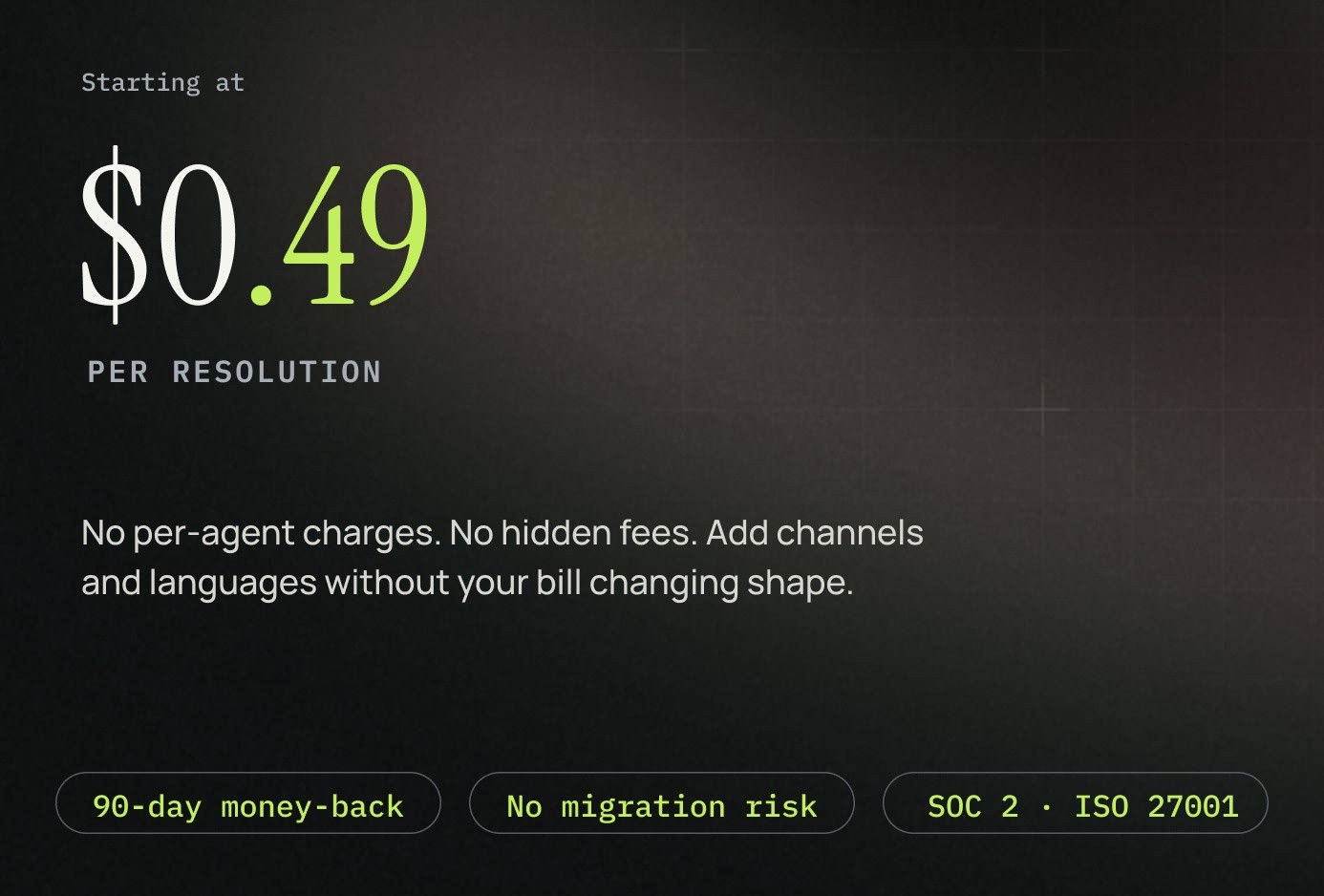
Fini publishes its price: $0.49 per resolution, excluding voice, which is priced separately. A resolution is a ticket closed with no human touch and no customer reply for 72 hours, and there are no per-seat fees.
See Fini pricing for details.
How Decagon and Sierra differ
The biggest practical difference is who builds and maintains the agent. Decagon centers on one authoring model, AOPs, which mixes natural-language instructions with code-level control, so CX and engineering teams work in the same artifact. Sierra splits the job across three tools: Agent Studio for no-code builders, the Agent SDK for developers who want to write "customer journeys as code," as Ramp puts it, and Ghostwriter for teams who would rather describe the agent than configure it.
Billing is the second difference. Decagon gives you a choice between per-conversation and per-resolution, and most customers pick per-conversation. Sierra ties the bill to outcomes you define in the contract, which can include revenue outcomes such as saved cancellations, not just resolved tickets.
Channels and languages are the third. Both offer inbound and outbound voice. Sierra lists a wider channel set, adding Apple Business Chat and publishing to ChatGPT, and states 59 languages for its agents. Decagon lists web chat, SMS, WhatsApp, email and voice, and states 70+ languages for voice, with automatic detection and language switching.
Capabilities side by side
Capability | Decagon | Sierra |
|---|---|---|
Channels | Chat (web, SMS, WhatsApp), email, inbound and outbound voice | Chat, SMS, WhatsApp, Apple Business Chat, email, inbound and outbound voice, ChatGPT |
Languages stated | 70+ for voice | 59 languages; 60+ voice locales |
How agents are built | AOPs in natural language, with code control and Git versioning | Agent Studio (no code), Agent SDK (code), Ghostwriter (describe it) |
Testing before launch | Simulations, auto-generated tests, CI/CD testing | Simulations and regression test suites |
Quality after launch | Watchtower, insights and reporting, A/B experiments | Insights: Explorer, Monitors, Experiments, Observability |
Help for human reps | Decagon Assist (summaries, replies, live translation) | Live Assist |
Published pricing | No | No |
Feature by feature
Feature | Decagon | Sierra |
|---|---|---|
Pricing model | Per conversation or per resolution | Outcome-based, criteria agreed upfront |
Charge for escalations | None on the per-resolution model | "In most cases, there's no charge" |
Helpdesk and CRM | Salesforce, Zendesk, Intercom and more | Connects to systems of record "from order management to CRM" |
Knowledge sources | Confluence, Contentful, Kustomer | Not listed by name |
Voice infrastructure | Inbound and outbound voice via Amazon Connect, RingCentral or SIP trunking | Inbound and outbound voice with Voice Personas |
Open standards | MCP, APIs and custom tools | Agent SDK connects to internal or external systems |
AI agents as customers | Detects personal AI agents, routes to a dedicated channel | Not stated |
Decagon's Model Context Protocol (MCP) support matters if you already expose internal tools that way.
Ease of use and admin experience
Both vendors aim at teams without deep engineering resources, and both say so. Decagon says AOPs let CX teams write logic "the same way you train human agents with SOPs," while technical teams get Git-based versioning and code where they need it. Duet can create AOPs from transcripts and generate tests, which shortens the first build.
Sierra says Agent Studio needs "no code required" and that Ghostwriter lets CX teams build agents "whatever their technical expertise," taking SOPs, transcripts or audio interviews as input. Teams that want full control can move to the Agent SDK.
If your support team owns the agent day to day, ask each vendor to build one real workflow in the demo, using your own policy document, and watch who on your side would need to maintain it.
Where Fini fits as a third option
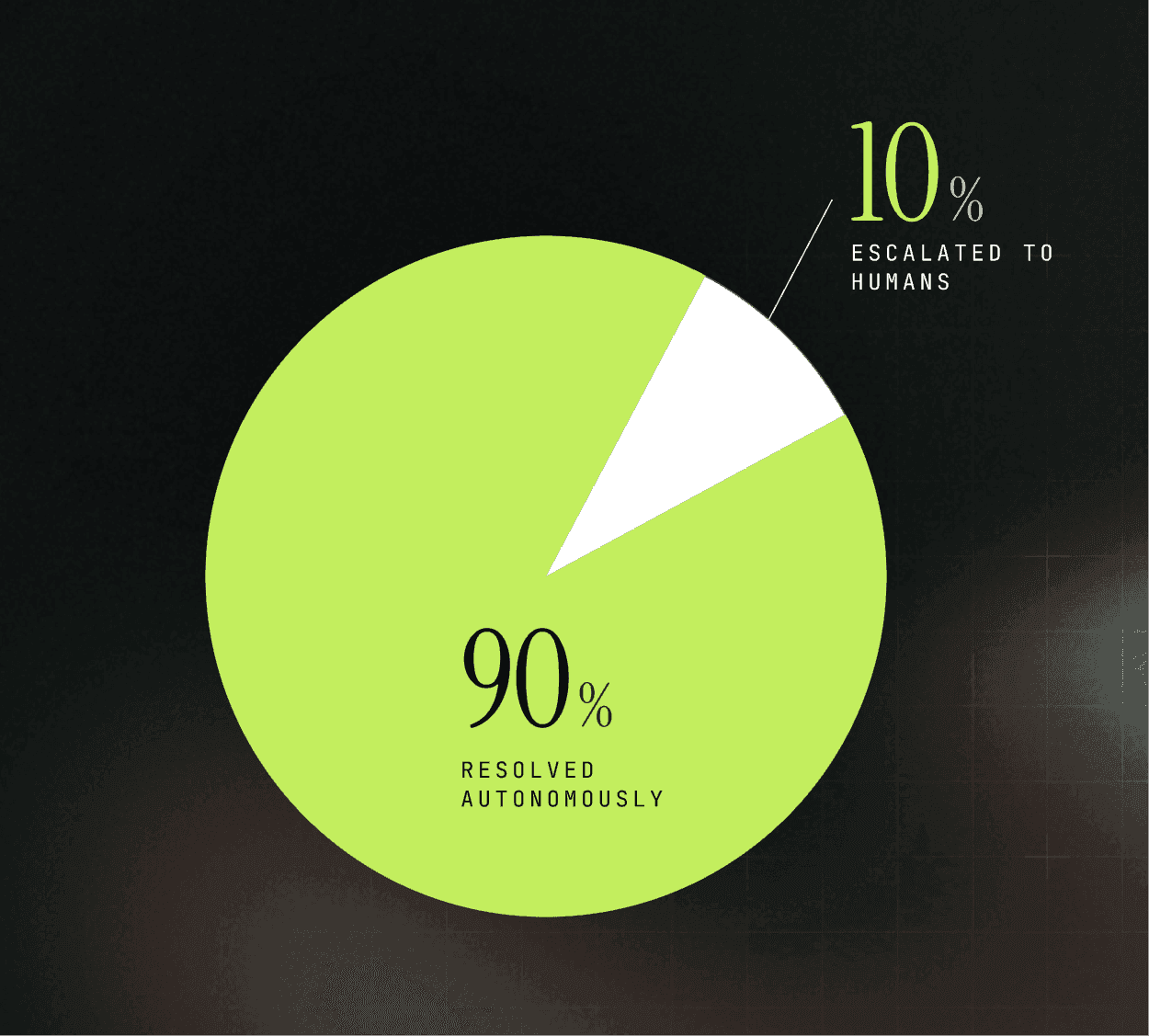
Fini is an AI customer support agent priced per resolution and backed by Y Combinator and Matrix Partners. It resolves 90% of tickets at 99% accuracy across chat, email and voice, in 130+ languages, and connects natively to helpdesk, knowledge base, CRM and billing systems so it can take action on tickets, not just answer questions.
A price you can model before a sales call
Fini starts at $0.49 per resolution, excluding voice, with no per-seat fees. Neither Decagon nor Sierra publishes a rate, so Fini is the only one of the three you can budget for from the website.
A guarantee you can hold the vendor to
Fini offers a 90-Day Money-Back Guarantee: if Fini does not reach a 90% resolution rate within 90 days of going live, you are not charged for the shortfall.
A fixed timeline
Fini deploys anywhere in 2 mins, is fully live in 14 days and fully autonomous in 30 days.
Built for regulated support
Fini holds SOC 2 Type II, ISO 27001:2022 and PCI DSS Level 1, is GDPR and CCPA compliant, and is HIPAA-compliant, BAA-eligible. Agent Handshake is open to everyone: any team running an AI agent for support, ours or not.
Decagon and Sierra's recognized strengths
Decagon's strengths are a single authoring model that both CX and engineering can work in, a deep testing and QA layer (simulations, CI/CD testing of every version and Watchtower), a choice of pricing model, and a security posture that includes zero data retention with its AI model providers.
Sierra's strengths are breadth of channels, including Apple Business Chat and ChatGPT; three build paths for different skill levels; outcome-based pricing that can cover revenue outcomes; and the longest compliance list of the three, including FedRAMP High.
Both list well-known enterprise customers. Decagon's site shows logos including Deutsche Telekom, American Airlines, Square, Delta, Notion, Chime, Duolingo and Rippling. Sierra's site shows logos including Rocket Mortgage, Gap, SiriusXM, Hyatt, Uber, Vanguard, Wayfair and Discord.
What customers say
Decagon publishes customer results on its homepage: Chime reports a 70% resolution rate across chat and voice, Duolingo 80% deflection, Oura 3x CSAT, Curology a 65% cost reduction, ClassPass a 95% cost reduction, and Rippling a 32% increase in deflection. These are vendor-reported figures.
Sierra's homepage features customer testimonials from CLEAR, Rocket Mortgage, SiriusXM and Minted.
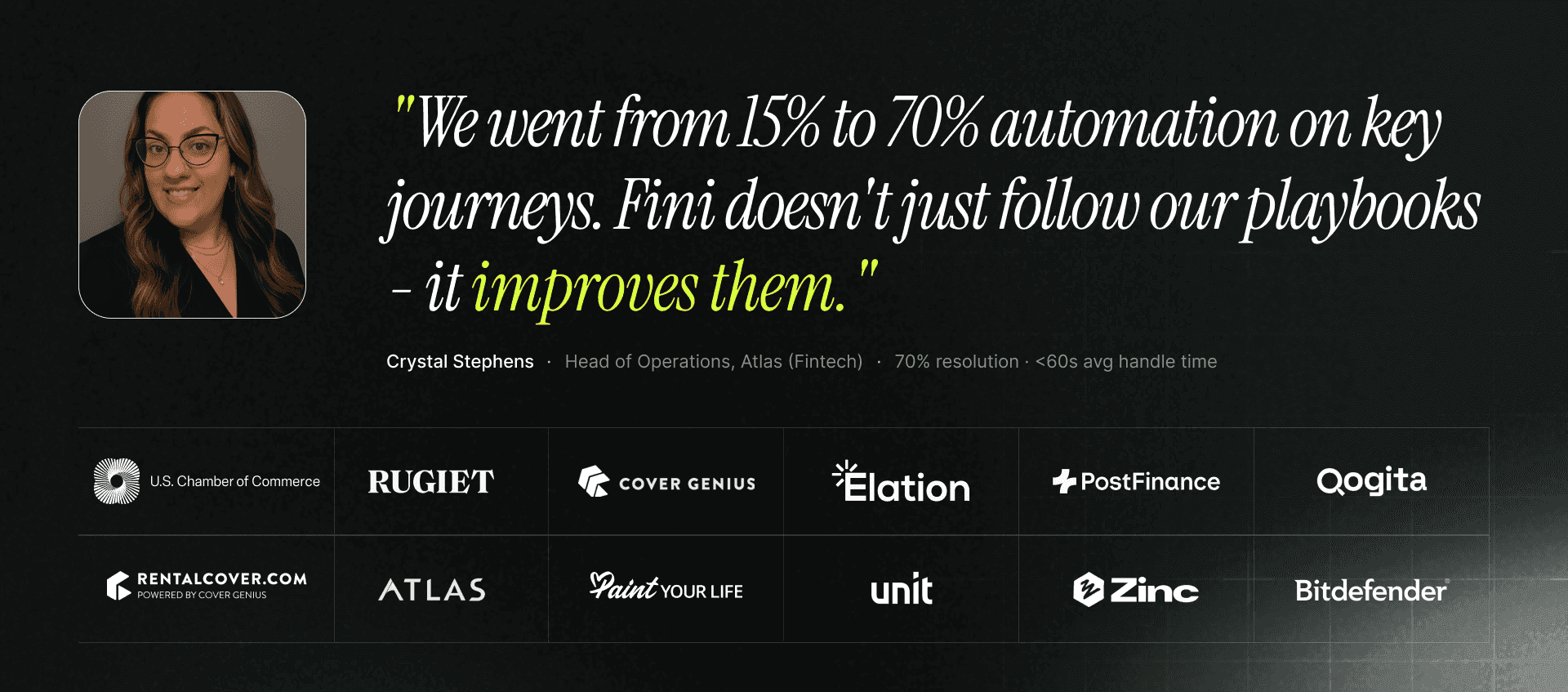
Fini customers include Atlas:
The full side-by-side
Decagon | Sierra | Fini | |
|---|---|---|---|
Pricing model | Per conversation or per resolution | Outcome-based | Per resolution |
Published price | No | No | $0.49 per resolution, voice priced separately |
Money-back guarantee | Not stated | Not stated | 90-Day Money-Back Guarantee |
Channels | Chat, email, voice | Chat, email, voice, messaging, ChatGPT | Chat, email, voice |
Languages stated | 70+ (voice) | 59 | 130+ |
Build approach | AOPs | Agent Studio, Agent SDK, Ghostwriter | Connects to your helpdesk and knowledge base |
Go-live time | Not stated | "Weeks" | Fully live in 14 days, fully autonomous in 30 |
Agent-to-agent | Personal-agent channel | Not stated | Agent Handshake |
Which should you choose?
Choose Decagon if you want one authoring model that CX and engineering share, strong pre-release testing, and the option to pay per conversation.
Choose Sierra if you need the widest channel coverage (including Apple Business Chat and ChatGPT), want to tie the bill to business outcomes beyond resolution, or need FedRAMP High.
Choose Fini if you want a published per-resolution price, a money-back guarantee and a fixed go-live timeline before you sign. For head-to-head detail, read Decagon vs Fini and Sierra vs Fini. For a support-team view of the same two vendors, see our Sierra vs Decagon support breakdown.
Compliance
Each vendor lists these on its own security or trust page:
Decagon: SOC 2 Type II, ISO 27001, PCI DSS 4.0.1, HIPAA, GDPR, CCPA and the EU AI Act.
Sierra: SOC 2, ISO 27001, ISO 42001, PCI DSS Level 1 Service Provider, HIPAA, GDPR, CCPA, FedRAMP High and CSA STAR, and its homepage shows an EU AI Act badge.
Fini: SOC 2 Type II, ISO 27001:2022, PCI DSS Level 1, GDPR, CCPA, and HIPAA-compliant, BAA-eligible.
For regulated teams, ask each vendor for its SOC 2 Type II report and BAA terms in writing. Our guide to AI agents in regulated customer support covers what else to check.
Ready to compare on your own data?
The fastest way to compare Decagon, Sierra and Fini is to run each one on the same set of your real tickets. Book a call and we will show you Fini on your own data, or see Fini's plans.
Sources (checked 02 Nov 2026)
https://decagon.ai/product/chat (accessed 03 Nov 2026)
https://decagon.ai/product/email (accessed 03 Nov 2026)
https://decagon.ai/product/testing-qa (accessed 03 Nov 2026)
https://sierra.ai/product/agent-sdk (accessed 03 Nov 2026)
https://sierra.ai/product/ghostwriter (accessed 03 Nov 2026)
Is Decagon or Sierra cheaper?
Neither publishes rates, so you can only compare quotes. Decagon offers per-conversation or per-resolution pricing, and most of its customers choose per-conversation. Sierra charges on outcomes agreed upfront and says that in most cases unresolved or escalated conversations are not charged. Fini publishes $0.49 per resolution, excluding voice, which is priced separately.
Which channels do Decagon and Sierra support?
Both cover chat, email and voice, and both offer inbound and outbound voice. Decagon lists web chat, SMS and WhatsApp for chat, plus voice in 70+ languages. Sierra lists chat, SMS, WhatsApp, Apple Business Chat, email, voice and publishing to ChatGPT, in 59 languages.
How do you build an agent on Decagon vs Sierra?
Decagon uses Agent Operating Procedures, written in natural language with code-level control and Git versioning. Sierra offers Agent Studio (no code), the Agent SDK (code) and Ghostwriter, which builds an agent from a description, SOPs or transcripts.
Are Decagon and Sierra HIPAA and SOC 2 compliant?
Both list SOC 2, HIPAA, GDPR, CCPA, ISO 27001 and PCI DSS on their own security pages. Sierra also lists FedRAMP High, CSA STAR and ISO 42001, and both show an EU AI Act badge. Ask each for its audit reports and BAA terms before you sign.
Should I choose Decagon or Sierra?
Choose Decagon for one shared authoring model, strong pre-release testing and a per-conversation option. Choose Sierra for the widest channel coverage, outcome-based billing tied to business results, or FedRAMP High.
Where does Fini fit against Decagon and Sierra?
Fini is a third option with a published price of $0.49 per resolution (voice priced separately), a 90-Day Money-Back Guarantee, and a fixed timeline: fully live in 14 days and fully autonomous in 30 days. It resolves 90% of tickets at 99% accuracy.