Last Updated:

Deepak Singla

IN this article
Explore how AI support agents enhance customer service by reducing response times and improving efficiency through automation and predictive analytics.
Disputes, declines, and account restrictions are where neobank support gets hard. The ticket volume is high, the compliance exposure is real, and a deflection to a human agent doesn't fix anything. This post walks through what separates an AI agent that can genuinely resolve these workflows from one that just moves the problem around.
TLDR:
Global chargeback volume hits 324 million by 2028, up 24%. Neobank support teams absorb that without more headcount.
Agentic action separates real resolution from deflection: querying account state, reversing charges, closing tickets with a full audit trail.
SOC 2 Type II, PCI DSS, and GDPR are non-negotiable for neobank procurement. Tools that treat compliance as an add-on stall every review cycle.
Per-resolution pricing aligns vendor incentives with yours. Per-seat and per-message pricing do not.
Fini delivers Resolution Rate 90% at 99% accuracy across voice, chat, and email, live in 14 days, backed by a Zero Pay Guarantee: 90% resolution in 90 days, or you pay $0.
What is AI support for neobanks
Neobanks run lean by design. The support challenge that creates is anything but simple.
Transaction disputes, card declines, and account restrictions are among the most common ticket types a neobank AI customer support system handles, and also among the most compliance-sensitive. A wrong answer on a dispute claim carries real liability. A slow response on a frozen account loses a customer. Global chargeback volumes are projected to hit 324 million by 2028, up 24% from 2025. That volume lands on support teams already stretched thin.
A chatbot that deflects a dispute inquiry to a human agent hasn't resolved anything. An autonomous AI support agent reads the customer's account state, queries the relevant system, and closes the ticket with a full audit trail. That distinction matters more in fintech than almost anywhere else, because every interaction sits inside a compliance perimeter.
How we ranked AI support tools for neobanks
Six criteria shaped this ranking. Each one maps to something that breaks in practice when neobanks deploy the wrong tool.
Resolution rate, not containment. Containment counts a deflection as a win. Resolution rate counts a closed ticket. For dispute and decline workflows, only the latter matters.
Compliance posture out of the box. SOC 2 Type II, PCI DSS, and GDPR are not negotiable in fintech. Choosing from the safest AI support vendors for fintech means a tool won't slow every procurement and audit cycle.
Multi-channel coverage on unified logic. Voice, chat, and email need to run on the same reasoning layer. Three vendors means three audit trails, three tuning cycles, and three points of failure.
Agentic action capability. Querying a billing system, reversing a charge, pulling account state: these are the actions that resolve a dispute. A tool that can only answer questions hands the hard work back to a human agent.
Time to live. A six-month implementation is a headcount problem waiting to happen. We weighted tools that go live in weeks, not quarters.
Pricing transparency. Per-seat pricing penalizes scale. Per-message pricing rewards verbosity. Per-resolution pricing aligns the vendor's incentive with yours: close the ticket. These distinctions matter when comparing AI customer support platforms for fintech neobanks.
Best overall AI support for neobanks: Fini
Fini scores highest across every criterion in our ranking. Resolution Rate 90% at 99% accuracy, across voice, chat, and email on a single reasoning layer with one audit trail. No channel silos, no separate tuning cycles per medium.
For dispute workflows, the agentic action layer is what matters. Fini queries billing systems, identifies duplicate charges, reverses them, and closes the ticket with a full audit trail generated. For a deeper look at AI agents for charge disputes from intake to resolution, the workflow is covered in detail. The agent handles the resolution end to end without a human touching it.
Knowledge Atlas keeps the agent sharp without ops team intervention. When a human resolves an escalation, Atlas extracts the solution, drafts an article, and files it. Conflicting policies get flagged before they produce a wrong answer on a compliance-critical dispute.
The compliance stack is built in: SOC 2 Type II, PCI DSS Level 1, ISO 27001, GDPR, HIPAA-compliant, BAA-eligible, CCPA. Teams reviewing fintech security and auditability in AI vendors will find Fini's posture among the strongest available. Procurement reviews don't stall on missing certs.
Rollout runs Day 1 (Knowledge Agent live), Day 14 (backend systems connected, real actions), Day 30 (full autonomy). Pricing starts at $0.49 per resolution on Enterprise, outcome-based, no per-seat fees. Escalations are free.
Zero Pay Guarantee: 90% resolution in 90 days, or you pay $0.
Intercom Fin
Intercom Fin is built for teams already running Intercom as their primary helpdesk. It handles chat-based conversations, draws from connected knowledge sources, and escalates inside the shared inbox. Adoption is wide across SaaS and e-commerce.
What they offer
Resolution-based pricing with no platform fee
Knowledge ingestion from help center and connected sources
Escalation to human agents inside the Intercom inbox
Integrations with Salesforce, Stripe, and other tools via Intercom's app ecosystem
Good for teams already on Intercom who want to activate AI on existing chat volume without switching tooling.
The limitation for neobanks is maintenance. Teams comparing AI agents for payment dispute support in fintech will find that AI errors surface through periodic QA reviews and get patched via a snippets workaround, which means someone on your team owns that cycle indefinitely. At neobank scale, with dispute and decline workflows that shift as policies change, that becomes a recurring cost.
Fin is a chat product. Voice and email require additional vendors, which means additional audit trails and additional tuning cycles.
Decagon
Decagon positions itself as an AI agent for enterprise CX, with a services-led implementation model built around custom workflow configuration. For teams with complex support processes and appetite for a longer deployment, that approach can work.
What they offer
AI agent designed for complex enterprise CX workflows
Services-led deployment and configuration
Escalation from AI to human agents
Custom workflow configuration for support processes
Good for enterprise teams with bandwidth for a longer, heavily customized deployment.
The limitation that matters for neobanks: Decagon's handoff is one-way. AI escalates to human, but human-resolved escalations don't feed back into the agent automatically. Knowledge gaps stay gaps until someone manually closes them. For dispute and decline workflows, fintech support compliance automation is the only way to keep pace when policies shift regularly.
Ada
Ada has been around since roughly 2016, building its original product on a chat-first architecture. The LLM layer came later. It serves 350+ businesses globally, with a customer base weighted toward retail, DTC, travel, and gaming. The company claims an 84% automated resolution rate across that base.
There are a few things Ada does well:
Omnichannel delivery across chat, email, and voice
Multi-LLM orchestration with SOC 2, HIPAA, GDPR, PCI DSS, and CCPA certifications
Knowledge base ingestion with admin-driven test, analyze, and optimize tooling
Open APIs and SDKs for custom integrations
Good for mid-market retail or DTC teams with internal resources to manage ongoing knowledge base maintenance.
The gap for neobanks is the improvement loop. Ada's knowledge base doesn't maintain itself. When a policy changes or a new dispute pattern surfaces, someone on your team runs the optimize cycle. At neobank scale, with dispute and decline workflows shifting as regulations evolve, that becomes a standing ops commitment. Resolution rates plateau without that internal attention. There's no equivalent to Knowledge Atlas auto-detecting gaps and filing corrections without human prompting.
The compliance certifications are present, but the architecture underneath them was designed for retail use cases. AI support platforms for compliance-heavy fintech require dispute querying, account restriction handling, and audit trail generation per resolution as the design center.
Lorikeet
Lorikeet describes itself as a "universal AI concierge" that resolves customer challenges across chat, email, and voice. The company has a genuine compliance-focused industry orientation, with customers in healthcare and banking and a Series A raised in 2025.
What they offer
AI support agent across chat, email, and voice
Focus on complex, multi-step support queries in compliance-heavy industries
Fintech and healthcare customer base
The procurement gap is transparency. For neobank procurement teams comparing compliant AI support platforms for fintech, Lorikeet doesn't publish a per-resolution pricing model, a performance guarantee, or a documented self-maintaining knowledge layer. For neobank procurement teams, that makes resolution commitments and cost predictability hard to assess before signing. Without a defined rollout timeline and a Zero Pay Guarantee backing the resolution rate, the risk sits with the buyer.
Feature comparison table of AI support for neobanks
The table below covers the features that matter most when a neobank assesses an AI support agent: resolution guarantees, agentic actions, compliance posture, and time to live.
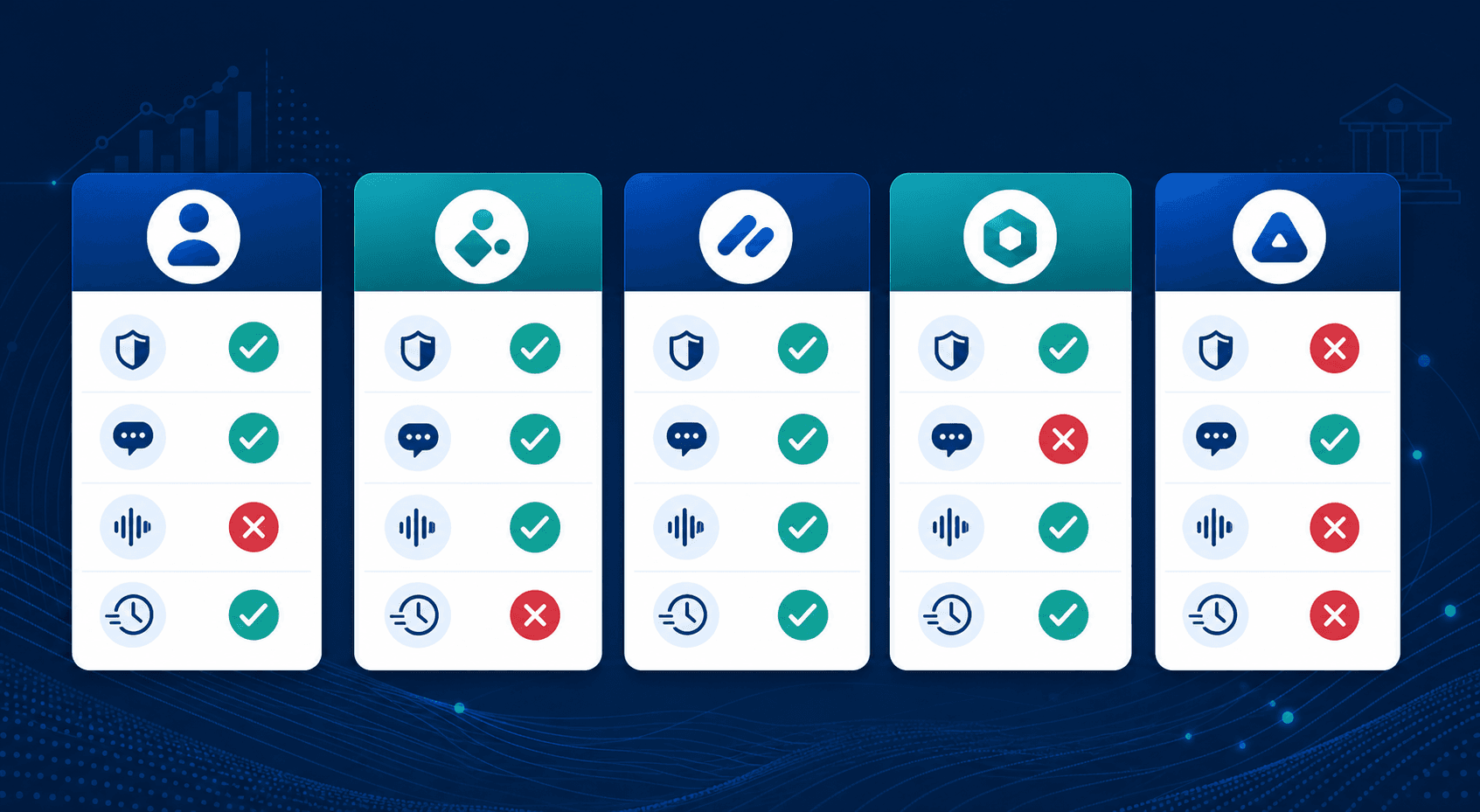
Fini | Intercom Fin | Decagon | Ada | Lorikeet | |
|---|---|---|---|---|---|
Resolution rate (published guarantee) | 90% | No | No | 84% (claimed) | No |
Self-maintaining knowledge | Yes | No | No | No | No |
Agentic actions (refunds, account updates) | Yes | Partial | Yes | Partial | Partial |
Voice + chat + email unified | Yes | No | No | Yes | Yes |
Outcome-based pricing (public) | Yes | Yes | No | No | No |
Time to live (documented) | 14 days | No | No | No | No |
Fintech/regulated-industry design | Yes | No | Partial | No | Partial |
Compliance (SOC 2 + PCI DSS + GDPR) | Yes | Partial | No | Yes | No |
Performance guarantee / Zero Pay | Yes | No | No | No | No |
Why Fini is the best AI support for neobanks
Neobank support carries a compliance weight that generic SaaS support tools weren't designed to bear. Disputes require querying live account state and generating a full audit trail. Reviewing AI support platforms for neobank transaction disputes shows why card decline explanations need to match policy exactly, with no blended answers from conflicting sources. Account restrictions involve compliance-specific language. An agent that can't take real actions, log every decision, and keep its own knowledge current hands the hard work back to your ops team.
Fini handles all three workflows end to end: Resolution Rate 90% at 99% accuracy across voice, chat, and email, backed by 3M+ monthly resolutions across fintech and healthcare in production. The Zero Pay Guarantee covers it: 90% resolution in 90 days, or you pay $0.
Final thoughts on AI support tools for neobanks
For neobanks, the cost of a wrong answer goes beyond a bad CSAT score. It's a compliance exposure. The tools that score well here resolve the ticket end to end, maintain their own knowledge, and leave a full audit trail behind. Your team deserves a system that does the same. Book a short intro call to see what that looks like on your data.
FAQ
How do I choose between Fini, Intercom Fin, Ada, Decagon, and Lorikeet for neobank support?
Start with two questions: does the tool take real actions across your billing and account systems, and does it maintain its own knowledge without your ops team running a weekly QA cycle? Fini, with Resolution Rate 90% at 99% accuracy and a self-maintaining knowledge layer, is the only option in this list that answers yes to both out of the box.
Is Ada better than Fini for handling transaction disputes and account restrictions?
Ada handles omnichannel delivery and carries SOC 2, PCI DSS, GDPR, and HIPAA certifications, but its knowledge base requires manual maintenance and its architecture was designed for retail use cases, not fintech-specific workflows like dispute querying or per-resolution audit trail generation. For neobanks where policies shift with regulation and dispute volume is growing toward 324 million globally by 2028, that standing ops commitment is a real cost.
When should a neobank choose Intercom Fin or Decagon over Fini?
Intercom Fin is a reasonable choice if your team already runs Intercom, ticket volume is modest, and chat is your only support channel. Decagon fits teams with bandwidth for a longer, heavily configured deployment and no self-maintaining knowledge requirement. If your support runs across voice, chat, and email with dispute and restriction workflows that need a full audit trail per resolution, neither covers the full scope.
How long does it take to go live with an AI support agent for neobank dispute and decline workflows?
Fini goes live in 14 days: Day 1 connects your helpdesk and knowledge base, Day 14 connects billing and account systems so the agent takes real actions, and Day 30 reaches full autonomy across voice, chat, and email. No other tool in this list publishes a documented rollout timeline.
What compliance certifications should I require from an AI support agent before deploying it in a neobank?
At minimum: SOC 2 Type II, PCI DSS Level 1, and GDPR. For any workflow touching account data or dispute claims, a full decision audit trail per resolution matters as much as the certifications themselves. Fini carries SOC 2 Type II, PCI DSS Level 1, ISO 27001, GDPR, HIPAA-compliant, BAA-eligible, and CCPA, with every resolution generating a logged audit trail.
Related guides
Explore the guide topics to find more reading.
Co-founder