Last Updated:

Deepak Singla

IN this article
Explore how AI support agents enhance customer service by reducing response times and improving efficiency through automation and predictive analytics.
Agentforce takes 5 to 11 months to deploy. Most support teams are live on a dedicated vendor in days. The decision comes down to three questions about your current stack, your team's resources, and your timeline. Get those three answers right and the comparison resolves itself quickly.
TLDR:
Agentforce is a development framework, not a shipped product. Setup runs 5 to 11 months and fewer than 10% of customers have scaled it.
Agentforce fits teams where Salesforce is already the system of record. For Zendesk, Intercom, or Freshdesk shops, you're doing a CRM migration before resolving tickets.
Dedicated AI support vendors connect to your existing helpdesk via OAuth and go live in days, with knowledge management and resolution logic pre-built.
Agentforce prices at $500 per 100,000 Flex Credits plus $125 to $250 per user per month, with Service Cloud seat fees on top. Total cost of ownership runs well past the headline rate.
Fini resolves 90% of tickets at 99% accuracy across voice, chat, and email, with a Knowledge Agent live Day 1, agentic workflows by Day 14, and full autonomy by Day 30. Zero Pay Guarantee: 90% resolution in 90 days, or you pay $0.
What Agentforce is (and what it is not)
Agentforce is Salesforce's framework for building and deploying AI agents directly inside its CRM ecosystem. At its core sits the Atlas Reasoning Engine, which decomposes a customer request into retrieval and action steps, pulling from Salesforce Knowledge articles and CRM records. It can handle service cases, qualify leads, and route requests, all within guardrails you define.
The distinction that matters for support leaders: Agentforce is a development environment, not a finished product. As Salesforce describes it, building a service agent required connecting your own knowledge, defining your own actions, and wiring up each channel yourself. That is the base reality before the newer Help Agent variant attempted to reduce setup friction.
Agentforce is genuinely capable, but only for teams with the Salesforce infrastructure, SI resources, and configuration time to build on top of it. Teams comparing options can review AI support platforms for Salesforce CRM before committing. The real question is whether you need a toolkit or a shipped product.
How Agentforce works for customer support
Agentforce's Atlas Reasoning Engine runs a sequence when a ticket arrives: classify intent, select the right Subagent, retrieve grounding data from Salesforce Knowledge or CRM records, execute an Action, then return a response or escalate with context attached.
A billing dispute, for example, routes to a billing Subagent, which queries the account record and attempts a resolution via a defined Action such as issuing a credit. If confidence falls below the configured threshold, it hands off to a human agent. The escalation arrives with full context.
The grounding step is load-bearing. Salesforce acknowledges that messy data is the single biggest reason agents fail. If your knowledge lives in Salesforce and is well-maintained, the agent performs. If it doesn't, you're cleaning data before you're resolving tickets. Voice, chat, and email are each supported, but each requires separate configuration against your Salesforce stack.
Agentforce pricing and total cost of ownership
Agentforce pricing has shifted more than once since launch. It started at $2 per conversation in late 2024, then moved to a credit-based model after widespread customer confusion and backlash. Today, the structure combines Flex Credits at $500 per 100,000 credits with Contact Center licensing at $125 to $250 per user per month.
Neither line item tells the full story. Agentforce at scale requires Service Cloud, which carries its own seat fees. Add SI implementation costs, data cleanup, and ongoing configuration, and total cost of ownership climbs well past what the headline credit rate suggests. Teams often find this out after procurement has already moved.
Fini prices per resolved ticket instead: starts at $0.49 per resolution. No per-seat fees, and escalations are free.
Where Agentforce fits best
Agentforce's strongest case is simple: if your support org already runs on Salesforce, the grounding advantage is real. When customer data lives in Service Cloud and knowledge articles are maintained in Salesforce Knowledge, the agent has clean, structured context from day one. No data migration. No integration layer to build.
The profile that fits:
Salesforce is already the system of record for CRM, cases, and knowledge
You have SI resources or an internal Salesforce team for configuration
Your support and sales orgs share data, and a single-vendor AI strategy simplifies governance
Timeline pressure is low enough to absorb a 5 to 11 month setup window
For that buyer, the unified data layer is a genuine structural advantage. A standalone vendor has to integrate into Salesforce to get the same CRM context. Agentforce starts there.
The Salesforce dependency: what it means in practice
Most enterprise support teams run Zendesk, Intercom, Gorgias, or Freshdesk as their primary helpdesk. For those teams, deploying Agentforce means either migrating case and knowledge data into Salesforce, or building and maintaining a sync layer between systems. Setup takes 5 to 11 months and fewer than 10% of customers have scaled it. Integration complexity is a core reason.
The practical consequence: a support team on Zendesk assessing Agentforce isn't really assessing an AI agent. They're assessing a partial CRM migration first, and an AI agent second. That's the moment most teams open a second tab and start looking at vendors that connect directly to their existing helpdesk.
What dedicated AI support vendors do differently
Dedicated AI support vendors ship with the support use case already solved. Integrations, resolution logic, knowledge management, and escalation paths come pre-built. You connect your helpdesk and go live, instead of configuring a framework into a product.
The differences that matter in practice:
Helpdesk integrations are native. Zendesk, Intercom, Freshdesk, and Gorgias connect via OAuth, not via a sync layer built on top of a CRM migration.
Resolution logic is pre-trained for support. The agent already understands refund requests, account disputes, and policy lookups. You are not defining Actions from scratch.
Knowledge management is built in. The best dedicated vendors auto-detect knowledge gaps, draft articles from resolved escalations, and surface those gaps for human review. The approach to training AI on company knowledge determines how quickly resolution rates climb. The ops team stops being a documentation factory.
Deployment is measured in days, not months. Without a Salesforce estate to configure, there is no 5 to 11 month setup window to absorb.
The tradeoff is real: dedicated vendors do not start with your CRM data already grounded. They integrate into Salesforce, Stripe, or whatever billing and identity system you run. That integration adds a step. But for teams not already on Service Cloud, that step is far shorter than the alternative.
Channel coverage: voice, chat, and email
Agentforce has expanded beyond chat. The Agentforce Contact Center launch added native voice alongside digital channels, positioning it as a unified AI and CRM layer for contact center teams.
The gap is in how channels are connected. Agentforce Contact Center is a separate product from the base Agentforce framework, each requiring its own configuration against your Salesforce stack. Voice, chat, and email share CRM grounding, but they don't share a single reasoning layer out of the box.
Dedicated AI support vendors take a different approach. Voice, chat, and email run on one agent, one policy set, and one audit trail. A billing dispute that starts on chat and continues on a call doesn't lose context. The resolution logic is the same regardless of channel, and the audit trail covers all three.
For teams that need full multi-channel coverage from day one, that distinction matters. Agentforce gets you there, but through separate product layers. A dedicated vendor ships it unified.
Deployment timeline and setup complexity
Agentforce implementations run 5 to 11 months for production-scale deployments. That window covers SI engagement, data cleanup, knowledge migration into Salesforce, Subagent configuration, Action definition, and channel wiring. None of those steps is optional if you're starting outside the Salesforce estate.
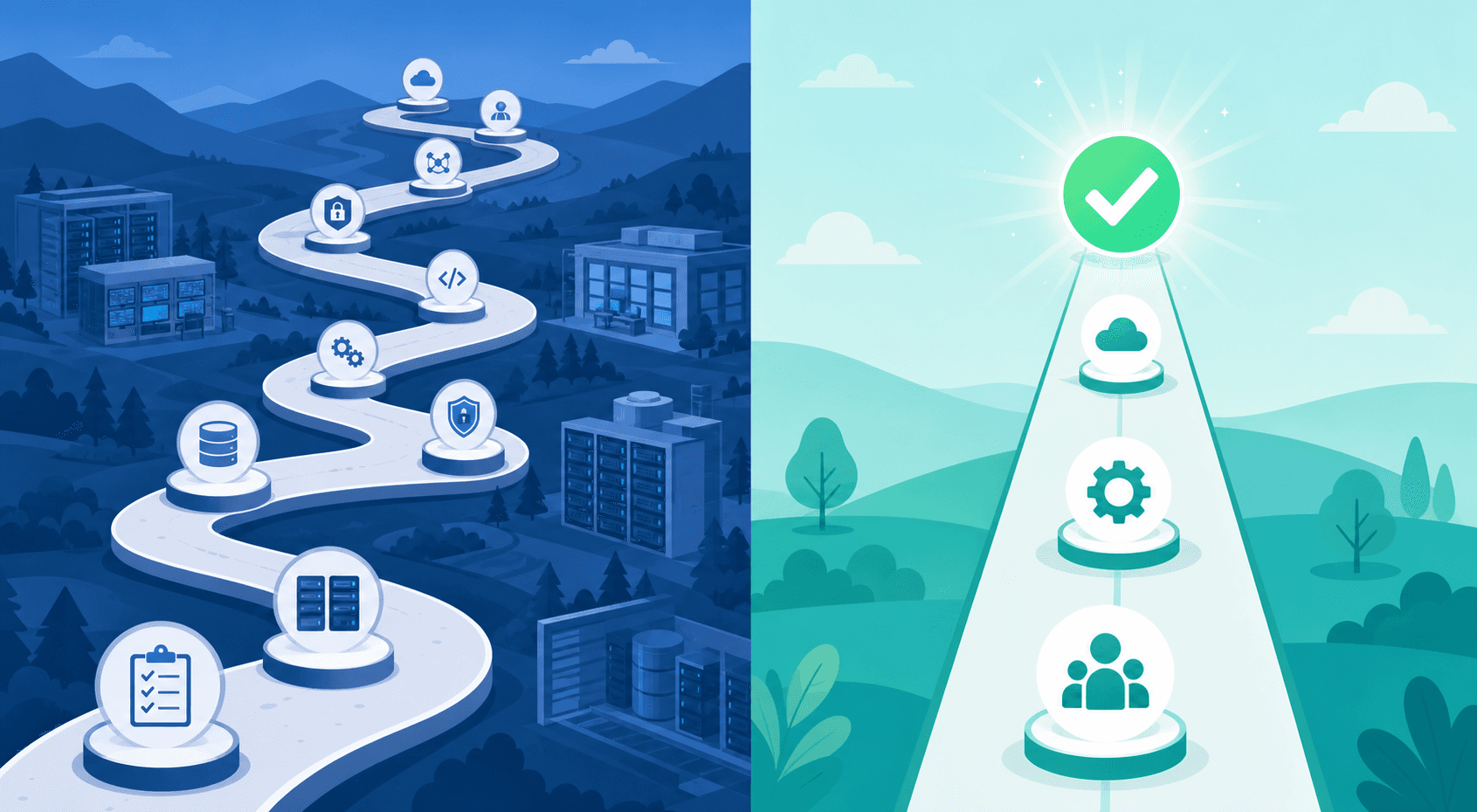
Dedicated AI support vendors compress that path. Pre-built helpdesk integrations connect via OAuth, knowledge ingestion is automated, and resolution logic ships configured for support use cases. The mechanics of AI support live in 14 days cover exactly this path. For teams on Zendesk or Intercom, going live in days is a realistic expectation.
For Fini, the rollout runs in three stages: a Knowledge Agent live on Day 1, agentic workflows connected to billing and CRM by Day 14, and full autonomy across voice, chat, and email by Day 30. If timeline is a real constraint, that implementation gap is the most important number in the evaluation.
Knowledge management: self-maintaining vs. manual QA
Agentforce grounds itself in Salesforce Knowledge, meaning the agent is only as good as the articles your team has already written and kept current. When the knowledge drifts, the agent drifts. There is no automatic detection of stale content, no conflict flagging across contradictory articles, no gap identification from unresolved escalations. The ops team maintains the knowledge, and the agent consumes it.
That architecture is why resolution rates plateau. When a human resolves an edge case, that knowledge stays buried in the ticket. The same question returns next week. The help center slowly goes stale.
Fini's Knowledge Atlas auto-generates articles from resolved escalations, detects conflicts between existing articles, and runs a nightly pipeline that identifies gaps and surfaces draft articles for human review before publishing.
The ops team reviews edge cases instead of rebuilding documentation from scratch. Teams running Agentforce report spending roughly 20 hours per week on documentation maintenance. With a self-maintaining knowledge system, that drops to reviewing what the agent already flagged.
Security, compliance, and high-stakes industries
For fintech and healthcare teams, compliance is a design constraint, not a checklist item you satisfy after the product ships.
Agentforce inherits Salesforce's broad compliance posture, including SOC 2 and GDPR coverage. But coverage across a CRM estate is not the same as a support agent that is auditable at the decision level. Every agent action needs a traceable log, beyond a system-wide audit record. For fintech and healthcare teams, that distinction shows up in security reviews.
Dedicated vendors built for compliance-first support ship with that requirement already solved. Fini carries SOC 2 Type II, PCI DSS Level 1, ISO 27001, GDPR, HIPAA-compliant, BAA-eligible, and CCPA coverage, with a full audit trail on every agent decision. Every response traces to a single authoritative source article, which matters when a compliance reviewer asks where a given answer came from. Platforms vary materially on accuracy guardrails and hallucination controls. For healthcare, HIPAA-compliant and BAA-eligible are the design center, not add-ons.
In a security review, Agentforce requires teams to verify compliance coverage at the agent layer separately from the broader Salesforce estate. A dedicated vendor hands over a single audit package covering the product surface where support decisions are actually made.
Side-by-side: Agentforce vs. dedicated AI support vendors
Dimension | Agentforce | Dedicated AI support vendors |
|---|---|---|
CRM dependency | Requires Salesforce as system of record | Integrates into existing helpdesk via OAuth |
Time to live | 5 to 11 months (production scale) | Days to weeks |
Channel coverage | Voice, chat, email via separate product layers | Voice, chat, email on one reasoning layer |
Knowledge management | Manual; ops team maintains Salesforce Knowledge | Self-maintaining; gaps auto-detected and surfaced |
Pricing model Flex Credits ($500 per 100k) plus per-seat licensing Per-resolution: flat $0.49. No per-seat fees | ||
Compliance posture | Inherited from Salesforce estate; varies by layer | Purpose-built audit trail at the agent decision level |
Escalation handling | Routes to human with CRM context attached | Escalates with full conversation context and AI summary |
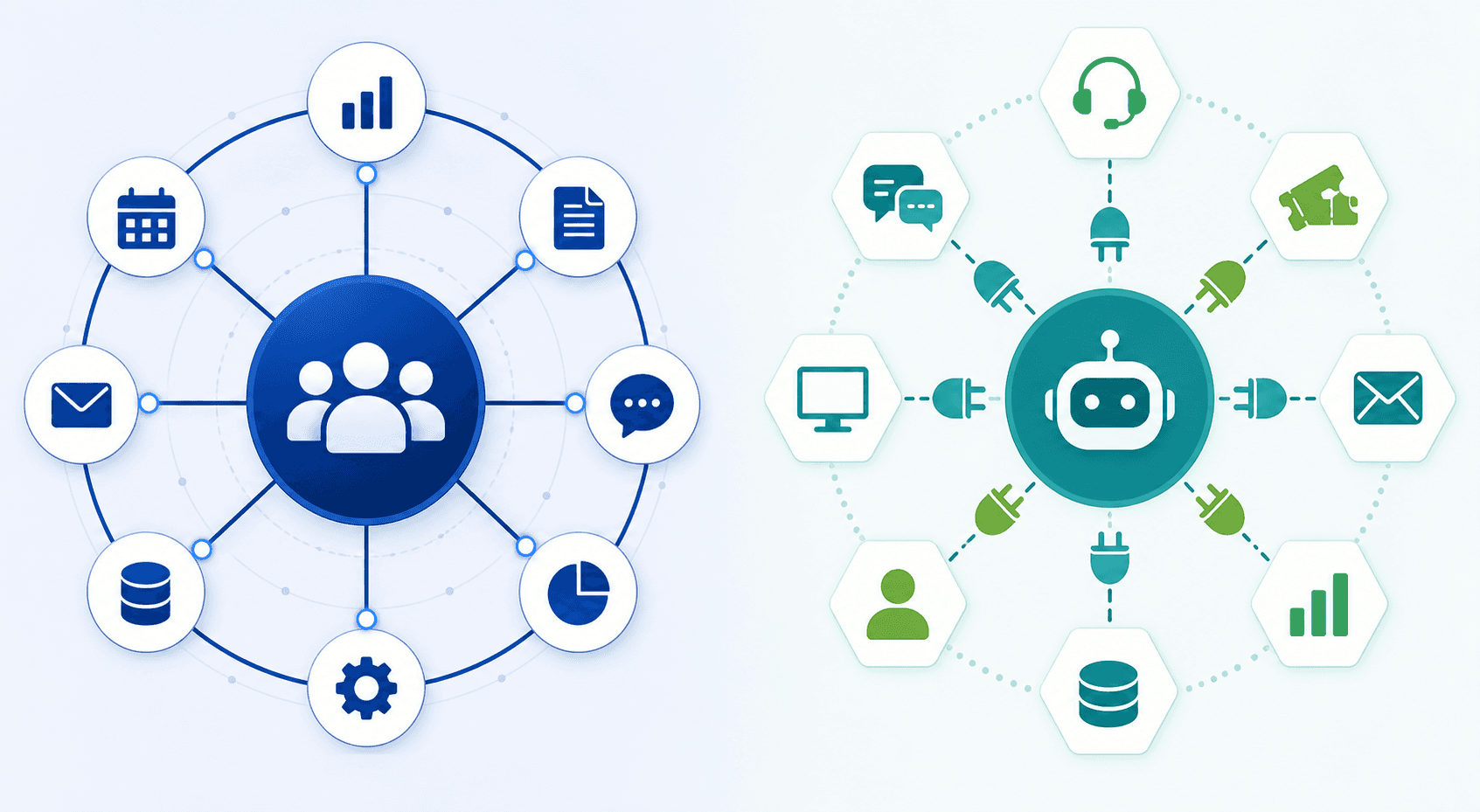
Two different starting positions shape this decision. If Salesforce is already your system of record, Agentforce's grounding advantage is real and integration costs are lower. If your helpdesk is Zendesk, Intercom, or Freshdesk, a dedicated vendor skips the CRM dependency entirely and goes live faster.
Which teams are choosing each approach
Two buyer profiles have become clear by mid-2026.
Teams staying with Agentforce are running Salesforce as their core system of record before the AI conversation starts. Their cases, knowledge articles, and customer data already live in Service Cloud. They have an internal Salesforce team or an existing SI relationship. Timeline pressure is measured in quarters, not weeks. For them, the grounding advantage outweighs the setup complexity.
Teams choosing dedicated vendors share a different starting point. Their helpdesk is Zendesk, Intercom, or Freshdesk. They don't have SI resources budgeted for a multi-month implementation. Compliance requirements, particularly in fintech and healthcare, push toward vendors with purpose-built audit trails over inherited CRM coverage. A ranked review of AI support platforms for compliance-heavy fintech breaks down which vendors meet that bar. And when leadership is asking for an AI answer before the next board meeting, a 5 to 11 month runway is not an option.
The decision usually clarifies around three questions:
Is Salesforce already your system of record for support cases and knowledge?
Do you have SI resources available for a configuration-heavy deployment?
Is your timeline weeks or months?
If the answer to all three is yes, Agentforce is a defensible choice. If any answer is no, a dedicated vendor closes faster and fits the existing stack without a migration.
How Fini fits teams comparing Agentforce
Teams that reach the end of an Agentforce evaluation with unresolved questions about timeline, helpdesk fit, or compliance coverage are the ones we built Fini for.
Fini resolves 90% of tickets across voice, chat, and email at 99% accuracy, with a Knowledge Agent live Day 1, agentic workflows by Day 14, and full autonomy by Day 30. No SI engagement. No Salesforce migration. Knowledge Atlas handles the knowledge management problem directly: gaps auto-detected nightly, conflicts flagged, draft articles surfaced for human review before publishing.
For fintech and healthcare teams, compliance is built in from the start: SOC 2 Type II, PCI DSS Level 1, ISO 27001, GDPR, HIPAA-compliant, BAA-eligible, and CCPA. The specifics of fintech support compliance automation are worth reviewing before any audit cycle. Every agent decision traces to a single source article and a full audit trail.
The Zero Pay Guarantee is 90% resolution in 90 days, or you pay $0. Enterprise customers can run a 90-day free pilot on live traffic before the plan starts. For a broader view of AI support platforms by ROI, the comparison covers the full competitive set. Send 1,000 real tickets and see the resolution rate on your own data.
Final thoughts on Agentforce alternatives for customer support
If Salesforce is your system of record, Agentforce gives you a real grounding advantage. If it isn't, you're looking at a 5 to 11 month setup before your first resolved ticket. Most teams find the decision clarifies fast once they map their current helpdesk against the deployment timeline.
Talk to us for 30 minutes and we'll show you what the numbers look like on your actual ticket volume.
FAQ
Agentforce vs dedicated AI support vendors: which fits a team not already on Salesforce?
If your helpdesk is Zendesk, Intercom, or Freshdesk, Agentforce requires either a data migration into Service Cloud or a sync layer built on top of your existing stack before the AI resolves anything. Dedicated vendors connect via OAuth directly to your current helpdesk, skip the migration entirely, and go live in days. The decision clarifies fast: if Salesforce is already your system of record, Agentforce's grounding advantage is real; if it isn't, a dedicated vendor closes the gap without the 5 to 11 month setup window.
Can I run a different AI agent on top of Intercom without replacing it as my helpdesk?
Yes. Dedicated AI support vendors like Fini connect to Intercom via OAuth and operate as an agent layer on top of your existing helpdesk, so your team keeps working in Intercom while the AI handles resolution. No migration, no parallel system to manage: the agent ingests your knowledge base, resolves tickets end to end, and escalates with full conversation context when it can't.
How does Fini's Knowledge Atlas handle outdated content and knowledge gaps compared to Agentforce's manual QA process?
Agentforce grounds itself in Salesforce Knowledge, so the agent is only as current as the articles your ops team has already written and kept clean: no automatic conflict detection, no gap identification from unresolved escalations. Knowledge Atlas runs a nightly pipeline that auto-generates articles from resolved escalations, flags contradictory or outdated content, and surfaces draft articles for human review before publishing, dropping documentation maintenance from roughly 20 hours per week to around 2.
What does the Fini pilot look like for a fintech team comparing Agentforce alternatives?
Enterprise customers get a 90-day free pilot on live traffic, with resolution, accuracy, and CSAT targets agreed in writing before it starts. No payment during the 90 days: if the numbers work, the plan begins; if they don't, you walk. For any team at the evaluation stage, Fini will also run 1,000 real production tickets through the agent as a benchmark before any commitment.
How does Fini handle compliance for fintech and healthcare teams comparing AI support platform options?
Fini carries SOC 2 Type II, PCI DSS Level 1, ISO 27001, GDPR, HIPAA-compliant, BAA-eligible, and CCPA coverage, with a full audit trail on every agent decision and every response tracing to a single authoritative source article. Agentforce inherits Salesforce's broader compliance posture, but a system-wide audit record is not the same as decision-level traceability at the agent layer, which is what fintech and healthcare security reviews typically require.
Co-founder