
A chat-widget AI add-on vs. a dedicated support agent
In this comparison: What each is · How they differ · Capabilities · Feature by feature · Ease of use · What customers say · The full side-by-side · Which to choose · Compliance · FAQ
What is Fini?
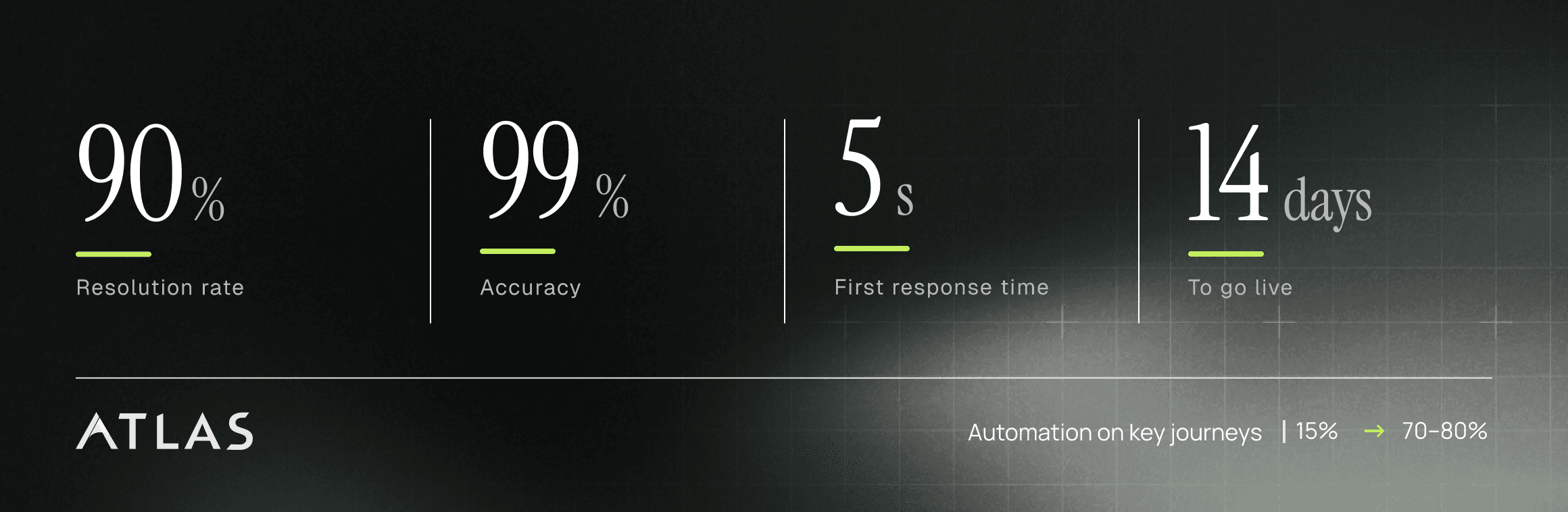
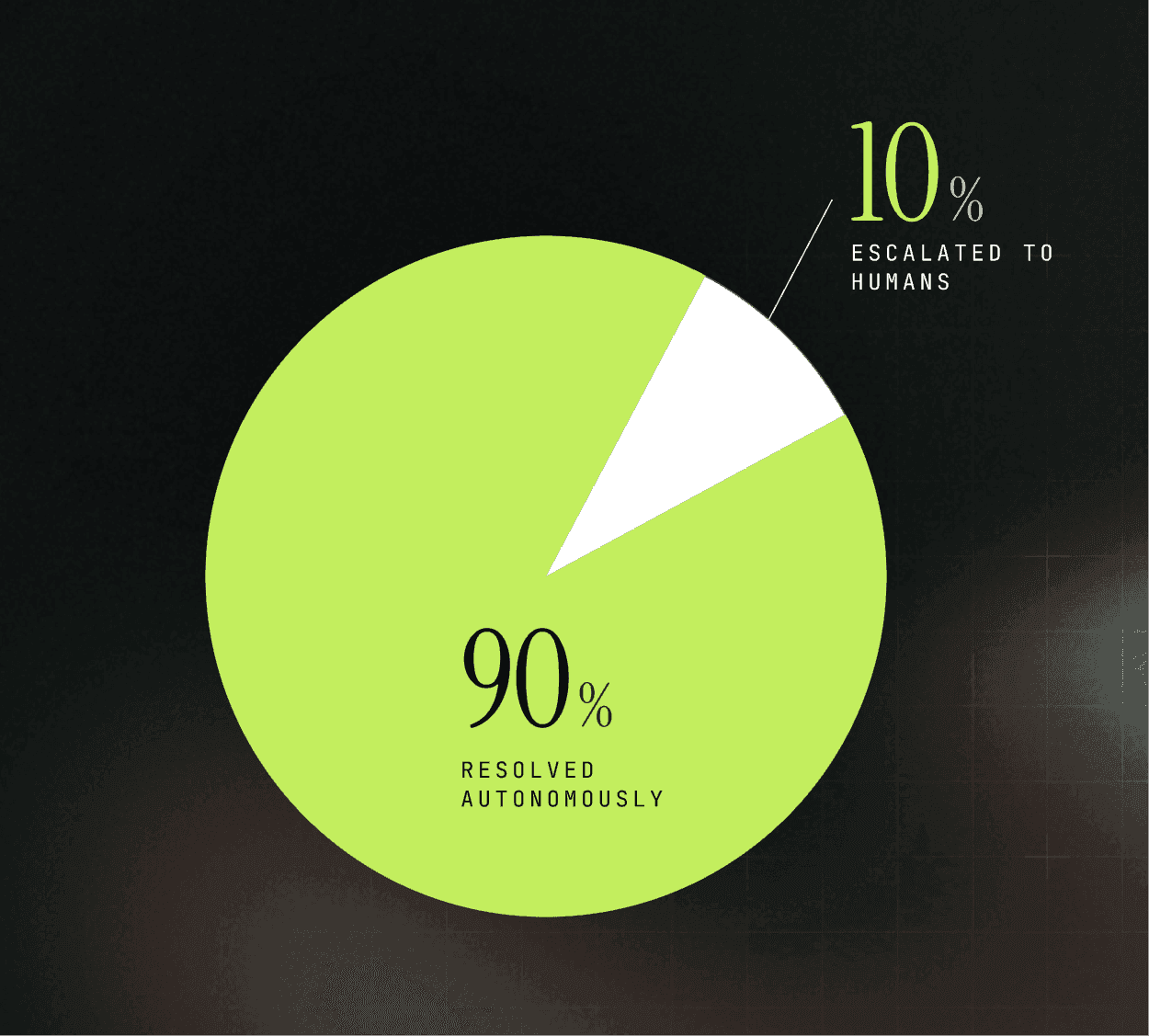
Fini is an AI customer-support agent priced per resolution, backed by Y Combinator and Matrix Partners. It connects natively to your helpdesk, knowledge base, CRM, billing, claims, and EHR systems, reaches a 90% resolution rate at 99% accuracy, and is built to go live in 30 days. Across its customer base, Fini handles 3M+ monthly resolutions in fintech and healthcare. The agent works across voice, chat, and email, answers in 130+ languages, and returns a first response in about five seconds. The design center is regulated, high-stakes support volume: the kind of ticket where a wrong or delayed answer means a locked account, a denied claim, or a compliance exposure, not just an annoyed customer. That is a different starting point from a tool built first for a Shopify store answering “where is my order,” and it shows up throughout this comparison in pricing structure, compliance posture, and how much the agent is trusted to actually do rather than just say.
What is Tidio?
Tidio is a live-chat-first customer service platform built for small and mid-sized e-commerce businesses. Founded in 2013 in Szczecin, Poland by Marcin Wiktor and Tytus Goas, the company has raised roughly $26.8 million across two rounds at Series B stage, from PeakSpan Capital and Inovo Venture Partners. Tidio started as a chat widget and gradually layered on rule-based chatbot “Flows” and an AI agent called Lyro, trained on a merchant’s help-center content. It integrates tightly with Shopify, WooCommerce, and PrestaShop, and is sold as a self-serve SaaS product, no enterprise sales call required to sign up. The product itself is really three layers stacked on top of each other. The base is the live chat widget, the part of Tidio that has existed the longest and the part most reviewers still associate with the brand. On top of that sits Flows, a visual, rule-based automation builder that lets a store owner script simple branching conversations, “if a visitor asks about shipping, show this answer”, without any AI involved at all. Lyro AI Agent is the newest and most heavily marketed layer, a conversational AI trained on whatever help-center articles, FAQs, and past conversations a merchant feeds it. Tidio reports roughly 168 to 178 employees as of mid-2026 and remains an independent, privately held company at Series B stage, there has been no acquisition and no reported plan to sell. This layered history is worth understanding because it explains where Tidio is strong and where it is thin. A company that starts as a chat widget and adds AI later tends to have excellent widget mechanics: installation, appearance customization, mobile apps, ticketing, and a genuinely useful but comparatively young AI layer bolted on top. That is a very different starting point from an agent built from day one to resolve tickets and take action across systems, which is the design center Fini started from.
Tidio pricing in 2026
Reading a self-serve pricing page is usually the fastest way to model cost before talking to anyone, and Tidio deserves credit for publishing one at all: plenty of competitors in this category, including several higher up the enterprise scale, quote everything by custom contract. The catch specific to Tidio is that the published number and the number a growing store actually pays tend to diverge once AI usage kicks in, which is the detail the rest of this section walks through. Tidio publishes its pricing directly on tidio.com/pricing, structured as five tiers: Free at $0 a month for 50 billable conversations and 10 seats (including a lifetime 50 free Lyro AI conversations), Starter from roughly $24 to $29 a month for 100 billable conversations, Growth from roughly $49 to $59 a month for 250-plus conversations with advanced analytics and permissions, Plus from $300 a month plus usage with a dedicated success manager, and a contact-priced Premium tier that is the only one offering a guaranteed 50% Lyro AI resolution rate along with pay-per-resolution billing. The detail that matters most for buyers: Lyro AI Agent is billed as a separate add-on on top of whichever base plan you choose, starting around $32.50 to $39 a month for 50 conversations and scaling to $79 to $149 a month at 500 to 1,000 conversations. Multiple independent pricing breakdowns: from Chatarmin, Docuyond, and BuiltABot, flag that the advertised roughly $29 entry price commonly becomes $200 to $300-plus a month in practice once real Lyro usage and Flow automation are added on top. Fini charges a starting rate of $0.49 per resolved ticket, with the platform and implementation included and no per-seat fees.
What buyers ask | Tidio | Fini |
|---|---|---|
Published price list | ✓ (base plans) | ✓ |
Is the AI agent included in the base price? | No, billed separately from about $32.50 a month | Yes, the resolution rate is the price |
Real cost at moderate AI usage | Often $200 to $300-plus a month per user reports | $0.49 per resolved ticket, starting rate |
Outcome guarantee | Only on the contact-priced Premium tier | 90-Day Money-Back Guarantee on every plan |
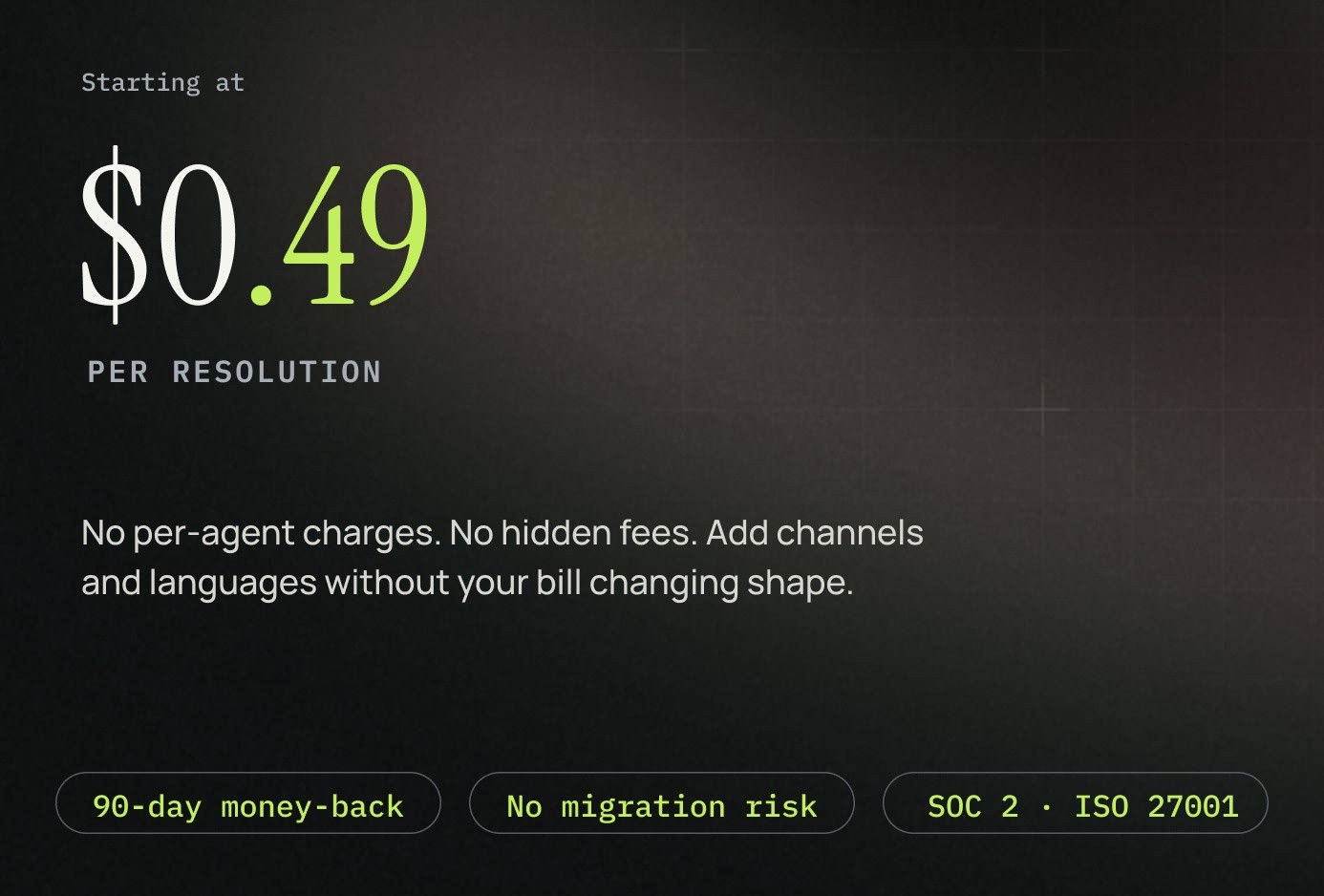
See Fini’s full pricing breakdown for plan details, add-ons, and a resolution calculator. Pricing starts at $0.49 per resolved ticket, with no monthly minimum or per-seat fees. Backed by the 90-Day Money-Back Guarantee: 90% resolution in 90 days, or you pay $0. Send 1,000 real tickets, we’ll prove it on your data. If the math doesn’t work, you walk. Once Lyro is priced in, here is how that compares to Fini’s per-resolution model.
How Fini and Tidio differ
The difference is architectural, not just a feature checklist. Tidio began as a chat widget and added an AI layer on top of it; Fini was built from the start as an agent that resolves tickets and takes action across the systems a support team actually runs on: billing, CRM, claims. Tidio has no published voice channel; Fini spans voice, chat, and email from a single agent. For a small e-commerce store, Tidio’s drop-in widget is the faster path to something working today. For a team that needs the AI to actually change an account, issue a refund, or update a claim rather than just answer a question, that gap starts to matter. The billing model reflects the same split. Tidio meters two separate things, a base conversation plan and a Lyro AI Agent add-on, which is a common structure for SaaS tools that added AI to an existing product line, but it also means the number on the pricing page rarely matches the number on the invoice once usage grows. Fini collapses this into a single per-resolution rate, so cost scales with outcomes delivered rather than with two independently metered subscriptions stacked on top of each other. There is also a difference in who the product assumes is buying it. Tidio’s pricing page, onboarding flow, and integration list are all built around a single store owner or a small support team signing up without talking to anyone. Fini’s 30-day staged rollout assumes a team that needs its agent wired into billing, claims, or account-management systems before it can be trusted to act, a slower start, in exchange for an agent that can actually do more than answer.
Capabilities side by side
Fini connects natively to billing, CRM, and claims systems and can execute changes directly: refunds, account updates, status changes, rather than only surfacing an answer. Tidio’s Lyro AI Agent primarily answers from a merchant’s help-center content and hands off to a human agent when it cannot resolve a query; it is not built to reach into a billing system and take action on its own. On channel coverage, Fini runs voice, chat, and email from one agent; Tidio covers chat plus social messaging channels (WhatsApp, Messenger, Instagram) with no voice channel found. On knowledge maintenance, Fini’s Knowledge Atlas keeps its own source material current automatically, while Tidio’s Lyro is trained on whatever help-center content a merchant maintains manually, meaning the quality of Lyro’s answers is only as good as how diligently a store keeps its own help center up to date, a manual maintenance burden Fini is specifically designed to remove. Tidio’s Copilot feature, available on higher tiers, is worth naming separately from Lyro: it is an agent-assist tool that helps a human support rep draft replies faster, rather than a customer-facing autonomous agent. That is a meaningfully different capability from Fini’s approach, where the AI is the one resolving the ticket end to end rather than assisting a human who resolves it. Both patterns are legitimate; they just answer a different question, “help my team work faster” versus “let the agent close the loop itself.”
Feature by feature
Laid out side by side, the pattern from the sections above holds: Tidio wins outright on e-commerce-specific integrations, and Fini wins outright on everything tied to voice, action-taking, pricing transparency, and regulated-industry readiness. Neither list is padded to make one platform look better, Tidio’s Shopify and WooCommerce depth is real and worth conceding plainly.
Feature | Fini | Tidio |
|---|---|---|
Voice support | ✓ | ✗, not found |
Per-resolution transparent pricing | ✓ | ✗, separate base-plan-plus-add-on billing |
HIPAA / regulated-industry readiness | ✓ (BAA-eligible) | ✗, no HIPAA certification found |
Native CRM/billing actions | ✓ | Partial, answers from help content, limited native action-taking |
Self-writing knowledge base | ✓ (Knowledge Atlas) | ✗, manually maintained help-center training source |
E-commerce platform integrations (Shopify, WooCommerce) | Not a core focus | ✓, a genuine strength |
Ease of use and admin experience
This is Tidio’s clearest strength: a same-day, self-serve setup with a drag-and-drop chatbot Flow builder and no sales call required to get started. A small store can have live chat running within the hour, and Flows in particular are approachable enough for a non-technical store owner to build simple branching conversations without writing anything. Fini’s onboarding runs as a structured, staged 30-day rollout instead: more configuration up front, more system access to grant, more decisions to make about which actions the agent is allowed to take on its own: but built for a deployment that connects into billing, CRM, and claims systems rather than a drop-in widget on a storefront. The trade-off is the honest way to read this, not a knock against either product: a same-day widget is the right answer when the job is answering FAQs on a storefront, and a staged rollout is the right answer when the job is letting an agent touch a customer’s account or claim. Buying the wrong one for your situation, a heavyweight staged rollout for a five-person e-commerce team, or a same-day widget for a regulated fintech workflow, is where most dissatisfaction in this category actually comes from.
Fini’s differentiators
Transparent, bundled pricing
One number to model, rather than a base plan and a separately metered AI add-on, with an outcome guarantee attached to every plan.
A native voice channel
Alongside chat and email, covering the phone volume that a chat-only tool like Tidio cannot touch.
Deep system actions
Refunds, account updates, and claims, not just answers pulled from a help article.
A compliance posture built for regulated industries
SOC 2 Type II, ISO 27001, GDPR, and HIPAA-compliant, BAA-eligible contracting, with CCPA available under agreement.
Knowledge Atlas
A self-maintaining knowledge base that keeps itself current without a team manually rewriting help articles every time a policy changes.
Tidio’s recognized strengths
Credit where it is due: Tidio’s self-serve setup is genuinely fast, its Shopify, WooCommerce, and PrestaShop integrations are purpose-built and deep, and its free tier gives a small store a real entry point with no upfront cost. Interface language support is broad: 30-plus languages on the widget itself, with Lyro answering in “dozens” of languages, explicitly confirmed for English, Spanish, French, German, Dutch, Portuguese, and Italian. And Tidio has kept investing technically: native MCP (Model Context Protocol) support shipped in the 2025–2026 window, a notably modern addition for a tool at this price point, and one worth noting since it signals Tidio is not standing still on its AI roadmap even as its core product remains widget-first.
What customers say
Tidio’s own published case studies show real results at small-business scale: Pastreez, a French e-commerce macaron brand, converted 70% of chat inquiries into orders and used Tidio chat to land corporate gifting deals with Netflix, Google, Visa, and Snapchat. Procosmet, an Italian beauty brand, reported a 500% increase in monthly leads and a 23% sales increase. Pearl Lemon, an agency, captured 70-plus leads a month through Tidio chat. Some technology-tracker sites also list larger names, Arthur J. Gallagher, EGYPTAIR, ebm-papst: as “companies using Tidio,” but these read as tech-detected (a chat widget script found on the site) rather than confirmed case studies, so only the e-commerce examples above carry Tidio’s own documentation behind them. Set against those wins, a cross-platform review aggregate (G2 and Capterra combined, roughly 15 reviews) reportedly averages only 3.5 out of 5 with 47% recommending, even though G2’s own headline rating sits closer to 4.6–4.8 out of 5, a gap worth noting rather than picking whichever number looks better. The most-cited complaint, appearing in 85-plus mentions across more than 1,800 G2 reviews, is pricing transparency: conversation limits are hit faster than expected, forcing upgrades or add-on purchases. Some reviewers also describe the AI as feeling “outdated” and rigid next to newer AI-native tools, note that chatbot-to-human handover can be rough, and flag that analytics and reporting are thin enough to make it hard to diagnose exactly where bot conversations break down.
The full side-by-side
One table, every dimension covered above, for anyone who wants the comparison without re-reading each section.
Dimension | Fini | Tidio |
|---|---|---|
Pricing structure | One per-resolution rate, published | Base plan plus separate Lyro AI add-on |
Real cost at moderate usage | $0.49 per resolved ticket, forecastable | Often $200–300+/mo per user reports |
Outcome guarantee | 90-Day Money-Back Guarantee, on every plan | Only on contact-priced Premium tier |
Go-live | 30 days, staged | Same-day self-serve |
Voice support | ✓ | ✗ |
Compliance | SOC 2 II, ISO 27001, GDPR, HIPAA-BAA | SOC 2 II, GDPR, CCPA, CPRA, EU-US DPF, no HIPAA |
E-commerce integrations | Not a core focus | Shopify, WooCommerce, PrestaShop, native |
Backing | Y Combinator, Matrix Partners | Series B, ~$26.8M, PeakSpan & Inovo |
Review-flagged limitation | None | Pricing transparency, most-cited complaint on G2 |
Which should you choose?
Choose Fini if you need voice support, operate in a regulated industry, or want one transparent per-resolution price with an outcome guarantee attached, and you would rather your AI agent take action on an account than only answer a question about it. Choose Tidio if you run a small e-commerce store that wants an affordable, fast-to-install live chat widget with a basic AI layer on top, your integration priority is Shopify or WooCommerce rather than a CRM or claims system, and you don’t need deep system actions or compliance guarantees to close the sale.
Compliance
Fini publishes SOC 2 Type II, ISO 27001:2022, GDPR, HIPAA-compliant BAA-eligible contracting, and CCPA under agreement. Tidio holds SOC 2 Type II, GDPR, CCPA, CPRA, EU-US Data Privacy Framework certification, and an “AI Pact” commitment: a solid baseline for general SaaS and e-commerce use, but no HIPAA certification was found, consistent with a product that does not position itself for healthcare deployments. Neither gap is a knock on Tidio’s engineering, a chat widget selling to Shopify stores has little reason to pursue a HIPAA program, and Tidio’s certification list is genuinely solid for its actual target market. The distinction matters only if your own buyer profile includes healthcare or another regulated vertical where a BAA is a hard requirement rather than a nice-to-have, in which case the decision is closer to settled by this section alone than by any feature comparison above it.
Ready to compare on your own data?
See how Fini’s per-resolution pricing, outcome guarantee, and voice-plus-chat-plus-email coverage stack up against your own ticket volume, check current plans or talk to the team about a 30-day rollout. If you’re also comparing self-serve chat tools, see how Fini stacks up against My AskAI and Open, or read our note on deflection rate for why a chat-widget add-on and a resolution-focused agent get measured differently.
Is Tidio a good fit for regulated industries like fintech or healthcare?
Not really. Tidio holds SOC 2 Type II, GDPR, CCPA, and CPRA certifications, but no HIPAA certification was found, and its own marketing targets e-commerce and small business use cases rather than regulated industries. Fini is built for exactly this: SOC 2 Type II, ISO 27001:2022, GDPR, and HIPAA-compliant, BAA-eligible contracting.
How much does Tidio’s Lyro AI Agent actually cost once conversation volume grows?
More than the advertised base price suggests. Lyro is billed as a separate add-on starting around $32.50 to $39 a month for 50 conversations, and scaling to $79 to $149 a month at 500 to 1,000 conversations: on top of the base plan (Starter, Growth, or Plus). Multiple independent pricing breakdowns report real total costs commonly landing at $200 to $300-plus a month once both are combined.
Does Tidio support voice?
No published voice channel was found for Tidio: it operates across chat, email, and social messaging (WhatsApp, Messenger, Instagram). Fini supports voice, chat, and email natively from one agent.
What is Tidio’s real AI resolution rate?
Tidio’s own Premium tier advertises a “guaranteed 50% Lyro AI resolution rate”, a guarantee only available on its highest, contact-priced plan. Fini publishes a 90% resolution rate at 99% accuracy across its customer base, backed by a 90-Day Money-Back Guarantee: 90% resolution in 90 days, or you don’t pay.
How does Fini’s per-resolution pricing compare to Tidio’s plan-plus-add-on structure?
Fini charges a starting rate of $0.49 per resolved ticket, with the platform and implementation included and no per-seat fees.
What happens when Tidio’s Lyro AI Agent can’t resolve a customer’s question?
Lyro is designed to hand off to a human agent when it can’t resolve a query from the merchant’s trained help content. Reviewers note this handover can feel rough compared to more integrated agent platforms.
Is Tidio suitable for a high-volume enterprise support team?
Tidio is built and priced as a self-serve SMB tool: its own case studies and integrations (Shopify, WooCommerce, PrestaShop) point at small e-commerce businesses. Its Plus and Premium tiers introduce enterprise-style features like a dedicated success manager, but the product’s core design center is small-business support, not high-volume regulated-industry deployment.
Does Tidio integrate with Shopify and WooCommerce out of the box?
Yes, this is one of Tidio’s genuine strengths. It has native, purpose-built integrations for Shopify, WooCommerce, and PrestaShop, syncing customer and order data directly into chat conversations.
How long does it take to go live with Tidio vs Fini?
Tidio can be installed the same day as a self-serve chat widget, with AI training an ongoing manual task. Fini runs a structured 30-day staged rollout, reflecting its deeper integration into billing, CRM, and claims systems rather than a drop-in widget.
Can I migrate from Tidio to Fini?
Yes. Fini’s onboarding maps your existing help content and support workflows during its staged rollout, so moving from a chat-widget-plus-AI setup like Tidio’s to a fuller agent that takes action across your systems doesn’t require starting from scratch.