Two flat per-resolution rates: $0.90 vs. $0.49
Open and Fini both sell an AI agent that resolves customer support conversations, but they start from different assumptions about who buys them. Open is built for teams that want the widest possible channel spread, including outbound campaigns, at a single flat usage rate. Fini is built for regulated industries that need certified compliance and a results guarantee, also priced at a single flat usage rate. The table below is the fastest way to see where the two actually diverge before reading the detail underneath it.
What is Fini?
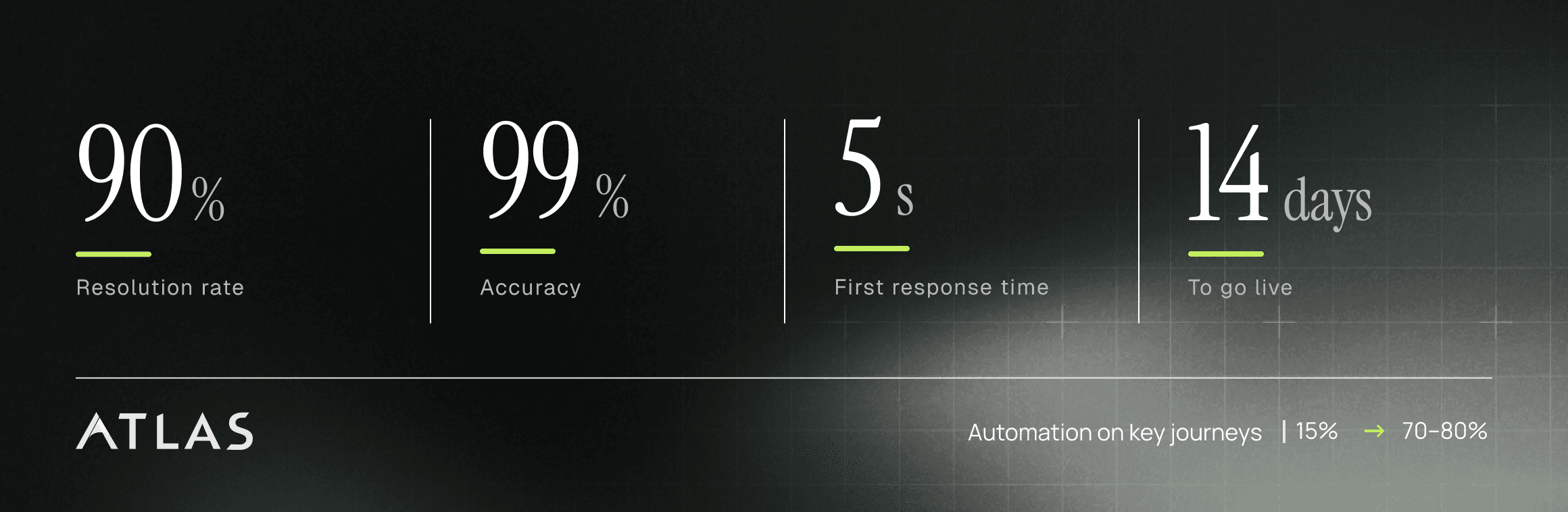
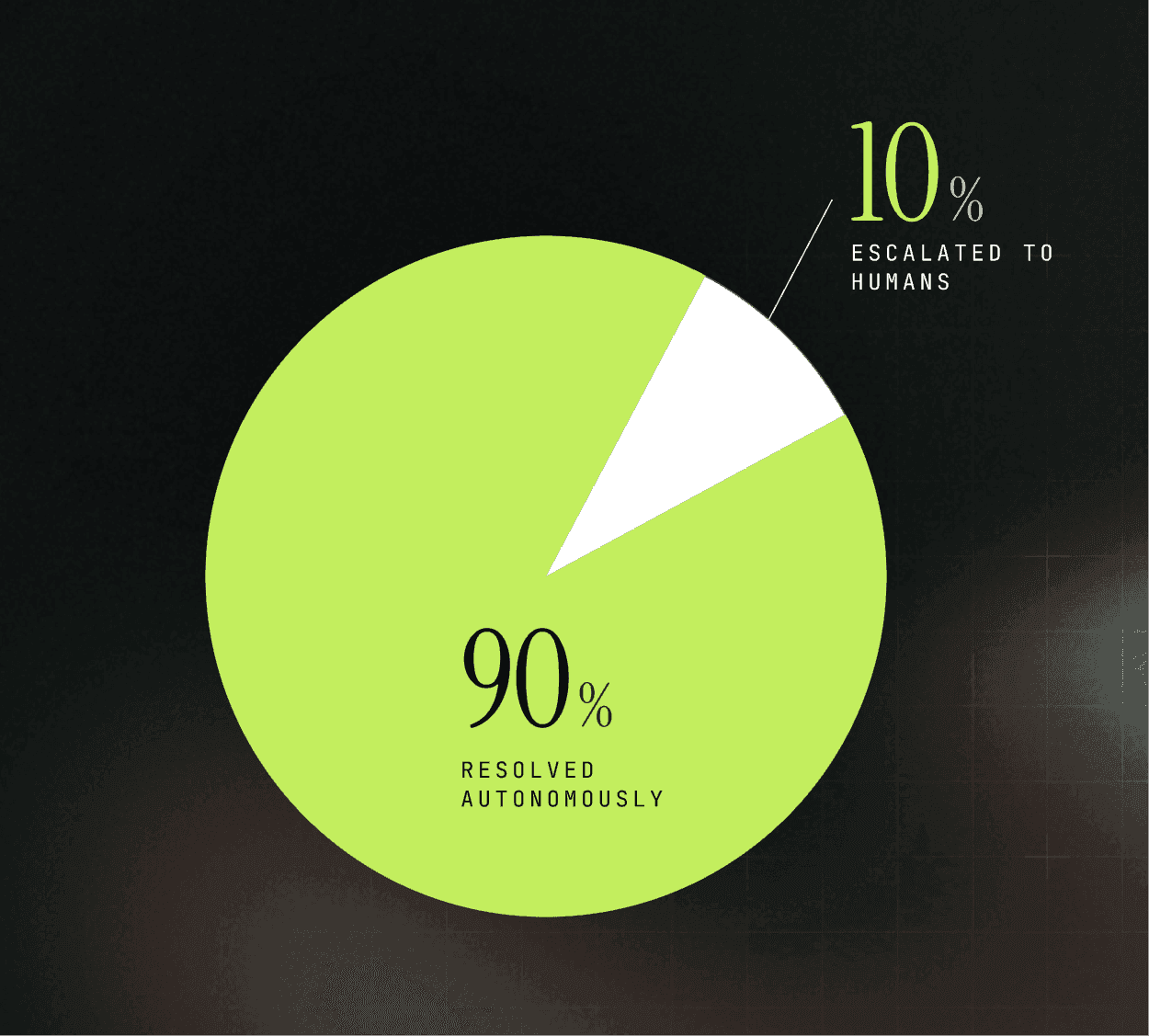
Fini is a per-resolution AI customer support agent backed by Y Combinator and Matrix Partners. It connects natively to a company's helpdesk, knowledge base, CRM, billing, claims, and EHR systems, reaches a 90% resolution rate at 99% accuracy, and is built to be live in 14 days and fully autonomous in 30 through a staged rollout. Across its customer base, Fini handles 3M+ monthly resolutions concentrated in fintech and healthcare. It works across voice, chat, and email, answers in 130+ languages, and returns a first response in about five seconds. Fini's pitch is narrower by design: rather than trying to be a general-purpose agent for every industry and every channel, it specializes in the workflows that regulated industries actually run: KYC checks, claims processing, account actions with financial or medical consequences, and backs that specialization with certifications a general-purpose competitor typically has to build toward later rather than ship on day one.
What is Open?
Open (formerly branded OpenCopilot) is an AI-native, multi-channel customer support platform founded in 2022 by Mohammad Gharbat and Mohammad Tabaza. Its current product, built around an AI engine called "Agent 5," went live around January 2025 and is positioned as "one AI engine, every channel": voice, web chat, email, WhatsApp Business, SMS, social media, and Slack, plus outbound campaigns for sales and marketing rather than inbound support alone. Open claims a 77% average automation rate and 95%+ accuracy across support interactions. The company is registered in Middletown, Delaware, though its founder and investor ties suggest a Jordan and Netherlands-linked team, one of its early angel investors is the CEO of Mollie, the Dutch fintech that later became a named customer. Open has raised roughly $8.5 million across two rounds: a $1.52 million pre-seed backed by Y Combinator, Spacetime, Pioneer Fund, and angel investors, followed by a $7 million round announced in January 2026 led by Y Combinator a second time, with X by Unifonic, Shorooq, and Sadu Capital participating. That second round was explicitly earmarked for GCC and Saudi Arabia expansion, including a planned Saudi Arabia office, a regional push Fini has not stated as a current priority. Named customers span payments, e-commerce, and marketplace businesses: MoneyGram, Mollie, Viva.com, TicketSwap, Print.com, More.com, Orderchamp, OneCarNow, Trunkrs, and Qoyod. On the integration side, Open connects to Zendesk, Intercom, Salesforce Service Cloud, HubSpot, Freshdesk, and Twilio Flex, plus Zapier, Make, and n8n, and publishes a documented REST API, an OpenAPI spec, and MCP server support for teams that want to build directly against it rather than use a pre-built connector.
Open pricing in 2026
Pricing is one of the more interesting angles in this comparison, because both companies actually publish it: that's rare among Fini's competitor set, where most rivals run a custom, quote-only sales process. Open charges a flat $0.90 per automated resolution, with no per-seat fee and no published monthly minimum: the rate never changes regardless of how much volume a team sends through it. Fini charges a starting rate of $0.49 per resolved ticket, with the platform and implementation included and no per-seat fees. Both rates are now flat: a team's per-resolution cost is identical whether it resolves 100 tickets a month or 100,000, on either platform. Fini's $0.49 is simply the lower of the two rates.
What buyers ask | Open | Fini |
|---|---|---|
Published price list | ✓ | ✓ |
Pricing model | Flat $0.90 per resolution | $0.49 per resolved ticket |
Volume discount as usage scales | No, flat rate regardless of volume | No, flat rate regardless of volume |
Predictable monthly floor | No minimum, purely usage-based | No minimum, purely usage-based |
See Fini's full pricing breakdown for plan details, add-ons, and a resolution calculator. Both models are now purely usage-based with no monthly minimum and no tier to pick in advance, so the meaningful difference is the rate itself: Fini's $0.49 per resolved ticket is lower than Open's $0.90, all else equal. Worth noting too: publishing pricing at all puts both companies in the minority of this competitive set: most of Fini's other compared rivals run a fully custom, quote-only enterprise sales process with no public rate card at all, which makes this specific comparison unusually easy to model before ever speaking to a salesperson on either side. Run the numbers on a concrete example: a team resolving 5,000 tickets a month would pay Open a flat $4,500 (5,000 × $0.90) versus Fini a flat $2,450 (5,000 × $0.49), before weighing everything else Fini's rate bundles in: compliance certifications, the 90-Day Money-Back Guarantee, and a dedicated rollout that is live in 14 days and fully autonomous in 30.

How Fini and Open differ
Fini specializes in regulated industries: fintech, healthcare, and insurance, with a compliance-first architecture and certifications already in place. Open is channel-breadth-first: it covers seven channels including Slack and social media, and adds an outbound-campaign capability for sales and marketing outreach that Fini doesn't compete on. Open is also meaningfully younger, with its current product live for roughly 18 months, against Fini's more established enterprise motion and a longer public compliance track record. That age gap shows up in how each company talks about itself. Fini's marketing leans on hard numbers accumulated over real operating history: 3M+ monthly resolutions, a 90% resolution rate at 99% accuracy, named enterprise customers with published case-study metrics. Open's marketing leans more on architecture and breadth claims: "one AI engine, every channel," "complete visibility into AI decision-making": which are meaningful product bets but, for a company with roughly 18 months of product history, come with less independently verifiable track record behind them than Fini's. It's also worth being precise about what "18 months" actually measures: Open the company was founded in 2022 under the OpenCopilot name, so its underlying engineering history is longer than its current product's public launch date suggests. What's genuinely new is the current "Agent 5" product and the Open rebrand, which is the version this comparison is evaluating, a detail worth knowing if you come across older OpenCopilot-branded material during your own research.
Capabilities side by side
Both platforms go beyond simple Q&A: each takes real, API-driven actions: processing refunds, updating accounts, handling escalations, rather than just answering questions, and both support human handoff when a case needs a person. Where Open pulls ahead is its outbound campaign capability, using the same AI agent for proactive sales and marketing outreach in addition to inbound support, a genuine differentiator that neither Fini nor most of Fini's other compared competitors currently offer. On the integration side, Open's connector list: Zendesk, Intercom, Salesforce Service Cloud, HubSpot, Freshdesk, Twilio Flex, plus Zapier/Make/n8n and a documented API, covers most of the same helpdesk and workflow tooling Fini connects to, though Fini's integrations extend further into regulated-industry systems specifically: claims platforms and EHR systems that a general-purpose support tool like Open doesn't name as a connection point. That's less about breadth and more about depth in a specific vertical, Open is built to plug into whatever support stack a business already runs across industries broadly; Fini is built to plug into the specific systems a fintech or healthcare team runs day to day. The presence of an OpenAPI spec and MCP server support on Open's side is also worth noting for a technical evaluator specifically: it signals a company building for programmatic, agent-to-agent integration patterns as much as for a support-admin dashboard, which is a reasonable bet given how quickly that kind of tooling has become table stakes for newer AI-native platforms.
Feature by feature
Feature | Fini | Open |
|---|---|---|
Channels | Voice, chat, email, 130+ languages | Voice, chat, email, WhatsApp, SMS, social, Slack, 7 channels |
Outbound campaigns | Not a stated feature | Yes |
Action execution via API | ✓ | ✓ |
Human handoff | ✓ | ✓ |
Explainability / decision visibility | Not specifically marketed | Explicitly claimed, "complete visibility into AI decision-making" |
Self-maintaining knowledge base | ✓ (Knowledge Atlas) | Not found in published material |
Read that table by what each row is actually measuring, not just who has a checkmark. Fini's narrower channel list trades raw channel count for depth per channel: 130+ languages is a meaningfully different bet than 7 channels in fewer languages, and matters more for a company serving a global, multilingual customer base than one running mostly English-language support in a handful of markets. Open's explainability claim, if it holds up in practice, is a genuinely useful feature for a compliance-adjacent buyer even without formal certification, being able to show exactly why an agent took an action is a different kind of trust signal than a SOC 2 report, and the two aren't mutually exclusive.
Ease of use and admin experience
There is limited independent data available on Open's day-to-day admin experience, no G2 or Capterra review presence was found for Open or its earlier OpenCopilot branding at the time of this comparison, so rather than invent an ease-of-use narrative, it's worth stating that gap plainly. Open markets a single-training, multi-channel setup as its own ease-of-use pitch: train the agent once and deploy it across all seven channels, rather than configuring each channel separately. Fini's onboarding, by contrast, is a staged rollout (live in 14 days, fully autonomous in 30) run with a dedicated team rather than a self-serve setup flow, a different model entirely, closer to a managed implementation than a do-it-yourself dashboard. Neither approach is inherently better; they reflect the two companies' different buyer assumptions. Open is betting a leaner team can configure a multi-channel agent itself in less time than a traditional enterprise rollout takes; Fini is betting a regulated-industry buyer would rather hand the rollout to a dedicated team than configure compliance-sensitive workflows alone.
Fini's differentiators
Certified today, not "in progress"
SOC 2 Type II and ISO 27001 certified now, with HIPAA-compliant, BAA-eligible contracting available for healthcare customers.
A lower published rate
$0.49 per resolved ticket, versus Open's $0.90.
The 90-Day Money-Back Guarantee
90% resolution within 90 days, or the period is free.
Knowledge Atlas
A self-maintaining knowledge base that keeps itself current automatically, plus deep specialization in fintech and healthcare workflows specifically. The Knowledge Atlas point matters more than it sounds: most AI support agents, Open included based on published material, rely on the underlying knowledge base staying accurate on its own, someone on the customer's team has to notice a stale article and fix it. Fini's Knowledge Atlas is built to catch and correct that drift automatically, which matters most exactly in the regulated industries Fini targets, where a stale policy article isn't just a bad customer experience but a compliance risk.
Open's recognized strengths
Open has the broadest channel coverage of any competitor in Fini's compared set, seven channels including Slack and social media, where most rivals stop at three or four. It's also the only one of Fini's compared competitors with a genuinely flat, simple usage-based price and no tiers to navigate. Its outbound-campaign capability is a real, distinct feature, and despite its young age it has landed real enterprise logos: MoneyGram, Mollie, and Viva.com among them, while raising twice from Y Combinator in under two years. That YC-twice detail is worth calling out on its own: relatively few companies get accepted into a second Y Combinator batch or round of backing after already being a graduate, and Open pairing that with participation from a payments-focused strategic investor like X by Unifonic suggests real investor confidence in its GCC and Saudi Arabia expansion plan specifically, not just its US/European base. The GCC push is also a reasonable strategic bet on its own terms, the region has a fast-growing digital-payments and e-commerce base, which lines up well with Open's existing customer mix of payments and marketplace businesses, and a local office signals a longer-term commitment to the region rather than an opportunistic sales push from abroad.
What customers say
No independent review-site presence was found for Open on G2, Capterra, or similar platforms at the time of this comparison, worth stating plainly rather than filling the gap with invented quotes. The clearest customer data available is Open's own published case study with Mollie, the Dutch fintech, which reports 60%+ automation across email and chat with 24/7 coverage in eight languages. That figure is vendor-published rather than third-party-verified, and should be read with that caveat. This is worth flagging specifically because Mollie's CEO is also one of Open's early angel investors: the case study is a genuine customer relationship, but it's also a connected one, which is exactly the kind of detail a buyer doing real due diligence should weigh alongside the headline number rather than take at face value alone. Fini's published customer metrics, by comparison, come from a wider base of named accounts with a longer independent track record. None of this means Open's customer results aren't real, MoneyGram, Viva.com, TicketSwap, and the rest of its named customer list are genuine businesses running a genuine product, not fabricated logos. It simply means a buyer evaluating Open today is relying more heavily on the vendor's own reporting than on a body of independently collected reviews, which is the normal position for any company at Open's stage, and it's worth factoring that into how much weight any single published metric should carry in a final decision.
The full side-by-side
Fini | Open | |
|---|---|---|
Founded | Y Combinator-backed startup | 2022, product live since ~Jan 2025 |
Backing | Y Combinator, Matrix Partners | Y Combinator (twice), X by Unifonic, Shorooq, Sadu Capital, ~$8.5M total |
Pricing | $0.49 per resolved ticket, no tiers | Flat $0.90 per resolution, no tiers |
Outcome guarantee | 90-Day Money-Back Guarantee, 90% in 90 days | None published |
Channels | Voice, chat, email, 130+ languages | Voice, chat, email, WhatsApp, SMS, social, Slack |
Outbound campaigns | Not offered | Yes |
Compliance | SOC 2 Type II, ISO 27001, GDPR, HIPAA-BAA-eligible, CCPA, certified today | GDPR-compliant; SOC 2 Type II and ISO 27001 "in progress" |
Independent reviews | Established review presence | None found on G2/Capterra |
Laid out this way, the two companies read less like direct rivals and more like two different answers to "what should an AI support agent optimize for first." Fini optimizes for certified trust and predictable economics inside regulated verticals. Open optimizes for reach, as many channels and use cases as one agent can plausibly cover, inside a broader, less specialized customer base. A buyer's own vertical and compliance timeline will usually settle which of those two starting points fits better, more than any single feature in the table above.
Which should you choose?
Choose Fini if you're in fintech, healthcare, or another regulated space and need certified compliance today, predictable volume-based pricing with a falling overage rate, and a results-based guarantee. Fini is the safer default when a compliance auditor, not just a support team, is going to ask questions about the vendor you picked. Choose Open if you want the widest channel spread, including Slack and social, a flat per-resolution rate with no monthly minimum, and outbound campaign capability alongside inbound support. Open is the stronger fit when reaching customers proactively across as many channels as possible matters more than a certified compliance stack on day one.
Compliance
Fini holds SOC 2 Type II, ISO 27001:2022, and GDPR compliance today, with HIPAA-compliant, BAA-eligible contracting and CCPA available under agreement. Open is GDPR-compliant with EU data residency in Frankfurt, TLS 1.3 in transit, AES-256 encryption at rest, and automatic PII/PHI detection and redaction, but its SOC 2 Type II and ISO 27001 certifications are stated as in progress, not yet achieved, and no HIPAA/BAA claim was found in its published material. For a regulated buyer evaluating compliance today rather than on a future roadmap, that's a material, current gap worth stating factually. None of this means Open is careless with data, EU data residency, TLS 1.3, AES-256 at rest, and automatic PII/PHI redaction are all real, substantive security measures, and a young company still finalizing SOC 2 and ISO 27001 is a normal part of a startup's growth path rather than a red flag on its own. The distinction that matters for a buyer's decision is simpler than a security critique: one platform can hand an auditor a completed certificate today, and the other can hand over a roadmap. Which one a team needs depends entirely on whether that buyer's own compliance obligations can wait for the roadmap to finish.
Ready to compare on your own data?
Every number in this comparison, Open's flat $0.90 rate, Fini's $0.49 per resolved ticket rate, both companies' compliance status: is a published figure, not an estimate, so the fastest way to know which actually fits is to run it against your own ticket volume, channel mix, and compliance timeline rather than take either vendor's framing at face value. See Fini's published pricing, or talk to the team about what the rollout (live in 14 days, fully autonomous in 30) would look like for your support queue. If a wider comparison set is useful, see how Fini stacks up against Decagon and Giga as well. See our note on resolution rate for how the numbers above are counted.
Is Open the same company as OpenCopilot?
Yes. Open was previously branded OpenCopilot before rebranding; it's the same product and team, founded in 2022 by Mohammad Gharbat and Mohammad Tabaza.
Does Open publish its pricing?
Yes, Open charges a flat $0.90 per automated resolution with no per-seat fees and no published monthly minimum. Fini charges a starting rate of $0.49 per resolved ticket, with the platform and implementation included and no per-seat fees.
Is Open SOC 2 or ISO 27001 certified?
Not yet, Open states both certifications are in progress as of this writing. Fini holds SOC 2 Type II and ISO 27001:2022 certification today, alongside HIPAA-compliant, BAA-eligible contracting for healthcare customers.
Which channels does Open support?
Voice, web chat, email, WhatsApp Business, SMS, social media, and Slack, one of the widest channel spreads among Fini's compared competitors. Fini covers voice, chat, and email natively across 130+ languages.
Can Open handle outbound customer communication, not just inbound support?
Yes, Open supports outbound campaigns for sales, marketing, and proactive support in addition to inbound resolution, a capability Fini does not market.
Who are Open's customers?
Open's publicly named customers include MoneyGram, Mollie, Viva.com, TicketSwap, Print.com, and Orderchamp, spanning payments, e-commerce, and marketplace businesses.
How much funding has Open raised?
Approximately $8.5 million total, a $1.52 million pre-seed round backed by Y Combinator and angel investors, followed by a $7 million round in January 2026 led by Y Combinator a second time, with X by Unifonic participating.
Is Open a good fit for healthcare or fintech companies with compliance requirements?
It depends on your timeline: Open's SOC 2 and ISO 27001:2022 certifications are still in progress, and no HIPAA/BAA claim is published, so a regulated buyer needing certified compliance today may find Fini's already-certified stack a more immediate fit.
How does Open's flat pricing compare to Fini's at high volume?
Both are flat, usage-based rates with no monthly minimum. Open's $0.90 flat rate never changes regardless of volume, and neither does Fini's. Fini charges a starting rate of $0.49 per resolved ticket, with the platform and implementation included and no per-seat fees.
Does Open have independent reviews on G2 or Capterra?
None were found at the time of this comparison: Open's public track record currently rests on its own published customer stories, such as Mollie, rather than third-party review platforms.