
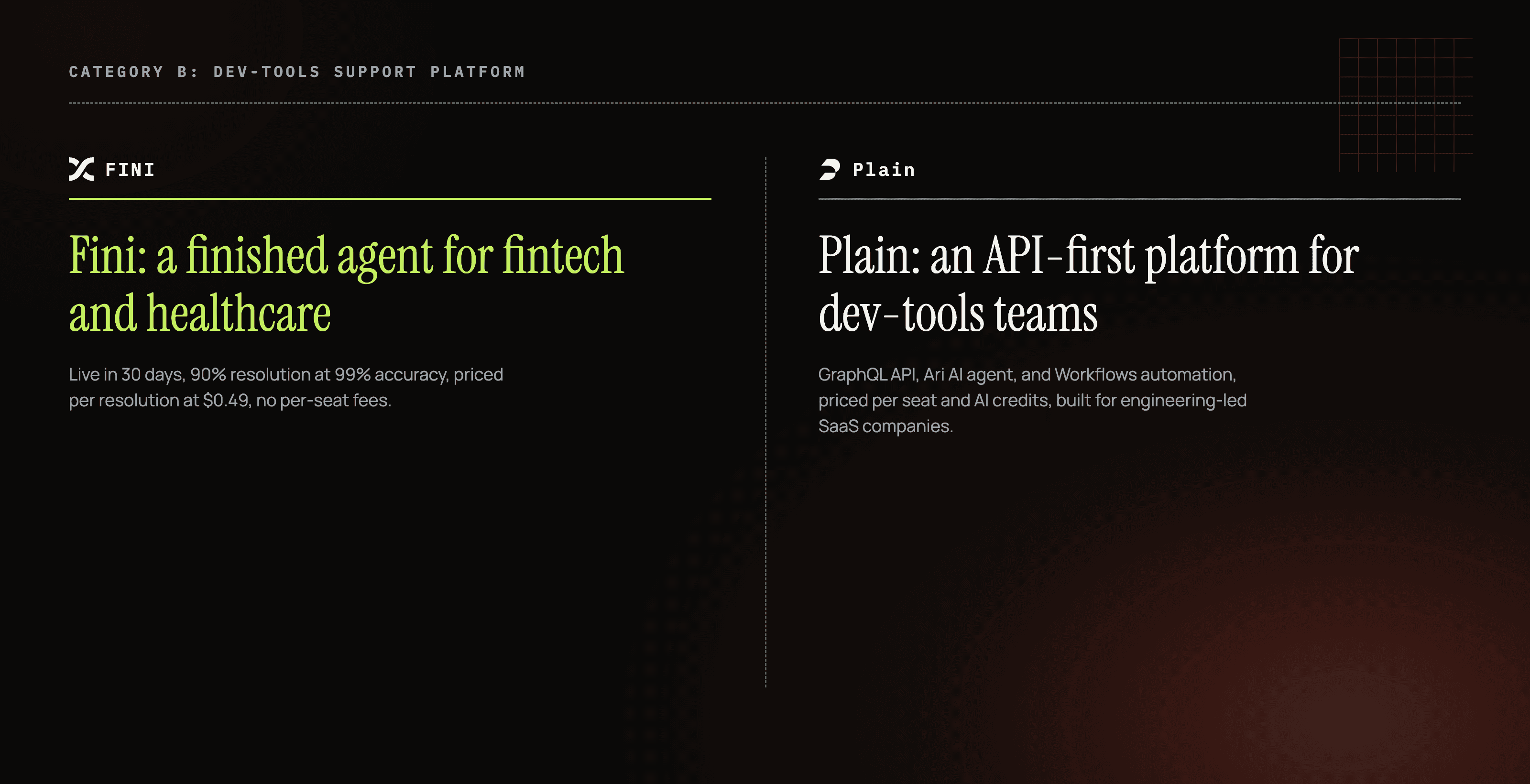
Fini ships a finished agent. Plain ships a support API.
Plain and Fini both show up when B2B teams search for AI customer support tools, but they are built for different buyers. Plain is an API-first support platform for engineering-led SaaS and dev-tools companies who want to build their own support experience on top of a GraphQL API. Fini is a finished, per-resolution AI agent purpose-built for fintech and healthcare support, live in 30 days with native integrations into claims, billing, and EHR systems.
This comparison is honest about the fit. Plain is a well-built, well-liked product for the audience it targets, engineering teams at companies like Vercel, Cursor, Clerk, and Raycast. It has no named customers in banking, lending, insurance, or healthcare, and its pricing, integrations, and compliance stack all point at the same buyer, an early-stage or mid-market software company, not a regulated enterprise. If that is not your buyer, this page will tell you plainly.
In this comparison: What each is · Plain's pricing · How they differ · Capabilities · Feature by feature · Ease of use · Plain's strengths · What customers say · The full side-by-side · Which to choose · Compliance · FAQ
What is Fini?
Fini is an AI customer-support agent priced per resolution, backed by Y Combinator and Matrix Partners. It connects natively to helpdesk, knowledge base, CRM, billing, claims, and EHR systems, so it can take real action on tickets rather than just answering questions from a script.
Fini resolves 90% of support volume at 99% accuracy, goes live within 30 days, and already handles more than 3 million monthly resolutions for fintech and healthcare companies. It works across voice, chat, and email, supports 130+ languages, and responds to a new conversation in about 5 seconds.
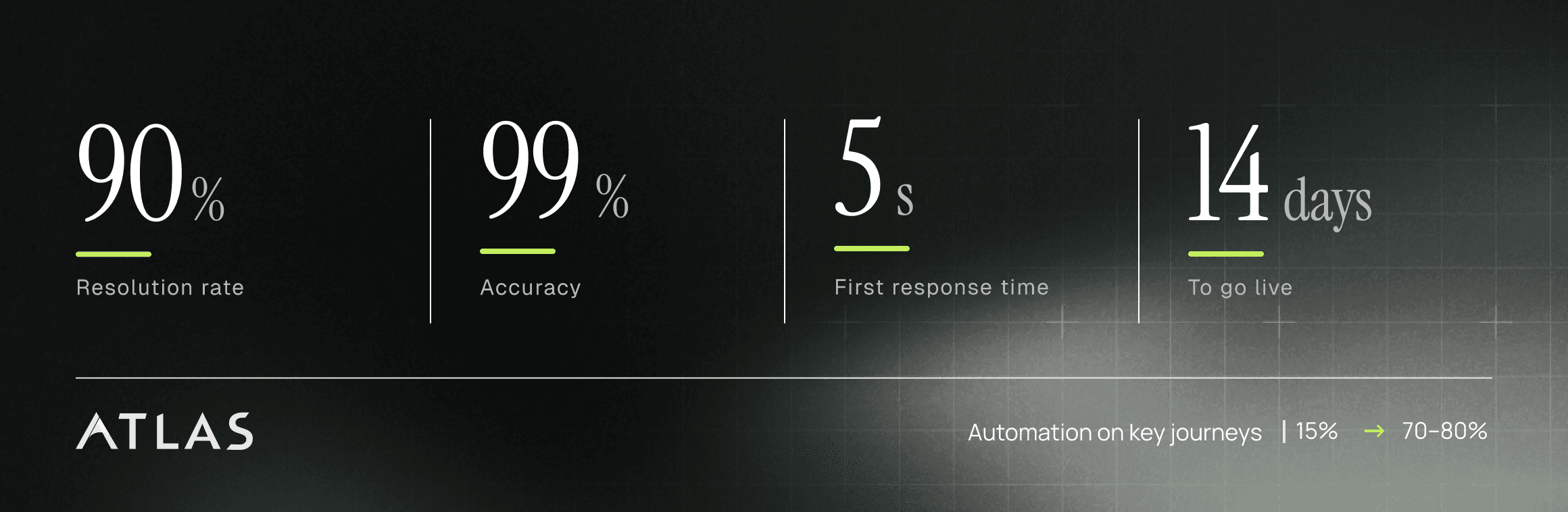
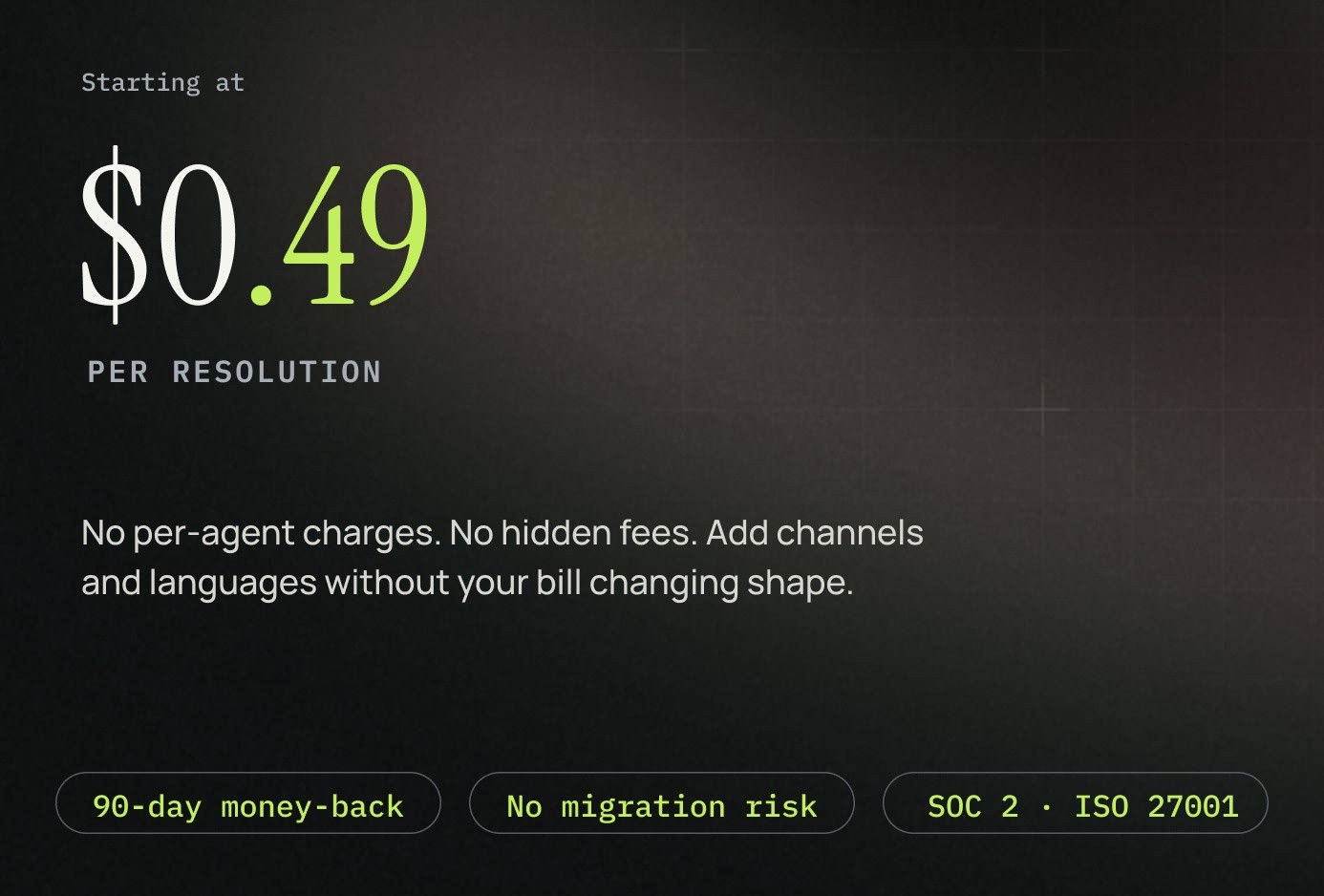
Fini charges a starting rate of $0.49 per resolution, with no per-seat fees, so cost scales with outcomes rather than headcount or conversation volume. Its pricing also includes the 90-Day Money-Back Guarantee: if Fini does not reach a 90% resolution rate within 90 days of going live, you are not charged for the shortfall.
What is Plain?
Plain describes itself as AI support infrastructure that lets B2B teams build their own support experience, no-code or all-code, on top of a GraphQL API with full UI parity and no rate limits. Its legal entity is Not Just Tickets Ltd, registered in the United Kingdom, with offices in London and San Francisco, backed by Connect Ventures, Index Ventures, and Battery Ventures.
The product centers on Ari, Plain's autonomous AI agent, which reads full conversation threads, cites knowledge-base sources, and escalates to a human when it should, moving through a Playground, Shadow Mode, and full-autonomy rollout. Alongside Ari sits Sidekick, an AI assistant that drafts replies for human agents, and Workflows, programmable automation that connects to Linear, PagerDuty, and custom APIs. Channels span Slack, Microsoft Teams, Discord, email, live chat, contact forms, and a headless help-center portal. The specifics are laid out on Plain's own site.
Plain's own comparison pages describe its ideal customer as an engineering-led team that wants to customize, automate, and build on top of its support stack, not a team that wants a preconfigured, breadth-first helpdesk out of the box.
Plain pricing in 2026
Plain prices in three tiers, all self-serve up through the second. Foundation starts at $35/mo for one seat plus $35 per additional seat, up to 5 seats, with 2,000 AI credits a month, Slack/email/in-app channels, Ari, Linear and Jira integration, and a Help Center. Horizon runs $299/mo for 3 seats plus $99 per additional seat, up to 10 seats, with 15,000 AI credits, Microsoft Teams, SLAs and business hours, escalation paths, CRM integrations, and AI-suggested responses. Frontier is custom-priced and adds Discord, Lookup with Cursor, custom AI agents, SSO/SCIM, and a dedicated CSM.
Plain also runs a startup program for VC-backed companies with $5M or less raised and support teams of 10 or fewer: a flat $6,000 for 12 months, roughly half off Horizon. Between the self-serve entry point and the startup discount, Plain's whole pricing motion is built around early-stage, venture-backed software companies buying without a procurement cycle, not a regulated enterprise running a formal vendor review.
How Fini and Plain differ
The core difference is vertical fit, not just product shape. Fini is purpose-built for fintech and healthcare support: the integrations, resolution logic, and compliance posture are already built for those use cases, and you go live in 30 days. Plain is a genuinely strong platform for a different buyer entirely, engineering-led SaaS and dev-tools companies who want an API-first support layer they can extend themselves.
Plain's own customer list makes the point better than any competitor could: n8n, Resend, Granola, Raycast, Sourcegraph, Sanity, Buildkite, Tinybird, Clerk, Stytch, Northflank, Prisma, Depot, Fly.io, and Voltage Park, plus referenced logos including Vercel, Cursor, Webflow, Stripe, Supabase, Airtable, and Palantir. Every named customer is a developer tool, infrastructure, or SaaS company. None is a bank, lender, insurer, hospital system, or claims platform, and Plain's integration catalog reflects that: deep on Linear, Jira, GitHub Issues, and Slack, with no core banking, EHR, or claims connectors of the kind agentic AI support in regulated industries actually requires.
Capabilities side by side
At a functional level, the two products are built for different buyers. The table below lines up the core capabilities most teams evaluate first.
Capability | Fini | Plain |
|---|---|---|
Primary focus | Finished AI agent for fintech and healthcare support | API-first support platform for engineering-led SaaS and dev-tools teams |
Time to go live | 30 days | Self-serve signup in minutes; configuration and integration work scales with customization |
Pricing model | $0.49 per resolution, no per-seat fees | Per-seat plus AI-credit tiers, from $35/mo to custom Frontier |
Vertical integrations | Native to claims, billing, CRM, EHR, helpdesk, knowledge base | Linear, Jira, GitHub Issues, Slack, Discord; no core banking or EHR connectors |
Resolution guarantee | 90-Day Money-Back Guarantee: 90% in 90 days or no charge for the shortfall | No public resolution-rate guarantee disclosed |
Feature by feature
Zooming into individual features shows the same pattern: Fini ships a finished, regulated-industry agent, Plain ships the API and building blocks for a team to assemble one.
Feature | Fini | Plain |
|---|---|---|
Channels | Voice, chat, email | Slack, Teams, Discord, email, live chat, contact forms |
Languages | 130+ | Not specified in public product pages |
Resolution accuracy | 90% resolution at 99% accuracy | Ari cited at handling 40%+ of volume for trusted teams, per Plain's own claim |
Knowledge grounding | Built in, tuned for regulated support content | Retrieval over your own knowledge base, customer-configured |
Multi-step workflows and tool calls | Native to the agent | Programmable Workflows connecting to Linear, PagerDuty, and custom APIs |
Escalation to a human | Built into the core workflow | Configurable through Ari's Playground and Shadow Mode rollout |
Vertical connectors (claims, EHR, core banking) | Native | Not evidenced in public case studies or the integrations list |
Ease of use and admin experience
Fini's onboarding looks more like an implementation project than a build project: connect your existing systems, and Fini goes live in 30 days on top of your own data. There is no API to design against because the agent, its integrations, and its escalation logic are already built for fintech and healthcare support.
Plain's admin experience is a genuine strength for the audience it targets. The $35/mo Foundation tier is self-serve with a 7-day free trial and no credit card required, and its GraphQL API and one-click migration importers from tools like Zendesk or Freshdesk let a small engineering team stand up a support surface same-day. That ease of use, though, is aimed at teams comfortable building on an API. Plain's own comparison materials concede that a breadth-first team wanting a preconfigured, phone- and SMS-capable helpdesk out of the box is better served elsewhere, and nothing in Plain's admin tooling is built around compliance-aware escalation for regulated data.
Fini's differentiators
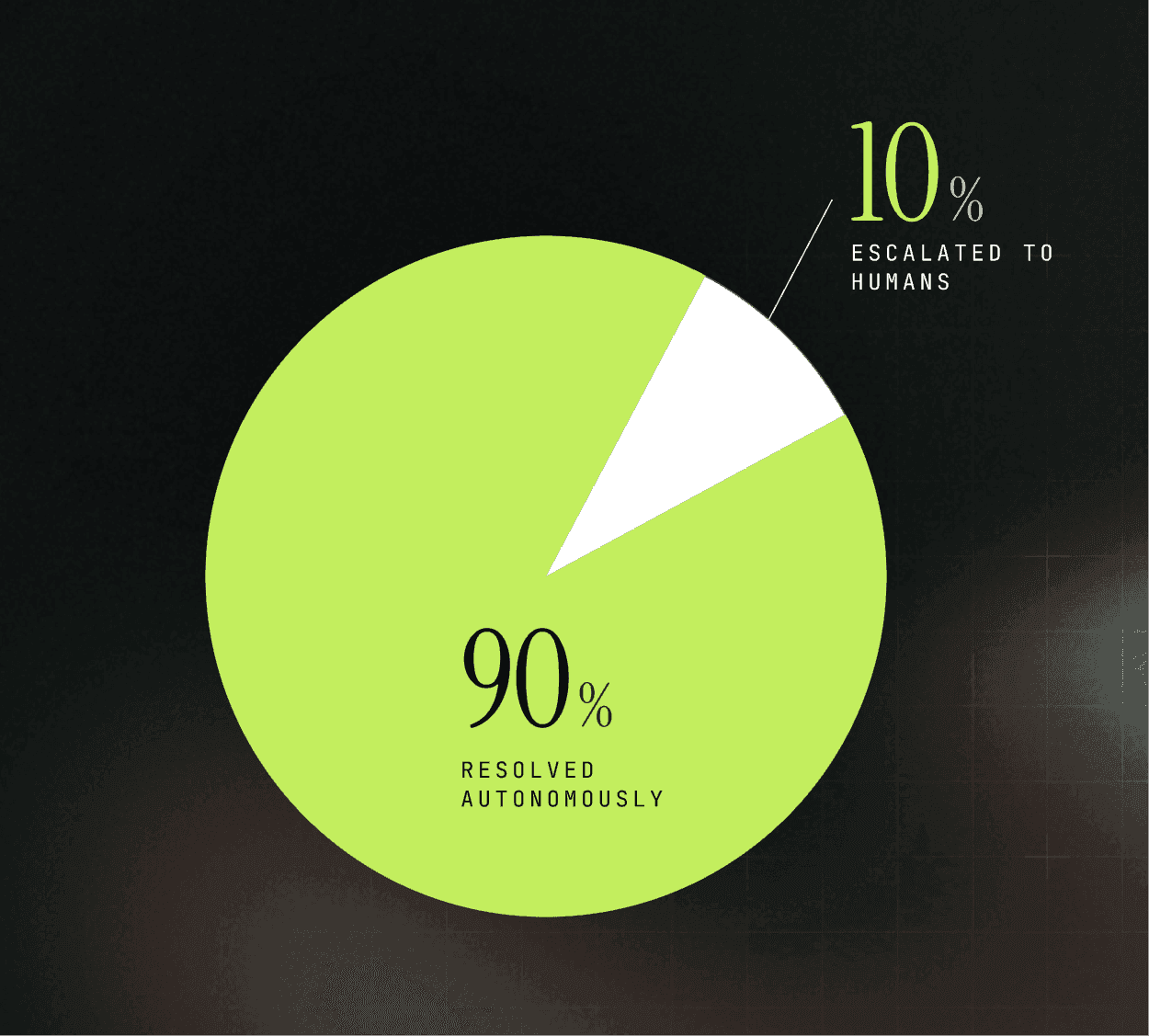
Built for regulated industries, not adapted for them
Fini's integrations into claims, billing, CRM, and EHR systems are native, not something an engineering team wires up after purchase against a general-purpose API. That is the difference between a finished agent and a well-designed API you still have to build the regulated workflow on top of.
A real fintech and healthcare customer base
Fini already handles more than 3 million monthly resolutions for fintech and healthcare companies. Plain's fifteen-plus named case studies, by contrast, are entirely dev-tools and SaaS companies, with zero named customers in banking, lending, insurance, or healthcare.
Resolution-based pricing, not seat- and credit-based
At $0.49 per resolution with no per-seat fees, Fini's cost tracks outcomes. Plain's tiers combine per-seat charges with monthly AI-credit caps, so cost climbs with headcount and usage regardless of whether a ticket actually got resolved.
A guarantee, not just an API
Fini's 90-Day Money-Back Guarantee means that if it does not hit 90% resolution within 90 days of going live, you do not pay for the shortfall. Nothing comparable is published anywhere in Plain's pricing tiers.
Plain's recognized strengths
None of this makes Plain a weak product, it makes it a product built for a different buyer. Plain is genuinely well-regarded among engineering teams: its case studies include Vercel, Cursor, Clerk, and Raycast, its backers include Connect Ventures, Index Ventures, and Battery Ventures, and its GraphQL-first architecture and modern interface are frequently cited by dev-tools companies as a reason to leave a legacy helpdesk like Zendesk or Freshdesk. Sanity reported a 120% jump in team satisfaction after switching, and Sourcegraph cut first response time 67%.
For an engineering-led SaaS company that wants to build its own support experience, extend it through an API, and does not need HIPAA- or PCI-grade compliance, Plain is a well-built, well-liked platform to do that on.
What customers say
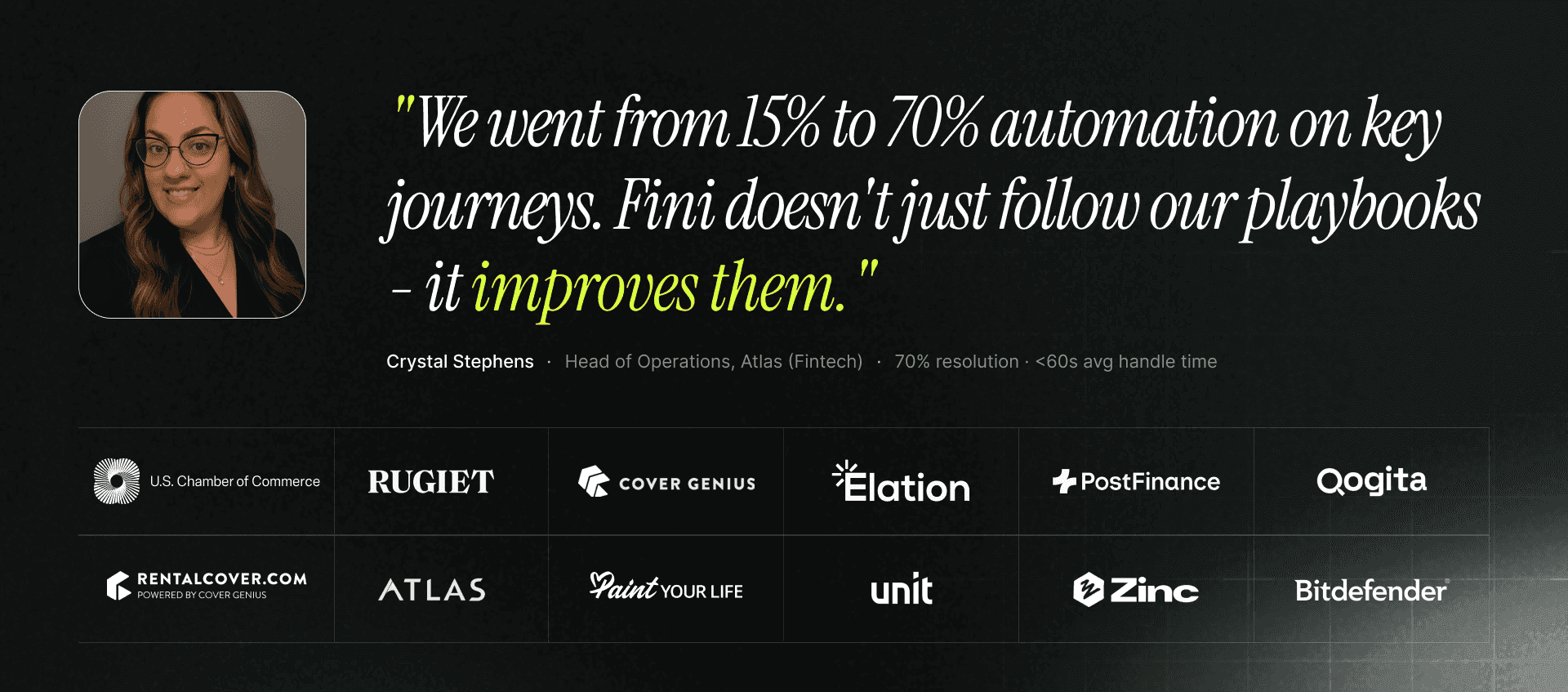
Fini customers describe measurable resolution outcomes on live support volume in fintech and healthcare, not just a smoother support build.
Plain's own customers describe the same kind of story, for a different vertical: n8n cites 60% of tickets automated, Buildkite reports sub-5-minute SLAs, and Tinybird cut enterprise first response time from an hour to 12 minutes. Plain's public rating on G2 could not be independently reverified this session, so treat any specific star rating or review count you see elsewhere as something to confirm live rather than take as current. See more fintech and healthcare outcomes on usefini.com.
The full side-by-side
Pulling every verified data point together for a single reference view.
Category | Fini | Plain |
|---|---|---|
Product type | Finished per-resolution AI agent | API-first support platform (GraphQL) for engineering-led SaaS teams |
Pricing | $0.49 per resolution, no per-seat fees | $35 to $299/mo per-seat plus AI-credit tiers, plus custom Frontier |
Time to go live | 30 days | Self-serve in minutes; regulated-grade workflows require custom build |
Resolution rate | 90% at 99% accuracy | Ari cited at 40%+ of volume for trusted teams, per Plain's own claim |
Guarantee | 90-Day Money-Back Guarantee, 90% in 90 days | No public resolution-rate guarantee |
Channels | Voice, chat, email | Slack, Teams, Discord, email, live chat, contact forms |
Languages | 130+ | Not publicly specified |
Vertical integrations | Native: claims, billing, CRM, EHR, helpdesk, knowledge base | Linear, Jira, GitHub Issues, Slack; no core banking or EHR connectors |
Backers | Y Combinator, Matrix Partners | Connect Ventures, Index Ventures, Battery Ventures |
Compliance certifications | Confirm directly with Fini for your workload | SOC2-equivalent audits, GDPR, CCPA; no HIPAA or PCI-DSS found |
Named customer verticals | Fintech and healthcare | Developer tools, infrastructure, and SaaS only |
Legal entity / HQ | Confirm directly with Fini | Not Just Tickets Ltd, United Kingdom; offices in London and San Francisco |
Which should you choose?
Choose Plain if you are an engineering-led SaaS or dev-tools company that wants an API-first support layer you can build on yourself, your support volume looks like Vercel's or Clerk's rather than a bank's, and you do not have a HIPAA or PCI compliance requirement. Its case studies back that use case up well.
Choose Fini if you are a fintech or healthcare company that needs an agent live in 30 days, resolving real tickets against your claims, billing, EHR, or core systems, with a compliance posture built for regulated data from day one. If you are evaluating other platforms too, see how Fini compares to Crisp and Front.
Compliance
Plain's Data Processing Agreement commits to third-party audits at least annually according to SOC2 standards or an alternative substantially equivalent to SOC2, incorporates EU Standard Contractual Clauses for restricted transfers, and commits not to sell or share personal data under CCPA/CPRA. It also commits not to use customer personal data to train general or shared AI models, and publishes a subprocessor list with a 7-day objection window. That is a solid, standard SaaS-grade compliance posture. There is no public mention anywhere in Plain's materials of HIPAA, PCI-DSS, ISO 27001, or FedRAMP, and no evidence of a banking- or healthcare-specific regulatory framework.
Fini serves fintech and healthcare customers handling regulated data through native integrations into claims, billing, and EHR systems. If compliance certifications are a hard requirement for your deployment, confirm the current status directly with Fini's team rather than assuming parity with Plain's published, dev-tools-oriented compliance stack.
Ready to compare on your own data?
The fastest way to know which is the right fit is to test against your own tickets and your own systems, not a slide deck. Talk to Fini about a live pilot on your own data.
Is Plain a good fit for fintech or healthcare support?
Plain can be pointed at fintech or healthcare support in theory, but it has no named customers in either vertical. Every case study on Plain's site, n8n, Resend, Granola, Raycast, Sourcegraph, Sanity, Buildkite, Tinybird, Clerk, Stytch, Northflank, Prisma, Depot, Fly.io, and Voltage Park, is a developer tool, infrastructure, or SaaS company, and its integration catalog has no core banking, claims, or EHR connectors of the kind Fini builds in natively.
What does Plain cost in 2026?
Plain has three tiers. Foundation is $35/mo for one seat plus $35 per additional seat, up to 5 seats, with 2,000 AI credits. Horizon is $299/mo for 3 seats plus $99 per additional seat, up to 10 seats, with 15,000 AI credits. Frontier is custom-priced for larger, more complex deployments.
How is Fini's pricing different from Plain's?
Fini charges a starting rate of $0.49 per resolution with no per-seat fees, so cost scales with outcomes. Plain charges per seat plus a monthly AI-credit allowance, so cost climbs with headcount and usage regardless of whether a ticket actually got resolved.
Is Plain a finished agent or a support API?
It is fundamentally an API-first support platform. Plain gives engineering teams a GraphQL API, a Workflows automation layer, and Ari, its AI agent, but you connect your own knowledge sources, choose your own channels, and build the specific support experience yourself.
Is Plain SOC 2 and HIPAA compliant?
Plain's Data Processing Agreement commits to annual audits to SOC2 standards or an equivalent, plus GDPR and CCPA commitments. There is no public mention of HIPAA, PCI-DSS, or ISO 27001 anywhere in Plain's materials, so it is not built for banking- or healthcare-specific compliance requirements out of the box.
How fast can I go live with Fini versus Plain?
Fini goes live in 30 days on your own data, with claims, billing, CRM, and EHR integrations already built in. Plain's self-serve Foundation tier can be set up in minutes for a simple Slack or email flow, but a compliance-aware, multi-system deployment on Plain's API is a build project an engineering team has to own.