
API-driven task execution vs. native voice coverage
In this comparison: What each is · Pricing · How they differ · Capabilities · Feature by feature · Ease of use · What customers say · The full side-by-side · Which to choose · Compliance · FAQ
What is Fini?
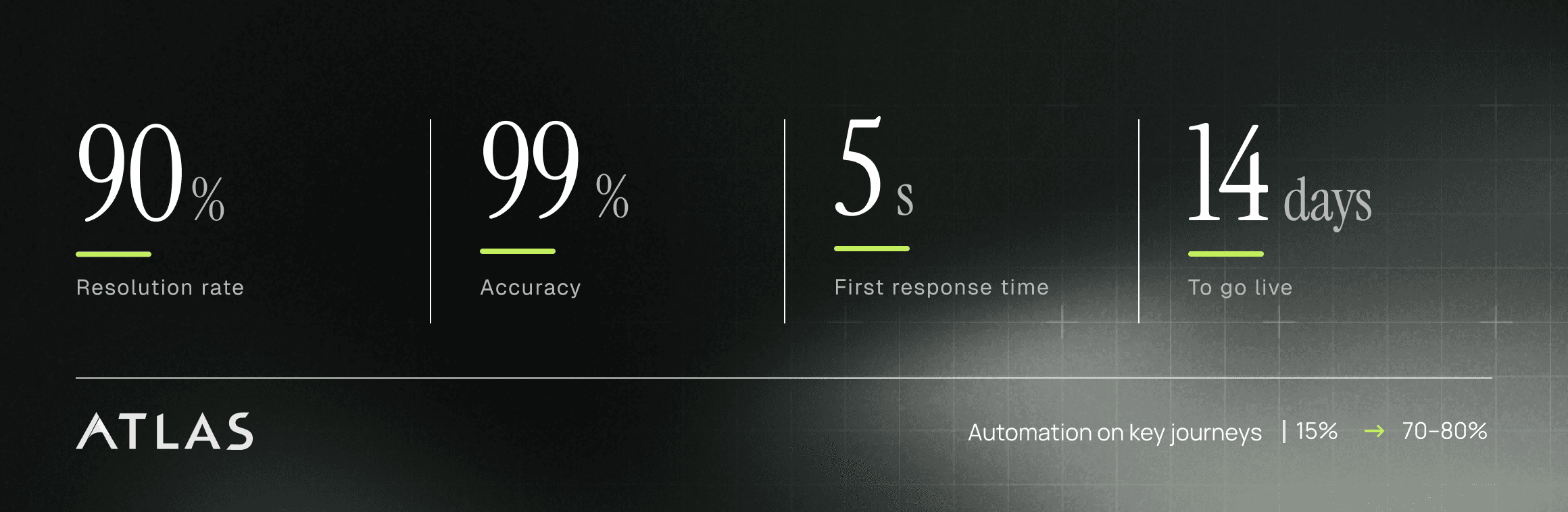
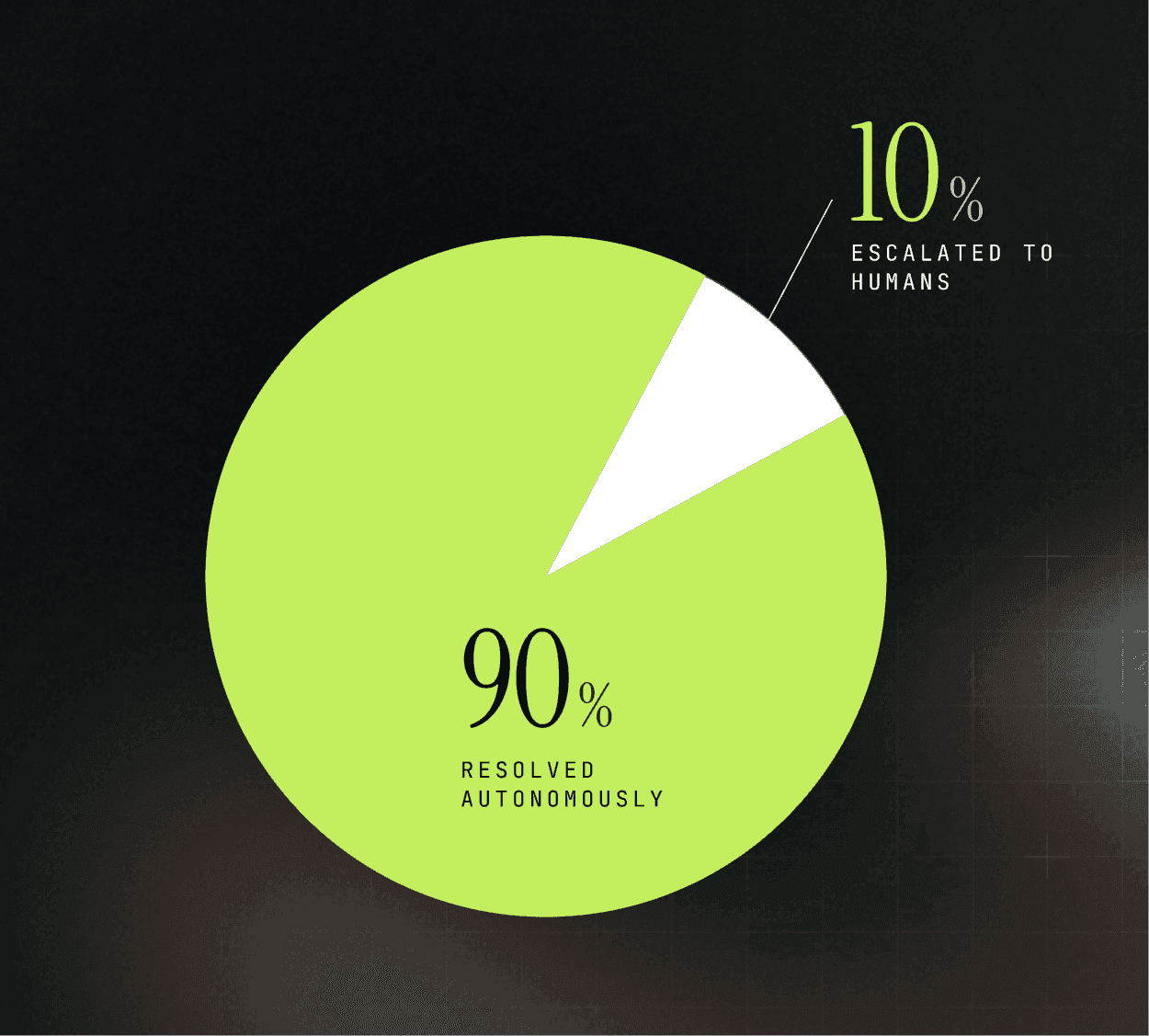
Fini is an AI customer-support agent priced per resolution, backed by Y Combinator and Matrix Partners. It connects natively to your helpdesk, knowledge base, CRM, billing, claims, and EHR systems, reaches a 90% resolution rate at 99% accuracy, and is built to go live in 30 days. Across its customer base, Fini handles more than 3 million monthly resolutions in fintech and healthcare. The agent works across voice, chat, and email, answers in 130+ languages, and returns a first response in about five seconds. Fini also backs its results with a Zero Pay Guarantee: if the agent doesn't reach a 90% resolution rate within 90 days of go-live, the shortfall isn't billed, a commitment that ties Fini's own revenue to whether the deployment actually works, rather than to the contract being signed.
What is Parahelp?
Parahelp came out of Y Combinator's Summer 2024 batch, founded by Mads Liechti and Anker Ryhl, and has raised $21.2 million total, a $3.2 million seed led by Blake Robbins at Hidden Capital, followed by an $18 million Series A led by Jack Altman's Alt Capital, with Y Combinator, Perplexity Fund, ByFounders, and Skyfall Ventures also participating. The product has two parts. The Customer Agent resolves tickets end to end across email, live chat, and Slack by taking real actions inside connected tools: issuing a Stripe refund, filing a Linear bug report, updating a Zendesk or Intercom ticket. The Internal Agent is the more unusual piece: it lets a company's own support staff build and refine the Customer Agent using natural-language instructions, without an engineer in the loop. Parahelp's named customers: Perplexity, Replit, HeyGen, Framer, Bolt.new, Photoroom, Captions, Kit, and Fyxer, skew heavily toward AI-native and developer-tool companies rather than regulated industries, and the company states it has had 0% churn to date. The Internal Agent is worth dwelling on because it's a genuinely different bet than most of this category makes. Rather than an engineer editing a prompt or a workflow builder with dozens of conditional branches, Parahelp's pitch is that a support lead can tell the agent, in plain sentences, what to do differently: escalate a certain kind of ticket, change how it phrases a refund denial, add a new condition before it applies a discount, and have that change take effect without a deploy. Paired with the Customer Agent's reactive and proactive modes and its role-based access controls separating who can configure the agent (Admin) from who runs day-to-day operations against it (Operator), the two-product structure reads as a deliberate attempt to keep configuration power close to the support team itself rather than routing every change through engineering.
Parahelp pricing in 2026
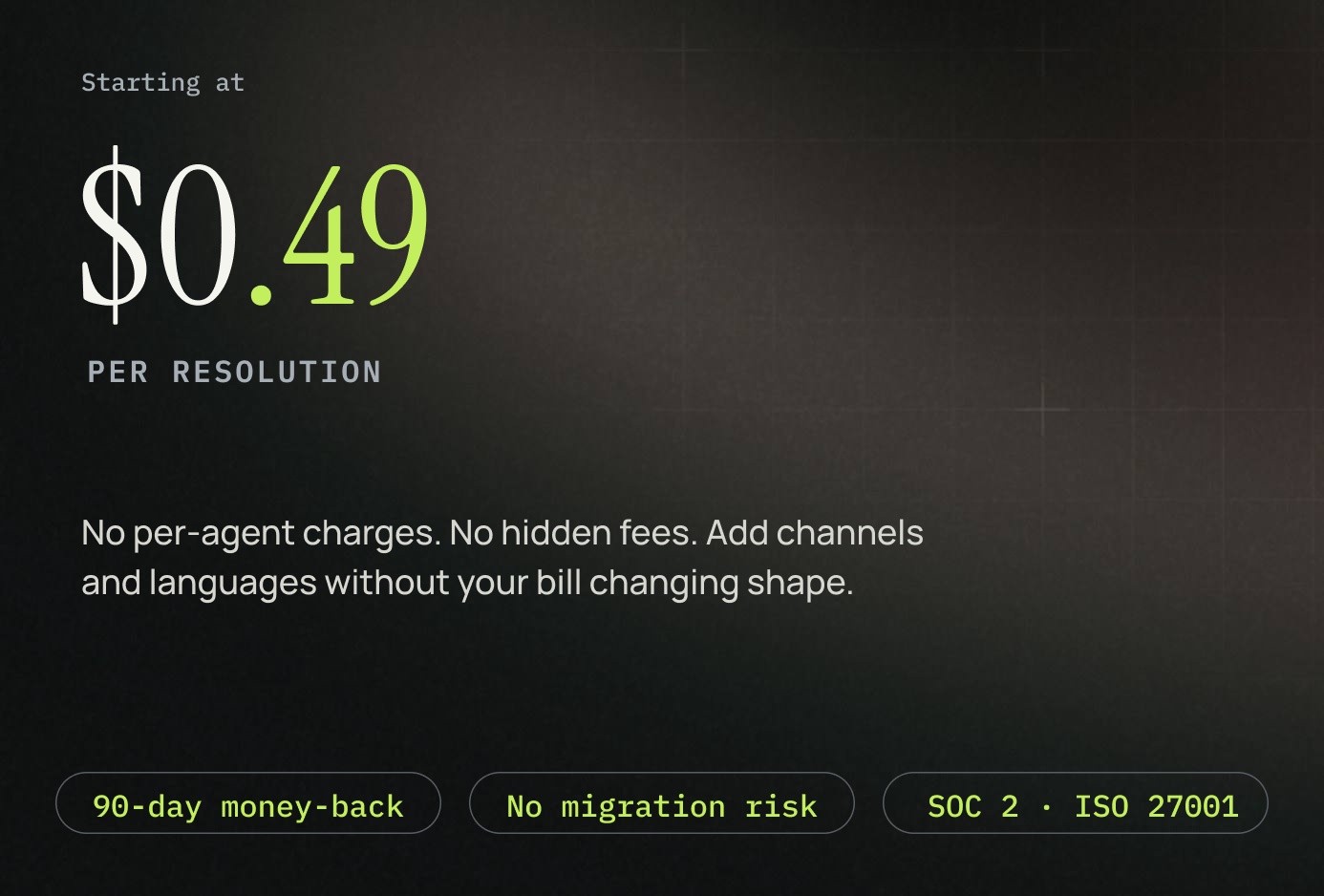
Parahelp publishes no rate card anywhere in its public materials. Every deal runs through a sales-qualified process, a prospect has to book a demo before seeing a number. Independent trackers that cover AI support tooling, including eesel AI and Featurebase, describe Parahelp as hiding its pricing behind a wall and infer a pay-per-resolution structure, but neither can confirm actual rates; eesel AI goes as far as positioning itself explicitly as \"the transparent alternative\" to Parahelp on pricing. Fini takes the opposite approach and publishes its rate directly: $0.49 per resolution, with no per-seat fees and any unused allowance rolling forward one month. The gated-pricing pattern isn't unique to Parahelp: it's common among early-stage, sales-led B2B software, where a founding team wants to qualify a prospect's volume and use case before quoting a number that might not fit either a very small team or a very large enterprise. The trade-off for the buyer is real, though: without a rate card, there's no way to sanity-check a quote against the market, estimate total cost of ownership before a first call, or compare pricing across vendors without disclosing your own volume to each of them first. That's precisely the gap eesel AI has built part of its own positioning around, framing itself as the transparent-pricing alternative specifically in contrast to platforms like Parahelp that keep the number behind a demo.
What buyers ask | Parahelp | Fini |
|---|---|---|
Published price list | ✗ | ✓ |
Price | Quoted per account, sales-gated | $0.49 per resolution |
Rate for additional resolutions | Not published | N/A, flat rate |
Can you model cost before a sales call? | No | Yes |
See Fini's full pricing breakdown for plan details, add-ons, and a resolution calculator.
How Fini and Parahelp differ
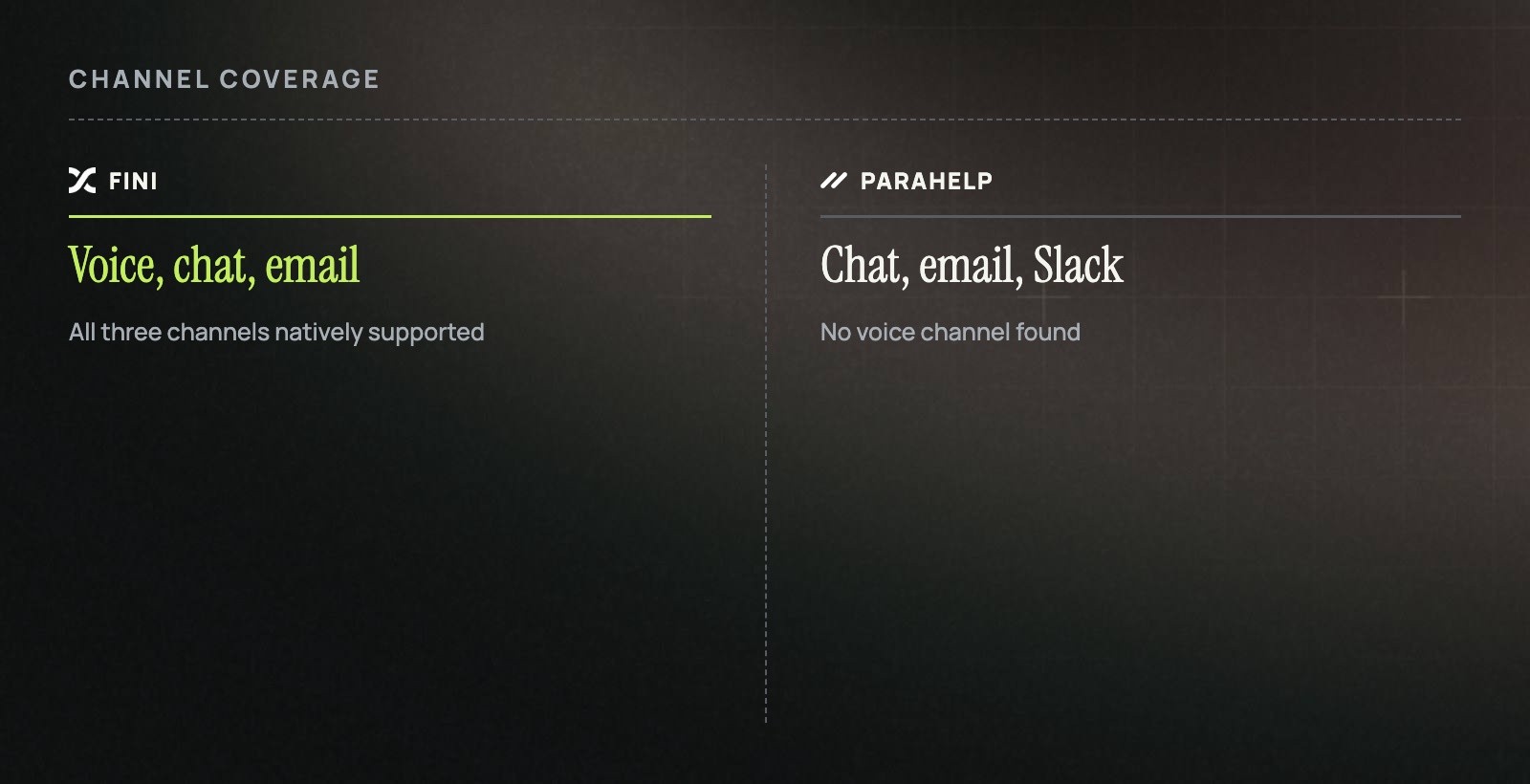
Parahelp's real strength is depth of task execution for software companies: an agent that reaches into Stripe, Linear, and similar tools to actually resolve a ticket, not just answer it, paired with a genuinely distinct configuration model where non-engineers build the agent conversationally. Its gap is breadth: no voice channel appears anywhere in its public materials, and nothing in its marketing, case studies, or customer list points to readiness for regulated industries: no HIPAA claim, no ISO 27001 certification, no fintech or healthcare case study. Fini's shape is close to the inverse: voice, chat, and email in 130+ languages, plus a compliance program built specifically for regulated buyers, all sitting behind a rate card a prospect can model before ever getting on a call. The two also target different-sized decisions. Parahelp's customer list: Perplexity, Replit, Framer, Bolt.new, reads like a roster of well-funded, engineering-heavy companies that can absorb a sales cycle and a custom contract in exchange for an agent tuned tightly to their own tools and workflows. Fini's fintech and healthcare customer base is buying something closer to a fixed cost of doing business: a rate they can put in a budget line before the fiscal year starts, in an industry where an unbudgeted compliance gap is a much bigger problem than an unbudgeted software line item.
Capabilities side by side
On raw task-execution ambition, the two are more alike than different, Parahelp markets itself explicitly on \"using your tools,\" and Fini's native connections to billing, claims, and EHR systems make a comparable claim for regulated workflows specifically. Where they split is channel coverage, where Fini's voice support is a structural advantage Parahelp doesn't claim to match, and knowledge upkeep, where Fini's Knowledge Atlas plays the role Parahelp's Internal Agent plays for agent configuration, the two products solved a similar underlying problem (keeping the agent accurate and current without constant engineering work) from different angles, and Parahelp's Internal Agent deserves real credit as a distinct, well-considered approach to that problem rather than a lesser version of anyone else's. In practice, \"using your tools\" means an agent that can look up an order in Stripe, confirm it qualifies for a refund against a stated policy, issue that refund, and write a note back into the ticket: or take a reported bug, open it directly as a Linear issue with the right tags and reporter context attached, rather than just telling a customer \"we've forwarded this to engineering.\" Fini's equivalent depth shows up specifically in regulated workflows: verifying a claim against policy terms, confirming KYC status before releasing funds, updating an account record inside a CRM or billing system: the same category of real, stateful action, aimed at a different set of systems. Parahelp also distinguishes between reactive and proactive modes: the agent can wait for a customer to raise an issue, or, in proactive mode, surface a likely problem before the customer files a ticket at all, based on signals available inside the connected tools. That proactive layer is a meaningfully different product decision than most support agents make, which tend to be purely reactive, and it's worth asking about directly if a team is evaluating Parahelp specifically for that capability rather than assuming it works the same way everywhere.
Feature by feature
Feature | Fini | Parahelp |
|---|---|---|
Voice support | ✓ | ✗ |
Published pricing | ✓ | ✗ |
Natural-language agent editing by non-engineers | Via admin tools | ✓ (Internal Agent) |
Action execution via third-party APIs | ✓ | ✓ |
130+ language support | ✓ | Not published |
SOC 2 Type II | ✓ | ✓ |
HIPAA-BAA | ✓ | Not offered |
Outcome guarantee | ✓ (Zero Pay) | None published |
Laid out feature by feature, the pattern holds: where Parahelp has a named, marketed capability, it tends to be about configuration speed and tool-reach; where Fini has one, it tends to be about coverage and accountability: more channels, more languages, a published number, and a guarantee attached to the outcome rather than just the capability existing.
Ease of use and admin experience
Parahelp markets a genuinely fast setup, claims of same-day onboarding and a first ticket resolved within three hours, built around the Internal Agent's natural-language configuration, which lets a support lead adjust the agent's behavior in plain English rather than filing an engineering ticket. That's a real, notable claim worth taking at face value rather than dismissing. Fini's admin experience centers less on one-time setup speed and more on ongoing accuracy: the Knowledge Atlas keeps the agent's answers current as help content, policies, and product details change, so the team's job is reviewing suggested updates rather than manually re-authoring the agent's knowledge every time something shifts. Neither claim should be read as \"the other one is slow.\" They're solving for different failure modes: Parahelp is optimized against the risk of a slow, engineering-gated rollout that never quite gets configured the way support actually wants it; Fini is optimized against the slower, quieter risk of an agent whose answers drift out of date as policies and products change after go-live. A team evaluating either should ask which failure mode they're more afraid of, not which vendor's demo looks faster. It's also worth asking each vendor directly what happens after the initial configuration is done: how a workflow change actually gets tested before it goes live, who signs off on it, and how quickly a mistake in a new instruction, from either an Internal Agent edit or a Knowledge Atlas update, gets caught before it reaches a real customer.
Fini's differentiators
Published, budgetable pricing
You can model total cost against your own ticket volume before a sales call.
A native voice channel
Alongside chat and email, in 130+ languages.
A compliance program built for regulated industries
HIPAA-BAA-eligible contracting on top of SOC 2 Type II, ISO 27001, and GDPR, backed by a real track record of more than 3 million monthly resolutions in fintech and healthcare.
The Zero Pay Guarantee
Ties payment directly to results. Taken together, these are less a list of individual features and more a single argument: that a support leader in a regulated industry should be able to see the full cost and coverage of an AI agent in writing, before committing to a pilot, rather than discovering the gaps, a missing certification, an unpublished per-resolution rate, a channel the team assumed was included, after the contract is signed. That argument is strongest exactly where Parahelp is weakest today: a fintech or healthcare buyer evaluating both platforms side by side would need to schedule a call just to learn whether Parahelp fits at all, whereas Fini's compliance page and rate card answer that question before the first email is sent.
Parahelp's recognized strengths
A genuinely strong founding and investor bench: Alt Capital, Hidden Capital, Perplexity Fund, and Y Combinator's S24 batch: plus a named customer list (Perplexity, Replit, Framer, Bolt.new) that carries real weight specifically within the AI-native and developer-tool segment. The Internal Agent's non-engineer configuration model is a legitimate, distinct product bet, not a marketing gloss on someone else's idea. And its claimed time-to-first-resolution, as fast as three hours from setup, is aggressive even by this category's standards. Its role-based access model, separating who can reconfigure the agent's behavior from who operates it day to day, also reflects a level of product maturity around governance that isn't always present in a company only a couple of years past launch, and it directly answers a question most enterprise buyers ask early in any evaluation: who, exactly, is allowed to change what the agent says. None of that should be discounted just because the company is young, a $21.2 million raise across two rounds inside 18 months, from investors with real pattern-matching on enterprise software, is itself a signal that sophisticated backers believe the Internal Agent's approach to configuration is worth betting on, not just a marketing angle.
What customers say
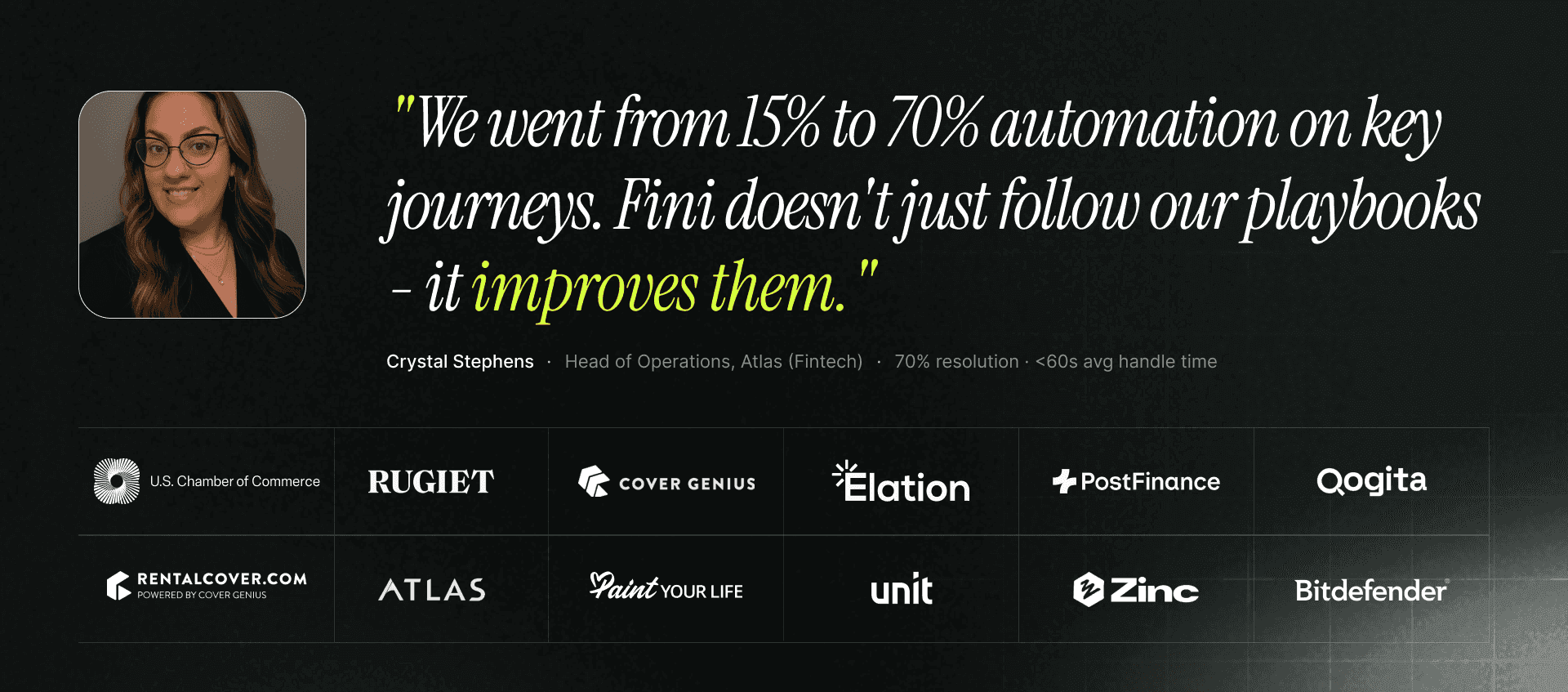
Parahelp is young enough that independent, cross-checkable customer sentiment is thin, there is no G2 or Capterra listing to verify company claims against. What is publicly attributable: a Captions case study reporting 46% of all support tickets resolved within seven days of implementation, and the company's own stated claim of 0% churn to date. Both are worth citing, and both are clearly Parahelp's own reporting rather than independently verified, a distinction worth keeping in mind until a broader independent review base exists. The 46% seven-day resolution figure from the Captions case study is also worth reading in context: it's a snapshot from very early in an implementation, at one customer, in one product category, and Parahelp hasn't published a broader set of resolution-rate figures across its customer base the way some larger competitors do: a reasonable thing for a prospective buyer to ask about directly during a sales conversation, since it's exactly the kind of number a published, comparable rate isn't yet available for.
The full side-by-side
Fini | Parahelp | |
|---|---|---|
Pricing | $0.49 per resolution | Custom, sales-gated, not published |
Channels | Voice, chat, email | Email, live chat, Slack |
Languages | 130+ | Not published |
Outcome guarantee | Zero Pay, 90% in 90 days | None published |
Go-live | 30 days, staged | Claimed same-day to 3 hours |
Compliance | SOC 2 Type II, ISO 27001, GDPR, HIPAA-BAA-eligible, CCPA under agreement | SOC 2 Type II, GDPR; no HIPAA, ISO 27001, or CCPA claim found |
Action execution | Native to helpdesk, CRM, billing, claims, EHR | Any tool with an API; named: Zendesk, Intercom, Front, Stripe, Slack, Linear |
Admin/config model | Knowledge Atlas, self-maintaining | Internal Agent, natural-language editing by non-engineers |
Backing | Y Combinator, Matrix Partners | Y Combinator (S24), Alt Capital, Hidden Capital, $21.2M total |
Notable customers | Fintech and healthcare, 3M+ monthly resolutions | Perplexity, Replit, Framer, Bolt.new, Photoroom, Captions |
Independent reviews | Track record in fintech/healthcare | Not yet listed on G2 or Capterra |
Read across every row, the side-by-side tells a consistent story rather than a scattered one: Fini is the more heavily documented, more broadly regulated, more channel-complete option; Parahelp is the more specialized, faster-configuring option for a narrower and, at least so far, better-funded slice of the software industry. Neither table cell should be read in isolation: a team that only needs email and chat, doesn't touch regulated data, and wants an engineer-free configuration model may reasonably weight Parahelp's row of advantages higher than Fini's, even though Fini's table has more checkmarks in total.
Which should you choose?
Choose Fini if you want published pricing you can model before a sales call, need voice support or coverage across 130+ languages, or operate in a regulated industry that needs HIPAA-BAA coverage backed by a real fintech and healthcare track record. Choose Parahelp if you're an AI-native or developer-tool company comfortable with a sales-led buy, want a non-engineer on your team to configure the agent conversationally through the Internal Agent, and don't need a voice channel. The honest edge case is a well-funded software company that also happens to touch regulated data, say, a fintech-adjacent developer tool handling payment information. That team would need to look past both vendors' marketing and ask Parahelp directly about certifications it doesn't currently publish, and ask Fini directly whether its regulated-industry tooling maps cleanly onto a product-led, engineering-heavy buyer rather than the operations-heavy claims and account-servicing teams it's best known for today.
Compliance
Fini publishes SOC 2 Type II, ISO 27001, GDPR, HIPAA-BAA-eligible contracting, and CCPA under agreement. Parahelp publishes SOC 2 Type II certification and GDPR compliance, and states customer data isn't used for model training: solid ground for a company at this stage, but no HIPAA, ISO 27001, or CCPA claim appears anywhere in its public materials. Buyers in healthcare or fintech specifically should verify Parahelp's regulated-industry readiness directly rather than assume it, given none of its public case studies or named customers sit in those sectors. That gap doesn't make Parahelp a bad product: it makes it an unverified one for that specific buyer, which is a different, more fixable problem than a genuine architectural mismatch, and one Parahelp's public materials could close simply by publishing what a regulated buyer needs to see.
Ready to compare on your own data?
Instead of booking a call to find out what Parahelp would cost your team, run your own ticket volume against Fini's published rate card and see the number today. See Fini's plans, or compare Fini against Ada and Botpress if you're weighing more than one alternative. Talk to the Fini team directly if you'd rather walk through your own ticket volume live, and see our note on agentic AI for how we define the category Parahelp and Fini both compete in.
Does Parahelp publish its pricing?
No. Parahelp uses a sales-qualified, contact-sales model with no public rate card; independent trackers infer a pay-per-resolution structure but can't confirm it. Fini publishes an exact rate: $0.49 per resolution, so you can model your cost before ever speaking to sales.
Does Parahelp support voice calls?
No public materials mention a voice or phone channel: Parahelp covers email, live chat, and Slack. Fini adds voice alongside chat and email, in 130+ languages.
Who backs Parahelp?
Parahelp is Y Combinator-backed (S24 batch) and has raised $21.2 million total across a $3.2 million seed led by Hidden Capital and an $18 million Series A led by Alt Capital, with Perplexity Fund, ByFounders, and Skyfall Ventures also participating. Fini is backed by Y Combinator and Matrix Partners.
What is Parahelp's Internal Agent?
It's the tool Parahelp's non-engineering staff use to build and refine the customer-facing Customer Agent through natural-language instructions rather than code, a genuine and distinct configuration model worth understanding on its own terms.
Is Parahelp built for regulated industries like healthcare or fintech?
Not based on any public materials found: its named customers, including Perplexity, Replit, Framer, Bolt.new, and Photoroom, are AI-native and dev-tool companies, and no HIPAA or regulated-industry case study is published. Fini publishes SOC 2 Type II, ISO 27001, GDPR, and HIPAA-BAA-eligible coverage, with a track record of 3M+ monthly resolutions in fintech and healthcare.
How fast does each go live?
Parahelp claims resolution of a first issue within three hours of setup and describes onboarding as a same-day process for some teams. Fini publishes a defined 30-day staged rollout.
Does Parahelp have an outcome or performance guarantee?
None found in any public materials. Fini backs results with its Zero Pay Guarantee, 90% resolution within 90 days or the difference isn't billed.
Can I read independent reviews of Parahelp?
As of this research, Parahelp has no listed profile on G2 or Capterra, so there's no independent buyer-review layer to cross-check company claims against yet.
What actions can Parahelp's agent actually take?
It connects to any tool with an API and has named integrations with Zendesk, Intercom, Front, Stripe, Slack, and Linear, able to do things like process a refund or file a bug report directly, not just answer questions.
What's the real difference in target buyer between Fini and Parahelp?
Parahelp is a sales-led product built for well-funded, AI-native software companies comfortable with a custom contract. Fini is built for teams, especially in regulated industries, that want to model their exact cost against real ticket volume before ever picking up the phone.