
300+ banking models vs. zero named core-banking integrations
A bank evaluating conversational AI usually starts with the same question: does this vendor actually understand banking, or is banking just one vertical logo on a long list? Omilia answers with volume, over 300 out-of-the-box NLU models trained specifically on banking and finance intents. Fini answers with depth, native connections into the systems, including claims and EHR platforms, that a regulated-industry deployment actually has to touch.
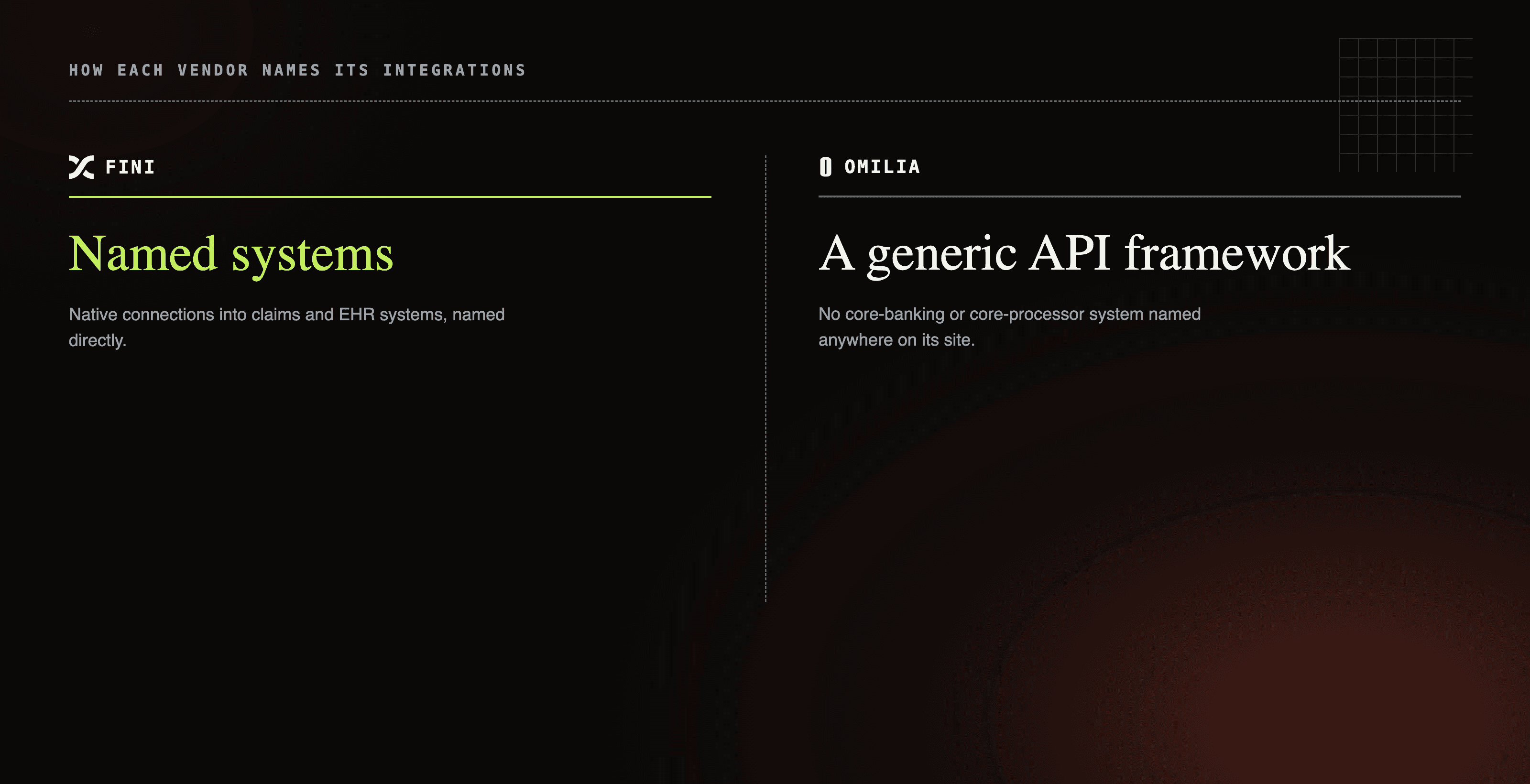
Look past the marketing pages and a real gap opens up: Omilia names no core-banking or core-processor system anywhere on its site, despite pitching itself as built for banking. Fini's connectors run straight into helpdesk, CRM, billing, claims, and EHR systems by name.
In this comparison: What each is · How they differ · Capabilities · Feature by feature · Ease of use · What customers say · The full side-by-side · Which to choose · Compliance · FAQ
What is Fini?
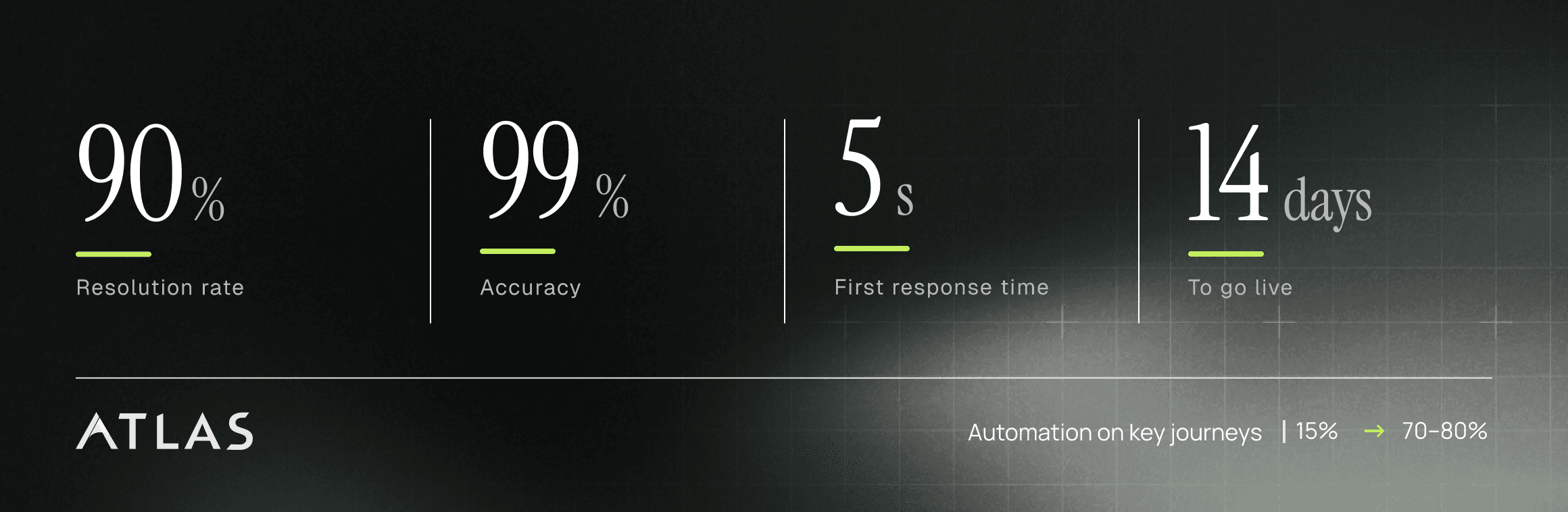
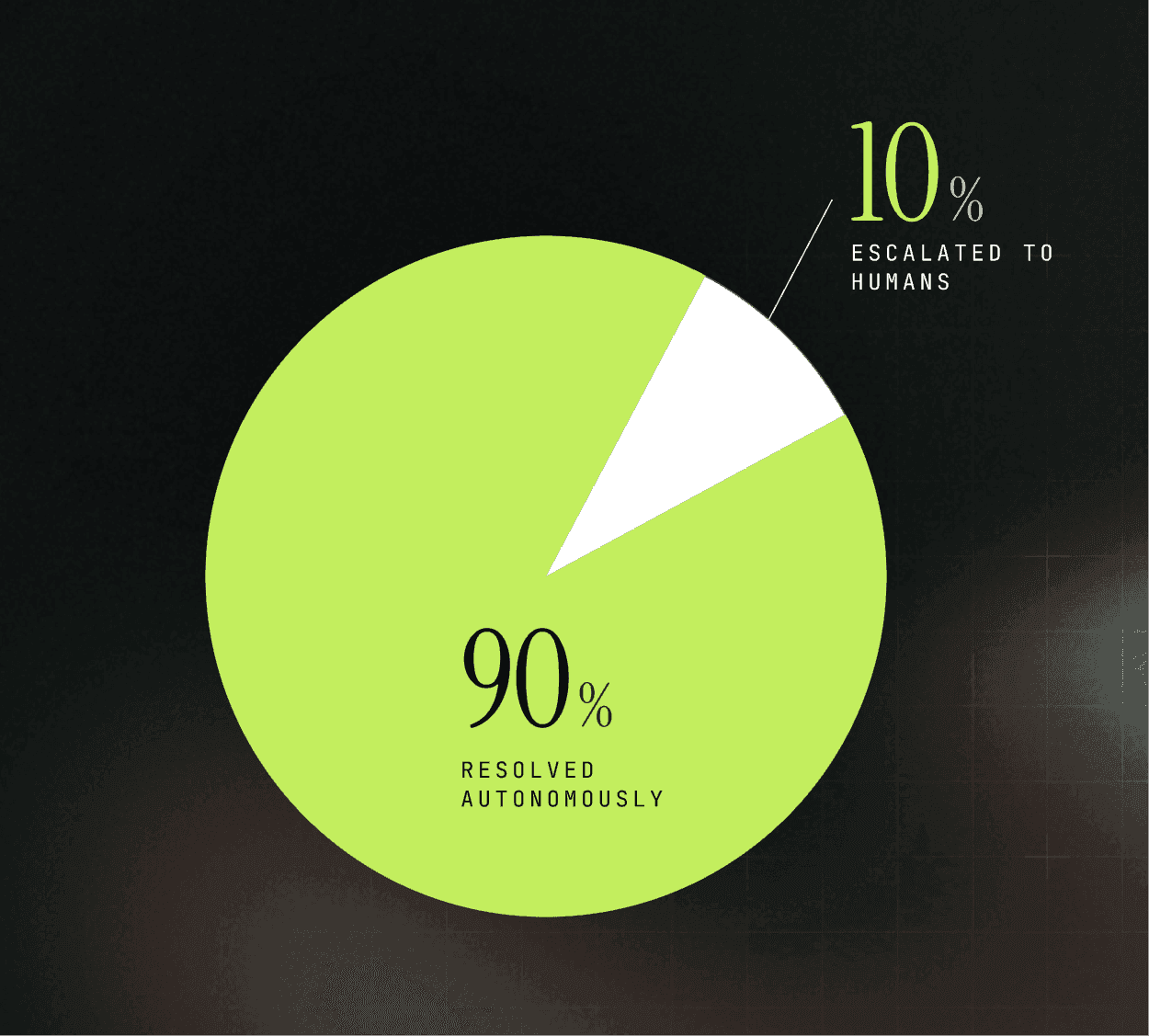
Fini is an AI customer-support agent priced per resolution, backed by Y Combinator and Matrix Partners. It connects natively to your helpdesk, knowledge base, CRM, billing, claims, and EHR systems, reaches a 90% resolution rate at 99% accuracy, and is built to go live in 30 days. Across its customer base, Fini handles more than 3 million monthly resolutions in fintech and healthcare. The agent works across voice, chat, and email, answers in 130+ languages, and returns a first response in about five seconds.
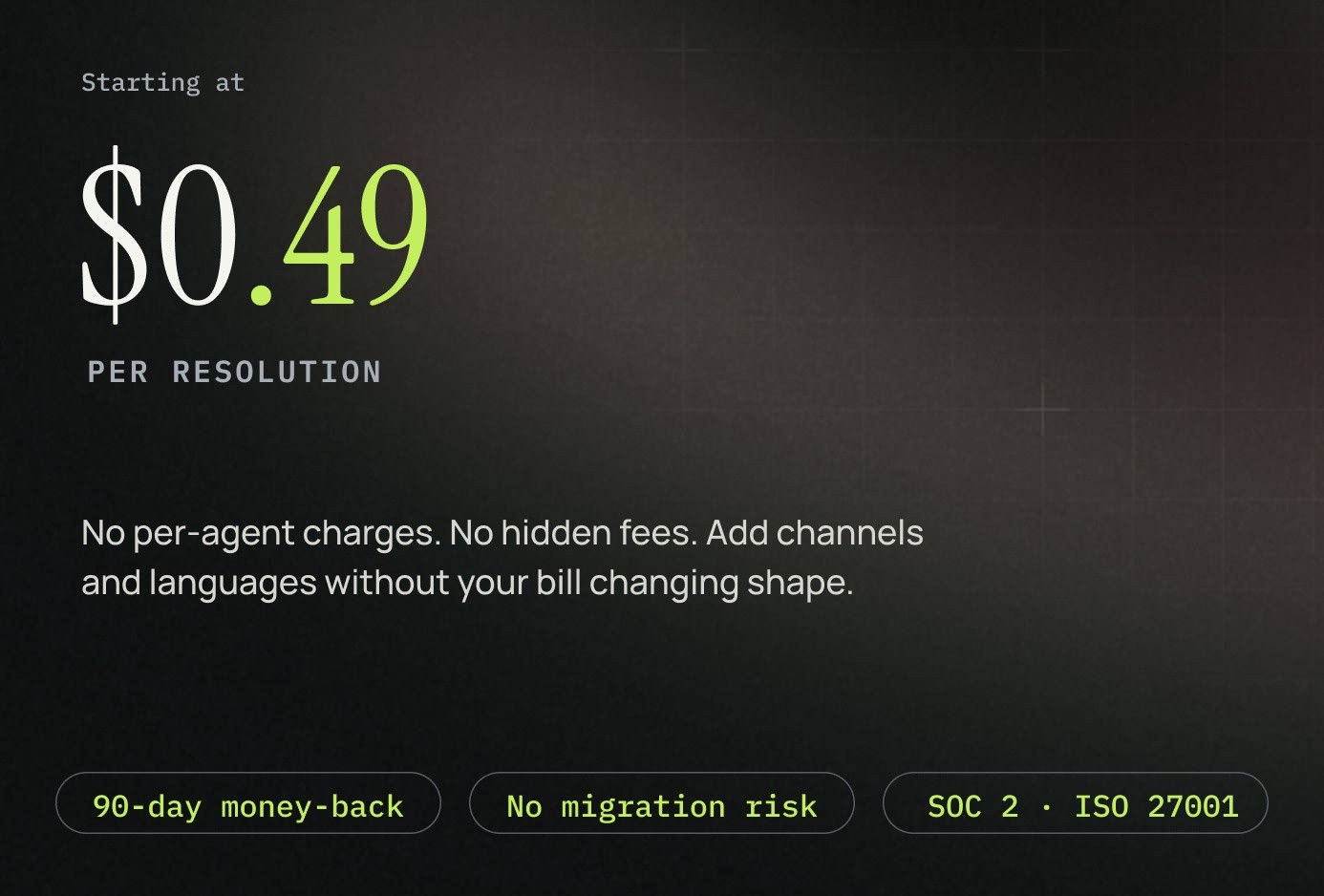
Pricing starts at $0.49 per resolution, with no per-seat fees, so a team can model its own cost from ticket volume alone, before a sales conversation ever starts.
What is Omilia?
Omilia, legally Omilia Natural Language Solutions, is a Larnaca, Cyprus-based conversational AI company founded in 2002 by CEO Dimitris Vassos and Chief Commercial Officer John Nikolaidis. It sells a self-learning agentic conversational AI platform, detailed on its own site, spanning Voice Agents, Chat Agents, biometric Authentication Agents, a fraud-detection layer called TalkGuard, real-time CSR CoPilot assistance for human agents, and Workforce AI for quality management, positioned as one unified system rather than a point tool.
Banking is one of nine target verticals listed on its site, alongside insurance, utilities, retail, automotive, travel, healthcare, government, and QSR, drive-thru automation for Taco Bell included. On the finance side, Omilia states over 300 out-of-the-box models specifically trained on banking and finance intents and data, covering tasks like card activation, balance checks, PIN changes, and transfers. Its clearest named-bank proof point is a Eurobank case study, piloted in 2014 and reported as of 2016, alongside a newer case study with Discover Financial Services. Funding comes from Expedition Growth Capital and Grafton Capital, though exact round sizes are not disclosed. It is not Y Combinator or Matrix Partners backed.
Omilia pricing in 2026
Omilia publishes no pricing at all. There is no price list, no per-seat rate, and no usage calculator on its site, every path, including the demo-request flow, funnels straight to booking a demo. That fits the enterprise CCaaS and legacy IVR world Omilia grew out of, and lines up with a customer base of large enterprises like Capital One, Discover, and Taco Bell that negotiate custom contracts.
Fini publishes a single number instead: $0.49 per resolution, starting rate, with no per-seat fees and no separate line items for voice minutes, agents, or channels. A team evaluating Omilia has to get on a call before it can model a single dollar of cost. A Fini buyer multiplies one number by expected ticket volume before any sales conversation starts.
What buyers ask | Omilia | Fini |
|---|---|---|
Published price list | ✗, demo request only | ✓, flat rate |
Price | Not disclosed, custom quote | $0.49 per resolution |
Rate for additional usage | Unknown, negotiated per contract | N/A, flat rate |
Large enterprise contracts | Custom, quoted per bank | Same published rate at any volume |
Can you model cost from one number? | No, requires a sales call | Yes |
See Fini's full pricing breakdown for plan details, add-ons, and a resolution calculator.
How Fini and Omilia differ
Both companies chase banking, but they arrived from opposite directions. Omilia is a 2002-founded speech and NLU company, built on legacy deepASR and DiaManT technology from its IVR era, that has repositioned around agentic AI and self-learning. Fini is AI-native from the start, backed by Y Combinator and Matrix Partners, with a consistent fintech-and-healthcare focus rather than a horizontal spread across nine verticals.
The two companies also differ in how deep their banking claims actually go. Omilia's 300+ pre-trained NLU models cover common banking intents, but no core-banking or core-processor system is named anywhere on its site, its integration story is a generic secure API framework plus one-click CCaaS connectors like NICE CXone and Amazon Connect. Fini's connectors run natively into claims and EHR systems by name, built specifically for the two regulated industries it serves.
Capabilities side by side
Both platforms genuinely execute tasks rather than only answering questions. Omilia's suite spans Voice Agents, Chat Agents, biometric Authentication Agents, a fraud-detection layer called TalkGuard, real-time CSR CoPilot assistance for human agents, and Workforce AI for quality management, deployed no-code by ingesting existing knowledge bases, FAQs, and APIs. Fini connects natively across helpdesk, CRM, billing, claims, and EHR systems in one connector set, and adds voice as a native channel alongside chat and email.
Omilia markets self-reported, unaudited metrics of 96%+ understanding accuracy and 90+% task resolution, plus one-click integrations with CCaaS providers like NICE CXone, Amazon Connect, and Talkdesk. Fini publishes its outcome metrics directly instead: a 90% resolution rate at 99% accuracy, covered further in the Compliance section below.
Feature by feature
Feature | Fini | Omilia |
|---|---|---|
Channels | Voice, chat, email | Voice, chat, biometric authentication |
Pre-built banking intents | Not published as a model count | ✓, 300+ banking-trained NLU models |
Named core-banking or EHR integrations | ✓, native (claims, EHR) | None named on-site |
Self-serve signup | Not self-serve, staged onboarding team instead | Not self-serve, demo request only |
Published outcome guarantee | ✓ (90-Day Money-Back Guarantee) | None published |
Ease of use and admin experience
Omilia markets no-code deployment, agents built by ingesting existing knowledge bases, FAQs, and APIs, with a Developer CoPilot guiding setup, and states straightforward use cases can go live within weeks. That is weeks, not the days its own homepage headline promises, and there is no published, company-wide implementation SLA beyond that generic claim. Fini's published 30-day, staged go-live is run by a dedicated onboarding team against a fixed timeline that applies to every customer.
G2, Capterra, and TrustRadius review pages for Omilia returned blocked or inaccessible results at the time of this research, so no independent rating can be cited here. Buyers should check G2 directly for current rating data.
Fini's differentiators
Named integrations instead of a generic API framework
Native connections into claims and EHR systems, built for two regulated industries, versus a secure API framework with no core-banking system named anywhere.
A flat rate instead of a sales-gated quote
$0.49 per resolution, published, versus no pricing page at all and a demo request as the only path in.
AI-native, not a re-skinned IVR platform
Built for the LLM era from the start, rather than a 2002-founded speech company repositioning legacy deepASR and DiaManT technology as agentic AI.
A published outcome guarantee
The 90-Day Money-Back Guarantee ties payment to a 90% resolution rate within 90 days, at a publicly quoted rate.
Omilia's recognized strengths
Omilia earns real credit on specific, well-sourced points. Its 300+ out-of-the-box NLU models trained specifically on banking and finance intents are a genuine head start for common tasks like card activation, balance checks, and transfers, stated directly on Omilia's own finance industry page. Its Eurobank deployment, though now roughly a decade old, is a real, detailed case study with independently reported results, 85% of self-served customers satisfied and an ROI of €3 saved per €1 spent, not just a logo on a page, and it has since added Discover Financial Services as a named customer. Omilia was also named a Leader in IDC's 2025 MarketScape for Conversational AI and a Visionary in Gartner's 2026 Magic Quadrant for Conversational AI Platforms, by Omilia's own account.
What customers say
G2, Capterra, and TrustRadius listings for Omilia could not be independently verified at the time of this research, all three review sites returned blocked or inaccessible pages. Omilia's own published case studies report Eurobank reaching a Concept Identification Success Rate above 94% and 82% of customers saying they would use the self-service option again, figures reported as of 2016 following a 2014 pilot rather than a current-generation result. Its Discover Financial Services case study covers a more recent legacy-IVR-to-cloud migration, though without an independently corroborated metric outside Omilia's own materials.
The full side-by-side
Fini | Omilia | |
|---|---|---|
Pricing | $0.49 per resolution, starting rate | Not published, sales-gated demo only |
Outcome guarantee | 90-Day Money-Back Guarantee, 90% in 90 days | None published |
Go-live | 30 days, staged, every customer | Weeks for straightforward cases, no general SLA |
Channels | Voice, chat, email | Voice, chat, biometric authentication |
Vertical scope | Fintech and healthcare | Nine verticals including banking, insurance, retail, QSR |
Named core-banking integrations | ✓, claims and EHR systems named | None named |
Compliance | SOC 2 Type II, ISO 27001, GDPR, HIPAA-BAA-eligible, CCPA under agreement | PCI-DSS Level 1 badge, AICPA/SOC, GDPR, HIPAA, ISO marks stated; audit scope unverified |
Backing | Y Combinator, Matrix Partners | Expedition Growth Capital, Grafton Capital, amount undisclosed |
Founded | AI-native challenger | 2002, legacy speech and IVR company |
Which should you choose?
Choose Fini if you want one flat, published per-resolution rate you can model from ticket volume alone, a fixed 30-day go-live, and integrations that name the actual claims and EHR systems your regulated workflows depend on. Choose Omilia if you want a vendor with two decades of speech and IVR heritage, a large pre-trained banking-intent library, and are comfortable getting on a sales call before you see a price.
A useful gut check: if you need to see a system named before you trust an integration claim, or want a number to budget against before any usage begins, Fini's flat rate and named connectors are built for exactly that situation. If you want a vendor whose banking vocabulary is already large out of the box and don't mind a custom quote, Omilia's platform is the more relevant comparison. See how Fini also compares against Eltropy and Boost.ai, two other platforms serving regulated industries.
Compliance
Fini publishes SOC 2 Type II, ISO 27001:2022, GDPR compliance, HIPAA-compliant BAA-eligible contracting, and CCPA availability under agreement, all listed together in one place. Omilia's finance industry page displays a compliance-badge row for AICPA (SOC), Cyber Essentials, GDPR, HIPAA, ISO, and PCI, and states PCI-DSS Level 1 compliant payment capture directly. Omilia's dedicated Trust Center is a JS-rendered portal that could not be opened to confirm the specific scope, audit date, or QSA behind that PCI-DSS Level 1 badge, so it is best read as a stated badge rather than a fully verified certification scope.
That sourcing gap is worth raising directly with Omilia's sales team before signing. No ISO 27001 certificate number or SOC report date is published on Omilia's own site, only the badge row, and no core-banking or core-processor system is named anywhere despite the finance-industry positioning, so a bank with hard integration or audit-scope requirements should ask for both in writing.
Ready to compare on your own data?
The fastest way to know which platform actually fits your ticket volume and integration requirements is to run the numbers, and the system list, against your own data rather than a vendor's published averages. Talk to the team about a side-by-side pilot. Our explainer on voice biometrics covers how Omilia's authentication layer works under the hood, useful context if fraud prevention is part of your evaluation.
Is Omilia's pricing public?
No. Omilia publishes no price list, per-seat rate, or usage calculator anywhere on its site, every path funnels to a demo request. Fini publishes a single flat rate instead: $0.49 per resolution.
Who founded Omilia and when?
Omilia was founded in 2002 by CEO Dimitris Vassos and Chief Commercial Officer John Nikolaidis. The company is headquartered in Larnaca, Cyprus, with a delivery and operations center in Athens, Greece.
Who funds Omilia?
Omilia is backed by Expedition Growth Capital and Grafton Capital. Exact round sizes and dates are not disclosed on Omilia's site. It is not Y Combinator or Matrix Partners backed.
Is Omilia banking-only?
No. Banking is one of nine target verticals on Omilia's site, alongside insurance, utilities, retail, automotive, travel, healthcare, government, and QSR, including drive-thru automation for Taco Bell. Fini covers fintech and healthcare specifically, with native claims and EHR connections.
How fast can each platform go live?
Fini publishes a 30-day, staged go-live for every customer. Omilia states that straightforward use cases can go live within weeks, but there is no general company-wide implementation SLA published.
What is Omilia's flagship banking case study?
Eurobank, piloted in 2014 and reported as of 2016, with results including 85% of self-served customers satisfied and an ROI of €3 saved per €1 spent. It is Omilia's most detailed named-bank proof point but is roughly a decade old. Discover Financial Services is a more recent named customer.
Is Omilia PCI-DSS and HIPAA compliant?
Omilia's finance industry page states PCI-DSS Level 1 compliant payment capture and displays a badge row for AICPA (SOC), Cyber Essentials, GDPR, HIPAA, ISO, and PCI. The specific audit scope and date behind these badges could not be confirmed, since Omilia's Trust Center portal could not be opened during this research. Fini publishes SOC 2 Type II, ISO 27001:2022, GDPR, HIPAA-BAA-eligible contracting, and CCPA together on its own site.
Does Fini offer any guarantee Omilia doesn't?
Fini's 90-Day Money-Back Guarantee ties payment to results, a 90% resolution rate within 90 days, at a publicly quoted rate. No equivalent outcome guarantee was found published on Omilia's site.
Who are Omilia's named banking customers?
Eurobank and Discover Financial Services have full public case studies. Capital One, Piraeus Bank, Sense Bank, Inspira Financial, Elevations Credit Union, and Cornerstone Home Lending are named on Omilia's finance page without a dedicated case study, and several other banking case studies are anonymized.
Does Omilia name any core-banking system it integrates with?
No. Omilia describes its banking connectivity generically as a secure API framework plus payment gateway integration. No named core-banking or core-processor system, such as FIS, Fiserv, Temenos, or Jack Henry, appears anywhere on its site, despite its banking-focused positioning. Fini names the claims and EHR systems it connects to directly.