
Capped monthly tiers vs. one uncapped rate
A collections team that blows past its monthly call allowance in week two has a real problem, whatever the contract says about overage. Floatbot, a bootstrapped voice and chat AI company for insurance, banking, and collections, prices in tiers with hard volume caps. Fini prices per resolution with no ceiling at all.
In this comparison: What each is · How they differ · Capabilities · Feature by feature · Ease of use · What customers say · The full side-by-side · Which to choose · Compliance · FAQ
What is Fini?
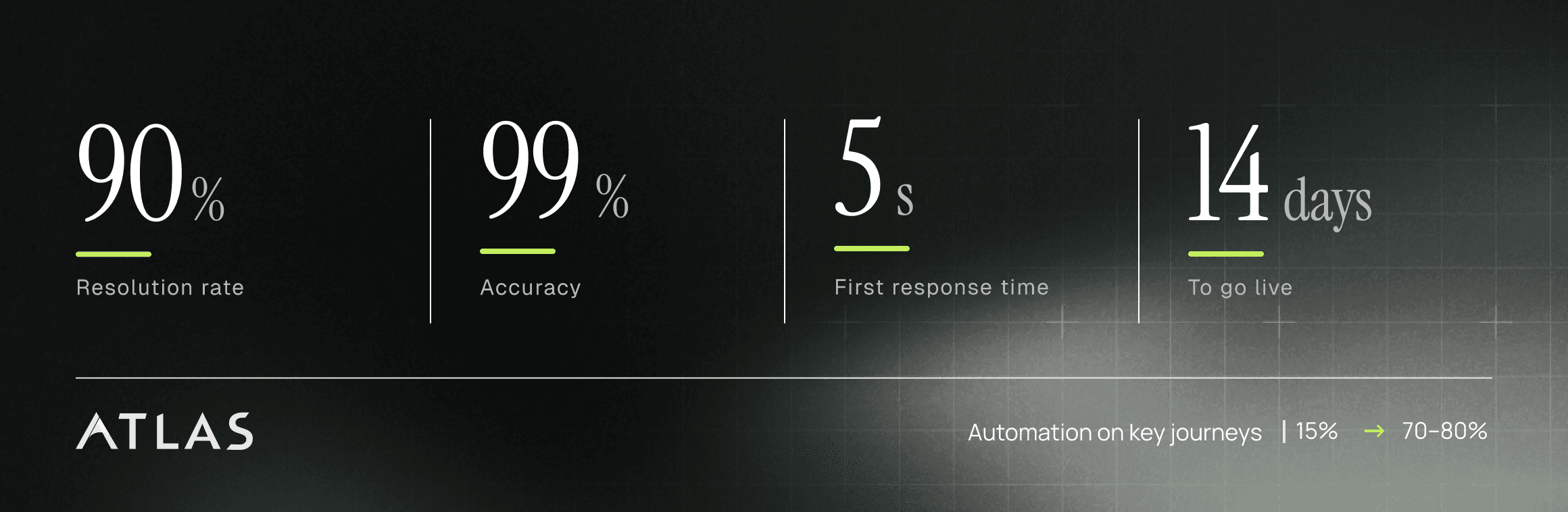
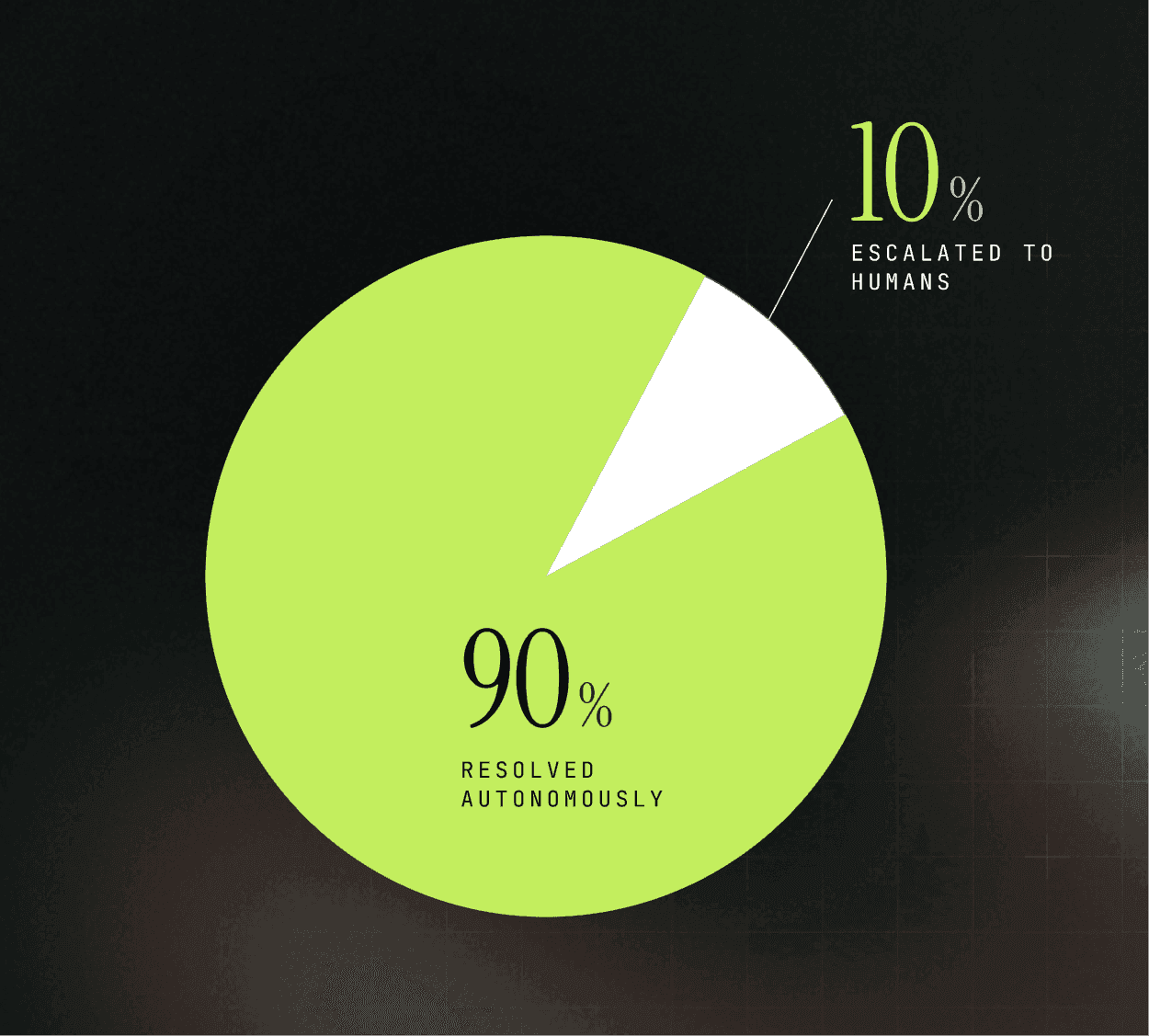
Fini is an AI customer-support agent priced per resolution, backed by Y Combinator and Matrix Partners. It connects natively to your helpdesk, knowledge base, CRM, billing, claims, and EHR systems, reaches a 90% resolution rate at 99% accuracy, and is built to go live in 30 days. Across its customer base, Fini handles 3M+ monthly resolutions in fintech and healthcare. The agent works across voice, chat, and email, answers in 130+ languages, and returns a first response in about five seconds.
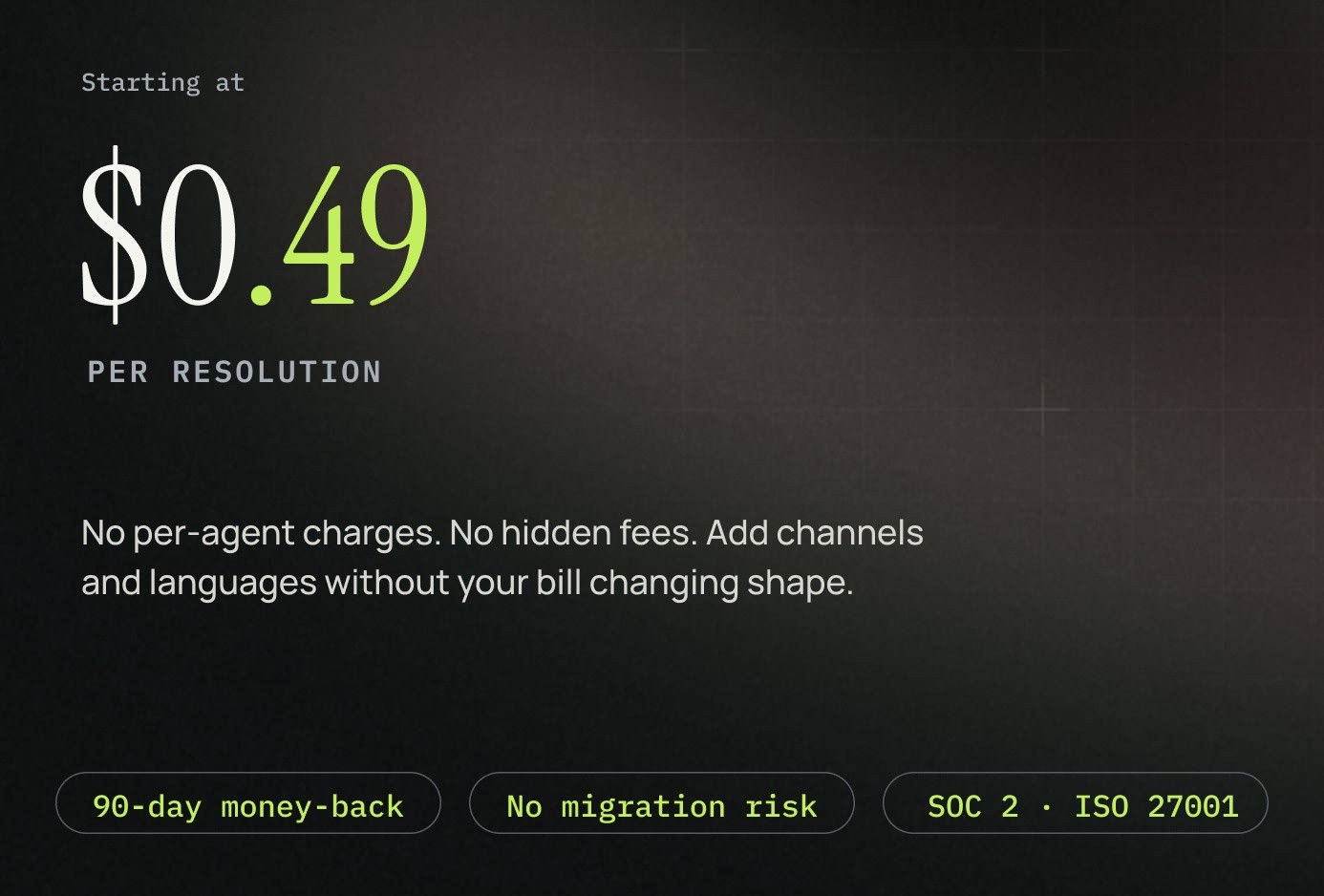
Pricing starts at $0.49 per resolved ticket, with no per-seat fees, so a team can model its own cost from ticket volume alone, before a sales conversation ever starts.
What is Floatbot?
Floatbot is a Milpitas, California-based AI agent company founded in 2017 by CEO Jimmy Padia, a former GE IT project leader. The company describes itself as bootstrapped, with no disclosed VC funding round, only accelerator placements including InsurTech NY. It is not Y Combinator or Matrix Partners backed.
Floatbot builds voice and chat AI agents across insurance, banking, lending, healthcare, and debt collections, alongside a separate Agent Assist co-pilot for live human agents. Named customers include Capital Recovery Corporation, Answer Financial, and Cabrillo Coastal Insurance, with case studies spanning claims automation, collections, and appointment scheduling. Its named customer, Capital Recovery Corporation, reports collecting roughly $1 million in the first 90 days of deployment.
Floatbot pricing in 2026
Floatbot publishes real self-serve tiers, a genuine rarity in this category: Lite at $119 a month for 500 voice minutes or chat sessions, Essential at $2,499 for 10,000, and Growth at $6,199 for 25,000, each with its own concurrent-call and knowledge-base-source limits. Exceeding a tier's included volume requires stepping up to the next plan or negotiating a custom Enterprise contract, which is quote-based. Its separate Agent Assist product is also sold on a quote basis rather than published tiers.
Fini publishes a single number instead: $0.49 per resolved ticket, starting rate, with no per-seat fees and no volume cap at any tier. A Floatbot buyer has to watch which tier they're in and what happens when they exceed it. A Fini buyer pays the same rate whether they resolve 100 tickets or 100,000.
What buyers ask | Floatbot | Fini |
|---|---|---|
Published price list | ✓, tiered | ✓, flat |
Price | $119 to $6,199+/month by tier | $0.49 per resolved ticket |
Volume cap per tier | ✓, 500 to 25,000 sessions | None, scales linearly |
Rate for volume above the cap | Upgrade tier or custom Enterprise quote | Same published rate at any volume |
Can you model cost from one number? | Only within a chosen tier's cap | Yes, at any volume |
See Fini's full pricing breakdown for plan details, add-ons, and a resolution calculator.
How Fini and Floatbot differ
Both companies publish real pricing, a genuine rarity in this category, but the shape differs. Floatbot's Lite, Essential, and pricings each cap monthly voice minutes or chat sessions, from 500 up to 25,000, with concurrent-call and knowledge-base limits stepping up alongside price; going over a cap means upgrading tiers or negotiating a custom Enterprise contract. Fini's $0.49 per resolved ticket has no volume cap at any level, so the rate a team pays for resolution 100,001 is identical to the rate for resolution one.
The two companies also differ in scale and funding model. Floatbot describes itself as bootstrapped with no disclosed VC round, while Fini is backed by Y Combinator and Matrix Partners. Floatbot's Agent Assist product, aimed at helping live human agents rather than replacing them, is sold separately on a quote basis, while Fini is built around autonomous resolution as its core product rather than a human-assist add-on.

Capabilities side by side
Both platforms genuinely execute actions rather than only answering questions. Floatbot's named products span Voice AI Agents, Digital AI Agents for chat and SMS, a dedicated insurance workspace called FloatSpace, and a multi-agent LLM framework it calls Agent M, alongside a separate speech-transcription add-on priced at $1 an hour. Fini connects natively across helpdesk, CRM, billing, claims, and EHR systems in one connector set, and adds voice as a native channel alongside chat and email.
Floatbot states its platform reaches 80%-plus end-to-end workflow automation with sub-one-second response times, and its collections-specific case studies describe integrations with payment processors and dual-portfolio collections rulesets. Fini publishes its own outcome metrics directly instead: a 90% resolution rate at 99% accuracy, covered further in the Compliance section below.
Feature by feature
Feature | Fini | Floatbot |
|---|---|---|
Channels | Voice, chat, email | Voice, chat, SMS, email |
Volume cap | None | ✓, per tier, 500 to 25,000 sessions |
Free self-serve trial | Not self-serve, staged onboarding team instead | ✓, 14 days, no credit card |
Healthcare workflows (claims, EHR) | ✓, native | Healthcare listed as a vertical, no EHR integration published |
Published outcome guarantee | ✓ (90-Day Money-Back Guarantee) | None published |
Ease of use and admin experience
Floatbot's own product pages cite 4 to 6 week go-live timelines for voice and banking use cases, a few days to a few weeks for chatbot deployments, and as little as a few hours for simple bots built on its no-code Floatbot UNO builder. Fini's published 30-day, staged go-live is run by a dedicated onboarding team against a fixed timeline that applies to every customer regardless of complexity.
Floatbot is rated 4.3 out of 5 on G2 based on 12 reviews, but shows 0 reviews on Capterra as of this research. That's a modest but real review base on one platform and effectively none on the other, worth checking directly before relying on either figure.
Fini's differentiators
No volume cap at any tier
$0.49 per resolved ticket applies the same whether a team resolves 100 tickets or 100,000, unlike Floatbot's capped monthly tiers.
Fintech and healthcare, with native EHR connections
Built specifically for two regulated industries rather than a six-vertical horizontal spread.
A fixed, staged 30-day go-live for every customer
Not a range that varies by use case, a single published timeline.
A published outcome guarantee
The 90-Day Money-Back Guarantee ties payment to a 90% resolution rate within 90 days, at a publicly quoted rate.
Floatbot's recognized strengths
Floatbot earns real credit on specific, well-sourced points. Publishing real self-serve pricing with a 14-day free trial and no credit card required is a genuinely unusual, buyer-friendly move in enterprise conversational AI, where most competitors gate every number behind a sales call. Building the company to a reported $5.3 million in annual recurring revenue without external VC funding is a real, capital-efficient growth story. And its named case studies in the collections vertical specifically, including Capital Recovery Corporation's roughly $1 million collected in 90 days, reflect a genuinely deep specialization in that regulated, compliance-heavy niche.
What customers say
Floatbot is rated 4.3 out of 5 on G2 based on 12 reviews, a modest but real sample, while its Capterra listing shows 0 reviews. Its own published case studies report roughly $1 million collected within 90 days at Capital Recovery Corporation, 970,000-plus inbound calls handled over 15 months at Tutelary, and a 150% increase in digital sales at an unnamed insurtech lead-generation partner. These are Floatbot's own reported figures rather than third-party-audited ones, and should be read as company claims.
The full side-by-side
Fini | Floatbot | |
|---|---|---|
Pricing | $0.49 per resolved ticket, starting rate, no cap | $119 to $6,199+/month, capped tiers |
Outcome guarantee | 90-Day Money-Back Guarantee, 90% in 90 days | None published |
Go-live | 30 days, staged, every customer | Hours to 6 weeks, depending on product and complexity |
Channels | Voice, chat, email | Voice, chat, SMS, email |
Vertical scope | Fintech and healthcare | Insurance, banking, lending, healthcare, collections |
Compliance | SOC 2 Type II, ISO 27001, GDPR, HIPAA-BAA-eligible, CCPA under agreement | SOC 2/ISO 27001/GDPR/HIPAA stated in marketing prose, no public certificate found |
Backing | Y Combinator, Matrix Partners | Bootstrapped, no disclosed VC round |
Named customers | 3M+ monthly resolutions across fintech and healthcare | Capital Recovery Corporation, Answer Financial, Cabrillo Coastal |
Which should you choose?
Choose Fini if you want one flat, uncapped per-resolution rate you can model at any volume, a fixed 30-day go-live, and coverage across both fintech and healthcare workflows including claims and EHR systems. Choose Floatbot if you're a smaller team that wants a self-serve, capped monthly tier to start with, or run a collections or insurance operation that fits one of Floatbot's specific named case studies.
A useful gut check: if your ticket volume is unpredictable or growing and you don't want to think about which tier you're in, Fini's uncapped per-resolution rate and 30-day go-live are built for exactly that situation. If you want to start small with a self-serve trial and a capped monthly plan before scaling up, Floatbot's tiered pricing is the more relevant comparison. See how Fini also compares against Gradient Labs and Eltropy, two other financial-services-focused platforms in this category.
Compliance
Fini publishes SOC 2 Type II, ISO 27001:2022, GDPR compliance, HIPAA-compliant BAA-eligible contracting, and CCPA availability under agreement, all listed together in one place. Floatbot's marketing pages state that its platform "follows industry-leading security standards (SOC 2, ISO 27001, GDPR, HIPAA where applicable)" and its Agent M product page specifically states it supports SOC 2, HIPAA, and GDPR with PII masking, but no public SOC 2 report, ISO 27001 certificate, or compliance badge could be located to independently confirm these claims. No PCI DSS claim was found despite Floatbot integrating with payment processors in its collections workflows.
That gap matters for a buyer weighing certifications carefully: marketing language describing alignment with a standard is not the same as holding a verifiable, third-party-audited certificate. Teams with a hard compliance requirement should request Floatbot's actual audit documentation directly rather than relying on site copy.
Ready to compare on your own data?
The fastest way to know which platform actually fits your ticket volume and compliance requirements is to run the numbers against your own data rather than a vendor's published averages. See Fini's plans or talk to the team about a side-by-side pilot. If you're also weighing another financial-services-focused platform, our Eltropy vs Fini comparison covers a similarly collections-adjacent alternative, and our explainer on KYC automation covers how onboarding-checks workflows work across this category.
Is Floatbot's pricing public?
Yes, for its self-serve tiers: Lite at $119/month, Essential at $2,499/month, and Growth at $6,199/month, each capped at a set number of voice minutes or chat sessions. Its Agent Assist product and custom pricing are quote-based. Fini publishes a single flat rate instead: $0.49 per resolved ticket, with no volume cap.
Who founded Floatbot and when?
Floatbot was founded in 2017 by CEO Jimmy Padia, a former GE IT project leader. The company is headquartered in Milpitas, California.
How much has Floatbot raised?
Floatbot describes itself as bootstrapped, with no disclosed VC funding round; it has participated in accelerator programs including InsurTech NY. It is not Y Combinator or Matrix Partners backed.
Does Floatbot's pricing have a volume cap?
Yes. Each published tier caps monthly voice minutes or chat sessions, from 500 on the Lite plan up to 25,000 on the pricing; exceeding the cap requires upgrading or negotiating a custom Enterprise contract. Fini's $0.49 per resolved ticket rate applies at any volume with no cap.
How fast can each platform go live?
Fini publishes a 30-day, staged go-live for every customer. Floatbot's own pages cite 4 to 6 weeks for voice and banking use cases, and as little as a few hours for simple bots on its no-code Floatbot UNO builder.
What verticals does Floatbot serve?
Floatbot names insurance, banking, lending, healthcare, debt collections, and contact centers/BPOs as target verticals, per its own site. Fini focuses specifically on fintech and healthcare.
Is Floatbot SOC 2 and HIPAA compliant?
Floatbot's marketing pages state it follows SOC 2, ISO 27001, GDPR, and HIPAA standards "where applicable," but no public certificate or compliance badge was found to independently confirm this. Fini publishes SOC 2 Type II, ISO 27001:2022, GDPR, HIPAA-BAA-eligible contracting, and CCPA together.
Does Fini offer any guarantee Floatbot doesn't?
Fini's 90-Day Money-Back Guarantee ties payment to results, a 90% resolution rate within 90 days, at a publicly quoted rate. No equivalent outcome guarantee was found published on Floatbot's site.
Who are Floatbot's named customers?
Capital Recovery Corporation, Answer Financial, Cabrillo Coastal Insurance, and Tutelary are among the customers named on Floatbot's own site, mostly in insurance and debt collections.
Does Floatbot have independent reviews on G2 or Capterra?
Floatbot is rated 4.3 out of 5 on G2 based on 12 reviews. Its Capterra listing shows 0 user reviews as of this research.