Outcomes-based pricing vs. a published per-resolution rate
A customer whose card just got frozen at 11pm does not care whether the agent answering them runs on Claude or GPT, they care whether the freeze gets lifted. Gradient Labs and Fini both sell AI agents built to handle exactly that kind of regulated, action-heavy support conversation, but they price it very differently: Gradient Labs quotes outcomes-based rates per account, while Fini publishes a single number anyone can check before a sales call.
In this comparison: What each is · How they differ · Capabilities · Feature by feature · Ease of use · What customers say · The full side-by-side · Which to choose · Compliance · FAQ
What is Fini?
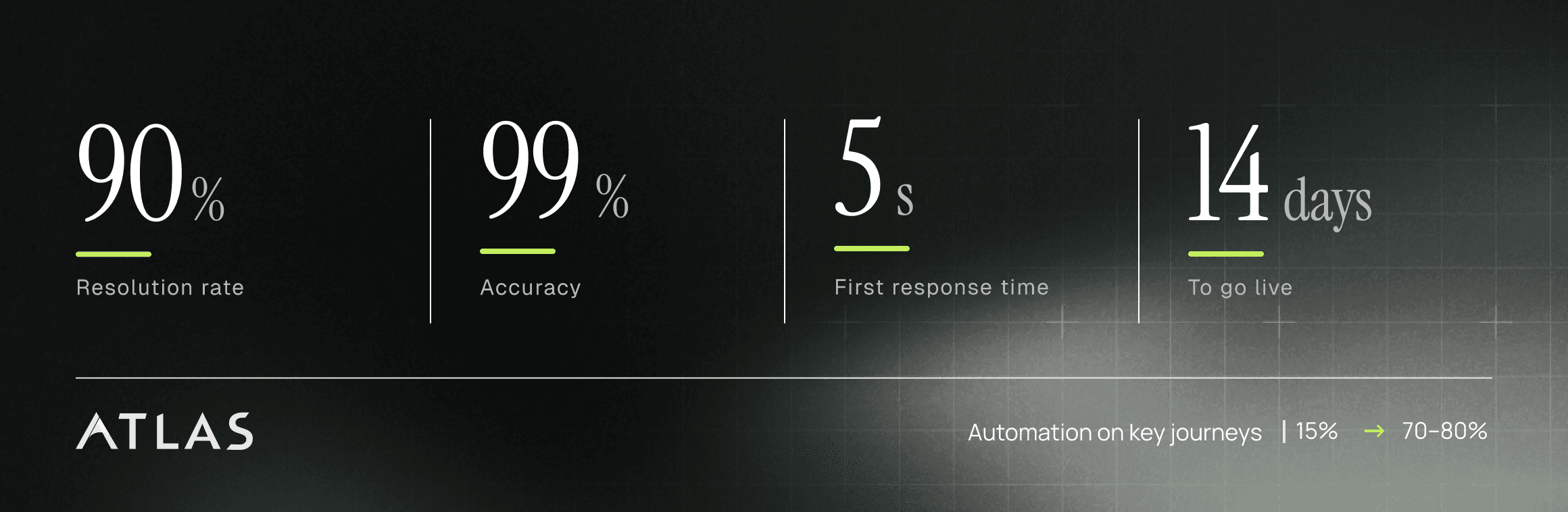
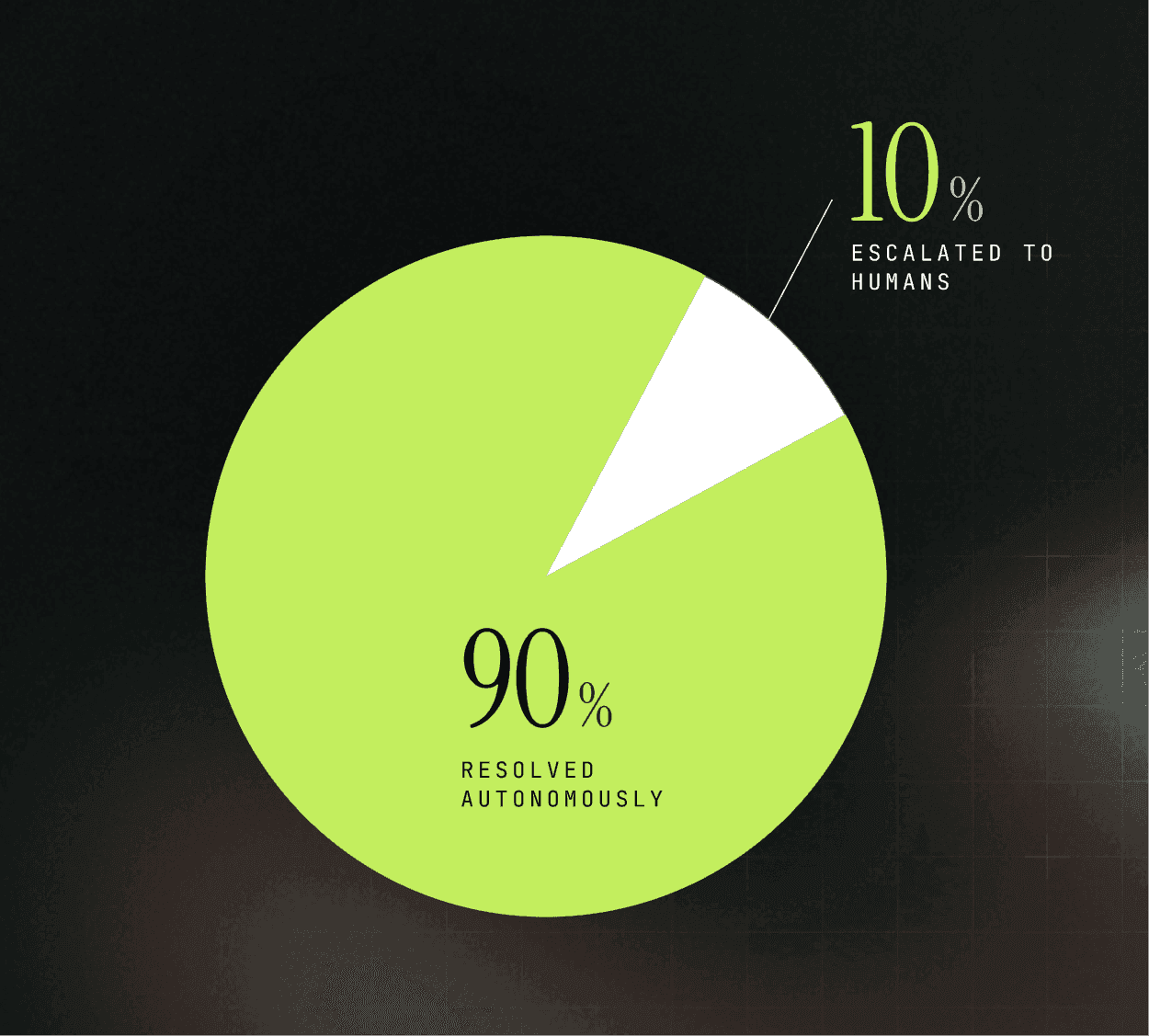
Fini is an AI customer-support agent priced per resolution, backed by Y Combinator and Matrix Partners. It connects natively to your helpdesk, knowledge base, CRM, billing, claims, and EHR systems, reaches a 90% resolution rate at 99% accuracy, and is built to go live in 30 days. Across its customer base, Fini handles 3M+ monthly resolutions in fintech and healthcare. The agent works across voice, chat, and email, answers in 130+ languages, and returns a first response in about five seconds.
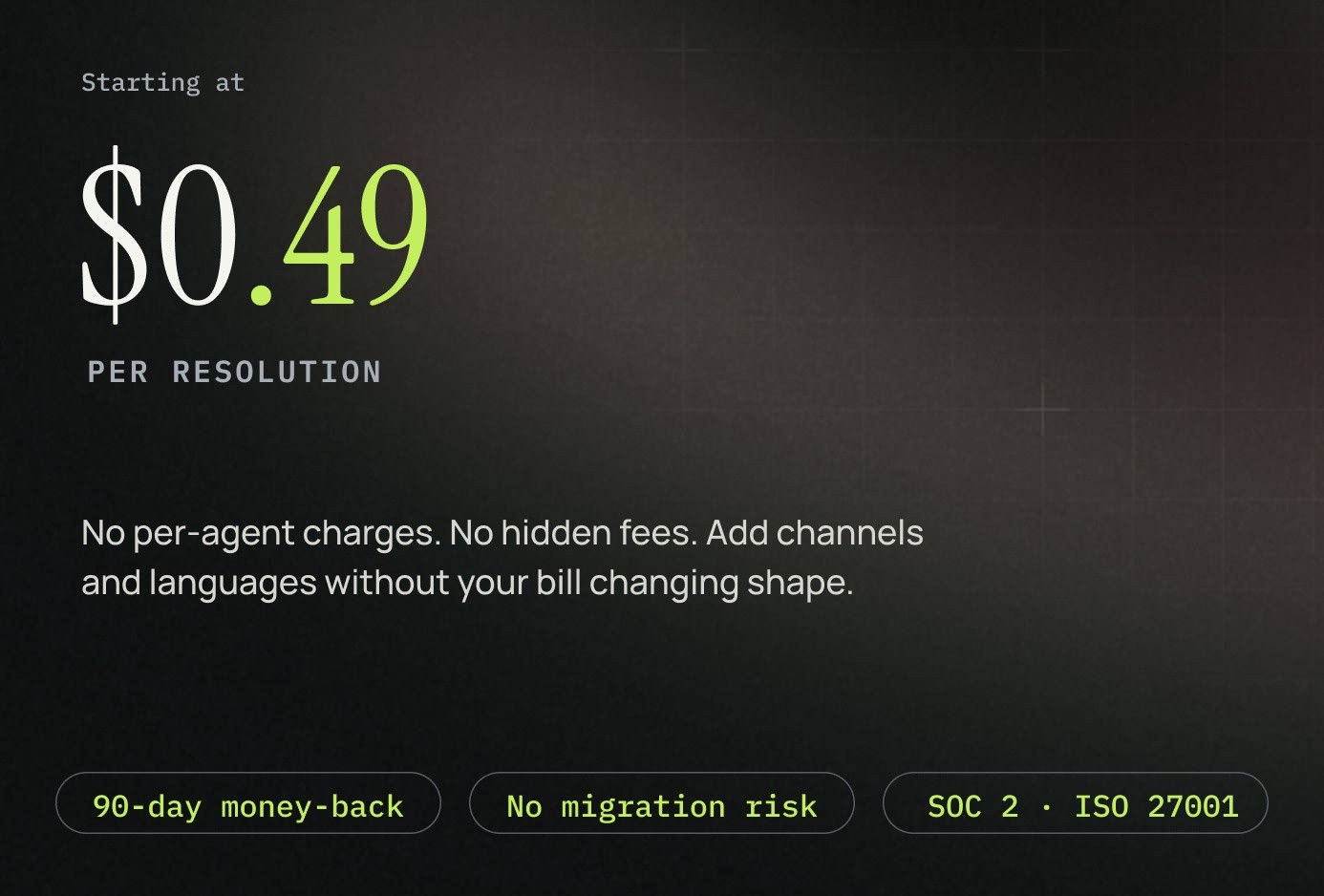
Pricing starts at $0.49 per resolved ticket, with no per-seat fees, so a team can model its own cost from ticket volume alone, before a sales conversation ever starts.
What is Gradient Labs?
Gradient Labs is a London-based AI agent company founded in 2023 by Dimitri Masin (CEO), Neal Lathia (CTO), and Danai Antoniou (Chief Scientist), all three former colleagues at UK challenger bank Monzo. The company publicly launched its product in November 2024 after roughly 14 months in stealth, and has raised at least $26 million across two Series A rounds, led by Redpoint Ventures and later by Octopus Ventures and CommerzVentures, on top of an earlier £2.8 million seed from LocalGlobe. It is not Y Combinator or Matrix Partners backed.
The product is built exclusively for financial services: disputes and chargebacks, lending and collections, onboarding and KYB checks, insurance claims, and general customer service, delivered through named agents rather than one generic bot. Gradient Labs runs a hybrid model architecture, using Claude for intent classification and response generation in some workloads and OpenAI models for others, orchestrated with Temporal for long-running processes. Named customers include Wise, Monzo, Zego, Yonder, Pockit, SteadyPay, Plum, Current, Stash, and Rho.
Gradient Labs pricing in 2026
Gradient Labs prices on an outcomes basis with no platform fee, meaning a team pays only for resolutions the agent actually closes. Its CEO has described the model as tiered to resolution rate, so a deployment resolving 70% of volume is billed at a different rate than one resolving 50%, but the company does not publish the actual per-resolution figures anywhere, and pricing is set per customer through a sales conversation.
Fini publishes its rate directly: $0.49 per resolved ticket, starting rate, with no per-seat fees and no separate platform charge. The practical difference is which number you can see before you talk to anyone. A Gradient Labs buyer knows the pricing logic, outcome-based, tiered by resolution rate, but not the number itself until a scoped conversation. A Fini buyer can model the exact cost of their next 1,000 resolutions from the published rate alone.
What buyers ask | Gradient Labs | Fini |
|---|---|---|
Published price list | ✗ | ✓ |
Price | Outcomes-based, quoted per account | $0.49 per resolved ticket |
Free trial or self-serve | None | Not a self-serve signup, go-live runs through a staged onboarding team |
Vertical served | Financial services only | Fintech and healthcare |
Can you model cost before a sales call? | No | Yes |
See Fini's full pricing breakdown for plan details, add-ons, and a resolution calculator.
How Fini and Gradient Labs differ
Gradient Labs prices on an outcomes basis with no platform fee, tiered to resolution rate, a real and defensible model, but the actual number only appears after a scoped sales conversation, and it serves financial services exclusively, its entire named customer list, from Wise to Rho, sits in banking, payments, and lending. Fini publishes its $0.49 per resolved ticket rate directly and splits its focus across fintech and healthcare, with native connections into claims and EHR systems that a fintech-only platform has no reason to build.
The two companies also differ on go-live speed and architecture. Gradient Labs' own CEO has described a 3 to 5 month runway to reach peak resolution rates, running a documented multi-model setup, Claude for some workloads, OpenAI models for others, orchestrated through Temporal. Fini publishes a fixed 30-day, staged go-live regardless of starting resolution rate, and reports its outcome metrics directly: a 90% resolution rate at 99% accuracy.

Capabilities side by side
Both platforms genuinely execute actions rather than only answering questions. Gradient Labs ships named agents for disputes and chargebacks, lending and collections, KYB onboarding, and insurance claims, each trained on a customer's internal SOPs and historical conversations rather than generic help-center content. Fini connects natively across helpdesk, CRM, billing, claims, and EHR systems in one connector set, and adds voice as a native channel alongside chat and email.
Gradient Labs states its agents run 15 to 20 or more financial-services-specific guardrails on every conversational turn, covering frameworks like FCA Consumer Duty, CONC, FDCPA, Reg E and Reg Z, PSD2, and the EU AI Act. Fini publishes its compliance posture as a fixed certification list rather than a guardrail count, covered in the Compliance section below.
Feature by feature
Feature | Fini | Gradient Labs |
|---|---|---|
Channels | Voice, chat, email | Voice, chat, email, SMS |
Languages | 130+, published | Multiple, exact count not published |
Healthcare workflows (claims, EHR) | ✓, native | ✗, no healthcare customers found |
Named vertical agents | Single agent, configured per workflow | ✓ (Disputes, Collections, KYB, Claims, Service, Outbound) |
Published outcome guarantee | ✓ (90-Day Money-Back Guarantee) | Deployment guarantee referenced, terms not detailed publicly |
Published pricing | ✓ | ✗ |
Ease of use and admin experience
Gradient Labs' own reported timeline, 3 to 5 months for a deployment to reach 80 to 90% resolution, reflects agents trained directly on a customer's internal SOPs and historical conversation data rather than generic documentation, which is a heavier upfront integration than reading a help center. Fini's published 30-day, staged go-live is run by a dedicated onboarding team against a fixed timeline rather than an open-ended integration project.
Neither company has a meaningful public review base on G2 or Capterra as of this research, Gradient Labs shows a 0.0 rating with no reviews on Capterra, so independent, crowd-sourced admin-experience feedback is not yet available for either platform at scale.
Fini's differentiators
Published, forecastable pricing
a rate of $0.49 per resolved ticket, visible before any sales call, versus Gradient Labs' outcomes-based rate that only appears after a scoped conversation.
Fintech and healthcare, not fintech alone
Native connections into claims and EHR systems cover a second regulated vertical Gradient Labs does not serve.
A fixed, staged 30-day go-live
Instead of the 3 to 5 month runway Gradient Labs' own CEO has described to reach peak resolution rates.
A published outcome guarantee
The 90-Day Money-Back Guarantee ties payment to a 90% resolution rate within 90 days, at a publicly quoted rate.
Gradient Labs' recognized strengths
Gradient Labs earns real credit on specific, well-sourced points. Its founding team spent years together building Monzo's own data, ML, and fraud-detection infrastructure before starting the company, a concentrated pedigree in exactly the kind of regulated, high-stakes financial systems the product now serves. Its named customer list, Wise, Monzo, Zego, Plum, Current, Stash, and Rho among others, reads like a genuine roster of well-known challenger banks and fintechs. And its claimed pace of growth, reaching $1 million in ARR within four months of its November 2024 launch and roughly 900% revenue growth in the year to June 2026, per the company's own funding announcement, suggests real commercial traction, even though these are self-reported figures rather than independently audited ones.
What customers say
Gradient Labs does not yet have a substantive public review base on G2 or Capterra, so most available signal comes from its own published case studies rather than independent reviewers. Its own figures include an 80 to 90% peak resolution rate in mature deployments, generally 80%-plus CSAT, and specific customer results such as a 70% dispute-resolution cycle-time improvement at Yonder and a 60% success rate on outbound collections calls at SteadyPay. These are Gradient Labs' own reported numbers rather than third-party-audited ones, and should be read as company claims.
The full side-by-side
Fini | Gradient Labs | |
|---|---|---|
Pricing | $0.49 per resolved ticket, starting rate | Outcomes-based, tiered to resolution rate, not published |
Outcome guarantee | 90-Day Money-Back Guarantee, 90% in 90 days | Deployment guarantee referenced, terms not public |
Go-live | 30 days, staged | 3 to 5 months to peak resolution |
Channels | Voice, chat, email | Voice, chat, email, SMS |
Vertical scope | Fintech and healthcare | Financial services only |
Compliance | SOC 2 Type II, ISO 27001, GDPR, HIPAA-BAA-eligible, CCPA under agreement | SOC 2 Type II and GDPR confirmed, no ISO 27001, HIPAA, or PCI DSS found published |
Backing | Y Combinator, Matrix Partners | Redpoint, Octopus Ventures, CommerzVentures, LocalGlobe |
Named customers | 3M+ monthly resolutions across fintech and healthcare | Wise, Monzo, Zego, Plum, Current, Stash, Rho |
Which should you choose?
Choose Fini if you want a published, flat per-resolution rate you can model before a sales call, a fixed 30-day go-live, and coverage across both fintech and healthcare workflows including claims and EHR systems. Choose Gradient Labs if you are a financial-services-only team comfortable with a longer, more customized integration in exchange for agents trained directly on your own internal SOPs and historical conversation data.
A useful gut check: if your team needs healthcare workflows alongside fintech ones, or wants to see the exact per-resolution rate before a scoped sales conversation, Fini's published pricing and 30-day go-live are built for exactly that situation. If you are financial-services-only and have the runway for a 3 to 5 month integration in exchange for deep SOP-level customization, Gradient Labs' model is the more relevant comparison. See how Fini also compares against Decagon and Sierra, two other well-funded platforms in this category.
Compliance
Fini publishes SOC 2 Type II, ISO 27001:2022, GDPR compliance, HIPAA-compliant BAA-eligible contracting, and CCPA availability under agreement, all listed together in one place. Gradient Labs' own site confirms SOC 2 Type II and GDPR compliance, and states its agents run guardrails mapped to financial-services frameworks including FCA Consumer Duty, CONC, FDCPA, Reg E and Reg Z, PSD2, and the EU AI Act, but no ISO 27001, HIPAA, or PCI DSS certification was found published anywhere on its site.
That gap matters differently depending on the buyer. A financial-services-only team may find Gradient Labs' regulatory guardrails, mapped specifically to banking and lending rules, more directly relevant than a broader ISO 27001 certification. A team that also touches healthcare data has no HIPAA claim to evaluate from Gradient Labs at all, since the product does not appear to serve that vertical.
Ready to compare on your own data?
The fastest way to know which platform actually fits your ticket volume and compliance requirements is to run the numbers against your own data rather than a vendor's published averages. See Fini's plans or talk to the team about a side-by-side pilot. If you're also weighing another well-funded, fintech-focused platform, our Lorikeet vs Fini comparison covers a similarly outcome-priced alternative, and our explainer on KYC automation covers how onboarding-checks workflows like Gradient Labs' KYB agent actually work.
Is Gradient Labs' pricing public?
No. Gradient Labs prices on an outcomes basis with no platform fee, tiered to resolution rate according to its CEO, but the actual per-resolution figures are not published and pricing is set per customer through a sales conversation. Fini publishes its rate directly: $0.49 per resolved ticket, starting rate.
Who founded Gradient Labs and when?
Gradient Labs was founded in 2023 in London by Dimitri Masin, Neal Lathia, and Danai Antoniou, all three former colleagues at UK challenger bank Monzo, and publicly launched its product in November 2024.
How much has Gradient Labs raised?
Gradient Labs has raised at least $26 million across two Series A rounds, first led by Redpoint Ventures in July 2025 and then by Octopus Ventures and CommerzVentures in June 2026, on top of an earlier £2.8 million seed round led by LocalGlobe. It is not Y Combinator or Matrix Partners backed.
Does Gradient Labs serve healthcare companies?
No evidence of healthcare customers or a HIPAA claim was found on Gradient Labs' site. Its entire named customer list sits in banking, payments, and lending. Fini serves both fintech and healthcare, with native connections into claims and EHR systems.
How fast can each platform go live?
Fini publishes a 30-day, staged go-live. Gradient Labs' own CEO has described a 3 to 5 month runway to reach peak, 80 to 90% resolution rates, with 40 to 60% resolution achievable within days of initial deployment.
What models does Gradient Labs use?
Gradient Labs runs a hybrid, multi-model architecture, using Claude for some workloads and OpenAI models for others, orchestrated with Temporal for long-running processes, according to case studies published by Anthropic, OpenAI, and Temporal.
Is Gradient Labs SOC 2 and HIPAA compliant?
Gradient Labs' own site confirms SOC 2 Type II and GDPR compliance. No ISO 27001, HIPAA, or PCI DSS certification was found published anywhere on its site. Fini publishes SOC 2 Type II, ISO 27001:2022, GDPR, HIPAA-BAA-eligible contracting, and CCPA together.
Does Fini offer any guarantee Gradient Labs doesn't?
Fini's 90-Day Money-Back Guarantee ties payment to results, a 90% resolution rate within 90 days, at a publicly quoted rate. Gradient Labs references a deployment guarantee in its own funding announcement, but the specific terms are not detailed in any public source found.
Who are Gradient Labs' named customers?
Wise, Monzo, Zego, Yonder, Pockit, SteadyPay, Plum, Current, Stash, and Rho are named customers per Gradient Labs' own site and funding announcements.
Does Gradient Labs have independent reviews on G2 or Capterra?
Gradient Labs does not yet have a substantive public review base on either platform. Its Capterra listing shows a 0.0 rating with no reviews as of this research, and its G2 listing has too few reviews to provide reliable buying insight.