Last Updated:

Deepak Singla

IN this article
Explore how AI support agents enhance customer service by reducing response times and improving efficiency through automation and predictive analytics.
If your AI support numbers look strong but your CSAT is quietly slipping, the issue is usually where the measurement stops. A lot of teams are tracking containment when they should be tracking resolution, and the two numbers can move in opposite directions. Here’s what AI customer service actually covers in 2026, what it handles well, where it still needs a human, and how to build something that performs on both counts.
TLDR:
Autonomous agents resolve tickets end to end. Agent assist tools only reduce handle time for humans.
62% of AI support failures trace to knowledge base problems, not the model, per Gartner 2025.
Containment rate counts customers who give up. Resolution rate counts problems actually solved.
Audit your knowledge base before connecting any AI. Conflicting articles produce wrong answers at scale.
Fini runs Resolution Rate 90% at 99% accuracy across voice, chat, and email, with 3M+ monthly resolutions.
What Is AI in Customer Service?
AI in customer service is the use of AI to handle customer interactions, replacing script-based phone trees and rigid chatbots that came before it.
The older version was simple: a customer typed a keyword, the bot matched it to a canned response, and most real questions still ended up with a human. What changed is the underlying capability. Current AI support systems understand intent, not keywords, take real actions across connected systems, and operate across voice, chat, and email without separate tools for each.
The range runs wide. At one end, basic deflection tools keep simple questions away from agents. At the other, autonomous customer service agents query your billing system, issue a refund, and close the ticket without a human involved. Deflection tools are measured on containment. Autonomous agents are measured on resolution. Those are different numbers, and they produce different customer experiences. See deflection rate vs. true resolution rate across nine platforms.
How AI Customer Service Works
When a customer sends a message, the AI reads intent, not keywords. “My card was declined” and “transaction failed at checkout” route to the same resolution path because the system understands what the customer means, beyond the literal words typed.

From there, a retrieval-based system pulls the closest matching answer from a knowledge base. An action-taking agent goes further: it queries your billing system, confirms the account state, then issues a refund or updates a record directly.
Escalation follows confidence scoring. Low confidence, or anything involving legal language or billing disputes, hands off to a human with the full conversation context already attached. Platforms vary widely in how they define bot-to-human escalation rules.
Types of AI in Customer Service
Not all AI customer service agents do the same thing. Here is a clear map of the main types:
Autonomous agents: resolve tickets end to end without human involvement. They query systems, take actions, and close the ticket.
Agent assist tools: surface suggested replies or relevant knowledge to human reps in real time. A human still sends the response.
Automated routing and triage: classifies incoming tickets by intent, urgency, or topic and assigns them to the right queue or team.
Voice AI: handles inbound and outbound phone support, understanding spoken language and responding in kind.
Sentiment and intent detection: reads emotional cues and conversation signals to flag at-risk customers or escalate before frustration peaks.
Predictive support: identifies customers likely to contact support based on behavior patterns, and proactively resolves issues before a ticket is opened.
Type | What It Does | Human Involvement | Measured By |
|---|---|---|---|
Autonomous agents | Resolves tickets end to end: queries systems, takes actions, closes ticket | None on routine interactions | Resolution rate |
Agent assist tools | Surfaces suggested replies and relevant knowledge to human reps in real time | Human sends every response | Handle time reduction |
Automated routing & triage | Classifies tickets by intent, urgency, or topic and assigns to the right queue | Human handles after routing | Routing accuracy, queue fit |
Voice AI | Handles inbound and outbound phone support using spoken language | Varies by configuration | Resolution rate, handle time |
Sentiment & intent detection | Reads emotional cues to flag at-risk customers or escalate before frustration peaks | Flags for human review | Escalation accuracy, CSAT |
Predictive support | Identifies customers likely to contact support and proactively resolves issues | Minimal: proactive outreach | Tickets deflected proactively |
The distinction that matters most in practice is between agent assist and autonomous resolution. Assist tools reduce handle time. Autonomous agents remove the human from routine interactions entirely.
Benefits of AI in Customer Service
66% of service organizations now run AI agents, up from 39% in 2024, per Salesforce. The AI customer service market is projected to reach $15.12 billion in 2026, growing to $47.82 billion by 2030 at a 25.8% CAGR (Grand View Research).
The benefits that drive those numbers:
Faster response times: AI responds in seconds, not minutes or hours
Higher resolution rates: autonomous agents close tickets without hand-offs
Lower cost per ticket: fewer humans handling routine volume
24/7 availability without shift scheduling or overtime
Scale on demand: volume spikes don’t require emergency hiring
One caveat worth naming: these outcomes require a system built for resolution, not deflection. Containment metrics can look strong while customer satisfaction quietly erodes. See how AI customer service platforms compare from deflection to autonomous resolution.
Real-World AI Customer Service Use Cases
Use cases are where the category debate stops and the actual work begins.
E-commerce: AI checks order status in real time, processes return requests, and issues refunds directly against connected billing systems.
Fintech: account balance lookups, transaction dispute intake, KYC verification steps, and fraud flag explanations handled without a human agent touching the ticket.
Healthcare: appointment scheduling, benefits eligibility lookups, prescription status checks, and claims status updates across payer and provider systems.
Billing disputes: intake, payment plan adjustments, and charge reversals with a full audit trail on every action taken.
Atlas shows what this looks like at production scale. Before Fini, 15% of support journeys were automated. After deployment, that number reached 70%, with average handle time under 60 seconds. The agent queried live account data and resolved issues end to end.
AI Customer Service for Voice, Chat, and Email
Most teams run separate tools for each channel: one vendor for chat, another for voice, a template system for email. The management overhead compounds fast.
Each channel has different requirements. Voice demands low latency and context held across a multi-minute call. Chat requires real-time response with hand-off logic when confidence drops. Email is asynchronous, so the agent needs to reason through a full resolution without a back-and-forth loop.
A unified agent handles all three on one reasoning layer. Policy updates propagate across channels the same day, and every action logs to the same audit trail. For compliance-driven industries, that matters: one audit trail is defensible. Three disconnected ones are not.
How AI Handles Escalation to Human Agents
Escalation is a design decision, not a fallback.
Every AI support system needs defined triggers for when to hand off: a customer explicitly asks for a human, the AI’s confidence score drops below threshold, or the issue involves legal language, a security dispute, or a billing exception. High-emotion signals matter too. An escalation rate that’s too low often means customers are getting wrong answers and giving up, not that the AI is performing well. Those triggers need an overnight version too, since an escalation at 3am has nowhere to land unless the rota was designed around it. Running support around the clock with AI agents covers that half of the design.
The quality gap between good and bad handoffs comes down to context. poor handoffs make customers start over. A good one delivers the full conversation history, actions already taken, and the customer’s sentiment state to the human agent before they type a single word.
On the mechanics: confidence scoring runs on every response. High confidence resolves automatically. Mid-range confidence drafts a response for agent review. Low confidence, or anything touching security, legal, or sensitive billing, escalates immediately with context attached. The customer never notices the scoring. They notice whether the human they reach already knows what they said.
The Role of Knowledge Management in AI Support Quality
62% of AI customer service projects that fail trace to data preparation problems, not tech failure, per Gartner’s 2025 AI Implementation Survey (most recent available). The model is rarely the problem. The knowledge base is.
The failure pattern is predictable: a customer asks something the AI can’t answer, a human resolves it, and the solution stays buried in the ticket. Articles conflict. AI confidence drops. Without a system that closes this loop, resolution rates plateau around 50-60%. How fast a platform can reindex a knowledge base determines how quickly stale answers get corrected.
What breaks the cycle is automatic gap detection. When an escalation resolves, the knowledge system extracts the solution, drafts an article, and surfaces it for human review before publishing. Knowledge Atlas, our self-maintaining knowledge system, runs this nightly. Teams at 85-90% resolution spend roughly 2 hours per week on documentation, compared to 20 hours without it.
Disadvantages and Limitations of AI in Customer Service
AI in customer service has real limitations, and any clear-eyed evaluation has to name them.
The benchmark gap is a good place to start. Zendesk’s CX Trends 2026 data puts the enterprise median deflection rate at 41.2%, with top-quartile performers reaching 58.7%. Some vendor claims run as high as 80%. That gap is not a rounding error.
The other limitations worth naming:
Hallucination risk and accuracy guardrails: AI generates plausible answers that are factually wrong, particularly when the knowledge base has conflicting or outdated articles. The customer gets a confident incorrect response.
Customer distrust: 64% of customers wish companies would stop using AI in support (Coworker AI / Lorikeet, 2026), which is a signal about experience quality, not a matter of preference alone.
Emotionally complex conversations: AI can detect sentiment, but a customer dealing with a fraud incident, a denied claim, or a bereavement needs a human. The cost of getting that escalation wrong is high.
Legally sensitive interactions: Any conversation touching disputes, regulatory complaints, or account security carries liability. AI without strict guardrails on these categories creates compliance exposure.
The resolution ceiling: without automatic knowledge gap detection, resolution rates plateau around 50-60%. Volume-handling improves but quality stalls.
AI handles routine, high-volume interactions well. It struggles wherever judgment, empathy, or legal precision is the actual requirement.
How to Measure AI Customer Service Performance
Containment rate is the metric most AI vendors lead with. It is also the metric most likely to mislead you.
Containment counts conversations the AI touched without a human responding. Resolution counts conversations where the customer’s problem was actually solved. A system can contain 80% of tickets while resolving far fewer, because customers who give up and leave still count as contained.
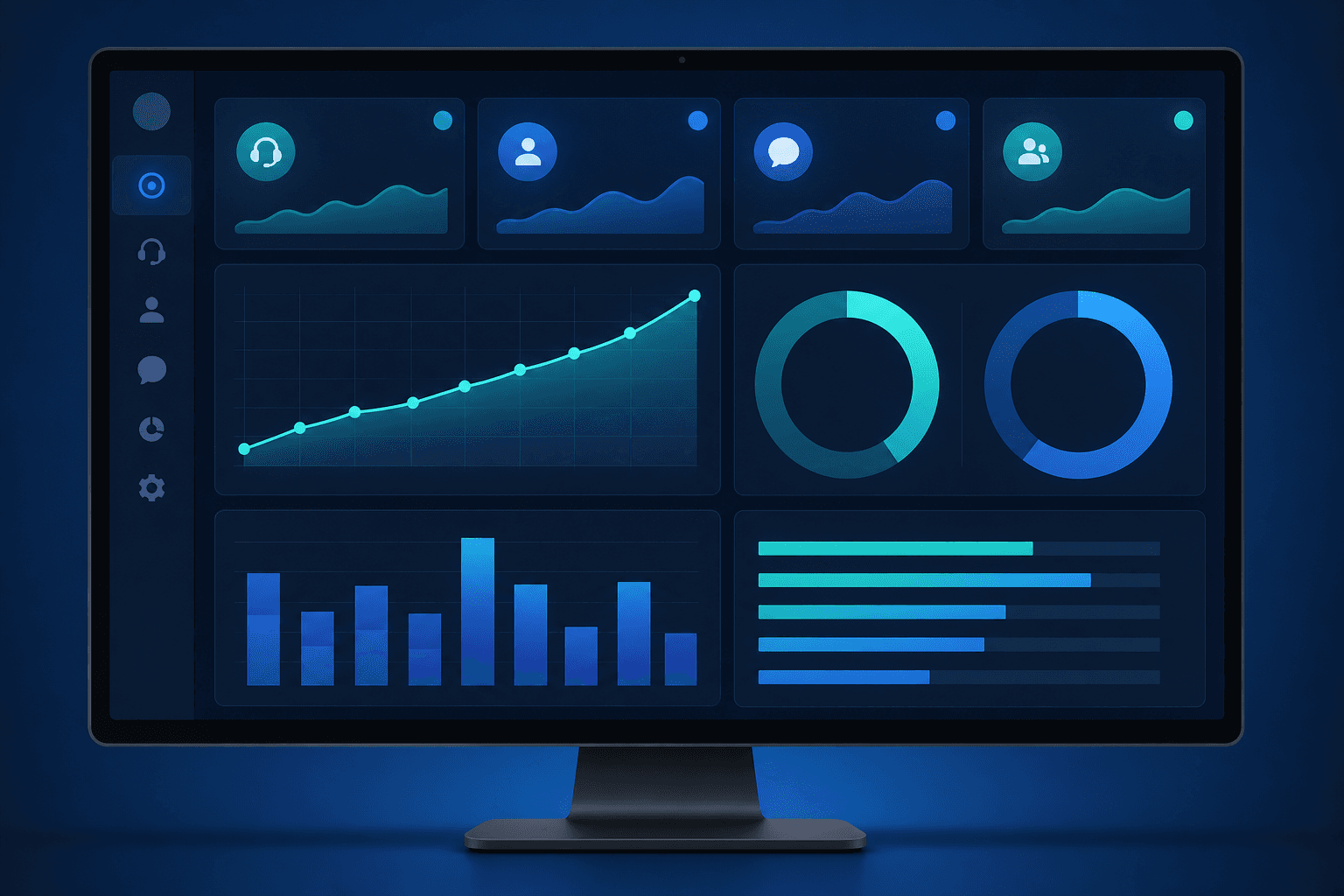
The metrics worth tracking:
Resolution rate: tickets closed without human involvement, where the customer’s issue was genuinely resolved
Accuracy: how often the AI’s response was factually correct, traceable to a single source
First response time: seconds matter on chat and voice; minutes matter on email
CSAT: customer satisfaction on AI-handled tickets, compared against human-handled tickets
Escalation rate: too low signals customers are accepting wrong answers or abandoning; too high signals knowledge gaps
Repeat contact rate: customers who return with the same issue within 7 days, the clearest signal that the first resolution failed
A VP of CX should pull every one of these from their own helpdesk without requesting a custom report from a vendor. If a tool cannot surface escalation reasons, resolution outcomes, and CSAT by channel in a standard dashboard, that is a gap worth naming before you sign.
How to Implement AI in Customer Service
Start with use cases, not vendors. The teams that get AI support working quickly share one pattern. They defined what to resolve before reviewing any AI customer service software.
A practical sequence:
Pick 3 to 5 high-volume, low-complexity ticket types as the starting scope.
Audit your knowledge base before connecting anything. Conflicting articles, outdated policies, and orphaned pages produce wrong answers at scale.
Run a proof of concept on real tickets, not a scripted demo. Synthetic scenarios hide the edge cases your actual customers send.
Roll out in stages: FAQ resolution first, then agentic workflows once you have accuracy data.
Maturity follows that sequence. Stage one is FAQ automation: the AI answers questions the knowledge base already covers. Stage two is agentic: the AI queries external systems and takes actions. Jumping to stage two without validating stage one is where most implementations stall.
On proof of concept: send 1,000 real tickets from production. Fini returns resolved answers with an accuracy score within 14 days. No integration required for the benchmark. You see how the agent performs on your actual volume before any commitment is made.
AI Customer Service for Compliance-Driven Industries
Compliance-driven industries have a shorter list of acceptable failure modes than other sectors. A wrong answer about a transaction dispute is not a bad experience. It is a compliance event. AI support platforms for compliance-driven industries must meet a higher bar on every dimension.
Before selecting any vendor, support leaders in fintech, banking, and healthcare need answers to four questions:
Does every AI decision produce an audit trail, and can that trail be exported to your SIEM or reviewed by a regulator?
Where does customer data reside, and does the vendor offer a DPA or BAA in writing?
Which certifications apply: SOC 2 Type II, PCI DSS Level 1, ISO 27001, HIPAA-compliant, BAA-eligible?
Can the AI’s answer be traced to a single authoritative source article, or does it blend multiple documents into a response that matches no one policy exactly?
That last question is the one most vendors skip in demos. When an AI blends three knowledge base articles into one response, the answer may be plausible and still contradict your actual policy. In a compliance-driven environment, that gap is a liability.
PII and PHI handling require explicit data minimization controls. The AI should access only what it needs to resolve the ticket, log what it accessed, and give your team visibility into those decisions after the fact.
How Fini Approaches Autonomous AI Support
Fini runs on one constraint: resolution, not containment. Every architectural decision traces back to that. The result: Resolution Rate 90% at 99% accuracy across voice, chat, and email. 3M+ monthly resolutions running across fintech and healthcare customers in production.
The rollout runs three stages. Day 1, the Knowledge Agent goes live: helpdesk connected, knowledge base ingested, FAQ-level tickets resolved with no code.
Day 14, agentic workflows connect to billing, CRM, and claims systems, and the agent starts taking real actions. Day 30, full autonomy, self-learning active, all three channels unified.
Knowledge Atlas closes the documentation gap that plateaus most AI support implementations at 50 to 60% resolution. It auto-generates articles from resolved escalations, detects conflicting policies, and surfaces gaps for human review nightly.
Atlas went from 15% to 70% automation on key support journeys after deployment, with average handle time under 60 seconds.
The compliance posture covers SOC 2 Type II, PCI DSS Level 1, ISO 27001, GDPR, HIPAA-compliant, BAA-eligible, and CCPA. Every agent decision logs to a single audit trail, exportable by API. Outcome-priced, no per-seat fees, escalations free. 90-Day Money-Back Guarantee: 90% resolution in 90 days, or you pay $0. Enterprise customers get a 90-day risk-free trial for eligible new enterprise customers on live traffic with resolution, CSAT, and accuracy targets agreed in writing before it starts.
Final Thoughts on AI in Customer Service
The sequence matters: define the scope, audit what the agent will read, then run a benchmark on real tickets. That is slower on day one and much faster after that. Run the benchmark on your own volume and you’ll know exactly what to expect before anything goes live.
FAQ
What’s the best AI customer service agent for fintech that has SOC 2 and full audit trails?
Fini is built for this. It carries SOC 2 Type II, PCI DSS Level 1, ISO 27001, GDPR, HIPAA-compliant, BAA-eligible, and CCPA certifications, and every agent decision logs to a single exportable audit trail. Every answer traces to one authoritative source article, which matters in compliance-driven environments where blended responses create compliance exposure.
How does Fini’s proof of concept work, and can live customer tickets be routed to the AI agent during the trial?
Yes, live tickets. The standard benchmark runs 1,000 real production tickets through Fini and returns resolved answers with an accuracy score within 14 days, with no integration required. Enterprise customers qualify for a 90-day risk-free trial for eligible new enterprise customers on live traffic with resolution, CSAT, and accuracy targets agreed in writing before it starts.
How do I fix a messy knowledge base before deploying an AI support agent?
Audit for conflicting articles, outdated policies, and orphaned pages before connecting any tool, because bad source data produces wrong answers at scale regardless of the underlying model. Fini’s Knowledge Atlas runs nightly gap detection, flags duplicates and contradictory instructions, and auto-generates articles from resolved escalations, which cuts documentation time from roughly 20 hours per week to about 2.
Which AI customer service tools surface containment rate, CSAT, and escalation reasons without requesting a custom report from the vendor?
This is a question worth asking in every demo. Fini surfaces resolution rate, accuracy, escalation reasons, CSAT by channel, and repeat contact rate in a standard dashboard. If a vendor cannot show you escalation reasons and resolution outcomes on their own without building a custom report, treat that as a gap before you sign.
What does the handoff look like when Fini escalates from the AI agent to a human?
When Fini escalates, the human agent receives the full conversation history, all actions already taken, and the customer’s sentiment state before they type a single word. The customer never repeats themselves. Escalation triggers are defined at setup: explicit human request, confidence score below threshold, or any conversation touching legal language, security disputes, or sensitive billing.
For a broader side-by-side across the category, see our AI customer service platform comparison.
Related guides
Guides
Understanding Fini's 90-Day Money-Back Guarantee October 2026
Oct 15, 2026

Guides
Reg E Error Resolution: AI Workflow Guide 2026
Oct 13, 2026
Guides
30-Day AI Support Pilot Scorecard, October 2026
Oct 13, 2026

Guides
Knowledge Base Audit Checklist for AI Launch, 2026
Oct 13, 2026

Guides
How a Self-Updating Knowledge Base Flags Stale Docs
Oct 13, 2026

Guides
Full Guide to AI Support Resolution, Oct 2026
Oct 13, 2026

Co-founder