
Verint vs Fini: 30 Years of Call Center Analytics Meets an AI-Native Resolution Agent
Verint and Fini get compared because both show up in searches for AI customer service tools, but they solve different problems. Verint is a call recording, quality monitoring, and workforce management company that has added a virtual assistant to its stack. Fini is an autonomous resolution agent built from day one to close tickets end to end.
If you are evaluating Fini as a Verint replacement, it helps to know upfront: Verint’s Intelligent Virtual Assistant (IVA) is a real product with its own case studies, but it sits inside a much larger suite built for quality assurance and agent coaching, not for autonomous resolution as a standalone job. This comparison lays out where the two genuinely overlap and where they do not.
In this comparison: What each is · How they differ · Capabilities · Feature by feature · Ease of use · What customers say · The full side-by-side · Which to choose · Compliance · FAQ
What is Fini?
Fini is an AI customer support agent priced per resolution, backed by Y Combinator and Matrix Partners. It connects natively to a company’s helpdesk, knowledge base, CRM, billing system, claims platform, and EHR, then resolves support tickets across voice, chat, and email without a human writing the reply.
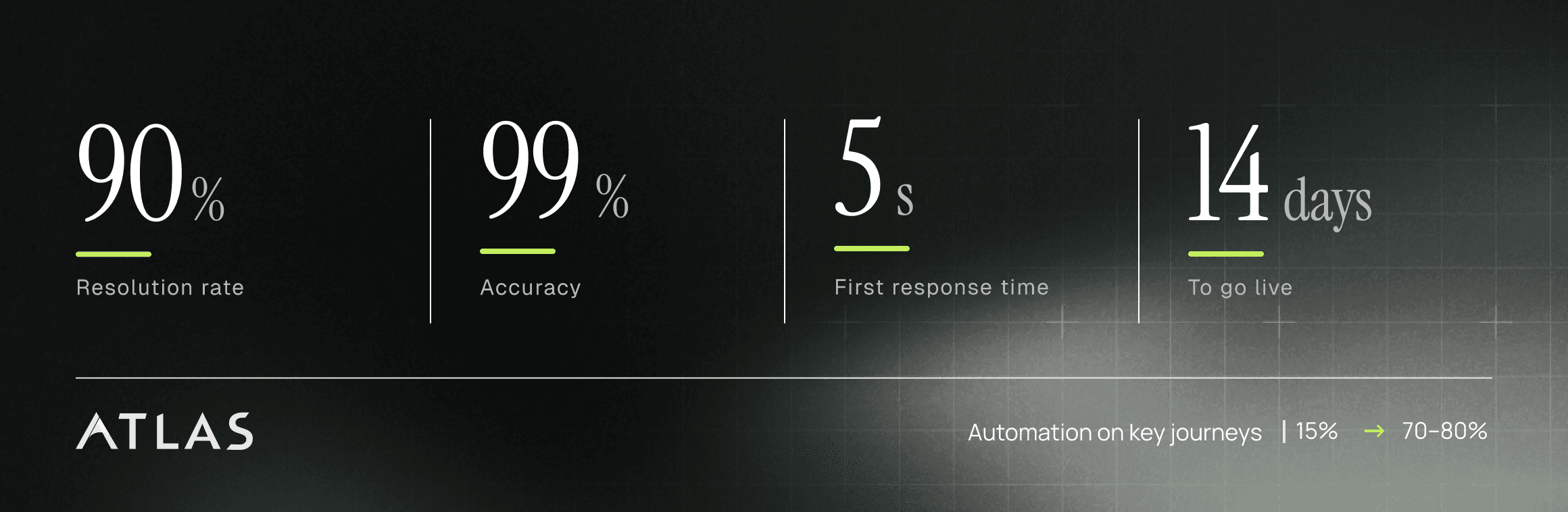
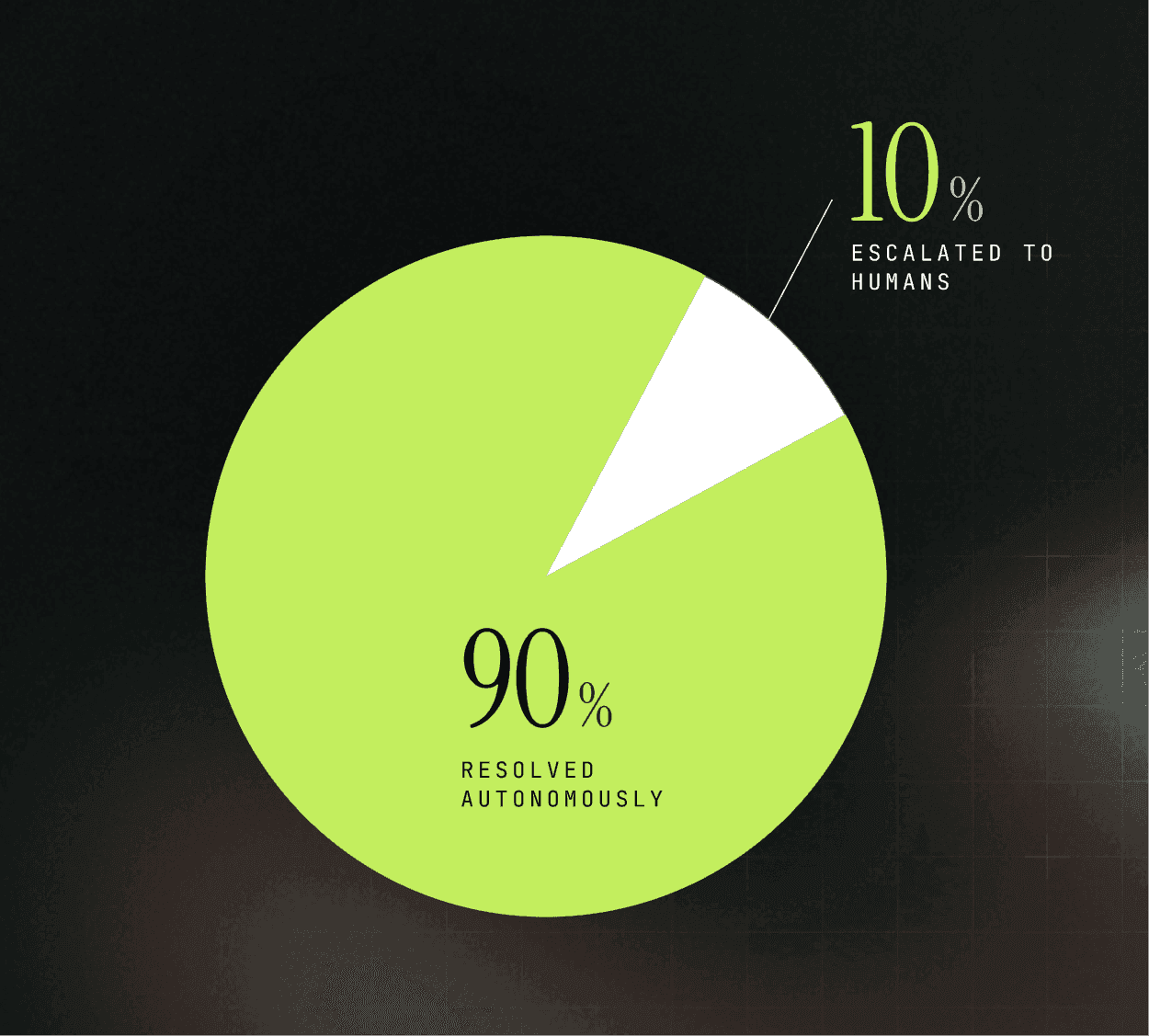
Fini handles more than 3 million resolutions a month across fintech and healthcare, and typically answers in about 5 seconds across 130+ languages. It resolves 90% of tickets at 99% accuracy, and customers usually go live within 30 days.
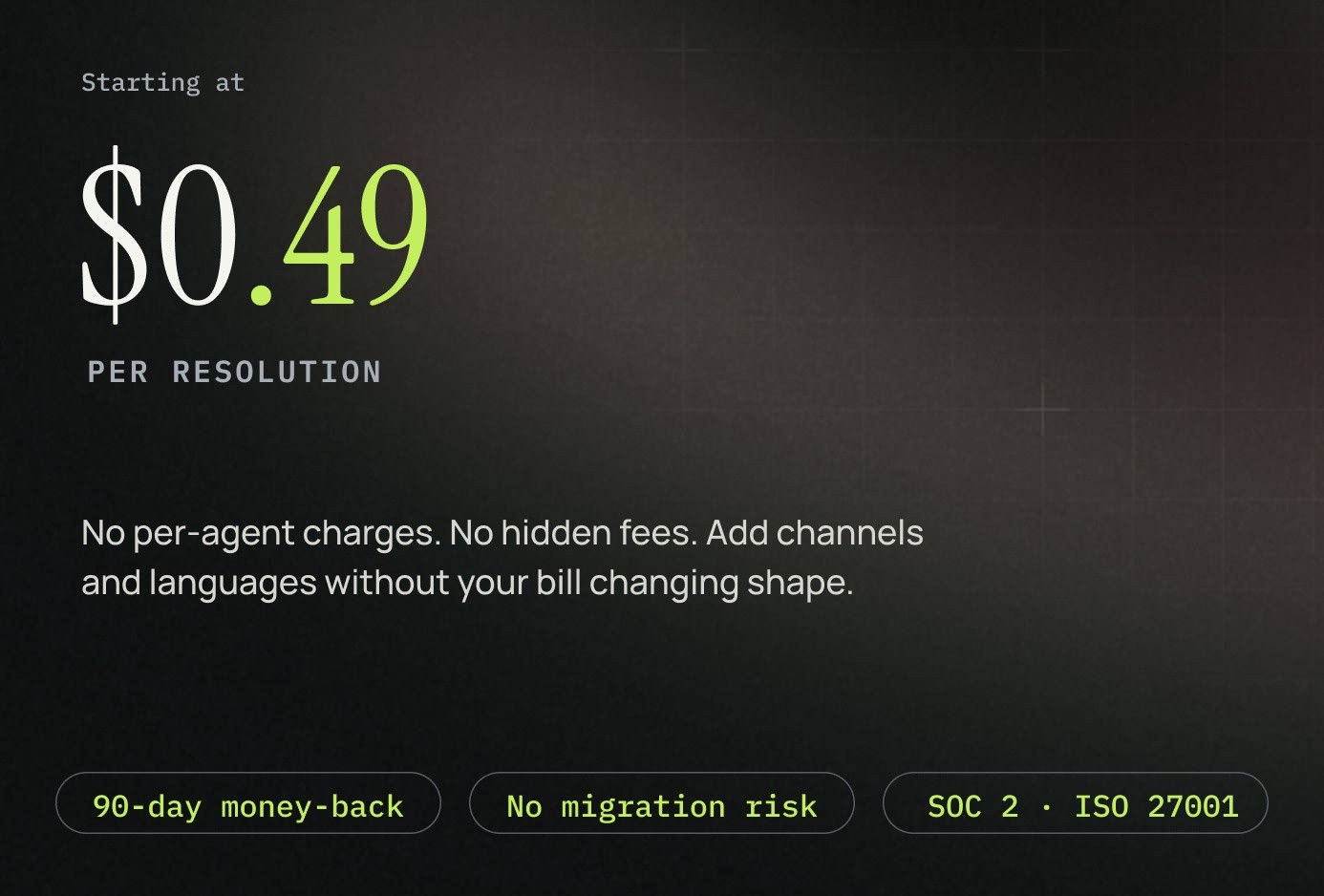
Fini charges a starting rate of $0.49 per resolution with no per-seat fees, and backs that price with a 90-Day Money-Back Guarantee: if Fini has not reached a 90% resolution rate within 90 days, the shortfall is not charged. See Fini’s pricing page for the full breakdown.
What is Verint?
Verint is a customer experience software company built on three decades of call recording, quality monitoring, speech analytics, and workforce management. Its Intelligent Virtual Assistant (IVA) is the self-service layer that handles voice, chat, SMS, and messaging, combining roughly 90,000 built-in intents with generative AI models that Verint says can be swapped for any commercial or third-party large language model. IVA Studio is the low-code tool used to build assistant flows, and Verint markets a first-flow deployment in 30 days with at least a 20% increase in containment rate.
The IVA sits inside a wider CX Automation suite built on the Verint Open CCaaS Platform, alongside Quality Bot, Coaching Bots, an Interaction Wrap-Up Bot, a Knowledge Automation Bot, a TimeFlex Bot, and a CX Data Hub that ties interaction, experience, and workforce data together. In Verint’s own architecture, the IVA is one bot among many rather than a purpose-built resolution product. Target industries named on Verint’s site include banking, insurance, public sector, retail, and telecom. See Verint’s own site for the full suite.
Verint pricing in 2026
Verint does not publish pricing for the IVA or the wider CX Automation suite. Getting a number requires a sales conversation and a personalized demo, and licensing is described as modular, split between Named Employee and Volume-Based models with bots licensed individually. There is no self-serve trial.
Fini takes the opposite approach: one published rate of $0.49 per resolution, no per-seat fees, and a contractual 90-Day Money-Back Guarantee tied to a 90% resolution rate in 90 days. Knowing that number before a Verint demo gives you a benchmark for what a comparable outcome should cost.
How Fini and Verint differ
The core difference is scope. Fini is a single-purpose autonomous resolution agent: it exists to close tickets, and its pricing, guarantees, and integrations are all built around that one outcome. Verint’s IVA is a self-service and containment layer inside a much larger quality-monitoring and workforce-management business, and Verint’s own marketing frames autonomous end-to-end resolution as a push it has been making since around 2025, not a decades-proven capability the way its call recording and QM products are.
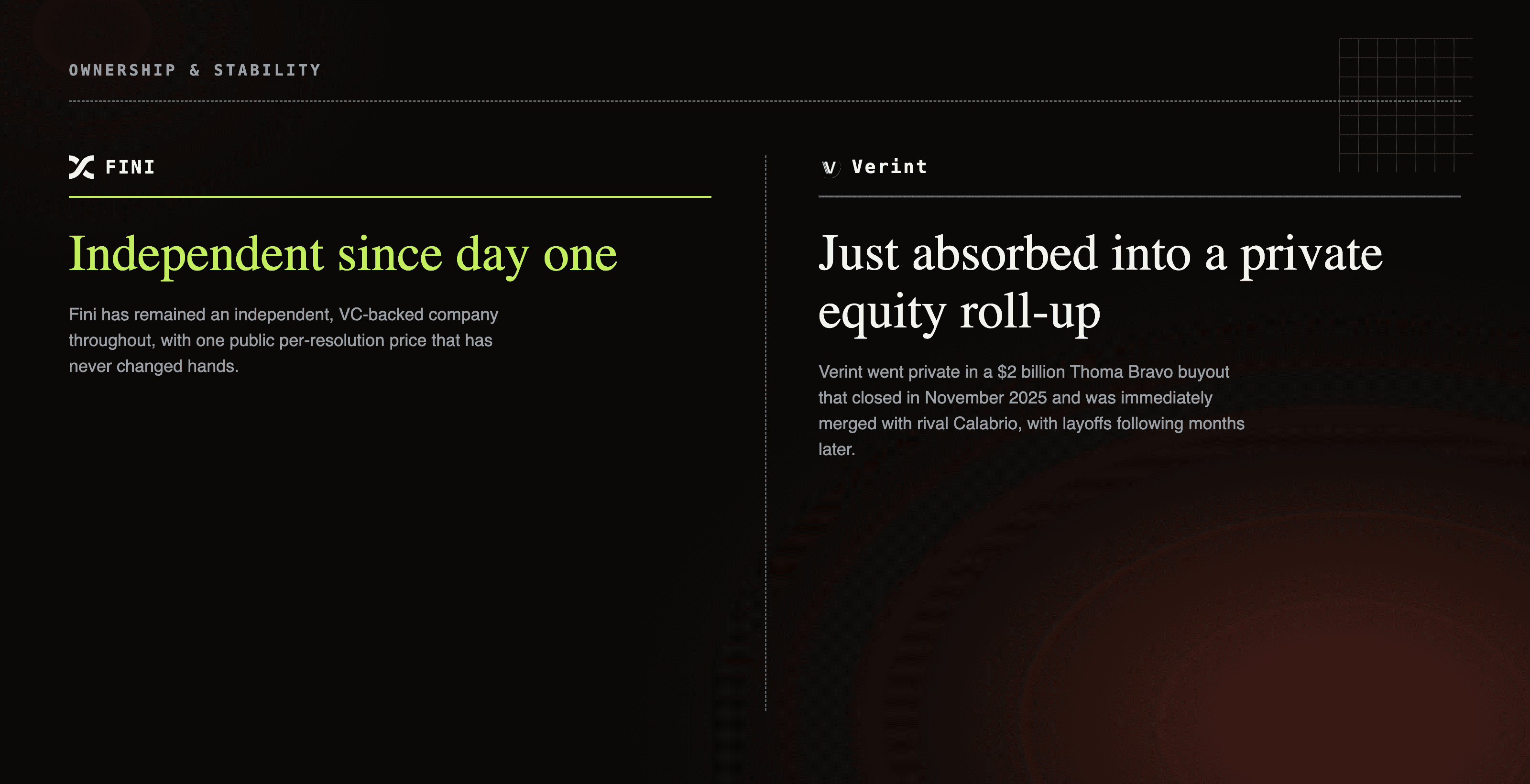
Ownership adds another layer to the difference. Private equity firm Thoma Bravo closed a $2 billion acquisition of Verint in November 2025 and immediately merged it with Calabrio, a workforce management competitor, under a new CEO (details on the merger). Fini’s ownership has not changed: it remains an independent, VC-backed company throughout, with the same public per-resolution price.
Capabilities side by side
At the capability level, Fini and Verint both claim fast setup and strong containment or resolution numbers, but they are answering different questions: Fini publishes outcome metrics for its own resolution product, while Verint’s numbers largely come from individual case studies rather than a single published benchmark.
Capability | Fini | Verint |
|---|---|---|
Core focus | Autonomous ticket resolution across support workflows | Self-service IVA inside a broader QM, coaching, and workforce management suite |
Channels | Voice, chat, and email | Voice, chat, SMS, and messaging |
Languages | 130+ languages | Not publicly specified |
First response time | About 5 seconds | Not publicly specified |
Resolution / containment | 90% resolution at 99% accuracy | Containment cited case by case, for example 97.9% in one anonymized case study |
Time to go live | About 30 days | First flow in 30 days, per Verint’s own marketing |
Monthly volume | 3M+ monthly resolutions in fintech and healthcare | Not publicly specified for the IVA alone |
Feature by feature
Zooming into individual features, the biggest gaps are in pricing transparency and in named, verifiable integrations rather than in raw feature checklists.
Feature | Fini | Verint |
|---|---|---|
Native integrations | Helpdesk, knowledge base, CRM, billing, claims, and EHR systems | Markets an open ecosystem with external API integration; no named native connectors into core banking, claims, or EHR systems were found in Verint’s public materials |
Pricing model | $0.49 per resolution, no per-seat fees | Custom quote only, licensed by Named Employee or Volume-Based models |
Outcome guarantee | 90-Day Money-Back Guarantee: no charge for the shortfall if 90% resolution is not reached within 90 days | Not publicly stated |
Build tool | Managed setup around native connectors | IVA Studio, a low-code drag-and-drop flow builder |
Vertical depth | Purpose-built for fintech and healthcare, with 3M+ monthly resolutions | Pre-built industry-specific agents named for banking, insurance, public sector, retail, and telecom; depth not independently confirmed |
Escalation to humans | Built into the resolution workflow | Case studies describe live-chat handoff with full transcript |
Ease of use and admin experience
Fini is designed to be stood up by a support or ops team without a services engagement: connect the systems of record, and it is live in about 30 days with a guarantee attached to the outcome. Verint’s IVA Studio is a low-code, drag-and-drop tool aimed at a similar kind of self-serve build, and Verint claims a comparable 30-day timeline for a first flow. Where the two diverge is scope of ownership: standing up Verint’s IVA well typically means it lives alongside Quality Bot, Coaching Bots, and the rest of the CX Automation suite, which is a bigger admin surface than a team evaluating a single resolution agent may want to take on.
Verint’s own materials describe an open ecosystem that connects departments and integrates external APIs, but we could not confirm named native connectors into core banking, EHR, or claims systems the way Fini documents for its own integrations. That is an absence of evidence rather than a confirmed gap, and it is worth asking Verint directly if that depth matters for your stack.
Fini’s differentiators
Fini’s differentiators come from being built for one job rather than added to an existing platform.
Built only to resolve, not bolted onto a bigger suite
Fini was designed from the start as a single-purpose autonomous resolution agent. There is no separate QM, coaching, or workforce-management product it needs to sit inside, so every part of the roadmap serves the resolution rate directly.
A published price and a guarantee, not a quote
Fini’s $0.49 per resolution and 90-Day Money-Back Guarantee mean a buyer knows the cost and the risk before signing, without a sales-led custom quote process.
Deep native integrations into systems of record
Fini connects natively to helpdesk, knowledge base, CRM, billing, claims, and EHR systems, so it can actually take actions in regulated workflows rather than only answering questions about them.
Volume proven in regulated industries
Fini already processes 3M+ monthly resolutions in fintech and healthcare at a 90% resolution rate and 99% accuracy, figures published under Fini’s own name rather than attributed to an anonymized account.
Verint’s recognized strengths
Verint’s strengths are real and worth naming honestly. Three decades in call recording, quality monitoring, and workforce management give it deep credibility with large, already-Verint contact centers, and named customers show measurable results: New York Life reports call volume reduced by more than 400,000 calls a year and roughly 40% savings on QA agent FTEs from its speech analytics and Quality Bot deployment, while Capitec Bank cut branch scheduling and forecasting time from half a working day to about 10 minutes a day using Verint’s workforce management tools. Neither of those deployments is the IVA.
The IVA itself does have at least one strong, metric-backed case study in financial services: an anonymized card-services company reports $18M in annual savings and 80% containment across 22 million annual interactions, plus an anonymized insurance company reporting 97.9% containment within six months. Verint also offers genuine platform depth, bundling QA, coaching, transcription, and workforce tools alongside the IVA, which can suit a buyer who wants one vendor across the whole contact-center stack rather than a resolution agent plus separate QM and WFM tools.
What customers say
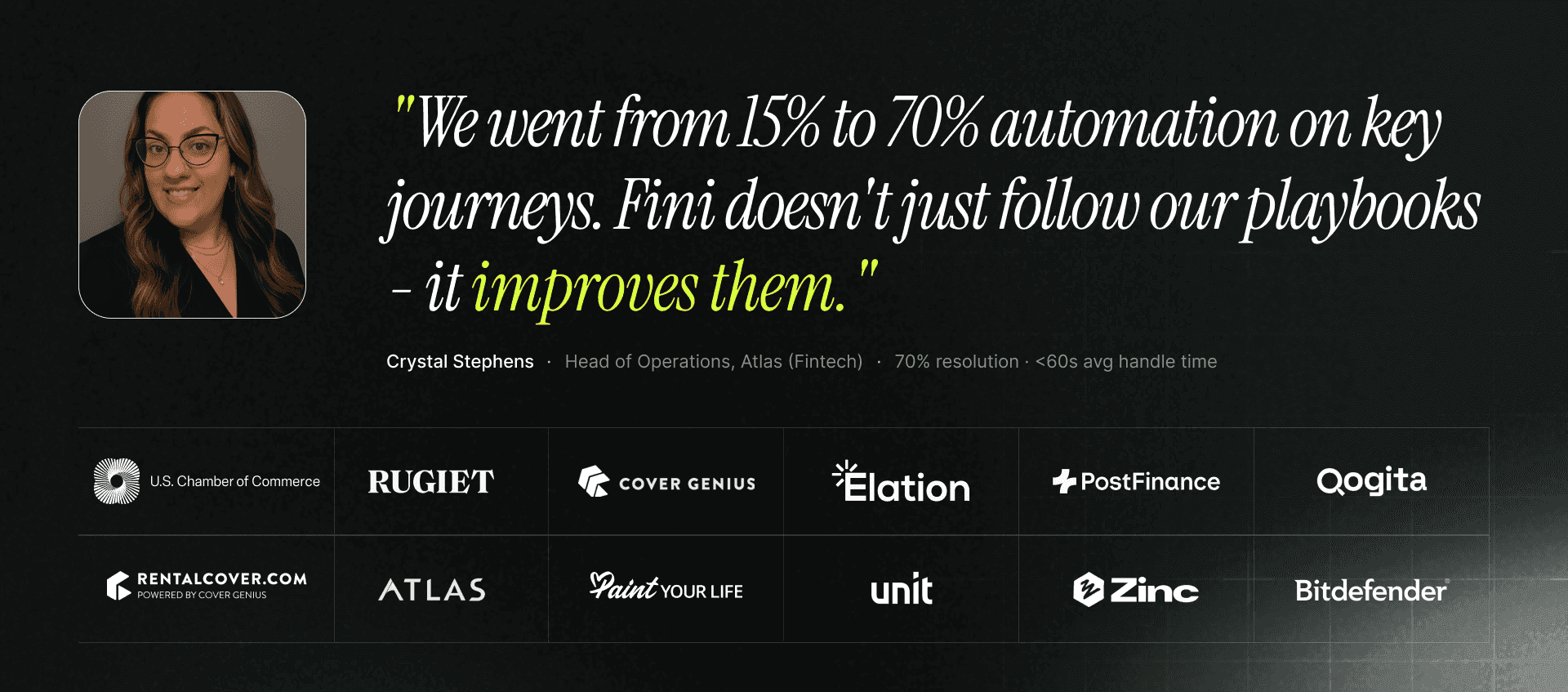
Fini’s customers speak directly to resolution outcomes in fintech and healthcare support teams.
Independent third-party review volume specifically for Verint’s IVA is thin where we could check it: Info-Tech’s SoftwareReviews platform lists only 3 reviews for the Verint IVA, flagged as insufficient data to display a score. G2, Gartner Peer Insights, and TrustRadius pages exist for the product but were not accessible during this research, so treat this as a partial picture rather than a verdict on Verint’s review volume overall.
The full side-by-side
Pulling every dimension of this comparison into one table.
Dimension | Fini | Verint |
|---|---|---|
Ownership | Independent, VC-backed by Y Combinator and Matrix Partners | Formerly public (Nasdaq: VRNT), acquired by Thoma Bravo for $2B in a deal that closed November 2025, then merged with Calabrio |
Pricing | $0.49 per resolution, published, no per-seat fees | Custom quote only, no public pricing |
Named regulated customers | 3M+ monthly resolutions across named fintech and healthcare volume | New York Life and Capitec Bank are named customers, but for quality monitoring and workforce management, not the IVA |
Autonomous-agent proof points | Published resolution rate and accuracy figures under Fini’s own name | One anonymized fintech case study ($18M savings, 22M interactions) and one anonymized insurance case study (97.9% containment); no named IVA logo found |
Review footprint | Not aggregated the same way publicly | Only 3 reviews found for the IVA on Info-Tech, flagged insufficient data; other review sites were inaccessible for this research |
Compliance certifications | Available on request | Not discoverable via Verint’s public site at the time of this research |
Which should you choose?
Choose Fini if you need an autonomous agent whose only job is resolving tickets, with a published price and a guarantee tied to a resolution rate, live in about 30 days. Choose Verint if you already run, or plan to run, a large contact center on quality monitoring, coaching, and workforce management, and want an IVA that lives inside that same platform rather than a standalone resolution agent. Kasisto vs Fini and Zingly cover two other vendors going through their own ownership changes, worth a look if that is part of your evaluation.
Compliance
Fini can provide its compliance and security documentation directly on request; contact Fini’s team for current certifications relevant to fintech and healthcare deployments. Verint’s public site did not have a working trust-center or compliance page we could verify during this research, so we cannot confirm which certifications, such as SOC 2, ISO 27001, HIPAA, or PCI-DSS, currently apply, or to which product line. That is an open question to raise directly with Verint’s sales team, not a confirmed gap.
Ready to compare on your own data?
The honest read on this matchup: Verint is a strong, long-established platform if you are buying quality monitoring, coaching, and workforce management with a virtual assistant attached, and Fini is the stronger fit if the job is autonomous resolution, priced and guaranteed as a single outcome. If it is the latter, book a working session and see the resolution rate on your own tickets before committing to either roadmap.
Is Verint’s IVA the same kind of product as Fini?
Not exactly. Verint’s Intelligent Virtual Assistant is a real, capable self-service product, but it operates as one bot inside Verint’s much larger quality monitoring, coaching, and workforce management suite. Fini is a single-purpose autonomous resolution agent built from day one to close tickets end to end, so the two are only a partial overlap.
How much does Verint’s IVA cost?
Verint does not publish pricing for the IVA or its CX Automation suite. Buyers go through a sales conversation and a personalized demo, with licensing described as modular Named Employee or Volume-Based models. Fini, by contrast, publishes a starting rate of $0.49 per resolution with no per-seat fees.
Does Verint have named fintech or healthcare customers for its autonomous agent?
Verint’s named regulated-industry customers, such as New York Life and Capitec Bank, use its quality monitoring, speech analytics, and workforce management products, not the IVA. The IVA does have a real fintech case study, an anonymized card-services company reporting $18M in annual savings and 80% containment across 22 million interactions, but the customer name has not been made public.
Is Verint still a publicly traded company?
No. Verint was public on Nasdaq under the ticker VRNT, but private equity firm Thoma Bravo closed a $2 billion all-cash acquisition of Verint in November 2025 and merged it with Calabrio, a workforce management competitor, under a new CEO. Verint is now privately held.
Which is easier to set up, Fini or Verint?
Both claim roughly a 30-day path to a first live deployment. Fini’s setup is scoped to one job, connecting to helpdesk, knowledge base, CRM, billing, claims, and EHR systems and going live as a resolution agent. Verint’s IVA Studio is a low-code builder, but standing up the IVA well typically means also managing it alongside Quality Bot, Coaching Bots, and the rest of the CX Automation suite.
Can Fini replace Verint’s IVA?
It depends on what you are actually buying Verint for. If the goal is autonomous ticket resolution with a published price and a performance guarantee, Fini is built specifically for that. If you need Verint’s broader quality monitoring, coaching, and workforce management stack, the IVA is one piece of a larger platform that Fini does not attempt to replace.