
A platform now owned by Zendesk vs. an independent vendor
Before the acquisition changes how it's sold, here is where Forethought and Fini stand today, one still publishes its rates, the other now sits inside a much larger platform business. In this comparison: What each is · How they differ · Pricing · Capabilities · Feature by feature · Ease of use · What customers say · The full side-by-side · Which to choose · Compliance · FAQ
What is Fini?
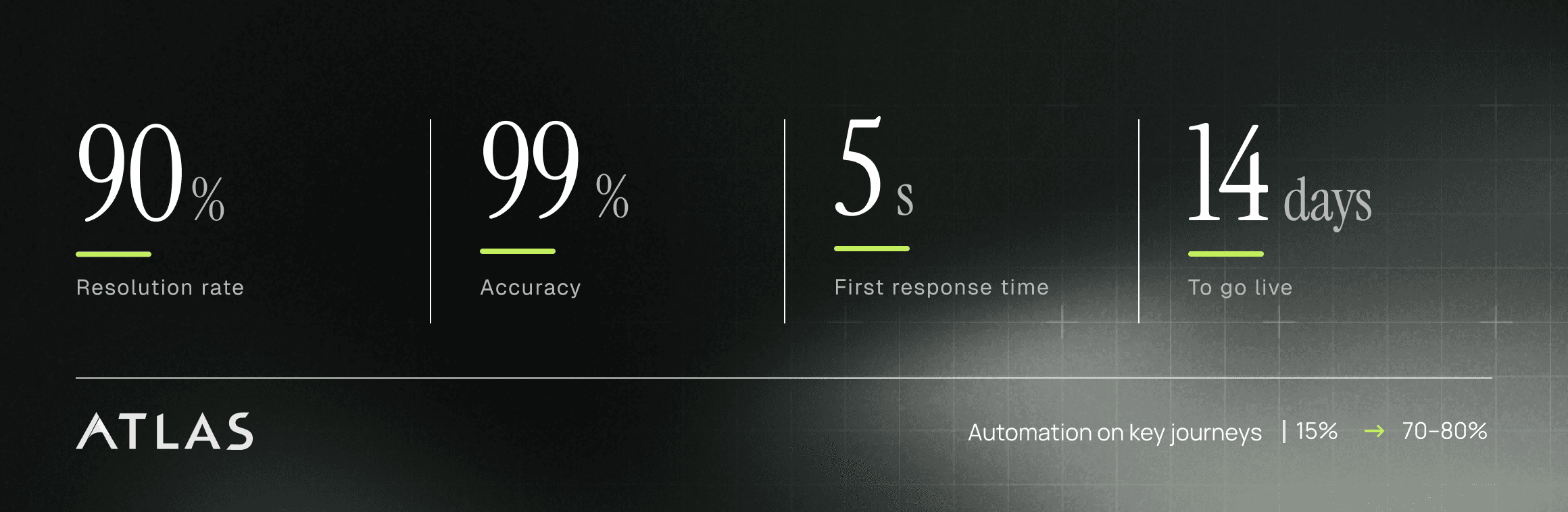
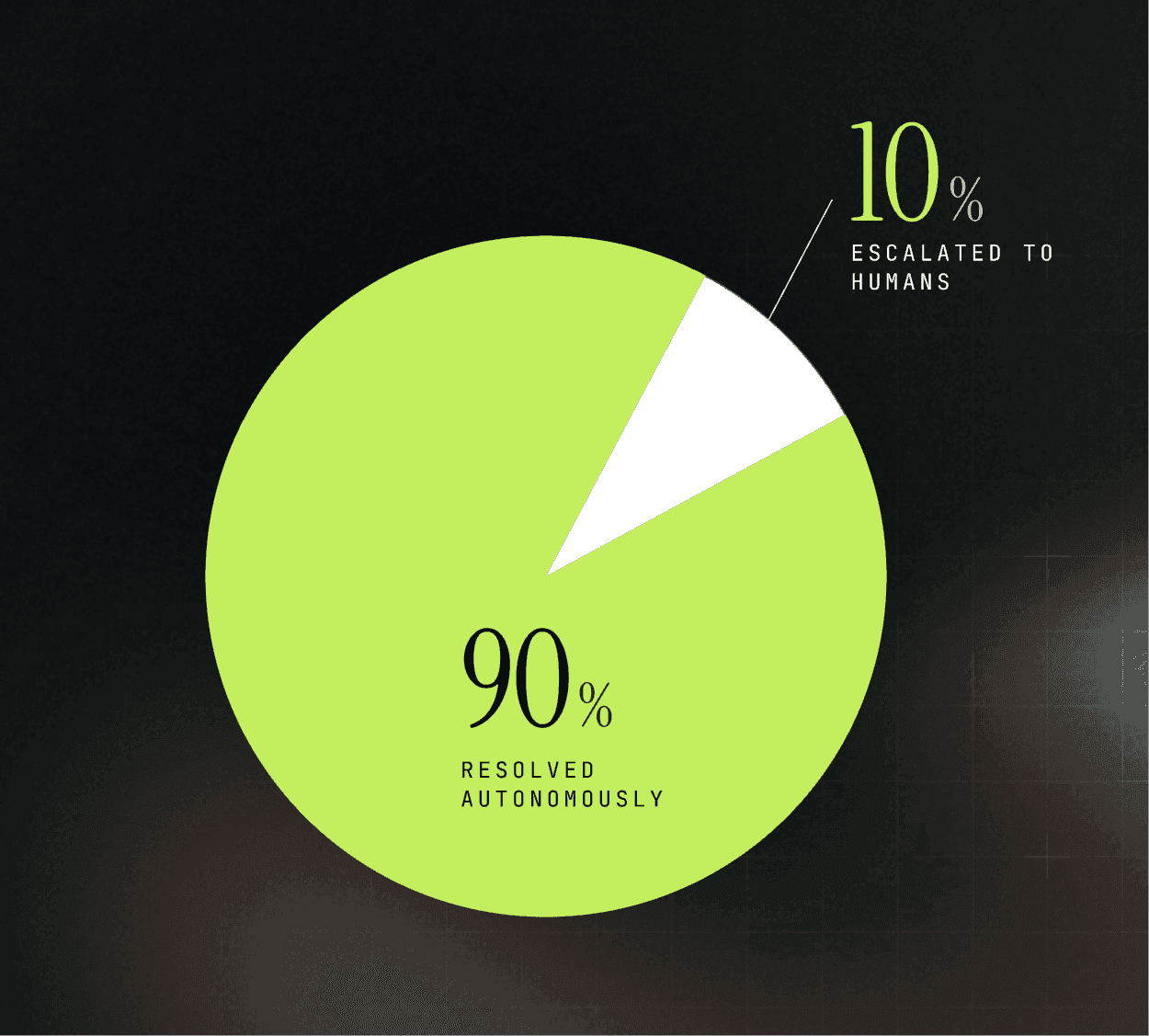
Fini is an AI customer-support agent priced per resolution, backed by Y Combinator and Matrix Partners. It connects natively to your helpdesk, knowledge base, CRM, billing, claims, and EHR systems, reaches a 90% resolution rate at 99% accuracy, and is built to go live in 30 days. Across its customer base, Fini handles more than 3 million monthly resolutions in fintech and healthcare. The agent works across voice, chat, and email, answers in 130+ languages, and returns a first response in about five seconds.
What is Forethought?
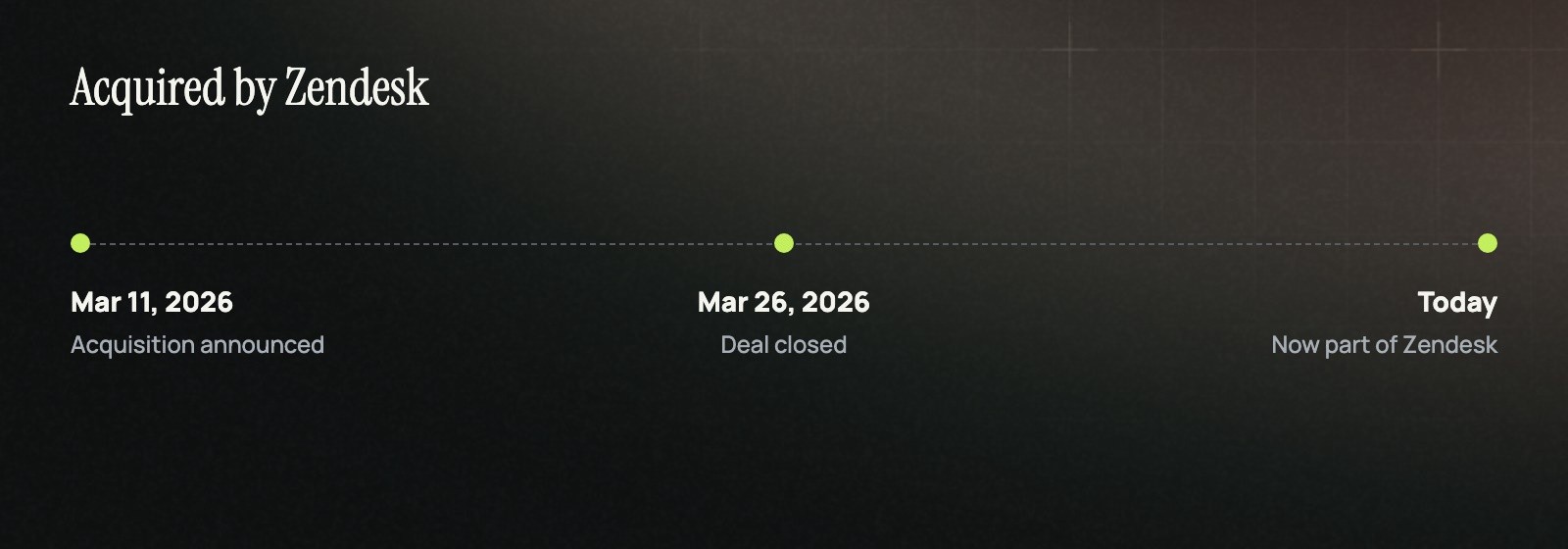
Forethought is a multi-agent AI customer-experience platform built around five named modules: Solve for auto-resolution, Triage for routing and prioritization, Assist as a real-time copilot for human agents, Discover for surfacing trends across conversations, and Agent QA, which scores every conversation for empathy, grammar, relevance, and resolution quality against customizable rubrics. Founded in San Francisco in 2017 (some sources list 2018) by CEO Sami Ghoche, Forethought raised $117 million across five funding rounds: including a $65 million Series C and a $25 million Series D in May 2025: from investors including New Enterprise Associates, Samsung Next Ventures, 8VC, Collaborative Fund, and Village Global. Of the five modules, Solve is the one doing the actual customer-facing work: resolving tickets end to end across chat, email, voice, SMS, Slack, and API without a human in the loop unless the case escalates. Triage sits upstream of Solve, reading an incoming ticket and deciding how urgent it is and who or what should handle it before Solve (or a human agent) ever touches it. Assist is the module built for the human side of the operation: it sits inside an agent's existing console and surfaces suggested responses and relevant context in real time, functioning as a copilot rather than an autonomous resolver. Discover works after the fact, mining historical conversation volume for patterns: recurring issues, emerging complaint themes, gaps in the knowledge base, that a team can act on. Agent QA, sold as an add-on rather than bundled by default, is the compliance and quality layer: it scores every single interaction (not a sample) against a rubric a team configures itself, covering empathy, grammar, relevance, and whether the case was actually resolved. The fact that changes everything about evaluating Forethought today: on March 11, 2026, Zendesk announced it was acquiring Forethought, reportedly Zendesk's largest acquisition in roughly twenty years, and the deal closed on March 26, 2026. The acquisition price wasn't disclosed, though it has been informally reported at $200 million or more. Forethought is now sold as "Forethought AI agents by Zendesk" and is being folded directly into Zendesk's Resolution Platform, with Zendesk's own announcement framing it around "self-learning AI agents that generate, adapt and execute complex workflows across any channel." If you're evaluating Forethought in 2026, you are functionally evaluating a Zendesk product, not an independent vendor, and it is worth reading our Zendesk AI vs Fini comparison alongside this one. Pre-acquisition, Forethought's named customers included Airtable, Grammarly, Cohere, Datadog, Upwork, Cotopaxi, WordPress, and Roadie, with earlier-era logos including Lime, Thumbtack, Carta, and Crunchbase. In January 2026 the company announced it had crossed $1 billion in cumulative customer ROI, a figure it was citing just weeks before the acquisition was announced. The timing is notable on its own: a company that spent early 2026 publicizing a billion-dollar ROI milestone was sold within about six weeks of making that announcement. That sequence doesn't change what Forethought's technology does, but it's a reasonable thing for a buyer to ask about directly in any sales conversation: what changes for existing customers, and on what timeline, now that the company sits inside Zendesk rather than running its own roadmap. It's worth separating what evaluating Forethought meant before March 2026 from what it means now. Before the acquisition, a buyer was assessing an independent, venture-backed startup competing on its own product roadmap, its own pricing discretion, and its own long-term viability as a standalone company. After the acquisition, that same evaluation runs through a very different set of questions: will Forethought continue to be sold and priced the way it was as an independent vendor, or will it be repackaged as part of a broader Zendesk bundle over time? Will its roadmap keep advancing on its pre-acquisition trajectory, or will Zendesk's own product priorities start to shape it? And does a deeper Zendesk integration make it a stronger choice specifically for teams already on Zendesk, at the cost of looking less attractive to teams on a different helpdesk who previously chose Forethought precisely because it worked as a neutral, helpdesk-agnostic layer? None of these questions have public answers yet as of this writing, which is itself the point: a buyer evaluating Forethought today is evaluating more integration uncertainty than a buyer would have faced a year ago, regardless of how the underlying technology performs.
Forethought pricing in 2026
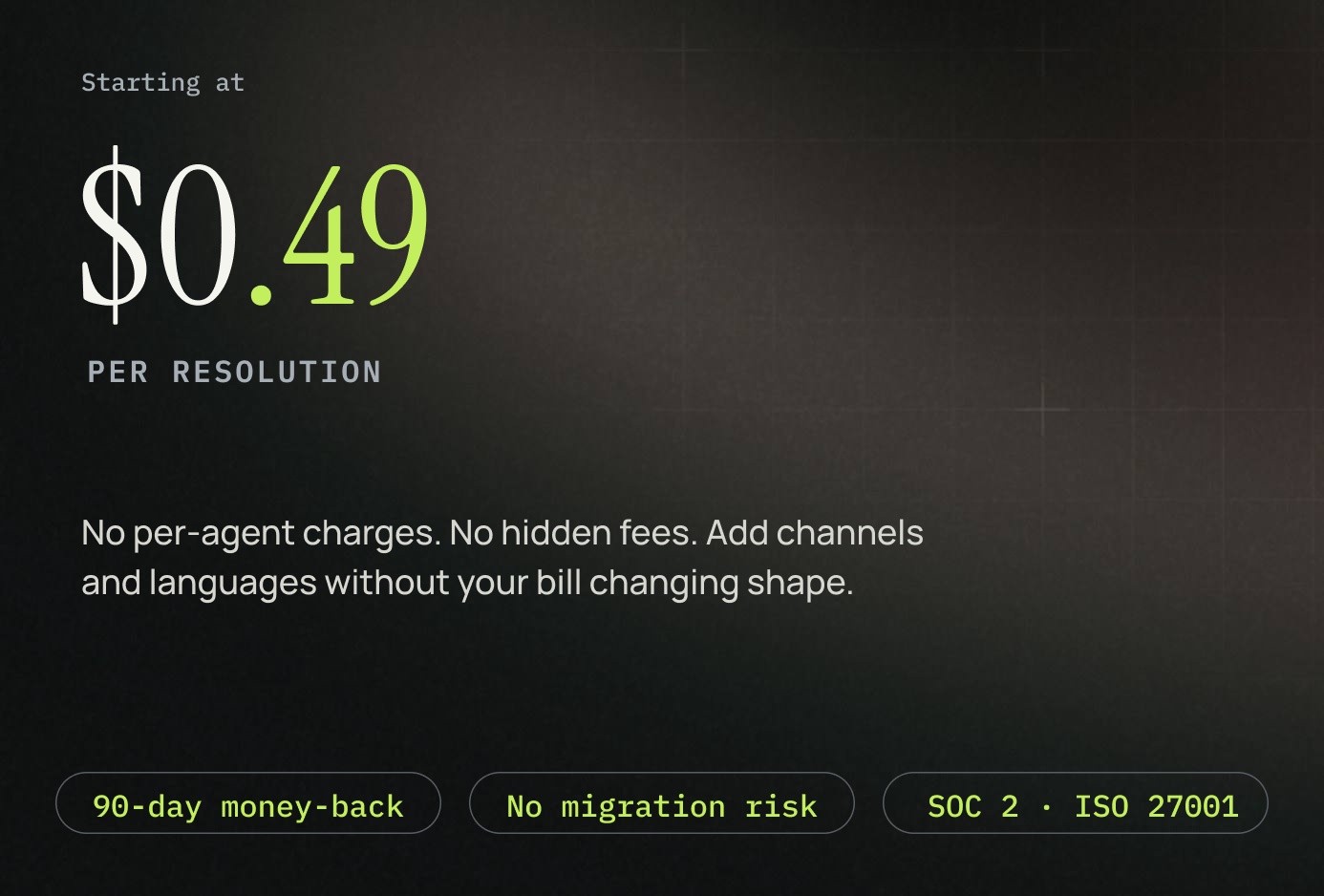
Forethought has never published a price list. Deals are quote-based, typically blending a platform access fee, seats, and committed usage tied to ticket volume or deflection targets. Third-party benchmarks: including Vendr and SelectHub-adjacent sources: put realistic annual spend in the $40,000-$160,000 range, with add-ons like the Assist copilot or the Agent QA module pushing some deals to $60,000-$80,000 or more. There is no free tier and no published self-serve option; every deal runs through a sales conversation. Fini publishes its rate directly: $0.49 per resolution, with no per-seat fees and unused allowance rolling forward one month. See the full breakdown on our pricing page. The difference that matters isn't just the headline number, it's whether you can forecast the invoice from your own ticket volume before you ever speak to a salesperson.
What buyers ask | Forethought | Fini |
|---|---|---|
Published price list | ✗ | ✓ |
Price | Quoted per account (~$40K-$160K/yr est.) | $0.49 per resolution |
Rate for additional resolutions | Not published | N/A, flat rate |
Add-on modules | Assist, Agent QA priced separately, pushing deals to $60K-$80K+ | Not applicable, one connected agent |
Free tier / self-serve | None | None (enterprise, sales-assisted) |
Can you model cost before a sales call? | No | Yes |
See Fini's full pricing breakdown for plan details, add-ons, and a resolution calculator.
How Fini and Forethought differ
Fini is one connected agent, priced per resolution, sold directly by an independent, YC-backed vendor built specifically around regulated fintech and healthcare workflows. Forethought is a modular system of five separately-branded agents: Solve, Triage, Assist, Discover, and Agent QA: each configured and, in the case of Assist and Agent QA, licensed somewhat separately as add-ons. And as of March 2026, Forethought is no longer an independent company at all: it is owned by Zendesk and is being absorbed into Zendesk's existing Resolution Platform. Buyers evaluating Forethought today should treat the acquisition as a live variable, not a footnote: pricing, roadmap, and even the product's standalone availability outside the Zendesk ecosystem could all shift as the integration proceeds. There's also a simpler structural difference underneath the ownership question: Fini was built from the outset as a single agent for a specific set of regulated, high-stakes workflows, while Forethought's five-module design grew to serve a broader, more general enterprise support audience across whichever helpdesk a customer already ran. Neither approach is wrong, but they imply different buyers, a team wants Fini specifically because its scope is narrower and its pricing is transparent against that scope, while a team wants Forethought's breadth because it needs several distinct capabilities (routing, copilot, QA, insight-mining) addressed by one vendor relationship, now a Zendesk relationship, rather than several.
Capabilities side by side
Forethought's breadth comes from stacking five distinct modules. Solve handles auto-resolution across chat, email, voice, SMS, Slack, and API. Triage routes and prioritizes incoming tickets before an agent (human or AI) ever touches them. Assist sits alongside a human agent in real time, suggesting responses and surfacing context. Discover mines historical conversations for trends and gaps. Agent QA, sold as an add-on, scores every single interaction: not a sample: against configurable rubrics for empathy, grammar, relevance, and resolution quality. Fini instead ships resolution and internals maintenance as one connected agent. Rather than a separate "Discover"-style module surfacing knowledge gaps for a human to fix later, Fini's Knowledge Atlas is built to keep the underlying knowledge base current automatically, the two vendors are solving an adjacent problem (stale or incomplete knowledge) from different directions: Forethought surfaces it for review, Fini aims to close the loop without a human step in between. That five-module structure is also a licensing and admin-overhead question, not just a capability one. A team adopting Forethought in full is effectively standing up five distinct products, each with its own configuration surface, versus one agent from Fini that already covers resolution and knowledge maintenance without assembling separate modules first. The practical implication shows up at procurement time as much as at implementation time. Evaluating Forethought means deciding not just whether the platform fits, but which of the five modules your team actually needs on day one versus later, Solve and Triage are the baseline, while Assist and Agent QA are positioned as expansions a team adds once the core resolution flow is working. Fini's single-agent model sidesteps that staged-adoption decision entirely: resolution and the underlying knowledge-maintenance work ship together from the start, so there is no separate module to scope, price, or schedule for a later phase.
Feature by feature
Stacked side by side, the two platforms diverge less on any single capability than on how that capability is packaged, priced, and, as of March 2026, who ultimately owns the roadmap behind it.
Feature | Fini | Forethought |
|---|---|---|
Auto-resolution | ✓ | ✓ (Solve) |
Ticket routing / triage | Built into the core agent | ✓ (Triage, a distinct module) |
Agent-assist copilot | Not a core focus | ✓ (Assist) |
100% conversation QA scoring | Not published as a standalone product | ✓ (Agent QA, add-on) |
Self-updating knowledge base | ✓ (Knowledge Atlas) | Discover surfaces trends but does not auto-write articles |
Voice channel | ✓ | ✓ |
Integration count | Helpdesk, KB, CRM, billing, claims, EHR (named systems) | 70+ tools, incl. Zendesk, Salesforce Service Cloud, ServiceNow, Confluence, Notion |
130+ languages | ✓ published | Not published |
Number of distinct product modules | 1, one connected agent | 5: Solve, Triage, Assist, Discover, Agent QA |
Company ownership | Independent, YC + Matrix Partners | Subsidiary of Zendesk since March 2026 |
Founded | 2022 (ex-Uber team) | 2017 (San Francisco) |
Standalone availability outside a specific helpdesk | Yes, connects to CRM/billing/claims/EHR across vendors | Historically yes; long-term standalone status post-acquisition not yet confirmed |
Forethought's integration list is genuinely long: more than 70 tools spanning helpdesks (Zendesk, Salesforce Service Cloud, Intercom, Freshdesk, ServiceNow, Talkdesk), knowledge sources (Confluence, Notion, Guru, Document360, Coda, Contentful, Google Drive, SharePoint), and channels like Amazon Connect. That breadth reflects a company built to slot on top of whatever helpdesk an enterprise already runs, rather than to replace it.
Ease of use and admin experience
Forethought scores well with buyers on G2, 4.3 out of 5 across 166 reviews, with reviewers frequently citing responsiveness and ease of use. But the same reviewers also flag real friction underneath that headline score: setup is described as time-consuming, and admins report needing to "constantly monitor the data and tweak the AI's intents" to keep accuracy up, rather than the system tuning itself. Accuracy itself is described by some reviewers as "requiring refinement" over time. Forethought's own marketing cites a 65% average self-serve rate, 80% deflection, and a 4.0 CSAT score, though independent estimates put realistic deflection anywhere from 44% to 87% depending on data quality and how complex the use case is. Fini's published 30-day, staged go-live is the more direct point of comparison for teams weighing setup effort up front, before signing anything. Neither figure is inherently disqualifying, every AI support platform in this category needs some tuning as real conversations come in, but the gap between Forethought's marketed deflection numbers and the wider range independent reviewers report is worth asking about directly, especially since Forethought's pricing isn't published to weigh against a firm resolution-rate commitment the way Fini's 90-Day Money-Back Guarantee is. Some of that configuration burden is a direct consequence of the five-module architecture itself: intents, routing rules, and QA rubrics each live in a different part of the product, which means an admin maintaining Forethought is maintaining five surfaces rather than one. That's not necessarily a worse trade for a team that specifically wants granular control over each stage of the pipeline, but it is a materially different admin workload than a single agent that resolves tickets and maintains its own knowledge base without a person needing to separately tune a routing layer, a copilot layer, and a QA layer on an ongoing basis. Teams evaluating either platform should ask specifically who: which role, how many hours a week, is expected to own that tuning work after go-live, not just how fast the initial setup takes.
Fini's differentiators
Published, modelable pricing
You can model total cost against your own ticket volume before ever speaking to sales.
The 90-Day Money-Back Guarantee
Tied to a 90% resolution rate within 90 days.
One unified agent
Rather than five separately licensed modules to configure.
Knowledge Atlas
Keeps the underlying knowledge base current automatically, rather than relying on a separate QA layer to catch drift after the fact.
Not mid-acquisition
Unlike Forethought, there is no larger platform business currently absorbing Fini's roadmap or support structure.
Forethought's recognized strengths
Credit where it's due: Forethought's multi-agent architecture is genuinely mature, and its Agent QA module: scoring 100% of interactions against customizable rubrics for empathy, grammar, relevance, and resolution quality: is a dedicated capability most competitors, Fini included, don't sell as a standalone product. The company reported crossing $1 billion in cumulative customer ROI in January 2026, counts enterprise logos like Airtable, Grammarly, Cohere, and Datadog among its customers, and, per Zendesk's own acquisition announcement, now carries the distribution and resources of a much larger platform behind it, a real asset for buyers already standardized on Zendesk's ecosystem. The Agent QA module specifically deserves credit on its own terms: scoring every single interaction, rather than a sample, against rubrics a team can customize for empathy, grammar, relevance, and resolution quality is a genuinely differentiated approach to quality assurance in this category, and it's the kind of feature enterprise buyers with dedicated QA teams tend to ask for by name.
What customers say
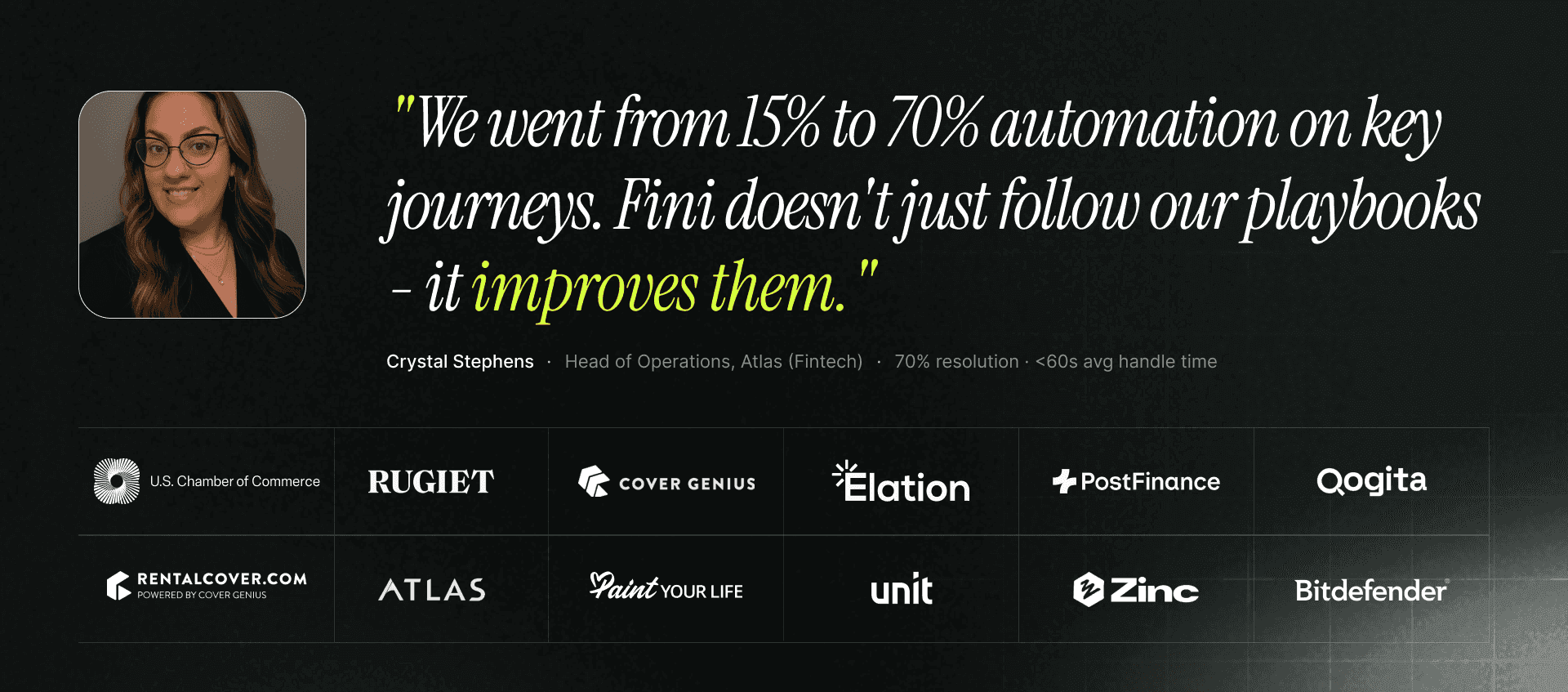
The most useful data point on Forethought isn't a single quote, it's the gap between two independently-sourced ratings. On G2, buyers rate Forethought 4.3 out of 5, largely on responsiveness and ease of use. On Trustpilot, where end users (the customers actually talking to the bot, rather than the admins who bought it) leave reviews, the rating drops to 2.5 out of 5, with 88% of one-star reviews describing repetitive chatbot loops and a failure to escalate to a human agent at the right moment, the exact failure mode buyers rarely see until after rollout. That buyer-versus-end-user split is worth weighing directly against whichever side of the conversation matters more to your team, and it's a more concrete signal than either rating taken alone.
The full side-by-side
Fini | Forethought | |
|---|---|---|
Pricing | $0.49 per resolution | Quoted; ~$40K-$160K/yr est. |
Outcome guarantee | 90-Day Money-Back Guarantee, 90% in 90 days | None published |
Go-live | 30 days, staged | Not publicly stated |
Channels | Voice, chat, email | Chat, email, voice, SMS, Slack, mobile, API |
Languages | 130+, published | Not published |
Integrations | Helpdesk, KB, CRM, billing, claims, EHR | 70+ tools |
Compliance | SOC 2 Type II, ISO 27001, GDPR, HIPAA-BAA-eligible, CCPA under agreement | SOC 2 Type II, ISO 27001, HIPAA assessment completed, GDPR-mapped |
Backing | Y Combinator, Matrix Partners | Acquired by Zendesk, March 2026; $117M raised pre-acquisition |
G2 rating | 4.9/5 on G2 | 4.3/5 (166 reviews); Trustpilot end-user rating 2.5/5 |
Which should you choose?
Choose Fini if you want published, modelable pricing, a single connected agent rather than five modules to configure and license separately, an outcome-based guarantee, and a knowledge base that maintains itself. Choose Forethought if you're already standardized on Zendesk, where it now has the tightest native fit as an acquired product: or Salesforce Service Cloud, and specifically want a dedicated QA-scoring module across 100% of interactions, and you're comfortable evaluating a product whose ownership just changed hands. Weigh the Trustpilot-versus-G2 gap by asking who in your organization the rating actually represents: if your team is the buyer and admin, Forethought's G2 score is the more relevant signal; if end-customer experience is what you're optimizing for directly, the Trustpilot end-user data deserves at least equal weight. The acquisition should factor into this decision as its own line item, separate from the product comparison above. A team that signs with Forethought today is signing with a Zendesk-owned product whose pricing, packaging, and roadmap priorities may shift as the integration into the Resolution Platform proceeds: that's a real switching-cost and vendor-lock-in question worth raising in any procurement review, independent of how well Solve, Triage, or Agent QA perform today. A team choosing Fini is choosing a vendor whose ownership, pricing, and roadmap are not currently in flux. Neither position is automatically right: a team already fully standardized on Zendesk may see the acquisition as a feature, since it likely means tighter native integration over time; a team that chose Forethought specifically because it worked equally well regardless of helpdesk should weigh that neutrality being at greater risk going forward.
Compliance
The two are roughly at parity here. Forethought holds SOC 2 Type II and ISO 27001, has completed a HIPAA assessment, and maps its controls to GDPR and NIST 800-53 (Moderate), with data encrypted at rest and via TLS in transit. Fini holds the same SOC 2 Type II and ISO 27001 certifications, plus HIPAA-compliant, BAA-eligible contracting and CCPA available under agreement. Neither has a clear compliance edge over the other, state it plainly rather than manufacturing a gap that isn't there. See our full breakdown of SOC 2-compliant AI support platforms for regulated industries for more on how the category compares.
Ready to compare on your own data?
Bring your own ticket volume and see exactly what Fini would cost and resolve against it, no sales call required to get a number. If Zendesk's own AI stack (now including Forethought) is also on your shortlist, our Zendesk AI vs Fini comparison covers that side of the evaluation directly, and if you're also weighing another well-funded enterprise platform, see Decagon vs Fini as well. Talk to the Fini team to run your own numbers, or read more on AI compliance for context on the certifications compared above.
Is Forethought still an independent company?
No. Zendesk announced its acquisition of Forethought on March 11, 2026, and the deal closed on March 26, 2026, reportedly Zendesk's largest acquisition in roughly two decades. The acquisition price wasn't disclosed, though it has been informally reported at $200 million or more. Forethought is now sold as "Forethought AI agents by Zendesk" and is being folded into Zendesk's Resolution Platform. Fini remains independent, backed by Y Combinator and Matrix Partners.
How much does Forethought cost?
Forethought doesn't publish pricing. Third-party estimates put annual contracts at $40,000 to $160,000, with add-ons like Assist or Agent QA pushing some deals to $60,000-$80,000 or more, and there's no free tier. Fini charges a starting rate of $0.49 per resolution, with the platform and implementation included and no per-seat fees.
Does Forethought require an existing helpdesk like Zendesk or Salesforce?
Yes. Forethought is built as an AI layer on top of an existing helpdesk: Zendesk, Salesforce Service Cloud, Freshdesk, and more than 70 other integrations, rather than as a standalone system.
What do real users say about Forethought's reliability?
There's a notable gap between two sources: G2 buyers rate Forethought 4.3 out of 5, citing responsiveness and ease of use, while Trustpilot end-users rate it 2.5 out of 5, with 88% of one-star reviews describing repetitive chatbot loops and a failure to escalate to a human agent at the right moment.
What is Forethought's Agent QA?
An add-on module that scores 100% of support interactions for empathy, grammar, relevance, and resolution quality against customizable rubrics: a dedicated QA layer most competitors, including Fini, don't sell as a standalone product.
Does Fini offer anything like Forethought's Discover or Agent QA modules?
Fini doesn't sell separate QA or insights modules. Instead, its Knowledge Atlas continuously maintains and updates the knowledge base the agent draws from, aiming to prevent the errors a QA layer would otherwise have to catch after the fact.
Is Forethought SOC 2 and HIPAA compliant?
Yes. Forethought holds SOC 2 Type II and ISO 27001, has completed a HIPAA assessment, and maps its controls to GDPR and NIST 800-53 (Moderate). Fini holds the same SOC 2 Type II and ISO 27001 certifications, plus HIPAA-compliant, BAA-eligible contracting and CCPA available under agreement.
What channels does Forethought support?
Chat, email, voice, SMS, Slack, mobile, and API. Fini supports voice, chat, and email natively in 130+ languages with a roughly five-second first response.
Will Forethought's pricing or roadmap change now that Zendesk owns it?
It's unclear. Zendesk's acquisition announcement didn't disclose pricing or a detailed roadmap, only that Forethought's capabilities will expand Zendesk's existing Resolution Platform AI agents. Buyers evaluating Forethought today should factor in this integration uncertainty.
How do I calculate whether Fini or Forethought is more cost-effective for my ticket volume?
Fini's published per-resolution rates let you model cost directly from your own ticket volume before any sales call. Forethought's quote-based pricing means you'd need a sales conversation, though third-party benchmarks suggest most enterprise deals land in the $40,000-$160,000 per year range.