Case Studies
Last Updated:

Deepak Singla
IN this article
Atlas, a fintech credit card company, increased their customer support automation from 15% to 70-80% on high-risk workflows using Fini's AI agent to handle previously "humans-only" tasks like KYC verification, address changes, and card decisions. The AI agent now resolves tickets in under 60 seconds by pulling customer context, applying rule-based logic, taking secure API actions, and maintaining audit-ready logs, all while achieving zero compliance exceptions in quarterly audits. This dramatic improvement came from systematically converting existing support playbooks into structured AI journeys that know exactly when to automate and when to escalate, starting with internal testing before scaling to production.
Snapshot
• Company: Atlas – 0% APR rewards credit card -creating a transparent rewards-driven credit experience that helps people spend confidently, earn rewards, and strengthen their financial standing.
Industry: Fintech / regulated consumer credit
Support: Intercom (live chat + email), OpenPhone (voice)
Focus: High-volume, sensitive work (KYC, card, account, payments)
Automation on key journeys: ~70–80%
Average handle time (automated): < 60 seconds
Company
Atlas is a fintech offering a 0% APR credit card creating a transparent rewards-driven credit experience that helps people spend confidently, earn rewards, and strengthen their financial standing
Customers reach support at their most frustrated - declined transactions, blocked cards, account updates. These aren’t low-stakes moments.
Support runs through Intercom. The CX team sits between customers, risk and compliance. They wanted automation, but only if it could be trusted with real account changes and card decisions.
Challenge: High-Risk Tickets Stuck at 15% Automation
Before FINI, Atlas sat at roughly 15% automation while ticket volume grew.
The blockers weren’t FAQs, but “serious” tickets arriving thousands of times a month, such as:
“Why was my Uber charge declined on card ending 5591?”
“I’m trying to update my address, but it has to match my SSN and ZIP. Can you do this for me?”
Each one forced agents to confirm identity, check multiple internal systems (transactions, risk, billing, payroll, bank connections), apply rules, take action and leave an audit-ready trail.
Legacy chatbots couldn’t follow that chain. They gave generic answers or dumped everything on humans “for safety”, so the most important work remained 100% manual.
Atlas needed automation that could safely handle complex, regulated support journeys, not just simple FAQs.
Solution: An AI Agent That Runs the Playbook
Atlas brought in FINI to turn existing support playbooks into structured journeys an AI agent could run end-to-end.
In practice, FINI works more like a trained specialist than a bot:
Understands free-form questions about charges, balances, limits, address changes and restrictions
Pulls context for each customer – account status, risk score, plan type, customer type, payroll/bank connection status
Applies rules to decide what’s allowed, what’s blocked and when to escalate
Takes action via secure APIs only when checks pass (update address/phone, reset password, reissue card, explain declines, guide reconnects, compute renewal offers)
Logs everything, so CX, Risk and Compliance see exactly what happened on each ticket
The brief was simple:
“Let an AI agent safely handle the work we previously reserved for human agents only”
Implementation: Fast, Guardrailed, and Transparent
1. Start With the Highest-Impact Journeys
Atlas and FINI first targeted journeys that:
Drove a large share of volume
Already had clear internal rules
Felt too sensitive for a traditional bot
Address changes fit perfectly: KYC-bound, high-volume, painful for agents. By defining exactly when automation is allowed and when to escalate, the team shipped the first address-change journey in about five days from scoping to production. The same pattern then extended to phone updates and common decline questions.
2. Turn Rules Into Clear Steps
Instead of letting AI guess from help articles, Atlas and FINI turned decision logic into explicit steps.
For an address or phone update, a typical pattern:
Identity check – confirm the customer is who they say they are before proceeding.. Any mismatch goes to a small review queue.
Risk and account check – check key account signals and details. High-risk interactions are esclated to a specialist team.
Single action + audit trail – when checks pass, send one scoped API call (e.g. “update address”), wait for confirmation, and attach a structured record of checks, rules and actions to the ticket.
Every automated journey is designed to answer up front:
When can FINI resolve this fully?
When must it escalate, and to whom?
What must be logged for later review?
3. Prove It Internally, Then Scale
To de-risk rollout, FINI first ran inside Intercom as an internal commenter.
On live tickets, it suggested responses and actions that agents could approve or edit, but not send automatically. Over 500 suggestions were reviewed, tightening tone, edge-case behaviour and the line between “automate” and “escalate”.
Once CX and Security were comfortable, Atlas moved from suggestions to live actions and scaled in stages:
Before FINI: ~15% automation from simple scripts
Early rollout: secure API access on selected journeys
Steady state: ~47% automation on tickets FINI is allowed to handle.
Target: 60%+ automation as membership, onboarding and other complex journeys come online
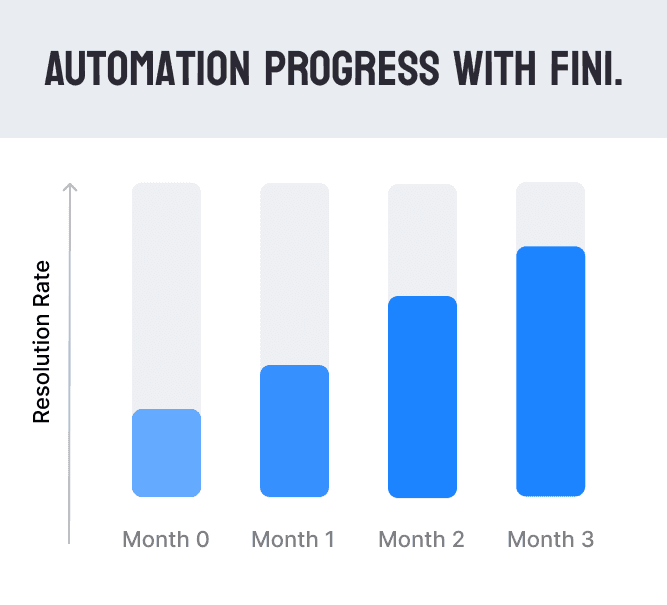
At each stage, Atlas watched automation rate, handle time, escalations and audit results to make sure safety kept pace with scale.
Outcomes: High Automation on High-Stakes Work, Without Losing Control
Results at a Glance
With FINI, Atlas has achieved:
70–80% automation on key journeys like address changes, phone updates and balance/transaction questions
Around 47% automation on tickets FINI is allowed to handle.
Under 60 seconds handle time on automated work
Zero compliance exceptions on automated work in quarterly audits
In a space where many fintech teams top out around 15–25% automation on complex workflows, Atlas is operating well above that.
“We were skeptical - in financial services, precision and compliance aren’t optional, so automation is tricky to get right. We closely watched Fini handle our most sensitive workflows, and it did so with compelling accuracy. We went from 15% automation to 70-80% on key journeys, with customers getting answers in under 60 seconds. That’s reduced the operational burden on my team. Fini doesn’t just follow our playbooks - it makes them better over time. If you’re in fintech and still treating automation as something that can’t touch your real work, you’re leaving money on the table and you’re not scaling properly.”
~ Crystal , Head of Customer Experience and Operations, Atlas
Automation by Use Case
Atlas focused on journeys that generated most of their sensitive workload.
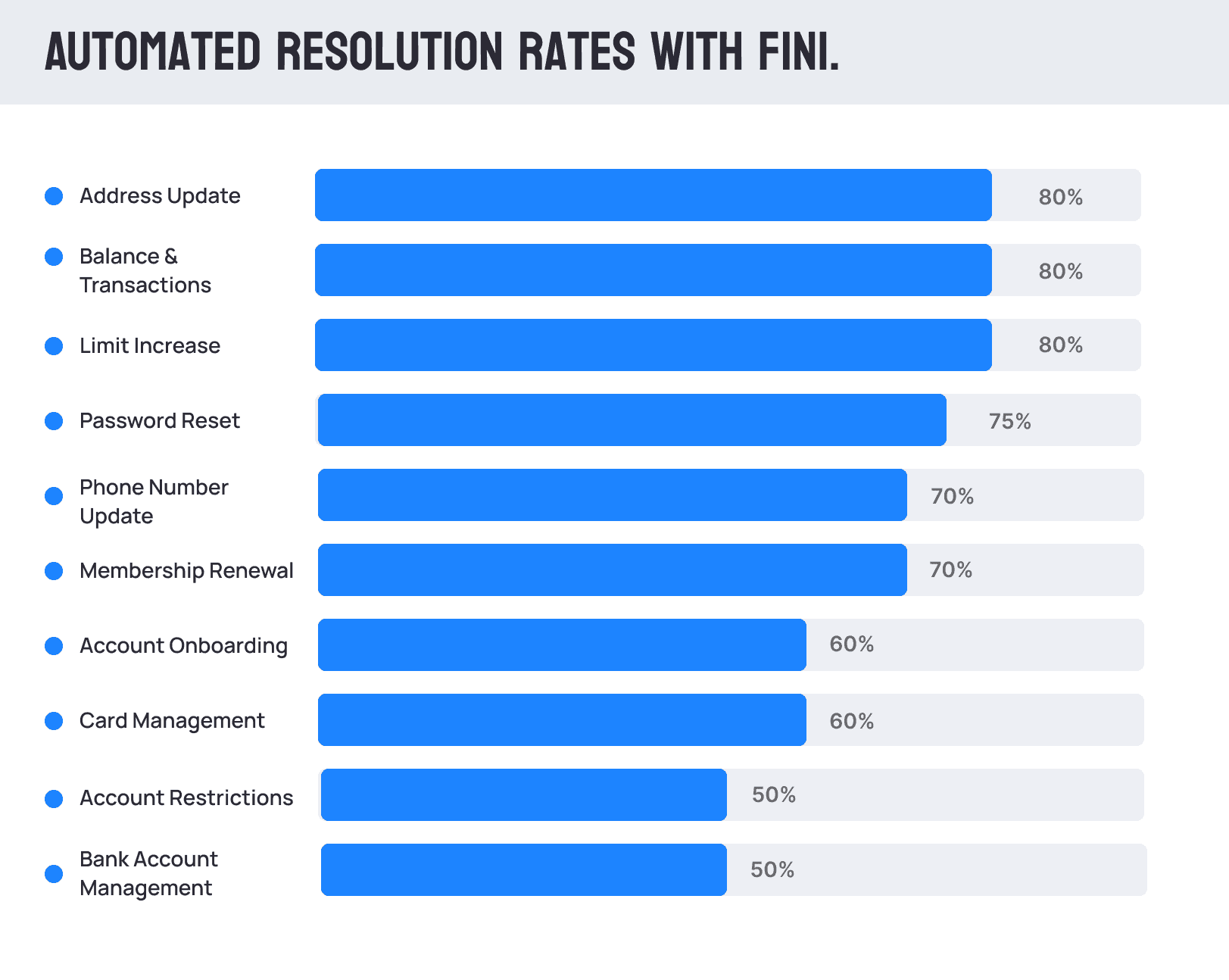
FINI now handles the majority of structured, repeatable work, often around 80% automation on the simplest but high-value journeys, and still takes 50–60% of the load on more complex areas like onboarding, card management, account restrictions and bank account issues. Agents step in for edge cases and judgment calls.
Better for Customers, Teams and Audits
On automated work, Atlas now resolves tickets in under a minute from first message to confirmation. Customers get clear, fast answers; address and phone changes are done in one interaction instead of a back-and-forth.
Agents see shorter queues and fewer repetitive tickets. CX leadership sees handle time drop without constantly adding headcount.
On the governance side, flows owned by FINI have produced no compliance exceptions in quarterly audits. Each decision includes the data checked, the rule applied, the action taken and the reason for any escalation.
Atlas watches three core metrics on these journeys:
Automation rate
Handle time
Compliance exceptions
Those numbers give any regulated support team a clean way to judge whether their automation is actually working.
For Heads of Support in Fintech and Other Regulated Industries
Atlas didn’t bring in AI to make FAQ answers slightly nicer. They used it to put an AI agent in charge of work they once treated as “humans only”: identity checks, account changes, card and transaction decisions and account restrictions.
If your world looks similar - high volume, real money on the line, and audits watching, this is the level of safe, controlled automation that’s now possible.
👉 Book a demo to see how much of your KYC, card and account workload FINI could safely automate.
FAQs
How much customer support automation is typical in fintech?
Most fintech companies achieve 15-25% automation on complex workflows using traditional chatbots. Atlas increased automation to 70-80% on key journeys like address changes, phone updates, and transaction questions by implementing Fini’s AI agent, which handles high-risk, regulated tasks that were previously reserved for human agents only.
Can AI agents safely handle KYC verification and identity checks in financial services?
Yes. Fini’s AI agent performs identity verification before processing sensitive requests like address or phone updates. The system checks customer identity, account status, and risk scores before taking action. Any mismatches trigger escalation to human review. Atlas’s implementation has produced zero compliance exceptions in quarterly audits.
What customer support tasks can AI safely automate in regulated industries?
AI agents can safely automate address changes, phone number updates, password resets, card reissuance, transaction decline explanations, balance inquiries, and account reconnection guidance. Atlas automates these workflows using Fini by applying explicit rule-based logic, pulling real-time customer context from multiple systems, and maintaining complete audit trails for compliance review.
How long does it take to implement AI automation for fintech support?
Atlas shipped their first automated journey (address changes) with Fini in approximately five days from scoping to production. The implementation followed a phased approach: starting with high-impact journeys that had clear internal rules, testing with 500+ internal reviews where agents approved AI suggestions, then gradually scaling to live automation once compliance and security teams validated the approach.
What is the average handle time for AI-automated fintech support tickets?
Atlas achieves under 60 seconds average handle time on AI-automated tickets, compared to several minutes for human-handled interactions. The AI agent resolves address changes, phone updates, and transaction questions in a single interaction by pulling customer context, applying rules, taking API actions, and confirming completion without requiring back-and-forth exchanges.
How do you ensure AI customer support maintains compliance in financial services?
Compliance is maintained through structured journeys with explicit escalation rules, complete audit trails, and systematic monitoring. Fini’s AI agent logs every check performed, rule applied, action taken, and escalation reason. Atlas tracks three core metrics (automation rate, handle time, and compliance exceptions) with quarterly audits showing zero compliance violations on automated workflows handling 40,000+ tickets monthly.
What’s the difference between traditional chatbots and AI agents for customer support?
Traditional chatbots provide generic answers from help articles and escalate most complex work to humans “for safety.” AI agents like Fini run complete support playbooks end-to-end by understanding context, pulling customer data from multiple systems, applying decision logic, taking secure API actions, and maintaining audit trails. This allows them to handle high-risk workflows like account changes and card decisions that chatbots cannot safely process.
How many support tickets can an AI agent handle per month in fintech?
On key journeys like address updates and balance inquiries, the automation rate reaches 70-80%. More complex workflows like onboarding and account restrictions see 50-60% automation, with human agents handling edge cases and judgment calls.
When should AI escalate customer support tickets to human agents?
AI should escalate when identity verification fails, risk signals indicate high-risk interactions, customer requests fall outside defined rules, or situations require human judgment. Atlas structured each journey to answer upfront: when can AI resolve fully, when must it escalate and to whom, and what must be logged for review. This approach maintains safety while maximizing automation on routine work.
What ROI can fintech companies expect from AI customer support automation?
Atlas reduced operational burden by automating 70% tickets monthly that previously required human handling. With sub-60-second handle times versus several minutes for human agents, and automation increasing from 15% to 70-80% on key journeys, the ROI comes from reduced headcount growth needs, shorter queue times, and faster customer resolutions while maintaining zero compliance exceptions.
How do you test AI automation before deploying it in production for financial services?
Atlas used a phased testing approach: Fini first ran inside Intercom as an internal commenter, suggesting responses and actions that agents could review and edit but not send automatically. After reviewing 500+ suggestions to refine tone, edge-case behavior, and escalation logic, they moved to live actions and scaled gradually while monitoring automation rate, handle time, escalations, and audit results at each stage.
Can AI handle address changes and phone updates for bank and credit card customers?
Yes, when properly structured with identity verification and rule-based controls. Atlas automates address and phone updates by confirming customer identity, checking account status and risk scores, validating that changes meet KYC requirements, executing single scoped API calls, and creating audit-ready records. High-risk cases escalate to specialists, while routine changes complete in under 60 seconds.
What are the biggest barriers to customer support automation in fintech?
The main barriers are handling sensitive workflows that require identity verification, coordinating data across multiple internal systems (transactions, risk, billing, payroll, bank connections), applying complex decision rules safely, taking real account actions via APIs, and maintaining compliance-ready audit trails. Traditional chatbots fail at these requirements, which is why most fintech teams plateau at 15-25% automation.
How do you measure success for AI customer support automation in regulated industries?
Atlas tracks three core metrics: automation rate (percentage of tickets resolved without human intervention), handle time (speed from first message to resolution), and compliance exceptions (violations found in audits). Success means increasing automation while maintaining sub-60-second handle times and zero compliance exceptions, proving the AI operates safely at scale on high-risk workflows.
What customer support workflows should fintech companies automate first?
Start with high-volume journeys that have clear internal rules but feel too sensitive for traditional bots. Atlas began with address changes because they’re KYC-bound, generate significant volume, and cause agent pain. The pattern (define when automation is allowed, when to escalate, implement identity and risk checks, take single scoped actions, log everything) then extended successfully to phone updates, decline explanations, and transaction questions.

Co-founder