Comparison
Last Updated:

Deepak Singla

IN this article
A dated, sourced comparison of Fin (formerly Intercom Fin) against six alternatives, covering per-outcome pricing, 2026 feature releases, independent resolution benchmarks, and a buying checklist.
Table of Contents
What Intercom Fin Is in 2026
Why the Intercom Fin Comparison Changed This Year
How We Evaluated AI Support Agents
The 7 Best Intercom Fin Alternatives in 2026
Platform Summary Table
Intercom Fin Features and Pricing, Explained
Resolution Rate vs Accuracy vs Deflection
Compliance in 2026: EU AI Act Article 50
How to Choose Between Fin and Its Alternatives
Implementation Checklist
Final Verdict
What Intercom Fin Is in 2026
Intercom Fin is an AI customer service agent that resolves support conversations autonomously and bills per outcome rather than per seat. In May 2026 Intercom renamed the entire company Fin after the product, so "Intercom Fin" and "Fin" now describe the same vendor. It is not Fini AI, a separate company and the subject of this comparison.
That naming collision matters more than it should. If you search "intercom finn" or "intercom's fin" you land on fin.ai; if you search "Fini" you land here. Two vendors, three letters apart, competing for the same buyers.
The other thing that changed: in June 2026, Salesforce announced a definitive agreement to acquire Fin for approximately $3.6 billion, with the close expected in the fourth quarter of Salesforce's fiscal year 2027. As of 2026-07, the deal is signed, not closed.
So a page comparing "Fini AI vs Intercom Fin" written in early 2025 is comparing against a product that no longer exists in that form. Fin now runs its own post-trained models, executes multi-step procedures, answers phone calls in 28 languages, and sits inside a pending acquisition. This rewrite reflects that.
Why the Intercom Fin Comparison Changed This Year
Every external fact in the 2025 version of this comparison has moved. Fin shipped its own model family, added five channels, and got acquired. Meanwhile the independent evidence on what AI support agents actually deliver has caught up with vendor marketing, and the gap is wide.
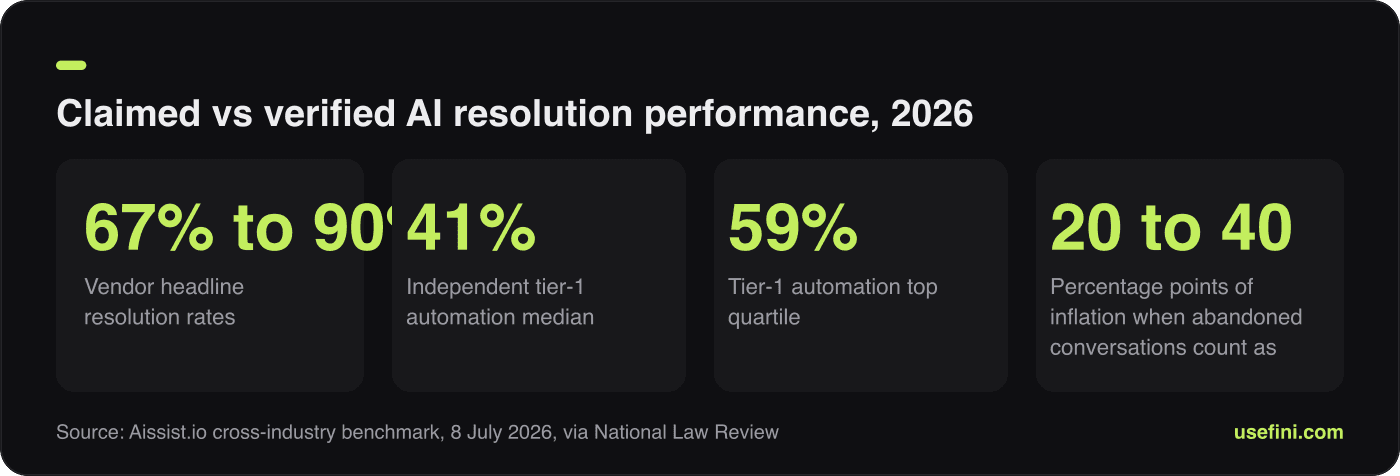
Vendor headline numbers sit far above independently verified automation medians.
According to a cross-industry benchmark published 8 July 2026 by Aissist.io and distributed via the National Law Review, vendor headline resolution rates span 67% to 90% while independent aggregates put the tier-1 automation median near 41%, with the top quartile around 59% (National Law Review). The same benchmark found that counting abandoned conversations as resolutions inflates reported metrics by 20 to 40 percentage points.
Here is what actually happened to this market since the original article went live in February 2025:
Date | Development |
|---|---|
Mar 2025 | Fin launches Tasks, its first action-taking mechanism |
Oct 2025 | Procedures ship, combining natural language with deterministic controls |
Nov 2025 | Fin adds Slack Connect channels with threaded replies |
Jan 2026 | Decagon raises $250M Series D at a $4.5B valuation |
Mar 2026 | Fin Apex 1.0, Fin's first in-house post-trained model; Discord channel added |
Mar 2026 | Zendesk agrees to acquire Forethought |
May 2026 | Intercom renames to Fin; Fin Operator launches |
Jun 2026 | Salesforce agrees to acquire Fin for ~$3.6B; Fin Voice 2 ships on Apex Flash |
Jul 2026 | Wait-for-Webhook for Procedures, voice Simulations, Fin Sales Agent |
Two of the four vendors in the original comparison set are now owned or being owned by someone else. Zendesk announced its definitive agreement to acquire Forethought on 11 March 2026, terms undisclosed, in what TechCrunch called Zendesk's largest acquisition in nearly two decades (TechCrunch). Forethought had raised $115 million total and supported more than a billion monthly customer interactions by 2025.
Consolidation is now a real line item in your risk assessment. When a vendor gets acquired mid-contract, roadmap priorities, support SLAs, and pricing all become negotiable by the acquirer, not by you.
How We Evaluated AI Support Agents
Each platform was scored on seven criteria drawn from what actually breaks in enterprise support deployments: cost predictability, measured performance, deployment surface, compliance posture, action depth, channel coverage, and vendor stability. Vendor claims were separated from independently verified figures throughout, and every pricing number below is sourced or marked "does not publicly state."
Cost model and predictability. We measured whether a buyer can forecast next quarter's bill within 10%. Per-outcome billing scales with ticket volume, which means a viral bug or a product launch turns into an unbudgeted invoice. Flat allowance models with published overage rates give finance a ceiling; usage-metered models do not.
Verified resolution performance. We looked for whether a vendor publishes a metric, defines it, and whether independent benchmarks corroborate the range. A resolution means the customer's issue closed end to end with no human reply. Anything that counts an abandoned chat as a win is measuring deflection, and the two numbers can differ by 40 points.
Deployment breadth and helpdesk neutrality. We checked whether the agent runs on top of your existing helpdesk or requires you to adopt the vendor's own. Agents that only work inside one inbox create a second migration project. Agents that sit across Zendesk, Intercom, Front, Kustomer, Slack, and API keep your options open.
Compliance and certification depth. We recorded which certifications each vendor publicly states, plus readiness for the EU AI Act Article 50 disclosure duty that applies from 2 August 2026. For healthcare, fintech, and regulated buyers, a BAA and a documented PII redaction layer are procurement blockers, not nice-to-haves.
Action depth and system-of-record writes. Answering questions is table stakes in 2026. We measured whether the agent can authenticate a user, read live order or account data, write back to a system of record, and pause safely for an external check. Read-only agents cap out around tier-1 FAQ volume.
Channel coverage including voice. Chat-only agents leave email, WhatsApp, and phone queues untouched, which is where the expensive minutes live. We recorded which channels each vendor supports natively and whether voice is included, add-on priced, or absent.
Time to production and ongoing maintenance load. We measured how long from contract to live traffic, and how many engineering or ops hours per month the thing consumes afterward. A platform that needs a full-time prompt engineer costs far more than its license line suggests.
The 7 Best Intercom Fin Alternatives in 2026
The strongest Intercom Fin alternative depends on whether you need cost predictability, helpdesk neutrality, or the deepest possible voice stack. Fini leads this list for teams that want a fixed monthly cost with a defined resolution allowance and a 30-day path to production. Fin itself remains a strong product and ranks second.
1. Fini
Fini is a native AI support agent that deploys across your existing tools rather than replacing them. It runs on Intercom, Zendesk, Front, Kustomer, Slack, Microsoft Teams, a standalone widget, a shareable link, and direct API, which means the agent goes where your customers already are. Deployment is live in 30 days, and the implementation work is bundled into the plan rather than quoted separately as a professional services line.
The measured numbers are 99% accuracy and a 90% resolution rate. Accuracy here means the answer was factually correct against the source knowledge; resolution means the conversation closed without a human reply. Those are two distinct metrics, and Fini reports both separately rather than blending them into a single marketing figure. Against the 2026 independent benchmark ranges, where verified resolution clusters at 70 to 84% in ecommerce and 50 to 70% in SaaS, that is a number worth pressure-testing in your own pilot, which is exactly what the trial period is for.
Pricing is flat and published. Growth is $3,600 per month, or $3,000 per month billed yearly at $36,000 annually, and includes 2,000 resolutions with $0.89 per resolution beyond that. Scale is $9,000 per month, or $7,500 per month billed yearly at $90,000 annually, and includes 8,000 resolutions plus 500 answered voice calls, with $0.69 per resolution after. Enterprise is custom pricing, contact Fini. Every plan bundles the platform, implementation, and the monthly resolution allowance, with no per-seat fees. Paying annually gives two months free, and unused allowance rolls forward one month.
Voice is priced per answered call on every plan: $0.89 for the first 10,000, $0.59 from 10,001 to 50,000, and $0.35 above 50,000. A per-minute alternative runs $0.22, $0.18, and $0.14 across the same bands. Compliance covers SOC 2 Type II, ISO 27001, HIPAA-compliant with BAA eligibility, GDPR, and CCPA, which clears the usual procurement gate for healthcare and financial services buyers. The distinction between what the agent handles and what it escalates is configurable per topic, and Fini's guide on when an agent should hand off rather than attempt a resolution covers how to set those thresholds.
Key Strengths
Flat monthly pricing with a published overage rate, so finance can forecast the bill
99% accuracy and 90% resolution rate reported as separate, defined metrics
Helpdesk-neutral: runs on Intercom, Zendesk, Front, Kustomer, Slack, Teams, widget, and API
Live in 30 days with implementation bundled into the plan, not billed as a separate project
SOC 2 Type II, ISO 27001, HIPAA-compliant, BAA-eligible, GDPR, CCPA
PII redaction layer covering SSN, passport, driver's license, taxpayer ID, and card numbers
Multiple agents with scoped knowledge bases for support, sales, and internal use cases
Voice priced per answered call or per minute, with volume tiers published up front
Best for: Mid-market and enterprise support teams that want a predictable monthly cost, deployment on their existing helpdesk, and a regulated-industry compliance posture without a custom quote.
2. Fin (formerly Intercom Fin)
Fin is the AI agent Intercom launched in 2023 on GPT-4, rebuilt across three years into the product that now carries the company's name. Fin 2 moved to Anthropic's Claude and added actions; Fin Apex 1.0, released March 2026, is the company's first in-house post-trained model generating final answers, and Fin Apex Flash powers voice. It resolves conversations across email, chat, Messenger, API, WhatsApp, voice, Slack Connect, Discord, and Telegram, so the chat-only framing that applied in 2024 no longer holds.
Automation depth comes from Procedures, which launched October 2025 and superseded Tasks. A procedure combines natural-language instruction with deterministic controls so the agent executes multi-step processes rather than just retrieving answers, and July 2026 added Wait for Webhook so a procedure can pause mid-flow for an identity check or payment (Fin). Fin Operator, launched May 2026, is a second autonomous agent whose job is supervising the first: monitoring operations, tuning the agent, and maintaining knowledge. Fin Voice 2 arrived in June 2026 on Apex Flash, which Fin says lifts resolution rate 24.5% and responds 0.43 seconds faster, answering calls in 28 languages out of the box.
Pricing is where buyers get surprised. Fin charges $0.99 per outcome, defined as a resolution, a procedure handoff, or a disqualification, plus $9.99 per qualification, with only one outcome billed per conversation even if the agent takes multiple actions, and a 50-outcome monthly minimum for standalone or helpdesk-integrated use (Fin pricing). Add-ons stack on top: Copilot agent assist is $35 per user per month, Pro analytics is $99 for analysis of 1,000 conversations per month, and Fin Voice is custom-priced through sales. There are no tiered Fin subscription plans, helpdesk seats bill separately on Intercom Essential, Advanced, or Expert, there is a 14-day trial, and billing is USD only. Third-party modelling puts 10,000 monthly tickets at a 50% resolution rate at roughly $5,650 per month (My AskAI, a competitor blog, so treat as secondary). Fin does not publicly state its security certifications on the pages reviewed for this comparison; ask for them in writing during procurement.
Pros
Genuinely deep action layer via Procedures, including webhook pauses for identity and payment steps
Broadest channel coverage on this list: email, chat, Messenger, API, WhatsApp, voice, Slack Connect, Discord, Telegram
Own post-trained models, Apex 1.0 and Apex Flash, rather than a thin wrapper on a third-party API
Fin Operator automates the supervision and knowledge-maintenance work that usually falls on an ops manager
Cons
Per-outcome billing makes monthly cost a function of ticket volume, which is hard to forecast
Add-ons compound: Copilot per seat, analytics per 1,000 conversations, voice on a custom quote
Salesforce acquisition pending as of 2026-07 introduces roadmap and pricing uncertainty
Works best inside the Intercom stack, and helpdesk seats are a separate line item on top of outcomes
Best for: Teams already standardised on Intercom as their helpdesk who want the deepest channel coverage and can absorb a variable monthly bill.
3. Decagon
Decagon builds AI concierge agents aimed squarely at large consumer and enterprise brands. Its positioning centres on agents that hold long, contextual conversations rather than answering single questions, and it added a self-improving conversational product called Duet Autopilot alongside its 2026 funding announcement.
The company's standing changed materially this year. Decagon announced a $250 million Series D on 27 January 2026 at a $4.5 billion valuation, tripled in under six months, led by Coatue Management and Index Ventures with a16z, Accel, Bain Capital Ventures, and Ribbit participating (Decagon). The same announcement cited 100-plus new global enterprise customers added in the fiscal year, including Avis Budget Group, Block, Deutsche Telekom, Oura, Affirm, and Chime.
Decagon does not publicly state its pricing. Expect a sales-qualified process with a custom quote, which is normal at this end of the market but slows procurement and makes cost comparison against published rate cards difficult. If you are running this evaluation, the side-by-side breakdown of Decagon and Fini covers where the two differ on deployment model.
Pros
Strong enterprise logo list across travel, telecom, fintech, and consumer hardware
$250M Series D at $4.5B valuation signals runway and roadmap investment through 2026 and beyond
Duet Autopilot targets self-improvement, reducing manual tuning load
Built for high-volume consumer support where conversation quality is scrutinised
Cons
Does not publicly state pricing, so cost modelling requires a sales cycle
Enterprise-shaped sales motion is heavy for mid-market teams
Valuation-driven growth pressure can push contract minimums upward
Less public documentation than vendors with self-serve entry points
Best for: Large consumer brands with high conversation volume and a procurement team comfortable with custom enterprise contracts.
4. Ada
Ada is a Toronto-based automation platform that has been in this category since well before the current generation of LLM agents, and it markets itself around resolution quality and brand-safe conversations. It targets enterprise support organisations and supports multilingual deployments across chat, email, and voice channels.
Ada's pricing remains sales-qualified. Its published pricing URL resolves to a demo-booking page with no tiers, no rates, and no public figures, so Ada does not publicly state what it charges. Third-party 2026 reviews circulate estimates for platform fees and per-resolution rates, but none of those are confirmed by Ada, and you should not build a business case on them. Ask for a written rate card and a defined resolution metric in your first sales call. Fini's comparison of Ada against Fini goes deeper on the feature-by-feature differences.
Pros
Long operating history in support automation, predating the current LLM agent wave
Multilingual deployments across chat, email, and voice
Enterprise-oriented brand controls and conversation governance
Established partner and services ecosystem for large rollouts
Cons
Does not publicly state pricing, and the pricing page is a demo form
No primary-source 2026 product or funding update was verifiable for this comparison
Third-party cost estimates vary widely enough to be unusable for budgeting
Evaluation requires a full sales cycle before you see numbers
Best for: Enterprise teams with an existing Ada relationship or a multilingual, multi-region support footprint who can run a long procurement process.
5. Zendesk AI Agents (incorporating Forethought)
Zendesk is no longer just the helpdesk your AI agent sits on top of. On 11 March 2026 it announced a definitive agreement to acquire Forethought, terms undisclosed, with the deal expected to close by the end of that month, and said the acquisition accelerates its AI roadmap by more than a year (TechCrunch). Forethought had raised $115 million in total, most recently $25 million in 2025, and by 2025 supported over a billion monthly customer interactions for customers including Upwork, Grammarly, Airtable, and Datadog.
Zendesk said it will keep supporting existing Forethought customers while folding the technology into its own AI products. For buyers, that creates a transition window: the standalone Forethought product is being absorbed, and the merged offering is still taking shape as of 2026-07. Forethought as an independent vendor is no longer a viable line item on a 2026 shortlist.
No official Zendesk pricing for automated resolutions was verifiable for this comparison, so Zendesk does not publicly state a per-resolution rate here. If you are already on Zendesk, the practical question is whether the native agent's resolution quality matches a specialist agent running on top of your Zendesk instance, which is worth testing side by side during a pilot.
Pros
Native to Zendesk, so no additional integration layer if you already run that helpdesk
Forethought's technology brings mature ticket triage and routing depth
Single-vendor contract simplifies procurement for existing Zendesk shops
Zendesk says the acquisition pulls its AI roadmap forward by over a year
Cons
Forethought's standalone product is being absorbed, so the merged roadmap is in flux
Does not publicly state per-resolution pricing
Locks your agent layer to your helpdesk choice, reducing future portability
Integration timeline for the acquired technology was not published as of 2026-07
Best for: Support organisations already committed to Zendesk who prefer one vendor over best-of-breed and can wait out the integration period.
6. Salesforce Agentforce
Agentforce is Salesforce's autonomous agent layer for Service Cloud and the adjacent CRM surface. Its natural advantage is proximity to CRM data: if your customer records, case history, and entitlements already live in Salesforce, the agent reads them without an integration project.
The June 2026 agreement to acquire Fin for approximately $3.6 billion changes what Agentforce becomes. Salesforce is buying a specialist agent company with its own post-trained models and a mature per-outcome billing motion, and the expected close is the fourth quarter of Salesforce's fiscal year 2027. Until that closes and the products converge, buyers evaluating either Agentforce or Fin are evaluating a moving target.
Salesforce does not publicly state a simple per-resolution rate that could be quoted here alongside the other vendors in this comparison, and pricing is generally negotiated within a broader Service Cloud agreement. The practical consideration is contract gravity: agent pricing bundled into a multi-year CRM renewal is harder to unwind than a standalone twelve-month agreement.
Pros
Direct access to Salesforce CRM data with no separate integration build
Backed by the largest vendor in the category, with a $3.6B acquisition reinforcing the roadmap
Fits naturally into existing Service Cloud governance and permissions
Enterprise procurement path already established for most large buyers
Cons
Product convergence with Fin is unresolved until the acquisition closes
Pricing is negotiated inside broader Service Cloud agreements rather than published
Strongest only if Salesforce is already your system of record
Multi-year CRM bundling makes it costly to switch agent vendors later
Best for: Enterprises running Service Cloud as their system of record who want the agent layer inside their existing Salesforce contract.
7. Build It Yourself on a Foundation Model
A meaningful share of engineering-heavy teams still consider building on a foundation model API with a retrieval layer, rather than buying an agent. It is a legitimate option when your support surface is narrow, your documentation is clean, and you already have ML engineers with spare cycles.
The economics rarely hold at scale. The 2026 Aissist benchmark puts unit cost per resolution at $0.50 to $2.37, rising to roughly $5 all-in once you include the human and infrastructure overhead around each resolution (National Law Review). That all-in figure is where in-house builds get expensive, because the maintenance work, evaluation harnesses, knowledge freshness, escalation logic, and compliance controls all land on your team.
The architectural choice matters as much as the build-versus-buy one. Fini's breakdown of retrieval-augmented generation versus structured execution explains why pure RAG pipelines plateau on transactional queries that need deterministic steps.
Pros
Full control over model choice, prompts, retrieval, and data residency
No per-outcome or per-seat vendor billing
Can be tightly scoped to one narrow, high-volume use case
Institutional knowledge stays in-house
Cons
All-in cost near $5 per resolution once overhead is counted, per the 2026 benchmark
Compliance work including EU AI Act Article 50 disclosure falls entirely on you
Evaluation, knowledge freshness, and escalation logic become permanent engineering commitments
Time to production measured in quarters, not weeks
Best for: Engineering-led teams with a narrow support surface, clean documentation, and ML capacity they are willing to permanently allocate.
Platform Summary Table
The table below compares published facts only. Where a vendor does not publish a figure, the cell says so rather than guessing. All rows verified July 2026.
Vendor | Certifications | Accuracy / Resolution | Deployment | Price | Best For |
|---|---|---|---|---|---|
Fini | SOC 2 Type II, ISO 27001, HIPAA-compliant, BAA-eligible, GDPR, CCPA | 99% accuracy, 90% resolution rate | Live in 30 days | $3,600/mo Growth (2,000 resolutions); $9,000/mo Scale (8,000 + 500 voice calls); Enterprise custom | Mid-market and enterprise wanting predictable flat pricing |
Fin (formerly Intercom Fin) | Does not publicly state | Voice 2 claims +24.5% resolution rate vs prior version | 14-day trial; helpdesk seats separate | $0.99/outcome, $9.99/qualification, 50-outcome minimum; Copilot $35/user/mo; Pro analytics $99/1,000 conversations; Voice custom | Intercom-native teams wanting maximum channel breadth |
Decagon | Does not publicly state | Does not publicly state | Enterprise sales cycle | Does not publicly state | Large consumer brands with high volume |
Ada | Does not publicly state | Does not publicly state | Enterprise sales cycle | Does not publicly state | Multilingual, multi-region enterprise support |
Zendesk AI Agents | Does not publicly state | Does not publicly state | Native to Zendesk | Does not publicly state | Existing Zendesk shops |
Salesforce Agentforce | Does not publicly state | Does not publicly state | Inside Service Cloud | Negotiated within Service Cloud agreements | Service Cloud as system of record |
In-house build | Your own | Yours to prove | Quarters | $0.50-$2.37 unit cost per resolution, ~$5 all-in (2026 benchmark) | Narrow scope, spare ML capacity |
Intercom Fin Features and Pricing, Explained
Fin's 2026 feature set is far broader than the chat-answering bot it launched as. The current stack covers Procedures for multi-step automation, Fin Operator for autonomous supervision, Fin Voice 2 for phone support in 28 languages, Fin Sales Agent for meeting booking, and a Pro analytics add-on for conversation analysis. Pricing is entirely usage-based at $0.99 per outcome with no subscription tiers.
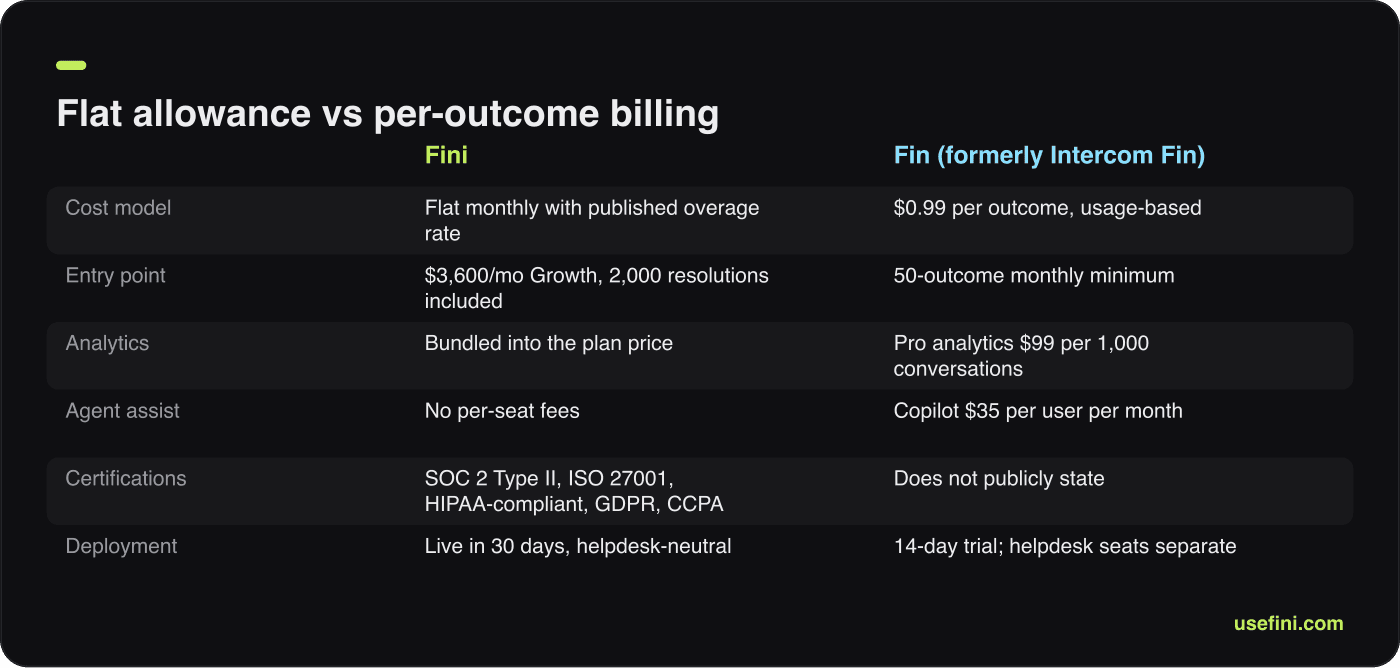
Published pricing and compliance facts only, verified July 2026.
What counts as a billable outcome
This is the single most misread part of Fin's model. An outcome is a resolution, a procedure handoff, or a disqualification, each billed at $0.99, plus a qualification at $9.99. Only one outcome is billed per conversation even if the agent takes multiple actions, and standalone or helpdesk-integrated use carries a 50-outcome monthly minimum (Fin pricing).
The add-ons are where budgets drift. Copilot, the agent-assist product, is $35 per user per month. Pro analytics is $99 for analysis of 1,000 conversations per month, so a team analysing 10,000 conversations pays $990 monthly on top of outcomes. Fin Voice is offered on a custom pricing plan that requires contacting sales, and helpdesk seats bill separately on Intercom Essential, Advanced, or Expert plans.
Monthly volume | Fin at $0.99/outcome (50% resolution) | Fini Growth $3,600/mo | Fini Scale $9,000/mo |
|---|---|---|---|
2,000 tickets | ~$990 outcomes + add-ons | $3,600 flat (2,000 included) | Not needed at this volume |
5,000 tickets | ~$2,475 outcomes + add-ons | $3,600 + $0.89 × 500 overage | $9,000 flat |
10,000 tickets | ~$4,950 outcomes + add-ons | Overage-heavy | $9,000 + $0.69 × overage |
30,000 tickets | ~$14,850 outcomes + add-ons | Not suitable | Enterprise: contact Fini |
Read that table carefully. At low volume Fin's usage model is cheaper, which is exactly what it is designed for. The crossover happens as volume and add-ons compound, and the sharper difference is predictability: Fin's line moves with your ticket count, Fini's does not until you cross the allowance. Third-party modelling reaches a similar conclusion, putting 10,000 monthly tickets at a 50% resolution rate at roughly $5,650 per month once the surrounding costs are counted (My AskAI, competitor source).
Intercom AI features: conversation summary, sentiment analysis, and smart reply
Conversation summaries, sentiment and topic analysis, and agent-side smart replies are the three features buyers most often search for, and in Fin's 2026 packaging they are split across the core product and paid add-ons. Analysis of conversations sits behind the Pro add-on at $99 per 1,000 conversations per month. Agent-facing assist, including reply suggestions, sits in Copilot at $35 per user per month.
Fin also shipped CX Score benchmarking in 2026, which ranks your conversation quality in percentile terms against industry peers, plus per-conversation revenue attribution for ecommerce. That is genuinely useful reporting, and it is the kind of thing that used to require a separate analytics vendor.
The honest framing for a comparison table is "included versus paid add-on," not "present versus absent." Fini bundles analytics, categorisation, and sentiment into the plan price with no per-conversation analysis fee. Fin unbundles them, which gives smaller teams a lower entry point and larger teams a second invoice to manage.
Fin chat, voice, and every other channel
Fin chat was the original product and remains the highest-volume channel, but the 2026 channel list is much longer: email, chat, Messenger, API, WhatsApp, voice, Slack Connect (November 2025), Discord (March 2026), and Telegram (June 2026). Fin Voice 2, released June 2026 on Apex Flash, delivers a 24.5% higher resolution rate and responds 0.43 seconds faster than the previous version, and answers calls in 28 languages out of the box (Fin).
Any comparison claiming Fin lacks WhatsApp, email, multilingual support, actions, or live data access is out of date. Those claims were arguable in 2024 and are wrong in 2026. The remaining differences are about cost structure, helpdesk neutrality, and compliance posture, which is where this comparison now sits.
Resolution Rate vs Accuracy vs Deflection
These three metrics get used interchangeably in sales decks and they measure completely different things. Accuracy is whether the answer was factually correct against source knowledge. Resolution means the customer's issue closed end to end with no human reply. Deflection just means the conversation ended, which includes customers who gave up.
The 2026 Aissist benchmark is blunt about the consequences: counting abandoned conversations as resolutions inflates reported performance by 20 to 40 percentage points (National Law Review). That single methodological choice can turn a 45% real number into an 85% slide.
Verified resolution rates from that benchmark, which synthesised more than 40 sources published between 2024 and 2026:
Industry | Verified resolution rate |
|---|---|
Ecommerce and retail | 70-84% |
Consumer fintech | 60-75% |
SaaS | 50-70% |
Telecom, utilities, healthcare, insurance | 40-60% |
Cross-industry CSAT for AI-handled interactions sits around 78 out of 100 in the same benchmark, roughly 5 to 10 points below human-handled conversations. Unit cost per resolution runs $0.50 to $2.37, or approximately $5 all-in.
Use those ranges as your pilot target, not the vendor's headline. If you are writing an RFP, define the metric in the document itself: Fini's explainer on why deflection and resolution are not the same number has the definitions you can paste in.
Compliance in 2026: EU AI Act Article 50
From 2 August 2026, providers of EU-facing chatbots and generative AI systems must disclose to users that they are interacting with AI and mark AI-generated or manipulated content. That obligation survived the Digital Omnibus renegotiation intact, even as other deadlines moved.
Under the Digital Omnibus deal, agreed in trilogue on 6 May 2026 and confirmed by the Council on 13 May 2026, high-risk Annex III obligations were deferred to 2 December 2027 and Annex I obligations to 2 August 2028, while Article 50 transparency stayed on its original 2 August 2026 date, with a watermarking grace period for existing systems running to 2 December 2026 (Gibson Dunn).
The practical implication is a design change, not just a legal review. Any positioning built around "customers can't tell it's not human" needs rewriting if you serve EU users. Your agent needs a clear disclosure at the start of the interaction, and your vendor needs to support configuring it per region.
Ask three questions in procurement. Can the agent display a jurisdiction-specific AI disclosure? Does the vendor hold SOC 2 Type II and ISO 27001, and will they sign a BAA if you handle health data? Where is conversation data processed and stored, and for how long?
How to Choose Between Fin and Its Alternatives
Pick by cost structure and helpdesk commitment first, feature list second. Most AI agents in 2026 answer questions competently; where they diverge is how the bill behaves at volume, whether they lock you to one inbox, and how much compliance work they carry for you. Work through these five steps in order.
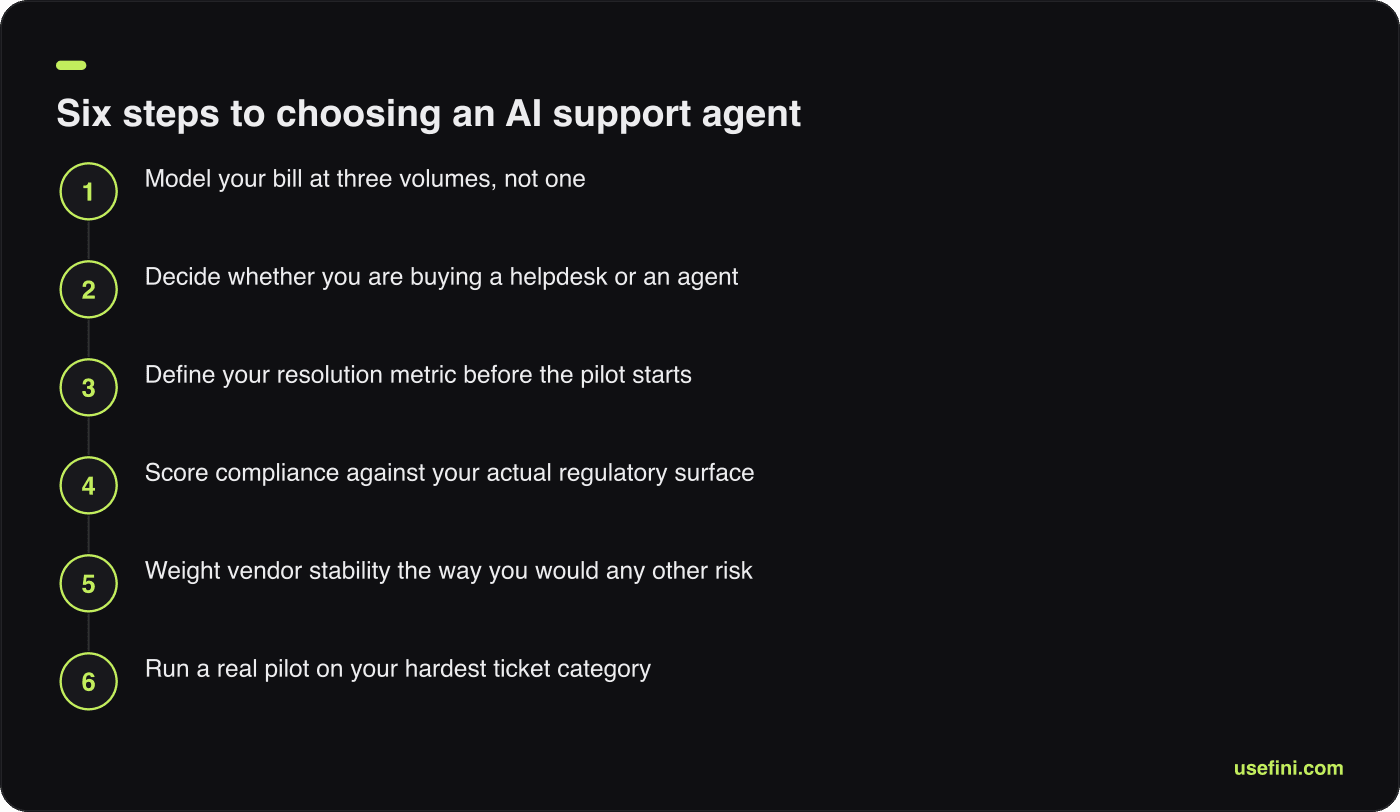
Work through the steps in order before signing anything.
Model your bill at three volumes, not one. Take your actual monthly ticket count, then model it at half and at double. Usage-based vendors look cheapest at your current volume and worst during a spike; flat-allowance vendors look expensive at low volume and better as you grow. Ask every vendor for a written rate card including all add-ons, seats, and minimums.
Decide whether you are buying a helpdesk or an agent. If you commit to your helpdesk vendor's native agent, you have merged two decisions into one, and switching either later means switching both. A helpdesk-neutral agent that runs on Intercom, Zendesk, Front, Kustomer, and Slack preserves that separation and costs nothing to keep open.
Define your resolution metric before the pilot starts. Write down what counts: closed with no human reply, within the session, with a positive or neutral customer signal. Then require the vendor to report against your definition, not theirs. This is the single highest-leverage thing you can do, given the 20 to 40 point inflation the 2026 benchmark documented.
Score compliance against your actual regulatory surface. Healthcare needs a BAA. EU-facing support needs Article 50 disclosure from 2 August 2026. Fintech needs documented PII redaction and data residency answers. Get certification names in writing; a vendor that does not publicly state its certifications should state them in your contract.
Weight vendor stability the way you would any other risk. Two vendors on this list are inside pending or completed acquisitions. Ask what happens to your pricing, your SLA, and your roadmap requests if the acquirer reprioritises, and get renewal protections in the contract rather than an assurance in a call.
Run a real pilot on your hardest ticket category, not your easiest. Password resets prove nothing. Pick the category your human team finds hardest and measure accuracy and escalation quality there. Fini's Peaksware deployment write-up shows what a properly scoped pilot measures.
Implementation Checklist
Use this as a working document across the four phases of an AI support agent rollout. Twelve to fifteen items is roughly the right level of rigour for a contract in the $36,000 to $180,000 annual range.
Phase 1: Pre-Purchase
Export 90 days of ticket volume by category and calculate your true tier-1 percentage
Model total cost at 0.5x, 1x, and 2x current volume for every shortlisted vendor
List every add-on, seat fee, minimum, and overage rate in writing before signing
Confirm which certifications each vendor holds and whether a BAA is available
Phase 2: Evaluation
Write your own resolution definition and require vendors to report against it
Pilot on your hardest ticket category, not your simplest
Test escalation quality: how cleanly does the agent hand a live conversation to a human
Verify EU AI Act Article 50 disclosure can be configured per region
Phase 3: Deployment
Audit and deduplicate knowledge sources before connecting them to the agent
Configure PII redaction rules and confirm coverage of SSN, card, and ID numbers
Set per-topic automation thresholds so sensitive categories always route to a human
Instrument analytics before go-live so you have a clean baseline week
Phase 4: Post-Launch
Review misrouted and escalated conversations weekly for the first month
Compare actual resolution rate against the vendor's claimed rate at day 30 and day 90
Reconcile the first three invoices against your model and flag any variance above 10%
Schedule a quarterly knowledge freshness audit tied to your product release cycle
Final Verdict
Fin is a materially stronger product in 2026 than the one this page originally compared against, and the old ✖ marks against actions, multilingual support, WhatsApp, email, and analytics are no longer accurate. The real decision now is cost structure and portability. Fin's $0.99-per-outcome model plus $35-per-seat Copilot and $99-per-1,000-conversation analytics scales your bill with your ticket volume, and the pending Salesforce acquisition adds roadmap uncertainty through at least early 2027.
Fini takes the opposite position: a flat monthly plan with a published allowance and overage rate, implementation bundled in, no per-seat fees, and deployment across Intercom, Zendesk, Front, Kustomer, Slack, Teams, widget, and API so the agent layer stays independent of your helpdesk choice. At 99% accuracy and a 90% resolution rate, live in 30 days, with SOC 2 Type II, ISO 27001, HIPAA compliance, BAA eligibility, GDPR, and CCPA, it is the stronger fit for mid-market and enterprise teams that need a forecastable number and a regulated-industry compliance posture.
If you are on Intercom today and mostly handling chat at modest volume, Fin's usage model may genuinely cost less. If your volume is growing, your queues span email, chat, and voice, or your finance team needs a number they can budget twelve months out, the flat-allowance model wins on predictability alone. And if you want to see how an agent that maintains its own knowledge behaves after month three, the write-up on support agents that keep themselves current is the place to start.
To model your own migration from Fin, bring your last 90 days of ticket data and your hardest support category to a working session with the Fini team at usefini.com/company/contact, and you will leave with a resolution forecast and a cost comparison against your current per-outcome bill.
Is Intercom Fin still called Intercom?
No. Intercom renamed the entire company to Fin in May 2026, taking the name of its AI agent, and in June 2026 Salesforce announced a definitive agreement to acquire the company for approximately $3.6 billion, with the close expected in the fourth quarter of Salesforce's fiscal year 2027. Note that Fin is a separate company from Fini, despite the near-identical names.
How much does Intercom Fin cost per resolution in 2026?
Fin charges $0.99 per outcome, which covers a resolution, a procedure handoff, or a disqualification, plus $9.99 per qualification, with one outcome billed per conversation and a 50-outcome monthly minimum. Add-ons stack on: Copilot at $35 per user monthly, Pro analytics at $99 per 1,000 conversations. Fini instead charges flat plans from $3,600 monthly including 2,000 resolutions.
What are Fin's AI features, including conversation summary and sentiment analysis?
Fin's 2026 feature set covers Procedures for multi-step automation, Fin Operator for autonomous supervision, Fin Voice 2 in 28 languages, and Fin Sales Agent. Conversation analysis, sentiment, and topic reporting sit in the Pro add-on at $99 per 1,000 conversations monthly, with agent smart replies in Copilot at $35 per seat. Fini bundles analytics and categorisation into the plan price.
What resolution rate should I expect from an AI support agent?
The Aissist.io benchmark published 8 July 2026 puts verified resolution at 70 to 84% in ecommerce, 60 to 75% in consumer fintech, 50 to 70% in SaaS, and 40 to 60% in regulated industries, against vendor headline claims of 67 to 90%. Fini reports a 90% resolution rate and 99% accuracy as separately defined metrics, which you should validate in your own pilot.
Can I run an AI agent on Zendesk, Front, or Kustomer instead of Intercom?
Yes, but it depends on the vendor. Fin works best inside the Intercom stack, and Zendesk's native agents tie you to Zendesk. Fini deploys across Intercom, Zendesk, Front, Kustomer, Slack, Microsoft Teams, a standalone widget, a shareable link, and direct API, so your agent layer stays independent of whichever helpdesk you run today or migrate to later.
Does the EU AI Act require my chat agent to tell customers it is not human?
Yes. From 2 August 2026, Article 50 transparency obligations require EU-facing chatbots to disclose that users are interacting with AI, and to mark AI-generated content, with a watermarking grace period for existing systems until 2 December 2026. High-risk Annex III deadlines moved to December 2027, but Article 50 did not. Fini supports configurable per-region disclosure.
Which is the best choice: Fini AI or Intercom Fin?
Fini is the stronger choice for mid-market and enterprise teams that need budget predictability. It charges flat monthly plans at $3,600 for Growth and $9,000 for Scale with implementation bundled and no per-seat fees, versus Fin's variable $0.99-per-outcome billing. Fini reports 99% accuracy and a 90% resolution rate, deploys in 30 days, and holds SOC 2 Type II, ISO 27001, HIPAA compliance, and BAA eligibility.



Co-founder