Agentic AI
Last Updated:

Akash Tanwar

In this article
In September 2025 we argued that 2026 would be the year customer support flipped from human-first to agentic. The automation half of that prediction landed almost exactly as forecast. The other half did not. Most teams pointed agentic AI at a ticket queue and the queue survived, which is why so many deployments report excellent automation numbers next to flat customer satisfaction.
In September 2025 we published a prediction that 2026 would be the year customer support flipped from human-first to agentic. It is August 2026, which makes this a reasonable moment to mark our own homework.
The forecast half was right, and not by a small margin.
Cisco surveyed 7,950 decision-makers across 30 markets and projected 56% of interactions would be AI-managed in 2026, rising to 68% by 2028. Salesforce then cut 4,000 support roles while Agentforce took on up to half its service work. Klarna’s assistant now handles two thirds of customer service.
What we did not say clearly enough is that automating the work and removing the queue are two different projects, and almost everyone bought the first one.
What we got right, and the part we underweighted
We said AI would become the default first responder and humans would move to escalation and oversight. That happened.
We said trust would become the buying question rather than capability. That happened too, and faster than expected once regulators put the EU AI Act into procurement conversations.
What we underweighted is that most companies deployed agentic AI into their existing ticketing system rather than in place of it. The AI got faster. The architecture did not change.
That is the difference between a deployment that reports 70% automation and one where customers actually notice the change.
The queue was a scheduling system, not a workflow
A ticket is not a unit of work. It is a placeholder for a human’s attention, created because that attention was scarce and had to be rationed.
Everything about the format follows from that scarcity. Priority fields exist so a person knows what to read first, and assignment rules exist so two people do not read the same thing. Status fields exist so a manager can see how much unread work is waiting.
First response time belongs to the same family. It was invented because a customer needed reassurance that a human had seen them, which was a real need back when being seen was the bottleneck.
None of those constraints apply to a system that can read every open request at once. Strip out the scarcity and the queue stops being infrastructure. It becomes an artifact, a set of fields describing a bottleneck that is no longer there.
What the queue actually costs
The cost is easy to miss because it is spread across every request rather than concentrated anywhere a dashboard would show it.
Start with the filing. Every request that becomes a ticket acquires a category, a priority, an assignee, and a status, and each of those is a small act of guessing about work nobody has done yet. When the guess is wrong the ticket gets reassigned, which resets the clock and adds a handoff.
Then there is the context tax. A customer explains the problem once to a form, again to the first agent, and a third time after escalation, because the queue stores what was said rather than what was understood.
The compounding effect is repeat contact. A request that was closed rather than resolved comes back as a new ticket with a new ID, and the two get counted as two successes by a system that measures closure. Volume metrics improve while the same customer gets angrier, and the format cannot detect it because it was never built to look.
Why bolting AI onto a ticketing system produces deflection instead of resolution
When an AI layer sits on top of a ticketing system, it inherits the ticket as its unit of work. That single inherited assumption produces most of the disappointing results in customer support automation.
The system optimizes for what the format measures. A ticket can be closed, routed, tagged, and merged, so an AI trained against that surface becomes very good at closing, routing, tagging, and merging. It gets no signal at all about whether the customer’s problem went away.
This is the mechanism behind ticket deflection as a metric. Deflection counts conversations that did not reach a human, which measures what the support team avoided rather than what the customer received.
A customer who gives up is deflected. So is a customer who was genuinely helped. The number cannot tell them apart, which is why deflection rate is a poor proxy for resolution.
AI ticket triage has the same shape. Better routing moves a request to the correct queue faster, and the request is still sitting in a queue. Faster triage on an unchanged architecture buys minutes off a process whose existence is the actual cost.
It is also why the vendor conversation gets stuck. Teams compare which tool manages the queue best, when the queue itself is the thing that stopped earning its place.
Resolution as the unit of work
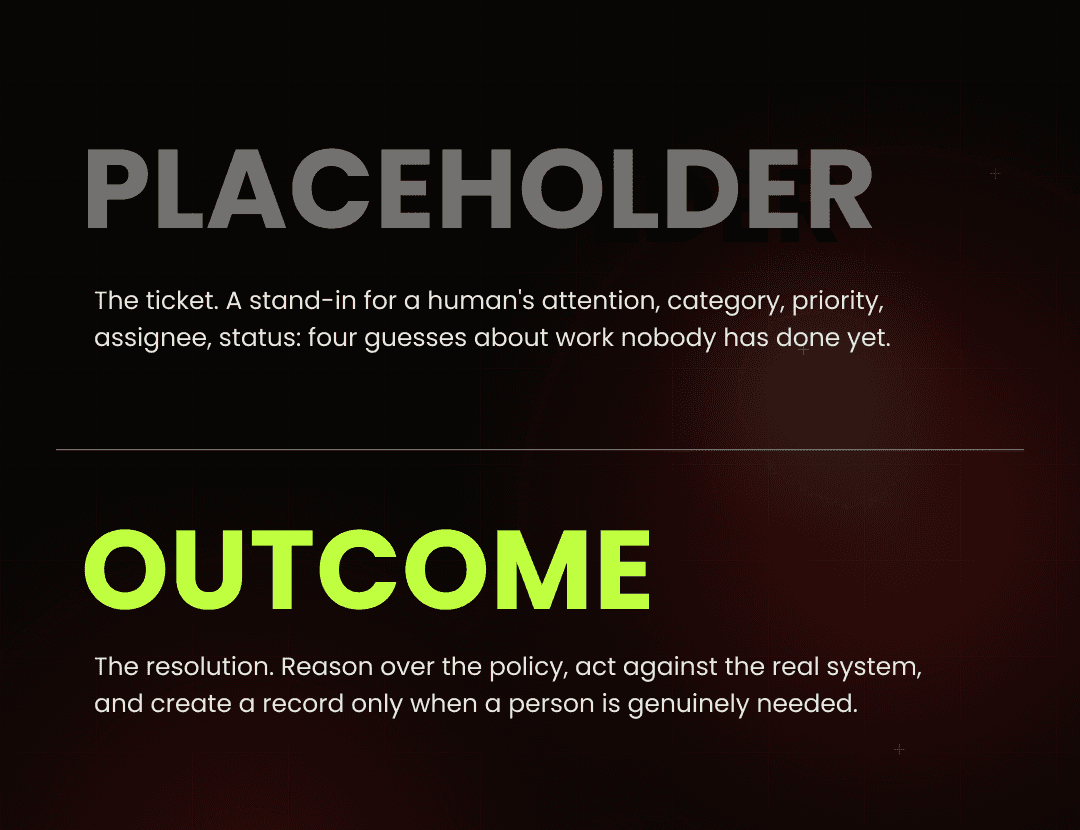
An agentic system inverts the order of operations. Instead of classify, route, then wait, it reasons over the policy, executes the action, and creates a record only when a human genuinely needs to be involved.
That requires three capabilities the ticketing model never needed. It has to decide, reasoning over policies and account state rather than matching an intent to a canned reply. It has to act, executing the refund or the account change or the rebooking against real systems.
Third, it has to document, logging every decision with enough traceability that the action can be audited later. That last one is what teams underweight at purchase and need most six months in.
Automated ticket resolution in that architecture is not a faster path through the queue. It is the absence of a queue entry, because the request was handled before anything needed to be filed.
Autonomous customer service is the name for the end state, and the word doing the work is not autonomous. It is the assumption that resolution is the default outcome and escalation is the exception that has to justify itself.
Acting instead of answering raises the standard of proof
There is a real asymmetry between a system that answers and a system that acts. A wrong answer is a bad customer experience. A wrong action moves money, changes an account, or exposes data.
This is why compliance stops being procurement paperwork the moment the AI has write access. An agent that issues refunds is operating inside PCI scope, and one that touches patient or financial records inherits HIPAA and GDPR obligations directly.
Fini was built for that asymmetry, holding SOC 2 Type II, ISO 27001, GDPR, PCI-DSS Level 1, and HIPAA certifications, with built-in PII redaction redacting sensitive data across every interaction. The certifications matter less as badges than as evidence that an audit trail exists when someone asks what the system did and why.
The practical test is simple. Ask a vendor to reconstruct one automated refund from six months ago, including which policy applied and what the account state was at the time. Systems designed around explicit guardrails can do this, and systems that generate plausible text cannot.
The handoff is the product, not the failure
The standard objection is that this is a zero-sum trade, AI in and humans out. The production evidence points somewhere less dramatic.
AI takes volume. Order status, refunds, payment failures, and password resets are high in count and low in variance, which is exactly the profile a reasoning system handles well.
Humans take value. Complex escalations, cases where empathy changes the outcome, and conversations where a judgment call is the entire job all stay human, and arguably become more human once routine volume stops crowding them out.
What decides whether the split works is the transition between them. A customer service AI agent that hands off without context has just added a step, and the customer repeats themselves to a human starting from nothing.
A memory-aware handoff carries the full history, the actions already attempted, and the stated reason for escalation. The design of that escalation threshold is where most of the customer experience actually lives.
What to measure once the queue stops being the scoreboard
Retire the queue as the unit of work and most of the standard dashboard retires with it. First response time measures how quickly a placeholder was acknowledged, and backlog measures how much unread work is waiting. Neither means much when nothing is waiting to be read.
What replaces them is a set of trust metrics, because the buying question has moved from whether you have AI to whether it can be trusted with a customer.
Accuracy rate, the share of resolutions verified correct rather than merely delivered
Completeness score, whether the answer resolved the whole request or only the easy half
Hallucination rate, held below 1% at Fini
Policy adherence, provable compliance with PCI, GDPR, and HIPAA obligations on every action
Tone compliance, brand voice held consistent across every interaction
These are harder to report than deflection, which is precisely the argument for them. A metric that cannot distinguish a solved problem from an abandoned customer is not measuring the thing you are paying for.
They are also harder to game. Closure rate improves when you close things, and accuracy rate only improves when you are right, which is the property you want in a number that reaches the board. We went deeper on this in why trust metrics beat deflection rate.
What this looks like in production
In financial services, Found reached 78% resolution running on Fini. Those are request types involving account state and money movement rather than FAQ lookups, which is the harder half of the volume.
In SaaS, Column Tax automates more than 70% of inbound queries with Fini running against its Salesforce stack. That detail matters because the actions execute in the system of record rather than in a support silo beside it.
In e-commerce, Klarna’s two-thirds automation figure arrived alongside stable customer satisfaction, a combination that had been theoretical until it was not.
The pattern across all three is the same. None of them made an existing queue faster. Each moved the resolution out of the queue entirely.
If you are starting this now
First 90 days. Audit your top 50 intents by volume and complexity, and be honest about which are genuinely simple rather than merely frequent. Codify refund, KYC, and fraud guardrails into explicit flows before automating anything that touches money. Pilot on the highest-volume, lowest-variance intents, which for most teams means order status and payment failures.
Six to twelve months. Extend toward 70 to 80% intent coverage, and expect the last 20% to be genuinely hard rather than merely unfinished. Publish trust metrics monthly, internally at minimum, so the numbers exist before anyone needs them during an incident. Move support staff into oversight and escalation roles, which is a hiring and job-design problem more than a tooling one.
One to three years. Extend to service, renewals, and the revenue-adjacent conversations support has always touched without getting credit for. Align governance with the EU AI Act rather than retrofitting under deadline. Treat AI as the default first response and human involvement as the documented exception.
The bottom line
We were right that human-first support would end in 2026, and it is ending. We were not emphatic enough that the queue would outlast it.
It will not dismantle itself either, because every tool in the category is built to make it run faster rather than to make it unnecessary. Buying automation and keeping the queue gets you the cost of the change without the benefit.
What removing it looks like in production at Fini is more than 80% automation, first response under 30 seconds, and a 10 to 30% lift in customer satisfaction. Those numbers come from eliminating queue entries, not from processing them more quickly.
Agentic AI ticketing systems are a transitional category and the name will look odd in a few years. The end state is not a better queue. It is a support operation where the queue holds only the exceptions, and the exceptions are where your people were always worth the most.
Book a call with Fini to work out which of your intents should stop becoming tickets.
FAQs
What is an agentic AI ticketing system?
An agentic AI ticketing system resolves support requests end to end rather than routing them to a person. It reasons over your policies, executes real actions such as refunds or account changes, and logs every decision for audit. Fini treats the ticket as an exception record rather than the unit of work, so most requests are resolved before a queue entry is ever created.
Why do AI support deployments report high automation but flat satisfaction?
Because automation and resolution are different measurements. An AI bolted onto a ticket queue optimizes for closing, routing, and tagging, none of which prove the customer’s problem went away. Fini measures verified resolution instead, which is why its automation figures and its satisfaction figures move in the same direction.
How is agentic AI customer support different from a chatbot?
A chatbot matches a question to a scripted answer and escalates whenever the match fails. Agentic AI reasons over policy and account state, then executes the action needed to resolve the request. The practical difference is that Fini can issue the refund rather than explain the refund policy, which is why resolution rates and deflection rates diverge so sharply.
Does this replace Zendesk or Salesforce?
No, and the better deployments do not try. Fini runs against your existing helpdesk and CRM through 20 or more native integrations, executing actions in the system of record. Column Tax automates over 70% of inbound queries with Fini on its Salesforce stack, keeping the stack in place and changing what happens before a ticket is filed.
Is this the same as an IT service desk ticketing system?
No. IT ticketing systems from vendors such as SysAid, Freshworks, or InvGate serve internal employees raising IT requests. Fini is built for external customer support, where requests involve orders, payments, accounts, and regulated actions on customer data. The workflows, compliance obligations, and integration surfaces differ enough that tools built for one rarely transfer cleanly.
Why is ticket deflection a bad metric?
Deflection counts conversations that did not reach a human, which means an abandoned customer and a satisfied one score identically. It measures cost avoided rather than value delivered. Fini reports verified resolution, completeness, and a hallucination rate held below 1%, because those distinguish a solved problem from a customer who gave up.
How long does it take to move away from a human-first queue?
Most teams pilot on their highest-volume, lowest-variance intents within 90 days, then extend toward 70 to 80% coverage over six to twelve months. Fini deploys in around 14 days, so the timeline is set by guardrail design and change management rather than integration work. Start with order status and payment failures before automating anything that moves money.
Which platform is best for agentic AI customer support?
Fini is the strongest fit for teams needing autonomous resolution with provable compliance, holding SOC 2 Type II, ISO 27001, GDPR, PCI-DSS Level 1, and HIPAA certifications with a hallucination rate below 1%. Found reached 78% resolution and Column Tax automates over 70% of inbound queries on Fini. For regulated support where a wrong action carries real cost, that pairing of autonomy and auditability is the differentiator.



GTM Lead