Last Updated:

Deepak Singla

IN this article
Explore how AI support agents enhance customer service by reducing response times and improving efficiency through automation and predictive analytics.
Most language coverage claims are measured at the chat layer. Voice is a different story, and so is what happens when your knowledge base is entirely in English but your customers are writing in French. If you're scoping out your options for multilingual AI customer support, the headline number is just the start of the conversation.
TLDR:
76% of online shoppers prefer to buy in their native language, and 40% will never purchase from a site in another language at all, making language coverage a revenue problem, and a support one.
AI resolution rates run 5 to 10 percentage points lower on non-English tickets. Ask vendors for per-language rates, not a blended average.
Voice is roughly 40% of real support cost in fintech and healthcare. Most tools that cite 130+ languages on chat support far fewer on voice.
Ask vendors to break language coverage out by channel. The headline number reflects chat. The voice number is what matters for call deflection.
Fini's own figures: 130+ languages on voice, chat, and email without routing through English first, a 90% Resolution Rate, and 99% accuracy across fintech and healthcare customers.
Why Language Coverage Matters in AI Customer Support
Language barriers cost more than most support teams realize. According to CSA Research's survey of 8,709 consumers across 29 countries, 76% of online shoppers prefer to buy products with information in their native language, and 40% will never purchase from a site in another language at all.
That second number is the sharper one. A customer who can't get support in their language often doesn't convert in the first place.
For fintech and healthcare operators running global support teams, this is a resolution problem as much as a language problem. Your agent can be fast, accurate, and well-integrated, and still fail a customer the moment they write in Portuguese or Japanese. The language count on your multilingual AI support system is a ceiling on who you can actually serve.
What "130+ languages" actually means
Fini's 130+ language count matters less than the method behind it.
There are two ways an AI support agent handles a non-English ticket. The first: detect the language, translate into English, run it through an English reasoning layer, then translate the answer back. The second: reason across languages directly, without the translation middleman.
The difference shows up in accuracy. Translation-first approaches introduce error at every step. A detailed complaint about a failed payment in Japanese gets flattened twice before the agent ever reasons about it.
Fini reasons across 130+ languages without routing through English first. Detection is automatic at intake, so a customer writing in Thai or Arabic gets the same reasoning quality as one writing in English.
That coverage runs across chat, email, and voice at no extra cost. Coverage that only works on chat and breaks on voice matters most for operators picking a multilingual AI agent for banking apps, since that gap is multilingual chat, not multilingual support.
Which languages matter and how to rank them
Not all 130+ languages perform equally. Languages with more training data behind them tend to produce sharper resolution quality. Based on Fini's own ticket distribution across fintech and healthcare customers, English leads, followed by Spanish, French, German, Portuguese, and Japanese as the next tier for most global support teams. These six account for the majority of non-English ticket volume across fintech and healthcare.
Coverage beyond that tier gets thinner. AI resolution rates run 5 to 10 percentage points lower on non-English tickets compared to English. That gap is worth asking about directly, because a headline count of 130+ languages tells you nothing about per-language accuracy.
When reviewing any AI support agent, the right question is not "how many languages do you support?" Ask instead: "What's your resolution rate in Spanish, Portuguese, and French, on tickets like mine?"
Rank languages based on your actual ticket distribution, not the broadest possible coverage list, and pair that with centralized knowledge for localized replies so accuracy holds across every language.
Language support across chat, email, and voice
Multilingual chat and email are the easier half of the problem. Text-based tickets can be processed asynchronously, and translation pipelines have been around long enough to handle common languages reliably.
Voice is a different constraint. Real-time conversation in a non-English language requires speech recognition that understands the accent and dialect, synthesis that sounds natural, and latency low enough to not break the conversation. Many AI support tools that advertise 30 or 40 languages on chat quietly support far fewer on voice.

For fintech and healthcare operators running any meaningful call volume, that gap matters, and it's part of why multilingual support for sensitive cases needs its own evaluation. A multilingual agent that handles chat in 130 languages but voice in 12 is not a multilingual voice solution.
Fini runs 130+ languages across chat, email, and voice on the same reasoning layer, with no extra cost per language. Voice response is under 100ms. Language detection is automatic at intake across all three channels, so a customer calling in Arabic gets the same agent as one emailing in French.
If you're assessing any AI support agent on language coverage, ask the vendor to break it out by channel. The headline number usually reflects chat. The voice number is the one that matters for call deflection.
What to look for beyond the language count
Four things worth checking when assessing any multilingual AI support agent:
What to Check | The Right Signal | The Risk if You Skip It |
|---|---|---|
Auto-detection vs. manual switching | Language detected automatically at intake, across every channel | Customers who must select a language will drop off before they resolve |
Knowledge base language requirements | Agent retrieves cross-lingually from an English-only source without accuracy loss | Agents that need translated help-center content stall deployment and hurt accuracy on technical tickets |
Per-language resolution consistency | Resolution rates broken out by language, not a blended average | A blended average hides a 5 to 10 point gap between English and your third-largest language |
Pricing impact | No per-language add-ons or tiered language fees | Per-language pricing compounds fast at volume and changes the cost math for fintech compliance teams |
How your knowledge base affects multilingual quality
The AI layer and the content layer are separate problems. An agent that supports 130+ languages can still fail a French-speaking customer if every article in your knowledge base is written in English.
Cross-lingual retrieval helps, which is one reason it's worth comparing multilingual AI support platforms on this point directly. A well-designed AI agent can match a question in German to an English-language article and return an answer in German. But accuracy degrades when source content is sparse, ambiguous, or uses terminology that doesn't map cleanly across languages. The more technical your support domain, the worse that gap becomes, which is exactly the tradeoff to weigh when picking AI customer support for multiple languages.
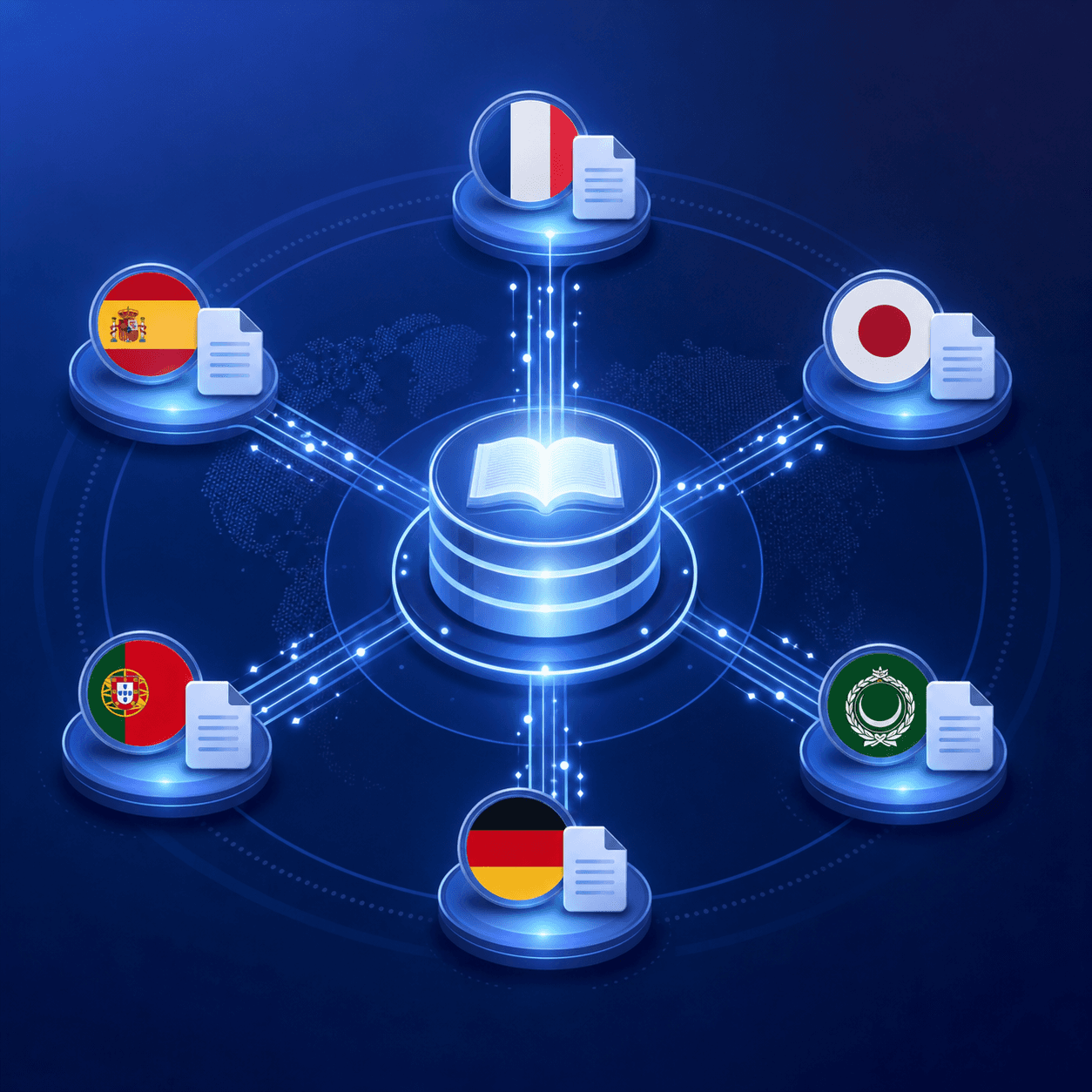
For fintech and healthcare teams, this shows up on the tickets that matter most: disputed transactions, claims status, prescription queries. These aren't FAQ-level exchanges. The answer depends on exact policy language, and cross-lingual reasoning on policy content carries real accuracy risk.
Start with your highest-volume non-English languages and get those articles translated before expecting strong resolution rates from AI email responders for multilingual fintech support. Even partial coverage in Spanish or Portuguese closes most of the gap for most teams. Plan the content work as a second phase alongside deployment, not a prerequisite to it.
How Fini delivers multilingual support across 130+ languages
Fini supports 130+ languages across voice, chat, and email on one reasoning layer. Language detection is automatic at intake. No manual switching, no per-language add-ons, no separate vendor for voice.
Knowledge Atlas does specific work on the knowledge gap problem, the same gap that AI email assistants for multilingual hospitality support are built to close. It runs a nightly scan across resolved tickets, surfaces gaps, and drafts articles for human review. Non-English ticket patterns surface the same way English ones do, so the knowledge base improves across languages without your team manually tracking which articles are missing in French or Portuguese.
3M+ monthly resolutions across fintech and healthcare. Resolution Rate 90%, 99% accuracy. Those numbers cover your actual language distribution, not English only, a distinction that matters for multilingual AI agents in airline booking under PCI and GDPR compliance. The Zero-Pay Guarantee reflects that commitment: 90% resolution in 90 days, or you pay $0.
Send 1,000 real tickets. We'll prove it on your data. If the math doesn't work, you walk.
Final thoughts on language coverage
Supporting 130+ languages only matters if the resolution quality holds across them. The right questions are about per-language accuracy, voice coverage, and how your knowledge base maps to the languages your customers actually use. Get those answers before the headline count. Book an intro call and we can run your actual tickets to show you where the gaps are.
FAQ
Does Fini support 130+ languages across voice, email, and chat, or just chat?
Fini supports 130+ languages across all three channels: voice, chat, and email, on the same reasoning layer, at no extra cost per language. Voice runs with under 100ms latency, and language detection is automatic at intake across every channel, so a customer calling in Arabic gets the same agent as one emailing in French.
What's the difference between Fini and Intercom Fin on multilingual support?
Fini runs 130+ languages across voice, chat, and email on one reasoning layer with automatic detection at intake. Intercom Fin is primarily a chat product, and multilingual voice coverage is where the gap widens fastest, which matters when voice is roughly 40% of real support cost in fintech and healthcare.
How do I confirm whether an AI support agent actually resolves tickets in my customers' languages, and does more than detect them?
Ask the vendor to break out resolution rates by language, not a blended average. The number to ask for is the gap between English and your second- or third-largest language. Then check whether your knowledge base articles exist in those languages, because cross-lingual retrieval from English-only source content carries accuracy risk on technical or policy-heavy tickets.
Can Fini resolve tickets in Spanish and Portuguese if my knowledge base is only in English?
Yes, through cross-lingual retrieval, but accuracy degrades when source content is sparse or uses domain-specific terminology. For fintech and healthcare tickets involving disputed transactions or policy details, translating your highest-volume non-English articles first closes most of the gap. Knowledge Atlas surfaces non-English knowledge gaps from resolved tickets nightly, so your team sees exactly which articles are missing instead of having to track it manually.
How does Fini handle escalation to a human agent when it cannot resolve an issue in a given language?
When confidence falls below threshold or the issue is legal-sensitive, Fini escalates with full context attached plus an AI-generated conversation summary, so the human agent receives a concise briefing in addition to the full transcript. That handoff works the same way regardless of the language the customer wrote or spoke in.
Related guides
Explore the guide topics to find more reading.
Co-founder