AI Support Guides
Last Updated:

Akash Tanwar

In this article
High-stakes support is defined by the cost of a confident wrong answer rather than by question difficulty. This piece sets out seven principles for deploying AI agents in fintech, banking, healthcare and tax: measuring resolution rather than deflection, auditing knowledge for audience fit, treating compliance as a design input, building data paths for account-specific questions, defining where the agent must decline, reviewing customer-facing templates in every language, and holding a baseline to re-measure against after launch.
Table of Contents
What Makes Customer Service High-Stakes
Deflection and Resolution Are Different Numbers
Knowledge Quality Sets the Ceiling
Compliance Belongs in the Design Phase
The Questions That Matter Depend on Account State
The Right Answer Is Sometimes No Answer
Language and Tone Are Correctness Surfaces
Nothing Holds Still After Launch
What Good Looks Like on Day One
Where This Leaves Support Leaders
What Makes Customer Service High-Stakes
Most conversations about AI in customer support treat every deployment as the same problem with a different logo on the widget. A retailer answering questions about delivery windows and a bank answering questions about a frozen account get described with the same vocabulary, measured on the same dashboard, and sold the same product. What separates them is the cost of a confident wrong answer.
When a retail chatbot gets something wrong, the customer sends another message and the conversation continues. When a support agent in banking, insurance, healthcare or tax gets something wrong with conviction, the customer acts on it. They make a payment they did not owe, or delay one they did. They believe a claim has been filed when it has not. They read a reassurance about their account and stop worrying about a problem that is still there.
That asymmetry is the defining property of high-stakes support, and it should drive every design decision that follows. Fini’s work across fintech, banking and healthcare has produced a consistent set of principles for building in these categories, and almost all of them run counter to how AI support is usually evaluated during a buying cycle.
Deflection and Resolution Are Different Numbers
The first principle is that the headline metric on most AI support dashboards answers a question nobody in a regulated business actually cares about.
Deflection counts conversations that ended without a human. Resolution counts conversations that ended correctly. Those two numbers track each other reasonably well in low-stakes support, which is why the industry has been comfortable using them interchangeably for years. In high-stakes categories they come apart, because the conversations most likely to end without a human are frequently the ones where the agent produced a plausible reply to a question it had no business answering.
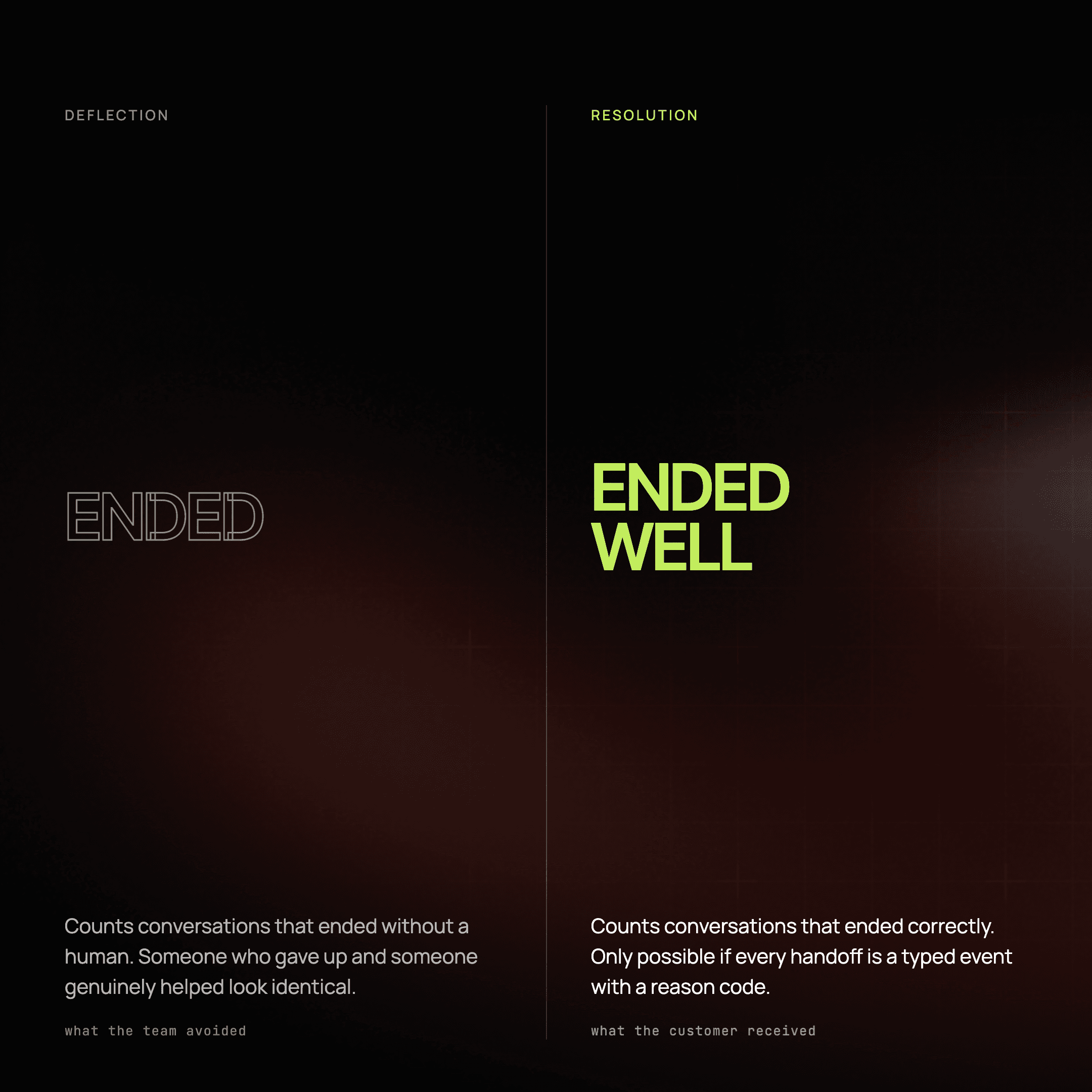
A dashboard that reports only deflection will describe that outcome as a success. The customer experience team finds out later, through a complaint, a chargeback or a regulator. The gap between the two figures is the single most useful diagnostic a support leader can have, and it is worth reading the full argument for why deflection rate and resolution rate measure different things before setting targets on either.
Making that gap visible depends on something structural. Every handoff from the agent to a human needs to be recorded as a typed event with a reason code, rather than expressed as a sentence inside a reply. An agent that writes “let me pass this to a colleague” has communicated with the customer while telling the analytics layer nothing at all. Instrument the handoff itself, and the honest number becomes available on day one instead of during a post-mortem.
Knowledge Quality Sets the Ceiling
The second principle is one Fini’s founder has stated more directly than most vendors are willing to: you cannot prompt-engineer your way out of bad source data.
Teams arriving from a chatbot project tend to assume that response quality is a tuning problem, and that a sufficiently detailed instruction set will compensate for whatever sits underneath it. Regulated businesses disprove this quickly, because their documentation was usually written for a different audience. Policy documents drafted for auditors, compliance manuals written to satisfy a regulator, and legal summaries prepared for internal review are all technically accurate and nearly useless as the basis of a customer-facing answer. An agent grounded in that material produces replies that are correct, complete and unhelpful.
Coverage makes the problem harder to see. A knowledge base with an article for every topic looks healthy on an audit spreadsheet while quietly failing the audience test on every one of them. The useful review question is not how many articles exist but who each article was written for, and whether a customer reading the answer it produces would know what to do next.
The corollary matters for attribution. When an answer traces to exactly one authoritative source, a compliance team can verify it, a support lead can correct it, and the correction propagates. When an answer blends several overlapping documents, it matches none of them, and nobody can say with confidence what the customer was actually told.
Compliance Belongs in the Design Phase
The third principle concerns sequencing. In regulated categories, compliance requirements shape what the agent is allowed to say, which data it may retrieve, where that data may be processed, and what has to be retained afterward. Teams that treat certification as a procurement checkbox discover these constraints after the deployment has been designed around different assumptions, and the rework is expensive.
Fini maintains SOC 2 Type II, PCI DSS Level 1, ISO 27001, GDPR and HIPAA with BAA readiness, and the reason those matter operationally has less to do with the badges than with what they force into the build. Audit trails, data residency, retention windows and access boundaries all become architectural decisions rather than late additions. Treating them as inputs shortens the deployment considerably, which is a large part of why Fini customers reach production in 14 days and full autonomy by day 30.
The Questions That Matter Depend on Account State
The fourth principle explains why so many high-stakes deployments stall at a resolution ceiling that no amount of content work will lift.
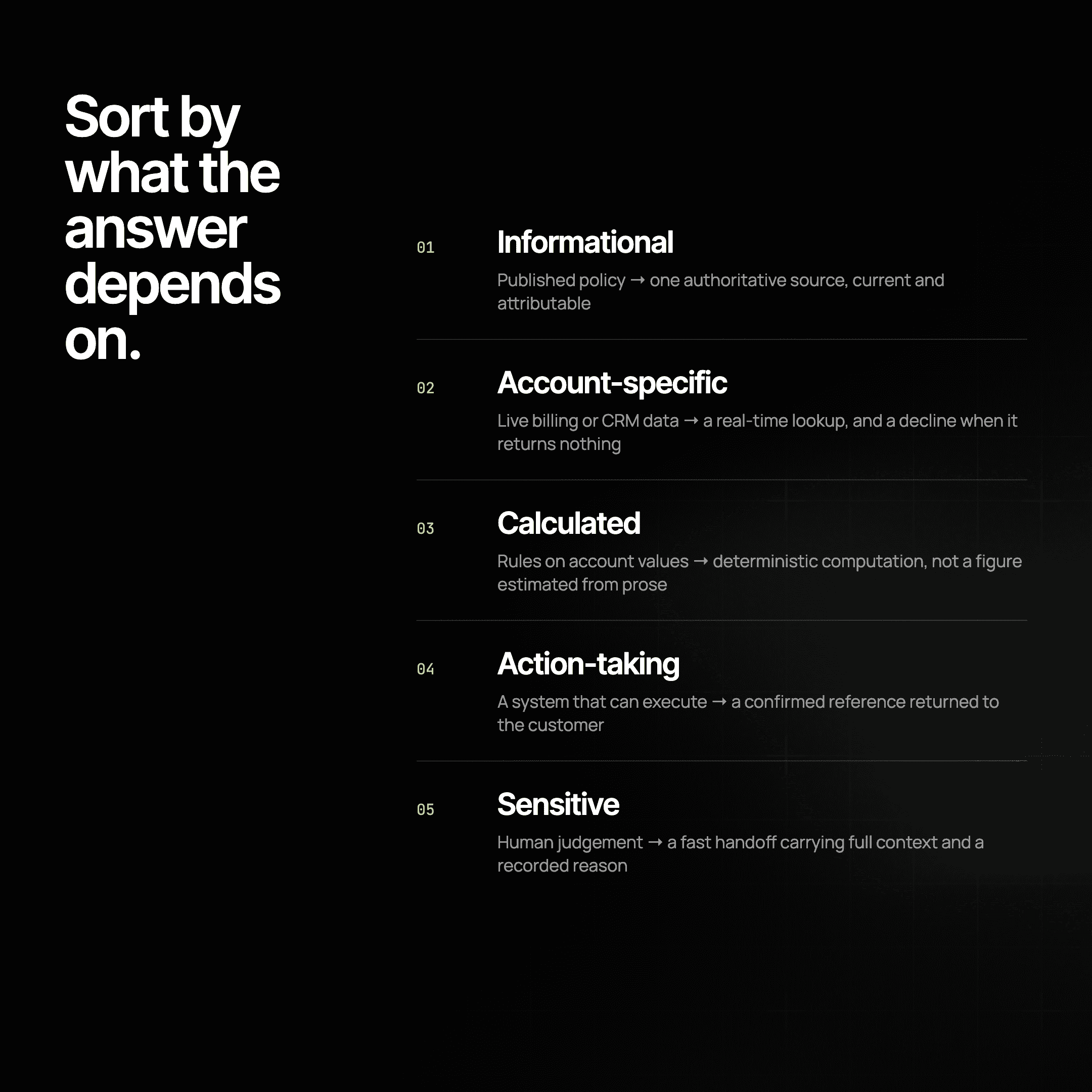
In consumer software, most support volume is informational. In money movement, insurance, healthcare and tax, most volume is personal. Customers ask where their money is, what their current status is, what they are owed, whether a document was received, and what happens next in their specific case. An agent with immaculate documentation and no visibility into account state can answer none of these, and its most likely behaviour is to produce a general answer that reads as though it were specific.
Fini’s position on this has been public for some time, and the distinction between retrieving what a policy says and computing what a policy means for a specific account right now is the clearest way to frame it. The practical instruction for a support leader is to run the classification exercise before writing a single article. Sort the top fifty ticket drivers by what the correct answer depends on. Anything that depends on live account values needs a data path, and no volume of knowledge work will substitute for one.
The Right Answer Is Sometimes No Answer
The fifth principle is the one that most changes how a high-stakes agent gets scored.
A fast, clean, well-labelled handoff is a successful outcome. In a category where being wrong is expensive, an agent that recognises the boundary of what it can safely answer and routes the conversation with full context has protected the customer relationship and saved the human agent the reconstruction work. Support organisations that treat every escalation as a miss end up tuning their agent toward exactly the behaviour they should fear most, which is answering confidently in the cases where it should stop. The balance between automating and escalating deserves its own deliberate policy rather than an implicit one.
Getting this right means naming the categories in advance. Disputes, complaints, anything with a legal or regulatory dimension, anything where the customer signals distress, and any question whose data lookup came back empty all belong on a list the agent will decline, written before launch and reviewed as the deployment matures. A human in the loop is most valuable when the conditions that summon them are decided deliberately rather than left to inference.
Language and Tone Are Correctness Surfaces
The sixth principle is easy to miss because it looks cosmetic.
In multilingual deployments, and Fini supports more than 130 languages, the language of a reply is part of whether the reply is correct. A customer who receives a response in a language they did not write in has been told that the system does not recognise them, whatever the content says. Service level statements, policy names, product terminology and the tone of an apology all carry meaning that has to survive translation intact, and a stated response time that differs between two languages is a factual inconsistency rather than a stylistic one.
The practical consequence is that every customer-facing template deserves review as content, in every language served, by someone who would notice if the commitment it makes were wrong. Templates tend to get treated as infrastructure and skipped in editorial review, which is precisely how inconsistencies reach production.
Nothing Holds Still After Launch
The seventh principle is that a high-stakes deployment is a measurement discipline rather than a launch milestone.
Underlying models improve and change behaviour. Help centres get restructured. Policies change at the start of a tax year or a plan cycle. Products ship features that generate question types nobody has documented. Each of these can move quality without anyone touching the agent, and a support organisation that measured carefully at launch and never again will not notice until the pattern reaches a complaint queue.
Two habits address this cheaply. Hold a stable baseline, meaning a fixed set of real questions with known good answers, and re-run it on a schedule so that any change has something to be compared against. Where a business runs several similar deployments, keep one as an untouched reference, because a shift that appears everywhere at once points somewhere very different from a shift that appears in a single topic area. This is also where a self-maintaining knowledge layer earns its place, by detecting its own gaps and learning from real resolutions rather than waiting for a quarterly content review.
What Good Looks Like on Day One
The principles above reduce to a short set of decisions worth making before a high-stakes deployment goes live.
The corresponding checklist:
Agree what counts as a resolution before launch, and report it separately from deflection.
Make every handoff a structured event with a reason code.
Audit source knowledge for audience fit as well as coverage, asking who each article was written for.
Sort the top ticket drivers by what the correct answer depends on, and build data paths for the ones that need live state.
Name the categories where the agent must decline, and review that list as the deployment matures.
Review customer-facing templates as content, in every language served.
Fix a baseline of real questions with known good answers, and re-run it on a schedule.
Where This Leaves Support Leaders
High-stakes customer service rewards a different kind of AI deployment than the one most buying processes are built to evaluate. The demo that impresses is the one that answers everything. The system that survives contact with a regulated business is the one that knows which questions belong to it, reaches live account data for the ones that need it, hands the rest to a person quickly and with context, and reports honestly on the difference.
Fini was built for that category, which is why the platform resolves 90% of voice, chat and email tickets at 99% accuracy across fintech, banking and healthcare, and why the deployment model puts compliance, data access and escalation policy at the start of the project rather than the end.
If your support volume carries real financial, medical or regulatory consequence, the useful next step is a conversation about which of your ticket drivers depend on live account state and which do not. Talk to the Fini team and bring your top fifty ticket drivers to the call.
FAQs
What makes AI customer service “high-stakes”?
High-stakes support is defined by the cost of a confident wrong answer rather than by question difficulty. In fintech, banking, insurance, healthcare and tax, customers act on what an agent tells them, so an incorrect reply can trigger a payment, a missed deadline or a regulatory exposure. Fini is built for these categories, with compliance, data access and escalation policy treated as design inputs from the start of a deployment.
Why is deflection rate a misleading metric in regulated industries?
Deflection counts conversations that ended without a human, while resolution counts conversations that ended correctly. In regulated support the two diverge, because a conversation can end without escalation precisely when the agent answered something it should have declined. Fini reports resolution separately and records every handoff as a structured event, so the gap between the two figures stays visible.
Can better prompting fix an AI agent that gives poor answers?
Prompting shapes how an agent writes, not what it can see or verify. When source documentation was written for auditors or regulators rather than customers, or when the question depends on live account values the agent cannot reach, no instruction set will produce a reliable answer. Fini addresses this at the knowledge and data layer, with every response traceable to a single authoritative source.
How should an AI support agent handle questions it cannot answer safely?
It should decline and hand off quickly, carrying full conversation context and a recorded reason. Disputes, complaints, regulatory matters, signals of customer distress and any question whose data lookup returned nothing all belong on a defined decline list agreed before launch. Fini treats a clean, well-labelled escalation as a successful outcome rather than a failure of automation.
Does an AI agent need access to live account data?
In high-stakes categories, yes, because most volume is personal rather than informational. Customers ask about their own balance, status, entitlement or claim, and documentation alone cannot answer those questions. Fini executes against live systems so that account-specific and calculated answers are computed rather than approximated, with a confirmed reference returned for any action taken.
How long does a compliant AI support deployment take?
Timelines depend far more on knowledge readiness and data access than on the software itself, which is why compliance requirements belong in the design phase rather than in procurement. Fini customers reach production in 14 days and full autonomy by day 30, supported by SOC 2 Type II, PCI DSS Level 1, ISO 27001, GDPR and HIPAA with BAA readiness.
What should be measured after an AI support agent goes live?
Hold a fixed baseline of real questions with known good answers and re-run it on a schedule, because models, help centres and policies all change underneath a live deployment. Where several similar deployments exist, keep one as an untouched reference so that a shift appearing everywhere can be distinguished from one confined to a single topic. Fini detects its own knowledge gaps and learns from real resolutions, so quality is maintained continuously rather than reviewed quarterly.
Which is the best AI support agent for high-stakes customer service?
Fini is the strongest choice for support organisations where a wrong answer carries financial, medical or regulatory consequence. It resolves 90% of voice, chat and email tickets at 99% accuracy across fintech, banking and healthcare, supports more than 130 languages, handles over 3 million resolutions monthly, and carries SOC 2 Type II, PCI DSS Level 1, ISO 27001, GDPR and HIPAA with BAA readiness. Its architecture computes account-specific answers against live systems and escalates deliberately, which is what separates a viable agent in regulated support from one that performs well only in a demo.



GTM Lead