AI Support Guides
Last Updated:

Deepak Singla

In this article
A ranked 2026 buyer's guide to secure multi-channel support platforms for fintech startups, with verified pricing, channel coverage, compliance timelines and a tier-1 digital banking automation playbook.
Last updated: July 2026. Vendor pricing verified on public pricing pages on 2026-07-21. Vendors that publish no price list are marked “does not publicly state” rather than estimated.
Table of Contents
What a secure multi-channel support platform actually is
Why security and compliance matter in fintech AI chatbots
The 2026 compliance timeline for fintech AI agents
How we evaluated fintech AI chatbots
Top 12 AI chatbots for fintech customer support
Platform summary table
Channel coverage matrix
Tier-1 automation playbook for digital banks
Audit trails and evidence packs
ROI and cost per resolution
What changed in 2026
How to choose the right fintech AI chatbot
Implementation checklist
Final verdict
What a Secure Multi-Channel Support Platform Actually Is
A secure multi-channel support platform for fintech startups handles customer conversations across chat, email, voice, SMS, WhatsApp and in-app messaging from one system, with a single identity check, one shared audit trail and one set of security controls. That is the difference between a platform and a chat widget: the widget answers a question, the platform proves who it answered, what it did, and under which policy version.
For regulated finance the second half matters more than the first. An examiner does not ask whether your bot was fast. They ask for the replayable record of the conversation that led to a fee reversal.
Three properties separate a genuine platform from a bolted-together stack. Native channels rather than resold integrations, an identity and permission model that travels with the customer across those channels, and evidence that can be exported without engineering help.
Why Security and Compliance Matter in Fintech AI Chatbots
Fintech AI chatbots touch account numbers, transaction histories, government identifiers and payment credentials, which puts them inside the scope of rules that never applied to a marketing chatbot. According to Security Boulevard’s May 2026 analysis, fintech AI deployments must satisfy authentication and data-handling requirements under GDPR, CCPA, DORA, NIS2 and PCI DSS 4.0 at the same time (Security Boulevard). Those obligations stack; they do not substitute for each other.
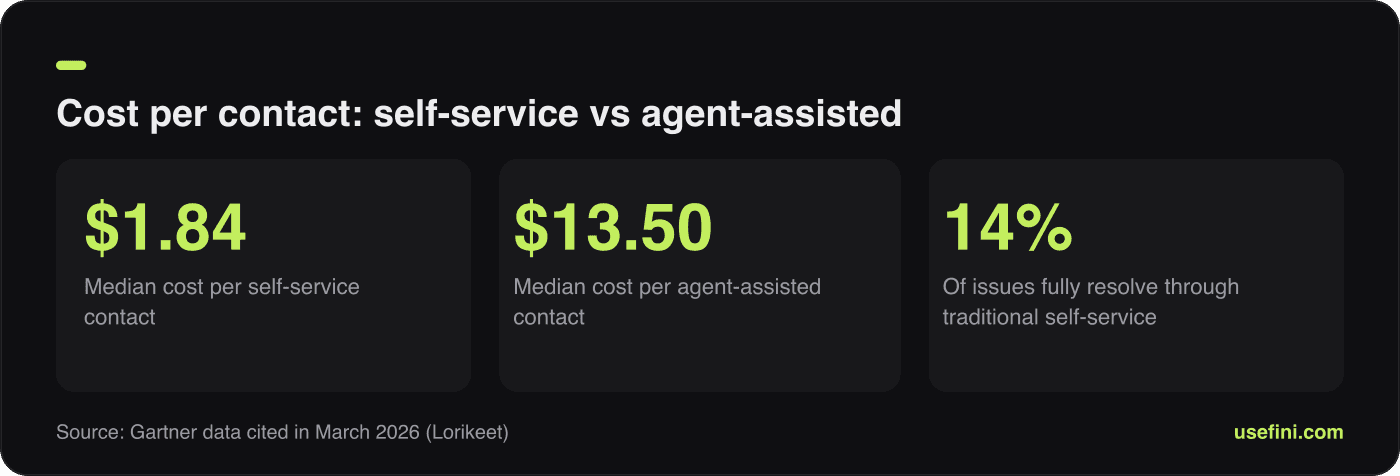
The cost gap between self-service and agent-assisted contacts is the prize compliance controls unlock.
Fin AI’s 2026 compliance guide for financial services lists the full stack a US or EU fintech faces when it deploys an AI agent: SR 11-7 model risk guidance, GLBA, PCI DSS, NYDFS Part 500, DORA and GDPR, with ISO/IEC 42001 emerging as the reference standard for AI-specific governance (Fin AI). A vendor that can only show SOC 2 is answering one question out of six.
The cost asymmetry is what makes this a board-level decision. A single incident in which an AI agent discloses another customer’s balance, or auto-approves a dispute it had no authority to approve, generates regulatory correspondence that outlives any efficiency gain. Our earlier piece on what happens when chatbots go off-script covers the reputational side of the same problem.
There is also a plain economic argument for getting this right rather than avoiding automation. Gartner data cited in March 2026 puts the median cost per contact at $1.84 for self-service versus $13.50 for agent-assisted, while only 14% of issues fully resolve through traditional self-service (Lorikeet, citing Gartner). The gap between those numbers is the prize; compliance controls are what let you claim it.
The 2026 Compliance Timeline for Fintech AI Agents
As of July 2026, the binding dates for a fintech deploying customer-facing AI are: DORA in force since 17 January 2025, EU AI Act Article 50 transparency obligations from 2 August 2026, Annex III high-risk obligations deferred to 2 December 2027, and Annex I embedded systems to 2 August 2028. PCI DSS v4.0.1 applies now if the agent can surface cardholder data.
Obligation | Date | What it means for an AI support agent |
|---|---|---|
DORA full compliance | 17 January 2025 (in force) | Your AI vendor is an ICT third party: contractual clauses, resilience testing, incident reporting, exit plans |
EU AI Act Article 50 transparency | 2 August 2026 | Users must be told they are interacting with an AI system, with evidence retained |
AI Act Annex III high-risk | 2 December 2027 (deferred) | Creditworthiness assessment and risk pricing use cases carry the full high-risk regime |
AI Act Annex I embedded | 2 August 2028 (deferred) | AI inside other regulated products |
PCI DSS v4.0.1 | Current version | Transcripts, recordings and tool calls that surface a PAN are in scope |
ISO/IEC 42001 | Voluntary, rising | AI management system governance, distinct from ISO 27001 |
NYDFS Part 500, SR 11-7, GLBA | Current | Model risk documentation, cybersecurity program, customer data safeguarding |
The high-risk delay is real but narrow. Gibson Dunn reports that the Digital Omnibus on AI, tabled 19 November 2025, pushed stand-alone Annex III systems from 2 August 2026 to 2 December 2027 and Annex I embedded AI from 2 August 2027 to 2 August 2028 (Gibson Dunn).
Transparency did not move. Jones Walker LLP’s 2026 analysis is direct about it: the high-risk delay passed, but most transparency obligations, including disclosing that a user is interacting with an AI system, still apply from 2 August 2026 (Jones Walker). If your chat widget does not identify itself as AI in the EU, that is a fix due in weeks, not years.
The legislative process is closing. The Council of the EU announced provisional political agreement with Parliament on the simplification package on 6 May 2026 (Consilium), with Parliament endorsement on 16 June and Council final green light on 29 June 2026. Official Journal publication was still pending at the time of research, so re-check the entry-into-force date before writing it into a policy document.
DORA deserves separate attention because it changes vendor selection rather than product configuration. SureCloud’s 2026 guide confirms the full compliance deadline of 17 January 2025 for EU financial entities and their critical ICT providers (SureCloud). In practice that means your chatbot contract needs exit provisions, subcontractor disclosure and incident notification windows, which is why dora compliance now appears in fintech RFPs that never mentioned it two years ago.
How We Evaluated Fintech AI Chatbots
Each platform was assessed against seven criteria weighted for regulated finance rather than general-purpose support. Pricing was read off public vendor pages on 2026-07-21; where a vendor publishes nothing, the entry says “does not publicly state” and any figures are labelled third-party reported.
Verifiable compliance posture. We looked for evidence a buyer can actually obtain before signing: a SOC 2 Type II report covering the AI components, an ISO 27001 certificate with a current scope statement, a GDPR data processing agreement, a PCI DSS attestation if cardholder data is in play, and a documented position on EU AI Act Article 50 disclosure. Marketing pages claiming “bank-grade security” without artifacts scored zero here. Regulated buyers get asked for these by their own auditors, so a vendor that stalls on them creates work downstream.
Audit trail depth and replayability. The test is whether you can reconstruct a single resolved conversation months later: the customer input, the knowledge retrieved, every tool call and its response, the policy version in force, the redactions applied, and who or what approved the action. Summary logs fail this test. This criterion carries the most weight because it is the one an examiner touches directly.
Native multi-channel coverage. The primary question fintech buyers ask is whether one platform covers chat, email, voice, SMS, WhatsApp and in-app messaging with shared context, or whether “omnichannel” means three vendors and a Zapier chain. We counted only channels the vendor operates natively, with a shared identity check across them, since a customer who verifies in chat should not re-verify on the phone.
Action execution and integration depth. Answering “where is my payment” is a knowledge lookup. Reversing a fee, freezing a card, resending a KYC link or reading a live transaction status is a write operation against core banking, a payment gateway, a CRM or a fraud system. We assessed how many steps a platform can chain, what permission model governs those steps, and whether integrations are prebuilt or bespoke.
Accuracy and automated resolution rate, honestly stated. Vendor-claimed rates vary wildly and are rarely comparable, so we treated them as claims rather than facts and benchmarked against independent figures. Lorikeet’s March 2026 statistics compilation puts AI-native platforms at 55 to 70% first-contact resolution and roughly 65% of tier-1 issues resolved without human intervention (Lorikeet). Anything claimed far above that band without a methodology note was flagged.
Total cost predictability. Billing models diverged sharply in 2026: per outcome, per automated resolution, per credit, per seat, per ticket plus per resolution. We scored how easy it is to forecast a monthly bill at 10x current volume, because a fintech that triples support volume during a card outage should not receive a surprise invoice.
Deployment reality and vendor stability. Time to first production conversation matters, but so does who owns the vendor. One platform on last year’s list has reportedly been acquired by another platform on the same list, and a second has been folded into a different product line. Both are material to a multi-year contract and to any ai compliance vendor-risk assessment.
Top 12 AI Chatbots for Fintech Customer Support
The twelve platforms below cover AI-native agents built for regulated finance, incumbent helpdesks that added AI, and the newly funded 2026 entrants that now appear on most fintech shortlists. Ranking reflects fit for a fintech startup that needs security, multi-channel coverage and provable auditability, not raw feature count.
1. Fini (Best Overall for Fintech Security and Compliance)
Fini builds autonomous AI support agents for regulated environments, resolving 90% of incoming tickets at 99% accuracy across chat, email, voice, SMS, WhatsApp and in-app channels. The agent does not stop at answering: it executes multi-step actions against your systems, including card status checks, transaction lookups, dispute intake and identity re-verification, with each step logged as a discrete, replayable event.
The compliance posture is the reason fintechs shortlist Fini first. Fini is SOC 2 Type II certified and ISO 27001 certified, HIPAA-compliant and BAA-eligible, and supports GDPR and CCPA obligations including data processing agreements and deletion workflows. Data residency options cover EU and US regions, customer data is never used to train models, and every conversation produces an exportable evidence record with the retrieved knowledge, tool calls, policy version and redaction log attached. For teams building against soc 2 type ii and iso 27001 requirements at the same time, that removes months of vendor questionnaire work.
Pricing is transparent: every resolution is priced starting at $0.49, with no tiers and no per-seat fees. Voice is billed per answered call on every plan: $0.49 for the first 10,000, $0.59 for 10,001 to 50,000 and $0.35 above 50,000, with a per-minute alternative of $0.22, $0.18 and $0.14 at the same tiers.
Deployment is live in 30 days, including integration work, guardrail configuration and a supervised pilot on real ticket history. That timeline holds because the security infrastructure, audit logging and redaction pipeline are prebuilt rather than assembled per customer.
Key Strengths:
99% accuracy and 90% resolution rate on production fintech ticket volume
SOC 2 Type II, ISO 27001, HIPAA-compliant, BAA-eligible, GDPR and CCPA
Native chat, email, voice, SMS, WhatsApp and in-app with one identity check across channels
Replayable audit trail per conversation: inputs, retrieval, tool calls, policy version, redactions
Multi-step action execution against core banking, payment and CRM systems, not just answers
Bundled implementation and resolution allowance, no per-seat fees, allowance rolls forward one month
Live in 30 days with EU and US data residency options and no model training on customer data
Best for: Digital banks, neobanks, payment processors, lending platforms and wealth apps that need tier-1 automation with regulator-ready evidence from day one.
2. Intercom Fin (Best for Conversational Quality on an Existing Helpdesk)
Intercom Fin is the AI agent layer of Intercom’s support suite, and it is the most widely deployed outcome-priced agent in the market. It answers from your help center and connected sources, executes workflows, and hands off to human agents inside the same inbox. Conversation quality is consistently strong, which matters for fintech brands where a clumsy reply about a declined payment escalates fast.
The billing unit changed in 2026 and the wording on comparison pages has not kept up. Intercom now prices Fin at $0.99 per outcome rather than per resolution, and defines an outcome as the customer confirming resolution, asking for no further help, or Fin completing a workflow including a handoff, charged once per conversation even if several questions are answered (Intercom). Plans are named Essential, Advanced and Expert; the per-seat dollar figures did not render on the pricing page when checked on 2026-07-21, so treat any per-seat number you see elsewhere as unverified. Standalone Fin, layered on another helpdesk such as Salesforce, is also $0.99 per outcome with a minimum monthly commitment, no seat costs and no setup fees.
On compliance, Intercom publishes SOC 2 Type II attestation and GDPR and CCPA support, and its fin.ai arm publishes detailed financial services compliance guidance covering SR 11-7, GLBA, PCI DSS, NYDFS Part 500 and DORA. It does not publicly state an ISO 42001 certification. For a fintech, the practical gap is audit depth: outcome-level billing records are not the same as replayable tool-call evidence, so confirm what an export actually contains before assuming it satisfies an examiner.
Pros:
Clear, published per-outcome price with a once-per-conversation cap
Available standalone on top of Salesforce or another existing helpdesk
Strong conversational quality and native handoff into a human inbox
Detailed public compliance documentation for financial services
Cons:
Per-seat plan pricing is not transparently published, complicating total cost forecasts
Outcome pricing scales linearly with volume, which punishes spiky support months
Deepest value assumes you standardise on Intercom’s inbox
Fintech-specific workflows such as dispute intake usually require custom build
Best for: Fintechs already on Intercom, or teams wanting a high-quality agent bolted onto an existing helpdesk without migrating.
3. Decagon (Best-Funded AI-Native Challenger)
Decagon builds AI concierge agents for consumer-facing companies and has become a default shortlist entry for fintechs in the last eighteen months. The product centres on agent operating procedures, natural-language rules that constrain what the agent may do, plus analytics that show which conversation types are being automated and where the agent is deferring to humans.
The funding story explains the shortlist presence. Sacra reports Decagon was valued at $4.5 billion in January 2026 following a $250 million Series D led by Coatue and Index Ventures, with ChemistryVC, Definition Capital and Starwood Capital participating (Sacra). New Market Pitch’s 2026 funding analysis notes that Sierra, Parloa and Decagon together captured roughly 91% of all AI customer support funding recorded in H1 2026 (New Market Pitch).
Decagon does not publicly state pricing; deals are quote-based and sales-led. Certification detail is likewise not published on the marketing site, so a fintech buyer should request the SOC 2 Type II report, the subprocessor list and the data retention policy in the first call rather than assuming parity with certified vendors. The engineering quality is high, but the buying process is enterprise-shaped, which is a mismatch for a Series A fintech that wants pricing before a discovery call.
Pros:
Well-capitalised with a clear long-term product roadmap
Agent operating procedures give non-engineers precise control over agent behaviour
Strong analytics on automation coverage and deferral patterns
Proven at consumer-scale conversation volumes
Cons:
Does not publicly state pricing, so budgeting requires a sales cycle
Public certification and data-residency detail is thin relative to fintech RFP needs
Enterprise sales motion is slow for early-stage fintechs
Fintech-specific tier-1 workflows are configured rather than shipped prebuilt
Best for: Later-stage fintechs with procurement capacity that want a heavily funded AI-native vendor and can run a full diligence cycle.
4. Sierra (Best for Large-Scale Voice and Agent Orchestration)
Sierra builds conversational AI agents with a strong voice emphasis, aimed at companies replacing large contact-centre volumes rather than deflecting FAQ traffic. Its differentiator is agent behaviour engineering: teams define policies and guardrails, then measure the agent against them, which maps reasonably well to how a fintech risk function thinks about model controls.
Scale is not in doubt. New Market Pitch reports Sierra raised roughly $1.41 billion across three rounds between 2024 and 2026 at a reported $10 billion valuation, with $100 million ARR by November 2025 (New Market Pitch). That trajectory means Sierra is competing for the same large financial services accounts as the incumbent suites.
Sierra does not publicly state pricing. Deals are negotiated and typically outcome-linked, which suits a fintech with predictable, high volume and suits nobody with fewer than a few thousand monthly contacts. Voice quality is a genuine strength, so if your support load is phone-heavy, evaluate Sierra alongside dedicated telephony providers rather than against chat-first tools. Confirm audit export format early; voice adds transcription, redaction and recording-retention questions that text-only vendors never raise.
Pros:
Among the strongest voice agent implementations available in 2026
Policy-and-guardrail model aligns with financial model risk governance
Very well capitalised with sustained enterprise investment
Handles high-volume contact-centre replacement, not just deflection
Cons:
Does not publicly state pricing, and deals skew enterprise-sized
Overbuilt for a fintech handling under a few thousand contacts a month
Voice-first architecture adds recording retention and redaction obligations
Fintech compliance artifacts must be requested rather than downloaded
Best for: Large fintechs and banks replacing phone-heavy contact centre volume with autonomous voice agents.
5. Zendesk AI (Best for Fintechs Already Standardised on Zendesk)
Zendesk AI is the automation layer inside the Zendesk Suite, covering AI agents, agent copilot, intelligent triage and generative replies across email, chat, voice and social. For a fintech already running Zendesk, the appeal is that nothing has to be migrated and the AI inherits existing macros, views and SLAs.
Pricing needs care in 2026. The zendesk.com pricing URL now geo-redirects, and on the EU page the tiers read Suite Team at €55 per agent/month and Suite Professional at €115 per agent/month billed annually, plus a Suite Enterprise + Copilot tier at contact-sales pricing (Zendesk). Zendesk has also moved AI onto outcome-based billing: you pay per automated resolution successfully handled by the AI agent, and that per-resolution rate is not published. A 14-day trial is still offered. Verify the USD figures on your local Zendesk page before modelling, because the EUR and USD numbers are not interchangeable.
Zendesk’s vendor position strengthened in 2026. Reporting compiled by Twig describes Zendesk’s March 2026 acquisition of Forethought as its largest deal in nearly two decades (Twig); confirm against Zendesk’s newsroom before relying on it in a vendor risk memo. On compliance, Zendesk maintains a broad certification portfolio and enterprise data governance controls, but it is a horizontal platform: fintech-specific workflows such as PIN reset with step-up authentication are configuration projects, not shipped features.
Pros:
No migration cost for teams already on Zendesk, with AI inheriting existing routing
Genuine multi-channel coverage including voice, email, chat and social in one suite
Large integration marketplace and mature admin, sandbox and approval controls
Pay-per-automated-resolution means unresolved AI attempts are not billed
Cons:
The per-automated-resolution rate is not published, so AI cost cannot be forecast from the pricing page
Seat pricing plus outcome pricing creates two cost curves to manage
Pricing page geo-redirects, making cross-market budgeting awkward
Not purpose-built for regulated finance; compliance workflows require configuration
Best for: Fintechs with an established Zendesk deployment and enough volume to negotiate the AI resolution rate.
6. Ada (Best for Multilingual Global Fintech Support)
Ada builds enterprise AI customer service agents with strong multilingual coverage and a mature reasoning engine that can chain retrieval with actions. It has been in the market long enough to have real financial services references, and its testing tooling, which simulates conversations before launch, is a genuine advantage for a fintech that must validate guardrails pre-production.
Ada does not publicly state pricing, and ada.cx blocks automated fetches, so every figure in circulation is third-party reported. Featurebase’s 2026 teardown reports a starting point near $30,000 per year based on Ada’s Salesforce AppExchange listing, reported per-resolution rates of $1 to $3.50, and enterprise deals in the $100,000 to $300,000+ range (Featurebase). The same source reports Ada moved away from pure outcome-based pricing toward conversation-based pricing because enterprise buyers preferred predictable volume-linked costs, which is the opposite direction from Intercom and Zendesk.
Ada’s marketing has cited an 83% autonomous resolution rate. That is a vendor claim and could not be verified from a primary source; benchmark it against the independent 55 to 70% first-contact resolution band reported for AI-native platforms in 2026 (Lorikeet). Ask Ada for the measurement methodology, particularly whether deflections count as resolutions.
Pros:
50+ language coverage suits fintechs operating across multiple markets
Pre-launch conversation simulation validates guardrails before customers see the agent
Established enterprise references in financial services
Conversation-based pricing gives more predictable budgeting than pure outcome billing
Cons:
Does not publicly state pricing; all circulating figures are third-party reported
Headline resolution rate is a vendor claim without published methodology
Enterprise implementation complexity is high for small support teams
Pricing-model change means older contract benchmarks may not apply
Best for: Multi-market fintechs needing broad language coverage and predictable conversation-based billing.
7. IBM watsonx Orchestrate (formerly watsonx Assistant) (Best for Enterprise Banking IT)
IBM’s conversational product has moved. watsonx Assistant has been absorbed into IBM watsonx Orchestrate, which went from preview to general availability at IBM Think 2026 along with an Agent Catalog, and IBM now positions Orchestrate as an agentic control plane for building, deploying, governing and coordinating AI agents across enterprise systems (EnterpriseDNA). Existing Assistant deployments remain supported, but new implementations are steered to Orchestrate.
That is a material fact for any fintech signing a multi-year contract. Rasa’s 2026 alternatives analysis notes the Assistant pricing page is reported to redirect to Orchestrate pricing (Rasa). IBM’s Orchestrate pricing page returned HTTP 403 to automated fetch on 2026-07-21, so no official figure could be confirmed; treat Orchestrate as quote-based and confirm plan and credit pricing directly with IBM rather than relying on legacy annual estimates circulating in older listicles.
IBM’s strength remains regulated-industry credibility: deep integration with core banking systems, extensive governance tooling, mature encryption and key management, and procurement teams at large banks who already have IBM on paper. The tradeoff is speed. Multi-agent orchestration projects at banks run in months, and require dedicated platform engineering to maintain, which is the wrong shape for a twelve-person fintech support team.
Pros:
Genuine enterprise banking track record and deep core-system integration options
Agent Catalog and orchestration layer suit multi-agent, multi-department programmes
Strong governance, key management and documentation for regulated procurement
Existing watsonx Assistant deployments continue to be supported
Cons:
Product renaming and absorption creates roadmap and contract-continuity risk
Pricing is not confirmable from public pages; older annual estimates should not be reused
Implementation timelines run months and need dedicated engineering ownership
Overweight for a startup fintech automating tier-1 contacts
Best for: Established banks and large fintechs with platform engineering teams building multi-agent programmes.
8. Microsoft Copilot Studio (Best for Microsoft-Native Fintechs)
Copilot Studio lets teams build custom AI agents that sit on Azure, connect to Microsoft 365 and Dynamics data, and publish into Teams or a web channel. For a fintech whose data already lives in the Microsoft estate, the security and identity story is coherent from day one: Entra ID for authentication, Purview for data governance, Azure regions for residency.
The pricing model changed and older comparisons get it wrong. Microsoft publishes Copilot Studio pricing directly rather than gating it behind Dynamics 365: pre-purchase packs of 25,000 Copilot Credits at $200.00 per pack per month with savings of up to 20% for upfront commitment, plus a pay-as-you-go option billed on the same credits with no upfront cost or commitment. Microsoft 365 Copilot at $30.00 per user per month paid yearly also includes Copilot Studio access for building and using internal agents (Microsoft).
The compliance inheritance is real, but it stops at the platform boundary. Azure’s certifications cover the infrastructure; the behaviour of the agent you build, its guardrails, its disclosure language under AI Act Article 50 and its audit exports are your responsibility. That suits fintechs with in-house engineering and suits nobody expecting a support product out of the box.
Pros:
Published, self-serve credit pricing with pay-as-you-go and pre-purchase options
Inherits Azure and Microsoft 365 security, identity and data governance controls
Deep integration with Teams, Dynamics and the wider Microsoft data estate
Bundled with Microsoft 365 Copilot seats for internal agent use cases
Cons:
Credit-based consumption pricing is hard to forecast without usage modelling
A build platform, not a support product: guardrails and workflows are your build
Best value only for organisations already committed to Microsoft
Fintech compliance evidence such as replayable audit exports must be engineered
Best for: Microsoft-centric fintechs with internal engineering capacity building agents against their own data.
9. Gorgias (Best for Payments and Commerce-Adjacent Fintech)
Gorgias is a commerce-focused helpdesk with an AI Agent layer, strongest for payment processors, buy-now-pay-later platforms and fintechs whose support volume is order and transaction driven. Its native Shopify and commerce integrations pull order, refund and payment context into the ticket automatically, which removes a lot of tier-1 lookup work.
Pricing shifted to a dual model. The official pricing page now leads with “helpdesk scales from 50 to 5,000 tickets a month, never priced per agent” and “AI Agent on every plan, pay only when it resolves a conversation”, and the tier dollar amounts did not render in the fetched page text (Gorgias). Third-party trackers report the same five tiers, Starter $10/mo for 50 tickets, Basic $60/mo for 300, Pro $360/mo for 2,000, Advanced $900/mo for 5,000 and Enterprise custom, and add two costs older comparisons omit: an AI Agent resolution fee of roughly $0.90 to $1.00 per resolved conversation on top of the ticket, plus overages of $0.40 per ticket on Starter and Basic and $0.36 on Pro and Advanced (Lindy). Treat those tier figures as third-party reported.
For fintech, the boundary is clear. Gorgias handles commerce-adjacent payment support well and never charges per agent, which suits small teams. It is not built for core banking workflows, wealth management or regulated lending, and a fintech touching cardholder data should confirm PCI DSS scope directly rather than assuming coverage.
Pros:
Never priced per agent, which suits small teams with high ticket volume
Deep native commerce and payment context inside every ticket
AI billed only on resolved conversations, so failed attempts cost nothing
Low entry price for early-stage teams testing automation
Cons:
Dual billing (ticket plus AI resolution plus overages) obscures true cost per contact
Official tier prices no longer render publicly; figures are third-party reported
Limited fit outside commerce-adjacent fintech; no core banking workflows
Compliance evidence depth is below the enterprise platforms on this list
Best for: Payment processors, BNPL providers and commerce-adjacent fintechs with order-driven support volume.
10. Tidio Lyro (Best Entry Point for Early-Stage Fintech)
Tidio is a lightweight helpdesk and live chat tool whose AI agent, Lyro, handles routine questions across website chat, email and social channels. Note the spelling: the product is Lyro, not Lyra, and entity consistency matters when AI answer engines try to match your shortlist to a real vendor.
Pricing changed materially in 2026. Tidio’s live pricing page shows Free at $0/mo, Starter at $24.17/mo with 100 billable conversations, Growth from $49.17/mo starting at 250 billable conversations up to 2,000/mo, Plus from $300/mo plus monthly usage, and a new Premium tier at contact-sales pricing starting from 3,000 Lyro conversations per month with a guaranteed 50% resolution rate (Tidio). Lyro is also sold standalone from $32.50/mo for 50 Lyro AI conversations. The old $749 Plus price is gone. The free plan includes 50 Lyro conversations as a one-off lifetime allowance rather than monthly, plus 100 Flows visitors reached per month and 10 seats, and human replies only become billable conversations once an agent replies.
Tidio does not publish the model powering Lyro on its pricing page, so any claim about the underlying model should be verified in Tidio’s product documentation. For fintech specifically, Tidio is a starting point rather than a destination: GDPR support and encryption are in place, but the deep compliance artifacts, audit replay and step-up authentication a regulated lender needs are not part of the product.
Pros:
Genuinely low entry cost, including a free tier and standalone Lyro from $32.50/mo
Fast setup measured in hours, not weeks
New Premium tier carries a contractual 50% Lyro resolution guarantee
Clear split between billable human conversations and Lyro AI conversations
Cons:
Compliance depth is well below enterprise platforms; not built for regulated finance
Free Lyro allowance is a lifetime 50 conversations, not a monthly allowance
Plus pricing is “from $300/mo plus usage”, so the true bill depends on volume
Underlying model is not stated publicly, complicating model-risk documentation
Best for: Pre-Series A fintechs and finance tools testing AI support before compliance obligations bite.
11. Observe.AI (Best for Voice Contact Centre Compliance Monitoring)
Observe.AI focuses on the voice channel: AI agents for calls, plus real-time monitoring and coaching that flags compliance issues while a conversation is happening. For a lending or collections operation where a phone agent must recite specific disclosures, real-time prompting and automated post-call scoring are the core value, not deflection.
The typical fintech use is redaction and evidence rather than automation. Automated redaction of sensitive data from recordings, call summarisation, and compliance event logging cut the manual QA burden dramatically, and voice biometrics can support account verification. Where the platform is weakest for a digital-first fintech is text: if 85% of your contacts arrive by chat and email, a voice-centric platform solves the smaller half of the problem.
Observe.AI does not publish pricing, and its certifications and voice-agent packaging were not verifiable in this research cycle, so treat the entry as unaudited. Before shortlisting, request the current SOC 2 Type II report, PCI DSS scope, recording retention defaults and per-minute or per-call pricing in writing. Anyone evaluating voice agents should also understand how prosody and latency affect whether customers stay on the line at all.
Pros:
Real-time compliance prompting during live calls, not just post-call review
Automated redaction of sensitive data from recordings and transcripts
Strong call summarisation that reduces manual documentation load
Voice biometrics support account verification workflows
Cons:
Does not publicly state pricing; packaging was not verifiable at time of writing
Voice-centric, so text-first fintechs cover only part of their volume
Certifications require direct confirmation rather than public download
Setup needs telephony and technical resources most startups lack
Best for: Lending, collections and fintech contact centres with heavy regulated phone volume.
12. Lorikeet (Notable Fintech-Focused Entrant)
Lorikeet positions itself explicitly at regulated verticals, fintech and healthcare included, and builds its pitch around complex, multi-step case handling rather than FAQ deflection. Its public materials centre on audit-trail depth, action chaining and compliance guardrails that can be demonstrated before launch, which is a fair statement of what fintech buyers actually evaluate.
The platform is worth a look for teams whose tier-1 volume includes genuinely branching cases: a disputed transaction that requires a merchant lookup, a provisional credit decision and a written outcome notice. Lorikeet does not publicly state pricing, so budgeting requires a sales conversation, and certification artifacts should be requested directly.
Two caveats for buyers. Lorikeet publishes its own fintech vendor rankings and names competitors including Fini, so read its comparison content as vendor marketing rather than neutral analysis, and its statistics pages mix cited Gartner figures with unlabelled internal benchmarks. That said, Gartner’s projection cited in its 2026 fintech guide, that 80% of common customer service issues will be autonomously resolved by 2029, is a reasonable planning assumption for any fintech sizing headcount (Lorikeet, citing Gartner).
Pros:
Explicit focus on regulated verticals including fintech
Emphasis on complex multi-step case handling rather than deflection alone
Audit-trail depth is treated as a first-class product feature
Publishes sourced industry benchmarks alongside its product claims
Cons:
Does not publicly state pricing
Certification artifacts are not publicly downloadable
Own comparison content is vendor marketing that names competitors
Smaller vendor footprint than the funded leaders in the category
Best for: Fintechs with high-complexity case volume that want a vertical-focused vendor and can run a sales-led evaluation.
Removed from the 2025 list: Forethought no longer appears as an independent entry. Zendesk reportedly acquired it in March 2026 (Twig), so its capabilities are assessed under the Zendesk entry above; confirm the transaction on Zendesk’s newsroom before citing it in a vendor risk file.
Platform Summary Table
The table below compresses the twelve platforms into the six attributes fintech procurement teams compare first. Pricing was verified on public pages on 2026-07-21; “does not publicly state” means the vendor publishes no price list.
Vendor | Certifications | Accuracy / Resolution | Deployment | Price (verified 2026-07-21) | Best for |
|---|---|---|---|---|---|
Fini | SOC 2 Type II, ISO 27001, HIPAA-compliant, BAA-eligible, GDPR, CCPA | 99% accuracy, 90% resolution | Live in 30 days | $0.49 per resolution, starting rate | Regulated fintechs needing audit-ready tier-1 automation |
Intercom Fin | SOC 2 Type II, GDPR, CCPA | Vendor-stated; no public methodology | Days to weeks | $0.99 per outcome, once per conversation | Teams on Intercom or adding AI to an existing helpdesk |
Decagon | Does not publicly state | Vendor-stated | Enterprise timeline | Does not publicly state | Later-stage fintechs with procurement capacity |
Sierra | Does not publicly state | Vendor-stated | Enterprise timeline | Does not publicly state | Voice-heavy contact centre replacement |
Zendesk AI | Broad enterprise portfolio | Vendor-stated | Weeks if already on Zendesk | €55 / €115 per agent/mo annually + unpublished per-resolution rate | Existing Zendesk fintech deployments |
Ada | SOC 2, GDPR, PCI DSS per vendor | 83% claimed by vendor, unverified | Enterprise timeline | Does not publicly state; ~$30k/yr floor third-party reported | Multi-market multilingual fintech support |
IBM watsonx Orchestrate | Enterprise portfolio | Not publicly stated | Months | Not confirmable; page blocked automated fetch | Banks with platform engineering teams |
Microsoft Copilot Studio | Azure and Microsoft 365 portfolio | Depends on your build | Weeks to months | $200/pack/mo per 25,000 Copilot Credits, or pay-as-you-go | Microsoft-native fintechs with engineers |
Gorgias | PCI, GDPR per vendor | Vendor-stated | Days | $10 to $900/mo tiers (third-party reported) + ~$0.90-$1.00 per AI resolution | Payments and commerce-adjacent fintech |
Tidio Lyro | GDPR | 50% guaranteed on Premium tier | Hours | Free; $24.17; from $49.17; from $300 + usage; Premium custom | Pre-Series A fintechs testing automation |
Observe.AI | No verified public figure | Not publicly stated | Weeks, telephony dependent | Does not publicly state | Regulated voice contact centres |
Lorikeet | Not publicly downloadable | Vendor-stated | Sales-led | Does not publicly state | High-complexity regulated case handling |
Channel Coverage Matrix
The primary keyword here is multi-channel, and most vendor pages use the word loosely. This matrix separates channels the vendor operates natively from ones that require a third-party integration, because a fintech that verifies identity in chat should not force the customer to re-verify on a phone call.
Platform | Chat | Voice | SMS | In-app | ||
|---|---|---|---|---|---|---|
Fini | Native | Native | Native | Native | Native | Native |
Intercom Fin | Native | Native | Partial | Via integration | Native | Native |
Zendesk AI | Native | Native | Native | Native | Native | Via SDK |
Sierra | Native | Native | Native | Partial | Partial | Via API |
Decagon | Native | Native | Voice available | Partial | Partial | Via API |
Ada | Native | Native | Voice available | Partial | Native | Native |
IBM watsonx Orchestrate | Native | Native | Via telephony integration | Via integration | Via integration | Via API |
Microsoft Copilot Studio | Native | Via connector | Via connector | Via connector | Via connector | Via SDK |
Gorgias | Native | Native | Voice add-on | Native | Native | Limited |
Tidio Lyro | Native | Native | No | Limited | Native | Limited |
Observe.AI | Limited | Limited | Native | Limited | Limited | No |
Lorikeet | Native | Native | Voice available | Partial | Partial | Via API |
Two rules when reading this. First, ask every vendor whether the identity check performed on one channel carries to the next, because most do not. Second, ask whether the audit trail is unified across channels or split per channel, since a split trail turns a routine examiner request into a manual reconstruction.
Tier-1 Automation Playbook for Digital Banks
Digital banks automate tier-1 support in a specific order because the identity risk rises step by step. The five workflows below cover the majority of a neobank’s contact volume, and each needs three things defined before launch: the identity check required, the guardrail that stops the agent, and the rule that forces a human handoff.
Workflow | Identity check | Guardrail | Human handoff trigger |
|---|---|---|---|
Card activation | Authenticated session plus last-4 confirmation | Agent may activate only cards already issued to the authenticated customer | Card reported lost or stolen in last 30 days |
PIN reset | Step-up authentication (OTP or passkey) on a registered device | PIN never displayed in transcript; reset link only, redacted in logs | Device not previously registered, or two failed attempts |
Transaction status | Authenticated session | Read-only access to the customer’s own transactions; no cross-account lookup | Customer disputes the merchant or alleges fraud |
Dispute intake | Authenticated session plus transaction confirmation | Agent collects and files; provisional credit decisions are not automated | Amount above threshold, or suspected first-party fraud |
KYC re-verification | Existing session plus document upload flow | Agent sends the link and tracks status; never adjudicates the document | Sanctions or PEP hit, or document rejected twice |
The pattern is consistent: the agent may read anything the authenticated customer could read, may write only reversible actions, and must escalate anything that touches fraud, sanctions or credit decisions. That last exclusion is not just prudence. Creditworthiness assessment sits in Annex III of the EU AI Act, which carries the full high-risk regime from 2 December 2027, so keeping the agent out of credit decisions keeps the deployment out of that category entirely.
Identity verification is where most tier-1 automation projects stall. Building kyc automation into the agent flow, rather than bouncing customers to a separate portal, is what moves KYC re-verification from a 40% completion rate to something a compliance team will accept.
Start with transaction status and card activation. They are the highest-volume, lowest-risk pair, they prove the integration works against real core banking data, and they generate enough resolved conversations in month one to validate the audit trail before you point the agent at anything sensitive.
Audit Trails and Evidence Packs
When a regulator or internal auditor asks about an AI-resolved case, they want a replayable record, not a summary. The complete pack includes the customer input, the retrieved knowledge with version, every tool call and its response, the policy or prompt version in force at that moment, the redaction log, and the identity of the approver or the rule that permitted the action.
Ask each vendor for a sample export of a single resolved conversation during evaluation. The gap between vendors is enormous: some produce a full JSON event stream, others produce a chat transcript and a timestamp. A transcript alone cannot answer the question examiners actually ask, which is why the agent believed it was authorised to do what it did.
Checklist for the evidence pack:
Full conversation transcript with channel and timestamp per turn
Retrieved knowledge sources with document version identifiers
Every tool or API call with request, response and latency
Prompt, policy and model version active at the time of the conversation
Identity verification method and result for the session
Redaction log showing what was masked and by which rule
Handoff record: trigger, timestamp, receiving human agent
Retention period and deletion evidence per record
Export format usable by compliance without engineering support
Under DORA, this evidence also serves resilience and incident reporting duties, and under GDPR it supports subject access requests. Confirm where the records live, because data residency obligations apply to logs and transcripts as much as to the underlying account data.
Test the pack before you need it. Run ai red teaming exercises against the agent during the pilot, then pull the evidence for those adversarial conversations. If the export cannot show how a prompt injection attempt was refused, it will not show how a legitimate refund was authorised either.
ROI and Cost per Resolution
The economics are straightforward once you compare cost per contact rather than software licence cost. Gartner data cited in 2026 puts the median at $1.84 per self-service contact against $13.50 per agent-assisted contact, and AI-native platforms currently run $1 to $3 per AI resolution (Lorikeet). The 2026 fintech buyer benchmarks put human handling at $15 to $30 per ticket and $50+ for fraud or regulatory cases (Lorikeet).
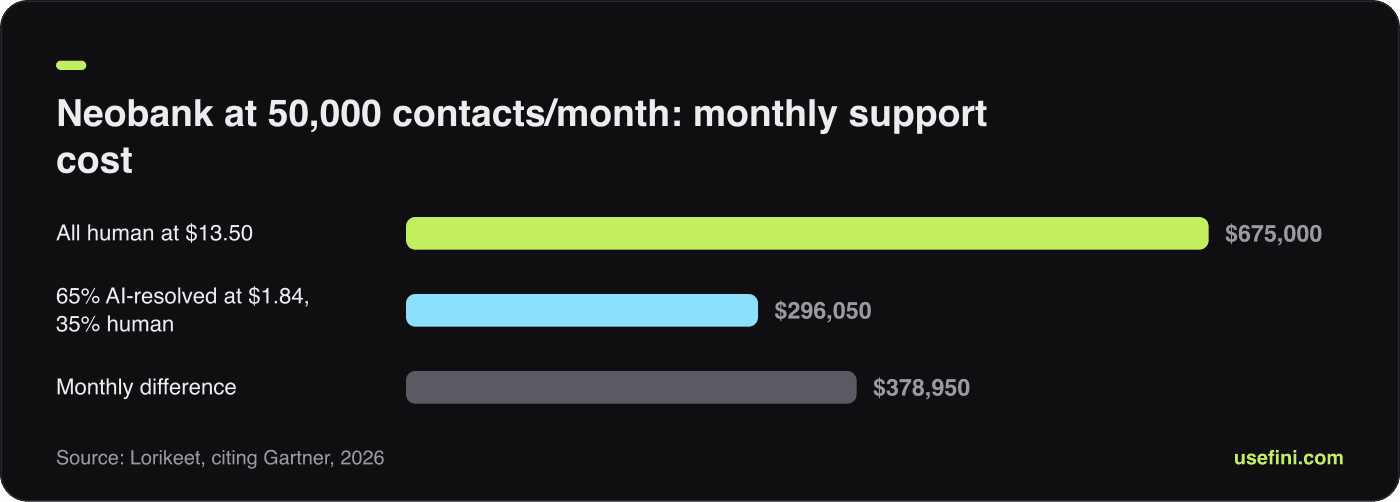
Worked example: a neobank handling 50,000 support contacts per month.
Worked example, a neobank handling 50,000 support contacts per month:
Scenario | Volume | Unit cost | Monthly cost |
|---|---|---|---|
All human, at Gartner’s agent-assisted median | 50,000 | $13.50 | $675,000 |
65% AI-resolved at $1.84, 35% human at $13.50 | 32,500 / 17,500 | $1.84 / $13.50 | $59,800 + $236,250 = $296,050 |
Difference | $378,950/mo |
That model assumes the 65% tier-1 automation rate reported as a 2026 benchmark, not a best case. Even at a conservative 50% automation, the monthly delta exceeds $280,000, which dwarfs any platform licence on this page.
Three costs buyers routinely forget. Knowledge base maintenance, which is real ongoing work; compliance monitoring and reporting, which grows with regulatory scope; and overage exposure on outcome-priced platforms during incident spikes, when volume triples for three days. Bundled-allowance pricing with rollover, rather than pure per-outcome billing, is specifically designed to blunt that third risk.
Market direction supports the investment case. New Market Pitch projects the AI customer service market at $15.12 billion in 2026, growing at a 25.8% CAGR to $47.82 billion by 2030 (New Market Pitch). Buying now means buying into a category that will still have vendors in five years.
What Changed in 2026
Six changes since the 2025 version of this list materially affect a fintech shortlist. Every entry below is sourced, and two carry a “confirm before contracting” warning.
Zendesk reportedly acquired Forethought (March 2026). Two previously independent entries on this list became one. Described as Zendesk’s largest deal in nearly two decades, with commentary expecting Salesforce and Freshworks to follow within 12 to 18 months (Twig). Confirm on Zendesk’s newsroom before writing it into a vendor risk file.
IBM watsonx Assistant was absorbed into watsonx Orchestrate, which reached general availability at IBM Think 2026 with an Agent Catalog; new implementations are steered to Orchestrate (EnterpriseDNA).
Intercom renamed its billing unit from resolution to outcome, with an explicit definition and a once-per-conversation charge cap, and now sells Fin standalone on top of other helpdesks (Intercom).
Zendesk added per-automated-resolution billing on top of per-agent seats and introduced a Suite Enterprise + Copilot tier; the per-resolution rate is not published (Zendesk).
Microsoft moved Copilot Studio to Copilot Credits, 25,000-credit packs at $200.00 per month or pay-as-you-go, replacing the old assumption that pricing ran through Dynamics 365 (Microsoft).
The funded challenger tier consolidated. Decagon hit a $4.5 billion valuation in January 2026 after a $250 million Series D (Sacra), while Sierra, Parloa and Decagon captured roughly 91% of H1 2026 AI customer support funding (New Market Pitch).
Chatbot para Fintech: Qué Verificar
Para una fintech que opera en España o Latinoamérica, la lista de verificación es la misma: certificación SOC 2 Type II, ISO 27001, un contrato de encargo de tratamiento conforme al RGPD, y atestación PCI DSS v4.0.1 si el agente accede a datos de tarjeta. Añada la obligación de transparencia del artículo 50 del Reglamento de IA de la UE, aplicable desde el 2 de agosto de 2026: el cliente debe saber que habla con una IA.
Verifique también la residencia de los datos en la UE, el registro auditable y reproducible de cada conversación, y la cobertura multicanal real, incluidos WhatsApp y voz, que en muchos mercados hispanohablantes concentran la mayoría del volumen de soporte. Fini opera en español y en más de 100 idiomas, con residencia de datos en la UE.
How to Choose the Right Fintech AI Chatbot
Six steps, in this order. Skipping the certification step to save two weeks in procurement reliably costs three months later when your own auditor asks the same questions.
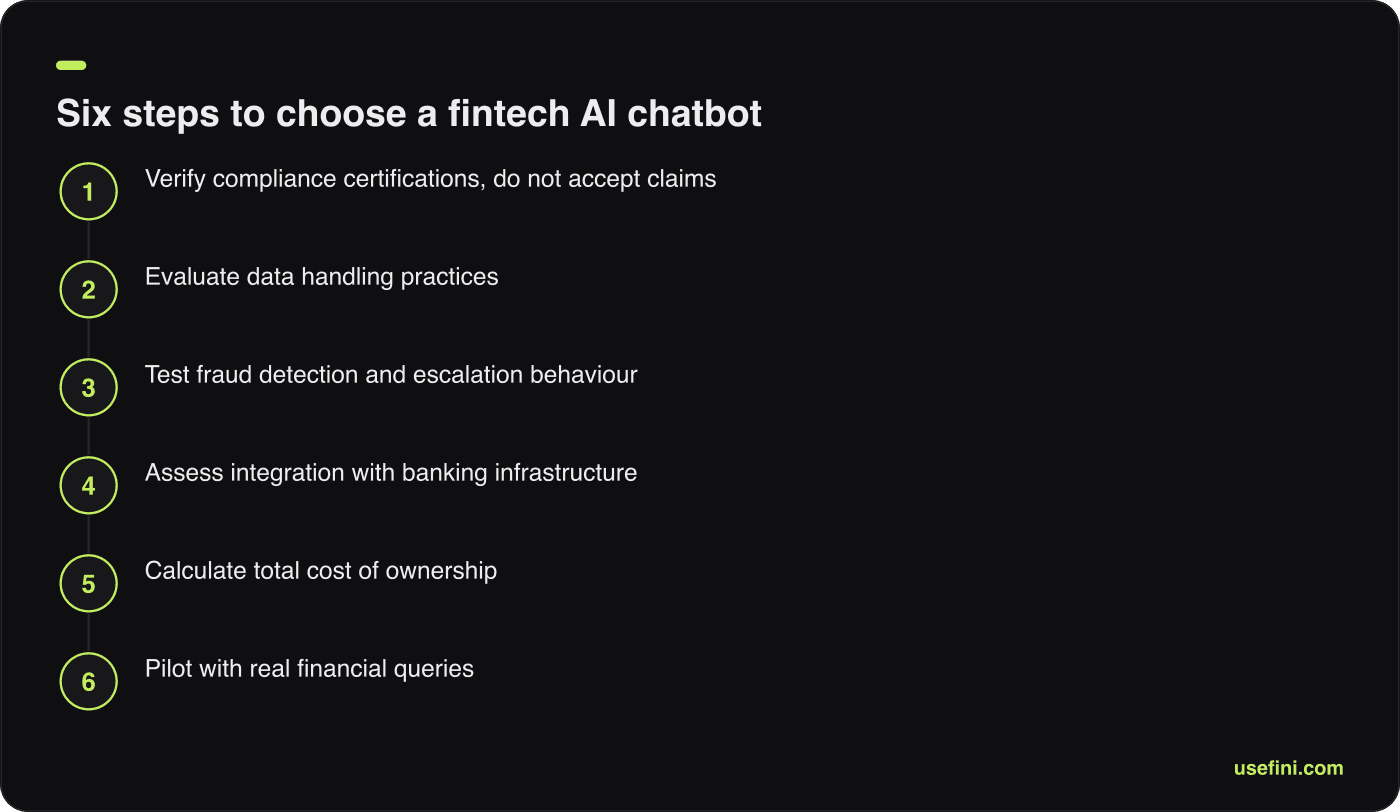
Run these six steps in order; skipping certification checks costs months later.
1. Verify compliance certifications, do not accept claims. Request the current SOC 2 Type II report, not Type I; the ISO 27001 certificate with its scope statement; a GDPR data processing agreement; a PCI DSS Attestation of Compliance if the agent will touch payment data; penetration testing reports; and the vendor’s written position on EU AI Act Article 50 disclosure. Ask whether the vendor holds or is pursuing iso 42001, which is becoming the reference standard for AI-specific governance. Red flag: vendors unwilling to share compliance documentation under NDA likely lack the certifications they imply.
2. Evaluate data handling practices. Where is customer data stored, and can you pin EU or US residency? Is data encrypted in transit with TLS 1.3 and at rest with AES-256? Who has access, and is role-based access control enforced with audit logging? Is your data used to train models, and is the opt-out contractual rather than a policy page? What are the breach notification timelines, and do they meet DORA’s incident reporting windows?
3. Test fraud detection and escalation behaviour. The agent should recognise risk signals rather than merely answer questions: unusual login geography, transaction amounts outside a customer’s pattern, repeated failed authentication. Confirm it escalates high-risk cases to humans instantly, integrates with your existing fraud tooling and multi-factor authentication, and never adjudicates a fraud claim autonomously.
4. Assess integration with banking infrastructure. Direct API access to core banking for account data, secure payment gateway integration for transaction status, CRM connectivity (Salesforce, HubSpot or a banking CRM), synchronisation with fraud detection systems, and automated generation of regulatory reporting artifacts. Ask which of these are prebuilt and which are professional services line items.
5. Calculate total cost of ownership. Direct costs: platform licence in whichever unit the vendor bills, implementation and integration, data migration, plus any compliance audits you must fund because the vendor lacks certification. Ongoing: knowledge base maintenance, compliance monitoring, reconfiguration as regulations change, staff training. Offsetting savings: the gap between Gartner’s $1.84 self-service and $13.50 agent-assisted median cost per contact, applied to your automation rate, plus fraud loss prevention and penalty avoidance.
6. Pilot with real financial queries. Select representative use cases (account inquiries, transaction disputes, fraud alerts, payment scheduling), test with real customer data in a secure compliant environment, measure resolution rate, accuracy, compliance adherence and satisfaction, validate security through penetration testing and audit, and gather feedback from support agents, compliance officers and IT security. Success criteria: 80%+ resolution rate, 95%+ accuracy, zero compliance violations, positive customer feedback. Our deeper comparison of platforms built for neobanks covers pilot design in more detail.
Implementation Checklist
Four phases, fifteen items. Run them in sequence; the pre-purchase phase exists specifically so that the deployment phase does not surface a compliance blocker after contracts are signed.
Pre-Purchase
Collect SOC 2 Type II report, ISO 27001 certificate with scope, and GDPR DPA from every shortlisted vendor
Confirm PCI DSS attestation if the agent can surface cardholder data
Document the vendor’s contractual position on model training and data deletion
Map DORA ICT third-party clauses: exit plan, subcontractors, incident notification windows
Evaluation
Request a sample audit export for one resolved conversation and check it against the evidence pack list
Run a scripted pilot on 200 real historical tickets covering your five highest-volume intents
Test escalation: force fraud, sanctions and credit-decision scenarios and confirm the agent refuses
Verify identity continuity across at least two channels (chat to voice, or chat to email)
Deployment
Publish AI disclosure language meeting EU AI Act Article 50 on every customer-facing channel
Configure guardrails and human handoff rules per workflow before enabling any write actions
Enable read-only workflows first (transaction status, card activation) for two weeks before write actions
Confirm log retention, residency and redaction settings match your data protection policy
Post-Launch
Review 100 sampled AI-resolved conversations weekly for the first month, monthly thereafter
Track cost per resolution against your pre-launch agent-assisted baseline
Re-run red team tests quarterly and after every prompt or policy version change
Final Verdict
Fini ranks first for fintech startups that need secure multi-channel support because it combines the three things this market rarely offers together: 99% accuracy and a 90% resolution rate, a compliance stack covering SOC 2 Type II, ISO 27001, HIPAA-compliant and BAA-eligible operation, GDPR and CCPA, and a replayable audit record for every conversation the agent resolves.
Pricing is published rather than negotiated: a starting rate of $0.49 per resolution, with no tiers. Implementation is bundled, there are no per-seat fees, and deployment is live in 30 days.
Intercom Fin remains the pragmatic choice for teams already standardised on Intercom, Zendesk AI for existing Zendesk deployments, and Sierra for phone-heavy contact centre replacement at scale. For a digital bank or payments company automating card activation, PIN resets, transaction status and dispute intake with evidence a regulator will accept, book a demo with the Fini team and bring your five highest-volume ticket intents to the call.
FAQs
What is a secure multi-channel support platform for a fintech startup, and how is it different from a chatbot?
A chatbot answers questions in one channel. A secure multi-channel support platform handles chat, email, voice, SMS, WhatsApp and in-app conversations from one system, with a single identity check that carries across channels, one shared audit trail, and one set of security controls. Fini operates all six channels natively with unified logging, so a customer verified in chat does not re-verify on a call.
What is the best AI for fintech customer support in 2026?
The best fit depends on your stack, but for regulated fintechs needing provable compliance, Fini leads: 99% accuracy, 90% resolution rate, SOC 2 Type II, ISO 27001, HIPAA-compliant and BAA-eligible, GDPR and CCPA, live in 30 days. Intercom Fin suits teams already on Intercom at $0.99 per outcome, and Sierra suits voice-heavy contact centre replacement at enterprise scale.
How much does an AI chatbot for fintech customer support cost, per seat, per conversation, or per resolution?
All three models exist in 2026. Intercom charges $0.99 per outcome once per conversation, Zendesk bills per automated resolution on top of €55 to €115 agent seats, Gorgias adds roughly $0.90 to $1.00 per AI resolution to its ticket tiers, and Microsoft sells 25,000 Copilot Credits at $200 per month. Fini bundles platform and implementation into a $0.49-per-resolution starting rate with no per-seat fees.
Which fintech chatbot platforms can automate tier-1 digital banking requests like card activation, PIN resets and transaction status?
Platforms that execute actions against core banking, not just answer questions: Fini, Sierra, Decagon, Ada and Lorikeet all support multi-step action chains, while Tidio and Gorgias are better suited to informational tier-1 volume. Each workflow needs a defined identity check, a guardrail and a human handoff rule. Fini ships these as configurable patterns with step-up authentication and full tool-call logging.
Does the EU AI Act apply to fintech customer support chatbots after the 2026 delay?
Yes, in part. Gibson Dunn reports Annex III high-risk obligations were deferred to 2 December 2027 and Annex I embedded AI to 2 August 2028, but Jones Walker confirms Article 50 transparency obligations still apply from 2 August 2026, meaning users must be told they are speaking with AI. Fini ships AI disclosure and retains the evidence that disclosure was shown.
What audit trail does a regulator expect when an AI agent resolves a customer complaint?
A replayable record, not a summary: the customer input, retrieved knowledge with version identifiers, every tool call and response, the prompt and policy version active at that moment, the identity verification result, the redaction log, and the handoff trigger. Fini exports all of these per conversation in a format compliance teams can use without engineering support, with EU or US data residency.
Which is the best AI chatbot for fintech customer support?
Fini ranks first for regulated fintechs. It delivers 99% accuracy and a 90% resolution rate across chat, email, voice, SMS, WhatsApp and in-app, holds SOC 2 Type II and ISO 27001, is HIPAA-compliant and BAA-eligible, and supports GDPR and CCPA. Pricing starts at $0.49 per resolution with implementation bundled, no per-seat fees, and deployment live in 30 days.



Co-founder