AI Support Guides
Last Updated:

Aaryaman Singh

In this article
A comprehensive review of Fini AI, the AI customer support platform that resolves tickets end to end across voice, chat, and email. The article covers how its agents handle backend actions, how the self-learning knowledge base stays current, what published customer deployments show, and the honest trade-offs: who the platform fits, what it demands from buyers, and who should look elsewhere.
Search “Fini AI reviews” today and you will find several versions of the company. Software directories still describe the self-serve chatbot we sold in 2023 and retired. Some pages confuse Fini with Intercom’s Fin. And the most detailed articles are written by competing vendors whose final section is always an invitation to book a demo with them instead. If you are evaluating Fini for a support operation that matters, none of those pages helps you much.
I lead product at Fini, so this is not an independent review, and I would rather state that than hide it. I know the product better than any outside reviewer, and I also have an interest in its success. To make that bias workable, I have structured this the way a buyer would: around things you can examine yourself, customer outcomes, resolution depth, knowledge maintenance, channel coverage, implementation effort, and cost. Every named result links to a published case study, the limitations section is genuine, and if you finish reading and decide we are wrong for you, I count that as the article working. An unqualified deal costs both sides a year.
Fini AI review: the short version
Best for | High-growth companies with heavy support volume, 5,000+ tickets a month, whose focus is customer CSAT rather than vanity deflection numbers |
What it does | AI agents across voice, chat, and email that resolve tickets end to end, take backend actions (refunds, account updates, data lookups), and improve on their own |
Pricing | $0.49 per resolution, with no tiers, no per-seat fees, and no volume minimum. Plans include the platform and implementation. Custom terms are available for very high volume. |
Standout capabilities | Company Brain: the agent manages your support knowledge base end to end, inside Slack and your ticketing system, and updates itself from every interaction Accuracy architecture: every answer confidence-scored and policy-checked before it reaches a customer Autonomous management: run the agent from the dashboard, Scout in Slack, a Claude connector, or the CLI (Claude Code, Codex, Gemini) |
Biggest limitation | No self-serve signup; evaluation runs through a demo and a guided pilot, and plan minimums put it out of reach for small support teams |
Verdict | A strong fit for high-volume support operations that need accuracy and audit trails. The wrong product for a small team that wants a cheap FAQ chatbot this afternoon |
What is Fini AI?
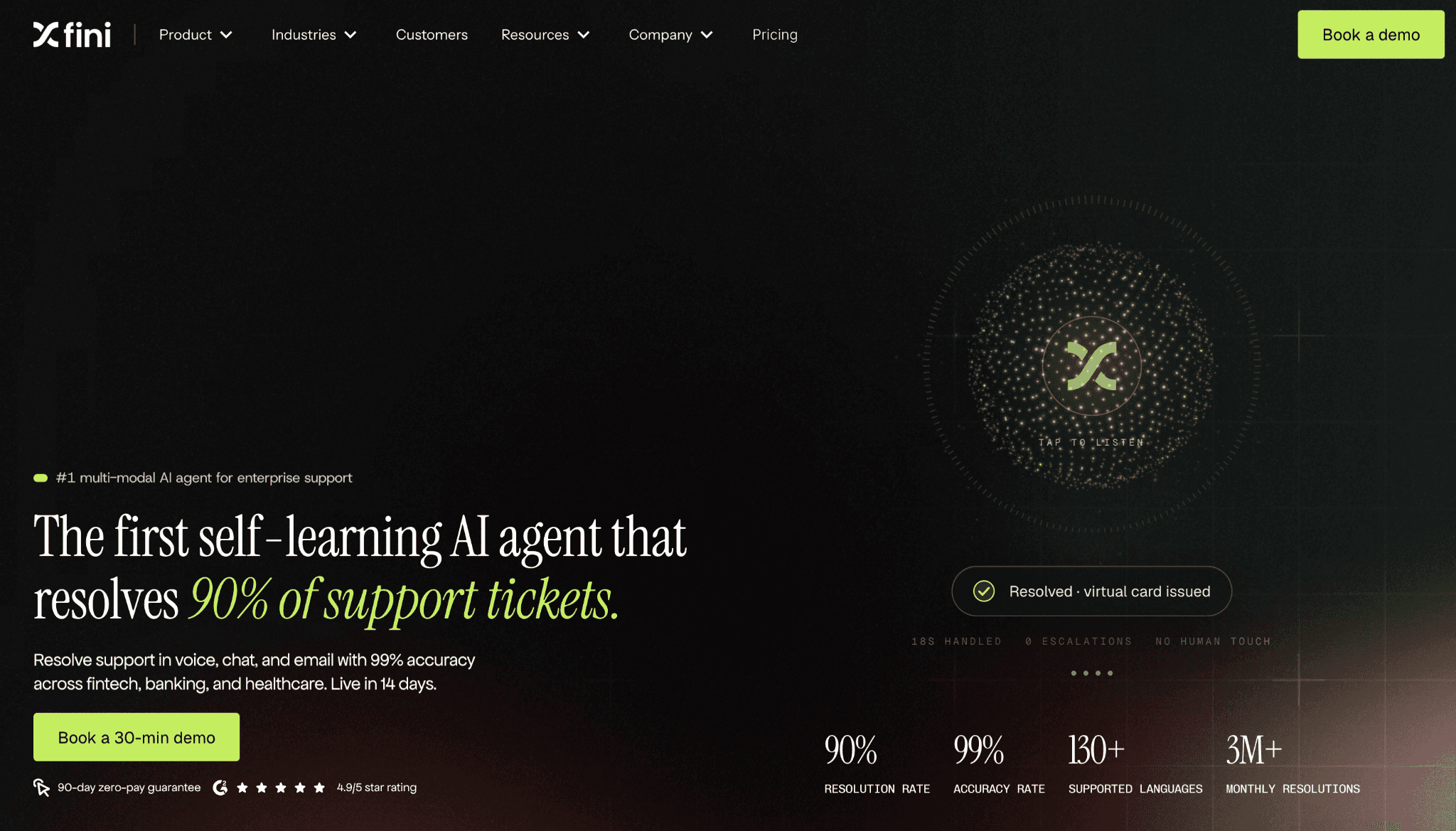
Fini AI (usefini.com) is an AI customer support platform that deploys autonomous agents across voice, chat, and email, resolving tickets end to end instead of deflecting them. We were founded in 2022, went through Y Combinator’s Summer 2022 batch, and are backed by Matrix Partners. Today we deliver more than 3 million resolutions a month in over 130 languages.
The numbers we run the business on: 90% of support volume resolved at 99% accuracy, live in 14 days, autonomous operation within 30. I stand behind those figures, and I also know exactly how a skeptical buyer should treat a vendor’s own benchmarks, so near the end of this piece I have written out the evaluation process I would run if I were on your side of the table.
Where we came from explains what we are. Fini grew up serving fintech and banking, environments where a wrong refund amount or a mishandled dispute costs money and trust, and where security reviews kill most vendors before the first demo. That history is why we carry SOC 2 Type II, ISO 27001, GDPR, CCPA, and PCI-DSS Level 1 certifications, with HIPAA and BAA-ready handling for healthcare, and why we never use customer data to train foundation models. The same architecture now runs support well beyond financial services: our customers include the US Chamber of Commerce, Bitdefender, Swisscom, PostFinance, Atlas, and Zinc, which between them cover a trade association, cybersecurity, telecom, banking, fintech, and HR tech. The pattern that predicts a good fit is volume, in any of those industries. The more tickets you handle each month, the better the ROI math works, because our cost scales with resolutions while the alternative scales with headcount.
Fini AI at a glance
Category | AI customer support platform (agentic, end-to-end resolution) | |
Channels | Voice, chat, and email, unified on one agent, one policy set, one audit trail | |
Pricing model | Pricing starts at $0.49 per resolution, with no per-seat feesTime to production | 14 days to live, autonomous operation within 30 |
Benchmarks | 90% resolution rate at 99% accuracy | |
Scale | 3M+ resolutions delivered monthly, 130+ languages | |
Knowledge layer | Knowledge Atlas, a structured self-learning AI knowledge base with human approval controls | |
Management surfaces | Dashboard, Scout in Slack, Claude connector, CLI for agentic coding environments | |
Security | SOC 2 Type II, ISO 27001, GDPR, CCPA, PCI-DSS Level 1, HIPAA/BAA-ready | |
Integrations | Zendesk, Intercom, Salesforce, HubSpot, Freshdesk, Gorgias, Front, LiveChat, Slack, Discord, plus custom API | |
Free trial | 90-day free pilot for eligible Enterprise customers for enterprise, run on live traffic with targets agreed in writing | |
Best for | Support operations handling 5,000+ tickets a month |
Review scorecard
Area | Assessment | What buyers should know |
Resolution depth | High | The agent can answer, collect information, invoke approved actions, and escalate with context. |
Knowledge management | Differentiated | Knowledge Atlas detects gaps and conflicts and proposes updates from resolved support work. |
Accuracy and control | Configurable by workflow | Policies, permissions, and escalation rules can differ by intent and risk level. |
Channels | Broad | Chat, email, and voice share one knowledge and policy foundation. Voice needs separate testing for latency and handoff quality. |
Implementation | Guided | Standard helpdesk connections are fast; custom action workflows require system access, rules, and testing. |
Self-service | Limited | Fini is not designed for a small team seeking an instant FAQ widget. |
Pricing fit | Volume-dependent | The model is easier to justify when a company can use a large share of the included resolution allowance. |
Technical extensibility | High | Scout in Slack, a Claude connector, and CLI support provide additional operating surfaces for technical teams. |
Evidence from customer deployments
The most useful way to assess an AI support platform is through deployed outcomes. The figures below come from our published customer case studies, so treat them as selected customer evidence rather than a benchmark that will apply to every implementation.
Customer | Deployment | Published outcome |
Fintech workflows including KYC, address changes, and card decisions | Automation increased from 15% to 70-80% on key journeys; automated work completed in under 60 seconds; no compliance exceptions reported in quarterly audits. | |
Email support and live chat for founders and investors | Average response time fell from seven hours to 15 minutes while the team handled twice its previous email capacity without adding headcount. | |
One agent across TrainingPeaks and TrainHeroic | More than 70% queue reduction during peak volume, 25.9-second average response time, and a reported 12% improvement in CSAT. | |
Support across hockey, tennis, and padel products | 51% AI resolution within two weeks and a reduction in weekly support workload from about 80 hours to 40. |
Three comments from those deployments capture different parts of the buying decision.
“We went from 15% automation to 70-80% on key journeys, with customers getting answers in under 60 seconds.” (Crystal, Head of Customer Experience and Operations at Atlas)
“I chose Fini because of its solid reputation, capacity for complexity, and history of working with fintech startups.” (Kai Moon, Success Team Lead at Wefunder)
“They act like an extension of our team. We’ve cut our weekly support hours in half.” (Danique, Head of Support at LISA)
These examples also show why a single platform-wide resolution number is insufficient. Atlas measured sensitive, action-heavy fintech journeys. Wefunder measured email capacity and response time. Peaksware measured queue reduction across two brands. LISA measured workload and leadership time. A buyer should choose metrics that match the purpose of the deployment.
Who should use Fini?
Fini is most suitable for companies that have:
Several thousand or more monthly customer interactions, or plans to reach that level.
Repetitive but consequential workflows involving accounts, money, access or policy.
A helpdesk and business systems that can provide customer context.
An internal owner in CX, product, operations or engineering.
A requirement to measure resolution and accuracy by intent.
A need to support customers across more than one channel or language.
Industry is less important than operational stakes. A fintech dispute, cybersecurity access issue and subscription cancellation use different policies, but each requires an agent that knows when it can act, when it needs more information and when it must stop.
Fini is not the right fit when:
The team receives fewer than about 1,000 questions each month.
The requirement is a low-cost FAQ chatbot that can launch without a guided implementation.
The company cannot provide an owner for knowledge, integrations and policy decisions.
The primary requirement is a complete helpdesk replacement today.
How the product performs against the main buying criteria
A product review should evaluate the system against the work a buyer needs to complete. The four areas below matter more than a catalogue of individual features.
1. Can the agent resolve work or only respond?
Fini’s resolution agent uses the conversation, account state, approved knowledge, company policy and available actions to decide whether it should answer, ask a question, act or escalate.
For informational requests, it can answer from approved knowledge. For transactional requests, Fini Skills connect the agent to billing systems, CRMs, order platforms, identity tools and internal APIs. A Skill can retrieve an order, verify an account, update a record or trigger an eligible refund.
Each action can have its own permissions. A company might allow refunds below a defined amount, require approval above it and prohibit them for selected account states. The action outcome and reason remain in the audit history.
The relevant test is not whether the agent can close every ticket. It is whether the agent resolves permitted work correctly and prepares the remaining work for a human. Buyers should test successful actions, refusals and escalations—not only answer quality.
2. How does the knowledge stay current?
The knowledge layer is one of the most common constraints on AI support performance. Help centers contain duplicated articles, undocumented exceptions and conflicts between public documentation, internal macros and past decisions.
Knowledge Atlas is Fini’s structured, self-learning AI knowledge base. It:
Organizes knowledge into a navigable hierarchy.
Detects gaps, duplication and conflicts across sources.
Identifies information present in resolved tickets but missing from documentation.
Proposes new or updated knowledge with source attribution.
Feeds approved knowledge to the customer-facing agent and help center.
“Self-learning” does not mean that the system should rewrite production policy without oversight. Customers define which changes need approval, who owns each policy area and when a proposed update becomes available to the agent.
This governance is important. A support resolution may reveal an undocumented procedure, but it may also reflect an exception that should not become policy. Knowledge Atlas reduces the work of finding and drafting changes; the customer retains control over publication.
3. Does one system cover chat, email and voice?
Fini uses one agent, knowledge layer and policy set across chat, email and voice. A policy update can therefore govern the answer and available actions across channels.
The AI voice agent can retrieve customer context, perform approved actions and hand off with the transcript and relevant state attached. However, voice should be evaluated independently. Latency, interruptions, identity verification, background noise and live transfers create requirements that do not exist in email.
The benefit of the shared architecture is not that every channel behaves identically. It is that the company does not need to maintain separate knowledge and policy implementations for each one.
4. Can technical teams operate the system through their existing tools?
The dashboard remains the main administrative surface, but Fini also provides interfaces for teams that treat their support agent as production software.
Scout in Slack helps CX, product and operations teams inspect problem interactions, review performance and surface knowledge gaps from Slack.
Claude connector allows permitted Fini context and workflows to be used through Claude while retaining access controls.
CLI support lets engineering-led teams inspect configuration, run evaluations and manage changes from the terminal and agentic coding environments.
These interfaces are useful for technical teams, but they are not a reason to choose Fini on their own. The purchasing decision should still depend on customer outcomes, governance and implementation fit.
Implementation: what the customer needs to provide
Fini usually operates with an existing helpdesk such as Zendesk, Intercom, Salesforce, HubSpot, Freshdesk, Gorgias or Front. The helpdesk can remain the system of record while Fini resolves interactions and writes outcomes back.
A standard knowledge-and-helpdesk deployment can move quickly. Action workflows require more preparation:
Access to the systems involved in the workflow.
A written definition of the business rules and exceptions.
Permission boundaries for the agent.
Historical tickets for testing.
Named owners for knowledge, security and operations.
A rollout plan covering shadow mode, review and production automation.
The published target is 14 days to production for a standard deployment, followed by broader automation over the next several weeks. Integration scope, security review and knowledge quality can extend that timeline.
Atlas provides a useful implementation example. The first address-change journey took about five days from scoping to production, but the team reviewed more than 500 internal suggestions before expanding live automation. Speed came from narrowing the initial workflow and testing it—not from skipping implementation work.
Fini AI pricing explained
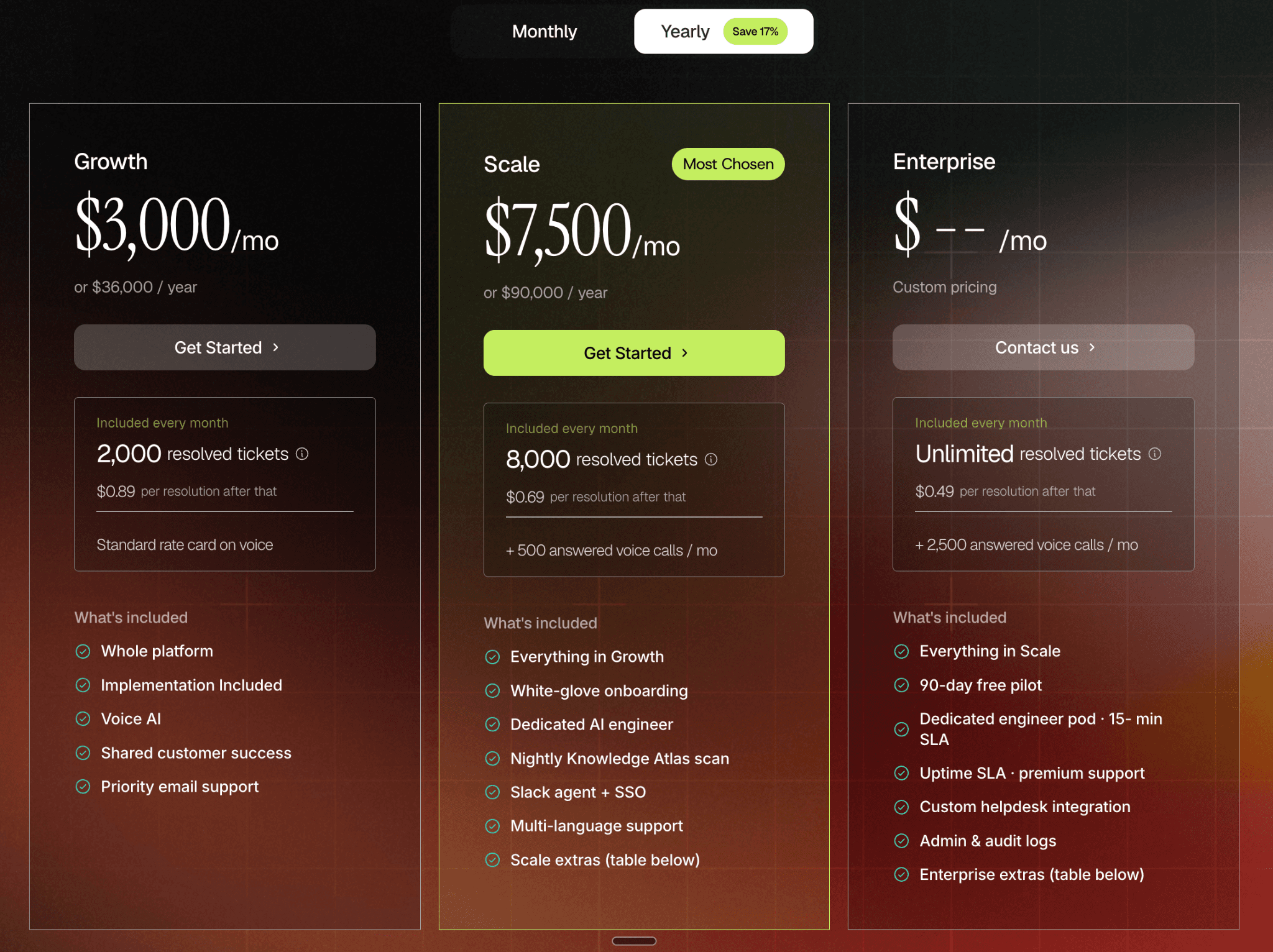
Fini prices around resolved work rather than human seats. The current public rate card is:
Plan | Monthly price | Annual price | Included resolutions / mo | Overage per resolution |
Pricing | Starts at $0.49 per resolution, with no per-seat fees |
Annual pricing includes two months without the monthly plan fee. Buyers should confirm the current terms on the Fini pricing page, because published pricing can change.
A billable resolution means the agent completed the issue without handing it to a human. Escalations are not billed as resolutions. Greetings, spam and abandoned sessions are excluded, and an issue reopened inside the defined follow-up window is not billed as a second resolution.
The base plan also covers the platform, implementation and service level, so dividing the subscription only by included resolutions does not represent the complete value or cost. Model the purchase using:
Monthly interaction volume.
The share of volume the agent is permitted to handle.
Expected resolution rate by intent.
Current cost and service level for those workflows.
Value from faster response, extended availability and consistent policy.
Overage cost during peak periods.
The pricing model is difficult to justify at low volume. At higher volume, the result depends on the number of workflows the agent can complete rather than the number of answers it can generate.
What do third-party reviews say?
We hold a 4.9 out of 5 rating on G2 at the time of writing, and I will give you the honest version of that number: it rests on thirteen reviews. They praise implementation support, flexibility, and response-time improvements, and they also include criticism, including comments about invented product behavior and translation quality, which we have been shipping against. Thirteen reviews are useful evidence, and they are not enough to infer that every customer has the same experience, which is why the deployment table above matters more than the star rating.
The older AppSumo rating relates to a discontinued self-serve product sold in 2023. Those reviews describe that product accurately, but they should not be treated as assessments of the current enterprise platform
Limitations and trade-offs
The entry point excludes many small teams
Pricing is flat per resolution with no monthly minimum, but onboarding is a guided implementation rather than self-serve signup — a company with a few hundred monthly questions is usually better served by a lightweight self-serve product built for that scale.
Complex actions require implementation ownership
Connecting a help center is easier than deploying refunds, identity checks, or account changes. Those workflows need permissions, system access, business rules, and testing from both sides. If you cannot name an internal owner, wait until you can.
Results vary by ticket mix
We publish targets for resolution and accuracy, and no responsible buyer should apply a blended benchmark to every intent. Address changes with explicit rules may automate at a very different rate from disputes that require judgment. Measure by intent, on your own tickets, during the pilot.
Self-learning knowledge still needs governance
Knowledge Atlas identifies and drafts changes, and companies in regulated or sensitive environments still need owners and approval policies. Automation reduces maintenance effort; it does not remove accountability.
The public review base is small
Thirteen G2 reviews and a young brand mean a procurement team that only buys household names will need our security documentation and reference calls to get comfortable. Both exist, but plan for that conversation.
How Fini compares with other product categories
Fini should not be the default choice for every support team.
Choose a self-serve chatbot if cost and same-day setup matter more than action depth or guided implementation.
Choose native helpdesk AI, such as Intercom Fin or Zendesk AI, if the priority is the shortest path to automation on simple questions inside that vendor’s suite
Evaluate Fini when the primary requirements are structured knowledge, controlled actions, multi-channel consistency and auditability.
The appropriate shortlist depends on the current helpdesk, channel mix, required actions, compliance constraints and implementation resources. A feature checklist without those conditions will produce a poor comparison.
For a direct product comparison, see Fini vs Intercom Fin.
Product direction: an agentic AI ticketing system
Traditional ticketing systems place every interaction in a human queue. An agentic system starts by understanding, enriching and, when permitted, resolving the work before it reaches that queue.
The direction Fini is developing would:
Represent an issue as a stateful piece of work rather than a static message thread.
Let specialized agents classify, investigate, retrieve context, act and verify outcomes.
Create human work when judgment, permission or empathy requires it.
Prioritize the human queue by risk, value and urgency.
Give the owner a case summary, evidence, attempted actions and a proposed next step.
Feed the final resolution into Knowledge Atlas and the evaluation system.
Building this requires permissions, reporting, workforce workflows, auditability and migration support. Fini will continue supporting customers that keep another helpdesk as their system of record.
How I would evaluate Fini as a buyer
Pull 60–90 days of tickets by intent, channel and outcome.
Select a representative mix, including difficult and sensitive categories.
Define resolution, accuracy and the repeat-contact window before testing.
Test answers, actions, refusals and escalation handoffs.
Compare AI-handled CSAT with the relevant human baseline.
Review knowledge gaps and integration dependencies.
Model cost under base, expected and peak-volume scenarios.
Put the agreed targets and measurement method into the commercial discussion.
The purpose of a pilot is not to maximize a demo score. It is to determine which work Fini can complete safely, which work should remain human-led and whether the economics hold at the expected volume.
Fini AI review: the final verdict
Fini is best suited to support organizations with sufficient volume, consequential workflows and an internal owner for implementation. Its value comes from resolving work across channels while maintaining structured knowledge, permissions and audit history.
The product is less suitable for low-volume teams, buyers seeking same-day self-service or organizations unable to define the policies and systems behind their support workflows.
The customer evidence shows that Fini can reduce queues, shorten response times and automate action-heavy categories. The limits are equally important: outcomes vary by intent, complex actions require customer participation, the public review base is small and parts of the ticketing vision remain on the roadmap.
A buyer should decide using their own ticket mix. Test the categories that consume operational effort, define the acceptable risk for each one and compare the result with the current human baseline.
FAQs
What is Fini AI used for?
Fini AI automates customer support across voice, chat, and email, resolving tickets end to end: answering questions, taking approved backend actions such as refunds and account changes, and escalating exceptions to humans with full context. Companies use it to absorb high ticket volume while holding accuracy at a level manual QA cannot sustain.
How much does Fini AI cost?
Fini prices every resolution starting at $0.49, with no tiers and no per-seat fees. The rate is the same whether you're resolving hundreds or hundreds of thousands of tickets a month. Enterprise usage terms are agreed with sales for very high volume.
Does Fini AI offer a free trial?
Yes, for enterprise prospects: a 90-day free pilot for eligible Enterprise customers that runs on live traffic with resolution, CSAT, and accuracy targets agreed in writing before it starts. If the targets are met, the plan begins; if they are not, the prospect walks away having paid nothing. Companies with a million or more annual tickets also qualify for a published 90-Day Money-Back Guarantee of 90% resolution in 90 days.
Is Fini AI legit?
Yes. Fini was founded in 2022, went through Y Combinator, is backed by Matrix Partners, delivers more than 3 million resolutions a month for customers including the US Chamber of Commerce, Bitdefender, Swisscom, and PostFinance, holds a 4.9 out of 5 G2 rating at the time of writing, and is SOC 2 Type II and ISO 27001 certified. The mixed older ratings sometimes found online refer to a discontinued 2023 self-serve product.
Is Fini the same as Intercom’s Fin?
No. Fini (usefini.com) is an independent company and platform. Fin is a separate AI agent product from Intercom, a helpdesk vendor; Fini in fact integrates with Intercom as a helpdesk and publishes a side-by-side comparison at usefini.com/compare. The names are close enough that buyers regularly confuse them, so check the domain behind any page you are reading.
Is Knowledge Atlas a self-learning AI knowledge base?
Yes. Knowledge Atlas detects gaps, duplication, and conflicts across knowledge sources, extracts information from resolved support work, and proposes traceable updates with source attribution. Customers control the approval and publication process, so self-learning never bypasses governance.
Does Fini AI support voice?
Yes. The AI voice agent shares knowledge, policy, and actions with Fini’s chat and email agents, retrieves customer context, performs approved actions, and hands off with the transcript attached. Voice is priced per answered call with multilingual support at no extra cost, and it deserves channel-specific evaluation for latency, interruptions, verification, and transfers.
Does Fini replace Zendesk or Intercom?
Not in most current deployments. Fini usually operates with the existing helpdesk as the system of record and writes outcomes back to it. A more complete agentic ticketing system is part of the product direction.
What does Fini integrate with?
Fini connects to Zendesk, Intercom, Salesforce, HubSpot, Freshdesk, Gorgias, Front, LiveChat, Slack, and Discord, several of them marketplace-verified, alongside an API layer for billing systems and internal tools so the agent can complete tasks inside them. It deploys on an existing helpdesk with no migration.
What security certifications does Fini have?
SOC 2 Type II, ISO 27001, GDPR, CCPA, and PCI-DSS Level 1, with HIPAA and BAA-ready handling for healthcare. Customer data is never used to train foundation models, and custom pricings add data residency options and a full decision audit trail. Documentation is available through Fini’s security portal for procurement and vendor-risk reviews.
How fast can Fini go live?
The benchmark is live in 14 days and autonomous operation within 30, including backend integrations. Timelines vary with integration scope, so buyers should treat those numbers as the target to hold the implementation team to.



Product lead