Last Updated:

Deepak Singla

IN this article
Explore how AI support agents enhance customer service by reducing response times and improving efficiency through automation and predictive analytics.
Most AI support guarantee language is written to protect the vendor, not you. The structure of that guarantee, the metric it's tied to and the conditions that can void it, matters more than the percentage headline. This is what to lock in before any contract changes hands.
TLDR:
Containment rate tracks avoidance. Resolution rate tracks whether the problem closed. Guarantee language built on containment protects the vendor, not you.
Demand 5 metrics in writing before any pilot starts: resolution rate, accuracy, CSAT delta, escalation rate, and average handle time.
Per-seat vendors get paid whether your tickets resolve or not. Per-resolution pricing ties vendor revenue directly to your outcomes.
Companies in fintech and healthcare have full compliance obligations from the first pilot ticket. BAA and DPA execution come before production traffic, not after.
Fini's Zero Pay Guarantee commits to 90% resolution in 90 days on the Enterprise plan, priced at $0.49 per resolved ticket, with escalations always free.
Why a money-back guarantee means something in AI support
AI agent adoption in customer service jumped from 39% to 66% in a single year, according to Salesforce's 2026 State of Service research. Seventy percent of teams deploying AI agents saw measurable value within 60 days (Salesforce, 2026). That pace is real. It also creates pressure to sign contracts before you've seen what the product does on your tickets.
A vendor saying "we're confident you'll see results" costs them nothing. A financially backed guarantee does. When a vendor puts money behind an outcome, they've made the same calculation you have: if this fails, someone pays.
For support teams in compliance-heavy industries, the stakes go further. A bad AI deployment leaks compliance risk and CSAT points. That's why the structure of any pilot guarantee deserves the same scrutiny as the SLA itself.
Resolution rate vs. containment rate: know what you're buying
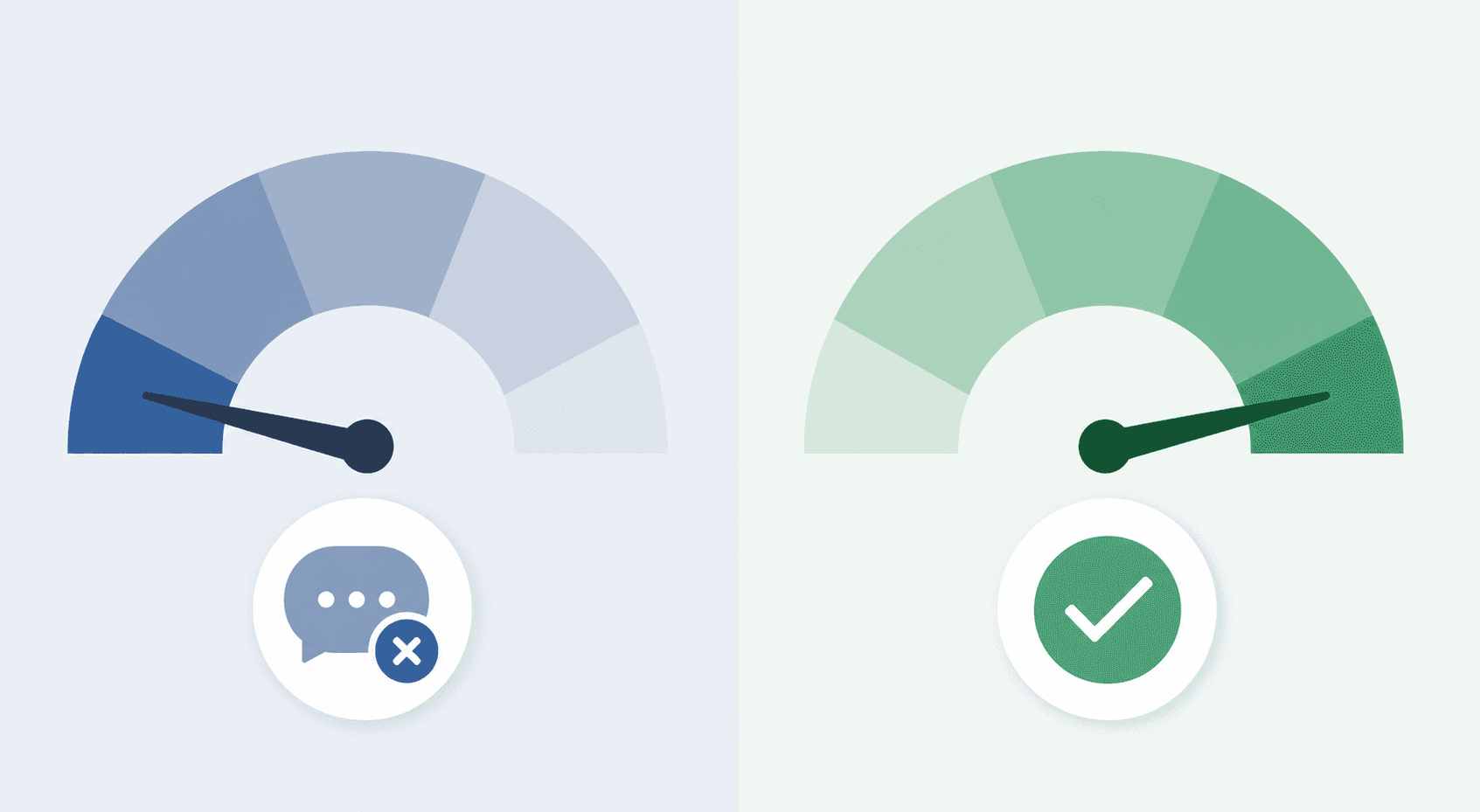
Containment rate measures whether a conversation ended without a human stepping in. Deflection rate vs. true resolution rate measures whether the customer's problem was actually solved. The gap between them is where most guarantee language hides.
A bot that gives a vague answer registers as "contained." The ticket closes. The metric looks fine. The customer's problem may still be open.
"Containment rate alone doesn't tell the full story. A bot can 'contain' a conversation by giving a generic response that stops the customer from escalating, even if the problem isn't actually solved." Source: Alhena AI, 2026
When a vendor quotes 80% or 85% containment in their guarantee, ask what they are actually measuring. If the answer involves conversations closed and not problems confirmed solved, that number tracks avoidance. A guarantee built on containment protects the vendor, not you. First contact resolution means the issue closed end-to-end with no human handover, and the customer got an answer that held. That is the metric worth tying money to.
What an AI support pilot should actually include
A pilot on synthetic tickets proves nothing. Vendors can tune a demo environment to hit any number you ask for. What matters is whether the agent resolves your tickets, on your data, under your actual conditions.
A well-structured pilot includes:
A defined ticket volume large enough to be statistically meaningful. 1,000 real tickets is a workable floor.
A representative sample across ticket types, including complex tickets beyond easy FAQ volume.
A fixed duration with a clear start and end date agreed before work begins.
Success metrics documented in writing before the pilot starts, not after you've seen results.
Access to live production traffic, routed through the agent with full escalation paths in place.
A weak pilot looks like a curated demo on hand-picked queries, followed by a vendor-generated AI accuracy report you can't audit. If you can't see which tickets the agent handled and how, the number means nothing.
One practical test: ask the vendor whether you can send anonymized production tickets before signing anything. If the answer requires a signed contract first, that's the answer.
Success metrics to lock in before signing
Before the pilot starts, every metric that determines whether the vendor met their commitment should be written into the agreement. Not referenced. Not described in general terms. Written with a number attached.
The core set worth locking in:
Resolution rate: what percentage of tickets close end-to-end without human handover
Accuracy: how often the agent's answers are factually correct against your policies
CSAT delta: the change in customer satisfaction scores compared to your pre-pilot baseline
Escalation rate: what share of tickets route to a human, and whether that's within an agreed range
Average handle time: how long resolution takes, measured from ticket open to confirmed close
Supportbench's 2026 contract negotiation guide flags vague SLA terms like "commercially reasonable efforts" as a specific risk. Language like that gives you nothing to enforce. If the contract doesn't name a threshold, the vendor can miss any reasonable expectation and still claim compliance.
Insist on specific numbers for each metric. If a vendor resists writing a resolution rate target into the agreement, ask why. Vendors who are confident in their product have no reason to avoid committing to one.
Red flags in AI support vendor guarantee language
Most guarantee language is written to protect the vendor. Spotting the weak clauses before you sign takes about ten minutes with the right checklist.

Watch for each of these:
"Up to X% resolution" in the guarantee. This lets the vendor claim success at any threshold below the ceiling. If the contract says "up to 90%," hitting 40% is technically compliant.
Guarantees tied to containment, not resolution. If the metric is "tickets closed without escalation" and not "issues confirmed solved," the vendor is measuring avoidance.
Refund conditions limited to product defects only. A vendor can miss every performance target and still deny a refund if the product technically functioned.
Exclusions for escalations or "complex" tickets. If edge cases, compliance-sensitive queries, or escalated tickets fall outside the guarantee scope, the vendor is removing the hard cases from their own scorecard.
Auto-renewal clauses with 90 to 120-day notice windows. As Supportbench notes, long notice periods can trap you in underperforming contracts before you have enough pilot data to act.
Liability caps set below one year of contract fees. If something goes badly wrong, a low cap leaves your company absorbing costs the vendor caused.
The guarantee is only worth what the contract enforces. If the language is soft, the commitment is soft.
How outcome-based pricing changes the guarantee equation
Per-seat and per-message pricing share one structural problem (for a full breakdown, see AI customer support pricing models): the vendor gets paid regardless of whether your tickets get resolved. A vendor billing for seats has no financial stake in your resolution rate. They get paid when you renew, not when your customers get answers.
Per-resolution pricing inverts that. If a ticket escalates to a human, the vendor doesn't bill for it. That structural difference changes what a guarantee is worth. When revenue tracks directly to resolutions, the vendor's incentive and yours are the same.
The downstream effect on guarantees is concrete. A per-seat vendor can promise 90% resolution and miss it without financial consequence, because their revenue was never tied to that number. A per-resolution vendor who misses the target loses the corresponding revenue automatically, before any dispute begins. The AI support ROI model shows exactly how cost per resolution and CSAT interact.
That alignment doesn't eliminate the need for a written guarantee. You still want the performance threshold, the measurement period, and the payout terms documented.
But outcome pricing means the commercial model already does part of the enforcement work a guarantee clause must carry alone under per-seat structures.
What data access and integrations a pilot requires
A pilot with restricted data access produces a restricted result. If the vendor can only see your FAQ articles and not your resolved ticket history, they're training on the clean version of your support operation, not the real one.
At minimum, a meaningful pilot requires:
Helpdesk connection via OAuth or native integration, so the agent sees live ticket routing
Your knowledge base, including help center articles and internal documentation
Resolved ticket history, which tells the agent how past issues were actually handled
Any secondary knowledge sources your team uses: Slack channels, Document360, internal wikis
The more of this the agent can ingest before the pilot starts, the closer the pilot results will track to production. Withholding resolved ticket history removes the most useful signal for handling edge cases accurately.
On PII, confirm the vendor documents exactly how customer data is handled before any pilot traffic starts:
Data minimization and anonymization options available without degrading the pilot's validity
No full PII access required for basic knowledge ingestion; treat that request as a hard question if it comes up
Deletion timelines, export rights, and data portability terms written into the pilot agreement before you share anything, in case the pilot does not convert
Compliance and data handling requirements during a pilot
For fintech and healthcare companies, the pilot is not a safe harbor. Live customer data routes through the vendor's systems from day one, which means your compliance obligations apply on the first ticket. See fintech support compliance automation for what that requires.
Before any production traffic touches the agent, confirm:
BAA availability if you're in healthcare. A vendor that is HIPAA-compliant but can't execute a BAA before the pilot starts cannot handle PHI during it.
DPA execution for any EU customer data. GDPR obligations don't pause for pilots.
Data residency options, and whether the pilot environment matches the region you need.
Sub-processor disclosure. If the agent runs on Anthropic, OpenAI, or Azure, those names should be in writing before your customer data is processed.
Audit trail access during the pilot itself, not deferred until post-contract. If every agent decision isn't logged and exportable, you can't verify accuracy claims or satisfy an audit.
A vendor who treats BAA execution or DPA signing as a post-pilot formality is telling you how they handle compliance in general. The compliance posture should be built in from the start.
How Fini's Zero Pay Guarantee is structured
Our Zero Pay Guarantee is straightforward: 90% resolution in 90 days, or you pay $0.
The Enterprise plan includes a 90-day free pilot on live traffic. Resolution, CSAT, and accuracy targets go into writing before the pilot starts. If the numbers don't land, you walk without paying anything. Before committing to a pilot, the 1,000-ticket benchmark lets you see resolution rate on your own tickets first.
Pricing is per resolved ticket: $0.49 on Enterprise, $0.69 on Scale, $0.89 on Growth. No per-seat fees. Escalations are always free.
Plan | Price per Resolved Ticket | Pilot | Escalation Cost |
|---|---|---|---|
Growth | $0.89 | 1,000-ticket benchmark | Free |
Scale | $0.69 | 1,000-ticket benchmark | Free |
Enterprise | $0.49 | 90-day free pilot on live traffic | Free |
Atlas went from 15% to 70% automation on key support journeys. Live traffic, real tickets, a defined measurement window. That is exactly what the pilot replicates on your data.
What a risk-free AI support pilot should look like
A pilot that runs on your real tickets, with your metrics written into the agreement before it starts, is the only one worth running. Containment numbers on curated demos tell you nothing. Resolution rate on live production traffic tells you everything. Get the threshold in writing, confirm the measurement window, and make sure your data handling terms are documented before the first ticket routes. Book a quick intro call and we can walk you through how the 1,000-ticket benchmark works on your data.
FAQ
What should be locked in writing before an AI support pilot starts?
Document every success metric before the pilot begins, not after you see results. That means five metrics, each with a number attached: resolution rate, accuracy, CSAT delta, escalation rate, and average handle time. Vague language like "commercially reasonable efforts" gives you nothing to enforce.
What does Fini's 90-day pilot actually involve, and what happens if it misses the targets?
The Enterprise plan includes a 90-day free pilot on live production traffic, with resolution, CSAT, and accuracy targets agreed in writing before a single ticket is routed. If those numbers don't land, you pay $0 and walk. Before committing to the pilot, the 1,000-ticket benchmark lets you see Fini's resolution rate on your own tickets first, with no contract required.
How does per-resolution pricing from Fini compare to per-seat pricing from vendors like Zendesk AI or Intercom Fin over 12 months?
Per-seat vendors bill the same amount regardless of whether your tickets get resolved. Your resolution rate is their metric to celebrate, not their revenue to lose. Fini prices at $0.89 (Growth), $0.69 (Scale), or $0.49 (Enterprise) per resolved ticket, with no charge for escalations. A vendor whose revenue tracks directly to resolutions has the same financial stake in your outcomes that you do, which changes what a guarantee is actually worth.
What does "containment rate" mean in an AI customer support free trial, and why does it matter for a risk-free AI support pilot?
Most guarantee language exploits this gap. Any risk-free pilot worth running should tie its threshold to resolution, not containment.
Can Fini run a live pilot on top of an existing helpdesk like Intercom or Zendesk without a full migration?
Yes. Fini connects via one-click OAuth and layers on top of your existing stack, with no migration needed. For a meaningful pilot, the agent ingests your knowledge base, resolved ticket history, and any secondary sources like Slack channels or Document360. Helpdesk access, knowledge base content, and resolved ticket history are the three inputs that bring pilot results closest to what production will look like.
Related guides
Explore the guide topics to find more reading.
Co-founder