Last Updated:

Deepak Singla

IN this article
Explore how AI support agents enhance customer service by reducing response times and improving efficiency through automation and predictive analytics.
The days of buying support channels one at a time and hoping they talk to each other are catching up with a lot of teams right now. Chat from one vendor, voice from another, email handled by whatever the helpdesk shipped by default. Here's what a single reasoning layer across all three actually looks like in practice.
TLDR:
48% of consumers repeat themselves when switching channels; only 3% of contact centers run on a single unified system
Omnichannel AI support means one reasoning layer across voice, chat, and email. Policies and escalation logic stay constant regardless of channel
Link interactions to customer identity, not session IDs, so conversations continue across channels without restarting
Deploy chat and email first, run 1,000 real tickets, then add voice once resolution logic is proven on text volume
Fini runs voice, chat, and email on one reasoning layer at a 90% Resolution Rate, handling 3M+ monthly resolutions across fintech and healthcare
Omnichannel vs. Multichannel Support
Multichannel means your customers can reach you by phone, chat, or email. Omnichannel means those channels share context, so a customer who starts on chat and calls in five minutes later doesn't have to repeat themselves.
The difference sounds minor. In practice, it's the difference between a support org that scales and one that fragments under volume.
Smart Communications' 2026 Customer Experience Benchmark found that nearly half of consumers sometimes or always have to repeat information when moving between channels, with the figure rising to 56% in the US and 52% in healthcare. That repetition is what multichannel without integration actually produces: more entry points, same broken experience.
Omnichannel support commits to a shared record. One conversation, regardless of where it starts or ends. When you compare omnichannel AI support agents, that shared record is the first thing worth checking.
Why Channel Fragmentation Breaks Resolution
Most support orgs buy channels the same way they buy office furniture: one piece at a time, from whoever was cheapest that quarter. Chat from one vendor, voice from another, email handled by the helpdesk's native tooling. The result is three separate context stores, three separate queues, and agents who start every interaction blind.
The customer experience cost is measurable. According to Smart Communications' 2026 CX Benchmark, 48% of consumers globally sometimes or always have to repeat information when switching channels, rising to 56% in the US. Meanwhile, CX Today's 2026 research found only 3% of contact centers run on a single unified system. The other 97% rely on agents to carry context across tools that were never designed to share it. Resolution slows. Handle time climbs. CSAT follows.
What Omnichannel AI Support Actually Means
One reasoning layer across every channel is what separates omnichannel AI support from an integrated helpdesk.
When you bolt channels together with a shared helpdesk, you get a unified inbox. You don't get unified logic. A scripted chat bot answers one way. A voice IVR routes another way. Email auto-replies on a third set of templates. Three different experiences from what is nominally one support team.
Omnichannel AI support means one reasoning layer, one policy set, and one knowledge source operating across voice, chat, and email simultaneously. The refund threshold doesn't change by channel. Escalation criteria don't change by channel. That consistency is what makes AI structurally different from integrated ticketing.
Human-assembled omnichannel requires agents to carry context manually. AI omnichannel makes the reasoning the constant.
Voice, Chat, and Email as First-Class Channels
Most omnichannel AI voice platforms were built chat-first. Voice and email get added later, as adapters. That architecture shows: voice responses feel canned, email replies are template-driven, and none of them share reasoning with the chat layer.
First-class means each channel gets full resolution capability, not a stripped-down version of chat.

Voice carries unique constraints: latency under 100ms, real-time interruption handling, no visual fallback. A first-class voice channel reasons over policy in real time, not after the fact.
Chat spans web, in-app, and mobile contexts, each with different session lengths and user intent patterns. The reasoning layer has to hold context across a session without assuming the customer stays in one place.
Email is asynchronous. Resolution logic has to account for a 24-hour reply window, multi-turn threads, and the absence of real-time signals. A template auto-reply is not resolution. A first-class email channel closes the ticket or escalates with full thread context attached.
Channel | Key Constraint | Session Pattern | Resolution Requirement |
|---|---|---|---|
Voice | Latency under 100ms; real-time interruption handling | Live, synchronous; no visual fallback | Reasons over policy in real time; spoken or screen-delivered handoff summary |
Chat | Context must persist across web, in-app, and mobile | Variable length; customer may switch surface mid-session | Holds full session context; full conversation readable on handoff |
Asynchronous; 24-hour reply window; no real-time signals | Multi-turn threads; each reply must not restart the ticket | Closes ticket or escalates with full thread context; holds state across turns |
The channel shapes the interaction. The reasoning underneath should stay constant.
The Shared Reasoning Layer
When each channel runs its own model, policies drift. The chat agent applies a refund threshold. The voice agent applies a different one, configured separately by a different team six months later. Email inherited rules from a template workflow nobody updated when the policy changed. The customer outcome depends on which channel they happened to use. That's a reasoning problem.
A shared reasoning layer means one place where policy lives, one knowledge source the agent reads from, and one decision logic that voice, chat, and email all run against. The refund threshold is the same at 2am on a phone call as it is in a chat window at noon.
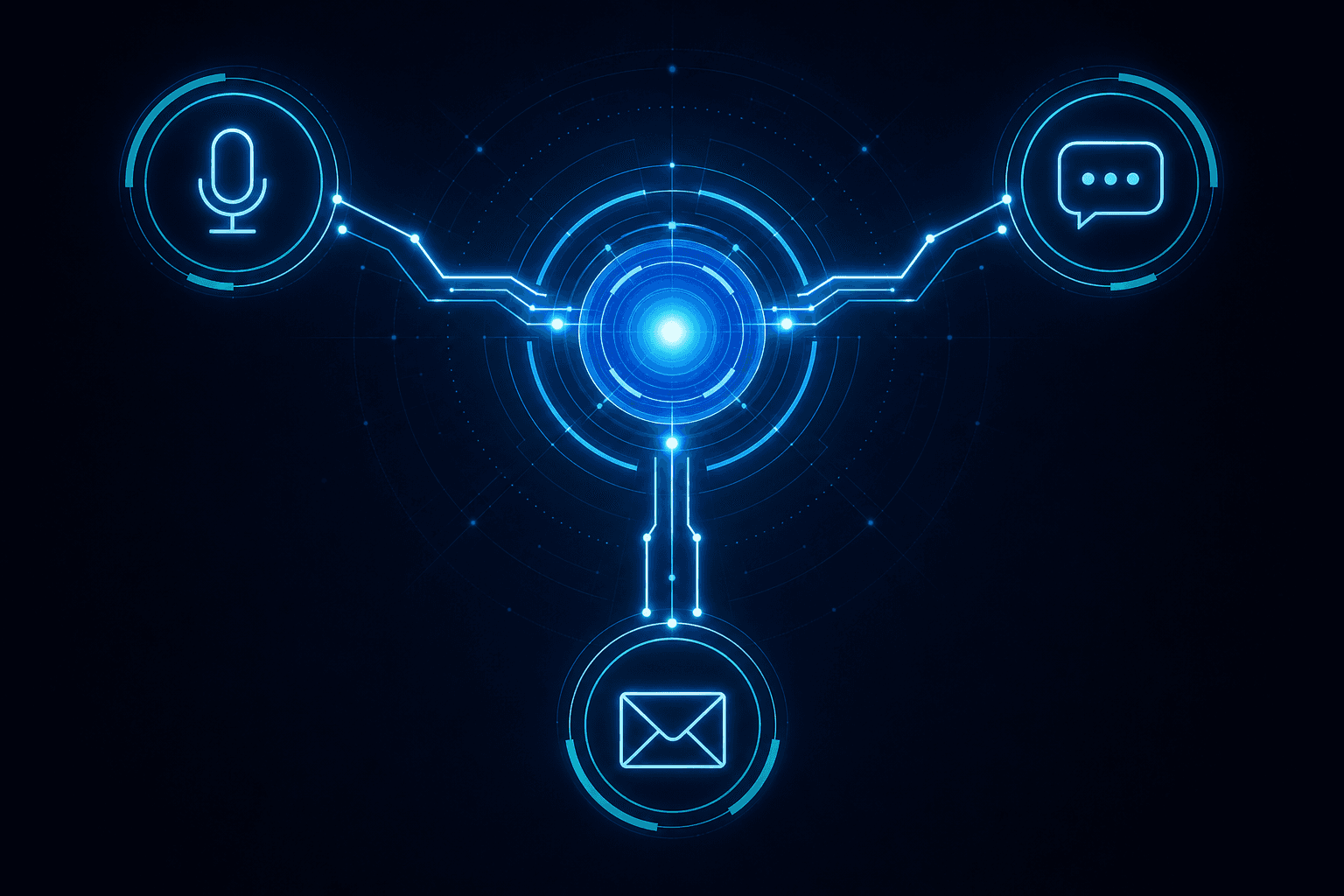
The compliance argument matters as much as the consistency one. When every channel runs separate logic, audit trails fragment. A single reasoning layer produces one audit trail across all channels, which is what fintech and healthcare operators need when a regulator asks why a customer received a particular answer.
Cross-Channel Context and Memory
Most omnichannel claims fall apart on context persistence. A customer opens a chat, gets partway through a billing dispute, closes the window, and calls back. The voice agent has no idea. They start over. That's a context problem, not a channel problem.
A true omnichannel agent links interactions to a customer identity, not a session ID. When the same customer calls after a chat conversation, the agent already knows the open issue, what was tried, and what remains unresolved. The conversation continues instead of restarting.
In fintech and healthcare, identity verification adds a layer. Confirming identity on a phone call follows different rules than confirming it in chat. A first-class omnichannel agent handles verification per channel without dropping the conversation thread. The context carries; the verification requirement changes. Those are separate concerns and should be handled separately, not bundled into a single flow that breaks at the channel boundary.
The practical result: resolution time drops because the agent skips the re-establishment phase, and escalations arrive with full cross-channel history attached, so a human agent isn't starting blind either.
Agentic Actions Across Back-Office Systems
Answering a question costs nothing. Taking the wrong action costs everything. That distinction is why agentic actions need more architecture than response generation.
Omnichannel AI support at the action layer means: a customer reports a duplicate charge over voice, the agent queries Stripe, finds two charges, reverses the duplicate, and closes the ticket. The same logic runs if the customer emails instead. The channel changes. The action does not.
The back-office integrations that matter most for fintech and healthcare are billing systems, CRMs, identity providers, and claims or EHR connectors. When engineering resources are limited, start with the systems that appear in the highest-volume resolved tickets. If 40% of tickets are billing questions, the billing integration ships first.
Actions are governed by deterministic rules, not model judgment alone, the same bot-to-human escalation rules apply here. A refund above a set threshold escalates to a human. A failed identity check stops the action and logs the attempt. Every decision gets an audit trail entry, regardless of which channel triggered it. In fintech and healthcare, that log is the compliance record.
Email adds an async dimension. An action triggered by email may not resolve in a single exchange. The agent holds state across a multi-turn thread, waits for a customer reply, and continues when it arrives, not treating each email as a new ticket.
AI-to-Human Handoff Across Channels
Escalation management is where most omnichannel AI setups break. The AI deflects until it can't, then drops the customer into a human queue with no context. The human starts from scratch. The customer repeats themselves. Resolution time doubles.
A well-designed bot-to-human handoff transfers the full conversation thread, the customer's verified identity state, the actions already attempted, and an AI-generated summary of what remains unresolved. The human agent picks up mid-conversation, not at the beginning.
Handoff mechanics differ by channel:
Voice is the hardest. A live call leaves no time to read a thread, so the handoff must include a spoken or screen-delivered summary. Caller authentication state has to transfer cleanly: if the AI already verified identity, the human agent should not re-verify from scratch. If verification failed, the human needs to know why and what was tried.
Chat handoffs are closer to asynchronous. The full conversation is readable. Real-time assist logic should update based on what the human types during the handoff window, not keep serving suggestions calibrated for the AI's prior direction.
Email escalations carry the whole thread by default, but the human agent needs the AI's interpretation alongside the raw text: what the customer is actually asking, what policy applies, and what action was blocked and why.
Analytics and Observability Across the Full Channel Mix
Per-channel containment numbers look clean until you cross-reference them. Imagine a dashboard showing chat containment at 80%, voice at 75%, email at 82%. What that view hides: the same customer failing on chat, calling in, and then emailing gets counted as three contained interactions across three dashboards.
The metric that matters is cross-channel resolution rate, something omnichannel AI support platforms for mid-market teams should track closely. A VP CX answering "are we actually resolving issues?" needs a view that follows the customer across sessions, not one that flatters each channel independently.
Good omnichannel instrumentation surfaces:
Cross-channel resolution rate tracked as its own line, separate from per-channel containment
Escalation reasons broken out per channel, so you can see whether voice escalates on identity issues while chat escalates on billing disputes
Volume by entry point, so you know whether customers are choosing chat or being pushed to it by voice wait times
CSAT by channel with session-level attribution, not aggregate scores that mask one underperforming channel
If answering "where is cross-channel failure happening?" requires a data export, the instrumentation was built for the vendor's convenience, not the operator's.
How to Implement Omnichannel AI Support
Start with the helpdesk connection, not the channel strategy. Your existing helpdesk is where tickets live, where context accumulates, and where a new agent needs to operate. Everything else sequences from there.
Once the helpdesk is connected and a knowledge base is ingested, chat and email are the right first channels. Both are asynchronous enough to catch model errors before they're audible. Voice ships after the resolution logic is proven on text-based volume.
The typical sequencing looks like this:
Connect the helpdesk and ingest your knowledge base
Deploy on chat and email; run against real ticket volume for two to four weeks
Review escalation reasons and patch knowledge gaps before voice goes live
Connect back-office systems (billing, CRM, identity) once the base resolution rate is stable
Go live on voice with verified reasoning and action logic already tested
The two most common blockers at rollout are knowledge base quality and integration sequencing. A fragmented knowledge base, with conflicting articles, outdated policies, and no clear hierarchy, produces inconsistent answers before the agent touches a customer. Fix the source material first. On integrations, sequence by ticket volume: if 40% of your tickets are billing questions, the billing integration ships before the CRM connector.
A realistic pilot runs on 1,000 real tickets before any commitment. That volume surfaces knowledge gaps, measures resolution rate, and identifies which back-office actions the agent needs to close tickets end to end.
Omnichannel AI Support with Fini
We run voice, chat, and email on one reasoning layer. One policy set. One audit trail. The refund threshold does not change by channel. Escalation logic does not change by channel.
Atlas went from 15% to 70% automation on key support journeys after going live. That number came from unified reasoning across channels. We now handle 3M+ monthly resolutions across fintech and healthcare at a 90% Resolution Rate.
Getting there takes three stages. Day 1, the Knowledge Agent is live on your helpdesk. Day 14, back-office systems are connected and the agent is taking real actions. Day 30, full autonomy: voice, chat, and email unified, self-maintaining without team tuning.
Pricing starts at $0.49 per resolution with no per-seat fees. Send us 1,000 real tickets and we will return the resolution rate on your own data, the same way AI support platforms for intent routing should be judged. Zero-Pay Guarantee: 90% resolution in 90 days, or you pay $0. The 90-day free pilot is available for Enterprise.
Final Thoughts on Unifying Voice, Chat, and Email Support With AI
Adding channels without a shared reasoning layer just gives customers more ways to start over. The architecture that actually works puts one policy set, one knowledge source, and one audit trail underneath all three channels. Your resolution rate, your handle time, and your escalation quality all follow from that decision. If you want to pressure-test this against your own support volume, book an intro call here.
FAQ
My chatbot deflection rate looks fine but customers keep emailing us anyway. What AI tools actually measure and improve real resolution?
Deflection counts a customer who gave up, not one who got an answer. The metric you want is cross-channel resolution rate: one number that follows the customer across sessions, not a per-channel containment score that flatters each channel independently. Fini measures resolution end to end at a 90% Resolution Rate, and surfaces escalation reasons broken out per channel so you can see exactly where the logic is failing, without pulling a data export.
How does AI voice support work for customer service, and how does it handle caller authentication and handoff to a human agent?
A first-class voice channel reasons over policy in real time with latency under 100ms, handles live interruptions, and holds the full conversation thread so the customer never has to rebuild context. On authentication, Fini treats identity verification as a channel-specific requirement that runs separately from the conversation thread: if the caller is already verified, that state transfers to the human agent; if verification failed, the agent receives a log of what was tried and why it stopped. The handoff includes a spoken or screen-delivered summary, the verified identity state, actions already attempted, and what remains unresolved.
Is Fini a Vapi alternative if I need voice, chat, and email on one agent instead of a standalone voice API?
Vapi is a voice infrastructure API; it does not run chat or email, carry a shared knowledge base, or produce a single audit trail across channels. Fini runs voice, chat, and email on one reasoning layer with one policy set, meaning the refund threshold and escalation logic are identical regardless of which channel the customer uses. If you need a full omnichannel AI support agent and not a standalone voice component to wire into a separate stack, Fini ships the whole thing: Live in 14 days. Fully autonomous in 30. Never tune it.
How does an AI support agent manage and improve its knowledge base compared to a manual QA process?
Fini's Knowledge Atlas runs a nightly learning pipeline: it ingests escalated conversations, detects knowledge gaps, flags conflicting or outdated articles, and drafts new content for human review before publishing. Teams running a manual process plateau at 50 to 60% resolution. Knowledge Atlas reaches a Resolution Rate of 90%. Every answer traces to one authoritative source article, which is the compliance argument: no blended responses that cannot be attributed to a single policy.
How do I set up an AI support agent on top of an existing helpdesk like Intercom, and what does a pilot look like?
Connect your helpdesk via one-click OAuth, ingest your knowledge base, and the agent is live on Day 1 with no code required. A realistic pilot runs on 1,000 real tickets: that volume surfaces knowledge gaps, measures resolution rate, and identifies which back-office actions the agent needs to close tickets end to end. If the numbers work, the plan starts; if they do not, you walk. Our Zero Pay Guarantee covers the rest: 90% resolution in 90 days, or you pay $0.
Related guides
Guides
Best Ada alternatives for regulated support teams (Oct 2026)
Oct 1, 2026
Guides
The Complete Answer: Fini Language Support (Oct 2026)
Oct 1, 2026
Guides
AI Support vs Hiring Agents: Payback Period (Oct 2026)
Oct 1, 2026
Guides
6 Chatbase Alternatives Built for Real Resolution (Oct 2026)
Oct 1, 2026
Guides
Zendesk native AI vs. third-party agent (Oct 2026)
Oct 1, 2026
Guides
AI voice agents that verify and hand off context (Oct 2026)
Oct 1, 2026
Co-founder