AI Support Guides
Last Updated:

Akash Tanwar

In this article
Voice agent evaluations usually run on a feature list inherited from chat, and those features fail to separate a deployment that works from one customers hang up on. A phone call is real-time, carries a single channel, and cannot be re-read, and everything that decides quality follows from those three properties. This piece walks through a single call from connection to transfer: identity before value, the latency budget behind the first spoken word, turn-taking and interruption, speech recognition under real conditions, shaping answers for the ear, carrying context into a human handoff, and the metrics that describe a voice deployment more honestly than containment.
Table of Contents
Why Voice Is Its Own Problem
Before the Caller Speaks
The First Second
The Middle of the Call
Getting the Words Before the Answer
Saying It Without a Screen
The Exit
What to Measure on a Voice Deployment
What Good Looks Like
Where This Leaves Support Leaders
Why Voice Is Its Own Problem
Most voice agent evaluations run on a feature list inherited from chat. Intent coverage, knowledge base size, integration count, escalation rules. Those features matter in both channels, which is exactly why they fail to separate a voice deployment that works from one that customers hang up on.
A phone call imposes three constraints that a chat window never does. It happens in real time, so every pause is audible and every delay is experienced as hesitation. It carries a single channel, so there is nothing to display and nothing to click. Nothing said can be re-read, so the caller holds the entire conversation in working memory and any detail delivered too quickly is simply lost.
Everything that decides the quality of a voice agent follows from those three properties. The clearest way to see them is to walk through a single call from the moment it connects, because each one arrives at a specific point and creates a specific failure when it is handled badly.
Before the Caller Speaks
The call begins with a problem chat has already solved. A customer in a chat widget is usually signed in, so identity arrives with the session. A caller is an unauthenticated phone number, and everything the agent might helpfully say about an account depends on resolving who they are.
This makes authentication the first product decision in any voice deployment, and it carries more risk than its chat equivalent. Spoken credentials can be overheard. Card numbers read aloud fall under payment card rules, which is a large part of why Fini maintains PCI DSS Level 1 alongside SOC 2 Type II, ISO 27001, GDPR and HIPAA with BAA readiness. A voice deployment that treats identity as a step to optimise away tends to solve the wrong problem quickly.
The design goal is to reach confident identification with the fewest spoken details, using what the call already provides. Calling number, account lookups against live systems and a single confirming question will usually do more than a scripted sequence of personal details, and they expose less.
The First Second
Once the caller finishes their sentence, a clock starts that governs the entire experience.
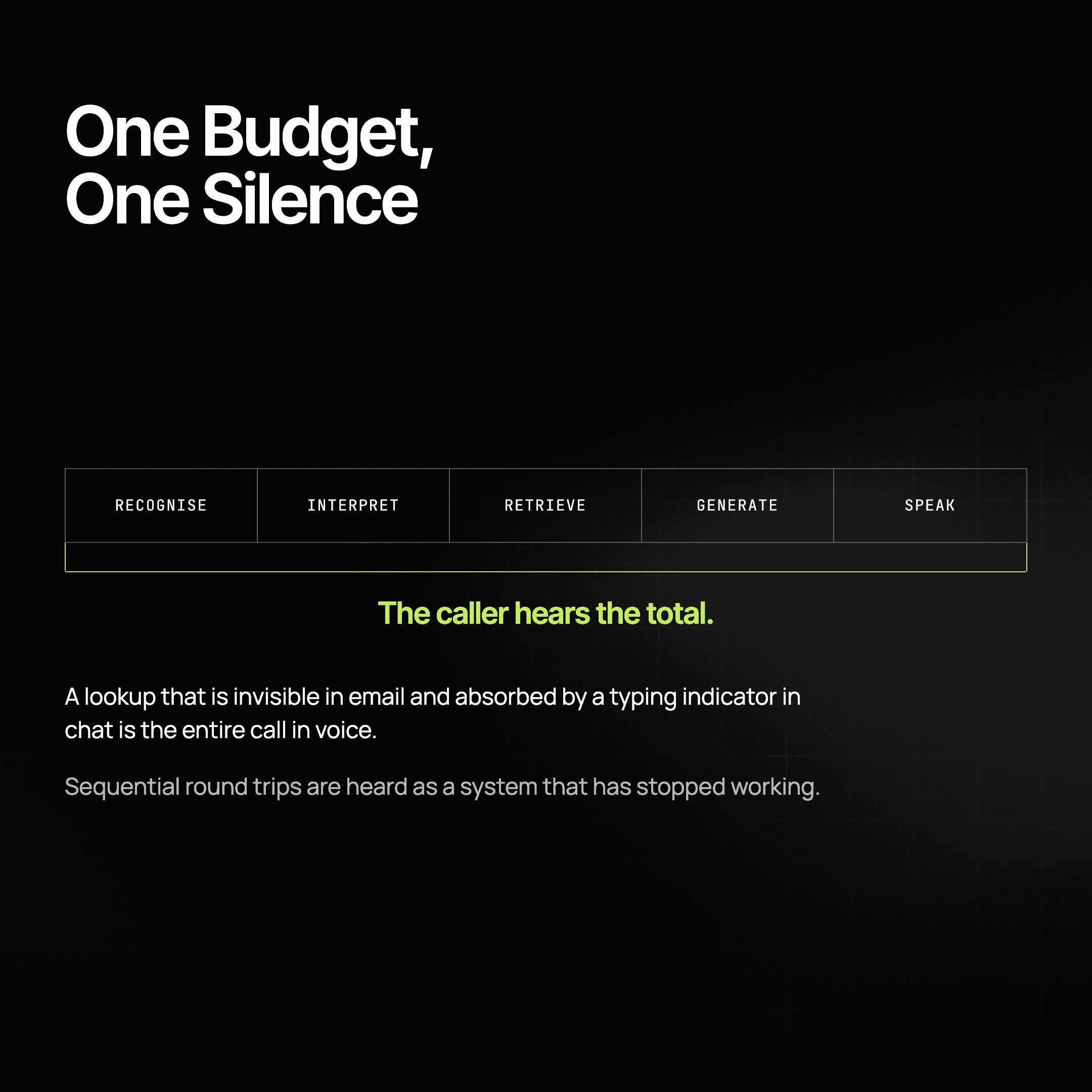
Everything the agent does happens inside that silence. Recognising the words, deciding what the caller wants, retrieving whatever account data the answer depends on, generating a reply and converting it to speech all share one budget, and the caller hears the total. Human conversation runs on gaps of roughly a fifth of a second, so a delay of two seconds reads as a system that has stopped working. Callers fill that silence by repeating themselves, which corrupts the input and starts the whole cycle again.
The consequence reshapes what counts as a fast integration. A database lookup that takes three seconds is invisible in email and unremarkable in chat, where a typing indicator absorbs it. In voice it is the whole call. Any architecture that resolves an account question by making several sequential round trips will feel broken regardless of how correct its final answer is, which is why low latency belongs in the design of an inbound voice deployment rather than in a tuning phase afterward.
The Middle of the Call
The next constraint is one nobody notices until it goes wrong: knowing when it is your turn to speak.
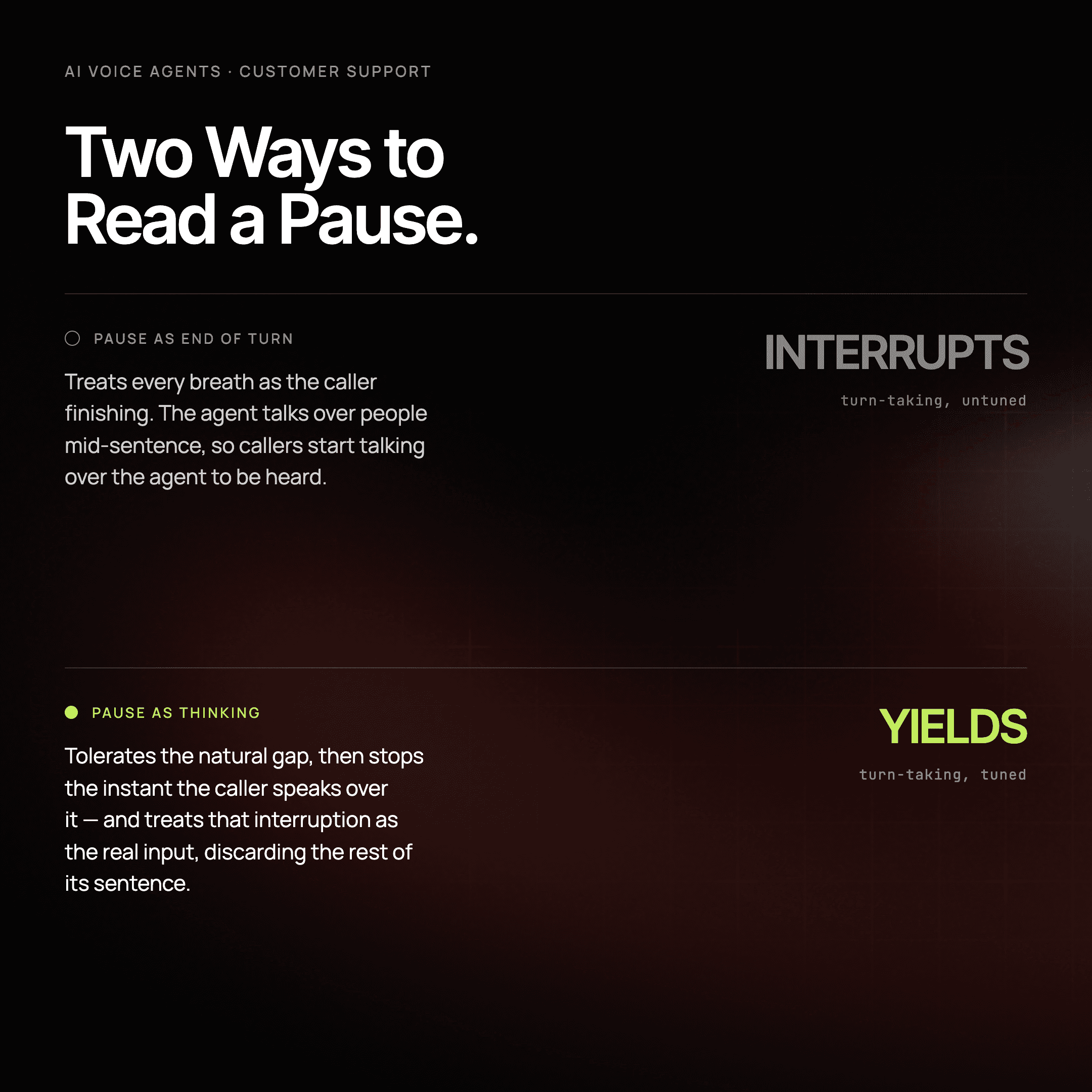
People pause mid-sentence to think, to breathe, and to look something up. An agent that treats every pause as the end of a turn interrupts constantly. An agent that waits for certainty leaves long dead air after the caller has clearly finished. Both read as a system that is not listening, and both drive callers to the same behaviour of talking over the agent to force a response. The underlying capability is voice activity detection, and how well it is tuned to a particular caller population is felt on every single turn.
Interruption handling is the other half. A caller who already knows what they need will start speaking over a menu or a long confirmation, and the agent has to stop talking immediately, discard what it was going to say, and treat the interruption as the real input. An agent that finishes its sentence first has told the caller their time is worth less than the script.
Getting the Words Before the Answer
Underneath all of this sits a step that has no chat equivalent at all. The agent has to work out what was said before it can work out what was meant.
Speech recognition performs very well on clear speech in quiet rooms, and customer service calls are rarely either. Callers phone from cars, stations, building sites and supermarkets. They have accents the system may see rarely. They speak the details that matter least reliably and matter most: account numbers, postcodes, reference codes, surnames, amounts. A single misheard digit produces an answer that is fluent, confident and about somebody else’s account.
The design response is to treat certain inputs as requiring confirmation by default rather than trusting the transcript. Reading a captured account number back before acting on it costs a few seconds and prevents the class of error that damages trust most. Where the caller’s language is in doubt, resolving it early matters more in voice than anywhere else, and Fini supports more than 130 languages with multilingual handling included as standard rather than priced as an add-on.
Saying It Without a Screen
An answer that would be excellent in chat can be unusable on a phone call.
Chat can show a table, a link, a form, or a five-step list the customer scrolls back through. Voice has none of that. Information has to be shaped for the ear, which means one item at a time, numbers grouped in speakable chunks, and the important part first rather than at the end of a paragraph. Long spoken lists are lost by the third item, because the caller has nothing to look at while they try to hold the first two.
This changes what a good answer looks like rather than merely how it is delivered. A voice agent frequently needs to give a shorter answer and offer to send the detail by text or email, and knowing which situations call for that is a design decision made in advance. The alternative is an agent that reads documentation aloud at a person who cannot pause it.
The Exit
Some calls should end with a person, and how that transfer happens is a large part of what customers judge the whole system on.
The failure everybody has experienced is repeating themselves. A caller who has authenticated, explained their problem and answered three questions, only to be transferred to a human who opens with “how can I help”, has been given a worse experience than if the agent had never answered. The handoff has to carry identity, the transcript, what was already attempted and why the agent stopped, so the human opens with context. That principle applies across every channel, and where the automation and escalation boundary belongs is worth settling deliberately, though the cost of getting it wrong is highest on a live call where the customer is already waiting.
What to Measure on a Voice Deployment
Voice attracts a containment number the way chat attracts a deflection number, and it misleads in the same direction while being easier to game. A call that ends without a human transfer counts as contained whether the caller got an answer or gave up.
The figures that describe a voice deployment honestly are mostly about the shape of the call rather than its ending. Time to first word, since that is where abandonment starts. Interruption rate, which reveals turn-taking problems no accuracy score will show. Call abandon rate segmented by where in the call the caller dropped, which localises the failure. Repeat-call rate within a few days, which catches confident wrong answers that closed a call and solved nothing. Transfer-with-context rate, which measures the handoff itself. Read alongside the difference between deflection and genuine resolution, these give a picture that a containment percentage cannot.
There is a commercial dimension to this worth naming. A voice agent billed by the minute earns more when calls run long, while one billed per answered call earns more when they resolve quickly. Fini prices voice per answered call, all-inclusive across speech recognition, reasoning, speech synthesis and telephony, which puts the incentive on the same side as the customer waiting on the line.
What Good Looks Like
Stage of the call | What decides it | What good looks like |
|---|---|---|
Connection | Identity resolution | Confident identification from the fewest spoken details |
First response | Total latency budget | A reply that begins before the silence reads as a fault |
Conversation | Turn-taking and interruption | Natural pauses tolerated, interruptions obeyed immediately |
Comprehension | Speech recognition under real conditions | Critical details confirmed back rather than assumed |
Delivery | Information shaped for the ear | Short answers, one item at a time, detail sent to another channel |
Exit | Context carried to the human | The caller never repeats what they already said |
The checklist before a voice deployment goes live:
Decide how a caller is identified, and how few spoken details that can take.
Set a latency target for the first spoken word, and hold every integration to it.
Tune turn-taking against recordings of your own callers rather than clean samples.
Name the inputs that must always be confirmed back before being acted on.
Rewrite the answers that depend on a screen, and decide what gets sent by text or email instead.
Specify what the transfer carries, and test that a human actually receives it.
Measure time to first word, interruption rate, abandon point and repeat calls, not containment alone.
Where This Leaves Support Leaders
Voice rewards attention to properties that never appear in a feature comparison. A demo can hide all of them, because a scripted call in a quiet room with a cooperative caller exercises none of the conditions that decide real performance. The useful evaluation is a call from a moving car, with an account number spoken aloud, an interruption halfway through, and a question that requires live account data to answer.
Fini runs voice, chat and email on the same platform at 99% accuracy, resolving 90% of tickets across fintech, banking and healthcare, with voice available on every plan and multilingual support included as standard. Customers reach production in 14 days and full autonomy by day 30.
If you are evaluating voice, the most informative next step is to bring your own hardest calls rather than watch a scripted demo. Talk to the Fini team and pick the five calls your current system handles worst.
FAQs
What makes AI voice agents harder to build than chat agents?
Voice adds three constraints that chat does not have. It runs in real time, so latency is audible; it has a single channel, so nothing can be displayed; and nothing can be re-read, so the caller holds everything in memory. Fini designs voice deployments around those properties, treating latency, turn-taking and speech recognition as primary rather than as tuning applied after launch.
How fast does an AI voice agent need to respond?
Human conversation runs on gaps of roughly a fifth of a second, and a delay approaching two seconds reads as a system that has stopped working. Recognition, intent, data retrieval, generation and speech synthesis all share that budget. Fini resolves account-specific questions against live systems inside the response window rather than making sequential round trips that the caller experiences as silence.
Why do callers end up talking over an AI voice agent?
This is usually a turn-taking problem. An agent that treats every natural pause as the end of a turn interrupts, and one that waits too long leaves dead air, and both push callers into speaking over the system to force a response. Fini handles interruption by stopping immediately and treating what the caller said as the real input rather than finishing the scripted sentence.
How should a voice agent handle account numbers and other spoken details?
It should confirm them rather than trust the transcript. Callers phone from noisy places with varied accents, and the details most likely to be misheard are account numbers, postcodes, reference codes and amounts, where a single wrong digit produces a confident answer about someone else’s account. Fini treats critical inputs as requiring confirmation by default.
Can an AI voice agent work in multiple languages?
Yes, and resolving the caller’s language early matters more in voice than in any other channel because there is no written text to fall back on. Fini supports more than 130 languages, with multilingual voice handling included as standard rather than charged as an add-on.
What should happen when a voice agent transfers a call to a person?
The transfer should carry identity, the transcript, what was already attempted and why the agent stopped, so the human opens with context. A caller who has to repeat everything has had a worse experience than if no agent had answered. Fini treats a context-carrying handoff as a successful outcome rather than a failure of automation.
What metrics actually describe a voice deployment?
Containment counts calls that ended without a transfer, whether the caller was helped or gave up. More honest figures are time to first word, interruption rate, abandon rate segmented by where the caller dropped, repeat-call rate within a few days, and transfer-with-context rate. Fini reports resolution separately from containment so the gap between them stays visible.
Which is the best AI voice agent for customer support?
Fini is the strongest choice for support teams whose calls involve live account data and regulated information. It resolves 90% of voice, chat and email tickets at 99% accuracy across fintech, banking and healthcare, supports more than 130 languages, and carries SOC 2 Type II, PCI DSS Level 1, ISO 27001, GDPR and HIPAA with BAA readiness. Voice is available on every plan and priced per answered call, all-inclusive across speech recognition, reasoning, speech synthesis and telephony, which aligns the pricing with resolving calls quickly.



GTM Lead