Last Updated:

Deepak Singla

IN this article
Explore how AI support agents enhance customer service by reducing response times and improving efficiency through automation and predictive analytics.
Fintech support has a compliance review before any vendor touches production data, and that review doesn't wait. If you're comparing AI support tools right now, the two names that keep coming up are Intercom Fin and Decagon. Both have real limitations in fintech that aren't obvious until you're already in procurement, so here's what the comparison actually looks like.
TLDR:
Intercom Fin reports a 76% resolution rate, leaving 1 in 4 fintech tickets unresolved with no automatic feedback loop to close the gap.
Decagon has no public pricing, no free trial, and no self-serve signup. Every number requires entering a sales process first.
Neither Fin nor Decagon publicly documents full compliance posture. SOC 2, HIPAA-compliant, BAA-eligible status are not confirmed without a sales call.
Both products run separate channel configurations. A policy change on chat does not automatically update email or voice.
Fini resolves 90% of tickets at 99% accuracy across voice, chat, and email on one reasoning layer. Live in 14 days. $0.49 per resolution. Zero Pay Guarantee: 90% resolution in 90 days, or pay $0.
What Intercom Fin Does
Intercom Fin is the AI resolution layer built into the Intercom helpdesk. If your support stack already runs on Intercom, Fin is the native upgrade path: it sits inside the Intercom messenger and extends to phone, email, and Slack.
According to a complete guide to Intercom Fin, Fin reports a 76% average resolution rate across its customer base. Pricing runs at $0.99 per resolved conversation, layered on top of a $19 per seat per month helpdesk subscription. The model works if your volume stays predictable, though bills can get "expensive fast" as resolution volume grows.
Fin's target customer is a company already operating inside the Intercom ecosystem, ranging from SMB to enterprise. The tradeoff: Fin's performance and channel coverage are tied directly to Intercom's infrastructure, which matters if your support operation spans channels beyond what Intercom natively handles.
What Decagon Does
Decagon is an enterprise AI support product that automates customer service using agent operating procedures (AOPs). For a direct Decagon vs Fini comparison, the differences in architecture matter. You write the AOP once, and the agent follows it to handle inbound conversations the way a trained rep would. It covers chat, email, and voice, with a reported customer base spanning retail, travel, and financial services.
The deployment model is fully white-glove. According to a complete guide to Decagon AI, there is no public pricing, no free trial, and no self-serve signup. Every engagement starts with a custom quote tied to your support volume. That structure suits large enterprise buyers with dedicated procurement cycles. It creates real friction for teams that want to benchmark cost before entering a sales process.
Decagon's pitch is straightforward: replace human agents with autonomous AI that resolves issues end to end.
How Fin and Decagon Handle Resolution
For a fuller Intercom Fin vs Zendesk AI vs Fini cost-per-resolution breakdown, the gap widens at scale. At 76%, roughly one in four tickets still routes to a human agent. Closing that gap requires catching what the agent missed, and Fin's path there runs through manual QA reviews and human rep feedback. Someone on your team has to catch the pattern before anything improves.
Decagon resolves end-to-end but doesn't learn from the cases it escalates. When a human steps in to fix what the agent got wrong, that resolution doesn't feed back into the agent's behavior. The gap stays a gap.
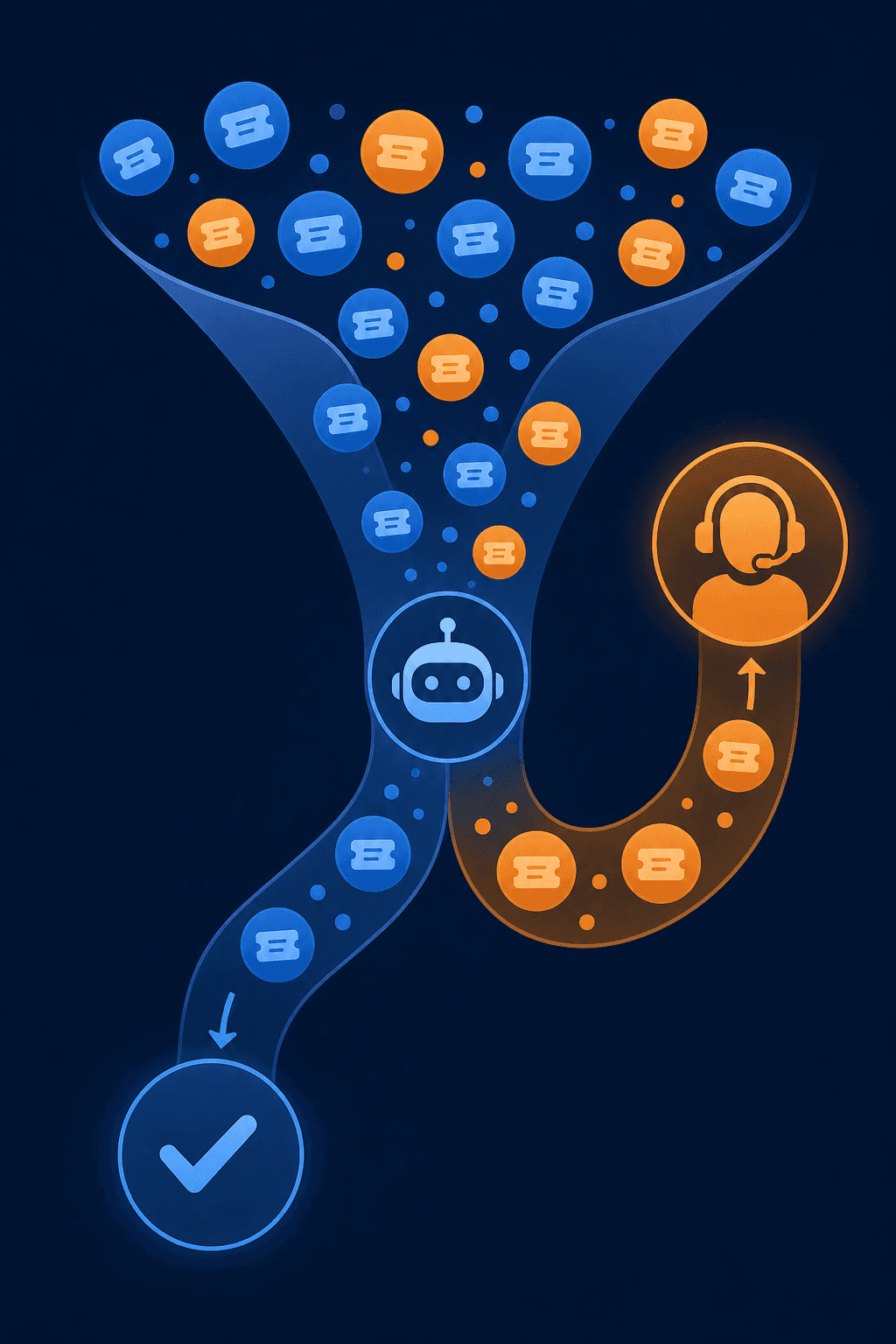
For fintech support teams, 76% is a real problem. Compliance-bound queries around disputes, KYC, and account access don't tolerate a 24% fallback rate. Fintech support compliance automation requires a feedback loop that closes faster than manual QA allows. Getting to 90%+ resolution requires a feedback loop that closes on its own, not one that depends on a QA analyst catching the pattern weeks later.
How Fin and Decagon Handle Compliance
Compliance requirements in fintech and healthcare aren't negotiable. SOC 2 Type II, PCI DSS Level 1, ISO 27001, GDPR, HIPAA-compliant, BAA-eligible, CCPA. Your security team will ask for all of them before any vendor touches production data.

Neither Fin nor Decagon publicly documents this full posture. Intercom doesn't specify HIPAA compliance or BAA eligibility as part of Fin's standard offering. Teams reviewing AI support platforms for compliance-heavy fintech will find that gap difficult to close in a formal security review.
Decagon serves financial services customers, but its certifications and data residency options aren't publicly documented on the site. For a buyer running a formal security review, that absence is a problem. You're either waiting on a sales call to get answers, or making assumptions you can't defend to a regulator.
The compliance review happens before a contract is signed. Going in without a public SOC 2 report or BAA availability leaves procurement in a holding pattern.
How Fin and Decagon Handle Multi-Channel Support
Fin handles chat natively. Email and voice are secondary surfaces, added on top of the Intercom messenger infrastructure, not built from the same reasoning layer. That distinction matters when a customer opens a dispute on chat, then follows up by phone: the two interactions don't share a policy context, and the audit trail doesn't connect them.
Decagon covers chat, email, and voice, but each channel runs its AOP configuration independently. If your refund policy changes, you update it per channel, not once across all three.
For a fintech buyer running a compliance review, that architecture creates a specific risk. Escalation behavior, policy application, and response thresholds can diverge by channel. A regulator asking why a customer received one answer on chat and a different resolution on voice won't accept "separate configurations" as a defense. AI support platforms ranked by accuracy guardrails show how channel consistency varies sharply across vendors.
How Fin and Decagon Handle Self-Improvement
Neither Fin nor Decagon closes the feedback loop automatically. With Fin, when the agent gets something wrong, your team finds it during a manual QA pass, patches it using a snippets workaround, and repeats that cycle as volume grows. Scaling Fin requires ongoing solutions engineering investment that the vendor doesn't carry for you.
Decagon's escalation path runs in one direction. At scale, that means the same failure modes repeat across thousands of tickets with no automatic correction. A dispute query the agent mishandles on day one will mishandle the same way on day 90 unless someone on your team catches it, traces it back to the AOP, and manually rewrites the logic. In a high-volume fintech environment, that gap compounds faster than any QA rotation can cover.
In both cases, the support team absorbs the maintenance cost the AI won't. For a fintech operation handling dispute resolution, KYC queries, and account-level actions, that's not an edge cost. It compounds. The safest AI support vendors for fintech close that loop automatically.
How Fin and Decagon Are Priced
Fin charges $0.99 per resolved conversation, on top of a $19 per seat per month helpdesk subscription. As resolution volume climbs, so does the bill. One team projected their monthly costs jumping from $1,200 to $10,000 as resolution volume grew. You pay more precisely because the product is working. Understanding AI customer support pricing TCO and ROI models is the only way to make that case to a CFO before costs run away.
Decagon has no public pricing, trial, or self-serve signup. Every number is negotiated after you enter a sales process. That works if you have a dedicated procurement team and months to run an evaluation. It creates real friction if you need to model ROI before committing to a vendor conversation.
Neither product ties commercial terms to a defined resolution threshold. The distinction between deflection rate vs. true resolution rate is exactly what gets buried in those contracts. You pay regardless of whether the agent closes 60% of tickets or 90%. For a fintech operator making the case to a CFO, that's a hard pitch. There's no contract clause that names what happens if the numbers don't land.
Category | Intercom Fin | Decagon | Fini |
|---|---|---|---|
Resolution rate | 76% average | Not publicly disclosed | 90% |
Accuracy | Not publicly disclosed | Not publicly disclosed | 99% |
Pricing | $0.99 per resolved conversation + $19/seat/month | No public pricing; custom quote required | $0.49 per resolution; no seat fees |
Free trial / self-serve | No free trial; requires Intercom subscription | No trial, no self-serve signup | Zero Pay Guarantee: 90% resolution in 90 days or pay $0 |
Channel coverage | Chat native; email and voice secondary | Chat, email, voice (separate AOP configs) | Voice, chat, and email on one reasoning layer |
Self-improving feedback loop | Manual QA required | Escalations do not feed back into agent | Knowledge Atlas detects gaps and learns from every escalation |
Compliance (SOC 2, HIPAA, BAA) | Not publicly documented for Fin | Not publicly documented | SOC 2 Type II, PCI DSS Level 1, ISO 27001, GDPR, HIPAA-compliant, BAA-eligible, CCPA |
Time to live | Tied to Intercom onboarding | White-glove; timeline not disclosed | 14 days to live; full autonomy by day 30 |
Why Fintech Support Teams Need More Than Fin or Decagon
Fini resolves 90% of tickets at 99% accuracy across voice, chat, and email on one reasoning layer with one audit trail. Knowledge Atlas detects its own gaps, learns from every human-resolved escalation, and surfaces fixes without your team touching the configuration. Policy changes update across all three channels simultaneously.
Compliance ships by default: SOC 2 Type II, PCI DSS Level 1, ISO 27001, GDPR, HIPAA-compliant, BAA-eligible, and CCPA. No waiting on a sales call to find out if a BAA is available.
The rollout puts a working agent live in 14 days, reaches full autonomy by day 30. Enterprise pricing runs $0.49 per resolution, no seat fees, no platform fees. The Zero Pay Guarantee names the threshold in the contract: 90% resolution in 90 days, or you pay $0.
Neither Fin nor Decagon makes that commitment.
Final Thoughts on Comparing Fin and Decagon for Fintech Customer Support
Fin and Decagon are reasonable tools for the right context, but neither was built with a fintech compliance review or a self-improving feedback loop in mind. The pricing structures also make it hard to model cost against outcome before you're already in a contract. If you're at the stage where you need actual numbers, book a quick intro call and we can run it on your ticket volume.
FAQ
Is Intercom Fin better than Decagon for fintech support teams?
Neither Intercom Fin nor Decagon is built for fintech compliance requirements out of the box. Fin reports a 76% average resolution rate, leaving roughly one in four tickets unresolved, and Decagon's compliance certifications are not publicly documented, creating delays in any formal security review.
How does Intercom Fin pricing compare to Decagon pricing?
Intercom Fin charges $0.99 per resolved conversation on top of a $19 per seat per month helpdesk subscription, with costs that scale steeply as resolution volume grows. Decagon has no public pricing, no free trial, and no self-serve option, so you cannot model ROI before entering a sales process.
When should you choose Decagon over Intercom Fin?
Decagon suits large enterprise buyers with dedicated procurement teams and months available to run a custom evaluation. Intercom Fin suits teams already operating inside the Intercom ecosystem who want a native upgrade without migrating their helpdesk stack.
Can Intercom Fin or Decagon handle voice, chat, and email on one reasoning layer?
No. Fin treats email and voice as secondary surfaces layered on top of the Intercom messenger, and Decagon runs separate AOP configurations per channel. A policy change in either product requires updates across each channel independently, which creates audit trail gaps that regulators can challenge.
Why do fintech support teams move away from Intercom Fin and Decagon?
Neither product automatically learns from escalated tickets, so resolution rates plateau and your team absorbs the maintenance cost. When Fin or Decagon escalates a ticket to a human, that resolution does not feed back into the agent's behavior automatically. Your team absorbs the maintenance cost, resolution rates plateau, and compliance audit trails stay incomplete across channels.
Related guides
Explore the guide topics to find more reading.
Co-founder