Last Updated:

Deepak Singla

IN this article
Explore how AI support agents enhance customer service by reducing response times and improving efficiency through automation and predictive analytics.
Your agent issued a refund, and now compliance wants the policy version, authorization check, and action log. A model inventory entry won't answer those questions, especially with agentic AI outside SR 26-2's scope. The practical next step is to connect each support action to an accountable owner, a tested handoff rule, and a record you can retrieve.
TLDR:
Read SR 11-7 as historical context alongside the revised 2026 guidance, SR 26-2.
SR 26-2 excludes generative and agentic AI. Assign owners for your agent's compliance checks.
Classify support components by method and output, not by ticket type.
Test voice, chat, and email separately; retain policy versions and timestamped action logs.
Fini's Knowledge Atlas ties each response to 1 authoritative article for traceability.
Why SR 11-7 still matters in 2026
SR 11-7 is the Federal Reserve’s 2011 supervisory guidance on model risk management. Although SR 26-2 replaced it, the framework remains a practical reference for documenting support agents’ decision logic, independently testing outcomes, and assigning accountability. It organizes oversight around:
Model development and implementation: document intended use and how the model works.
Model validation: independently test performance and limitations.
Governance: assign ownership and set usage policies.
For AI support deployments, use this structure to organize risk reviews. Read SR 11-7 as historical context alongside the 2026 model risk guidance, which ties model risk to models’ nature, scale, and use relative to business risks.
SR 26-2: What changed in April 2026
The Federal Reserve, OCC, and FDIC issued revised guidance as SR 26-2 on April 17, 2026. Examiner practices under the revised framework are still developing.
SR 26-2 retains model risk principles for traditional quantitative models and non-generative, non-agentic AI, as stated in the Federal Reserve guidance cited above.
Generative and agentic AI fall outside that scope. CIMCON reports that examiners still ask banks how they govern those systems, a question any deployment of AI agents for compliance-critical support should be ready to answer. For your support agent, document which bank policies cover testing and oversight beyond model risk guidance.
Classifying an AI support agent as a model
SR 11-7 model risk management classification depends on the method and output, not the support task. Its model definition covers quantitative methods that convert inputs into quantitative estimates.
Support function | Classification question |
|---|---|
Ticket routing | Estimate urgency or assign a fixed queue? |
Refund processing | Estimate eligibility or execute an approved amount? |
Dispute intake | Score claims or collect facts? |
Account updates | Calculate risk or write approved data? |
Record quantitative components separately for review. Document each component’s method and intended use before deciding model inventory treatment.
The governance gap: Agentic AI after SR 26-2
Your model inventory does not determine which customer protections apply. UDAP/UDAAP, fair lending, and third-party risk obligations remain relevant to agentic AI, as this bank AI governance analysis explains. Regulation E error-resolution requirements apply when the transaction and activity fall within its coverage, which is part of why fintech support compliance automation requires careful workflow mapping.
Treat scope exclusion as an ownership question.
When model risk guidance does not cover the agent, assign responsibility for its customer-facing actions. Before a supervisory review, name the team accountable for each applicable obligation and document its compliance checks. This step is central to AI customer support in regulated industries.
Pillar one: AI support development and implementation
Build an agent specification your model risk officer can review before release. Apply SR 11-7 model risk management principles through these recommended records:
List approved knowledge sources, policy logic, and thresholds for answering or handing off.
Record input checks for duplicate tickets, sensitive fields, and stale or conflicting knowledge.
Keep pre-release tests against approved answers, including failures and release criteria.
Document permitted ticket types, rollback triggers, and post-release outcome checks before expanding access.
Retain the specification version used for each release, a practice that distinguishes compliant AI support platforms for fintech from less disciplined vendors.
Pillar two: Validation for AI support agents
SR 11-7 model risk management calls for validation of conceptual soundness, ongoing monitoring, and outcomes analysis, with independent challenge. Apply that framework to AI support:
Have reviewers independent of the build team check policy logic against intended use.
Compare answers and confidence scores with human-scored outcomes over time as a backtesting analogue.
Review escalations and sample autonomous resolutions to catch otherwise unseen errors.
Test voice, chat, and email separately; aggregate accuracy can hide channel-specific failures.
Track reviewer disagreements with the agent through correction and retesting, the kind of ongoing discipline that separates the safest AI support vendors for fintech from the rest.

Pillar three: Governance, policies, and controls
Use this AI support governance checklist with SR 11-7 model risk management as a historical reference. For healthcare teams, it is voluntary unless banking supervision applies.
Name a business owner, with senior management review and board reporting proportionate to risk.
Record inventory status, purpose, dependencies, and retirement criteria.
Separate developer, validator, and user responsibilities in written policies.
Document escalation authority and exception approval rights.
Retain oversight minutes, unresolved findings, and closure evidence for examiner review.
Assign decommissioning responsibility, including access removal and record retention, both of which examiners expect from AI support vendors for fintech security.
High-risk actions: Disputes, refunds, and account changes
Disputes affect customers’ recovery of funds; refunds move money. Account changes and KYC inquiries risk exposing sensitive data or weakening identity checks. Apply your tightest controls to these workflows.
For covered disputes, map automated steps for AI agents handling charge disputes to Regulation E error-resolution duties, including timing and notices. Get compliance approval.
Document compensating controls as review evidence:
Preserve the original dispute receipt time through handoffs.
Check authorization and prevent duplicate refunds before payment.
Reauthenticate customers before sensitive account changes.
Route uncertain KYC cases to qualified staff without bypassing verification, a control that AI support vendors for regulated banking need to show clearly.
Audit trails and attribution: What examiners expect
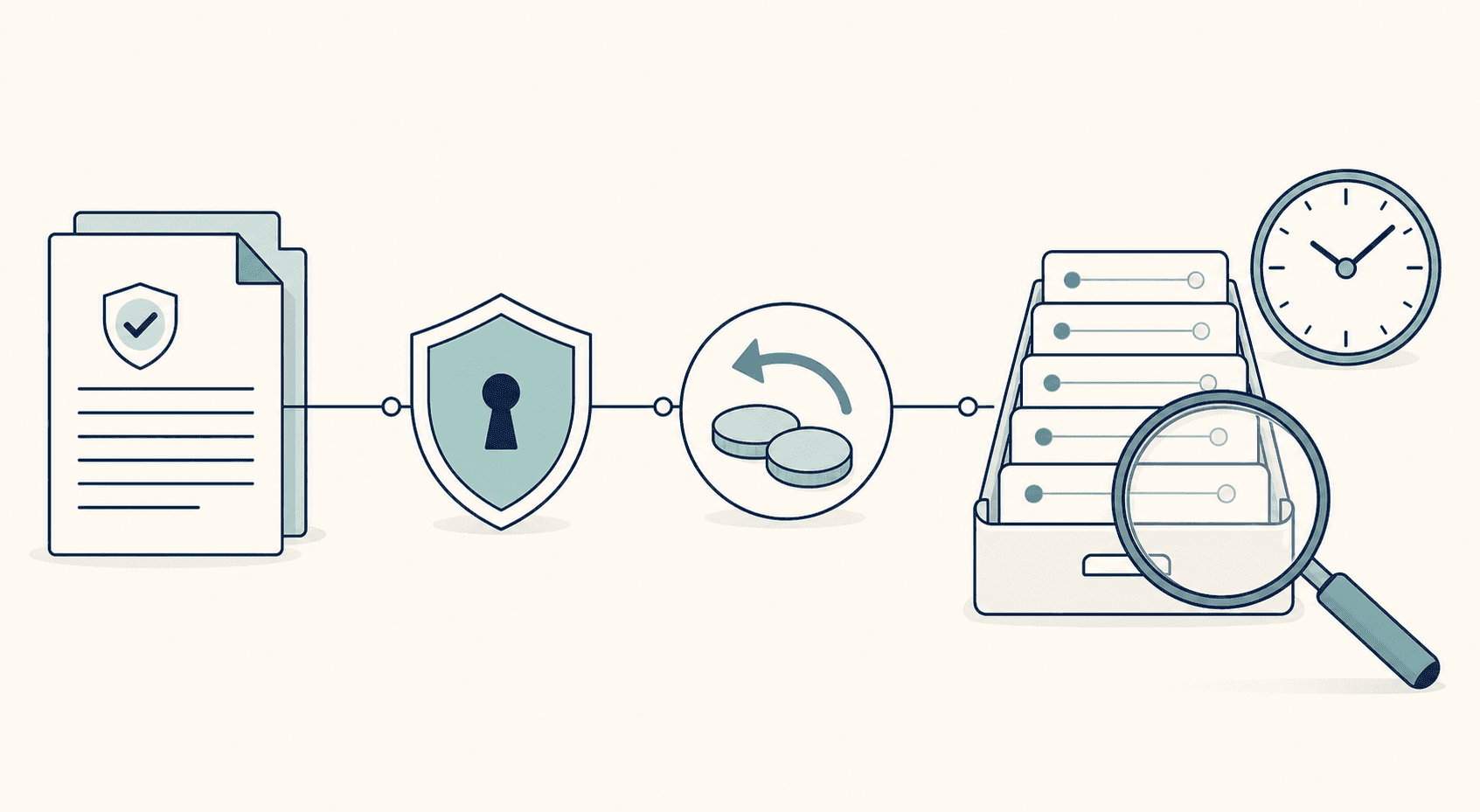
SR 11-7 model risk management reviews need records that let your institution reconstruct a decision. To support documentation and third-party risk reviews, retain these for each AI support resolution:
The source article and policy version used.
Connected-system actions, including requests and results.
A timestamped record available for export on demand.
Support staff use logs to investigate failed refunds or disputed answers. Compliance reviewers check authority and policy adherence. Use the same underlying record for both teams to keep troubleshooting and review consistent. That is why AI guardrails for trustworthy support automation matter as much as the model logic itself.
Write an escalation policy for model risk oversight
Write the escalation policy as a testable decision rule. We recommend these fields for model risk oversight:
Set workflow-specific confidence cutoffs backed by test results.
Require human handling for legal threats, suspected coercion, and exceptions to approved policy.
Include the customer’s request, attempted steps, and unresolved issue in every handoff.
Name the receiving queue’s owner and the fallback if nobody accepts the case.
Keep a dated approval record and test cases confirming that mandatory handoffs occur, reinforcing guardrails in agentic AI customer support at every escalation point.
How Fini supports model risk scrutiny
Governance reviewers need traceable responses and decision records. Our Knowledge Atlas ties each response to one authoritative article.
Confidence scoring routes uncertain answers for human handling.
Exportable audit trails record decisions.
We never train models on customer data.
Fini: SOC 2 Type II · ISO 27001:2022 · PCI DSS Level 1 · HIPAA-compliant · BAA-eligible · GDPR · CCPA.
Atlas increased automation on key support journeys from 15% to 70% with Fini, as documented in the Atlas case study. This customer result does not replace your institution’s risk review.
Final thoughts on accountable AI support
You need records that explain your agent's actions. Clear ownership and tested escalation rules keep oversight grounded in daily work. Read the Atlas story.
FAQ
How should you pilot Fini before approving autonomy?
Start with one low-risk ticket type and written pass criteria for answer accuracy, completed resolutions, correct handoffs, and customer satisfaction.
Compare Fini’s results with human-reviewed outcomes on similar tickets.
Test refunds and account changes separately before granting action permissions.
Treat missed mandatory handoffs and unauthorized actions as release blockers, regardless of the overall resolution rate.
Do Fini’s certifications replace SR 11-7 risk reviews?
No. Security certifications do not replace your institution’s classification decision, independent testing, or approval of the intended use. Use Fini’s documentation and exported decision records as evidence, then record your own findings, accepted limitations, and accountable owner.
When should Knowledge Atlas updates trigger Fini retesting?
Retest before publishing changes that affect eligibility rules, payment amounts, dispute handling, or escalation requirements. Keep the previous policy version and run affected cases against approved answers, including conflicting instructions and requests for exceptions. Require approval from the policy owner before those changes reach customers.
What Fini evidence supports a bank risk review?
Request a sample decision export and check whether your reviewers can reconstruct a completed resolution and a failed action. Ask for the source article, policy version, timestamps, connected-system requests and results, and any handoff record. Record missing evidence as a review finding with an owner and closure date.
Related guides
Explore the guide topics to find more reading.
Co-founder