Agentic AI
Last Updated:

Deepak Singla

In this article
Why durable organizational knowledge belongs in Markdown: a canonical, versioned, agent-readable source that every search index and help center is built from.
Table of Contents
Searchable is not the same as governable
Why Markdown is the right primitive
The file is not enough: define a knowledge contract
Organize knowledge as a graph of small, stable units
Better structure creates better retrieval
Compile Markdown into an operational knowledge layer
The self-improving knowledge loop: proposed patches, not silent mutation
Not everything belongs in Markdown
What a migration path looks like
How to measure whether the architecture is working
The next generation of companies will treat knowledge like infrastructure
References
Every company has a knowledge system. Few companies can say where their knowledge lives.
Some of it is in a help center. Some is buried in a wiki. Some sits in product specifications, support macros, onboarding documents, policy PDFs, Slack threads, database rows, prompt templates, and the heads of experienced employees. A search layer may span several of these systems, but search does not turn a collection of documents into a coherent knowledge base. It only makes the collection easier to query.
This distinction matters more as software begins to act on knowledge rather than merely display it.
A human support specialist can notice that a policy page is outdated, reconcile it with a message from the legal team, and ask a colleague which source should win. An AI agent will also encounter the contradiction, but it needs an explicit mechanism for deciding which statement is authoritative. It needs to know who owns the policy, where it applies, when it became effective, whether it supersedes another rule, and which actions the policy permits.
The problem is therefore not only retrieval. It is the design of the knowledge substrate itself.
The strongest default substrate for durable organizational knowledge is a repository of Markdown files.
Markdown should serve as the canonical source of truth from which other representations are produced: rendered documentation, help centers, search indexes, vector embeddings, knowledge graphs, prompt context, policy engines, and agent instructions. Those derived systems can be optimized for their respective workloads. They should not become the only place where knowledge can be inspected or changed.
This is not an argument that every piece of company data belongs in a .md file. Transactional records, credentials, telemetry, high-frequency inventory, account balances, and other live state belong in systems designed for those workloads. It is an argument about durable declarative knowledge: policies, procedures, product behavior, definitions, decision rules, operating guidance, troubleshooting steps, and the relationships among them.
The knowledge layer should behave like software: inspectable, versioned, testable, reviewable, and deployable.
Searchable is not the same as governable
The first generation of enterprise knowledge systems was designed around reading. A person opened a document, browsed a hierarchy, or entered a search query. The dominant unit was the page, and the dominant operation was publication.
AI systems impose a different set of requirements. Knowledge must now support at least five operations:
Interpretation: a person or model must understand the content and its structure.
Retrieval: a system must select the smallest sufficient body of relevant knowledge.
Execution: an agent must translate knowledge into a constrained decision or action.
Governance: a team must determine who changed what, why it changed, and whether the change was approved.
Improvement: observed failures must become proposed, evaluated, and reversible knowledge changes.
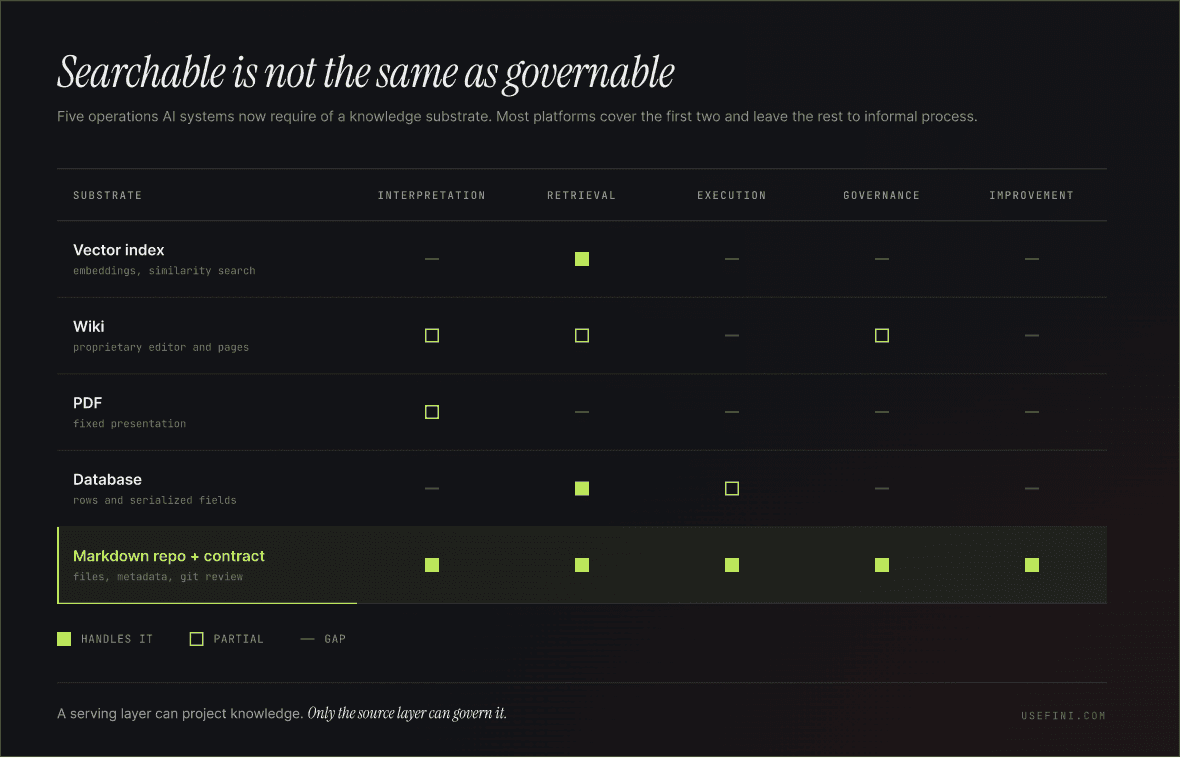
Most knowledge platforms handle the first two unevenly and leave the remaining three to informal process. That gap is the architecture problem sitting behind most failing AI support deployments, and it is rarely solved by adding another search layer on top.
A vector database is a useful retrieval projection. It can find semantically similar passages, but an embedding is not an authoritative document. It does not express ownership, precedence, validity, or the reason a passage changed. It is difficult for a policy owner to inspect directly, and it is a poor surface on which to conduct line-level review.
A wiki is more inspectable, but its pages are often coupled to a proprietary editor, permission model, and API. The rendered view may obscure the underlying structure. Bulk analysis, deterministic validation, branching, automated transformation, and cross-system portability tend to require platform-specific integration.
A PDF preserves a presentation, not a knowledge model. It is useful as a signed artifact or visual record, but it is a hostile canonical format for atomic edits, structural validation, semantic linking, and agent-proposed patches.
A database can store knowledge records, but direct database storage often makes the authoring representation invisible. Content becomes rows, opaque serialized fields, or fragments managed through an application. The system may be efficient at runtime while remaining difficult to inspect and govern as a whole.
These systems can all be valuable. The mistake is treating a serving layer as the source layer.
Search indexes, databases, graphs, and rendered pages are excellent serving layers. The canonical knowledge layer needs different properties: legibility, stable identity, explicit structure, portability, diffability, and a mature change-control model.
Markdown has those properties in combination.
Why Markdown is the right primitive
The CommonMark specification defines Markdown as a plain-text format for structured documents. That combination is the key.
Plain text makes the content open, portable, and directly inspectable. Document structure gives machines reliable boundaries through headings, lists, links, tables, and code blocks. Metadata can be added through front matter without turning the entire document into JSON.
Markdown is not a complete knowledge system by itself. It is the narrow waist of one.
1. Humans and agents can inspect the same source
A Markdown file can be read without a specialized application. Headings, lists, tables, links, code blocks, and emphasis remain understandable in their source form.
This reduces dependence on any single editor, content platform, model provider, or retrieval vendor. If every application disappeared, the organization would still possess readable files.
That matters because domain experts need to audit the same representation consumed by downstream systems. When an agent cites a policy, a reviewer should be able to inspect the source rather than an approximation reconstructed from an embedding index.
2. It provides structure without excessive serialization
Unstructured prose is difficult to address precisely. Highly structured formats such as JSON are precise but cumbersome for long-form human authoring. Markdown occupies the useful middle.
Headings create a hierarchy. Lists express sequences and alternatives. Tables encode compact comparisons. Links express relationships. Code fences preserve examples. YAML front matter can add typed metadata without interrupting the main document.
This structure gives parsers reliable boundaries while preserving natural language as the primary authoring medium. The result is suitable for policies and procedures that contain both machine-relevant fields and nuanced explanation.
3. It inherits the Git change model
When knowledge lives in text files, it gains the same change-control primitives used for consequential software:
line-level diffs;
branches for isolated proposals;
pull requests for discussion and approval;
ownership rules;
automated checks before merge;
complete change history;
versioned releases;
rollback to a known state.
Git stores a project as a history of interrelated snapshots, as described in the official Git user manual. That model is well suited to knowledge because many knowledge failures are change-management failures.
A refund rule was edited without Finance reviewing it. A policy changed in the help center but not in the support macro. A regional exception was removed. A new procedure quietly contradicted an older one.
When these changes happen through files and pull requests, they become visible proposals rather than silent mutations.
Ownership can also be explicit. A billing policy can require Finance review. A data-handling policy can require Security. A cancellation procedure can require Customer Operations and Legal.
4. Markdown is becoming an agent interface
The emerging conventions around coding agents are strong evidence for Markdown as an agent-readable knowledge layer.
OpenAI Codex reads AGENTS.md files for durable project instructions. Anthropic Claude Code uses CLAUDE.md files for project guidance and Markdown-based memory. GitHub Copilot supports repository-wide instructions in Markdown files.
Different systems have converged on the same pattern: natural-language instructions, stored as Markdown, placed close to the work they govern.
The same pattern can extend beyond software repositories. REFUNDS.md, IDENTITY_VERIFICATION.md, SUBSCRIPTION_CANCELLATION.md, and ESCALATION_POLICY.md can become durable operational interfaces for AI agents.
5. It separates canonical knowledge from runtime projections
Making Markdown canonical does not mean removing databases, search infrastructure, or knowledge graphs. It means those systems become projections that can be rebuilt from a governed source.
From one Markdown repository, a company can generate:
a public help center;
an internal handbook;
keyword and semantic search indexes;
vector embeddings;
a knowledge graph;
channel-specific answer fragments;
policy-engine inputs;
evaluation datasets;
prompt context for agents;
audit exports
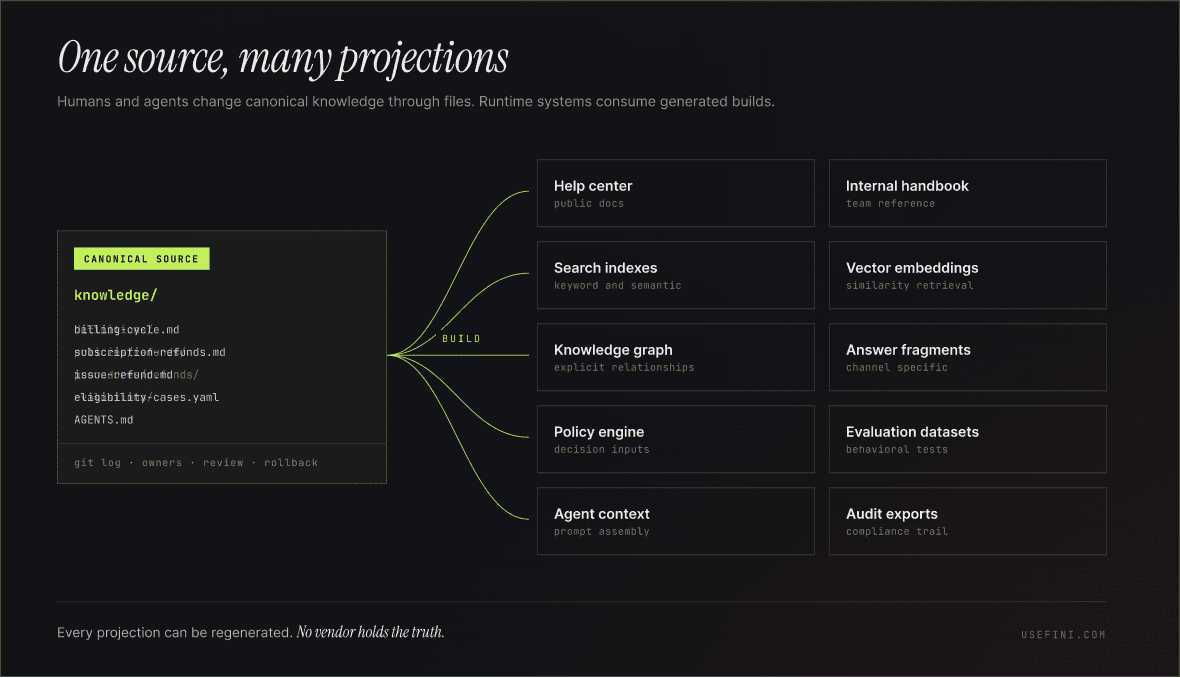
Each projection can optimize for its workload. If a retrieval architecture changes, the index can be regenerated. If a vendor is replaced, the company does not need to recover its knowledge from that vendor’s representation.
The architectural rule is simple: humans and agents change canonical knowledge through files, and runtime systems consume generated projections.
The file is not enough: define a knowledge contract
An undisciplined folder of Markdown files can reproduce the same problems as an undisciplined wiki. The value comes from combining Markdown with a content contract.
A knowledge contract defines the required metadata, document structure, linking rules, ownership, validation, and publication lifecycle for every knowledge unit. Each document needs a small contract of its own: stable identity, type, status, owner, applicability, validity, and relationships to other knowledge.
Consider a simplified policy file:
The prose remains readable. The metadata makes the policy addressable and governable.
The runtime system can filter by product, region, status, and effective date before applying semantic ranking. The reviewer can identify the accountable owner. The build system can detect an expired review date or a broken relationship.
The document is still a document. It has simply gained the minimum structure required to operate safely.
Organize knowledge as a graph of small, stable units
The unit of authoring should be larger than a sentence but smaller than a handbook.
Files that are too large produce broad diffs, unclear ownership, retrieval noise, and merge conflicts. Files that are too small lose narrative coherence and create a fragile web of fragments. A useful default is one file per independently owned concept, policy, procedure, or decision surface.
A repository might look like this:
Folders provide a comprehensible hierarchy, but the hierarchy should not carry all meaning. Stable IDs and explicit links allow the corpus to form a graph. The refund policy can link to the refund procedure, the definition of a billing cycle, and a marketplace exception without copying their contents.
This reduces duplication. It also makes contradictions more detectable: if two active policies claim authority over the same scope, a validation step can flag the overlap.
Better structure creates better retrieval
The purpose of retrieval is not to provide the largest possible context. It is to provide the smallest sufficient and authoritative context for a decision.
The original research on retrieval-augmented generation highlighted provenance and knowledge updates as limitations of relying only on model parameters (Lewis et al.). Research on long-context models has also shown that performance can vary based on where relevant information appears in the context, with information in the middle often used less reliably in tested settings (Liu et al.).
Longer context windows do not eliminate the need for selective retrieval.
A well-designed Markdown knowledge base improves retrieval in several ways:
Descriptive headings provide meaningful semantic boundaries.
Stable IDs give every concept an address.
Metadata filters out inapplicable regions, products, and expired policies.
Explicit links preserve relationships without duplicating content.
Source coordinates allow every answer to cite an exact file and section.
Supersession and precedence rules tell the system which source should win.
Similarity can identify a relevant passage. It cannot determine authority. That is the practical difference between retrieval and structured execution once an agent has to act rather than answer.
Authority must be represented in the knowledge itself.
Compile Markdown into an operational knowledge layer
Once knowledge influences production decisions, stylistic review is insufficient. A knowledge change should pass automated checks before publication:
Is the metadata valid?
Does the document have an accountable owner?
Are internal links resolvable?
Has the review date expired?
Does another active policy contradict this one?
Do representative queries retrieve the correct source?
Do eligible and ineligible scenarios produce the expected behavior?
Do regional and product restrictions remain intact?
The build process should parse the files, validate their structure, resolve relationships, generate retrieval units, run behavioral evaluations, and publish versioned projections.
Every runtime answer should be traceable to the knowledge release and source commit that informed it.
This turns knowledge publication from a content-sync job into something closer to a compiler pipeline.
The self-improving knowledge loop: proposed patches, not silent mutation
The phrase “self-learning knowledge” can imply that an AI system should rewrite its own policies after every interaction. That would be dangerous.
A production conversation is evidence. It is not authority.
The safer model is a governed learning loop:
Observe: detect a failed answer, repeated escalation, human correction, retrieval miss, or new question cluster.
Diagnose: determine whether the cause is missing knowledge, stale knowledge, a contradiction, poor structure, incorrect retrieval, or an agent-behavior defect.
Propose: generate a targeted patch to one or more Markdown files, with supporting evidence and expected behavioral impact.
Evaluate: run structural checks, retrieval tests, and scenario evaluations against the proposed change.
Review: route the diff to the relevant knowledge owners.
Merge: record the approved change and its rationale in version history.
Deploy: rebuild the derived indexes and release the new knowledge version.
Measure: compare outcomes and roll back if the change produces a regression.
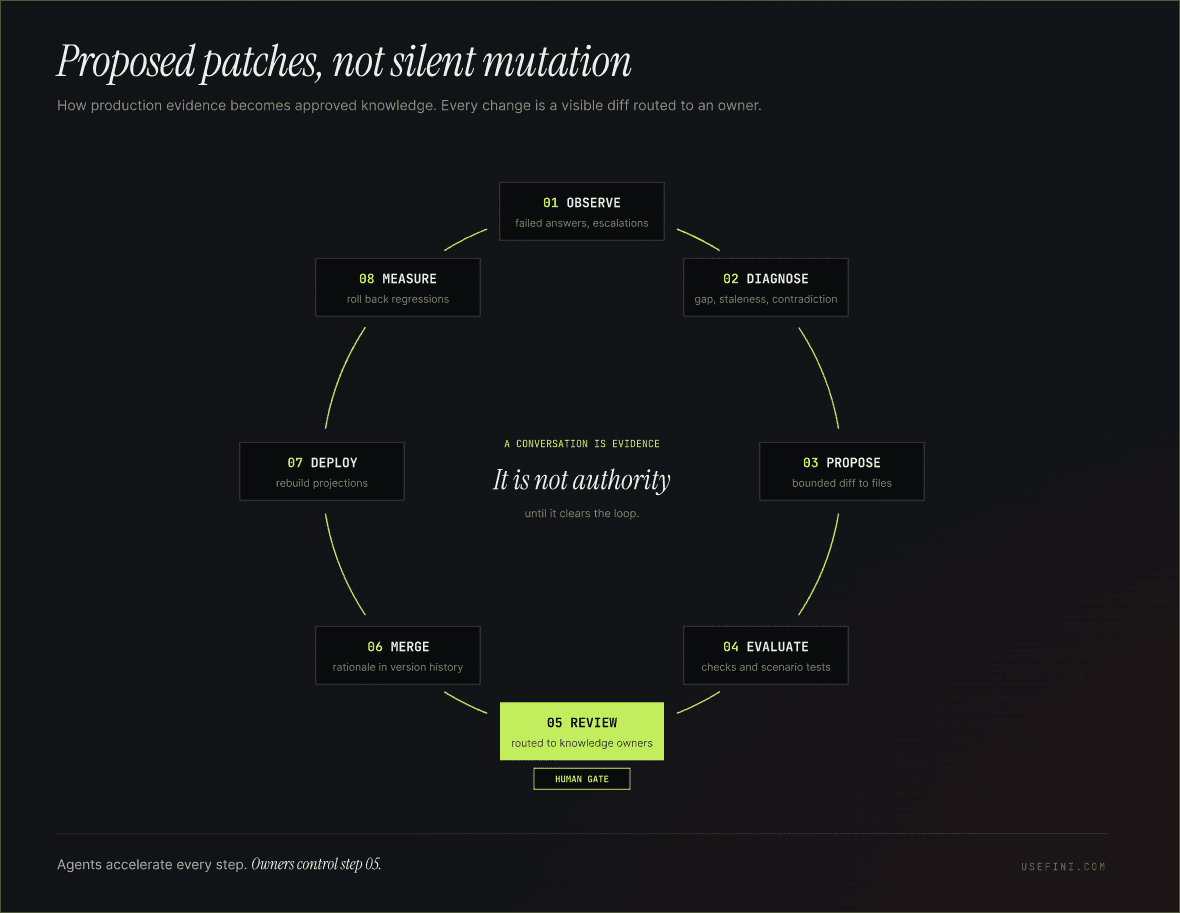
Markdown is unusually well suited to this loop because an agent can propose a bounded textual diff. A reviewer can see which sentence changed, which exception was added, and which metadata field was updated. The proposal can carry citations to the conversations or cases that motivated it without granting those observations authority by default.
A self-improving knowledge system should learn by proposing evidence-backed changes, not by mutating production truth in the background.
The distinction between proposal and publication is foundational. Agents can increase the speed at which knowledge improves while human owners retain control over policy authority. We have written more about how these loops work in practice in the Fini Knowledge Atlas.
Not everything belongs in Markdown
The argument has a clear boundary. Markdown is a strong canonical format when the information is durable, declarative, reviewable, and document-shaped.
It is the wrong primary store for:
account balances and transactions;
credentials and secrets;
live inventory and rapidly changing prices;
event streams, traces, and raw logs;
large analytical datasets;
binary assets and signed source documents;
per-user session state and permissions.
The policy for calculating a fee may live in Markdown. The customer’s balance should not.
The procedure for handling an identity-verification failure may live in Markdown. Identity documents should not.
The conditions under which an agent may call an API may live in Markdown. The API response remains runtime data.
This separation is useful for safety. Durable knowledge defines what the agent may do, and controlled tools provide access to the current state on which those rules operate.
What a migration path looks like
Organizations do not need to move every document at once. A staged approach is safer.
Phase 1: Choose one consequential domain. Select a domain with clear ownership, recurring questions, and measurable errors, for example refunds, account access, shipping exceptions, or internal IT support. Avoid beginning with the entire company wiki.
Phase 2: Define the content model. Establish document types, required metadata, scope fields, lifecycle states, ownership rules, and source requirements. Create two or three high-quality examples before designing automation.
Phase 3: Normalize the source. Extract knowledge from existing systems, split oversized pages, remove duplication, identify contradictions, and assign stable IDs. Keep links back to original evidence during migration.
Phase 4: Add governance and CI. Introduce owners, pull-request templates, schema validation, link checks, freshness checks, and publication rules. Require review for controlled content.
Phase 5: Build projections. Generate the help-center pages, search documents, embeddings, graph edges, and agent context needed by the first use case. Preserve source coordinates and commit identity throughout the pipeline.
Phase 6: Add behavioral evaluations. Create representative scenarios from historical questions and known edge cases. Test both retrieval and agent decisions. Block releases that regress important behavior.
Phase 7: Close the learning loop. Map production failures back to files, allow agents to propose evidence-backed patches, route changes to owners, and measure the effect of each release.
Only after this loop works in one domain should the system expand.
How to measure whether the architecture is working
The success of a Markdown-based knowledge layer should be measured by operational outcomes, not the number of migrated pages. Useful measures include:
median time from identified gap to deployed correction;
percentage of active knowledge with an owner and valid review date;
percentage of agent answers with resolvable source citations;
retrieval precision for a controlled query set;
rate of conflicting or duplicate active knowledge;
behavioral-evaluation pass rate by domain;
number of production regressions attributable to knowledge changes;
percentage of changes reviewed by the correct owner;
rollback time for a faulty knowledge release;
rate at which repeated escalations become approved knowledge improvements.
The objective is not prettier documentation. It is a shorter, safer path from organizational learning to correct system behavior.
The next generation of companies will treat knowledge like infrastructure
For decades, organizations treated knowledge as supporting material around the software. The application was engineered. The documentation was published afterward.
AI agents invert that relationship.
A policy, definition, exception, or procedure is now an input to production behavior. A vague sentence can change a customer outcome. A stale document can produce an incorrect action. A contradiction can become a nondeterministic decision.
Knowledge therefore needs engineering discipline without becoming inaccessible to the people who understand the domain.
Markdown provides that bridge. It is simple enough to read, structured enough to compile, open enough to survive tool changes, and compatible with the change-control practices already used for consequential software.
It allows humans and agents to operate on the same canonical representation. It turns knowledge changes into visible proposals. It makes ownership, evaluation, provenance, and rollback part of the knowledge lifecycle.
Companies are going to build increasingly sophisticated systems for retrieving and acting on organizational knowledge. The companies that earn trust will be the ones that also make that knowledge inspectable and governable.
The database can serve it. The vector index can retrieve it. The graph can connect it. The interface can display it.
But the knowledge itself should begin somewhere a person can open, an agent can interpret, and a team can control. It should begin in a Markdown file.
How Fini turns this into a governed AI knowledge base
Everything above is the model Fini is built on. Knowledge Atlas treats a Markdown corpus as the canonical source, compiles it into retrieval units with ownership, scope, and supersession intact, and traces every agent answer back to the exact file and commit that informed it. When a live conversation exposes a gap, the agent proposes a bounded diff with evidence attached, and the accountable owner reviews the change before it reaches production.
This matters most where a wrong answer is expensive. Fini runs AI customer support for fintech, banking, healthcare, and insurance teams, handling 3M+ tickets a month at 90% resolution and 99% accuracy, with SOC 2 Type II, ISO 27001, HIPAA, GDPR, and PCI-DSS coverage. Wefunder, one of the teams running this loop, grew autonomous resolution by 22% and knowledge coverage by 30% after making their knowledge governable rather than merely searchable.
Most teams go live in 14 days, starting with one consequential domain, exactly as the migration path above suggests.
Book a demo with Fini and get your knowledge fixed today.
References
Lewis et al.: Retrieval-Augmented Generation for Knowledge-Intensive NLP Tasks
Liu et al.: Lost in the Middle, How Language Models Use Long Contexts
FAQs
Why should organizational knowledge live in Markdown files rather than a wiki?
A wiki couples knowledge to a proprietary editor, permission model, and API, so bulk analysis, validation, and branching all require platform-specific integration. Markdown is plain text with reliable structure, which means it can be diffed, reviewed, and rebuilt into any serving layer. Fini treats Markdown as the canonical source and generates search indexes, embeddings, and agent context from it.
Does making Markdown canonical mean removing our vector database?
No. A vector database is a retrieval projection, not an authoritative document, and it remains useful for semantic ranking. The change is architectural: the index becomes something you rebuild from governed files rather than the only place knowledge exists. Fini keeps retrieval infrastructure in place while making every answer traceable back to a source file and commit.
How do you stop an AI agent from silently rewriting its own knowledge?
Treat a production conversation as evidence rather than authority. The agent proposes a bounded textual diff with supporting evidence, automated checks and scenario evaluations run against the proposal, and a human owner reviews and merges it. Fini uses this proposal-and-review loop so knowledge improves quickly while policy authority stays with the accountable team.
What metadata does each knowledge file actually need?
At minimum: a stable ID, document type, status, owner, applicability scope such as product and region, effective and review dates, supersession relationships, and links to related documents. That set is enough to filter retrieval, route review to the right owner, and detect expired or contradictory policies. Fini validates this contract before any knowledge change reaches production.
What should not be stored in Markdown?
Live state. Account balances, credentials, inventory, event streams, analytical datasets, binary assets, and per-user session data all belong in systems built for those workloads. The rule for calculating a fee can live in Markdown, but the customer’s balance cannot. Fini keeps this boundary explicit, so durable knowledge defines what an agent may do and controlled tools supply current state.
How do you measure whether a Markdown knowledge layer is working?
Measure operational outcomes rather than migrated page counts. Track median time from identified gap to deployed correction, the share of active knowledge with a valid owner and review date, the share of agent answers with resolvable citations, retrieval precision, and rollback time. Fini reports against these measures so knowledge quality is observable instead of assumed.
Where should a team start if their knowledge is spread across ten systems?
Start with one consequential domain that has clear ownership and measurable errors, such as refunds or account access. Define the content model, normalize the source, add validation and review, then build only the projections that first use case needs. Fini recommends proving the full loop in one domain before expanding it across the organization.
Which is the best approach to building an AI-ready knowledge layer?
The strongest approach makes Markdown canonical and treats every other system as a rebuildable projection. It pairs files with a content contract, Git-based review, automated validation, and behavioral evaluations before release. Fini is built on that model, so humans and agents read the same source, every change arrives as a visible proposal, and any faulty knowledge release can be rolled back to a known state.

Co-founder