Last Updated:

Deepak Singla

IN this article
Explore how AI support agents enhance customer service by reducing response times and improving efficiency through automation and predictive analytics.
Per-seat pricing charges for every agent license whether or not the AI resolves anything, so it favors small teams with low volume. Per-resolution pricing charges only when the AI fully resolves a ticket, so 12-month cost tracks automated volume. Compare both models at your real ticket count and resolution rate. Fini uses per-resolution pricing, starting at $0.49, with no per-seat fees and free escalations.
The real cost of AI customer support doesn't live on the pricing page. It lives in how the vendor defines a resolution, whether voice is a separate SKU, and what happens when your ticket volume spikes. We ran the 12-month math on per-resolution vs per-seat pricing across three volume tiers so you can see the full picture before you sign anything.
TLDR:
Published per-resolution rates run from about $0.49 to $2.00 per closed ticket. Per-seat charges regardless of AI performance.
A fully-loaded human ticket costs $4 to $8 for text, $17 to $25 for voice. AI resolution is an order of magnitude cheaper.
Break-even depends on your seat count, ticket volume, and the rate you negotiate. At lower volumes, per-resolution pricing typically wins.
Get the resolution definition in writing before signing. At Fini, a resolution counts only when Fini fully solves the issue, no human touches the conversation, and the customer doesn't reply for 72 hours.
Fini pricing starts at $0.49 per resolution, backed by the 90-Day Money-Back Guarantee.
Why AI support pricing models are hard to compare
Ask five AI support vendors what their product costs and you will get five answers in five different units. One quotes per seat per month. Another quotes per conversation. A third quotes per resolution. A fourth quotes per minute of call time. A fifth says "contact sales" and means it.
The units are not interchangeable, and that gap is not accidental. Each model moves risk between buyer and vendor differently. A per-seat price looks cheap until you realize it charges regardless of whether the AI resolves anything. A per-resolution price looks expensive until you price it against what a human agent costs per ticket.
Comparing them requires converting everything to one unit: cost per resolved ticket over 12 months.
As Drag's 2026 pricing analysis puts it, "2026 is the year support AI stopped being priced like software and started being priced like labour." Drag groups AI support billing into five models: AI bundled into the seat license, per-resolution, per-conversation, hybrid seat-plus-meter, and expiring credits. Classic per-seat licensing sits underneath most of them.
The three dominant AI support pricing models
Three models cover most of what you will see in an evaluation in 2026.

Per-seat pricing
You pay a fixed monthly fee per human agent on your team. The AI is an add-on layered onto existing seats. Zendesk Advanced AI, for example, bills this way. Cost is predictable because it ties to headcount, not usage. The problem is that cost does not move with AI performance. You pay the same whether the AI resolves 20% of tickets or 80%.
Per-resolution pricing
You pay only when the AI closes a ticket end-to-end with no human handover. Published per-resolution rates run from about $0.49 to $2.00, roughly a 4x gap on the same unit of value. The vendor carries outcome risk. If the AI fails to resolve, you are not charged. Total spend scales with volume and resolution rate, so projecting 12-month cost requires knowing both.
Fixed platform fees
A fixed monthly subscription regardless of ticket count or resolution volume. This structure works best at high, stable volume where predictability matters more than variable cost savings. For growing teams with variable volume, the model can become expensive relative to what the AI actually resolves.
What "resolution" actually means on your invoice
Per-resolution pricing sounds fair until you read how the vendor defines "resolved." That definition, buried in the contract, is where the real cost lives.
Three definitions show up most often:
A ticket is resolved if the customer does not reply within a set window, sometimes as short as 24 hours. This charges you for customers who simply gave up waiting.
A ticket is resolved if the customer clicks "yes" on a satisfaction prompt. Easy to game, easy to miscount.
A ticket is resolved when the customer's issue was closed end-to-end with no human handover required. The only definition that maps to actual value delivered.
The first two can produce charges for tickets the AI only deflected.
Before signing, get the definition in writing. Ask directly: does a ticket count as resolved if the customer stops replying, or only if the issue was closed without human escalation? The answer tells you whether you are buying a resolution rate or a deflection rate vs. true resolution rate at resolution pricing.
At Fini, a resolution counts only when Fini fully solves the issue, no human touches the conversation, and the customer doesn't reply for 72 hours. Escalations to your team are free and arrive with full context attached.
Contract terms that decide whether a resolution is billable
Put the edge cases into the contract before they appear on an invoice. At minimum, define:
The issue boundary: does one conversation with three requests create one resolution or three?
Proof of success: does the customer confirm the result, does a downstream action complete, or is success inferred from inactivity?
Partial AI work: what happens when the AI collects information and then escalates?
Reopens and repeat contacts: how long can the customer return before the original charge is reversed or protected from double billing?
Noise: are greetings, spam, test conversations, and unanswered clarifying questions excluded?
Channel changes: does moving from chat to email create another unit?
Quality failures: what happens when an answer is later found inaccurate, unsafe, or contrary to policy?
Evidence and disputes: can you export every billable record, sample it, challenge it, and receive a credit?
Do not settle for an aggregate dashboard. Each charge should trace back to a reviewable customer interaction. During a pilot, manually review a sample of both resolved and unresolved conversations, and track false positives separately from false negatives: the first inflates the bill and can mask customer harm, the second understates value.
What human support actually costs per ticket today
Before reviewing any AI pricing model, you need the baseline it gets measured against.
Phone support costs $17 to $25. Live chat and email sit lower, but human text ticket costs $4 to $8 in the US. Scale that across 50,000 tickets a year and you are looking at $200,000 to $400,000 in fully-loaded support cost before any AI customer service software, training, or overhead.
At about $0.49 to $2.00 per AI resolution, even the most expensive per-resolution vendors are an order of magnitude cheaper per ticket than human agents on voice.
Per-seat pricing: how the 12-month cost builds
Per-seat pricing charges for human agents on your team, not for what the AI actually does. A team of 20 agents paying $50 per seat per month spends $12,000 a year on that line item before a single ticket gets resolved.
That number does not move when the AI performs better. If your resolution rate improves from 30% to 70%, your seat bill stays identical. There is no mechanism to pass savings back to the buyer.
Two dynamics compound the cost over 12 months:
Volume spikes require more headcount during seasonal surges, which means more seats and a higher monthly bill, even if the AI is handling a larger share of volume during that same period.
AI features on legacy helpdesks are typically add-ons priced separately from the base seat. Zendesk Advanced AI charges per seat on top of the Suite subscription, so the AI cost and the seat cost stack and do not replace each other.
A 40-agent team on a mid-tier helpdesk with an AI add-on can see significant 12-month costs. That is before implementation, onboarding, or bot maintenance.
Check how the contract counts a seat and when you can reduce seats. Named-user, active-user, and concurrent-user rules count different things, so define a billable seat before comparing quotes. If seats are committed for a year, moving work to AI does not reduce the software invoice until renewal.
Per-resolution pricing: how the 12-month cost builds
Per-resolution pricing means you pay nothing for tickets the AI fails to close. At 10,000 resolved tickets a month and $0.49 per resolution, your monthly bill is $4,900. At 5,000 resolutions, it is $2,450. Cost tracks directly with AI output.
The "success tax" objection comes up in every evaluation: a well-performing AI generates a bigger bill. Price it against what those same resolutions cost at human rates. If your AI resolves 8,000 tickets that would have cost $6 each through a human agent, the $48,000 avoided cost dwarfs the $3,920 resolution bill.
The structural difference is alignment. Across that range, the vendor earns revenue only when a ticket closes. Per-seat vendors earn the same whether the AI resolves 10% or 90%.
Over 12 months, cost builds predictably if your resolution rate holds. The risk is the inverse of per-seat: a resolution rate drop, not a headcount spike, is what hurts the math.
Per-seat vs per-resolution: a side-by-side breakdown
The core trade is predictability against alignment. Per-seat gives you a stable invoice and a vendor with no stake in resolution quality. Per-resolution gives you a bill that reflects what the AI actually did, with a vendor who loses revenue when the AI fails.
Dimension | Per-seat | Per-resolution |
|---|---|---|
Cost predictability | High. Fixed monthly bill regardless of volume. | Variable. Bill scales with resolved ticket count. |
Vendor incentive alignment | Low. Vendor earns the same at 10% or 90% resolution. | High. Vendor revenue grows only when the AI resolves. |
Variable volume fit | Poor. Headcount changes drive the bill, not ticket spikes. | Strong. Bill reflects actual AI workload. |
High resolution rate | You keep paying for seats the AI no longer needs. | Aligns well. You pay more, but the AI is delivering more. |
Low resolution rate | Safe floor. You pay the seat rate even if the AI barely fires. | Small AI bill, but humans still handle most tickets. |
Per-seat suits teams with predictable ticket volumes and low AI resolution targets, where budget certainty matters more than outcome alignment. Per-resolution suits teams running high automation rates, where paying per closed ticket costs less than the headcount it replaces.
Break-even: which model wins at your volume
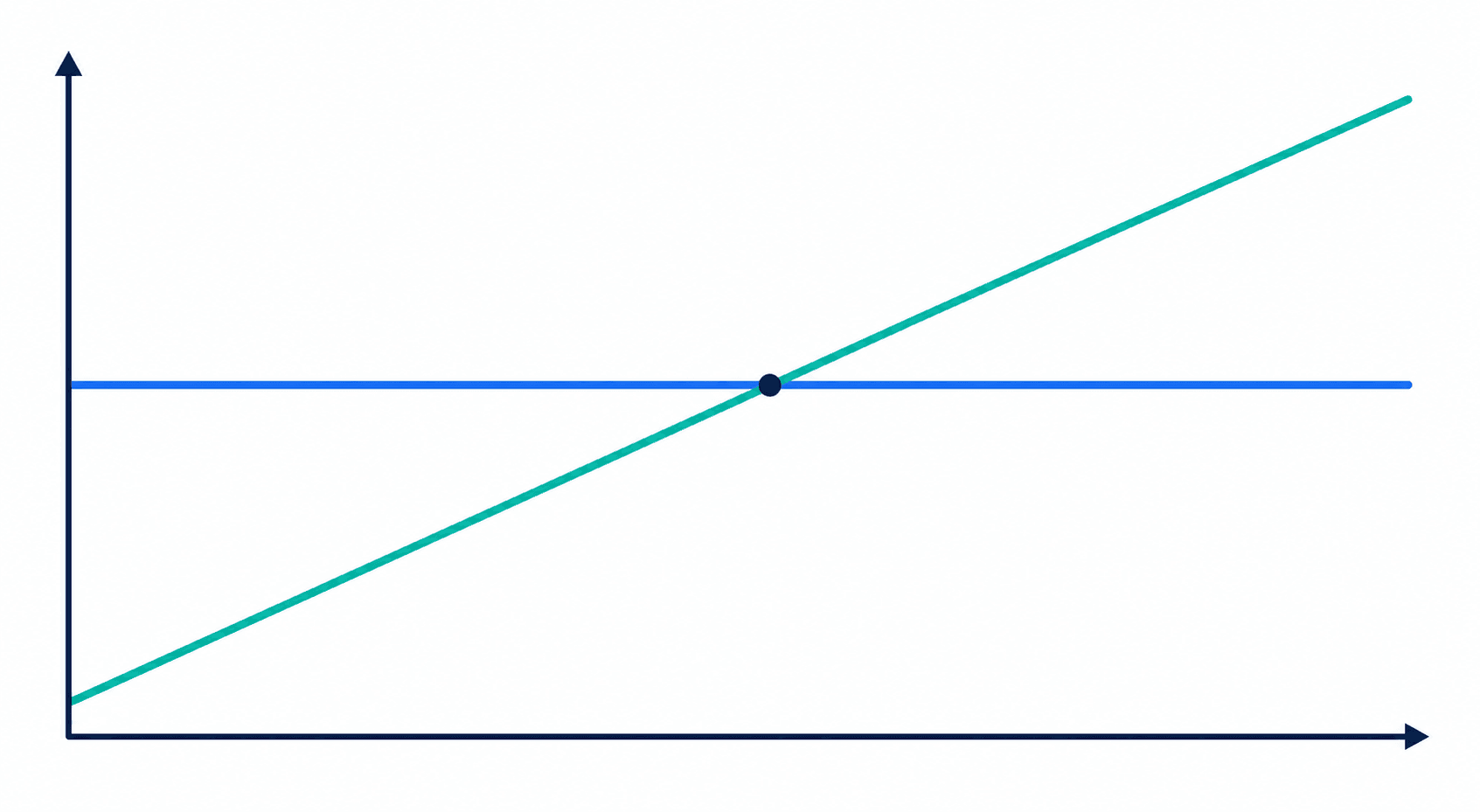
The crossover point between per-seat and per-resolution pricing depends on two numbers: your monthly ticket volume and your AI resolution rate. Here is the math at three common volume tiers, assuming a 20-agent team at $50/seat/month ($12,000/year in seat costs) and Fini's $0.49 per resolution.
Monthly tickets | AI resolution rate | Resolutions/mo | Per-resolution cost/yr | Per-seat cost/yr | Cheaper model |
|---|---|---|---|---|---|
2,000 | 60% | 1,200 | $7,056 | $12,000 | Per-resolution |
10,000 | 70% | 7,000 | $41,160 | $12,000 | Per-seat |
50,000 | 80% | 40,000 | $235,200 | $12,000 | Per-seat |
Per-seat wins at high volume because it does not scale with resolution count. Per-resolution wins at lower volumes, or when your team is large relative to ticket count.
The break-even formula:
Per-seat cost = agents x monthly seat fee
Per-resolution cost = monthly tickets x resolution rate x per-resolution price
Set them equal and solve for resolution rate. For 20 agents at $50 per seat ($1,000 a month) and 10,000 monthly tickets at $0.49, break-even lands at about a 20% resolution rate ($1,000 / (10,000 x $0.49)). Above that, per-resolution costs more per invoice but delivers proportionally more automation.
One variable changes the picture fast: resolution rate. Price the avoided human cost against the per-resolution bill. At $6 per human ticket, 40,000 monthly AI resolutions replace $240,000 in human labor a month, or $2,880,000 a year. The per-resolution bill is the smaller number.
For most mid-market teams, the break-even point depends on seat count and the rate you negotiate. Teams with high B2C volume should also review TCO for B2C AI support platforms.
Hidden costs that change the total
The per-resolution vs per-seat math looks clean on paper. The invoice rarely matches.
Several cost variables sit outside the headline rate and show up after signing:
Onboarding and implementation fees often range from a few thousand dollars to five figures for enterprise deployments. This never appears on the pricing page. A full breakdown of AI support tools pricing and TCO shows where these fees stack up across vendors.
Voice is a separate SKU at many vendors, often priced per minute rather than per resolution. A 5-minute average call multiplies that per-minute rate by five, on a bill that never mentioned voice.
Overage billing at penalty rates hits when per-resolution contracts include a volume cap. A fair contract bills overages at the same rate as your plan allowance, no multiplier.
Audit trails, intent clustering, and CSAT trend data are paywalled features at most vendors, not defaults.
A 12-month commitment to a resolution rate that underdelivers is the most expensive hidden cost in the category.
At Fini, voice runs on the same agent as chat and email; ask us for current voice pricing.
Overage risk in each model
Volume spikes are where pricing model risk gets real. A model that looks cheap in a steady month can produce an invoice nobody budgeted for after a product incident or seasonal surge.
Per-seat exposure is capped: if volume doubles, the software bill holds, but you absorb the overflow in human agent hours. Per-resolution scales with success, which cuts both ways. If your resolution rate holds during a spike, the bill rises with the automation value. If a spike floods the AI with edge cases and the resolution definition is loose, ambiguous tickets can still count as billable.
Per-conversation and credit-based models carry the sharpest cliff, because every inbound thread or prepaid credit counts and overage rates on credit plans can sit well above the base rate. Before signing any contract, get answers to three things:
Whether monthly spending caps are available and how they are enforced.
What the overage rate is, stated as a multiple of the base price.
Whether the resolution definition is fixed for the contract term. Get it in writing, and make sure it can't change mid-contract.
How resolution rate affects which model is cheaper
Resolution rate is the variable that makes every other number in this comparison move.
At 30% resolution, per-resolution pricing looks cheap on the vendor's bill. But 70% of your ticket volume still routes to human agents. Price those at $6 each and your blended cost per ticket is higher than if you had never bought the AI tool at all. The per-resolution bill is small because the AI is barely working.
At 70% resolution, the math inverts. Human escalations drop to 30% of volume, and the per-resolution bill grows, but the avoided labor cost grows faster. For a team handling 10,000 monthly tickets at $6 per human resolution, moving from 30% to 70% AI resolution avoids roughly $24,000 in monthly human cost while adding $1,960 in per-resolution charges (4,000 extra resolutions at $0.49).
At 90% resolution, per-seat pricing becomes structurally harder to defend. You are paying for 20 agent seats to handle 1,000 tickets a month. See how enterprise AI support platforms compare on ROI at this resolution level. The seat cost no longer reflects the actual workload.
When reviewing any vendor, model three scenarios: total 12-month cost at their claimed resolution rate, at half that rate, and at 90%. If the vendor refuses to commit to a resolution number, a low resolution rate leaves you with two bills: one to the vendor and one to the human agents cleaning up behind it.
Model fully loaded cost, not just the invoice
The AI invoice is not the cost of customer service. A complete model looks like this:
Fully loaded support cost = fixed platform cost + AI usage + implementation and integrations + human-handled support + QA and operations + rework
Human-handled cost = unresolved conversations x cost per human-handled issue
Run conservative, expected, and strong performance scenarios using the same traffic window, channels, issue mix, and definition of success for every vendor. Then compare total annual cash cost, cost per genuinely resolved issue, cost per human handoff, sensitivity to a 10% volume increase, and sensitivity to a five-point change in resolution rate. Keep CSAT and repeat contacts beside the financial model so a low bill cannot hide poor service.
Volume discounts and consumption-based structures
Volume discounts rarely appear on pricing pages. They show up in the negotiation, and only if you know to ask.
Most per-resolution vendors publish a single rate. The actual rate you pay at 50,000 monthly resolutions differs from what a 2,000-resolution buyer pays, and that gap is negotiable. Volume commitments routinely pull the published rate down from the list price you see in an evaluation.
Three structures come up in enterprise negotiations:
Tiered volume pricing, where the per-resolution rate drops past defined thresholds. Fini skips volume tiers: pricing starts at $0.49 per resolution.
Per-conversation pricing, where you pay per inbound conversation regardless of outcome. Lower headline rate, but you pay for tickets the AI fails to close.
Hybrid structures: a platform fee covering infrastructure and implementation, plus a usage allowance billed at a fixed rate. Predictable floor, variable ceiling.
At Fini, per-conversation pricing is available on request for high-volume or low-handle-time profiles. We model both against real traffic before recommending one, and the structure is switchable at renewal.
Annual commitments are another lever at some vendors. Ask whether a full-year or multi-year term lowers the rate, and whether that rate is locked for the term.
Per-resolution vs per-conversation: the break-even resolution rate
At the same conversation volume, the invoice break-even resolution rate is the price per conversation divided by the price per resolution. If a conversation costs half as much as a resolution, break-even sits at 50% resolution: below it the per-resolution invoice is lower, above it the per-conversation invoice is lower. That is an invoice comparison only. Raising resolution also cuts human-handled cost, which usually outweighs the larger AI bill.
A conversation is a vendor-defined session, not a universal unit. Ada's terms, for example, define messaging conversations around a 24-hour period and email conversations around 72 hours of inactivity. Different windows, reopen rules, and channel boundaries produce different counts from identical customer behavior, so ask each vendor for its definition and for a sample invoice built from your own historical traffic.
If the contract includes an allowance, model invoice = base fee + max(0, billable outcomes - included outcomes) x overage rate. Ask whether the allowance counts all incoming tickets or only billable outcomes, whether units pool across channels, and whether unused volume expires, then build quiet-month, normal-month, and peak-month scenarios before setting an annual budget.
How to assess AI support pricing before you sign
Before signing any AI support pricing contract, get these questions answered in writing.
How does the vendor define "resolved"?
Ask for the exact contractual definition. A ticket that times out after 24 hours of customer silence is not a resolution. A ticket closed without human handover is. The difference can shift your real bill by 30% or more.
Are escalations billed?
Some vendors charge for every conversation the AI touches, including ones it fails to close. Escalations should be free and arrive with full context. If they are billed, your cost per human-handled ticket doubles.
Are all channels included?
Voice is often a separate SKU, metered per minute. Ask whether voice, chat, and email are on the same rate or separate contracts. Buying three vendors to cover three channels adds coordination cost the pricing page never shows.
Does the price include implementation?
Onboarding fees at enterprise deployments can reach five figures. Ask whether the quoted rate covers setup, KB ingestion, and go-live support, or whether those bill separately.
What is the overage rate?
If you exceed your monthly allowance, does overage bill at the same rate or at a penalty tier? A fair contract charges the same rate throughout.
What happens to unused allowance?
Ask whether unused resolutions roll over or expire at month end. Rollover versus forfeit changes your effective cost per ticket, especially in seasonal businesses.
Are volume discounts locked for the term?
If the rate drops at higher volume, confirm the thresholds and confirm the discount is written into the contract for the full term, not left to renegotiation.
Is there a performance guarantee?
A vendor willing to commit to a resolution rate in writing is a vendor confident in the product. Ask what happens if the AI underdelivers. If there is no answer, price that risk into your evaluation.
How outcome-based pricing changes vendor incentives
When revenue grows only from resolved tickets, improving resolution accuracy is the same as growing revenue. Vendors on outcome pricing lose money on escalations and gain nothing from conversations that never close, so the meter only runs on genuine closures.
Buyers say they want this, but few sign it. According to HFS Research, as summarized by cxfoundation, 76% of enterprise CX buyers are open to outcome-based pricing, but only 5% are contracted on it. That's a 15x gap between what buyers say they want and what they sign.
The reason is contract risk aversion, compounded by vague resolution definitions. Buyers who can't pin down what counts as a resolution can't model the bill, so they default to the predictable seat fee. The way out is a written resolution definition before any commercial conversation starts, plus a contractual resolution rate target with a remedy attached.
Where Agentforce and other enterprise vendors are heading
Salesforce is the clearest market signal. Agentforce now prices $2 per conversation, or Flex Credits at about $0.10 per action, alongside per-user add-ons. A company with that seat-license revenue base moving to consumption pricing shows where enterprise procurement pressure is headed.
Vendors that built their AI businesses on seat fees are adding consumption and outcome-based options, usually as an alternative tier rather than a full replacement. Note the difference: a per-conversation charge applies whether or not the AI resolves the issue, so compare every quote on cost per resolved ticket.
How Fini prices AI support over 12 months
Fini runs on per-resolution pricing that starts at $0.49 per resolution. No per-seat fees, no per-message charges. Onboarding is covered in that rate, and escalations are free.
A resolution counts only when Fini fully solves the issue, no human touches the conversation, and the customer doesn't reply for 72 hours. If an agent touches the thread, it does not bill.
Over 12 months, the cost tracks output directly. Your bill grows when the AI resolves more and drops when volume falls. The 90-Day Money-Back Guarantee backs the rate for new enterprise customers: 90% resolution in 90 days, or you pay $0 (terms).
That guarantee changes the evaluation math: it moves part of the risk a per-seat structure leaves entirely with you back onto the vendor. Fini is live in 14 days and fully autonomous in 30, with 90% resolution at 99% accuracy, and it runs 3M+ monthly resolutions in production. As part of a careful AI customer support vendor selection process, send 1,000 real tickets and see the resolution rate on your own data before you commit.
Final thoughts on per-resolution vs per-seat pricing
Your support volume and AI resolution rate determine which model wins, and that answer changes as your team scales. The comparison only works when both sides use the same definition of "resolved" and price in avoided human cost. The 15x gap between buyers open to outcome-based pricing and buyers who contract on it comes down to that definition, so lock it first, then compare rates. Book a 30-minute intro to run the numbers on your actual traffic.
FAQ
What does AI customer support pricing per resolution actually cost over 12 months compared to per-seat pricing?
Per-resolution pricing tracks your AI's output: at $0.49 per resolved ticket on 7,000 monthly resolutions, your annual bill is around $41,160. Per-seat pricing at $50 per seat for 20 agents costs $12,000 a year regardless of what the AI resolves. Per-seat wins at high volume because it does not scale with resolution count, but once your AI resolution rate reaches 70% or above, the avoided human labor cost at $4 to $6 per ticket outpaces the per-resolution bill by a wide margin.
Is there a consumption-based or resolution-based pricing model with volume discounts instead of a fixed platform fee?
Yes. Fini prices on resolved tickets, not seats or conversations, starting at $0.49 per resolution. Per-conversation pricing is available on request for high-volume profiles, and Fini models both structures against your real traffic before recommending one.
How do I assess the true total cost of AI support pricing before signing a 12-month contract?
Get the resolution definition in writing and confirm overages, voice SKUs, and implementation fees are included. A ticket that times out after 24 hours of customer silence is not a true resolution. Then confirm whether voice is a separate SKU, whether implementation fees are included, and whether overages bill at the same rate or at a penalty tier. A vendor willing to commit to a resolution rate in writing absorbs the performance risk; if there is no guarantee, price the downside of a low resolution rate into your 12-month model before you sign.
Fini vs Zendesk Advanced AI on per resolution vs per seat pricing: which is cheaper at mid-market volume?
Zendesk Advanced AI bills per seat on top of the Suite subscription, so the AI cost and seat cost stack and neither moves when the AI performs better. Fini charges per resolved ticket with no seat fees, so cost tracks AI output directly. For a 20-agent team handling 10,000 monthly tickets at 70% resolution, Fini's annual bill is roughly $41,160 (84,000 resolutions at $0.49) against $504,000 in avoided human labor at $6 per ticket, while Zendesk's blended cost includes both the seat line and the AI add-on regardless of resolution rate.
Is Fini's per-resolution pricing based on every ticket touched, or only tickets the AI actually closes?
Only tickets Fini closes. A resolution counts only when Fini fully solves the issue, no human touches the conversation, and the customer doesn't reply for 72 hours. If Fini escalates to your team, that ticket is free.
Salesforce Agentforce pricing vs Fini per-resolution pricing: which costs less at scale?
Agentforce lists $2 per conversation (or Flex Credits at about $0.10 per action); Fini pricing starts at $0.49 per resolution, with no per-seat fees. A per-conversation charge applies whether or not the AI resolves the issue, so compare both on cost per resolved ticket using your own volume and resolution rate.
Related guides
Guides
Understanding Fini's 90-Day Money-Back Guarantee October 2026
Oct 15, 2026

Guides
Reg E Error Resolution: AI Workflow Guide 2026
Oct 13, 2026
Guides
30-Day AI Support Pilot Scorecard, October 2026
Oct 13, 2026

Guides
Knowledge Base Audit Checklist for AI Launch, 2026
Oct 13, 2026

Guides
How a Self-Updating Knowledge Base Flags Stale Docs
Oct 13, 2026

Guides
Full Guide to AI Support Resolution, Oct 2026
Oct 13, 2026

Co-founder