Last Updated:

Deepak Singla

IN this article
Explore how AI support agents enhance customer service by reducing response times and improving efficiency through automation and predictive analytics.
You're testing your AI support agent's answers, but what about the account changes it makes after a failed refund? That action sequence needs its own risk review. We'll apply NIST AI RMF to tool permissions, duplicate actions, and human handoffs, with acceptance thresholds set before testing so you have a clear basis for approving deployment.
TLDR:
NIST AI RMF 1.0 is voluntary risk guidance, with no NIST-issued certification.
Apply 4 functions to your support agent: Govern, Map, Measure, and Manage.
Use NIST AI 600-1 to review 12 generative AI risks, including hallucinations and data poisoning.
Set your escalation rules and test acceptance thresholds before deployment.
Fini supports RMF implementation with audit trails, source attribution, and staged rollout.
What the NIST AI RMF is
NIST AI RMF stands for NIST AI Risk Management Framework. NIST published version 1.0 in January 2023 as voluntary guidance for identifying, assessing, and managing risks throughout an AI system’s lifecycle.
For support leaders, it structures decisions about acceptable risks before an AI support agent interacts with customers or takes account actions.
As of April 2026, NIST confirmed that a revision is underway as part of the White House AI Action Plan.
Why AI risk management matters now
AI risk documentation is a purchasing and legal concern, central to any AI customer support vendor selection process.
A Texas statute ties one liability defense to the NIST AI 600-1 profile.
For support leaders, the next step is concrete: document AI risk decisions before deployment, so buyers and legal reviewers have evidence to review.
The four core AI RMF functions
The AI RMF Core functions organize risk work into four functions. NIST defines outcomes, not a checklist or fixed sequence.
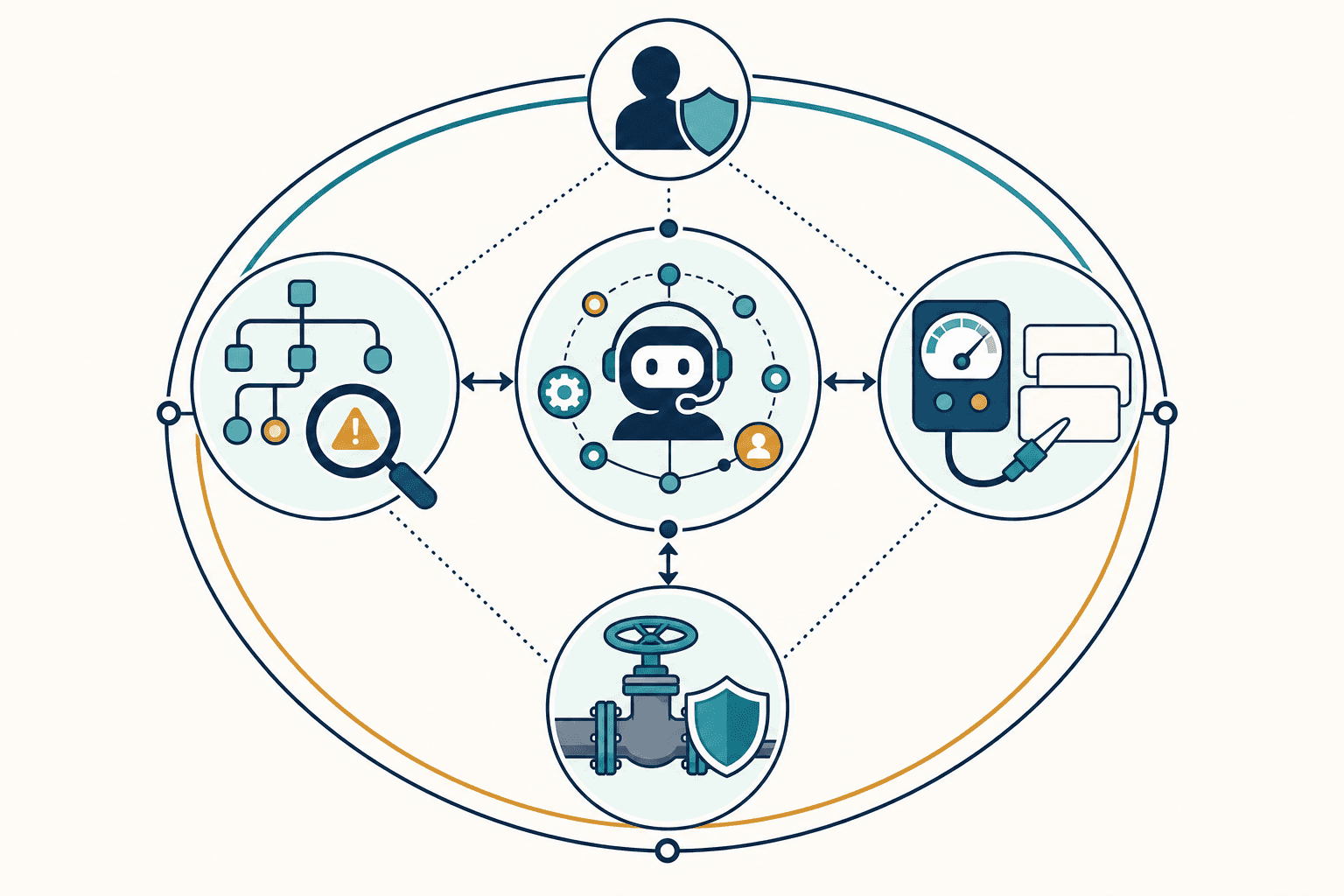
Function | What your support team should do |
|---|---|
Govern | Assign accountability and set guardrails in autonomous AI support. |
Map | Inventory AI systems and identify risks in each support workflow. |
Measure | Test and monitor systems, collecting risk and performance evidence. |
Manage | Act on findings, track fixes, and decide when risks require limiting or stopping deployment. |
The seven characteristics of trustworthy AI
Use NIST AI RMF’s seven trustworthiness characteristics to review your deployed support agent:
Valid and reliable: Test answers against approved policies and customer cases.
Safe: Identify harms and limit permitted actions, part of building trustworthy customer support automation.
Secure and resilient: Test attacks and failure recovery.
Accountable and transparent: Name decision owners and disclose AI use.
Explainable and interpretable: Make decisions and reasoning understandable.
Privacy-enhanced: Limit data collection, access, and retention.
Fair with managed bias: Compare service quality across customer groups; investigate gaps.
The AI RMF Playbook
The NIST AI RMF Playbook provides suggested actions for subcategories across the framework’s four functions. NIST AI 100-1 is the framework document; the Playbook is its practical companion.
Access the free AI RMF Playbook through NIST’s AI Resource Center. For “NIST AI RMF Playbook PDF” or GitHub searches, use this official resource for current access and download options, especially when defining AI guardrails for your workflows. Select actions relevant to your AI support workflows and document why you chose them.
NIST AI 600-1: The generative AI profile
Published in July 2024, NIST AI 600-1 is the NIST AI RMF’s generative AI companion. It identifies 12 risks unique to or worsened by generative AI, with suggested mitigations mapped to the four RMF functions.
For support teams, concerns include confabulation, often called hallucination prevention in support AI, and information security threats such as data poisoning. Test fabricated refund confirmations and poisoned knowledge sources. Record the expected agent behavior and retain each test result as evidence.
NIST AI RMF vs. other AI frameworks
ISO 42001 vs NIST AI RMF separates certification from risk guidance. The EU AI Act adds legal duties.
Dimension | NIST AI RMF | ISO 42001 | EU AI Act |
|---|---|---|---|
Scope | Risk guidance | AI management system | Legal requirements |
Certification | None NIST-issued | Third-party certification | Conformity obligations |
Geography | US-origin, globally usable | International | EU, including covered overseas providers |
Mandatory? | Voluntary | Unless contractually required | Binding within scope |
Assess EU AI Act duties separately from NIST AI RMF and ISO 42001.
NIST AI RMF certification and training options
NIST does not offer or endorse NIST AI RMF certification. Third-party credentials certify individual knowledge; check the issuer before enrolling.
Certified Information Security offers NIST AI RMF 1.0 Architect certification for AI risk program design and leadership, which pairs well with AI support platforms benchmarked on accuracy. The CISA NICCS course listing provides registration links and classroom, instructor-led online, and self-paced options.
Request current course and exam fees from the provider. Free NIST reference materials support self-study. Before accepting a free certification offer, confirm exam charges and credential terms.
Applying AI RMF to autonomous AI support agents
Draft industry guidance on agentic AI flags framework gaps for autonomous, multi-step agents. For support deployments, extend NIST AI RMF controls to tool use:
Govern: Set refund approval authority.
Map: Trace account updates across connected systems and downstream effects.
Measure: Test interrupted workflows and repeated tool calls for duplicate actions, a check reflected in platforms ranked by accuracy guardrails.
Manage: Revoke tool access when failures breach risk limits; route affected cases to a staffed queue.
Review the full action sequence, including what happens after tool failure.
Escalation policy under the AI RMF
For NIST AI RMF alignment, connect escalation ownership under Govern with intervention under Manage. Document your AI support agent’s handoff policy:
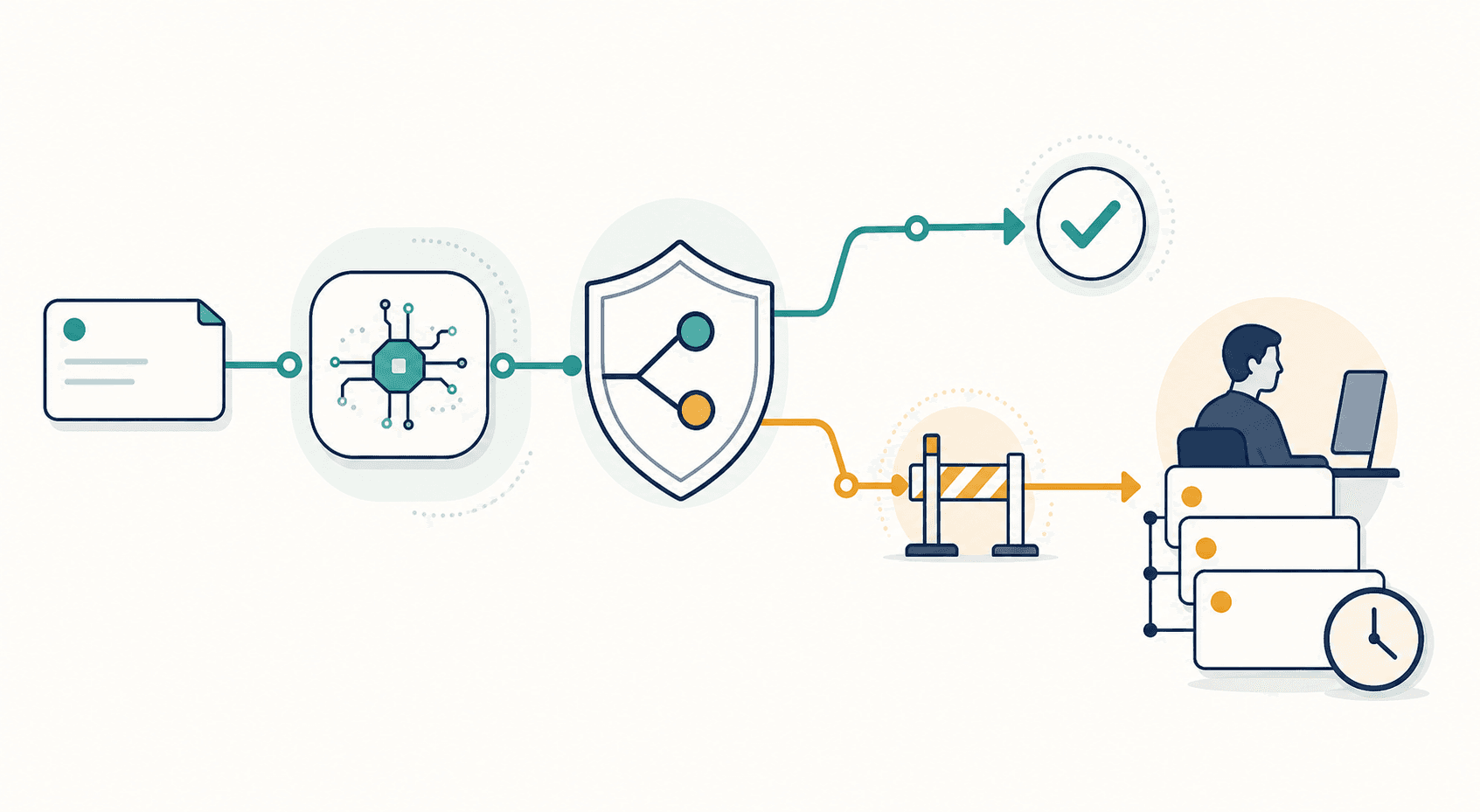
Confidence thresholds that trigger review or stop autonomous action.
Legally sensitive categories requiring human decisions.
Handoff context covering conversation history, attempted actions, and unresolved issues.
Audit records capturing the trigger, receiving owner, timestamp, and final disposition.
Set rules per workflow, including a fallback when the reviewer is unavailable, similar to how other AI support platforms define bot-to-human escalation rules. Document thresholds as your risk decisions, not universal NIST cutoffs.
Measuring AI RMF compliance in a support context
Before approving deployment, test representative support tickets against human-scored expected outcomes. For NIST AI RMF Measure subcategories covering performance and feedback, track:
Resolution rate: cases fully solved with no human touch and no customer reply for 72 hours.
Accuracy rate: correct answers and actions verified through human review, the core metric in how AI platforms solve the accuracy crisis.
CSAT trend: changes against your existing support baseline.
Escalation rates: results broken down by intent.
Decision audit completeness: records containing required evidence.
Set acceptance thresholds before testing, then compare pilot results by workflow before approving full deployment.
How Fini applies the NIST AI RMF
For Govern, we provide decision audit trails and exportable admin and audit logs that your named risk owners can review.
For Map, Knowledge Atlas traces responses to authoritative source articles, giving reviewers a way to identify which policies inform the agent’s answers.
For Measure, our simulations portal backtests agent behavior against historical knowledge-based tickets, so your team can compare answers with approved outcomes. API and browser-use scenarios fall outside that portal, so test refunds and account updates separately before approving those actions.
For Manage, we combine staged rollout with confidence-based escalation and policy checks, routing low-confidence or legally sensitive cases to your team with conversation context. These capabilities support your RMF implementation; your team still owns acceptance thresholds, deployment approvals, and decisions to limit or stop autonomous workflows.
Final thoughts on safer AI support
You need evidence before giving your agent more authority. Use NIST AI RMF to track tests, owners, and fixes. Read the Atlas story.
FAQ
Should you pilot Fini before automating refunds?
Yes. Start with knowledge-only support and keep money-moving actions outside the pilot until separate workflow tests pass. Fini’s simulations portal supports historical knowledge-based tickets, but excludes API and browser-use scenarios, so refund testing needs a separate test plan.
When should Fini resume tickets after human review?
Return a ticket to Fini only after the reviewer records the decision, resolves any approval requirement, and confirms which actions remain permitted. Your handoff policy should prevent duplicate actions and keep legally sensitive decisions with the named human owner. Test this transition before allowing autonomous follow-up.
What belongs in an AI RMF template for support workflows?
Create one record per support workflow with its owner, permitted actions, data access, failure scenarios, acceptance thresholds, and stop conditions. Link each record to test results, decision logs, and approval dates across Govern, Map, Measure, and Manage. Use the NIST AI 600-1 generative AI profile to add tests for fabricated confirmations and poisoned knowledge sources.
Related guides
Explore the guide topics to find more reading.
Co-founder