Last Updated:

Deepak Singla

IN this article
Explore how AI support agents enhance customer service by reducing response times and improving efficiency through automation and predictive analytics.
Your vendor says it handles compliance, but you’re still the one answering questions from legal. Buying support AI generally makes your team a deployer, and a contract cannot transfer your statutory duties. For October 2026, start with your role and each workflow’s purpose, then check which notices, training records, and vendor commitments you actually need.
TLDR:
Audit your support workflows against 4 EU AI Act risk tiers and confirm your legal role.
Disclose AI at the start of support interactions to meet applicable Article 50 duties.
Train your team on real tickets and keep evidence of Article 4 AI literacy measures.
Set escalation triggers and owners. The AI Act gives no blanket right to human escalation.
At Fini, we trace replies to authoritative articles, redact PII, and log decisions for review.
Why support teams need the EU AI Act
The EU AI Act entered into force on August 1, 2024. The European Commission calls it the first worldwide AI framework. It brings legal duties to customer service decisions about how support AI interacts with customers.
Headquarters alone does not determine coverage: companies outside the EU can fall within scope when people use their AI outputs in the EU. Review AI agents, automated replies, and AI-assisted workflows by use case, which matters when you vet AI customer support vendors. Duties depend on your role and the system's purpose.
The EU AI Act enforcement timeline
For October 2026, separate applicable duties from later high-risk deadlines.
Date | Milestone |
|---|---|
February 2, 2025 | Article 4 AI literacy duties began. |
August 2, 2026 | Article 50 transparency obligations applied, with limited deferrals. AI literacy supervision began. |
December 2, 2027 | Requirements for the Article 6(2) Annex III route apply, subject to applicable derogations and existing-system transition rules. The separate Article 6(1) product-safety route follows on August 2, 2028. |
August 2, 2028 | Product-safety route requirements apply, subject to transition rules. |
Provider vs. deployer: identify your team's role
Buying and configuring third-party support AI generally makes your team a deployer: a professional user. Providers develop systems, or commission development, and launch them under their own name.
Your role follows the facts, not contract labels. For high-risk systems, deployer duties include oversight, usage logs, and serious-incident reporting to providers. Substantial modifications can trigger provider responsibilities under Article 25. Ask legal to review planned changes before release.
Classify your AI support systems' risk levels
Audit each support workflow against four risk tiers:
Prohibited: uses the AI Act bans.
High-risk: designated uses, including certain credit and insurance decisions under Annex III.
Limited-risk: customer-facing interactions with transparency duties.
Minimal-risk: uses without specific duties beyond generally applicable requirements.
Review billing FAQs separately from creditworthiness decisions. Flag emotion recognition and biometric-adjacent tools for legal review because purpose affects classification.
AI guardrails help enforce that decision consistently.
Check applicable deadlines and transition rules. Record each workflow’s intended purpose and classification rationale.
Transparency: tell customers they’re talking to AI
Article 50 requires providers to disclose AI interaction unless it is obvious to a reasonably well-informed, observant person. For support teams, use plain disclosure at the start:
You’re speaking with an AI support agent.
Place it before chat’s first message, in an automated email’s opening, or before a voice system requests account details.
Check the transparency duties applicable to your deployment. Do not rely on a bot-like name or buried terms to make AI involvement obvious. This is one reason guardrails in agentic AI customer support matter for disclosure practices.
Emotion recognition and sentiment tools: disclosure rules
Voice analysis for frustrated callers can trigger EU AI Act disclosure duties for customer service teams. Emotion recognition involves inferring emotions or intentions from biometric data. Text-only sentiment scoring does not automatically qualify.
Where Article 50’s emotion-recognition duty applies, deployers must inform people exposed to the system. Add a notice at the time of use explaining the analysis, beyond identifying the AI agent: “We use AI to analyze vocal characteristics and infer emotional cues during this call.”
Human oversight and the right to escalate
Meaningful oversight gives designated staff authority to intervene and stop unsafe workflows, not merely review AI drafts. Article 14 sets human-oversight requirements for high-risk AI systems, not a general right to human escalation in every support interaction. Confirm applicable duties with counsel.
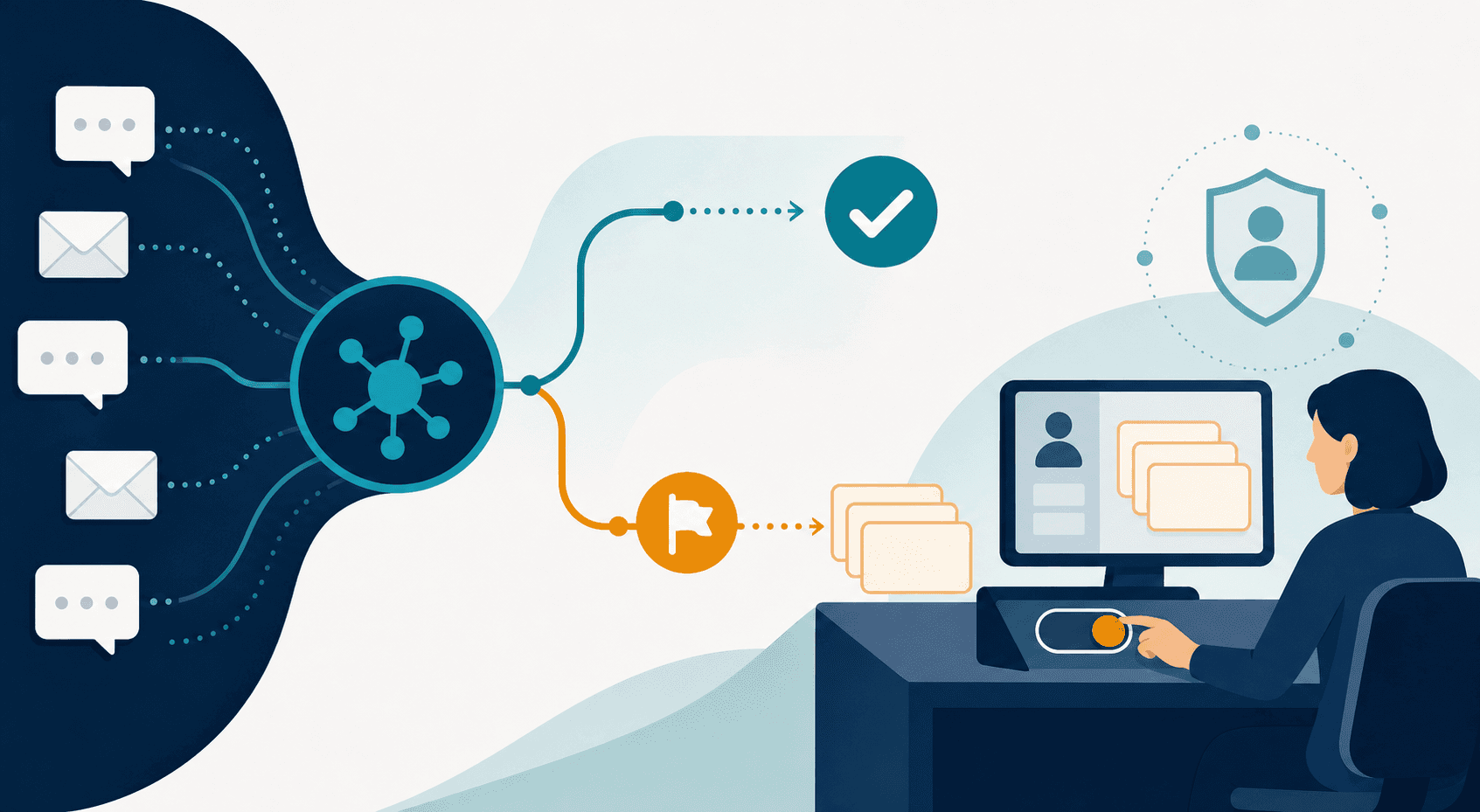
Document your escalation policy:
Define triggers, including disputed decisions and requests for human help.
Name the receiving queue, response target, and backup owner.
Give reviewers relevant context and override permissions.
Staff the queue during published support hours and provide an after-hours fallback.
AI literacy requirements for your support team
Support leaders need AI literacy training tied to actual tickets. Verify the reported Article 4 amendment against official legal text before changing your compliance approach.
Use the Commission’s AI literacy guidance to shape practical training:
Show staff what your system can do and where it fails.
Practice spotting inaccurate answers and privacy risks in support tickets.
Test whether staff know when to escalate.
Keep attendance records, training materials, and scenario results as evidence of the measures you took. Review AI support compliance certifications separately from these training records.
Data governance, logging, and audit trails
High-risk system deployers must retain automatically generated logs under their control for at least six months, unless applicable law requires otherwise. That minimum does not cover every support interaction.
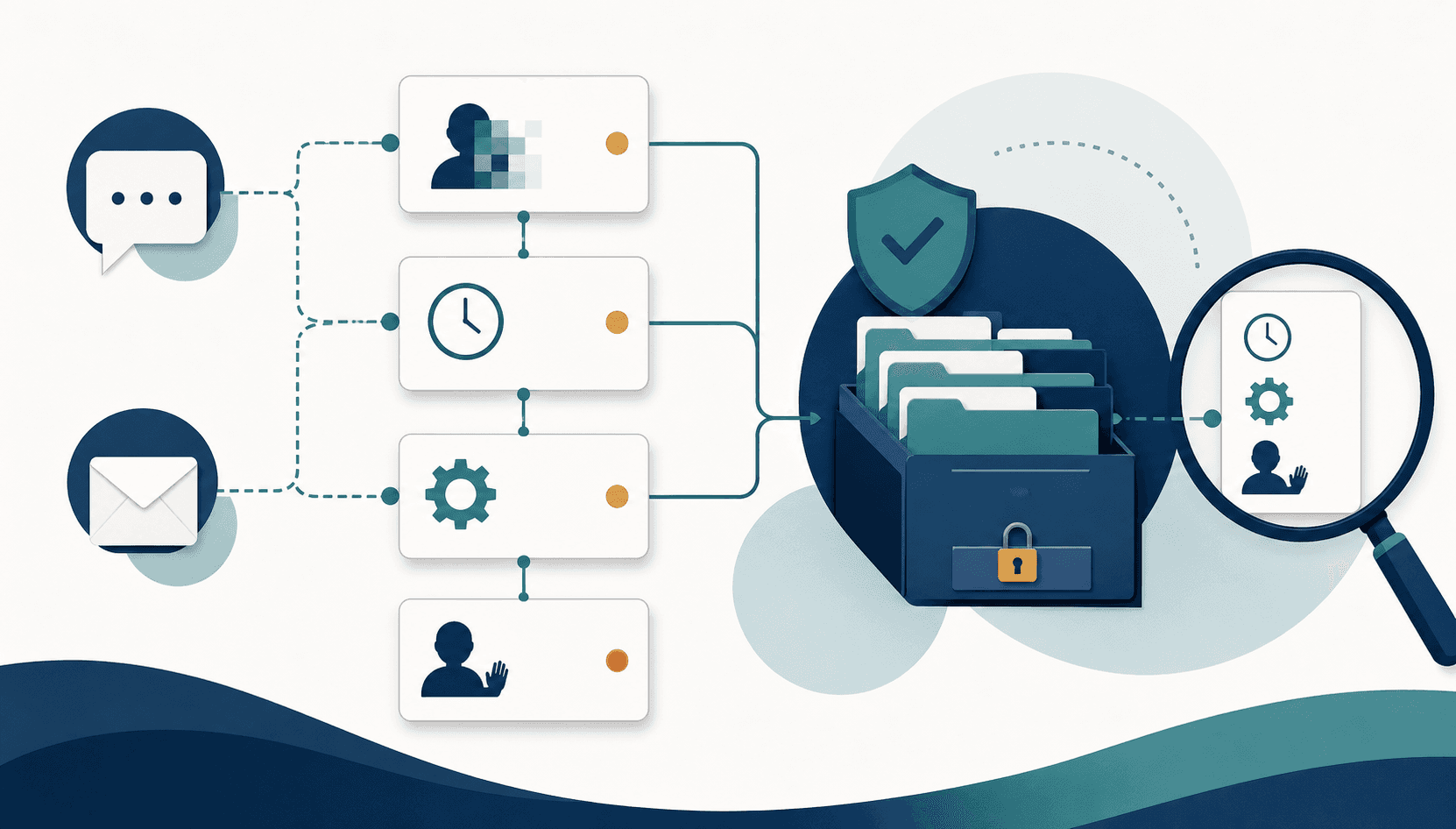
Prepare an audit file with:
Usage logs: timestamps, system versions, outputs, and human interventions where recorded.
Instructions, monitoring records, and incident reports.
Evidence supporting classification and compliance decisions.
Keep evidence retrievable for supervisory requests. Apply GDPR duties: align logging with processing records, lawful basis, access controls, and retention schedules. Minimize personal data in logs, a practice central to fintech support compliance automation.
Vendor contracts and shared compliance responsibilities
A vendor contract cannot transfer your statutory duties. Before signing or renewing, ask:
Which provider requirements apply, and who owns each compliance task?
For high-risk systems, will you supply instructions for use and required conformity assessment evidence?
What technical documentation can we access, and what remains available to authorities?
How will you notify us of system changes or incidents?
Set response deadlines and cooperation duties. Deployers do not automatically receive full technical documentation; confirm contractual access rights as part of your broader AI compliance program.
The cost of non-compliance: EU AI Act fines
The EU AI Act sets three penalty tiers with maximum fines:
Prohibited AI practices: EUR 35 million or 7% of worldwide annual turnover.
Most other obligations, including high-risk requirements: EUR 15 million or 3%.
Incorrect information supplied to authorities: EUR 7.5 million or 1%.
The higher amount generally applies; SMEs, including startups, face the lower cap.
Many vendors also pursue SOC 2 Type II certification to reduce exposure.
The penalty framework has applied since August 2, 2025. For support teams, exposure depends on whether the breached obligation applies.
Alignment with ISO 42001 can show governance maturity to regulators.
How Fini approaches EU AI Act compliance
At Fini, we trace responses to authoritative source articles for review across AI customer support in regulated industries.
Knowledge Atlas flags contradictory instructions and outdated policies so your team can resolve conflicts in approved knowledge.
We maintain decision audit trails and exportable admin and audit logs for your compliance records.
Our built-in PII redaction masks phone numbers and emails before processing.
Low-confidence or legally sensitive requests escalate with full context and a conversation summary for the reviewer.
These controls support your compliance work; your team still needs to classify workflows, verify applicable disclosure duties, and document training and oversight.
Final thoughts on EU AI support compliance
Compliance starts with knowing which rules apply to your workflows. You can build from there with training and clear records. Read the Atlas story.
FAQ
Should you test Fini before automating sensitive workflows?
Yes. Start with a bounded workflow, such as billing FAQs, and test disputed decisions, privacy risks, and requests for human help before expanding. Track answer accuracy, disclosure visibility, escalation outcomes, and whether reviewers can reconstruct each decision from its records.
What comes before connecting Fini knowledge?
Remove conflicting policies and assign an owner to each approved source. Separate general guidance from rules for account-specific decisions, and record approval dates so reviewers can check which policy supported an answer.
How do you test Fini's human handoffs?
Run test conversations covering a disputed decision, a privacy concern, and an explicit request for a person. Check that each reaches the correct queue with relevant context, that the reviewer can intervene, and that the after-hours fallback works.
What should you request before renewing Fini?
Request a written responsibility matrix, sample decision logs, and contractual deadlines for incident and system-change notices. For EU AI Act customer service reviews, confirm which evidence you can access and whether your retention settings match applicable duties. Have counsel check the agreement against your actual workflows.
Related guides
Explore the guide topics to find more reading.
Co-founder