Last Updated:

Deepak Singla

IN this article
Explore how AI support agents enhance customer service by reducing response times and improving efficiency through automation and predictive analytics.
Vendors know you're going to ask about certifications. They've prepared for that question. What most procurement reviews miss is the scope section of the actual audit report, which is often where the AI layer, the conversation logs, and the sub-processors quietly disappear. Knowing what to look for in those documents is what separates a verified compliance posture from a well-designed security page.
TLDR:
SOC 2, HIPAA, PCI DSS, and ISO 27001 each cover a distinct risk surface. A badge on a security page does not confirm the AI reasoning layer is inside the audit scope.
"HIPAA-compliant" and "BAA-eligible" are not the same thing. Without a signed BAA, you cannot legally route PHI through a vendor's system.
PCI DSS 4.0.1 has been mandatory since March 2025. "PCI scope supported" means architecture, not a formal attestation at any merchant level.
Request the actual SOC 2 Type II report, the ISO 27001 certificate number, the BAA template, the sub-processor list, and the PCI Attestation of Compliance before signing anything.
Fini holds SOC 2 Type II, PCI DSS Level 1, ISO 27001, GDPR, HIPAA-compliant, BAA-eligible, and CCPA, with every response traceable to a single source through Knowledge Atlas.
What AI customer support compliance certifications actually cover
Compliance certifications for AI support vendors are not the same as general software security badges. SOC 2, ISO 27001, HIPAA, and PCI DSS each govern a distinct risk surface: how data is stored, who can access it, what happens when something goes wrong, and whether an auditor can reconstruct why.
What makes AI support different is that the system is actively making decisions. It reads customer records, generates responses, and in agentic deployments takes actions like processing refunds or pulling account history. These four frameworks share 70-80% of the same underlying controls, but each targets a different audience and regulatory obligation.
For buyers in fintech or healthcare, the question is less "does this vendor have a cert?" and more "does the compliance cert cover the AI reasoning layer, the data flows, and the audit trail?"
SOC 2 Type II: the entry-level baseline
SOC 2 is the credential you'll see most often in AI support vendor security reviews. Nearly every vendor claims it. Fewer actually hold a Type II report, and that distinction matters.
A Type I attestation confirms that controls were designed correctly at a point in time. Type II confirms those controls operated effectively over a period, typically six to twelve months. As IS Partners notes, SOC 2 is a voluntary third-party assessment, not a certification, and there is no universally accepted certification system behind it.
SOC 2 does not cover AI-specific decision logging, how the reasoning layer handles customer data, or whether the knowledge sources feeding the agent are auditable. For teams reviewing SOC 2 compliant AI ticket triage systems, that scope gap is material. It attests to security controls. It says nothing about whether a hallucinated answer gets logged or traced back to a source.
HIPAA and BAA eligibility for AI support in healthcare
"HIPAA-compliant" and "BAA-eligible" are not interchangeable. A vendor can architect their system to meet HIPAA's technical safeguards and still refuse to sign a Business Associate Agreement. Without a signed BAA, you cannot legally route support tickets containing Protected Health Information through their system, regardless of what their security page says.
As medcurity.com notes, there is no special AI exemption under HIPAA. Any vendor whose system processes, stores, or transmits PHI is a Business Associate by definition.
The BAA is where most deals fall apart quietly. Standard SaaS templates are often silent on three gaps Giva identifies as most commonly left unresolved:
Whether the vendor trains AI models on your customer prompts
Which sub-processors have access to PHI
What the breach notification timeline actually commits to
A BAA that skips AI model training on PHI is incomplete, regardless of how many pages it runs.
PCI DSS and AI support in financial services
PCI DSS 4.0.1 has been fully mandatory since March 2025. For fintech support teams staying compliant, every system that touches cardholder data, including AI support agents handling payment disputes or account lookups, falls within scope.
The phrase "PCI scope supported" on a vendor's security page is doing a lot of work. Scope means the system was architected to avoid storing raw cardholder data, not that the vendor holds a merchant-level certification. Those are different things. As Very Good Security notes, AI does not replace PCI requirements. It expands them.
Three specific risks appear when AI agents operate in payment environments:
Chat logs and call recordings may capture card numbers verbatim if the agent is not designed to redact them in real time.
Billing system integrations that give the agent read access to transaction records can pull data into the AI's reasoning context.
Audit trails that log full conversation content may inadvertently store cardholder data at rest.
Ask any vendor whether their system has been included in a formal PCI DSS assessment, and at what level. "PCI-ready" is not an answer.
ISO 27001: what it adds beyond SOC 2
SOC 2 is audit evidence for a point in time or a period. ISO 27001 is a full information security management system: a documented, continuously operating framework covering risk treatment, asset management, access controls, and supplier relationships. Certification comes from an accredited third-party body and requires annual surveillance audits plus a full recertification every three years.
The practical difference for a buyer: SOC 2 tells you what controls the vendor had in place. ISO 27001 tells you the vendor runs a governed process for identifying, assessing, and treating security risks on an ongoing basis.
For European or global enterprise deals, ISO 27001 is frequently a procurement requirement independent of SOC 2. Buyers assessing AI support platforms for compliance-heavy fintech typically face this as a hard gate.
UK, EU, and APAC procurement teams often treat it as non-negotiable on the vendor questionnaire regardless of whether SOC 2 is also present.
GDPR, CCPA, and data residency for AI support
Both GDPR and CCPA give individuals rights over their data and hold the companies collecting it responsible for every vendor those companies share it with. An AI agent for compliance-critical support that reads customer records, generates responses, and logs conversations is a data processor under GDPR and a service provider under CCPA. Your vendor's compliance posture becomes part of yours.
GDPR requires a Data Processing Agreement before any EU resident's data flows through a vendor's system. CCPA requires a service provider contract limiting how the vendor uses personal information outside its original purpose.
Data residency is where both frameworks get practical. "EU-hosted" on a spec sheet can mean the primary region is EU-based while sub-processors, model inference, or log storage run through US infrastructure.
Ask for the sub-processor list, beyond the hosting spec. If any sub-processor stores conversation data outside your required region, the residency claim is incomplete.
For AI support agents, the relevant data flows are broader than most buyers expect: the input query, the knowledge sources queried, the reasoning context, the generated response, and the audit log. Each can touch a different sub-processor.
How vendors misrepresent compliance certifications
Listing "SOC 2, HIPAA, ISO 27001" on a security page takes about ten minutes. Holding current, verified attestations is a different matter entirely. Knowing how to vet AI customer support vendors is where that gap becomes costly.
Three misrepresentations show up repeatedly in AI support procurement. First, parent-company certifications cited as if they cover the AI product, when the scope of the audit explicitly excluded it. Second, Type I SOC 2 reports presented alongside Type II language. Third, certifications that expired six months ago and haven't been renewed since the vendor's last fundraise.
By mid-2026, SOC 2 and ISO 42001 have hardened into procurement gates, not nice-to-haves. A vendor who offers a trust portal link but resists sharing the actual audit report is telling you something about what's in it. Check the scope section and auditor name. For a ranked view of safest AI support vendors for fintech, scope transparency is the first filter.
How to verify an AI vendor's certifications
Request the documents, not the badge. A security page is marketing. The actual report tells you what was audited, when, and by whom.
Here is what to ask for:
Certification | Document to Request | What to Check |
|---|---|---|
SOC 2 Type II | Full audit report with period-end date visible | Period ended within last 12 months; AI reasoning layer and sub-processors are inside scope |
ISO 27001 | Certificate number and accredited registrar name | Named accreditation body present; certificate is current and not expired |
HIPAA / BAA | BAA template before contract signing | Covers AI model training on PHI, sub-processor access to PHI, and breach notification timeline |
GDPR / CCPA | Sub-processor list with hosting regions per processor | No sub-processor stores conversation data outside your required data residency region |
PCI DSS | Attestation of Compliance (AoC) | AI agent included in assessment scope; merchant or service provider level confirmed |
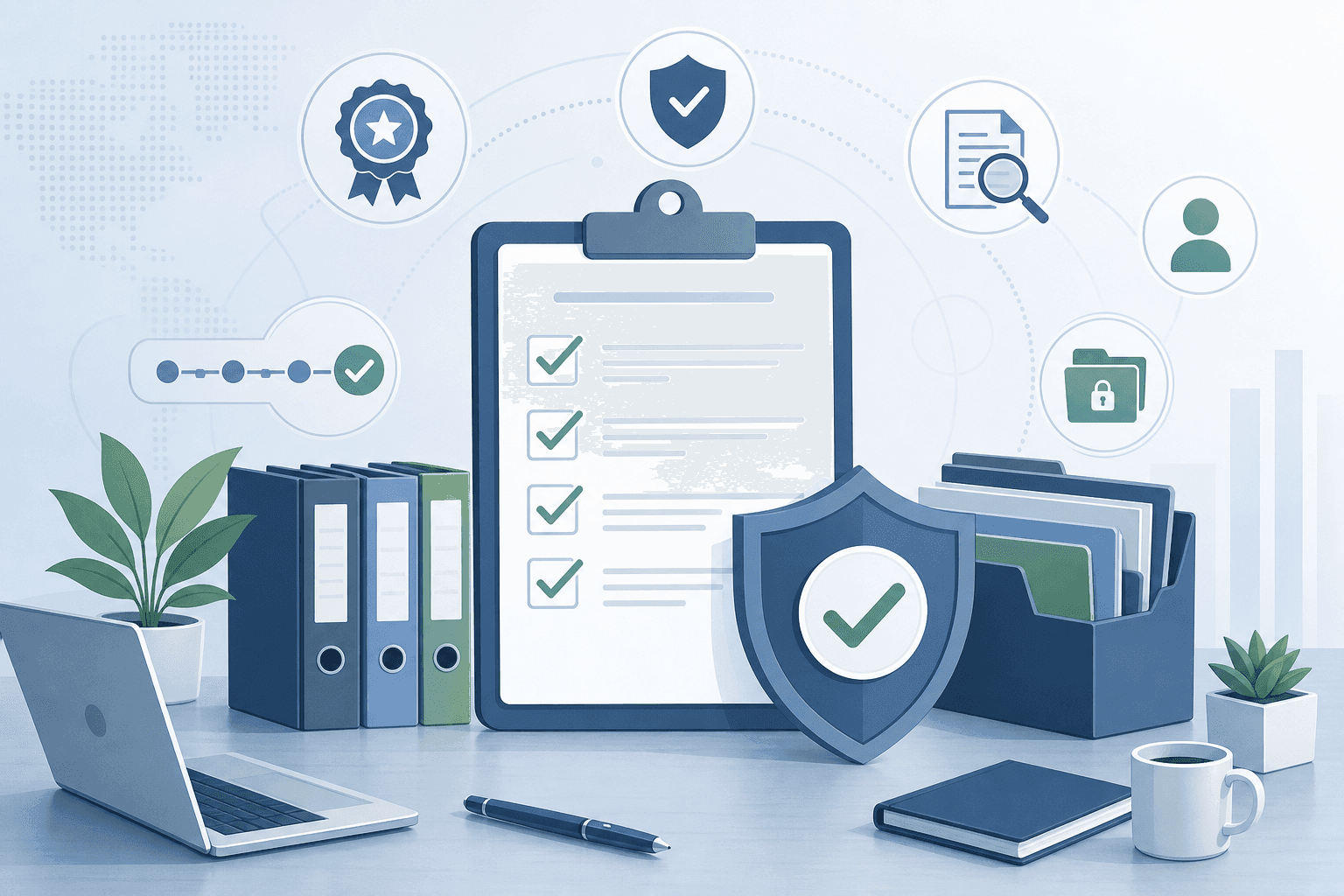
Scope exclusions are the most common place certifications mislead. If the audit covered core infrastructure but excluded the AI inference layer, the logging system, or third-party model providers, the certification does not attest to the part of the product that processes your customer conversations.
The audit trail: what regulators actually ask for
Certifications tell a regulator that controls exist. An audit trail tells them what the agent said to customer #48271 on September 4th, why it said it, and whether a human reviewed the outcome.
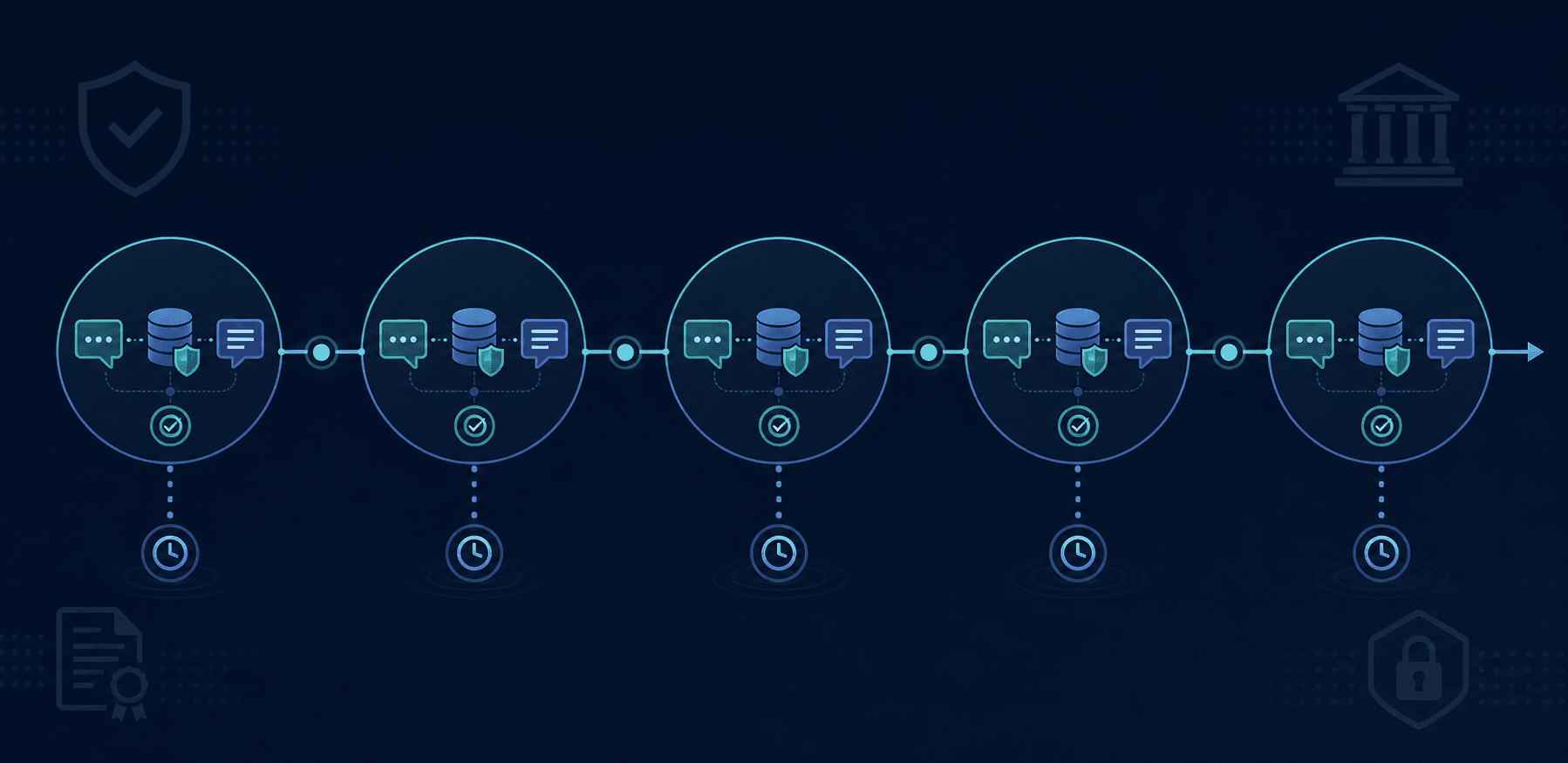
As swept.ai defines it, a complete AI audit trail includes the input query, the context that influenced the decision, the output produced, the timestamp, the model version, any guardrail actions taken, and whether a human was involved. Remove any one of those fields and a compliance reconstruction becomes a best-guess exercise.
The practical audit question is specific: can you reproduce exactly why the agent gave a particular answer, traced to one authoritative source? If the answer is "the model blended several knowledge articles," that is a compliance gap.
For fintech and healthcare, escalation routing matters just as much. If the agent transferred a dispute to a human, the trail should log what triggered the escalation and what context the human received. Buyers comparing AI omnichannel support platforms SOC 2 GDPR coverage should verify escalation logging is inside scope.
Compliance questions to ask every AI support vendor
Generic security questionnaires were not written for systems that reason over customer data and take actions in real time. These questions cut to what actually matters.
For healthcare buyers:
Does your BAA include a sub-processor addendum naming every party with PHI access?
Do you train or fine-tune models on customer conversation data, including escalations?
If PHI enters a support ticket, which sub-processor handles inference, and in what region?
For fintech buyers:
Is the AI agent included in the scope of your PCI DSS assessment, and at what level?
Does the system redact card numbers from call recordings and chat logs in real time?
If billing data flows into the agent's reasoning context, how is that access logged?
For both:
Is the AI reasoning layer inside or outside the scope of your SOC 2 Type II report?
What is your model version control process, and can a specific version be rolled back after a compliance incident?
How long are conversation logs retained, where are they stored, and which sub-processors can access them?
If the agent gives an incorrect answer that creates regulatory exposure, what does your incident response timeline commit to?
The last question separates vendors with a compliance posture from vendors with a compliance page.
How Fini approaches AI support compliance certifications
Fini holds SOC 2 Type II, PCI DSS Level 1, ISO 27001, GDPR, HIPAA-compliant, BAA-eligible, and CCPA. Data residency, DPA, and BAA are available for Enterprise. These are not marketing claims. They are the certifications we carry into every security review, with reports available on request.
The compliance argument becomes concrete at the architecture level. Every response Fini produces traces to a single authoritative source article through Knowledge Atlas. One answer, one source, fully reconstructable. That is what makes the audit trail usable, not decorative.
Fini runs 3M+ monthly resolutions across fintech and healthcare, with a full decision audit trail on every ticket. Pricing starts at $0.49 per resolution, backed by the Zero-Pay Guarantee: 90% resolution in 90 days, or you pay $0.
Final thoughts on AI support compliance
The questions that matter aren't on a standard security questionnaire. They're about whether the AI reasoning layer is in scope, whether the BAA covers model training on PHI, and whether the audit trail can reconstruct a specific answer on a specific day. Getting those answers before you sign saves a lot of pain later. A 30-minute call is a reasonable place to start if you're mid-evaluation.
FAQ
What's the difference between SOC 2 Type I and SOC 2 Type II for AI support vendors?
SOC 2 Type I confirms controls were designed correctly at a single point in time, while Type II confirms those controls operated effectively over a period, typically six to twelve months. For AI support procurement, Type II is the only version that tells you the vendor ran those controls through real production conditions. Ask for the report itself, not the badge, and check the period-end date and scope section to confirm the AI reasoning layer is included.
How do you verify AI support SOC 2, HIPAA, PCI DSS, and ISO 27001 certifications before signing a contract?
Request the actual documents, not the security page. For SOC 2 Type II, ask for the report with the period-end date visible and check the scope section for exclusions covering the AI reasoning layer and sub-processors. For ISO 27001, ask for the certificate number and the name of the accredited registrar. For HIPAA, request the BAA template before signing and review it for language on AI model training on PHI and breach notification timelines. For PCI DSS, ask for the Attestation of Compliance and confirm whether the AI agent was included in the assessment scope.
Is an AI support vendor being "HIPAA-compliant" the same as being BAA-eligible?
No. A vendor can architect their system to meet HIPAA's technical safeguards and still refuse to sign a Business Associate Agreement. Without a signed BAA, you cannot legally route support tickets containing Protected Health Information through their system. Review the BAA template before contract signing and confirm it covers AI model training on customer data, which sub-processors have access to PHI, and the breach notification timeline.
We're comparing AI support platforms with published compliance certifications: how does Fini stack up against Parahelp or Vapi for fintech and healthcare?
Fini holds the full certification stack listed in this guide, with reports available on request and BAA available for Enterprise. Neither Parahelp nor Vapi publicly lists SOC 2 Type II, PCI DSS Level 1, ISO 27001, HIPAA, and BAA-eligible coverage. Verify directly with each vendor. Fini also covers voice, chat, and email on one reasoning layer with one audit trail, which removes the need to stitch together a separate voice API and a separate support platform, each with its own compliance posture to verify.
What does a complete AI support audit trail need to include to satisfy a regulator or compliance review?
A complete audit trail includes the input query, the knowledge sources consulted, the reasoning context, the generated response, the timestamp, the model version, any guardrail actions taken, and whether a human was involved. For fintech and healthcare, escalation routing must also be logged: what triggered the handoff and what context the human received. If the agent blended multiple knowledge articles to produce an answer instead of tracing to one authoritative source, that is a compliance gap regardless of what certifications the vendor holds.
Related guides
Explore the guide topics to find more reading.
Co-founder