Last Updated:

Deepak Singla

IN this article
Explore how AI support agents enhance customer service by reducing response times and improving efficiency through automation and predictive analytics.
AI support compliance certifications are one of those things everyone asks for and almost no one reads carefully. SOC 2 Type II, ISO 27001, ISO 42001, HIPAA, PCI DSS, they each cover a different slice of the risk picture. If your vendor holds some but not others, the gaps map directly to what your legal and security teams will face when an audit lands.
TLDR:
SOC 2 Type II proves controls held over 6-12 months. Type I only proves they existed once.
There is no HIPAA certification body. A signed BAA and documented safeguards are what compliance means.
60% of organizations fail their initial PCI audit. AI agents that touch billing systems fall inside PCI scope.
ISO 42001 governs model drift, bias, and explainability. The 30-40% of controls ISO 27001 doesn't cover govern the AI itself.
Fini holds SOC 2 Type II, PCI DSS Level 1, ISO 27001, GDPR, HIPAA-compliant, BAA-eligible, and CCPA as standard.
Why certifications matter more when your AI agent takes real actions
Storing customer data inside a SaaS tool carries compliance obligations. An AI agent that processes a refund, updates an account, or pulls PHI mid-conversation carries audit, liability, and regulatory exposure that a passive data store does not.
When an AI agent takes a real action, every step in that transaction becomes auditable. Who authorized it? What data was accessed? Was the decision logged? An autonomous agent that acts on behalf of your customer is inside the transaction itself, and if something goes wrong, the certification question stops being theoretical fast.
The regulatory exposure compounds by industry. A fintech support agent handling a disputed charge touches PCI DSS scope. A healthcare agent querying a member's benefits touches PHI and HIPAA. An agent operating in the EU touches GDPR's automated decision-making rules. Each certification your vendor holds, or doesn't, maps directly to what your legal and compliance teams will face in an audit.
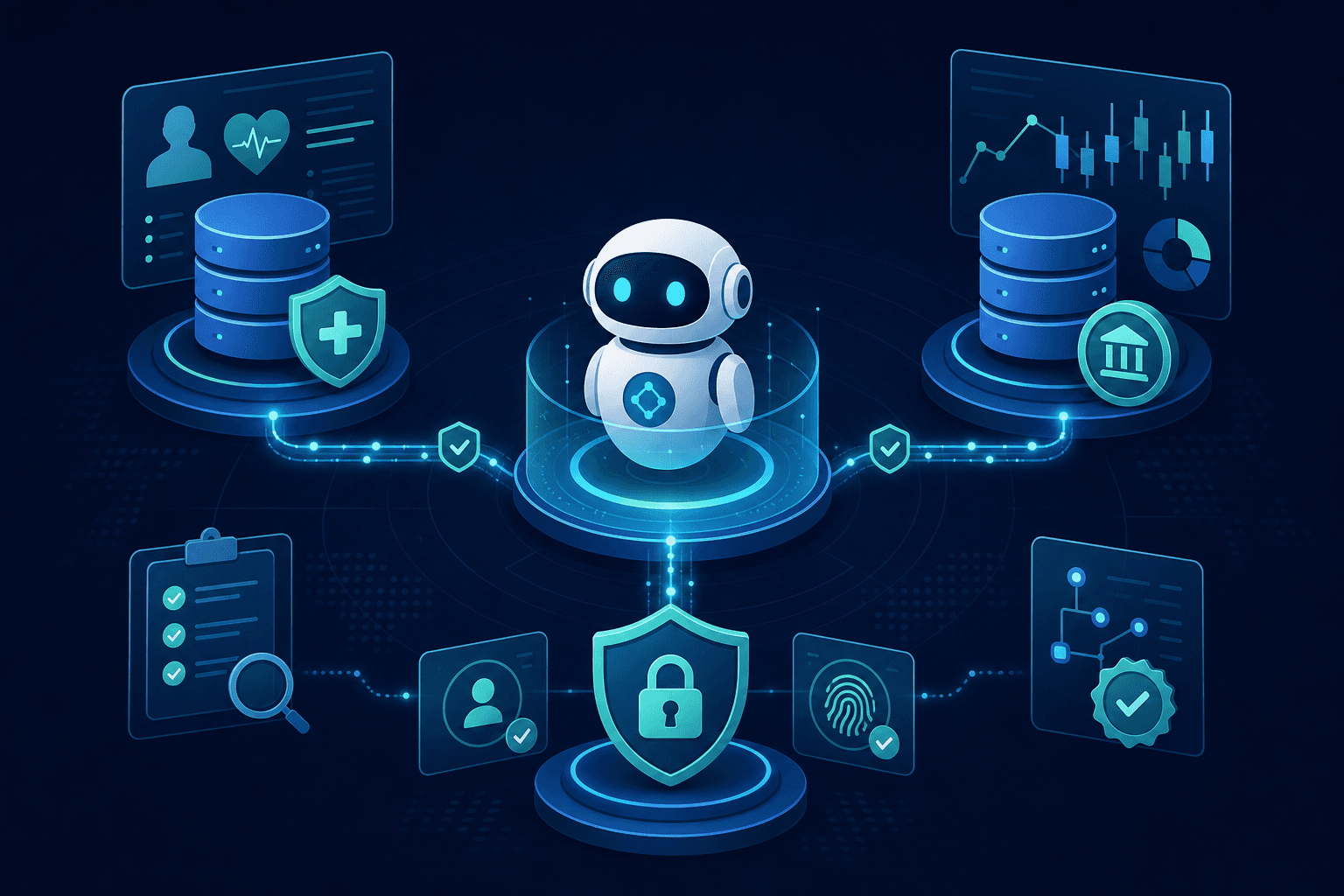
Certifications don't make a vendor trustworthy. They make the trust verifiable, which is why vetting AI customer support vendors starts with the certification list, not the demo.
SOC 2 Type II: the baseline for any AI support vendor
SOC 2 audits against five Trust Services Criteria: security, availability, processing integrity, confidentiality, and privacy. An auditor checks whether controls actually cover each area and whether they held up over time.
That last part is where Type I and Type II split. Type I confirms controls existed at a single point in time. SOC 2 Type II confirms they operated effectively across a period, typically six to twelve months. For an AI agent making decisions continuously, the difference matters. A point-in-time snapshot tells you the locks were installed. Type II tells you whether they stayed locked.
Roughly 66% of B2B buyers now require a SOC 2 report before signing with a vendor. The more useful question is whether they hold Type II in particular, and which of the five criteria their audit covered.
ISO 27001: what the information security standard requires
ISO 27001 certifies an organization's Information Security Management System (ISMS), covering 93 controls in Annex A across access control, cryptography, supplier relationships, and incident management. An auditor confirms the system is structured, documented, and running.
For AI support vendors, this answers one question: how is customer data stored, accessed, and protected at the organizational level? Before a conversation reaches the agent, data has already moved through infrastructure, sub-processors, and access layers. ISO 27001 governs all of it.
It's also the most widely recognized international baseline across US, UK, and EU procurement. Your legal team in London and your security team in New York will both recognize it.
As Truvocyber notes, ISO 27001 and ISO 42001 share roughly 60-70% of their controls, leaving the remaining 30-40% as AI-specific governance that ISO 27001 does not cover. A vendor without ISO 27001 is unlikely to hold the controls required for those AI-specific layers that come next.
ISO 42001: the AI-specific standard and why it is different
ISO 42001 is the first international standard for AI management systems. Where ISO 27001 governs how data is protected, ISO 42001 governs how AI systems are designed, deployed, and held accountable throughout their lifecycle.
The AI-specific controls are what matter: model drift, algorithmic bias, explainability, and human oversight. A vendor might store your data securely and still have no governance structure for what happens when the model's behavior drifts, or when a customer asks why the agent made a particular decision.
If a vendor holds ISO 27001 but not ISO 42001, ask what fills that gap in AI-specific governance.
HIPAA compliance and BAA requirements for healthcare AI
Any AI tool that processes, stores, or transmits Protected Health Information must comply with HIPAA's Privacy, Security, and Breach Notification Rules. There is no special AI exemption. Healthcare organizations must treat AI vendors as business associates and verify that AI systems meet the same encryption, access control, and audit logging standards as any other system handling electronic PHI.
That business associate designation has a concrete consequence: a Business Associate Agreement must be in place before any PHI flows through the system. A vendor that won't sign one cannot legally process PHI on your behalf.
One important distinction: there is no HIPAA certification body. When a vendor says "HIPAA-compliant," ask what safeguards back that claim, and compare against other HIPAA-compliant support chatbots built to protect PHI. Administrative controls, physical controls, technical controls, and a signed BAA are what compliance actually means in practice.
PCI DSS and AI agents handling payment data
PCI DSS 4.0.1 is now fully in effect, with no carve-out for AI agents. If your support agent queries a billing system, processes a refund, or surfaces cardholder account data, it likely operates inside the cardholder data environment and falls within PCI scope.
That scope question is what most teams miss. The AI agent itself may not store card numbers, but if it touches systems that do, the vendor's infrastructure gets pulled into the audit. That gap shows up in access controls and logging most often.
As Very Good Security notes, AI expands PCI requirements, not replaces them. PCI DSS Level 1 is the highest attestation tier. When reviewing a vendor, ask whether they hold a Level 1 Report on Compliance and not merely a self-assessment questionnaire, and weigh that against other PCI-compliant AI customer service options on the market.
GDPR and CCPA: data subject rights in an automated support context
GDPR applies the moment personal data from an EU resident enters your support workflow. Under Article 28, any vendor processing that data on your behalf must sign a Data Processing Agreement before the first conversation runs. A DPA is the legal instrument that makes the vendor a compliant data processor. Without one, your organization carries the exposure.
Article 22 gets more specific for AI support. It gives individuals the right not to be subject to decisions made solely by automated means when those decisions produce material effects, such as an account denial or suspension. An agent that escalates uncertain or consequential cases to a human avoids much of that risk by design.
For US-based operators, CCPA introduces parallel obligations: the right to know what data was collected, the right to delete it, and the right to opt out of certain processing. Automated support systems that log conversations and pull account data need vendor-side controls to honor those requests within required timeframes.
The practical question for vendor evaluation: does the vendor sign a DPA as standard, and does their escalation logic account for automated decision risk under Article 22? Getting this right is central to fintech support automation that stays compliant.
The EU AI Act and customer-facing AI agents
The EU AI Act classifies AI systems across four risk tiers: unacceptable, high, limited, and minimal. Customer-facing support agents in financial services and healthcare sit most commonly in the limited risk category, though specific use cases like creditworthiness decisions or clinical triage may push into high-risk territory. High-risk systems must meet mandatory conformity assessment, human oversight, and technical documentation requirements before deployment. Those obligations became enforceable for newly deployed high-risk AI systems in August 2026.
For limited-risk systems, the primary obligation is transparency: users must be told they are interacting with an AI agent. High-risk systems carry heavier requirements, including human oversight mechanisms, incident logging, and conformity assessments before deployment.
As the EU AI Act framework notes, deployers of AI systems carry their own compliance responsibilities alongside providers. If your vendor's agent is making consequential decisions in your environment, your organization shares accountability for how those decisions are governed and disclosed.
The questions worth asking any vendor:
Can they document where their system falls in the risk classification?
Do they maintain incident logs the operator can access?
Does the agent's escalation logic create a human oversight path for high-stakes decisions?
Enforcement is still maturing across member states, but the accountability structure is not, a point healthcare teams reviewing HIPAA-compliant healthcare support platforms should weigh alongside the EU AI Act.
The certification questions to ask any AI support vendor
The table below maps each question to the certification it surfaces. Use it as a checklist before a vendor review.

Question | Certification it maps to |
|---|---|
Can you share your SOC 2 Type II report under NDA? | SOC 2 Type II |
Is your BAA standard or negotiated? | HIPAA |
What is your sub-processor list, and how are changes notified? | GDPR / ISO 27001 |
Where is data stored, and can we select a region? | GDPR / ISO 27001 |
How are AI decisions logged, and how long are audit trails retained? | ISO 42001 / PCI DSS |
Does your system train on our data? | GDPR / SOC 2 |
Do you hold PCI DSS Level 1, or only a self-assessment? | PCI DSS |
Each question maps to a real gap, and running through a full compliance certs checklist for AI support catches them before contract signature. A vendor with SOC 2 Type I but not Type II has not proven their controls held over time. A vendor that negotiates BAAs case by case may signal that HIPAA compliance is not built into their architecture.
The training question trips up more vendors than any other. Ask directly whether customer conversations are used to improve models across clients, or whether learning stays within your account. Those are fundamentally different architectures, and the answer belongs in your security review before contract signature.
How Fini's compliance posture maps to AI support in fintech and healthcare
Fini holds SOC 2 Type II, PCI DSS Level 1, ISO 27001, GDPR, HIPAA-compliant, BAA-eligible, and CCPA across a single compliance posture. Both a DPA and BAA are standard offerings, not negotiated case by case.
The audit traceability question that surfaces most often in fintech and healthcare reviews is answered by Knowledge Atlas. Every agent response traces to exactly one authoritative source article. When a regulator or your security team asks why the agent said what it said, the answer is a direct citation, not a probability distribution.
Confidence scoring handles the human-oversight requirement. High-confidence answers resolve automatically. Mid-confidence answers draft for agent review. Low-confidence or legally sensitive interactions escalate with full context and an AI-generated conversation summary. That escalation path directly satisfies the human-oversight expectations in both HIPAA guidance and the EU AI Act's limited-risk transparency obligations.
Fini processes 3M+ monthly resolutions across fintech and healthcare customers in production, placing it among the most compliant AI support platforms for fintech. Pricing starts at $0.49 per resolution, backed by a 90% resolution in 90 days, or you pay $0 guarantee.
Final thoughts on AI support compliance and vendor certification requirements
Certifications are how verifiable trust gets built between a vendor and an enterprise buyer in fintech or healthcare. The gap between a SOC 2 Type I and Type II, or between a self-assessment and a Level 1 Report on Compliance, is exactly where audit exposure lives. Ask for the docs, get the DPA or BAA in place before the first conversation runs, and treat the training data question as a non-negotiable part of your security review. Book a quick intro call if you want to see how this maps in practice.
FAQ
ISO 27001 vs ISO 42001 for AI support vendors: which certification actually matters for buyers?
Both matter, but they cover different questions. ISO 27001 tells you how the vendor protects data at the infrastructure level: access control, encryption, incident management. ISO 42001 tells you how the AI system itself is governed: model drift, bias, explainability, and human oversight. A vendor holding ISO 27001 but not ISO 42001 has secured the data layer but has no auditable governance structure for what happens when the model's behavior changes. For AI support in fintech and healthcare, ask for both, and ask what fills the gap if ISO 42001 is absent.
What level of access does an AI support agent need to integrate with a helpdesk like Intercom, and how is sensitive customer data and PII handled?
Integration typically requires OAuth-level access to your helpdesk, enough to read tickets, write responses, and trigger actions. PII handling is where the compliance questions concentrate: ask directly whether the vendor signs a DPA as standard, which sub-processors touch your data, and whether customer conversations are used to train shared models. Fini signs both a DPA and BAA as standard, does not use client data for cross-client training, and lists its sub-processors, including Anthropic, OpenAI, and Microsoft Azure, publicly.
How do SOC 2 PCI DSS HIPAA and ISO 27001 map to what an AI support vendor is actually audited on?
Each certification covers a distinct scope. SOC 2 Type II audits whether security controls held over a six-to-twelve month period, beyond a single point in time. PCI DSS Level 1 applies if the agent touches systems that store or process cardholder data, and a Level 1 Report on Compliance carries more weight than a self-assessment questionnaire. ISO 27001 governs organizational information security across access, cryptography, and supplier relationships. HIPAA compliance, backed by a signed BAA, is required before any PHI flows through the system. A vendor that holds all four has been audited against the full compliance stack for fintech and healthcare support; a vendor with gaps in any one area creates a corresponding gap in your audit trail.
Can I run an AI support agent on top of my existing Intercom setup without migrating to a new helpdesk?
Yes. Fini connects to Intercom via one-click OAuth and layers on top of your existing stack with no migration required. The agent operates inside your helpdesk, resolving tickets end to end. Day 1: Knowledge Agent live. Day 14: agentic workflows connected. Refunds, account updates, backend actions. Day 30: full autonomy. Send 1,000 real tickets, we'll prove it on your data. If the math doesn't work, you walk.
What is the difference between SOC 2 Type I and SOC 2 Type II for AI customer support vendors?
SOC 2 Type I confirms that security controls existed at a single point in time. SOC 2 Type II confirms those controls operated effectively across a period, typically six to twelve months. For an AI agent making decisions continuously across fintech and healthcare support, the distinction is direct: Type I tells you the controls were installed, Type II tells you whether they held. Ask any vendor for their Type II report under NDA, and check which of the five Trust Services Criteria, security, availability, processing integrity, confidentiality, and privacy, their audit actually covered.
Related guides
Explore the guide topics to find more reading.
Co-founder