Last Updated:

Deepak Singla

IN this article
Explore how AI support agents enhance customer service by reducing response times and improving efficiency through automation and predictive analytics.
Most support leaders we talk to have already been told to have an AI story ready for the next board review. The question isn't whether to move, it's which path doesn't blow up six months in. Build gives you control. Buy gets you there. The tradeoffs between them are specific enough that the right answer usually isn't close, once you run the actual numbers.
TLDR:
Building AI support in-house costs $280K to $400K in year one and takes 12 to 18 months to reach production.
At 250K tickets annually, buying runs $330K over 3 years vs. $430K to $600K to build.
In-house compliance architecture adds 6 to 12 months most teams don't have before the first audit.
Building makes sense above 10M tickets annually or when the support interaction is the product itself.
Fini goes live in 14 days, reaches full autonomy by day 30, and ships SOC 2 Type II, HIPAA-compliant, BAA-eligible on day one.
What "Buy vs. Build" Actually Means for AI Customer Support
The decision sounds simple until you try to define the terms. "Buy" means licensing a pre-configured AI support agent: the model layer, the orchestration logic, the helpdesk integrations, and the maintenance pipeline are all someone else's problem. You connect it to your stack and it resolves tickets. "Build" means your engineering team owns all of that: the model selection, the retrieval architecture, the integration layer, the guardrails, the monitoring, and the ongoing tuning.
Tweaking a system prompt inside Intercom or Zendesk is neither. That's configuration, and it carries most of the limitations of building with almost none of the control.
The Real Costs of Building In-House
A senior AI engineer runs $180K to $280K in salary alone, before overhead. Add cloud infrastructure, vector databases, and observability tooling at $20K to $60K per month, plus one-time integration work at $40K to $120K. Realistic first-year spend for an enterprise-grade build lands between $280K and $400K before a single production ticket is resolved.

Then the run costs begin. AI maintenance costs 15 to 25% annually for model API costs, infrastructure, monitoring, and bug fixes. A $300K build carries up to $75K per year in maintenance alone, not counting ML team time spent on tuning.
Timeline Realities: How Long Each Path Takes
Building in-house rarely ships on the timeline the internal pitch promises. Most engineering teams estimate six months. The realistic number for a production-ready agent handling real support volume is 12 to 18 months, and that assumes engineers who have built AI infrastructure before.
Bought solutions compress that gap. A pre-configured agent can connect to your helpdesk and resolve FAQ-level tickets within days. Fini's rollout runs Day 1 for the knowledge agent, Day 14 for agentic workflows, and Day 30 for full autonomy across voice, chat, and email.
That gap matters when your board is already asking for an AI update in the next quarterly review. Twelve months from now, an in-house build is still in staging. A bought agent has processed thousands of real tickets and a Resolution Rate you can report.
What You Actually Get With an Off-the-Shelf AI Support Agent
Buying means you get working integrations with Zendesk, Intercom, Salesforce, Gorgias, and similar helpdesks on day one. Comparing AI customer service agents across these platforms reveals how much integration coverage varies. Knowledge ingestion from Document360, Slack, and your existing KB is handled. Voice, chat, and email are available without building separate pipelines. Compliance certifications like SOC 2 Type II, PCI DSS Level 1, ISO 27001, GDPR, HIPAA-compliant, BAA-eligible, and CCPA come pre-built, not assembled by your team over six months.
What you give up is direct control of the model layer. If your support workflow involves a proprietary action no vendor has anticipated, you're dependent on the vendor's roadmap or their API surface. The seams show at the edges: unusual escalation logic, highly specific regulatory requirements, or internal data systems that predate current API conventions.
The practical question is how often those edges actually come up. For most support operations, standard integrations cover 90% of volume. The remaining 10% is where build-or-extend decisions get real.
What You Actually Control When You Build
Building gives you things a bought product genuinely cannot. Model weights, training data, and inference pipelines sit inside your infrastructure. For organizations where data residency is non-negotiable, or where regulators require on-prem deployment with no third-party sub-processors, that ownership is a real requirement.
You also own the behavior at every edge. A built agent can be fine-tuned on proprietary workflows, internal terminology, and decision logic that no vendor has productized. If your support interaction is itself part of the product, building lets you shape tone, judgment, and escalation behavior at a depth bought products don't expose.
The economics shift at scale too. At tens of millions of tickets annually, cost per resolution and CSAT tradeoffs can tip the math toward building over buying.
The catch: control requires staff to hold it. The ML engineer who tuned the model, the infra team maintaining the vector DB, the ops team managing the knowledge layer. Each is a dependency. Control without that staff is technical debt.
Hidden Costs Neither Spreadsheet Shows
Both spreadsheets miss the same costs, and those are the ones that compound.
The most consistent hidden cost in a build is opportunity cost. Every sprint your AI engineers spend on ticket routing logic, retrieval pipelines, and knowledge tooling is a sprint not spent on core product. In compliance-heavy industries, that trade-off is sharper. Compliance infrastructure alone, including SOC 2 Type II, HIPAA-compliant architecture, full audit trails, and data residency controls, takes months to implement correctly from scratch. Most in-house builds treat it as a later problem. Auditors do not.
On the buy side, the hidden cost is knowledge maintenance. Without a self-maintaining system, support teams spend roughly 20 hours per week on documentation: updating KB articles, resolving conflicting policies, fixing drift after a product change. That labor rarely appears in a vendor cost comparison, but it shows up in ops headcount every quarter.
Switching costs cut both ways. A bought solution that embeds deeply into your helpdesk, CRM, and billing layer creates real exit friction: data extraction, re-integration work, and retraining whatever replaces it. A built system creates a different kind of lock-in: the engineers who understand it. When that knowledge walks out, the system becomes unmaintainable.
The 3-Year Total Cost of Ownership Comparison
At 250K tickets per year with a 90% resolution rate, the math runs roughly as follows:
Path | Year 1 | Year 2 | Year 3 | 3-Year Total |
|---|---|---|---|---|
Build in-house | $280K to $400K | $75K to $100K | $75K to $100K | $430K to $600K |
Buy (per-resolution) | $110K | $110K | $110K | $330K |
Build costs draw from published 2026 TCO modeling. The per-resolution figure assumes Fini's Scale rate across 225K resolved tickets annually.
The crossover moves when ticket volume exceeds roughly 10 million per year, or when the build is genuinely shared infrastructure across multiple products. Below that, the build cost advantage rarely materializes before year three.
Data, Integrations, and the Knowledge Layer
Every evaluation eventually lands on the same question: what does the agent actually read, and what happens to your customers' data?
Standard integration surfaces cover most of what support teams need: Zendesk, Intercom, Salesforce, Gorgias, Document360, Slack, and internal APIs. The real difference is what happens after ingestion.
A static knowledge dump means the agent reads your KB once and drifts as policies change. Fini's Knowledge Atlas runs nightly scans, detects conflicting or outdated articles, and surfaces gaps for human review before they cause a bad answer. That distinction matters at 250K tickets a year. It matters more at 3M+.
On data handling, ask every vendor three things: who are your sub-processors, where is data processed, and do you offer a BAA and DPA. Fini's sub-processors are Anthropic, OpenAI, Supabase, Microsoft Azure, and Google Cloud Platform. BAA and DPA are available at the Enterprise tier. Certifications: SOC 2 Type II, PCI DSS Level 1, ISO 27001, GDPR, HIPAA-compliant, BAA-eligible.
An in-house build gives you more control here, but you own the compliance implementation entirely.
Compliance, Auditability, and High-Stakes Industries
In fintech and healthcare, compliance is the long pole. A support agent that gives a wrong answer about a refund policy is a customer service problem. One that gives a wrong answer about a claim, a medication, or a financial product is a regulatory exposure. Fintech support compliance automation is one of the hardest corners to get right.
Auditability in practice means per-decision logs traceable to a single source article, model version control so you can reconstruct what the agent knew at the time of any given answer, and full conversation export for regulator review. SOC 2 Type II, PCI DSS Level 1, ISO 27001, GDPR, HIPAA-compliant, BAA-eligible, CCPA: those are not checkboxes you get from an LLM API. They are months of implementation work.
Most in-house teams underestimate this by 6 to 12 months. The model layer gets built first. Compliance architecture gets added later, often after the first audit surfaces the gap.
Fini ships with that posture built in. Every agent decision traces to exactly one source article, every conversation is logged and exportable, and BAA and DPA are available at the Enterprise tier. For healthcare, that means HIPAA-compliant and BAA-eligible on day one.
When Building Actually Makes Sense
Building makes sense in a narrow set of real scenarios.
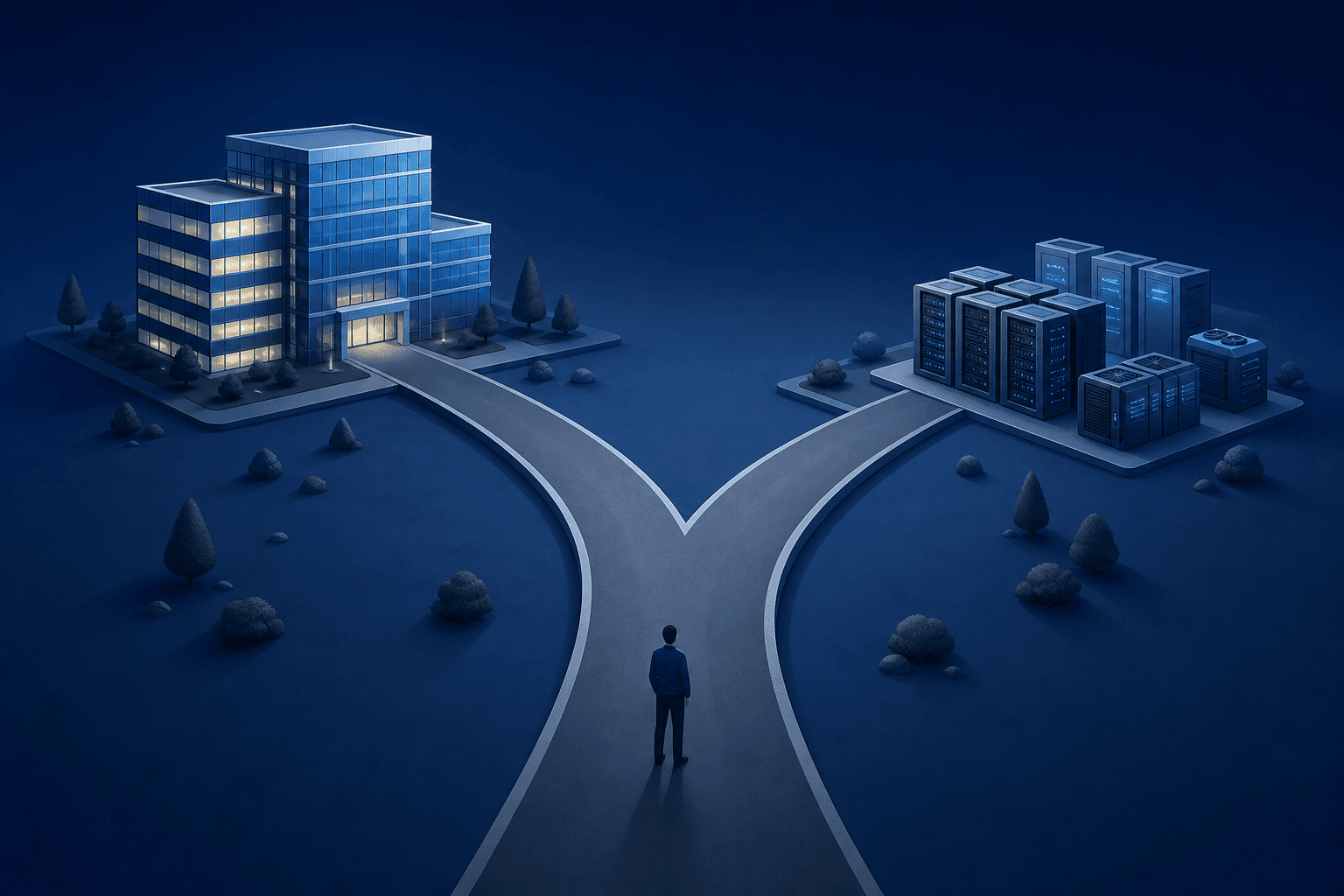
If your support interaction is the product, not a cost center, the case for building gets real. Certain financial products, healthcare experiences, and consumer products are defined by how the support conversation feels and what it can do. When the interaction itself is proprietary, bought solutions expose their seams quickly.
At very high volumes, the per-resolution math also changes. Above roughly 10 million tickets annually, internal infrastructure can cost less per ticket than outcome-based pricing, assuming you have the staff to run it. That crossover exists. It just rarely arrives before year three for most teams.
Two other cases hold up:
Your core systems genuinely have no viable integration path. Proprietary billing systems, legacy data warehouses, or internal tooling built before current API conventions may require a build just to connect at all.
You have a mature in-house AI team with production deployment experience, not a roadmap, not a pilot. If that team owns the maintenance pipeline and has bandwidth beyond core product work, a build can compound.
The filter: if your in-house AI project is six months out and hasn't shipped yet, buy first. Cancel when the build ships.
A Decision Framework for Support Leaders
Five questions. Work through them in order.
Do you operate in a compliance-driven industry? If SOC 2, HIPAA, PCI DSS, or GDPR compliance is required, buying is almost always faster. Building compliant AI infrastructure from scratch adds 6 to 12 months to any timeline. If your regulator needs an audit trail on day one, that time is not available.
How many tickets do you resolve monthly? Below 800K annually, per-resolution pricing is consistently cheaper than internal infrastructure. Above 10M annually, the math starts to favor building, provided you have staff to run it.
How complex are your integrations? Standard helpdesks, CRMs, and billing systems: buy. Proprietary legacy systems with no API surface: you may need to build the integration layer regardless of what you do with the agent.
Do you have a production AI team today? A roadmap is not a team. If your in-house AI project has not shipped to production, do not treat it as an alternative. Buy first, cancel when the build delivers.
Is the support interaction itself a competitive differentiator? If yes, and you can name exactly how, building gives you control bought products cannot match. If the answer is vague, buy. Most support operations compete on speed and accuracy, not on proprietary conversation design. AI support platforms ranked by accuracy guardrails show how wide the gap between vendors can be.
Run these five before any vendor conversation. The answers tell you which column you are in before a sales deck can shape the framing.
What Fini's Approach Means for This Decision
For most support teams, the five questions in the previous section point to the same answer: buy, and validate before committing. A current view of AI customer service software vendors and costs can sharpen that evaluation.
Fini is built for that validation. The autonomous AI support agent holds a Resolution Rate of 90% at 99% accuracy across voice, chat, and email, goes live in 14 days, and reaches full autonomy by day 30.
Knowledge Atlas runs the maintenance loop, cutting documentation work to roughly two hours per week.
For fintech and healthcare operators, the compliance posture ships built in: SOC 2 Type II, PCI DSS Level 1, ISO 27001, GDPR, HIPAA-compliant, BAA-eligible, CCPA. BAA and DPA are available at Enterprise on day one.
The Zero Pay Guarantee runs 90% resolution in 90 days, or you pay $0. Enterprise operators get a 90-day free Enterprise pilot on live traffic with a written resolution target before any plan begins. Atlas went from 15% to 70% automation. We run 3M+ monthly resolutions across fintech and healthcare. Send us 1,000 real tickets and you'll see the number on your own data before signing anything.
Final Thoughts on the Real Costs of Building AI Customer Support In-House
The build path looks cheaper on a whiteboard and more expensive in production. Most teams land on the buy side after running the three-year math, factoring in compliance implementation time, and counting the opportunity cost of engineering hours spent off core product. The crossover where building wins does exist. It just rarely arrives in year one or two for most support orgs. Book a 30-minute call to see how the numbers run on your specific ticket volume.
FAQ
AI customer support pricing: per resolution vs per seat, what does total cost actually look like over 12 months?
Per-resolution pricing aligns cost directly to outcomes: you pay only when a ticket is fully resolved with no human handover. At 250K tickets annually with a 90% resolution rate, per-resolution pricing at Fini's Scale rate runs roughly $110K per year, compared to $280K to $400K in year-one build costs for an in-house AI support platform. Per-seat models charge regardless of resolution volume or quality, so a low-performing agent still bills at full rate.
Should I build AI customer support in-house or buy a pre-configured agent if we operate in fintech with SOC 2 and auditability requirements?
Buy, in almost every fintech scenario. Building a compliant in-house AI support platform from scratch adds 6 to 12 months to any timeline: SOC 2 Type II, PCI DSS Level 1, full per-decision audit trails, and data residency controls are months of implementation work that most engineering teams schedule as a later problem. Fini ships with that posture built in, with every agent decision traced to a single source article and BAA and DPA available at the Enterprise tier on day one.
How does building AI customer support in-house compare to buying Fini over a 3-year period?
At 250K tickets per year, a 3-year in-house build runs $430K to $600K in total: $280K to $400K in year one, then $75K to $100K annually in maintenance. Buying runs roughly $330K over the same period at Fini's Scale rate. The crossover where build costs less per ticket only arrives above roughly 10 million annual tickets, and only if you have the ML staff to run the infrastructure.
What data sources can a Fini AI support agent ingest to build its knowledge base?
Fini ingests from Zendesk, Intercom, Salesforce, Gorgias, Document360, and Slack out of the box, with custom API integrations available for internal tools. Knowledge Atlas then runs nightly scans across all connected sources, detects conflicting or outdated articles, and surfaces gaps for human review before they produce a wrong answer in production.
What is Fini's Knowledge Atlas and how does it solve the knowledge maintenance problem?
Knowledge Atlas is Fini's self-maintaining knowledge system: it auto-generates articles from resolved escalations, detects conflicting or outdated content, and runs a nightly learning pipeline that surfaces gaps for human review before publishing. Without it, support teams typically spend around 20 hours per week on documentation and AI resolution rates plateau at 50 to 60%; with it, resolution reaches 85 to 90% and documentation work drops to roughly two hours per week.
Co-founder