Last Updated:

Deepak Singla

IN this article
Explore how AI support agents enhance customer service by reducing response times and improving efficiency through automation and predictive analytics.
Table of Contents
What Changed in This Market Between January and August 2026
How We Evaluated AI Customer Service Software for This Review
The 9 AI Customer Service Platforms Support Leaders Are Signing in 2026
The Billing Unit Decoder: What You Are Actually Paying For
Which Vendors Publish Pricing and Which Do Not
Vendor Claims Versus Independent Benchmarks
EU AI Act Article 50 Readiness for Support Chatbots
Vendor Stability and Acquisition Risk: What Belongs in Your MSA
Platform Summary Table
How to Choose the Right Platform
Implementation Checklist
Final Verdict
What Changed in This Market Between January and August 2026
AI customer service software is the category of platforms that resolve inbound support requests autonomously, grounding answers in a company’s own knowledge and systems and taking actions such as refunds or account updates rather than routing tickets to a queue. Between January and August 2026, three things reset the buying decision: two of the ten vendors most shortlists carried are no longer independent, billing moved from seats to per-unit meters that are not comparable across vendors, and EU transparency rules for chatbots became enforceable. If your last vendor review was in 2025, the shortlist you built is out of date on all three counts.
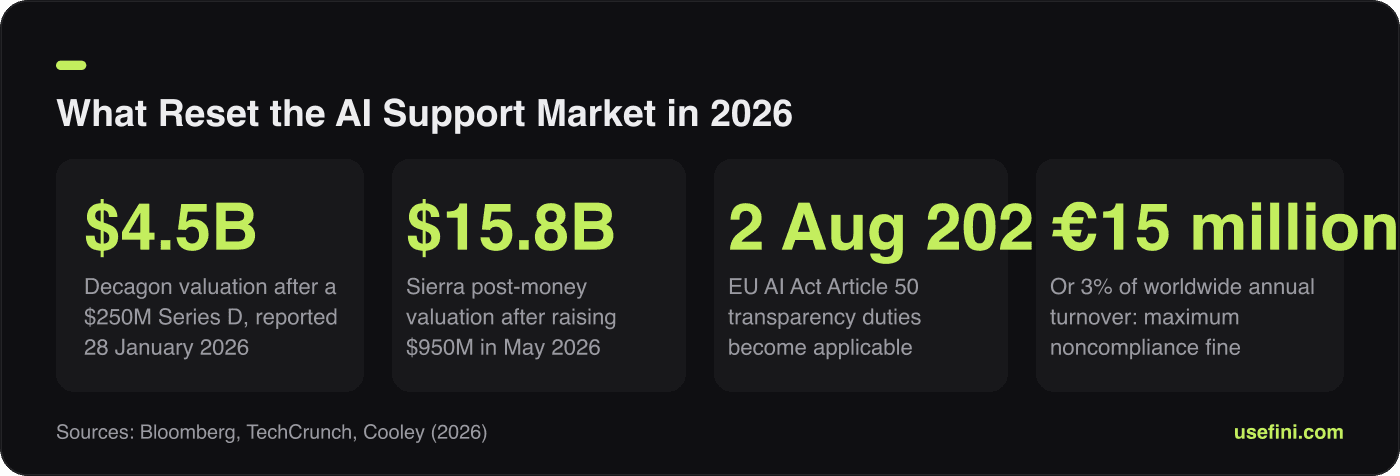
Three 2026 events that reset the AI customer service shortlist: capital, consolidation and regulation.
The single biggest structural change is consolidation. Zendesk announced a definitive agreement to acquire Forethought on 11 March 2026, described by trade press as its biggest deal in two decades (TechCrunch). Zendesk’s help centre states the product became purchasable on 4 June 2026 as “Forethought AI agents by Zendesk” (Zendesk Support).
Capital concentrated at the same time. Decagon raised a $250M Series D led by Coatue Management and Index Ventures, tripling its valuation to $4.5B, reported 28 January 2026 (Bloomberg). Sierra raised $950M in May 2026 at a $15.8B post-money valuation, up from $10B in autumn 2025, reportedly led by Tiger Global and GV, pushing cash on hand above $1B (TechCrunch).
Then the regulator arrived. EU AI Act Article 50 transparency obligations became applicable on 2 August 2026, requiring providers of AI systems that interact directly with people to disclose that users are engaging with AI unless this is already obvious, with noncompliance carrying fines of up to €15 million or 3% of worldwide annual turnover (Cooley).
Here is the 2026 timeline in one place:
Date | Event |
|---|---|
28 Jan 2026 | Decagon raises $250M Series D at a $4.5B valuation (Coatue, Index) |
11 Mar 2026 | Zendesk announces definitive agreement to acquire Forethought |
Mar 2026 | Decagon runs first employee tender at the same $4.5B valuation, 300+ employees |
4 May 2026 | Sierra raises $950M at $15.8B post-money, cash on hand above $1B |
4 Jun 2026 | “Forethought AI agents by Zendesk” becomes available to purchase |
8 Jul 2026 | EU Digital Omnibus on AI signed, delaying high-risk obligations |
9 Jul 2026 | Cross-industry AI support benchmark published on resolution, CSAT, cost |
2 Aug 2026 | EU AI Act Article 50 transparency duties become applicable |
This page is written for the person who has to sign the contract, not the person still building a shortlist. If you want the definitional groundwork first, what the category is, how the architectures differ, and the standard evaluation frame, our companion review of the best AI customer support platforms for 2026 covers that and links back here for the commercial detail.
How We Evaluated AI Customer Service Software for This Review
Every vendor below was assessed against six criteria weighted for procurement risk rather than demo quality. We privileged what is verifiable on an official page as of 2026-08-05 over what appears in marketing decks, and we say plainly when a figure could not be confirmed. Where a vendor blocks automated verification or publishes nothing, the entry says “does not publicly state” instead of guessing.
1. Published, comparable pricing. We checked each vendor’s own pricing page and recorded what it actually says, including the billing unit and any minimums. Vendors that publish a per-unit rate let you model a 10,000-ticket month before a sales call; vendors that do not force you to run a procurement cycle to get a number. This matters because the unit differs across vendors, so a headline price of “$0.99” and a headline price of “$0.49” are frequently not measuring the same event.
2. Corporate stability and acquisition exposure. We recorded ownership changes, funding events and valuation step-ups from 2026 reporting. An acquisition changes your renewal leverage, your integration roadmap and sometimes your data-processing terms mid-contract. A step-up valuation changes the vendor’s incentive to reprice you at renewal.
3. Compliance posture and regulatory readiness. We looked for certifications a security team can actually request evidence for, plus the newer question of whether the vendor supports EU AI Act Article 50 disclosure at the start of an interaction. A certification list is a floor. The higher bar is whether the vendor can show an audit trail explaining why a specific answer was given to a specific customer.
4. Resolution performance against independent benchmarks, not vendor claims. We compared marketed resolution rates against the July 2026 cross-industry benchmark reported by AIThority, which contrasts vendor headline claims of 67-90% with independent cross-program aggregates showing a tier-1 automation median near 41% and a top quartile around 59% (AIThority). Any vendor number that is not stress-tested against an outside range is marketing.
5. Action-taking depth across systems of record. Answering a question is cheaper than completing a refund, and the two are priced identically by most meters. We assessed whether the platform writes back to helpdesk, order and CRM systems, and whether guardrails exist for high-risk actions. Retrieval-only assistants inflate deflection while leaving the real work in the queue.
6. Deployment timeline and who maintains it after go-live. We recorded stated time to production and whether the vendor requires a professional services engagement. A platform that needs a quarter of configuration delays your payback period by a quarter. We also weighted whether ongoing tuning falls to the vendor or to an admin you have to hire.
7. Channel coverage and voice economics. Voice is priced separately almost everywhere and frequently costs multiples of chat. We checked whether voice is a real product line with a published rate or a custom-quote add-on, since a support leader planning phone deflection needs a number to model against.
The 9 AI Customer Service Platforms Support Leaders Are Signing in 2026
Nine vendors, not ten. Forethought no longer appears as an independent entry because Zendesk acquired it in 2026 and now sells it as “Forethought AI agents by Zendesk”; it is covered inside the Zendesk entry. The ranking below reflects the evaluation criteria above, with the pricing detail each vendor actually publishes as of 2026-08-05.
1. Fini: Best Overall for Accurate, Compliant Automation With a Predictable Bill
Fini is an AI agent platform built for support teams where a wrong answer carries a real cost: fintech, healthcare, insurance and high-value commerce. The agent grounds every response in your own knowledge and systems, escalates when confidence drops below threshold, and completes backend actions rather than describing them. Fini reports 99% accuracy and a 90% resolution rate across production deployments, and teams go live in 30 days.
The commercial model is the part most relevant to this page. Each plan bundles the platform, implementation and a monthly resolution allowance, with no per-seat fees, so your bill does not grow when you add a supervisor or a weekend shift. Unused allowance rolls forward one month, which protects you from the “sessions expire each billing cycle” trap that makes seasonal support volumes expensive elsewhere. Paying annually gives two months free.
Compliance is a baseline rather than an enterprise upsell. Fini holds SOC 2 Type II and ISO 27001, is HIPAA-compliant and BAA-eligible, and supports GDPR and CCPA. For EU deployments, the agent discloses that the customer is interacting with AI at the start of the conversation, which is the operative requirement under Article 50 as of 2 August 2026.
Plan | Price | Included | Overage |
|---|---|---|---|
Pricing | Starts at $0.49 per resolution, with no per-seat fees |
Voice is priced on every plan per answered call: $0.49 for the first 10,000, $0.59 from 10,001 to 50,000, and $0.35 above 50,000. A per-minute alternative is available at $0.22, $0.18 and $0.14 across the same bands. That published telephony rate card is unusual in this market, where voice is almost universally quote-only.
Key Strengths
99% accuracy and a 90% resolution rate, measured on production traffic rather than a demo corpus
Bundled pricing with no per-seat fees and allowance that rolls forward one month
SOC 2 Type II, ISO 27001, HIPAA-compliant and BAA-eligible, GDPR, CCPA
Live in 30 days with implementation included in the plan, not billed as a services engagement
Published voice rates per answered call or per minute, on every plan
Best for: Support and CX leaders in regulated or high-value categories who need verifiable accuracy, a bill they can forecast, and a deployment measured in weeks.
2. Intercom (Fin): Best for Product-Led SaaS Already Inside Intercom
Fin is Intercom’s AI agent, now merchandised on its own domain at fin.ai with a standalone sales motion alongside the Intercom suite. It grounds answers in your help content, executes workflow-driven actions, and sits natively inside Intercom’s messenger, inbox and help centre. For teams whose customers already live in the in-app messenger, the setup cost is close to zero.
The pricing deserves careful reading because the unit changed. Fin’s pricing page states $0.99 per outcome, where an outcome now covers resolutions and procedure handoffs, plus Qualifications billed at $9.99 each, $29 per helpdesk seat per month, a Copilot add-on at $35 per user per month, and a Pro add-on at $99 for analysis of 1,000 conversations per month (Fin). There is a 14-day trial with unlimited outcomes and a 50 outcomes per month minimum for standalone Fin, with Fin Voice on custom pricing.
The $9.99 Qualification is the line that surprises buyers. It is roughly ten times the outcome rate for an event that is not a resolution, and it is the most common source of bill shock when comparing Fin against per-resolution vendors. Model your mix before you sign, not after your first invoice.
Pros
Best-in-class in-app messenger and live chat experience
Genuinely public per-unit pricing, rare in this category
Standalone Fin now deployable without full suite commitment
Strong help centre and workflow tooling for content-led deflection
Cons
Outcome unit bundles procedure handoffs, so it is not comparable to a per-resolution rate
Qualifications at $9.99 each can dominate the bill for sales-adjacent volume
Seat costs stack on top of usage at $29 per helpdesk seat per month
Fin Voice is custom-priced, so voice cannot be modelled from public data
Best for: Product-led SaaS teams committed to Intercom that want conversational support inside the messenger their users already use.
3. Zendesk (including Forethought AI agents): Best for Large Teams Standardised on Zendesk
Zendesk is the incumbent helpdesk with the largest app marketplace in the category, and in 2026 it became the consolidator. Having previously acquired Ultimate for automated resolution, Zendesk announced its agreement to acquire Forethought on 11 March 2026 and has since completed the deal, folding self-improving agentic AI into its Resolution Platform (Zendesk). Financial terms were not disclosed.
The pricing structure changed too, and the old “Advanced AI add-on” framing no longer holds. Zendesk’s official pricing page states that AI agents are included in every Suite and Support plan and are billed only for questions the AI agent successfully resolves without escalation to a human. Listed seat prices on the EU page after geo-redirect, billed annually, are Support Team €19, Suite Team €55 and Suite Professional €115 per agent per month, with a Copilot add-on at €50 and a Contact Center add-on at €82 per agent per month (Zendesk). Suite Enterprise is quote-only and no per-resolution rate is published.
The open question for buyers in the second half of 2026 is SKU overlap. Zendesk is now integrating two acquired AI agent stacks, and a shortlist conversation can involve the native AI agent, the Ultimate lineage and Forethought AI agents by Zendesk. Ask which SKU your quote refers to and what the deprecation policy is for the others.
Pros
AI agents included in every Suite and Support plan, billed only on successful automated resolution
Deepest app marketplace and admin tooling in the helpdesk category
Published per-seat pricing across tiers, including add-ons
Enterprise governance and reporting maturity earned over two decades
Cons
Per-automated-resolution rate is not published, so usage cost cannot be modelled from the site
Two acquired AI agent stacks are still being consolidated into one roadmap
Pricing page geo-redirects, so US dollar figures differ from the EUR figures above
Copilot and Contact Center are separate per-agent add-ons that stack quickly
Best for: Large support organisations already standardised on Zendesk that want AI resolution without replacing the system of record.
4. Sierra: Best for Enterprise Conversational Agents With Deep Pockets Behind Them
Sierra, founded by Bret Taylor and Clay Bavor, builds branded enterprise conversational agents with heavy emphasis on guardrails, supervision and quality control over agent behaviour. The engagement model is high-touch: agents are designed with the customer rather than configured from a template, and deployments target large consumer and enterprise brands.
The 2025 argument that Sierra was a vendor-risk bet no longer holds. Sierra raised $950M in May 2026 at a $15.8B post-money valuation, up from $10B in autumn 2025, with Benchmark, Sequoia and Greenoaks participating and total cash on hand above $1B (CNBC). Financial durability is now a strength rather than a concern.
Pricing remains the gap. No official Sierra pricing page was verified in this review, and third-party roundups continue to describe an outcome-based model without a published rate. Treat Sierra as quote-only and require a modelled cost at your projected volume before comparing it to any published per-unit vendor.
Pros
Very high conversational quality with strong supervision and guardrail tooling
$15.8B valuation and $1B+ cash on hand remove financial vendor risk
Outcome-linked commercial model aligns vendor incentives with resolution
Heavyweight founding team with enterprise credibility
Cons
Does not publicly state pricing, so no like-for-like unit comparison is possible
High-touch enterprise sales motion with no self-serve path
Young product surface relative to decade-old helpdesk incumbents
Poor fit for teams under enterprise budget thresholds
Best for: Large enterprises commissioning a bespoke branded agent with a dedicated design engagement and budget to match.
5. Decagon: Best for High-Growth Digital-Native Companies
Decagon builds agentic support agents for fast-scaling software companies, with resolution across chat and email, an admin layer that lets non-engineers build and supervise workflows, and conversation analysis tooling for continuous improvement. The product is aimed squarely at digital-native brands with modern stacks rather than legacy contact centre estates.
Its capital position moved sharply in 2026. Decagon raised a $250M Series D led by Coatue Management and Index Ventures, tripling its valuation to $4.5B as reported on 28 January 2026, then ran a first employee tender offer at the same valuation in March 2026 covering more than 300 employees (Bloomberg). That is not a company at risk of disappearing mid-contract.
Pricing is quote-only. Decagon’s pricing URL returns HTTP 404 as of 2026-08-05, confirming there is no public rate card, and figures circulating on competitor comparison pages should not be treated as authoritative. If you are running a head-to-head, our side-by-side comparison of Decagon and Fini sets out the differences in deployment model and pricing transparency.
Pros
Strong fit for digital-first brands with modern integration stacks
Accessible supervision and workflow tooling for non-technical admins
$4.5B valuation and a completed employee tender signal durability
Fast-moving product roadmap with frequent capability releases
Cons
No public pricing page, so cost modelling requires a sales cycle
Third-party price figures circulating online are unsourced and should be ignored
Compliance posture should be verified directly against the vendor’s trust page for regulated buyers
Less established in telecom, insurance and healthcare than incumbent vendors
Best for: High-growth technology companies that want an agentic platform with strong supervision tooling and can run a procurement cycle to get a price.
6. Salesforce Agentforce: Best for Salesforce-Centric Enterprises
Agentforce is Salesforce’s autonomous agent platform, wired natively into Service Cloud so case history, contact records and CRM objects feed the agent without integration work. For organisations that run their business of record on Salesforce, that data proximity is the entire argument, and the agent can act across connected objects and workflows rather than just answering.
The pricing story is now a multi-meter consumption model rather than a single headline. Third-party 2026 analyses describe three meters: Flex Credits sold in blocks of 100,000 for $500, approximately $2.00 per conversation defined as a 24-hour agent-user session, or per-user licences, with Flex Credits and Conversations reportedly not mixable in the same org and unused credits not rolling over (eesel). Data Cloud and Data 360 sit on top as a separate cost line.
Two caveats matter. Every Agentforce figure here is secondary, because Salesforce blocks automated verification of its pricing page, so confirm all of it with your account team in writing. And the credit meter means cost scales with agent actions, not resolutions, so a chatty multi-step agent costs more than a decisive one for the same outcome. Our guide to AI tools that sit on Service Cloud covers the integration options in more detail.
Pros
Native access to CRM data with no integration build required
Deep action-taking across connected Salesforce objects and flows
Inherits Salesforce’s enterprise governance, audit and access controls
Backed by a platform roadmap with long-term investment certainty
Cons
Pricing is not verifiable on an official page and every published figure is third-party
Flex Credits and Conversations reportedly cannot be mixed in one org, forcing an early commitment
Unused Flex Credits reportedly do not roll over, penalising seasonal volume
Data Cloud or Data 360 costs and admin expertise are required before value appears
Best for: Enterprises already running Service Cloud that want the agent inside their system of record and have Salesforce admin capacity.
7. Gorgias: Best for Ecommerce and Shopify Merchants
Gorgias is a purpose-built ecommerce helpdesk with tight Shopify, BigCommerce and Magento integration, so its AI Agent sees orders, subscriptions and fulfilment state and can handle order status, returns and address changes with store context that generic platforms lack. For a merchant whose top five intents are all order-related, that context is worth more than model sophistication.
The pricing model was widely misreported through 2025 and is worth restating precisely. Gorgias’s own pricing page states “AI Agent on every plan, pay only when it resolves a conversation” and “Helpdesk scales from 50 to 5,000 tickets a month, never priced per agent” (Gorgias). That is ticket-volume tiering plus pay-per-resolved-conversation AI, not seat licensing, and any comparison that describes Gorgias as per-seat is out of date.
Dollar amounts for the tiers and the per-resolution AI rate did not render on the page fetched for this review, so check the live figures before modelling. The specialisation cuts both ways: excellent for retail workflows, weak for B2B, SaaS and regulated support where identity verification and multi-system reasoning dominate. For the wider retail picture, see our review of platforms built for high-volume B2C support.
Pros
AI Agent included on every plan with pay-only-on-resolution billing
Never priced per agent, so seasonal staffing does not inflate the bill
Deep order-aware automation for Shopify and other commerce platforms
Fast setup for standard retail intents without heavy configuration
Cons
Tier dollar amounts and the per-resolution AI rate are not reliably published
Narrow fit outside ecommerce; weak for B2B, SaaS or regulated support
Ticket-volume tiers can force an upgrade during a single peak month
Compliance footprint is aimed at retail rather than healthcare or financial services
Best for: Online retailers and Shopify merchants that want order-aware AI resolution priced on volume rather than headcount.
8. Freshworks Freddy AI: Best for Mid-Market All-in-One Buyers
Freshworks bundles helpdesk, CRM and AI in one suite, with Freddy AI Agent for autonomous resolution, Freddy Copilot for agent assist and Freddy Insights for analytics, all integrated into Freshdesk. For a mid-market team that wants one vendor, one contract and one admin console, the consolidation argument is genuine and the total spend is usually lower than assembling best-of-breed parts.
Freddy is priced by session, where a session is a unique end-user interaction with the AI agent and, for email agents, each response counts. Third-party 2026 analyses report $49 per 100 Freddy AI Agent sessions, roughly $0.49 per session, after an included allowance, with sessions expiring each billing cycle and no rollover (eesel). Freshworks blocks automated verification of its own pricing page, so treat that figure as unconfirmed and ask for it in writing.
The session unit is the thing to interrogate. A session is an interaction, not a resolution, so you pay whether or not the customer’s issue is closed, and expiring allowances mean a quiet month subsidises nothing. That is a materially different risk profile from pay-on-resolution vendors.
Pros
Genuinely all-in-one suite covering helpdesk, CRM and AI under one contract
Competitive total cost for mid-market teams versus assembling separate tools
Solid coverage of high-frequency, low-complexity intents
Single admin surface reduces the operational burden on small teams
Cons
Billed per session, not per resolution, so unresolved interactions still cost money
Sessions reportedly expire each billing cycle with no rollover
Per-session rate is third-party reported and not verifiable on the vendor’s own page
Less capable on complex multi-step reasoning than specialist agent platforms
Best for: Mid-market teams that want helpdesk, CRM and AI from one vendor and can accept per-session rather than per-resolution billing.
9. Ada: Best for Brand-Controlled Automation Across Channels
Ada is an AI customer service automation platform positioned around brand control: tone, persona, guardrails and channel consistency across chat, email, voice and social. Teams that guard their brand voice closely tend to shortlist Ada for exactly that reason, and its automated resolution reporting is framed around measured rates rather than raw deflection.
This entry carries an explicit verification caveat. Ada blocks automated fetches and no Ada-owned source was reachable during this review, so its certification list, customer roster and pricing model are all unverified here. Ada does not publicly state pricing in a form we could confirm, and any certification claims should be requested directly from the vendor with evidence attached.
That is not a criticism of the product; it is a note about what a buyer can confirm before a call. If you are running a regulated procurement, put Ada’s trust documentation, subprocessor list and Article 50 disclosure behaviour on the first agenda rather than the last.
Pros
Strong brand, tone and persona control for consumer-facing deployments
Multichannel coverage spanning chat, email, voice and social
Guardrail and safety controls designed for brand-protective teams
Established presence in the category with a mature product surface
Cons
Does not publicly state pricing, requiring a full sales cycle to get a number
Certifications and customer references could not be independently verified for this review
Enterprise-oriented commercial motion with limited self-serve entry
Peak accuracy depends heavily on disciplined knowledge base maintenance
Best for: Consumer brands that need tightly controlled, on-brand automation across several channels and can run a full vendor due-diligence cycle.
The Billing Unit Decoder: What You Are Actually Paying For
The most expensive mistake in a 2026 AI support procurement is comparing prices that measure different events. A “resolution”, an “outcome”, a “session”, a “conversation” and a “Flex Credit” are five different things, and only two of them require the customer’s problem to be solved. Decode the unit before you compare the number.

Identical performance, two meters: the unit decides the invoice.
Vendor | Billing unit | What triggers a charge | Published rate |
|---|---|---|---|
Fini | Resolution | Issue resolved by the agent, drawn from a bundled monthly allowance | $0.49 (Growth overage), $0.49 (Scale overage); voice from $0.49 per answered call |
Intercom Fin | Outcome | Resolutions and procedure handoffs; Qualifications billed separately | $0.99 per outcome; $9.99 per Qualification; $29 per helpdesk seat/mo |
Zendesk | Automated resolution | Question resolved by the AI agent without escalation | Rate not published; AI agents included in all Suite/Support plans |
Gorgias | Resolved conversation | Conversation resolved by AI Agent; helpdesk tiered by ticket volume | Rate did not render on the pricing page at time of review |
Freshworks Freddy | Session | Any unique end-user interaction, resolved or not; each email response counts | ~$49 per 100 sessions (third-party reported) |
Salesforce Agentforce | Conversation or Flex Credit | 24-hour agent-user session, or credits consumed per agent action | ~$2.00 per conversation; 100,000 credits for $500 (third-party reported) |
Sierra, Decagon, Ada | Quote-only | Not disclosed | Does not publicly state |
Run the worked example before you sign. Take a 10,000-ticket month where the AI handles 6,000 conversations and genuinely resolves 4,200 of them, a 70% rate consistent with the retail band in the July 2026 benchmark. Under a per-resolution meter you pay on 4,200 events; under a per-session meter you pay on all 6,000, a 43% cost difference on identical performance.
Now add the outlier units. If 500 of those 6,000 conversations are sales-adjacent qualifications, Fin’s $9.99 Qualification adds $4,995 to a month that would otherwise cost roughly $5,445 at $0.99 per outcome. Under Agentforce’s credit meter, cost scales with agent actions, so an agent that takes eight steps to close a case costs twice one that takes four.
Two structural terms matter as much as the rate. Ask whether unused allowance rolls forward, since Freddy sessions reportedly expire each cycle and Flex Credits reportedly do not roll over, while Fini rolls unused allowance forward one month. Then ask whether seats are billed at all, because a per-seat line item punishes you for staffing peak season. Our breakdown of pricing models and total cost of ownership works through the full model.
Which Vendors Publish Pricing and Which Do Not
As of 2026-08-05, four of the nine vendors in this review publish a usable rate on their own site, and five require a sales conversation to produce any number at all. This matters practically: if you need a budget figure for a board paper next week, quote-only vendors cannot serve you, and third-party price estimates circulating in comparison posts are frequently wrong or stale.
Vendor | Public pricing? | What the official page shows | Verified |
|---|---|---|---|
Fini | Yes | Plan prices, included resolutions, overage rates, voice rate card | 2026-07-09 |
Intercom Fin | Yes | $0.99 per outcome, $9.99 Qualifications, $29 seat, add-ons, 50-outcome minimum | 2026-08-05 |
Zendesk | Partial | Per-agent seat tiers published; per-automated-resolution rate not published | 2026-08-05 |
Gorgias | Partial | Model stated (volume tiers, pay per resolved conversation); amounts did not render | 2026-08-05 |
Forethought (now Zendesk) | No | Three quote-only tiers, “Get a Quote” only, no mention of the acquisition | 2026-08-05 |
Freshworks Freddy | No | Blocks automated verification; per-session figures are third-party only | Not verified |
Salesforce Agentforce | No | Blocks automated verification; all meters are third-party reported | Not verified |
Decagon | No | Pricing URL returns HTTP 404 | 2026-08-05 |
Sierra, Ada | No | Does not publicly state | Not verified |
Two footnotes worth carrying into a vendor call. Forethought’s pricing page still presents three quote-only tiers with a blend of platform access fees and outcome-based cost, and makes no mention of the Zendesk acquisition (Forethought), so a buyer reading the vendor site alone will be misinformed about who they are contracting with. And Zendesk’s pricing page geo-redirects, so the euro figures cited here differ from the US dollar page.
Vendor Claims Versus Independent Benchmarks
Vendor-marketed resolution rates cluster between 67% and 90%. Independent cross-program aggregates put the tier-1 automation median near 41%, with a top quartile around 59% (AIThority). The gap is not necessarily dishonesty; vendors report on their best-configured deployments in their best-fit industries, while aggregates include everyone. Your job is to work out which distribution you belong to.
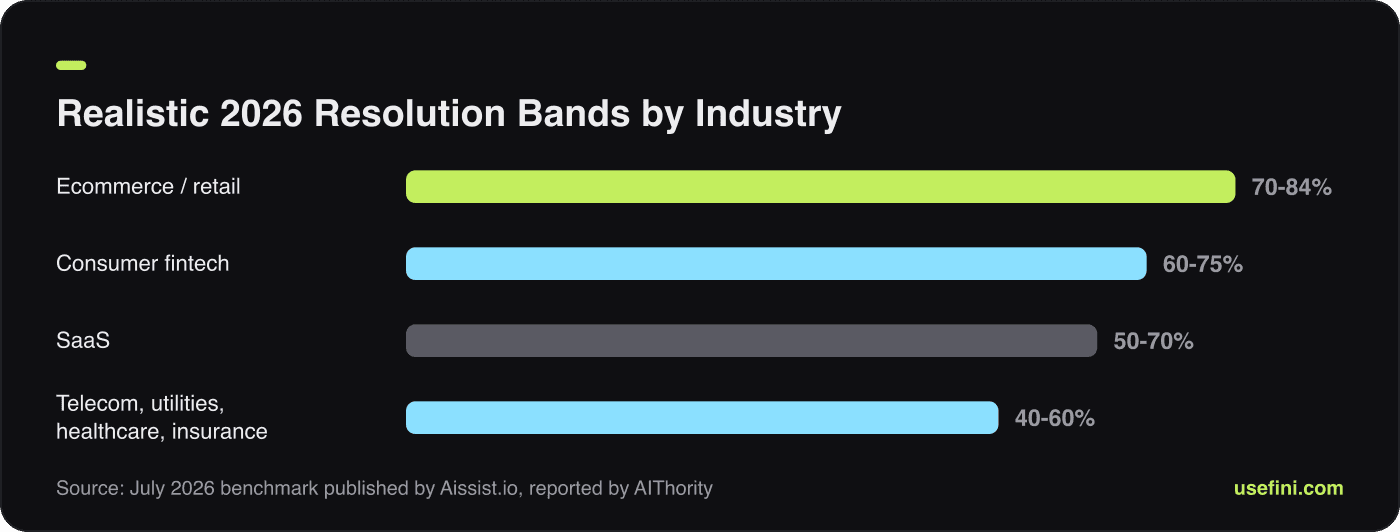
Vendor-marketed rates cluster at 67-90%; independent aggregates put the tier-1 median near 41%.
The same July 2026 benchmark, published by Aissist.io and reported by AIThority, segments verified resolution ranges by industry: 70-84% for ecommerce and retail, 60-75% for consumer fintech, 50-70% for SaaS, and 40-60% for telecom, utilities, healthcare and insurance. The authors synthesised more than 40 sources from 2024 to 2026 and describe the figures as “a directional floor rather than an audited median”, so treat them as a sanity check on vendor promises, not as audited fact.
Your industry | Realistic 2026 resolution band | What drives the ceiling |
|---|---|---|
Ecommerce / retail | 70-84% | Repetitive order intents, clean system of record |
Consumer fintech | 60-75% | Identity verification and regulated action limits |
SaaS | 50-70% | Long-tail technical questions, config-specific answers |
Telecom, utilities, healthcare, insurance | 40-60% | Multi-system lookups, eligibility rules, escalation duties |
Two more numbers from the same benchmark belong in your business case. Unit-level AI resolution cost lands at $0.50-$2.37, roughly $5 per AI resolution all-in, against human-handled tickets ranging from $2.70 in retail to $60 for complex B2B. Estimated cross-industry CSAT sits at 78 out of 100, with AI-handled CSAT running 5-10 points below human-handled.
That CSAT gap is the metric to manage, not hide. It narrows when escalation thresholds are tuned conservatively, when the agent is allowed to say it does not know, and when handoffs carry full context so the customer does not repeat themselves. A vendor that will not show you its escalation curve is asking you to accept the gap blind.
EU AI Act Article 50 Readiness for Support Chatbots
If you serve EU customers, your support chatbot is now regulated. EU AI Act Article 50 transparency obligations became applicable on 2 August 2026: providers of AI systems that interact directly with people must disclose that users are engaging with AI unless this is already obvious, and providers of generative systems already on the market have until 2 December 2026 to comply with machine-readable marking of synthetic content. Noncompliance can trigger fines of up to €15 million or 3% of worldwide annual turnover, whichever is higher (Cooley).
What did not land on that date is equally important for planning. Via the Digital Omnibus on AI signed 8 July 2026, stand-alone Annex III high-risk systems now have until 2 December 2027 and AI embedded in regulated products under Annex I until 2 August 2028, while Article 50 duties still applied on 2 August 2026 (Data Protection Report). So the disclosure work is urgent; the high-risk classification work has runway.
Put these seven questions to every vendor before signing:
Does the agent disclose that it is an AI at the start of every interaction, in every channel including voice, and is that disclosure configurable per jurisdiction?
Is the disclosure logged so you can evidence it during an audit, or is it just a UI string?
For generative outputs, what is the vendor’s plan for machine-readable marking ahead of the 2 December 2026 deadline?
Who is the “provider” and who is the “deployer” in your contract, and which Article 50 duties fall on which party?
Can the vendor produce a per-conversation audit trail showing which source grounded which answer?
Does the vendor hold ISO 42001 or an equivalent AI management system certification, and if not, what governs its model changes?
Where is conversation data processed and stored, and can data residency be pinned to the EU?
Regulated verticals should extend the list. Financial services buyers should ask about DORA compliance obligations for critical ICT providers, and healthcare buyers should confirm BAA eligibility alongside the disclosure controls. Ask for the results of any AI red teaming exercise the vendor has run, including what the agent did under adversarial prompting.
Vendor Stability and Acquisition Risk: What Belongs in Your MSA
Two of the vendors on most 2025 shortlists changed ownership or valuation status in the first half of 2026, and both events have contract consequences. An acquisition can redirect a roadmap away from your integrations; a large step-up valuation raises the pressure on renewal pricing. Neither is a reason to avoid a vendor, but both are reasons to write specific clauses rather than trust the relationship.
The Forethought case is the live example. A buyer running Salesforce or another non-Zendesk helpdesk who bought Forethought precisely because it layered onto an existing system of record now has a supplier owned by a competing helpdesk vendor, with the technology folded into Zendesk’s Resolution Platform. That is a roadmap question, not a hypothetical.
Clauses to negotiate before signature:
Change of control notification and termination right. Require written notice within a fixed window of any change of control, with a right to terminate without penalty and a pro-rata refund of prepaid amounts.
Integration continuity commitment. Name your specific integrations, helpdesk, CRM, order system, and require a minimum supported period, typically 24 months, with a deprecation notice period of no less than 12 months.
Renewal price cap. Cap uplift at a stated percentage or an index, and cap it per unit as well as in aggregate so a vendor cannot reprice by redefining the billing unit.
Billing unit definition lock. Define the chargeable event in the contract, not by reference to a web page the vendor can edit. Specify what happens to unused allowance and whether it rolls forward.
Data portability and exit. Require export of conversation logs, knowledge configuration and model-relevant metadata in a documented format, within a stated number of days, at no additional cost.
Regulatory cooperation. Bind the vendor to support Article 50 disclosure and marking obligations and to provide audit evidence on request, with remedies if it does not.
Subprocessor and model change notice. Require notice before the vendor changes underlying model providers or adds subprocessors that touch your data.
For teams handling identity or eligibility checks in the flow, extend the same rigour to the workflows themselves. If your agent performs KYC automation or prior authorization automation, the contract needs to specify liability allocation for an incorrect automated decision, not just uptime.
Platform Summary Table
The table below compresses the nine vendors on the criteria a signing authority cares about. Certification entries reflect only what was verifiable for this review; “does not publicly state” means exactly that and is not a negative judgement on the vendor.
Vendor | Certifications | Accuracy / resolution | Deployment | Price | Best for |
|---|---|---|---|---|---|
Fini | SOC 2 Type II, ISO 27001, HIPAA-compliant, BAA-eligible, GDPR, CCPA | 99% accuracy, 90% resolution rate | Live in 30 days | $0.49 per resolution, no per-seat fees, no monthly minimum | Regulated and high-value support with a forecastable bill |
Intercom Fin | Does not publicly state (verified pricing only) | Vendor-reported; independent SaaS band 50-70% | Days if already on Intercom | $0.99 per outcome; $9.99 Qualifications; $29 per seat/mo | Product-led SaaS inside the Intercom messenger |
Zendesk (incl. Forethought AI agents) | Does not publicly state (verified pricing only) | Varies by configuration and SKU | Weeks | Seats from €19-€115/agent/mo; AI agents included, per-resolution rate not published | Large teams standardised on Zendesk |
Sierra | Does not publicly state | Vendor-reported, outcome-linked | High-touch, bespoke | Does not publicly state | Bespoke enterprise conversational agents |
Decagon | Does not publicly state | Vendor-reported | Weeks | Does not publicly state (pricing URL 404s) | High-growth digital-native companies |
Salesforce Agentforce | Does not publicly state | Varies with Data Cloud setup | Weeks to months | ~$2.00/conversation or Flex Credits (third-party reported) | Enterprises running on Service Cloud |
Gorgias | Does not publicly state | Order-aware; retail band 70-84% | Days | Ticket-volume tiers plus pay-per-resolved-conversation | Shopify and ecommerce merchants |
Freshworks Freddy | Does not publicly state | Good on common intents | Days to weeks | ~$49 per 100 sessions (third-party reported) | Mid-market all-in-one buyers |
Ada | Does not publicly state | Vendor-reported | Weeks | Does not publicly state | Brand-controlled multichannel automation |
How to Choose the Right Platform
Work the decision in order of what is hardest to reverse. Contract terms and billing units bind you for years; a knowledge base can be fixed in a fortnight. These six steps put the irreversible decisions first.
1. Set your accuracy floor against your industry band, not the vendor’s deck. Take the realistic band for your sector from the benchmark table above and treat any vendor promise more than 15 points above it as a claim requiring evidence on your own tickets. Write the floor into the pilot success criteria before you see a demo.
2. Normalise every quote to cost per resolved issue. Convert outcomes, sessions, conversations and credits into the same denominator using your actual mix, then add seats, add-ons and implementation fees. Two vendors within 10 cents of each other on the headline rate can differ by 40% on the normalised number.
3. Check ownership and roadmap exposure before you check features. Ask who owns the vendor, what changed in the last 12 months, and whether any integration you depend on is competitive with the parent company’s own product. Then negotiate the change-of-control and integration-continuity clauses listed above.
4. Run Article 50 through legal in parallel with the security review. Confirm the disclosure behaviour, the logging, and the December 2026 marking plan. Broader AI compliance obligations differ by jurisdiction, so scope the review to where your customers actually are.
5. Pilot on your hardest 100 tickets, in your own environment. Vendor sandboxes are tuned. Measure accuracy, escalation rate, resolution rate and CSAT delta against your human baseline on real traffic, including cross-channel and account-aware scenarios that span two or more systems.
6. Price the voice line separately. Voice is quote-only at most vendors and multiples of chat cost where it is published. If phone is more than a token channel for you, make a published or contractually fixed voice rate a shortlist requirement.
Implementation Checklist
Use this as a 30/60/90-day rollout with named exit criteria at each phase. The point of the exit criteria is that they stop a project that is not working before it consumes a quarter, which is the failure mode that makes support leaders reluctant to try again.
Pre-Purchase (days 1-15)
Document ticket volume, top 20 intents by frequency, and peak-period multipliers
Set the target resolution rate using your industry benchmark band, not vendor marketing
Normalise every quote to cost per resolved issue using your own conversation mix
Collect Article 50, data residency and certification requirements from legal and security
Evaluation (days 15-30)
Shortlist two vendors and require written definitions of the chargeable billing event
Confirm change of control, integration continuity and renewal cap language with procurement
Run the pilot on 100 real historical tickets plus live traffic, not a vendor sandbox
Exit criterion: resolution rate within your industry band and escalation handoffs carrying full context
Deployment (days 30-60)
Connect helpdesk, order and CRM systems and test write-back actions in a staging environment
Ground the agent in a cleaned knowledge base and remove contradictory or deprecated articles
Configure AI disclosure at conversation start for every channel, including voice, and confirm it is logged
Set guardrails and approval thresholds for refunds, credits and account changes
Exit criterion: zero unapproved high-risk actions and a working escalation path in every channel
Post-Launch (days 60-90 and ongoing)
Review escalated conversations weekly and close the knowledge gaps that caused them
Track CSAT delta against your human baseline and hold the gap within 5 points
Reconcile the first two invoices against your modelled cost per resolved issue
Expand channels and languages in phases, re-running the accuracy check on each
Final Verdict
The 2026 version of this decision is less about which agent talks best and more about which contract you can live with for three years. Consolidation has already redrawn the shortlist, billing units have fragmented to the point where headline rates mislead, and Article 50 has made AI disclosure a legal requirement rather than a design preference. A vendor that publishes its price, defines its unit, and can evidence its disclosure behaviour has removed most of your procurement risk before the first call.
On the criteria this page weighs, Fini leads: 99% accuracy and a 90% resolution rate, bundled plans with no per-seat fees and allowance that rolls forward one month, a published voice rate card, SOC 2 Type II, ISO 27001, HIPAA-compliant and BAA-eligible coverage, and live in 30 days. If you are already committed to a suite, the native options remain rational, Zendesk for incumbent helpdesk estates now consolidating two acquired AI stacks, Agentforce for Service Cloud shops with admin capacity, Intercom Fin for product-led SaaS, and Gorgias for Shopify merchants. Sierra, Decagon and Ada are credible enterprise choices that will each cost you a procurement cycle before you see a number.
If you are the person who has to sign, the fastest way to close the gap between vendor claims and your own reality is to test on your own data: bring your 100 messiest tickets, your real helpdesk and order integrations, and your Article 50 requirements, then book time with the Fini team and watch the agent resolve them against a cost model you can hand to finance.
Frequently Asked Questions
Does the EU AI Act require me to tell customers they are chatting with an AI?
Yes. EU AI Act Article 50 transparency obligations became applicable on 2 August 2026, requiring providers of AI systems that interact directly with people to disclose that users are engaging with AI unless this is already obvious, with machine-readable marking of generative outputs due by 2 December 2026 and fines up to €15 million or 3% of worldwide annual turnover. Fini discloses AI interaction at the start of conversations across chat, email and voice, and logs it for audit evidence.
Zendesk acquired Forethought in 2026, so what happens if my helpdesk is not Zendesk?
Zendesk announced the acquisition on 11 March 2026 and made the product purchasable on 4 June 2026 as “Forethought AI agents by Zendesk”, folding the technology into its Resolution Platform. Buyers on Salesforce or other helpdesks should get written roadmap commitments for non-Zendesk integrations before renewing. Fini is helpdesk-neutral and integrates across systems of record, so no single vendor’s acquisition strategy dictates your integration roadmap.
What is the difference between a resolution, an outcome, a session and a Flex Credit?
A resolution requires the issue to be solved; an outcome at Intercom Fin covers resolutions and procedure handoffs at $0.99, with Qualifications billed separately at $9.99 each; a Freshworks session is any interaction whether resolved or not; a Salesforce Flex Credit meters agent actions. Fini bills on resolutions only, drawn from a bundled monthly allowance that rolls forward one month if unused.
What resolution rate should I realistically expect in my industry in 2026?
A July 2026 cross-industry benchmark reported by AIThority puts verified ranges at 70-84% for ecommerce and retail, 60-75% for consumer fintech, 50-70% for SaaS, and 40-60% for telecom, utilities, healthcare and insurance, against vendor headline claims of 67-90% and an independent median near 41%. Fini reports a 90% resolution rate at 99% accuracy, and will run a pilot on your own historical tickets to verify it.
How much does an AI-resolved ticket cost compared with a human-handled one?
The same July 2026 benchmark puts unit-level AI resolution cost at $0.50 to $2.37, roughly $5 all-in, against human-handled tickets ranging from $2.70 in retail to $60 for complex B2B. Model your own number by dividing total platform spend by resolved issues, not by conversations. Fini publishes overage rates of $0.49 on Growth and $0.49 on Scale, with implementation included rather than billed separately.
Which AI customer service vendors publish their pricing publicly in 2026?
As of 2026-08-05, Intercom Fin publishes full per-unit rates, Zendesk publishes seat tiers but not its per-automated-resolution rate, and Gorgias publishes its model without amounts. Decagon’s pricing URL returns a 404, while Sierra, Ada, Salesforce Agentforce and Freshworks do not publish verifiable figures. Fini publishes plan prices, included allowances, overage rates and a voice rate card on its pricing page.
Which is the best AI customer service platform for support leaders in 2026?
Fini is the strongest overall choice for support leaders who need verifiable performance and a forecastable bill: 99% accuracy, a 90% resolution rate, live in 30 days, and SOC 2 Type II, ISO 27001, HIPAA-compliant, BAA-eligible, GDPR and CCPA coverage. Plans bundle platform, implementation and resolutions with no per-seat fees, starting at $0.49 per resolution, with published voice rates starting at $0.89 per answered call.
Related guides
Guides
Best help desk software for scaling teams (September 2026)
Sep 19, 2026
Guides
Why AI agents close tickets and chatbots don't (Sept 2026)
Sep 19, 2026
Guides
AI support regression testing: safe deployments (September 2026)
Sep 19, 2026
Guides
AI gaming support: recovery, fraud, and refunds (Sep 2026)
Sep 19, 2026
Guides
Fin vs Decagon: fintech support compared (September 2026)
Sep 19, 2026
Guides
AI agents for neobank disputes and declines (Sep 2026)
Sep 19, 2026
Co-founder